13 Designer Tricks That Make a Small Living Room Look Bigger
A small living room does not need more square feet. It needs fewer visual stops. Every designer trick in this guide does the same job in a different place: it lets the eye travel further before something blocks it. Light colours remove stops on the walls. Raised furniture removes stops on the floor. Tall curtains remove the stop where the window used to end. Put together, the room reads as one calm open space instead of a collection of small crowded corners.
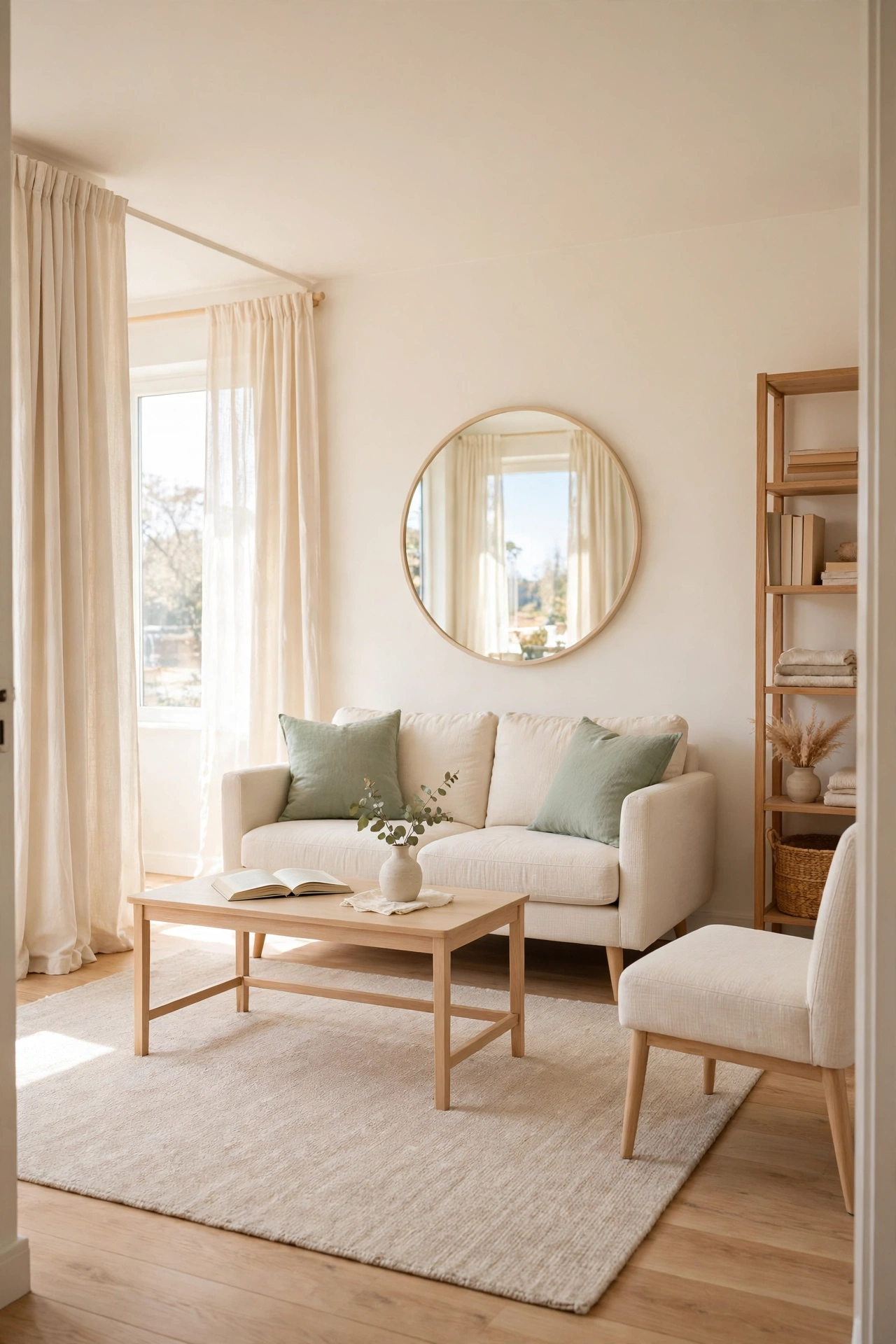
This guide builds one small room, a real apartment sized room, in a warm palette that keeps it friendly instead of stark: warm white walls, cream upholstery, light oak wood, soft beige textiles, and one quiet sage green accent that appears in exactly two places. No dark furniture, no heavy patterns, no black metal. Every trick is tested against that palette, because in a small room one wrong piece is not a small mistake. It is a large share of what the eye sees.
1. Paint the Whole Room One Warm Light Colour
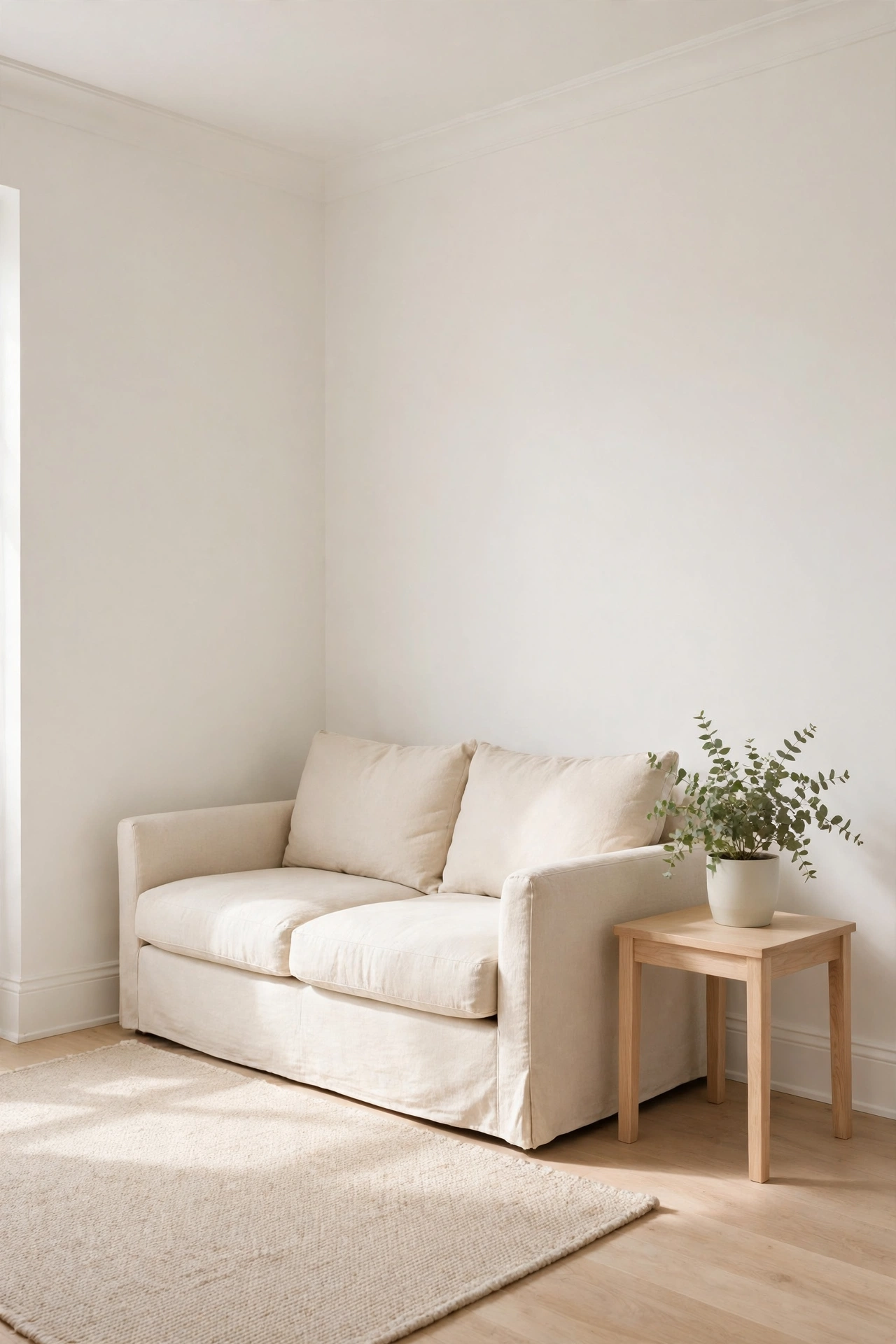
The fastest way to make a room feel bigger is to remove the lines where one colour stops and another starts. When walls, ceiling, and trim share one warm light colour, the eye cannot find the corners easily, and a room without visible corners reads as larger. Warm white is the right light colour here, because bright blue white makes a small room feel like a box and warm white makes it feel like a space.
How to do it: Choose one warm white or very pale cream and use it on walls and ceiling, with the trim in the same colour in a slightly glossier finish. Skip the accent wall completely. Paint any built in shelves the same colour too, so they read as wall, not furniture. Pro Tip: Test the paint on the darkest wall, not the brightest. A colour that stays warm in shade will stay warm everywhere. Common mistake: A dark feature wall in a small room. It walks toward the visitor and shortens the room by its full depth.
2. Hang One Large Mirror Where It Reflects the Window
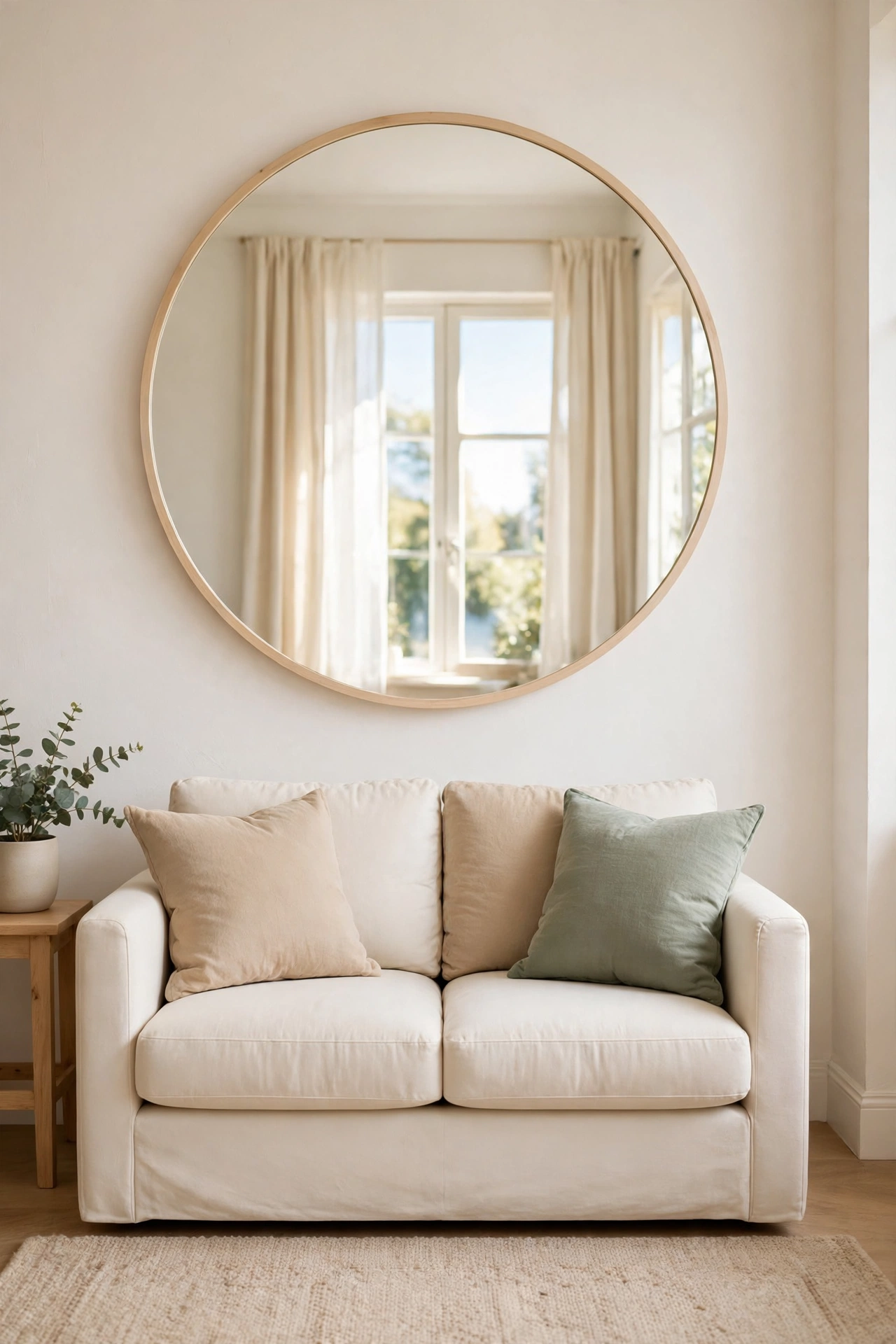
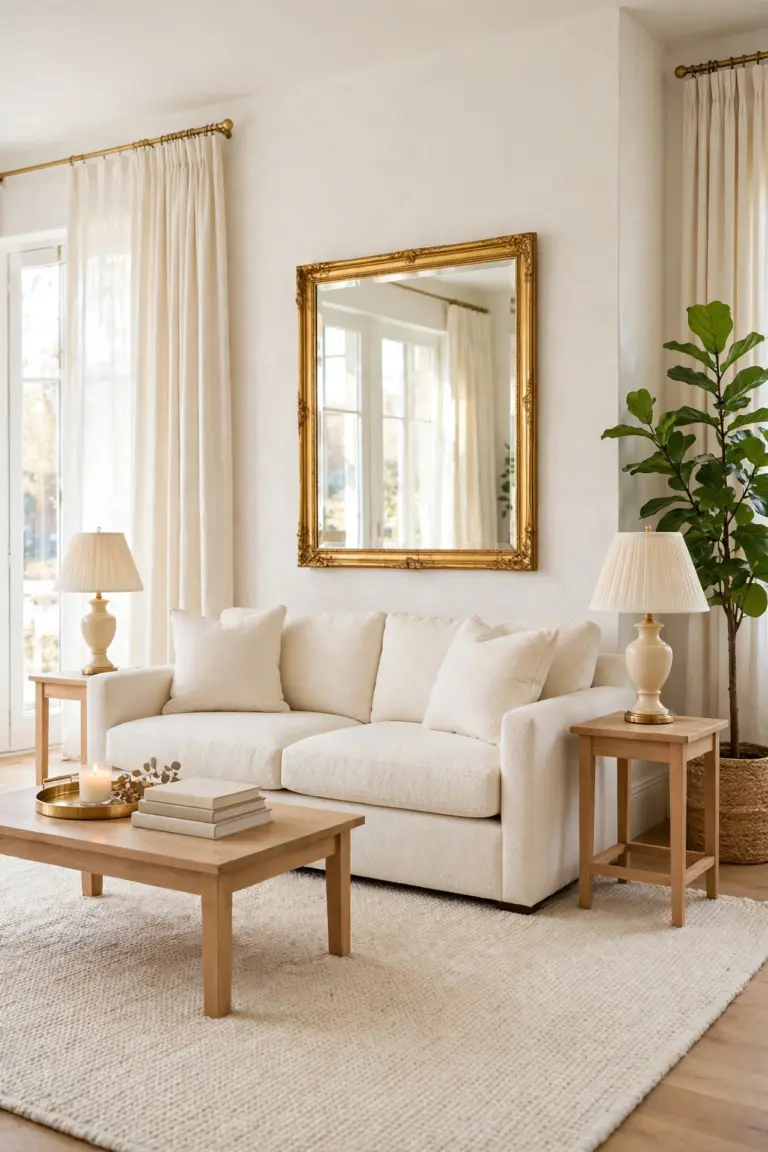
A mirror is the oldest designer trick because it truly works. It doubles the light, and it shows the room a second view of itself, which the brain reads as more space. In a small room the mirror must be large, because a small mirror reflects a small patch and changes nothing. One large round mirror also softens a room that is mostly straight lines and box shapes.
How to do it: Hang the mirror on the wall opposite or beside the window, so it reflects daylight and the view, never a blank wall or a door. Choose a mirror at least two thirds the width of the sofa or console under it. Keep the frame thin and light, pale wood or soft white, so the reflection is the show. Pro Tip: Sit on the sofa before fixing the height. The mirror should reflect the room you see, not the ceiling. Common mistake: A cluster of small mirrors. It reflects the room in pieces and adds clutter, which is the opposite of space.
3. Choose a Sofa With Legs and Raised Arms
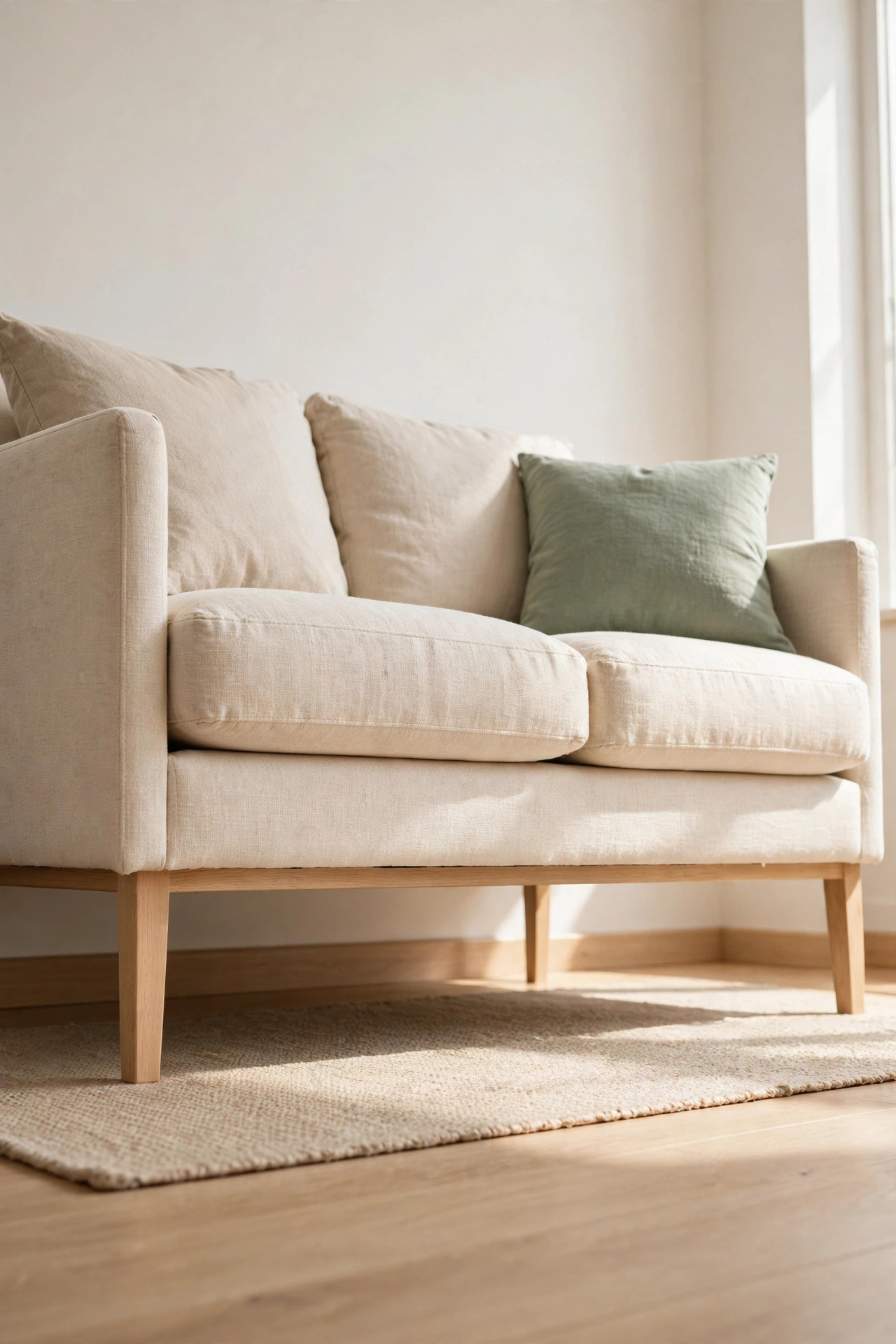
Floor is space the eye can count. A sofa that sits flat on the ground hides the floor under it and the room loses that area visually. A sofa on legs shows a band of floor running underneath, and that band connects the floor on both sides into one larger surface. This single change is why designer sofas in small rooms almost always stand on visible legs.
How to do it: Pick a loveseat or compact three seater raised at least 10 centimetres on light wood legs. Keep the arms slim, because fat arms eat seat width without adding comfort. Choose a pale fabric inside the room palette, cream or warm oatmeal, so the largest piece is also the lightest colour. Pro Tip: Measure the door and hallway before ordering. A small room often belongs to a small flat, and the best sofa is the one that arrives inside it. Common mistake: A deep oversized sofa because it was comfortable in the showroom. In the room it becomes the room.
4. Hang Curtains at the Ceiling, Wider Than the Window
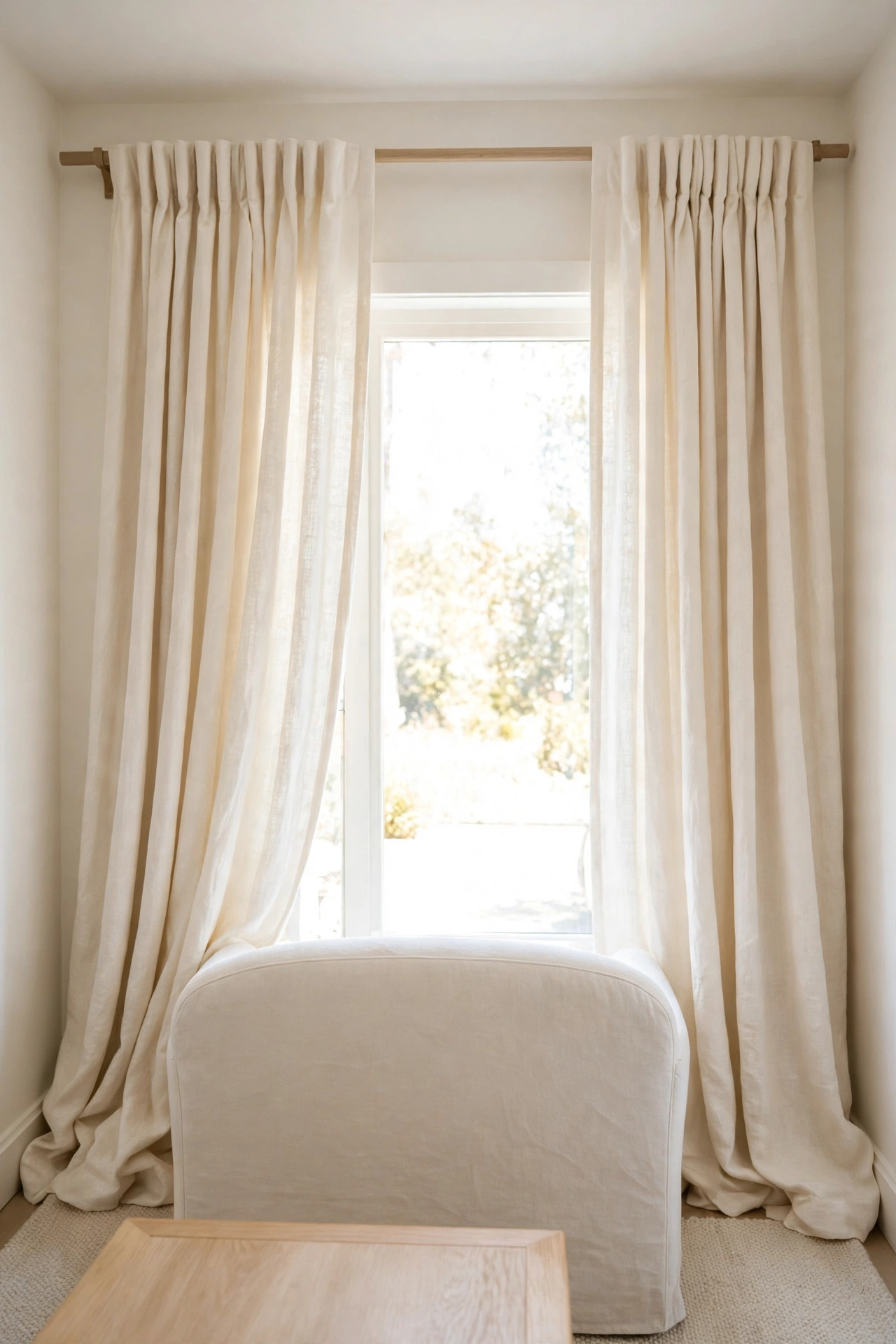
Curtains tell the eye where the window and the wall end. Hung at window height, they announce a small window in a low wall. Hung at the ceiling and spread wider than the frame, they announce a tall wall of light, and the window quietly grows to match. This costs nothing but rod length, which is why designers do it in every small room.
How to do it: Fix the rod within a few centimetres of the ceiling and extend it 20 to 30 centimetres past the window on each side. Let the curtains just touch the floor. Choose a warm white or cream linen look fabric that matches the walls, so the whole wall reads as one soft surface. Pro Tip: When the curtains are open, they should cover wall, not glass. If they cover glass, the rod is not wide enough. Common mistake: Short curtains ending at the sill. They draw a hard line across the wall and cut its height in half.
5. Lay One Large Light Rug, Not a Small One
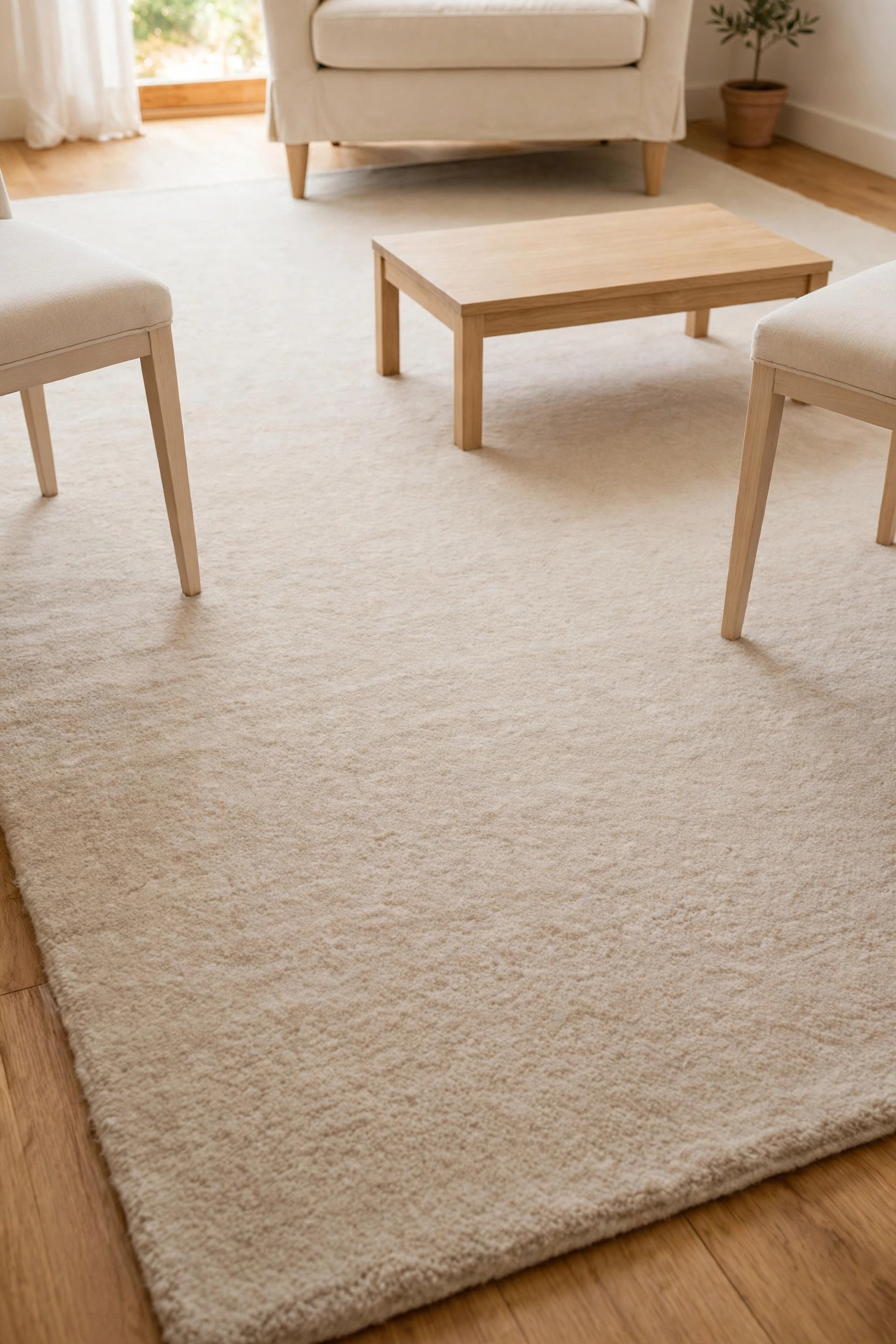
A small rug in a small room makes a small island, and the eye measures the island, not the room. One large rug works the other way. It gives the seating area one generous boundary, and the floor area inside it reads as a single calm space. Light colour matters as much as size, because the rug is the second largest surface in the room after the walls.
How to do it: Size the rug so the front legs of the sofa and both chairs stand on it, with rug still showing on every side of the group. Choose one soft light tone, warm beige or ivory, with texture instead of pattern. If the perfect size is out of budget, buy the larger plain rug and skip the smaller pretty one. Pro Tip: Tape the rug outline on the floor for a day before buying. Living inside the outline tells you the true size faster than any measuring guide. Common mistake: A rug that fits only under the coffee table. It shrinks the seating group to the size of the table.
6. Use a Glass or Pale Wood Coffee Table
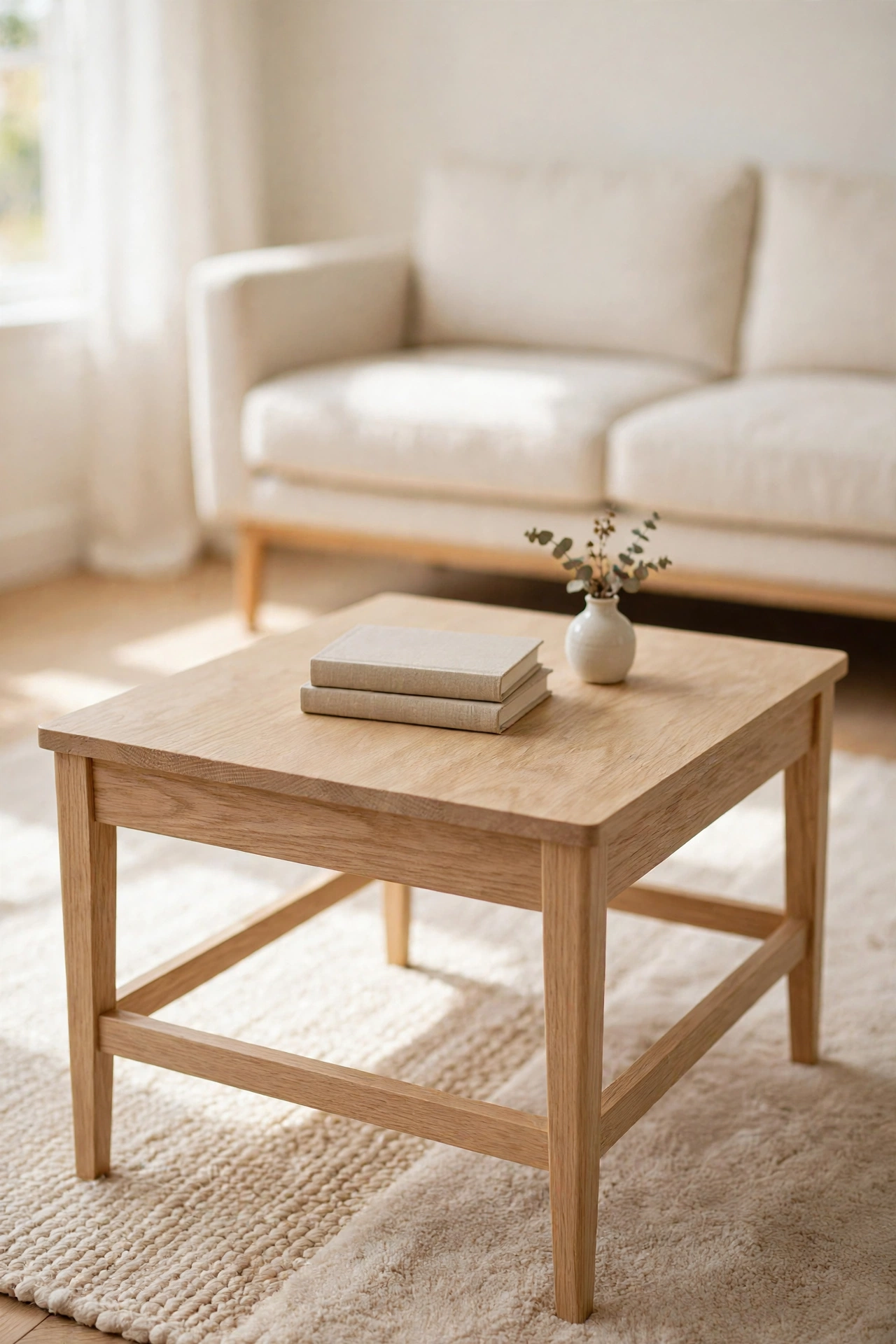
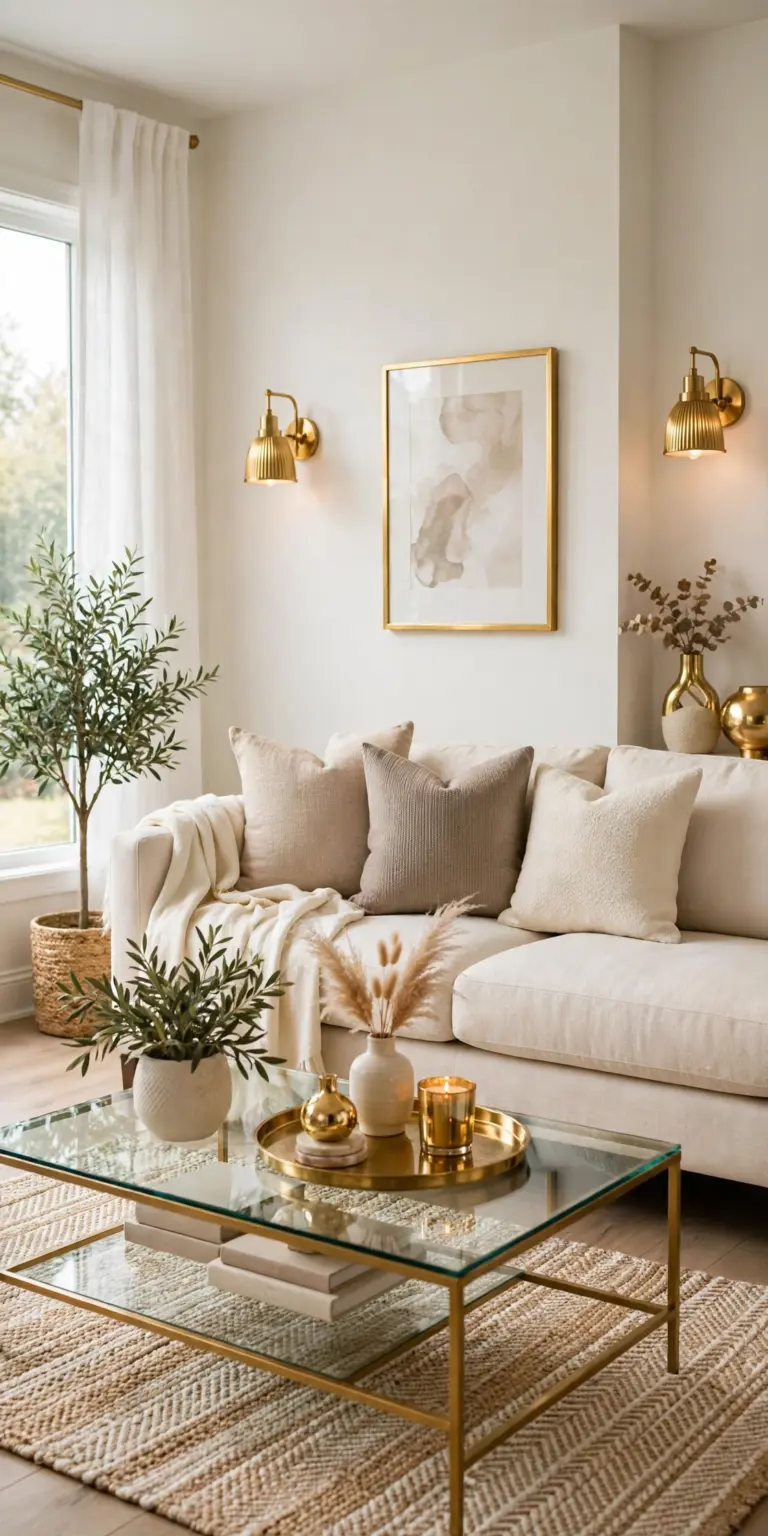
The coffee table stands in the middle of the room, exactly where the eye wants to travel. A heavy closed table blocks that path like a parked car. A light open table lets the rug show through and under it, so the centre of the room stays part of the room. Pale oak is the warm choice here, clear glass is the invisible choice, and both beat any dark solid block.
How to do it: Choose a table with legs and an open base, sized about two thirds the length of the sofa. Keep the top almost empty, one tray or one small stack, so the surface reads as space too. Round or oval corners keep movement easy in tight walkways. Pro Tip: If you need storage, choose a table with one low open shelf rather than drawers. The eye still reads it as open. Common mistake: Using a storage ottoman as the table and covering it with trays and books. The centre of the room becomes a pile.
7. Keep Every Large Piece Inside One Light Palette
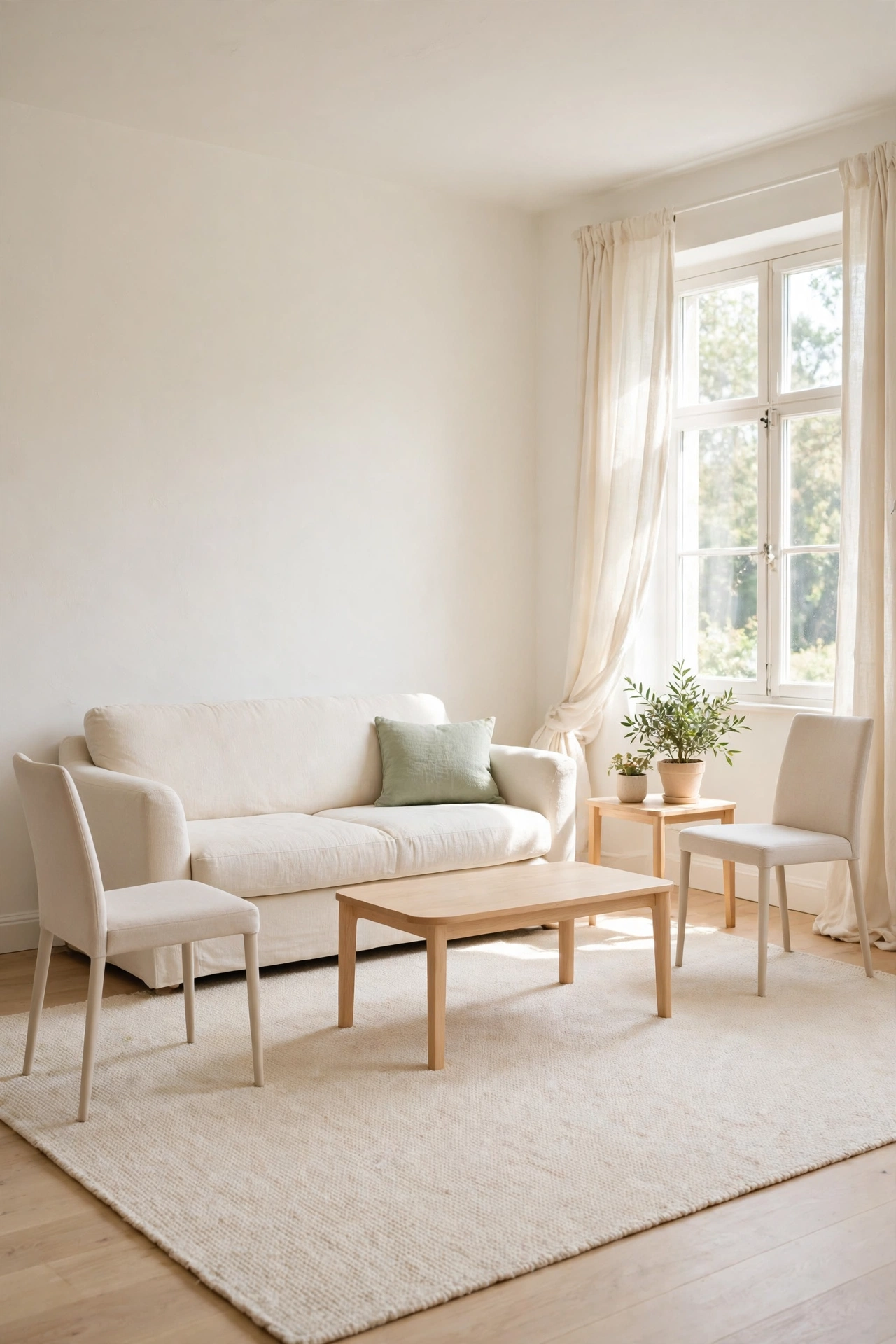
Contrast is a space cost. Every time a dark piece sits against light walls, the eye stops to read it, and a room full of stops feels busy and small. When the sofa, chairs, rug, and curtains all live inside one light tonal family, nothing interrupts, and the whole room reads as one larger shape. Colour can still come in, but it must come small.
How to do it: List your large pieces and check each one against the palette: warm white, cream, soft beige, light oak. Replace or cover the one piece that breaks it first, usually with a cream throw or a pale slipcover. Save stronger colour for cushions, books, and one plant. Pro Tip: Photograph the room in black and white. Tonal clutter shows at once, pieces that jump out in grey are the ones breaking the calm. Common mistake: One dark bookcase or black TV unit kept because it was expensive. In a small room it is the first and last thing seen.
8. Float the Seating Off the Walls
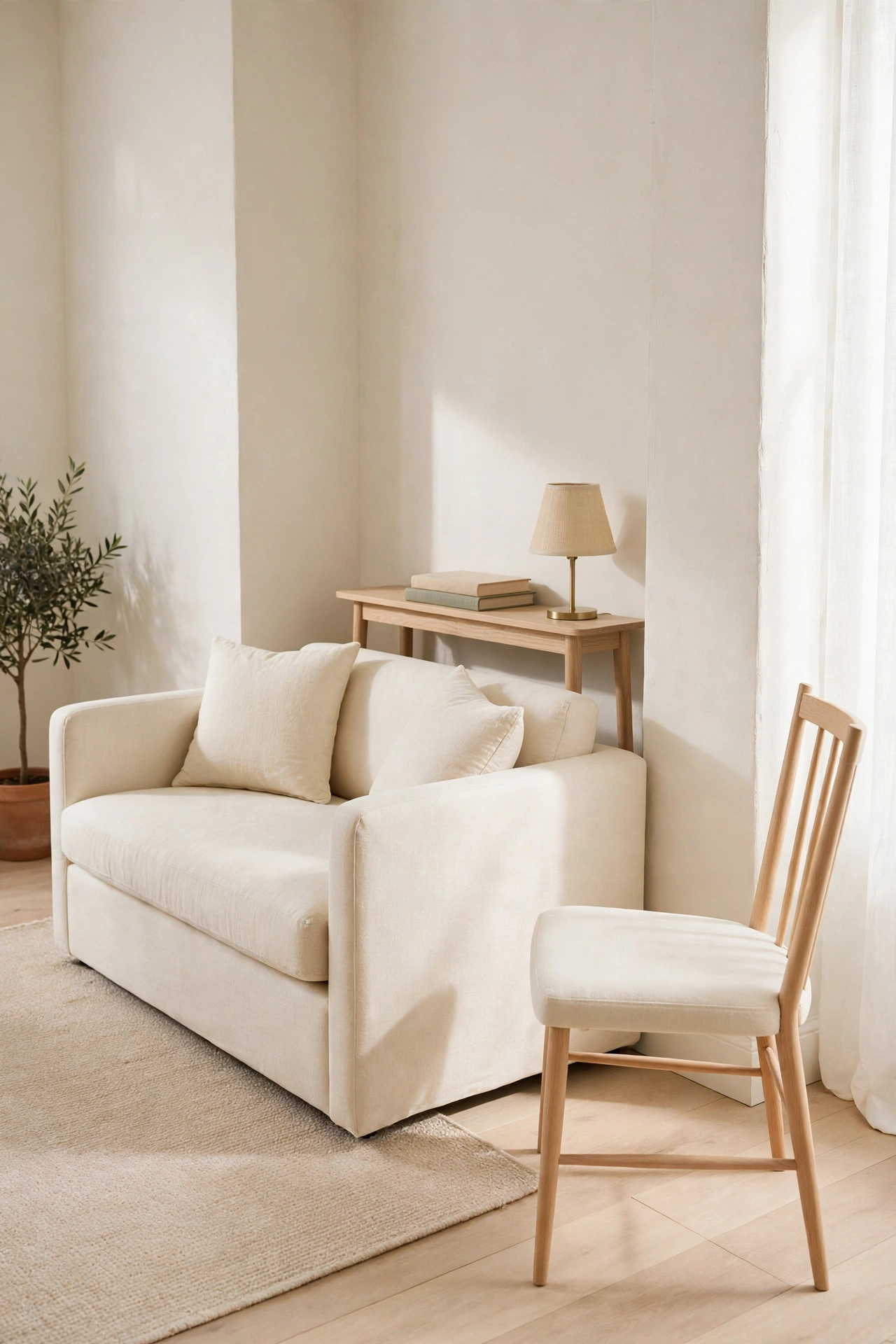
Pushing every piece against the walls feels logical in a small room and works against it. Walls crowded with furniture edges read as storage, and the middle becomes an empty stage nobody uses. Pulling the sofa even a hand of space off the wall creates a shadow line behind it, and that small depth makes the whole arrangement feel placed rather than stored.
How to do it: Pull the sofa 10 to 15 centimetres off the wall. If the gap looks odd, slide a narrow console or a low shelf behind it for books and a lamp. Angle one chair slightly toward the sofa instead of lining it on the wall. Pro Tip: This trick is free and takes five minutes. Try it for one evening before judging it. Common mistake: Floating everything into the middle. In a truly small room, float the sofa only and keep the sides clear for walking.
9. Build Storage Up, Not Out
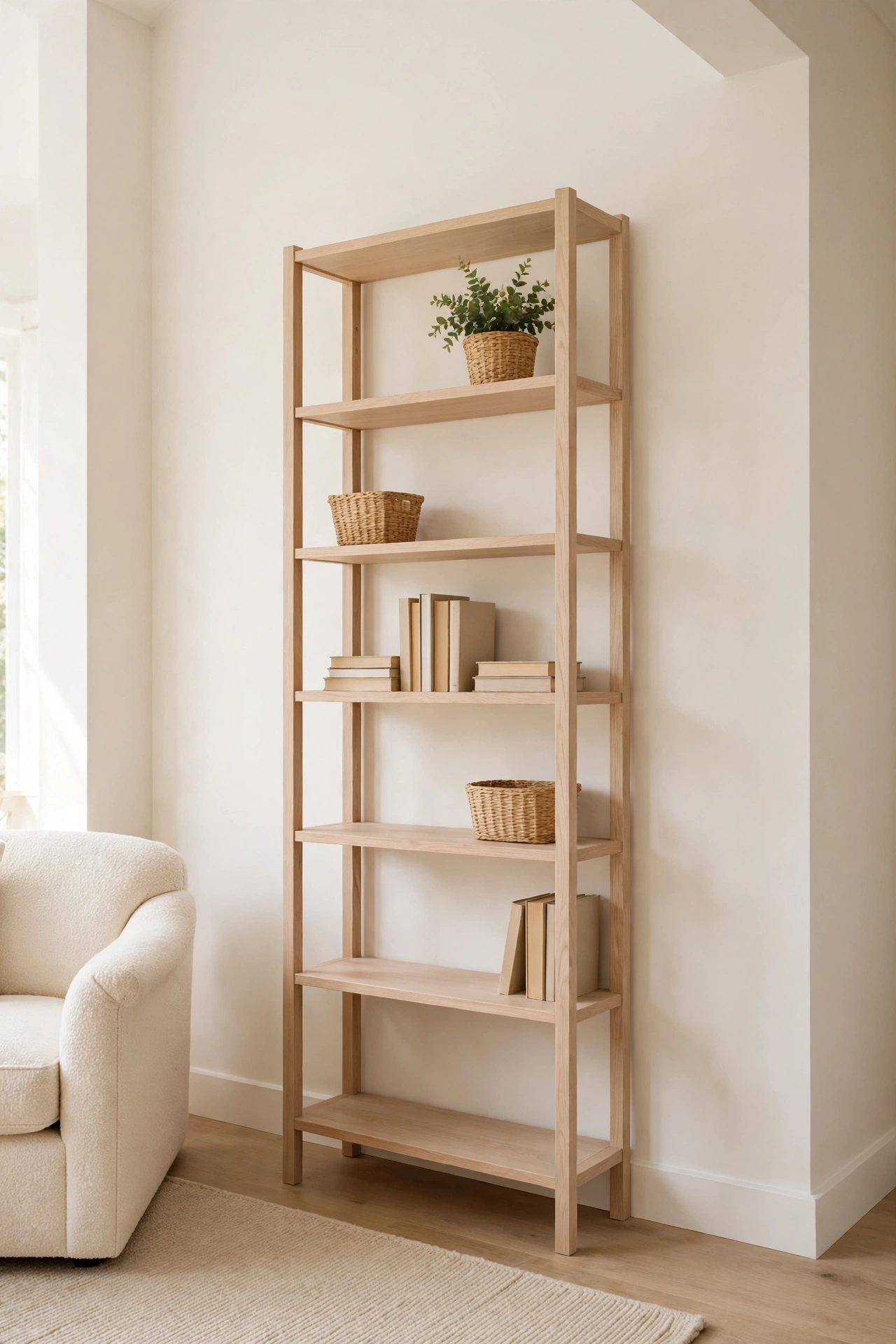
Floor space and wall space trade against each other. A wide low cabinet spends floor and gives little storage. A tall narrow bookcase spends wall, which a small room has more of, and its height pulls the eye upward into the room’s most wasted area. Vertical lines also make ceilings feel higher wherever they stand.
How to do it: Choose one tall narrow bookcase or shelving unit in pale oak or warm white, as close to ceiling height as you can. Keep the top shelves for light things, baskets and books in palette colours, and the eye level shelves almost empty. Fix tall units to the wall for safety. Pro Tip: Leave the highest shelf empty or hold one plant there. Crowding the top makes the unit feel like it is falling into the room. Common mistake: Three short cabinets along one wall. Together they cut the wall into segments and the room into pieces.
10. Replace One Chair With a See Through or Armless Piece
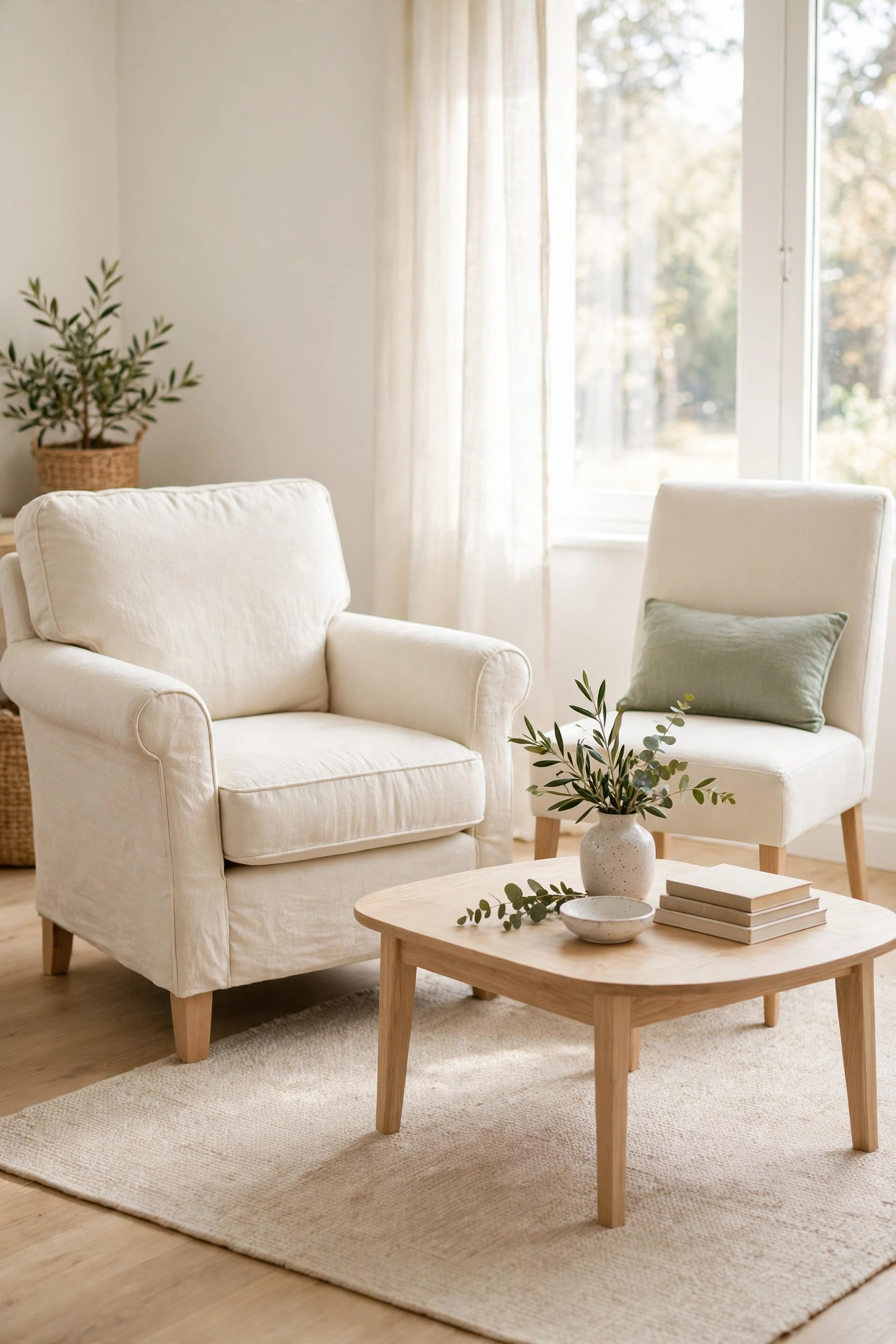
Two full armchairs can be one chair too many in a small room. An armless slipper chair or a light open frame chair gives the same seat with half the visual weight. The eye passes beside and through it instead of stopping at it, and that passing is the feeling of space. Every seat in the room does not need to be a throne.
How to do it: Keep one comfortable armchair and make the second seat armless, slim legged, or open backed, in the same cream family. Place it at an angle where its light profile faces the room’s entrance. Add comfort with one cushion, not with bulk. Pro Tip: A pair of different chairs looks collected on purpose when their fabrics match. Match the fabric, vary the shape. Common mistake: Matching chunky armchairs bought as a set. Sets belong in large rooms where their weight reads as luxury.
11. Use One Large Art Piece Instead of a Gallery Wall
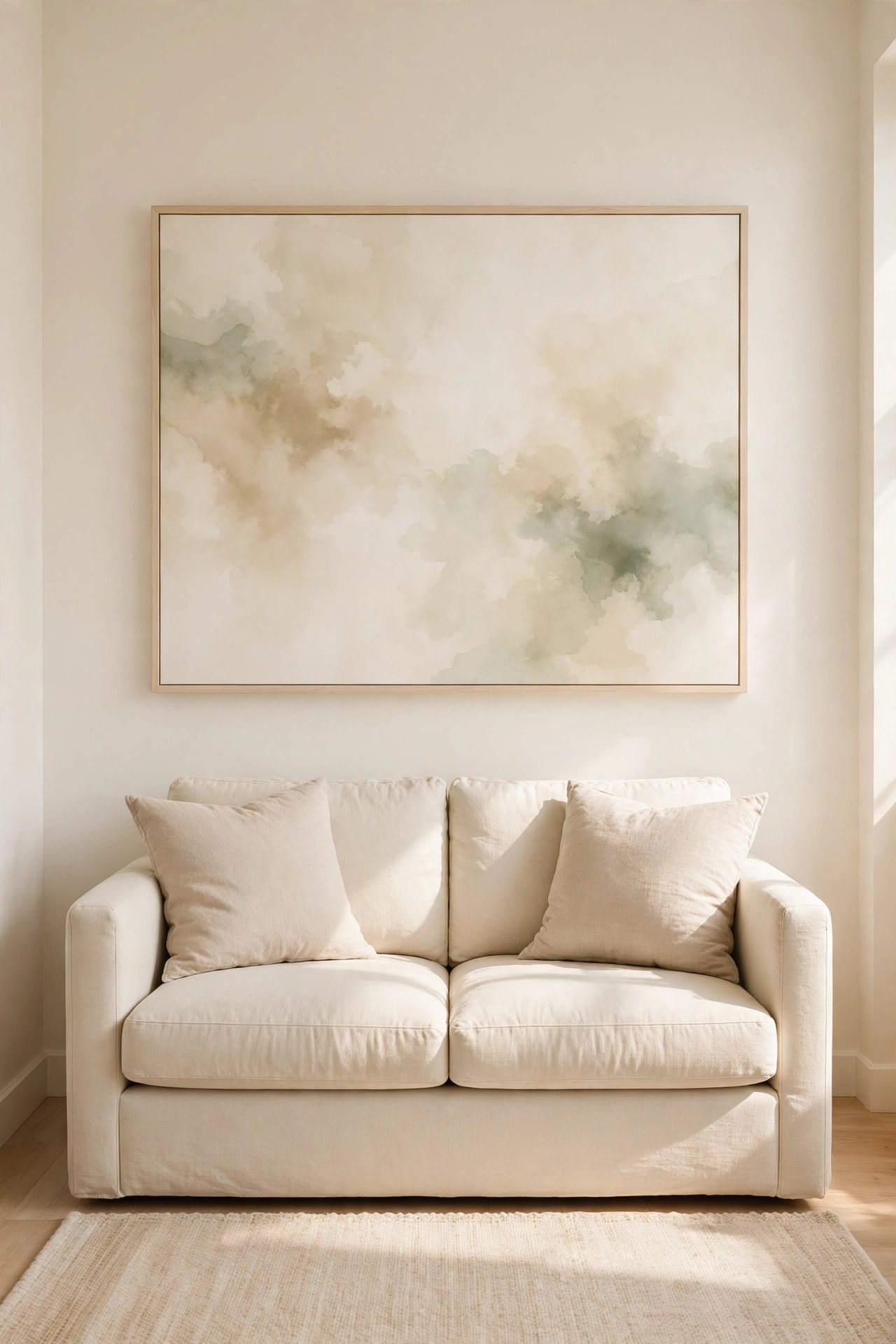
A gallery wall is many small stops for the eye. In a small room, ten frames are ten interruptions, and the wall feels nearer because it is busier. One large calm art piece does the opposite. It gives the wall a single quiet focus, and its size borrows the feeling of a bigger room, where art can afford to be large. Scale up is a designer signal that the room is confident.
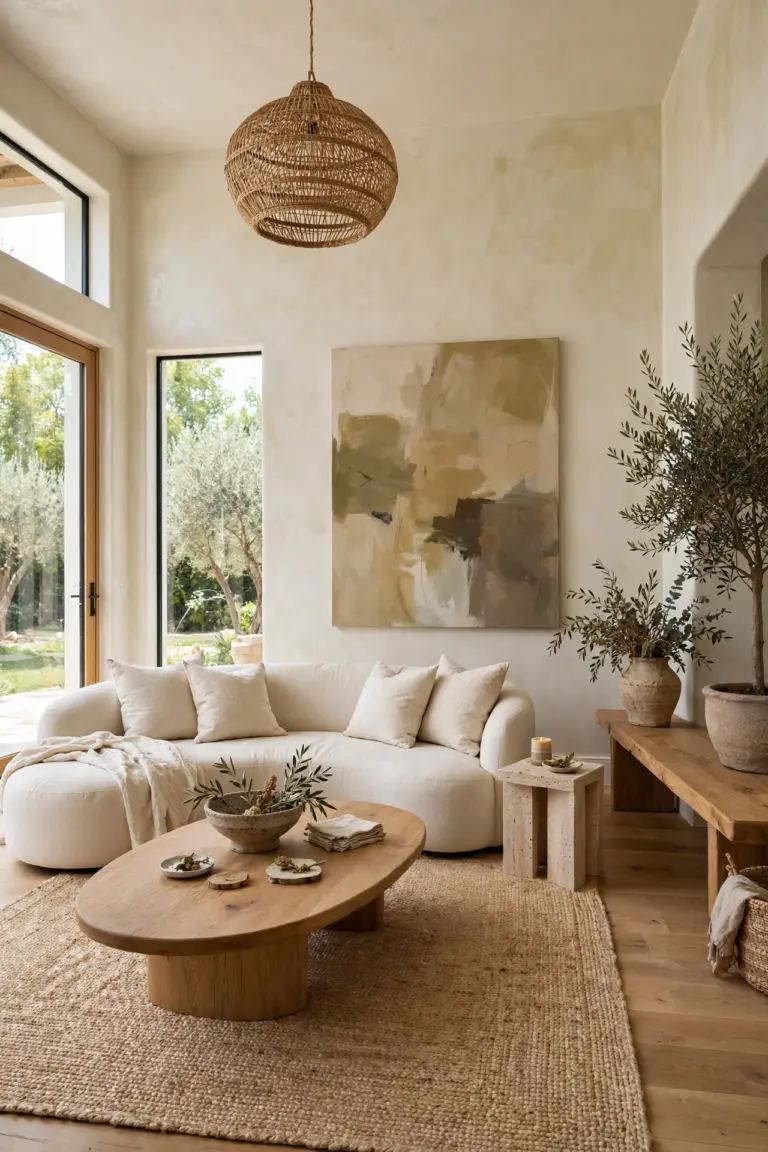
How to do it: Choose one large canvas, at least two thirds the width of the sofa, in soft colours from the palette, with one sage or muted tone if you want the room’s accent here. Hang it low, centred on the sofa, about 15 centimetres above the back. Keep every other wall in the room empty or nearly so. Pro Tip: If large art is costly, stretch a plain linen look fabric over a big frame and paint soft abstract shapes in leftover wall paint. The scale matters more than the art. Common mistake: Hanging the large piece high like a sign. Low and connected to the sofa is what makes it feel designed.
12. Light in Layers at Different Heights
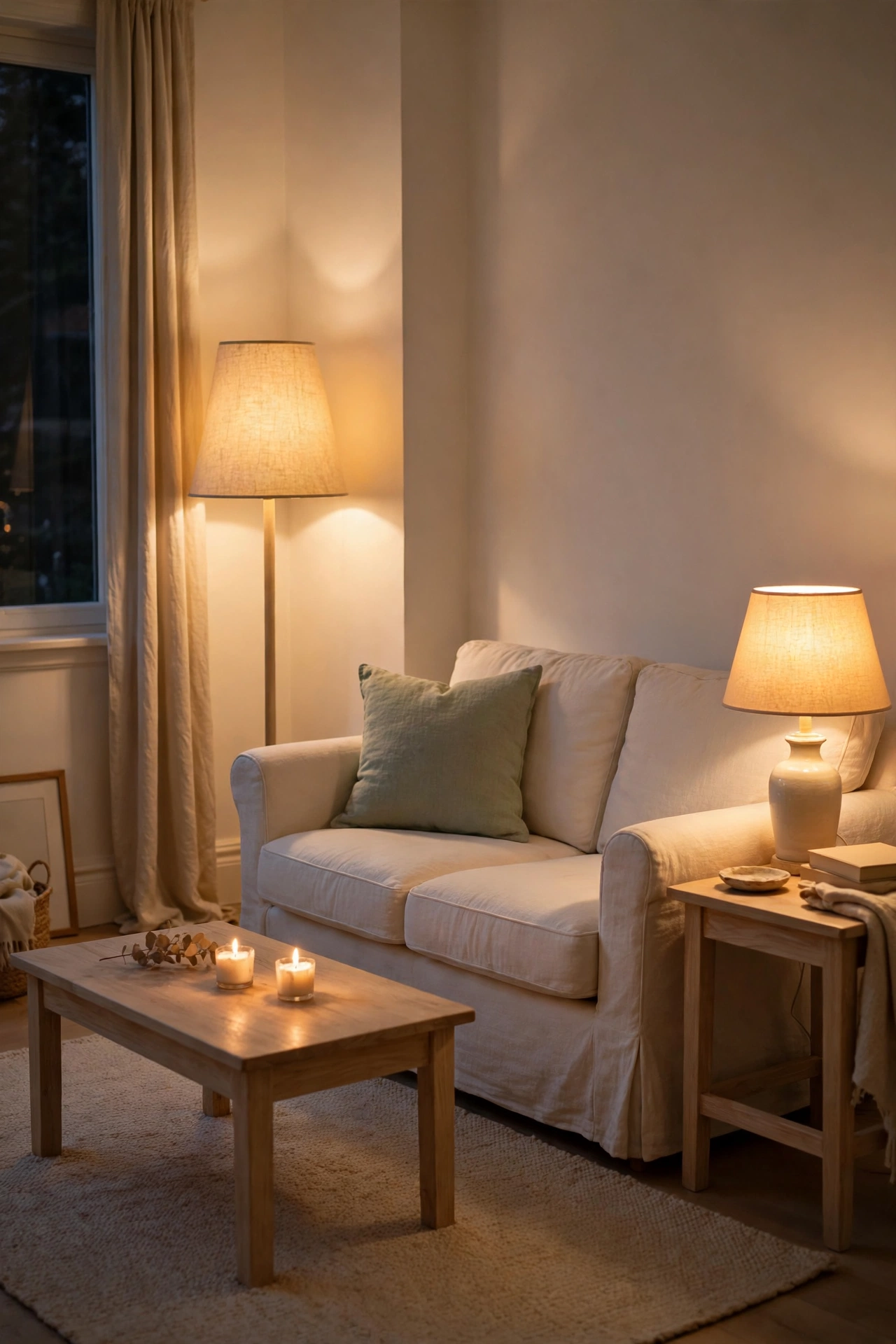
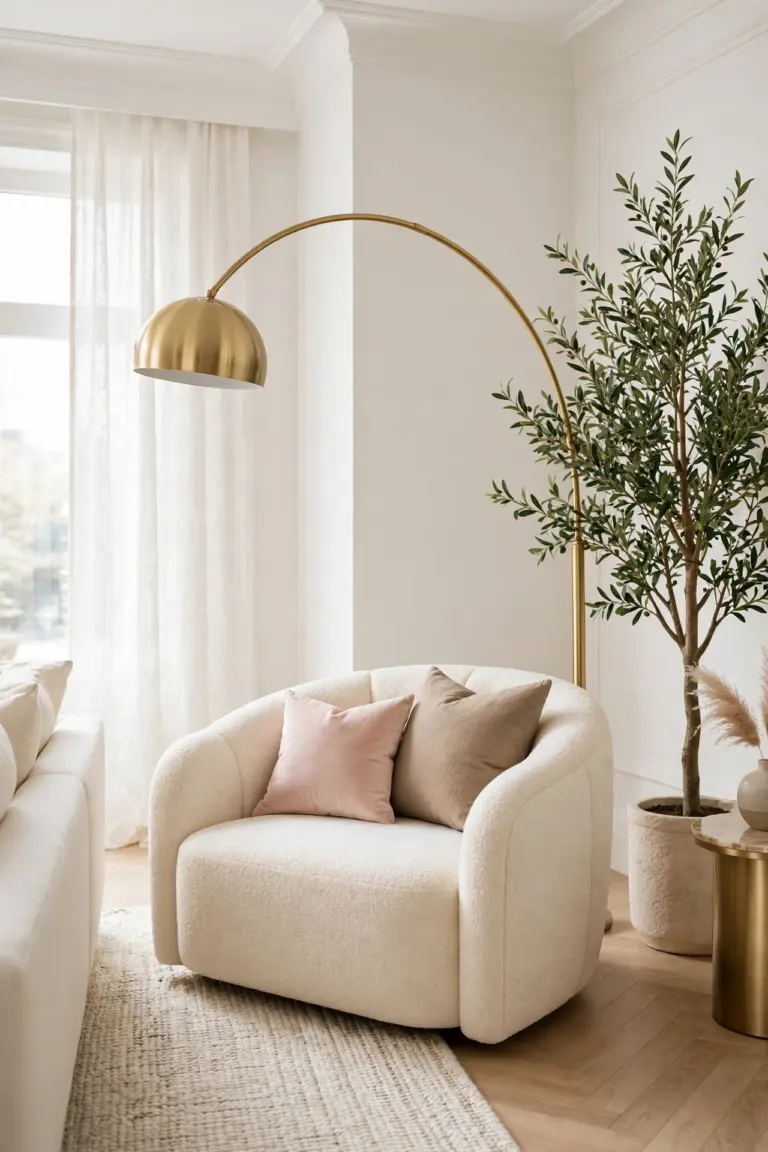
One ceiling light flattens a room and draws a hard border at the ceiling, which is the smallest possible version of the space. Layered light removes borders. A floor lamp lifts one corner, a table lamp warms the middle height, and their pools of light make the room feel wider because the edges go soft instead of ending at a line. Evening is when small rooms feel smallest, and light is the fix that works after dark.
How to do it: Plan three light points at three heights: one tall floor lamp, one table lamp at seat height, and candles or a small lamp low. Use warm bulbs everywhere, the same warmth, so the layers blend. Put lamps in corners, because lit corners stop pulling the walls inward. Pro Tip: A lamp behind a chair or plant throws leaf and fabric shadows that make walls feel further away. Depth is space. Common mistake: Brighter ceiling bulbs as the answer. More light from one point above only sharpens every edge in the room.
13. Finish With the Ten Minute Tidy Test
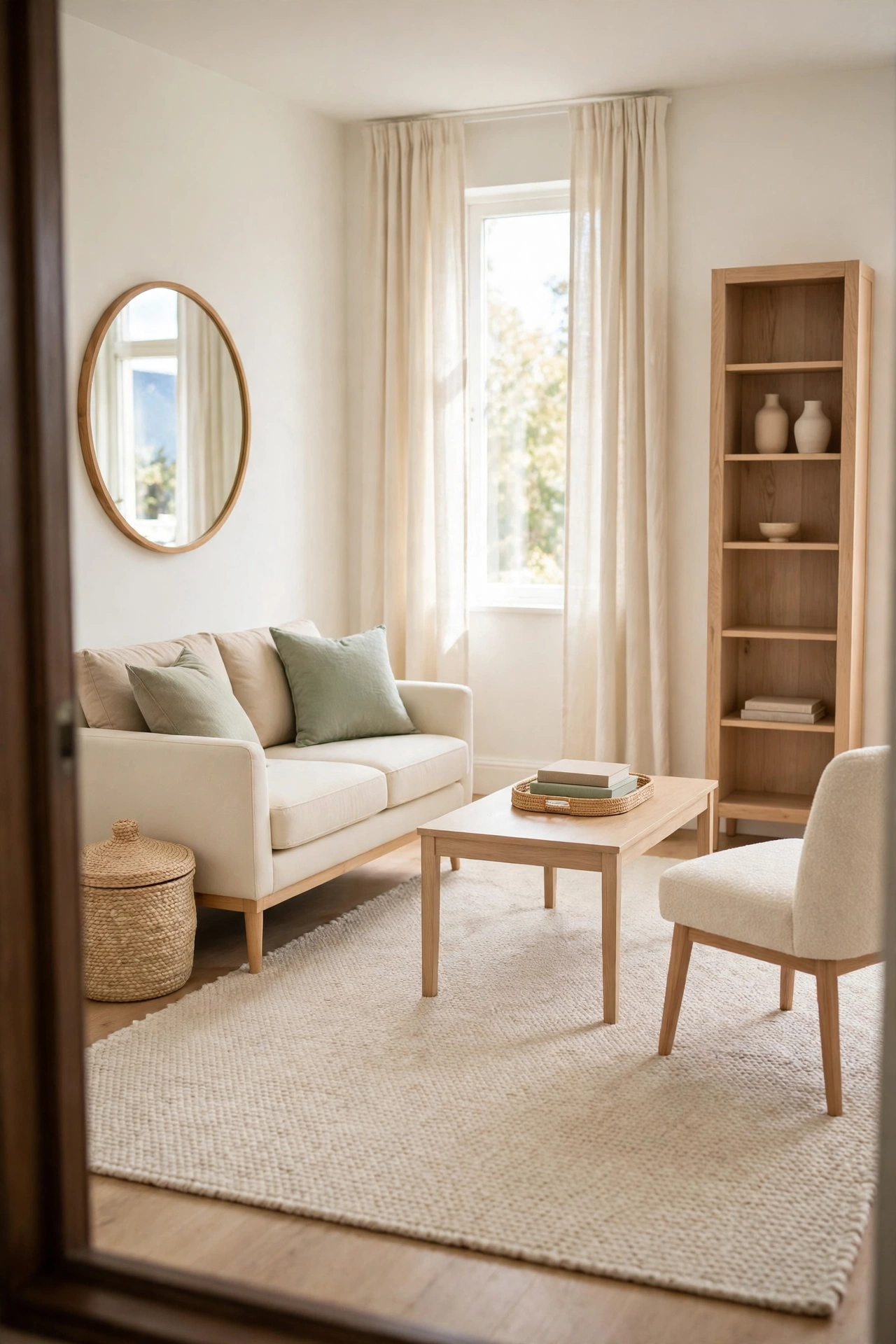
The last trick is a test, not a purchase. Stand at the door and count the objects you can see. In a small room, every visible object is a claim on space, and most small rooms are not small, they are full. Designers edit a finished room by removing a third of what is on show, and the room reliably looks bigger within minutes, because the remaining pieces finally get air around them.
How to do it: Give every surface a number it may hold: the coffee table three things, each shelf group one empty space in three. Hide daily clutter in one closed basket or one lidded box inside the palette, not in piles. Repeat the door test at night under the lamps, because that is the room you actually live in. Pro Tip: Store what you removed for one month before deciding its fate. Most of it is never missed, and the space it returns is permanent. Common mistake: Buying more storage to hold more things on show. The room grows calmer when it holds less, not when it organises more.
Quick Reference Table
| Part of the Room | The Bigger Feeling Choice |
|---|---|
| Walls and ceiling | One warm white everywhere, no accent wall |
| Mirror | One large round mirror reflecting the window |
| Sofa | Compact, pale, raised on light wood legs |
| Curtains | Ceiling height, wider than the window, wall colour |
| Rug | One large light rug under the whole group |
| Coffee table | Pale oak or glass, open base, almost empty top |
| Large pieces | All inside one light tonal palette |
| Layout | Sofa floated a hand of space off the wall |
| Storage | One tall narrow unit, storage goes up |
| Second chair | Armless or open frame, fabric matched |
| Art | One large calm canvas, hung low |
| Light | Three heights, warm bulbs, lit corners |
| Surfaces | A set number of objects, the rest hidden |
Small Room Checklist
- One warm light colour on walls, ceiling, and trim
- One large mirror reflecting daylight
- Sofa raised on legs, floor visible beneath
- Curtains at ceiling height and wider than the window
- One large light rug holding the seating group
- Coffee table open at the base, top almost clear
- Every large piece inside the light palette
- Sofa pulled slightly off the wall
- Storage tall and narrow, fixed to the wall
- One large art piece, other walls calm
- Three layers of warm light, corners lit
- The ten minute door test passed, day and night
Frequently Asked Questions
What colour makes a small living room look biggest?
One warm white or very pale cream used everywhere, walls, ceiling, and trim together. The single colour hides the corners, and warm tones keep the room friendly where bright blue whites turn it cold and boxy.
Does a mirror really make a small room look bigger?
Yes, when it is large and placed to reflect the window. It doubles the natural light and shows the room a second view of itself. A small mirror or one reflecting a blank wall does almost nothing.
Should a small living room have a rug?
Yes, one large light rug. It should be big enough for the front legs of the sofa and chairs to stand on it. A small rug shrinks the seating area to its own size, which is the mistake to avoid.
Conclusion
A small room feels bigger when the eye can travel: across one light colour, under raised furniture, over one generous rug, and up tall curtains to a soft ceiling line. None of these thirteen tricks adds a centimetre to the room. Together they remove the stops, and a room without stops is a room that feels twice its size.