21 Modern Organic Living Room Ideas for a Natural, Elegant Look
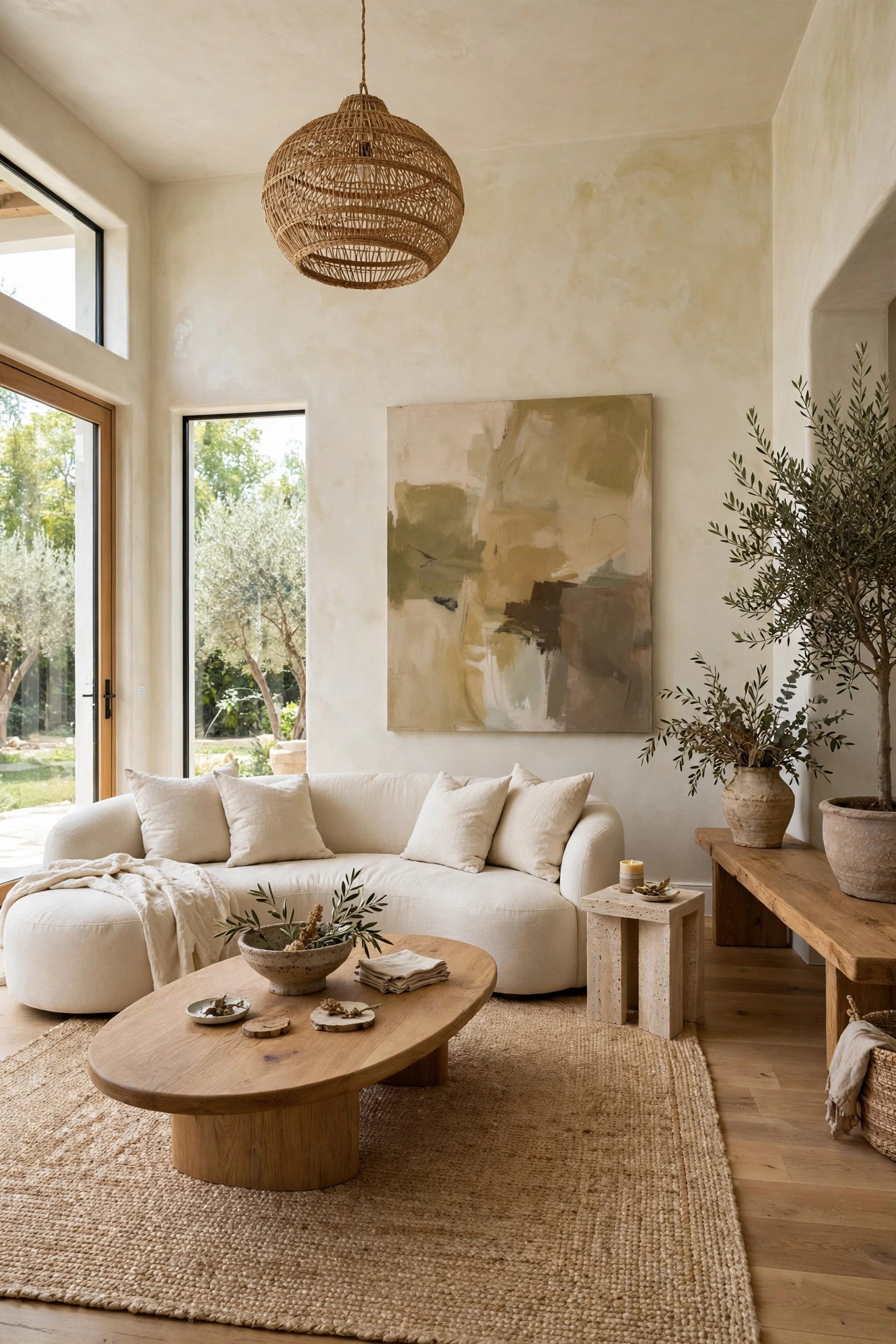
Modern organic is the style that lets a living room breathe. It takes the clean lines of modern design and softens every one of them with nature: curved shapes instead of sharp corners, wood with its grain showing, stone with its cool weight, linen and jute with their honest texture. Nothing in the room is glossy, nothing shouts, and that quiet is exactly what makes it elegant.
This guide builds one complete room in a fixed palette: warm white walls, cream and flax linen, natural oak, one deeper walnut note, stone grey beige, olive green, and a touch of clay. Every idea is tested against that palette and against one question, could this material come from the earth without embarrassment? If yes, it belongs. If it is plastic pretending to be natural, it does not, however pretty the photograph looked.
1. Start With Warm White Walls That Have Texture
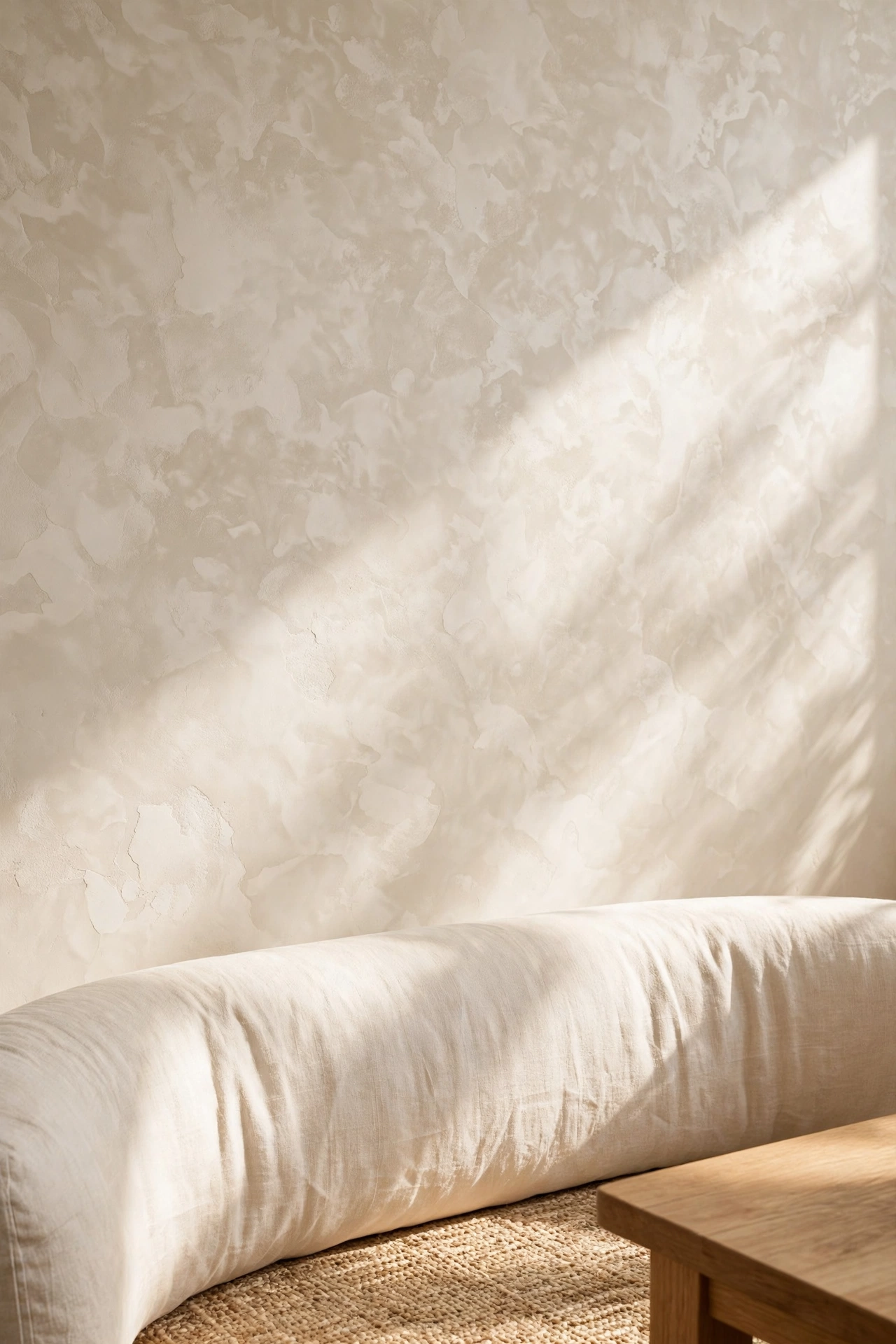
Flat bright white paint is modern, but it is not organic. Organic walls have a skin, a slight movement of tone that catches light unevenly, like limewash, clay paint, or a warm white with a matte chalky finish. That soft unevenness is the background the whole style stands on, because natural materials need a natural wall behind them.
How to do it: Choose a warm white with a yellow or clay base, never a blue base. Apply limewash with a block brush in loose crosses if you want the full effect, or use a limewash effect paint for the same look with less work. Keep the ceiling the same colour so the room feels carved, not boxed. Pro Tip: Paint one test patch and watch it at three times of day. Limewash changes character with the light, and its evening self is the one you will live with most. Common mistake: Bright white glossy paint. The shine fights every natural texture in the room and turns calm into clinical.
2. Choose a Low Curved Sofa in Natural Linen
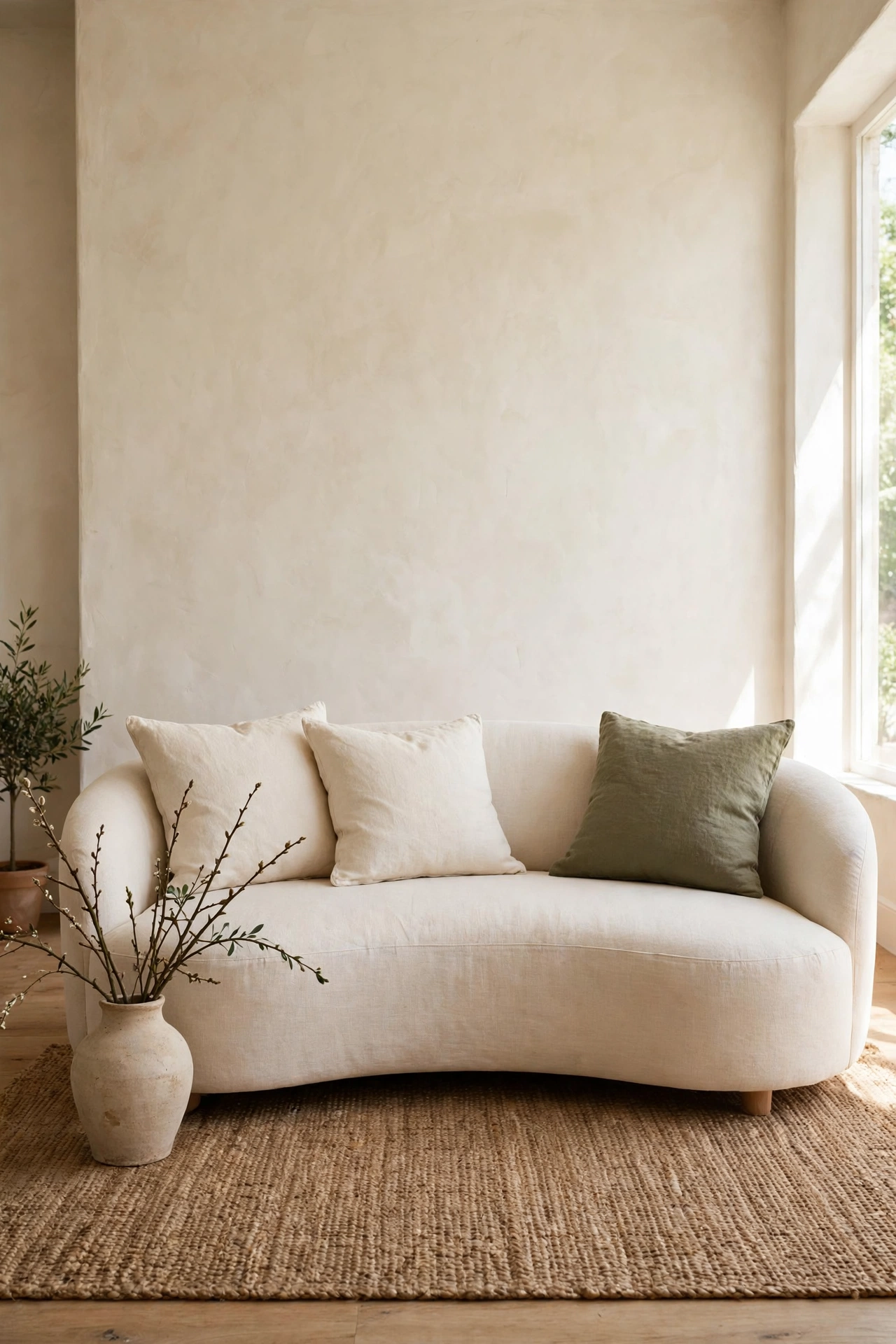
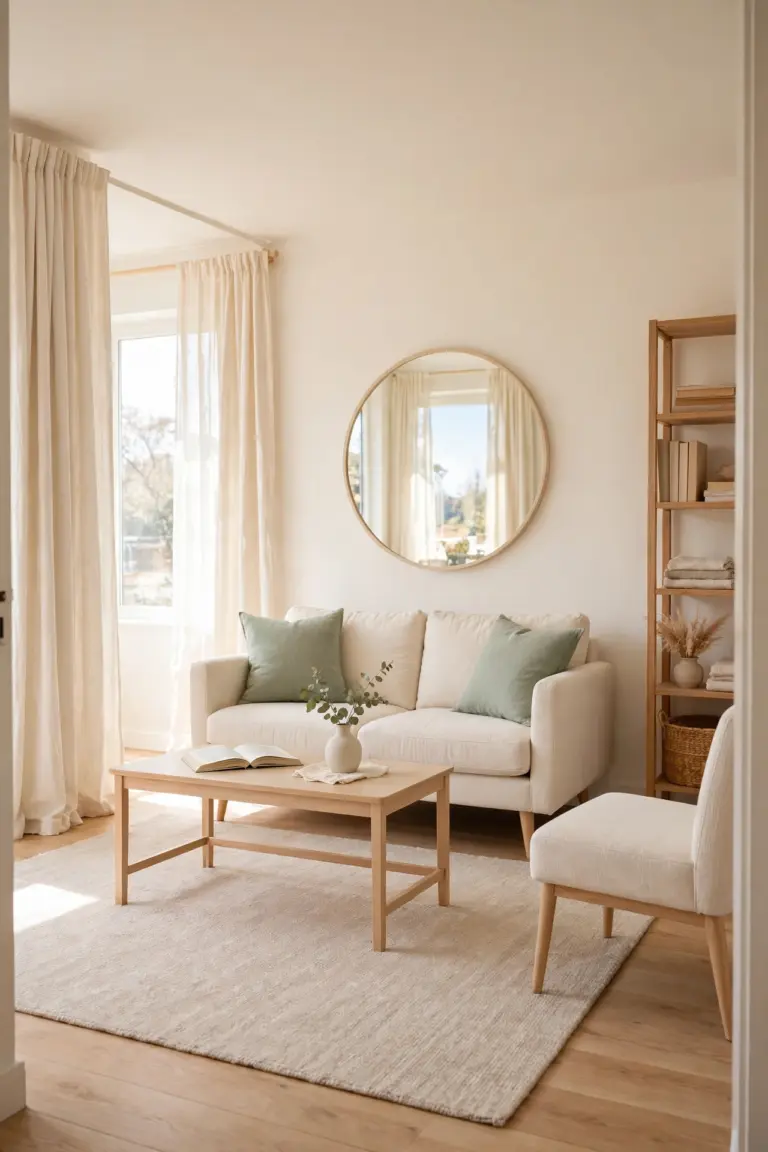
The sofa is the largest curve in the room, and curves are the grammar of this style. A low profile keeps the room’s horizon calm, and natural linen in cream or flax gives the curve a soft earthy surface. The sofa should look like it grew there, rounded and relaxed, not like it was machined.
How to do it: Pick a sofa with a rounded back and arms, low to the ground, in undyed or cream linen with visible weave. Keep cushions feather soft and slightly unstructured. Face it toward the room’s natural light if the layout allows. Pro Tip: If a curved sofa is out of reach, round the room with a curved chair and a round rug. Two strong curves can carry the feeling. Common mistake: A sharp rectangular sofa in grey fabric. Grey and sharp are the two words this style exists to replace.
3. Anchor the Room With a Solid Oak Coffee Table
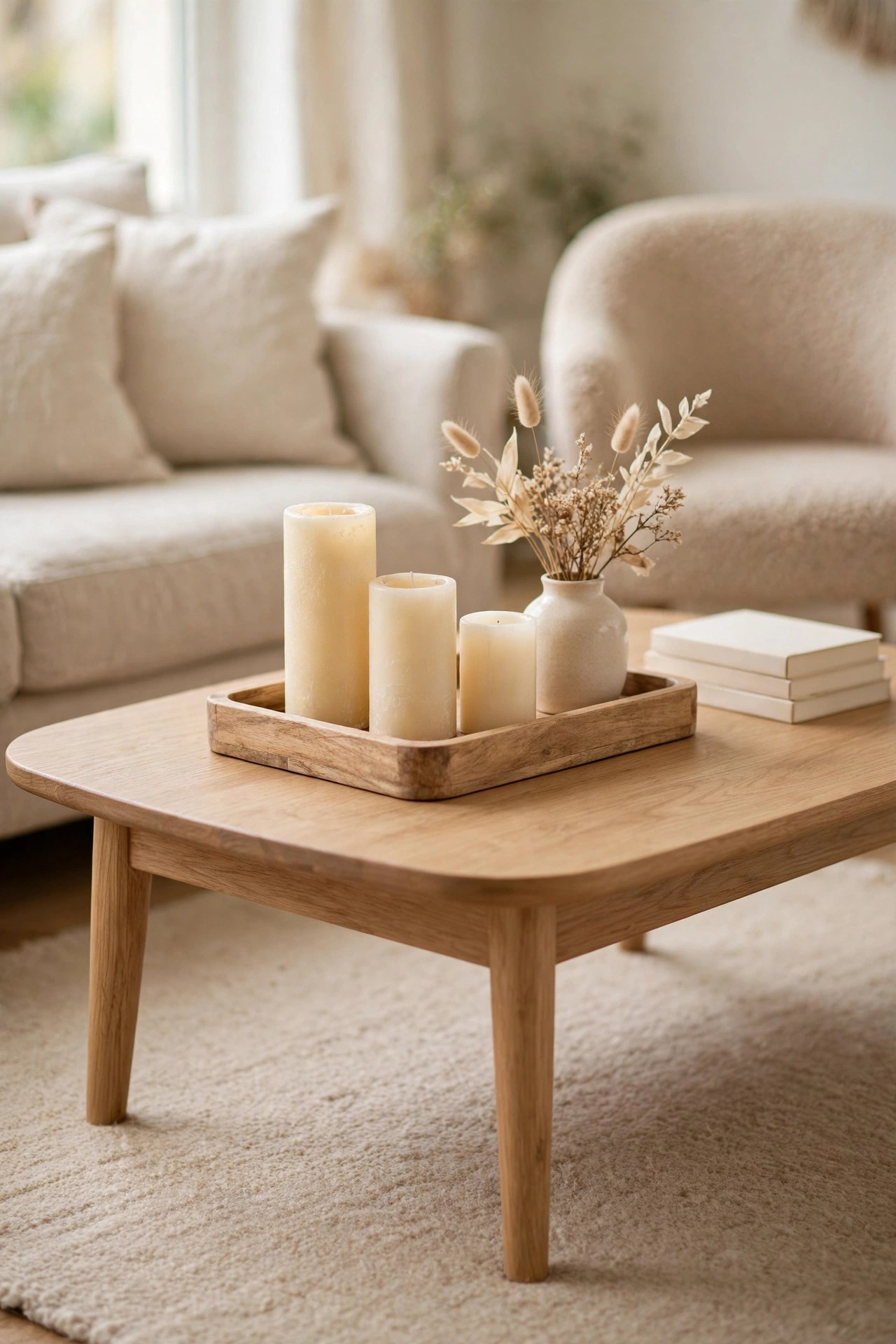
Wood is the second voice of the room, and the coffee table is where it speaks loudest. Solid oak with the grain open and the finish matte brings warmth that no imitation matches, and an organic shape, oval, kidney, or softly irregular, keeps the centre of the room free of hard angles.
How to do it: Choose the largest table the walkways allow, in natural oak with no stain darker than honey. Keep the top styled with three things at most, in ceramic, stone, or wood. Let the grain be the decoration. Pro Tip: Run your hand over the table in the shop. If it feels like plastic, the finish is too thick, and the room will feel it too. Common mistake: A high gloss or glass table. Both read as manufactured first and furniture second.
4. Lay a Natural Fibre Rug With Real Texture
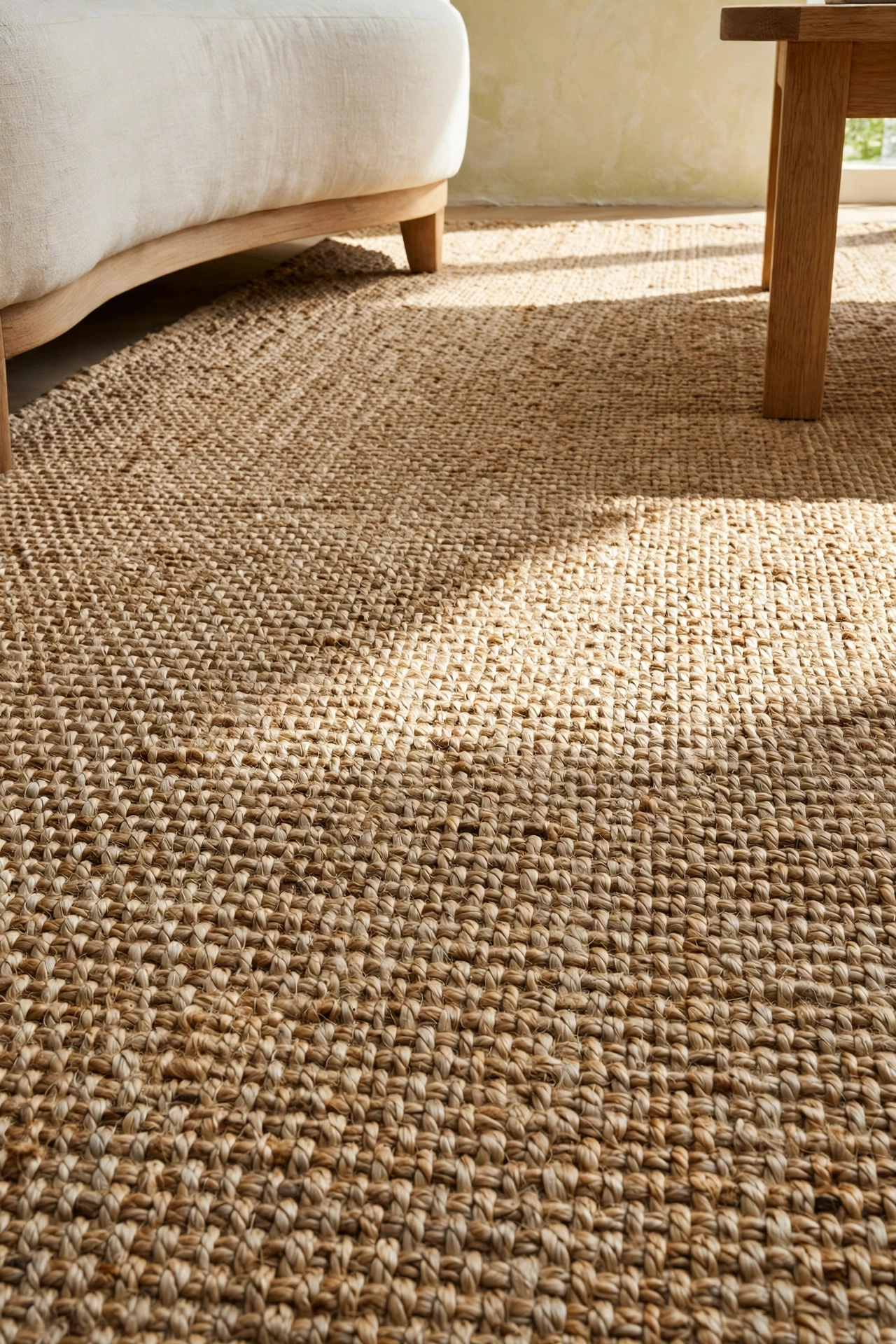
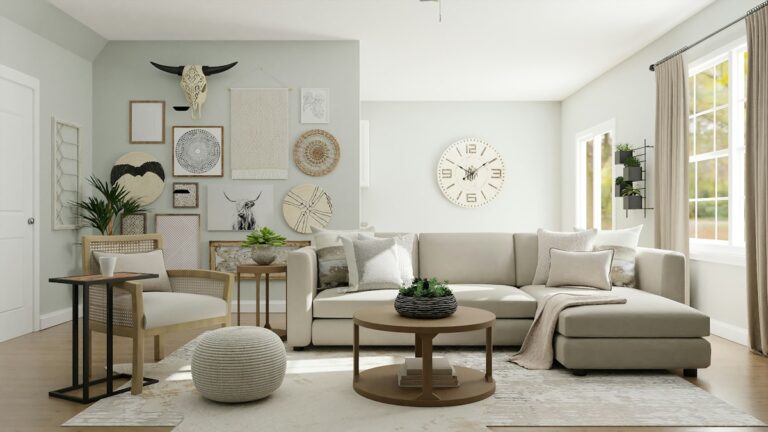
The floor layer of an organic room must feel like it was woven, not printed. Jute, wool, and sisal bring the roughness that balances all the soft upholstery, and their natural uneven colour hides real life gracefully. The rug is also the room’s map, defining the seating island inside the open space.
How to do it: Size the rug generously, front legs of every seat on it. Choose jute for texture or undyed wool for softness, in natural beige tones with visible variation. Layer a smaller flat wool rug over jute if you want softness where feet land most. Pro Tip: Natural fibre rugs shed and smell faintly of the field at first. Both fade within weeks and are the receipt that the material is real. Common mistake: A synthetic rug with a printed tribal pattern. Print is the opposite of organic, and the eye can tell at three steps away.
5. Give the Room One Living Tree
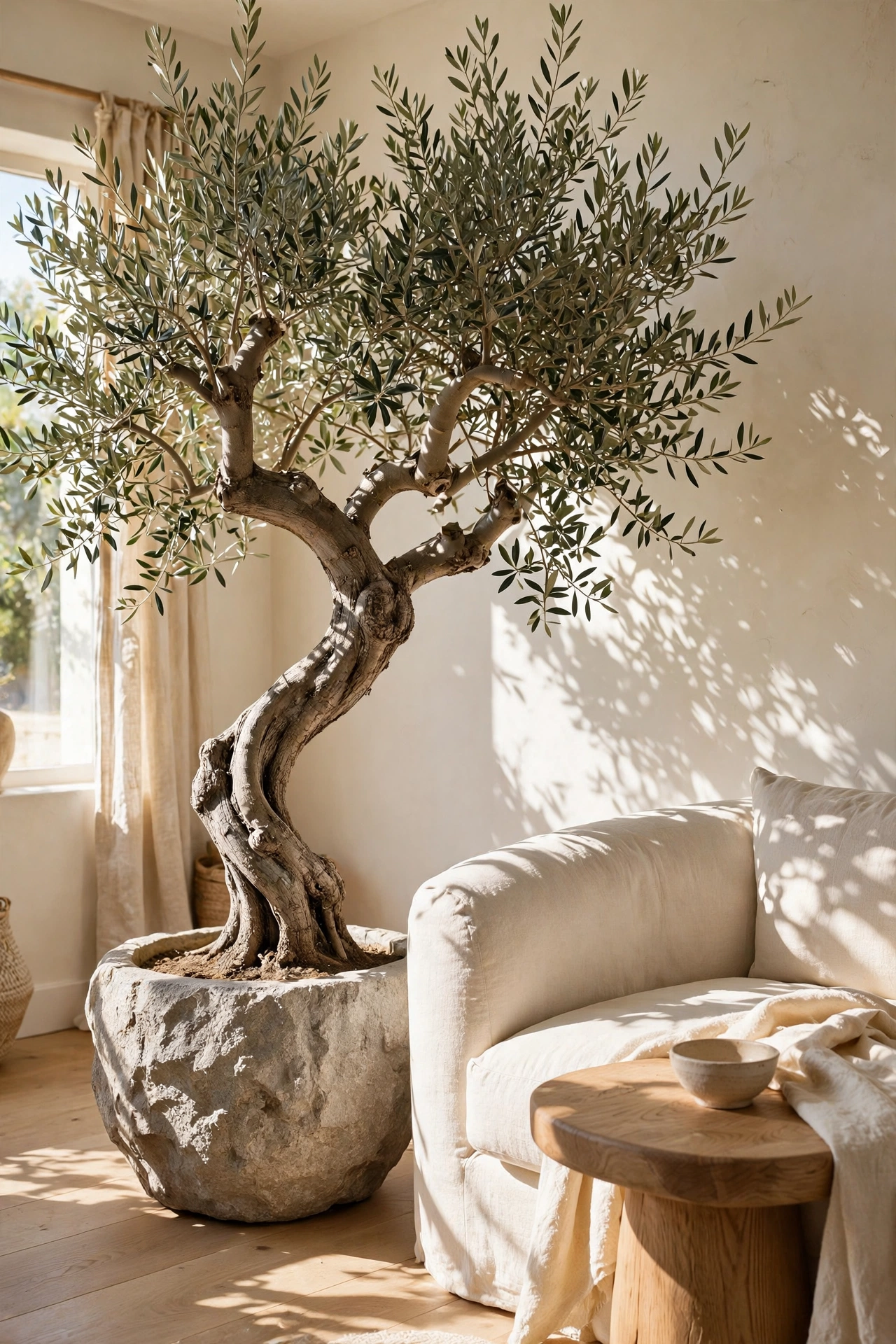
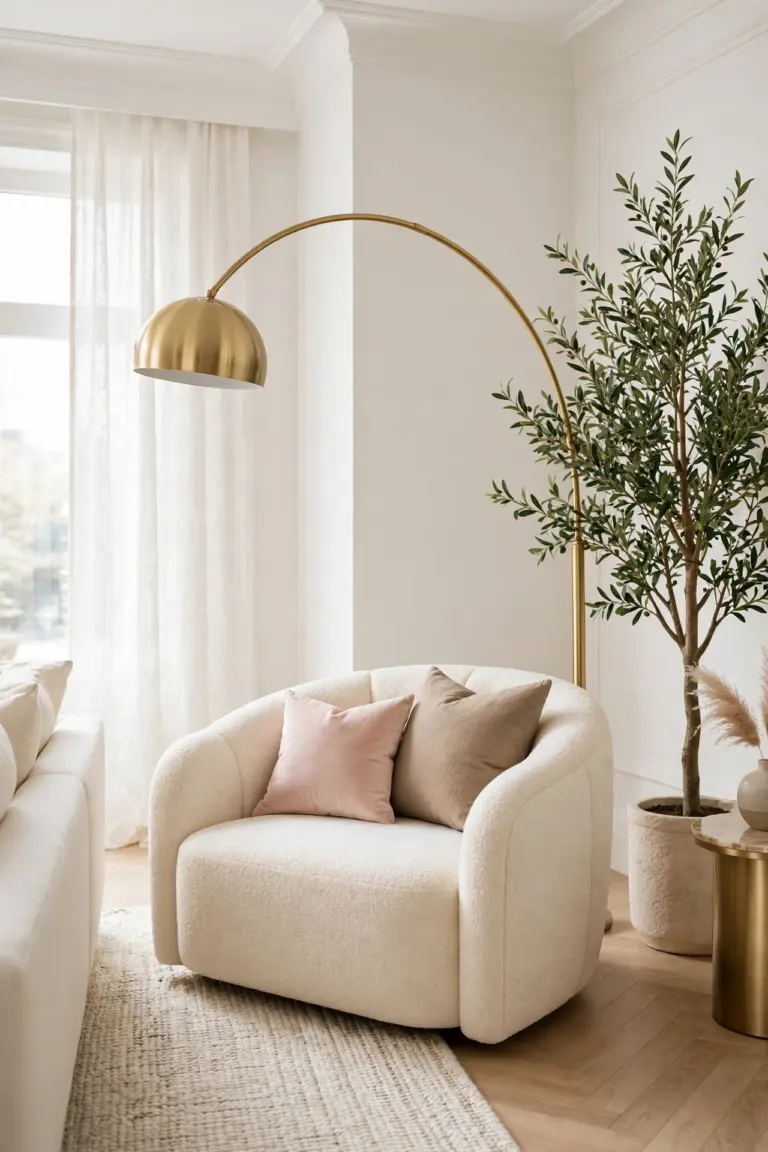
Every organic room needs one piece that is actually alive and taller than the furniture. An olive tree is the classic choice, soft grey green leaves, a sculptural trunk, and a Mediterranean calm that suits the palette. One tree, well placed, does more than five small plants scattered on shelves.
How to do it: Place the tree in the brightest corner, in a large stone, clay, or raw concrete pot with a matte finish. Choose height over bushiness, a tree that reaches toward the ceiling line. Turn it weekly so it grows evenly toward the light. Pro Tip: If real light is too weak, invest in one very good faux olive and dust it weekly. A neglected real tree is sadder than a cared for false one. Common mistake: A glossy black or white plastic pot. The pot is half the plant’s presence, and plastic breaks the material promise.
6. Hang Oversized Art in Earth Pigments
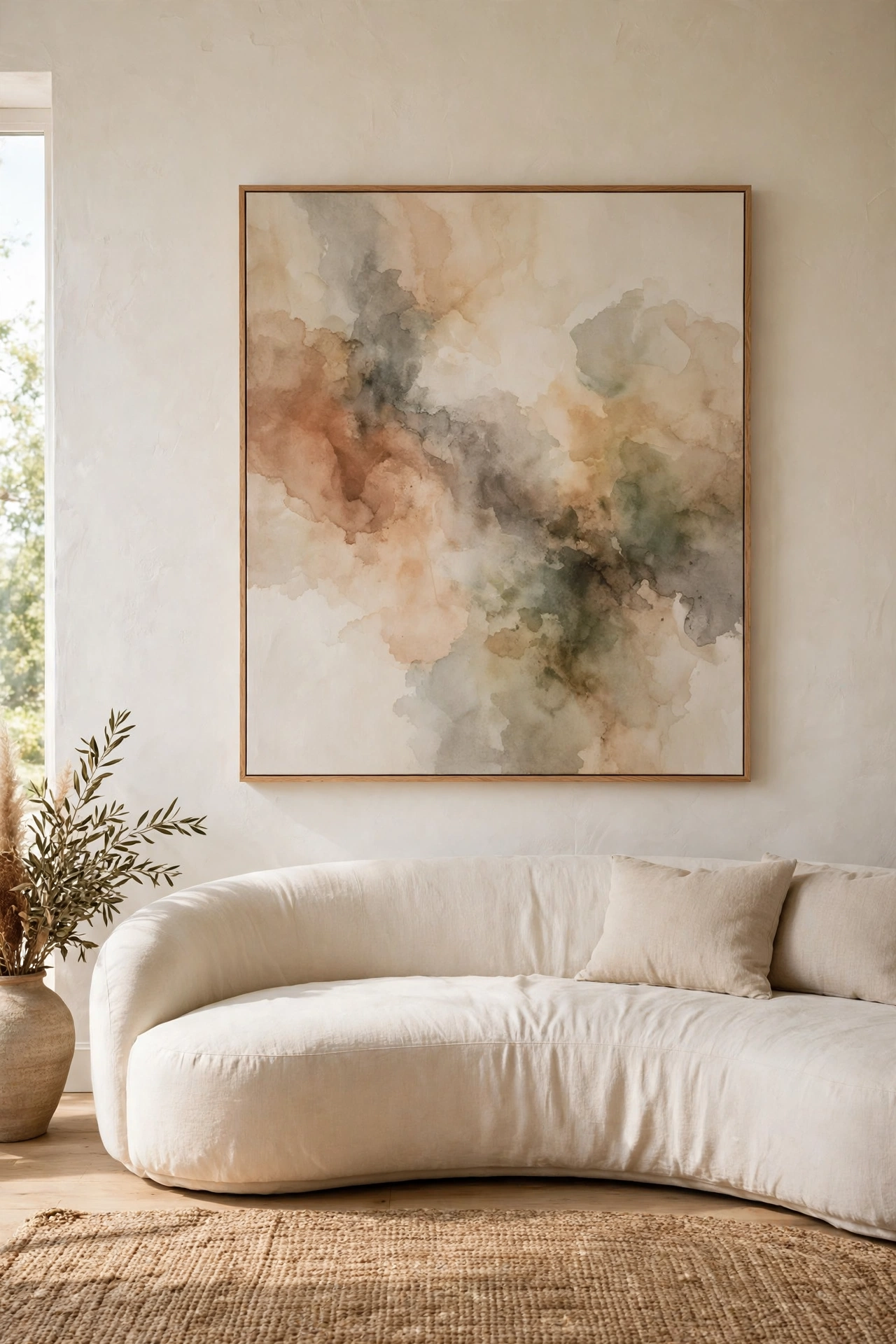
Art in this style is landscape without the picture, washes of sand, clay, stone, and olive that feel like a hillside remembered rather than drawn. One oversized piece keeps the wall calm and gives the room its quiet focal point, the way a view does in a house in the country.
How to do it: Choose one large canvas, at least two thirds the sofa’s width, in matte earth pigments with soft edges. Keep the frame raw oak or none at all. Hang it low, connected to the sofa group, with all other walls nearly bare. Pro Tip: Stand at the door and squint. The art should read as tones, not as a picture competing with the room. Common mistake: A gallery wall of small prints. Many small images are visual noise, and noise is what this style removes.
7. Add Walnut as the One Deep Wood Note
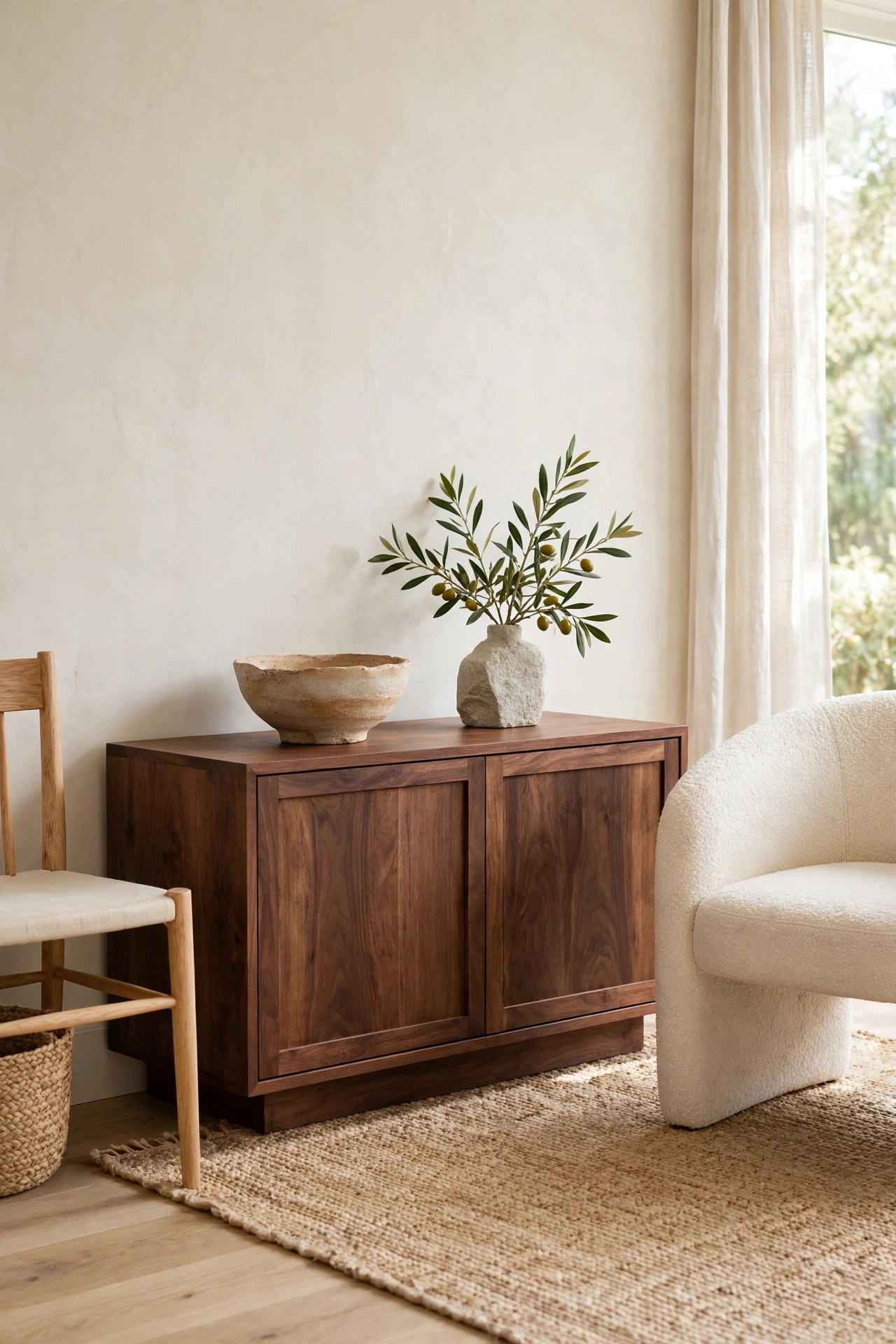
A room of only pale wood can drift toward bland. One deeper note, walnut, gives the palette its shadow and makes the oak look lighter by contrast. The rule is proportion: walnut is the accent, never the theme, appearing in one or two pieces at most.
How to do it: Choose one walnut piece, a sideboard, a side table, or a bowl on the coffee table, and repeat its tone nowhere else large. Place it where the eye lands second, not at the centre. Keep its finish matte like everything else. Pro Tip: Walnut and olive green are natural partners. A walnut piece near the tree doubles the effect of both. Common mistake: Mixing walnut with dark stained everything. The room slides from organic modern into heavy traditional in one purchase.
8. Pick Accent Chairs With Curved Backs
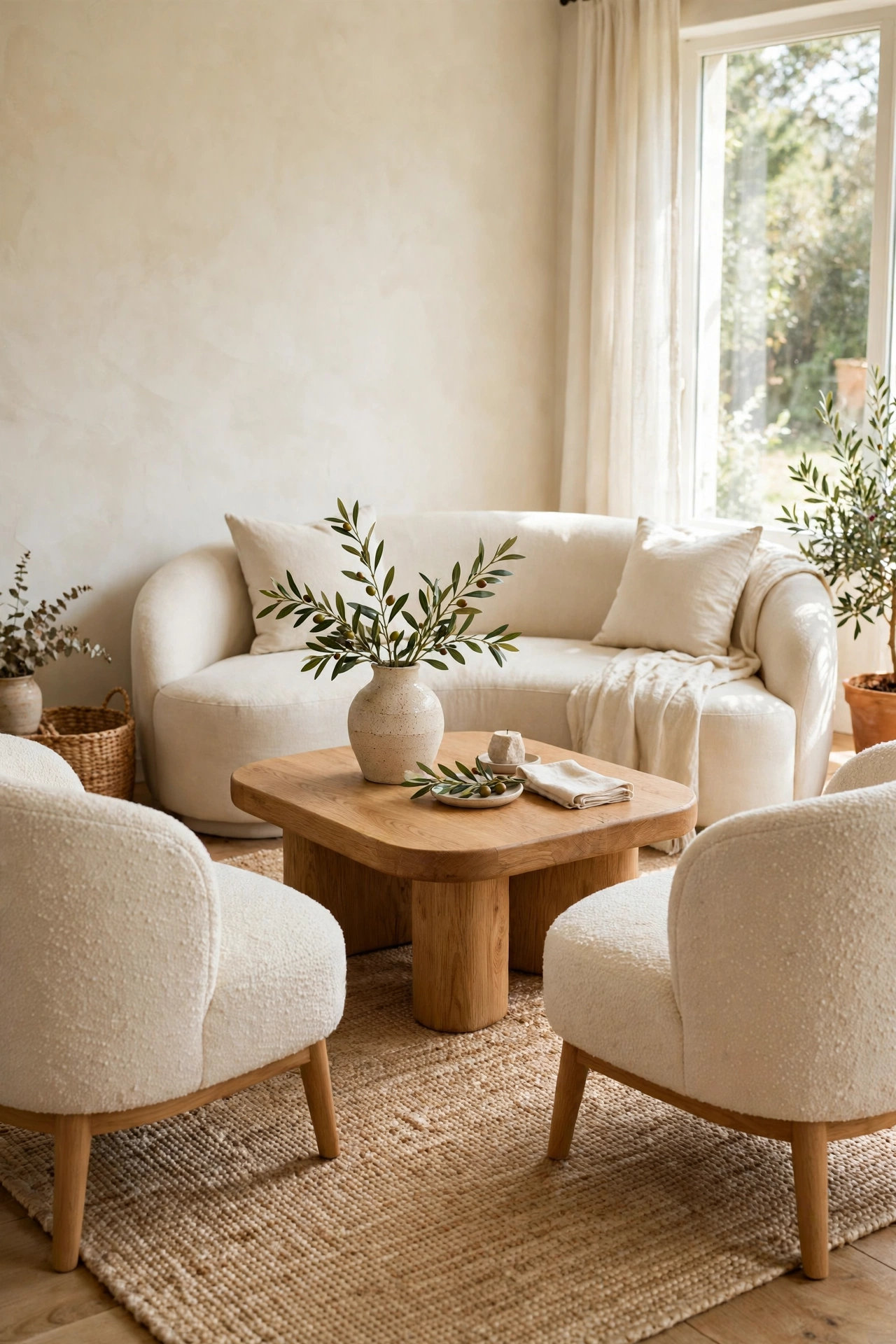
Accent chairs continue the curve story the sofa began. Rounded backs, barrel shapes, or wishbone frames in natural materials keep every seat in the room speaking the same soft language. Boucle in warm cream or a cane and oak frame are the two classic organic choices.
How to do it: Choose two chairs with visible curve, in boucle, linen, or cane with oak. Angle them toward the sofa, not in a row. Keep their height near the sofa’s, so the seating horizon stays level and calm. Pro Tip: Mix one boucle chair and one cane chair in the same tones for a collected natural feel, as long as both are curved. Common mistake: Dining chairs drafted in as accent chairs. Their straight backs and hard seats read as temporary, and the room feels unfinished.
9. Style With Handmade Ceramics in Uneven Groups
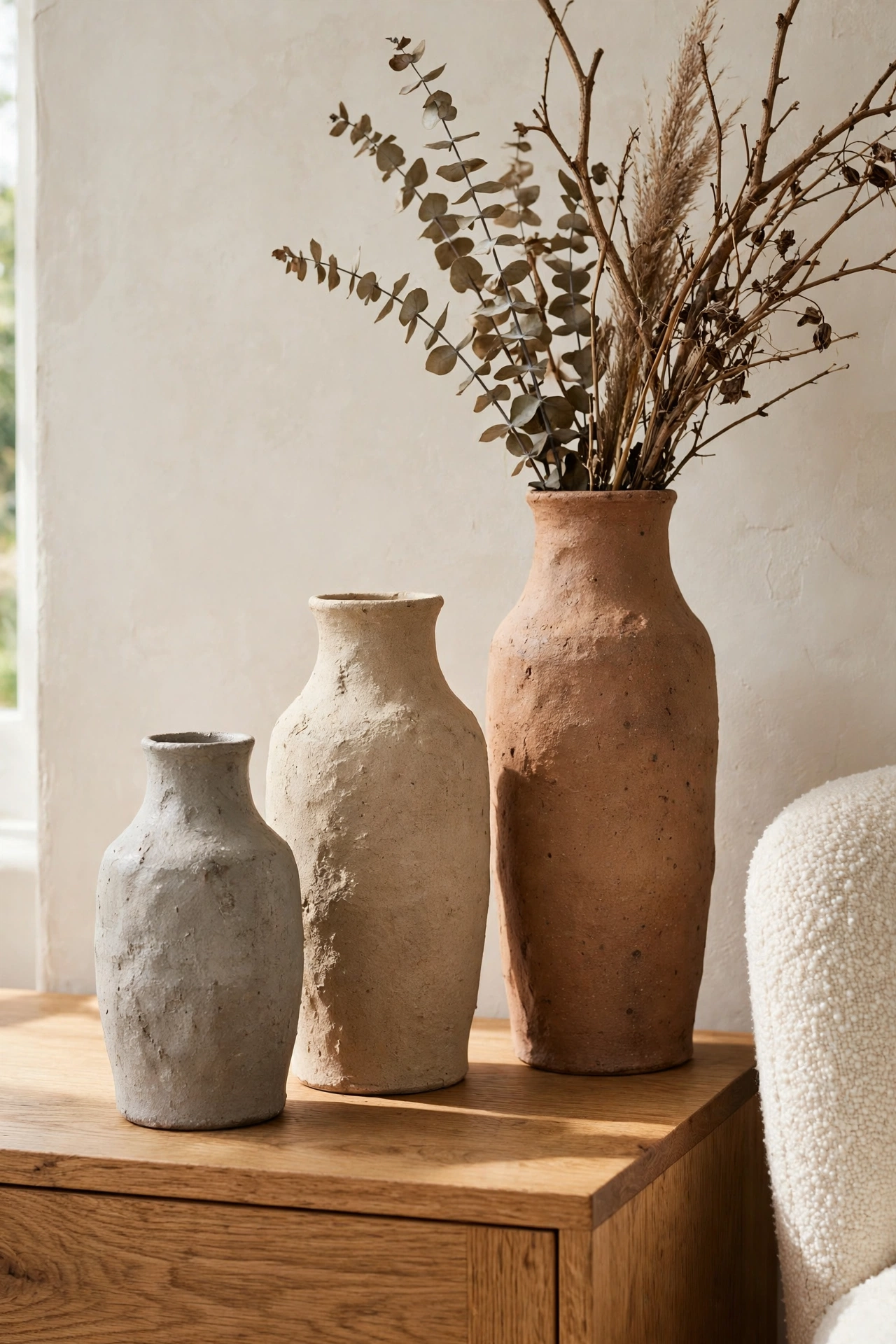
Handmade ceramics carry the fingerprints of their making, slight unevenness, glaze that pools and thins, shapes that are almost round. That almost is the soul of organic style. Grouped in threes at different heights, they decorate without a single manufactured object in sight.
How to do it: Collect vases and bowls in stone, sand, and clay tones, matte or eggshell glaze only. Group three on the sideboard or coffee table, tall, medium, small, with space between them. Leave some empty, one can hold branches. Pro Tip: Buy ceramics one at a time from makers when you travel. A shelf of remembered pieces beats a matched set in every way that matters. Common mistake: Glossy white matching vase sets. Uniform and shiny is the factory look this style avoids.
10. Bring in One Piece of Real Stone
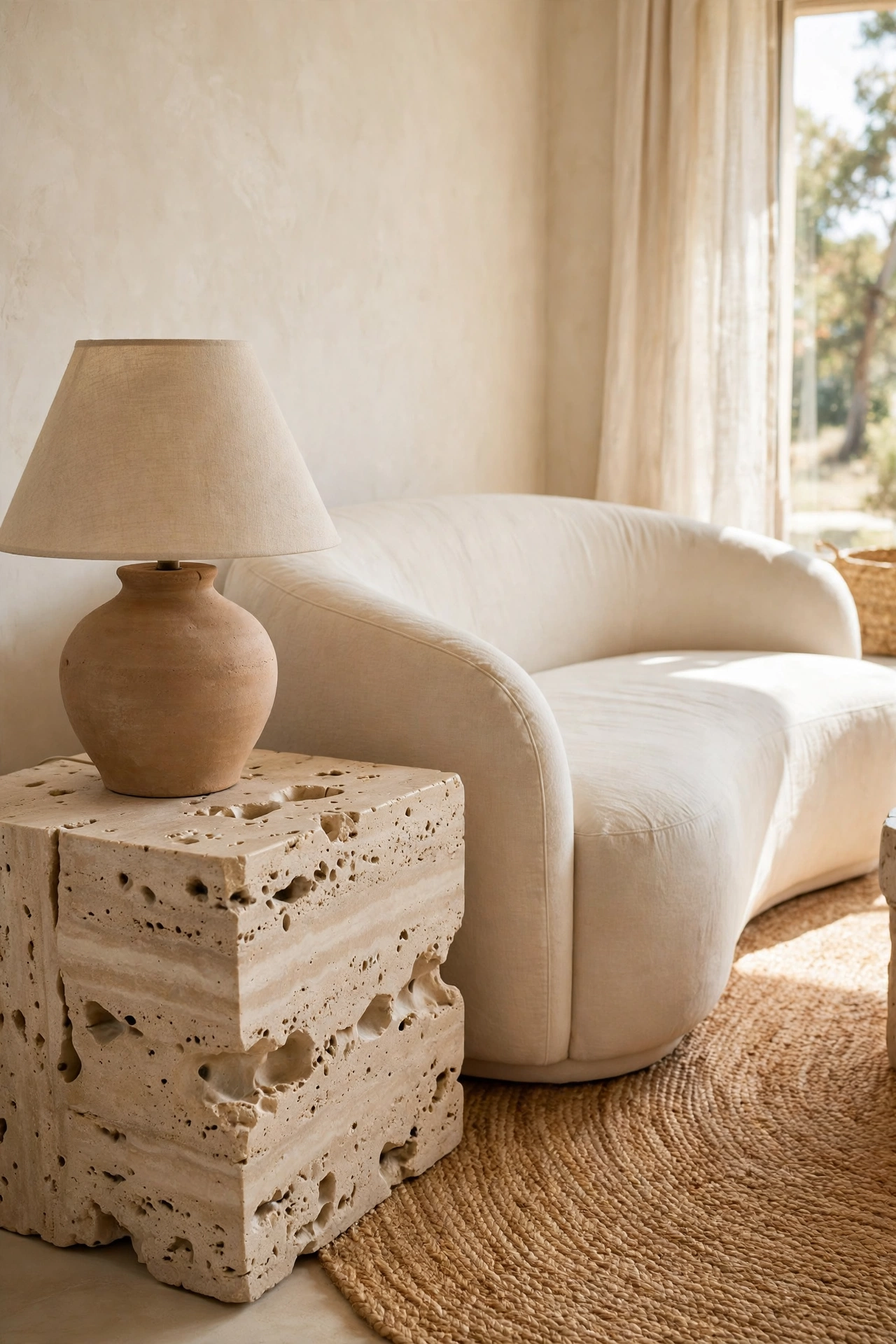
Stone is the cool weight that balances wood’s warmth. Travertine, with its pits and cloudy bands, is the organic favourite, appearing as a side table, a plinth, or a heavy tray. One stone piece is enough, its job is contrast, not coverage.
How to do it: Place a travertine or limestone side table beside the sofa or one chair. Keep its surface nearly bare, a lamp or a book only. Let people touch it, stone that is never touched might as well be a photograph. Pro Tip: Check second hand and stone yard offcuts for travertine. The material ages beautifully, and old stone suits this style better than new. Common mistake: Marble with bold glossy veins. It belongs to glam rooms, and its shine pulls the whole palette toward luxury and away from earth.
11. Dress the Windows in Natural Flax Linen
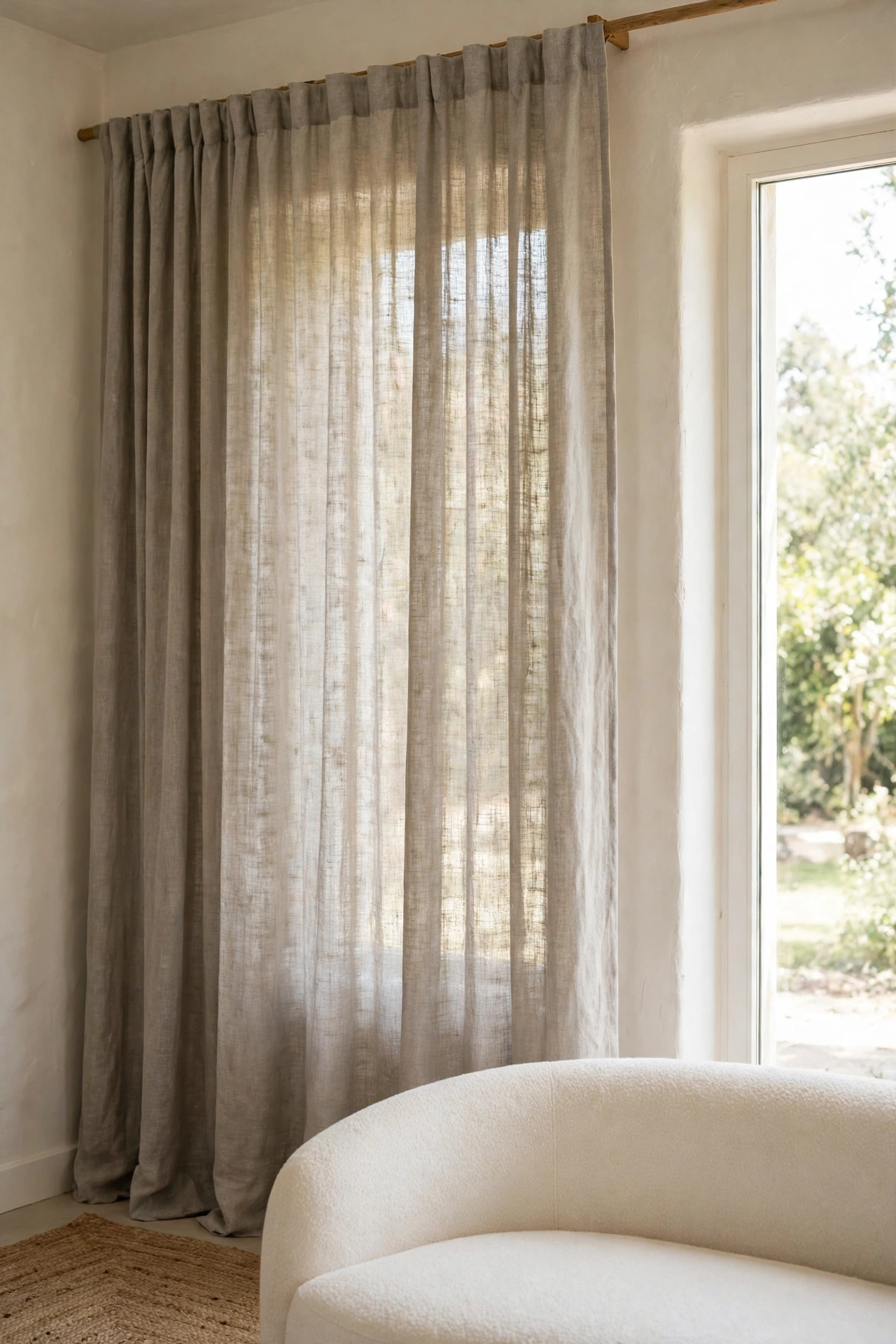
Curtains in this room should look like they were cut from the same cloth family as the sofa, literally. Undyed flax linen, with its slubs and slight irregularity, filters daylight into the soft glow organic rooms run on, and its natural beige grey tone bridges the warm whites and the woods.
How to do it: Hang full length panels from near the ceiling, in natural flax or warm white linen with visible weave. Let them hang straight and heavy, no tiebacks, no sheen. Keep rods wood or matte black and simple. Pro Tip: Buy one extra panel for fullness. Organic curtains look best slightly overfilled, falling in deep soft folds. Common mistake: Shiny synthetic curtains. The sheen reads as plastic at window light, the worst place in the room to fake a material.
12. Weave in One Rattan or Cane Piece
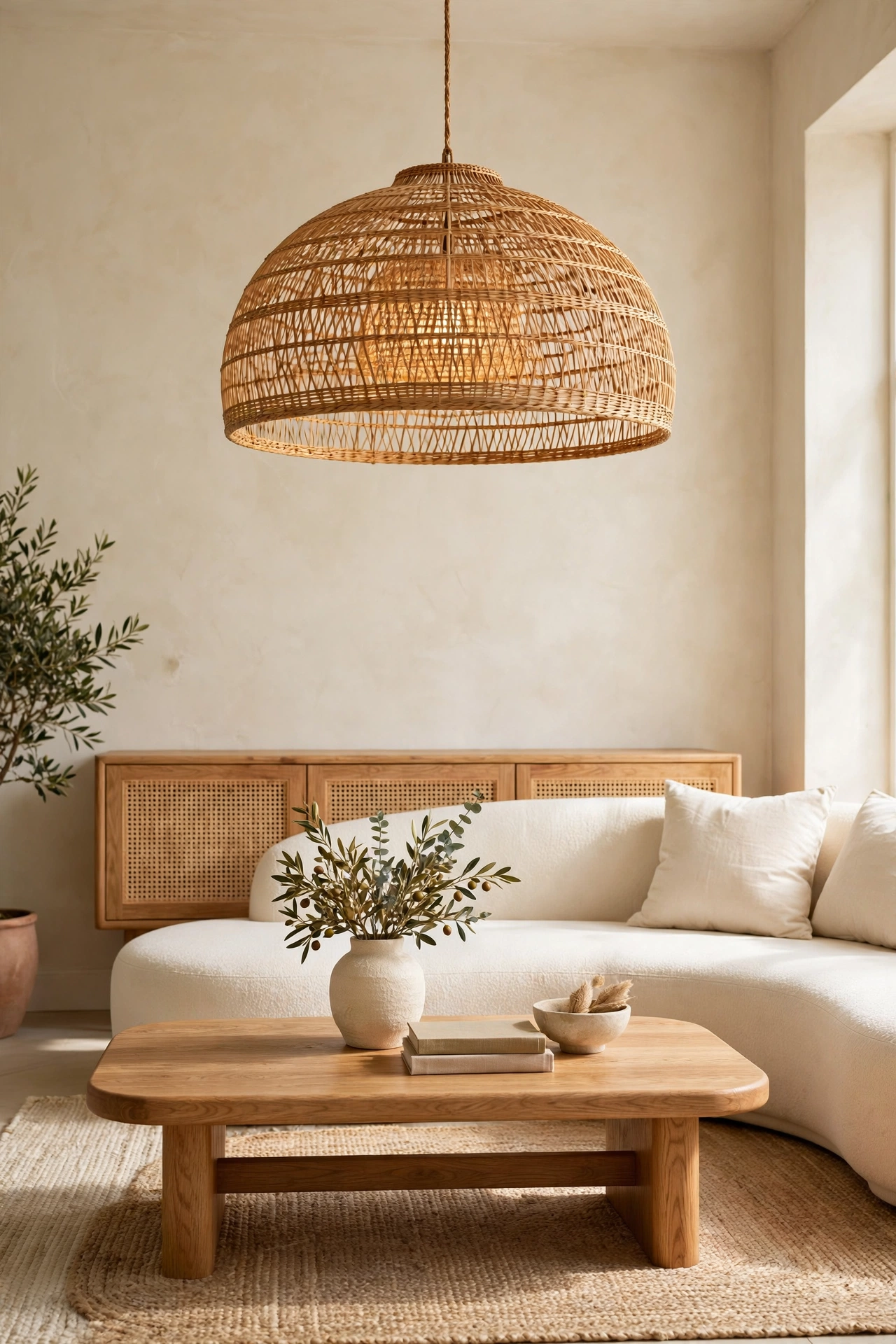
Woven materials bring pattern that nature wrote, cane webbing, rattan, seagrass, each a small geometry of plant fibre. One woven piece adds air and detail without colour, keeping the palette intact while the eye gets something fine to rest on.
How to do it: Choose one woven hero, a rattan pendant over the coffee table zone, a cane front console, or a seagrass basket set. Keep it natural honey tone, never painted white or black. Repeat the material only in one small echo, like a tray. Pro Tip: Woven shades and pendants throw beautiful patterned light in the evening, texture you get twice. Common mistake: Rattan everywhere. A room full of weave turns beach house, and the elegant half of modern organic leaves.
13. Layer Throws and Cushions in Natural Fibres Only
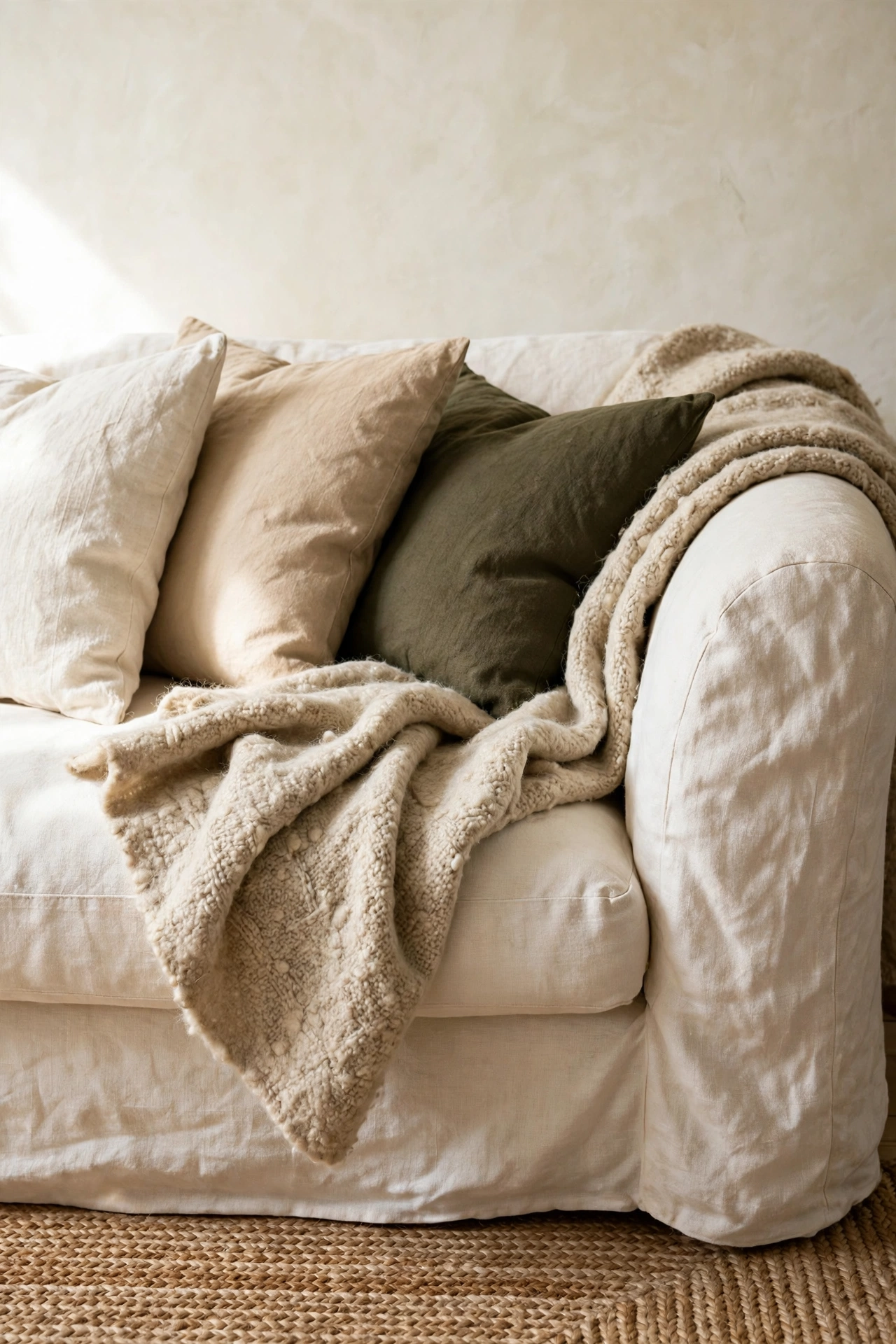
Soft layers are where the room’s tonal palette gets to play. Linen, cotton, and wool in cream, sand, clay, and olive, mixed by texture more than by colour, give the sofa its relaxed finished look. Every fibre here should be one a sheep or a plant produced.
How to do it: Use three cushions and one throw per seating group, odd numbers, mixed sizes. Keep colours within two steps of the sofa tone, with olive as the deepest note. Fold throws loosely over an arm, never draped in stiff symmetry. Pro Tip: The slub test, run the fabric between finger and thumb. Natural fibres feel slightly irregular, and that irregularity is the luxury here. Common mistake: Velvet or satin cushions. Their sheen belongs to glam style and fights the matte earth of this room.
14. Keep the Palette Tonal and Close
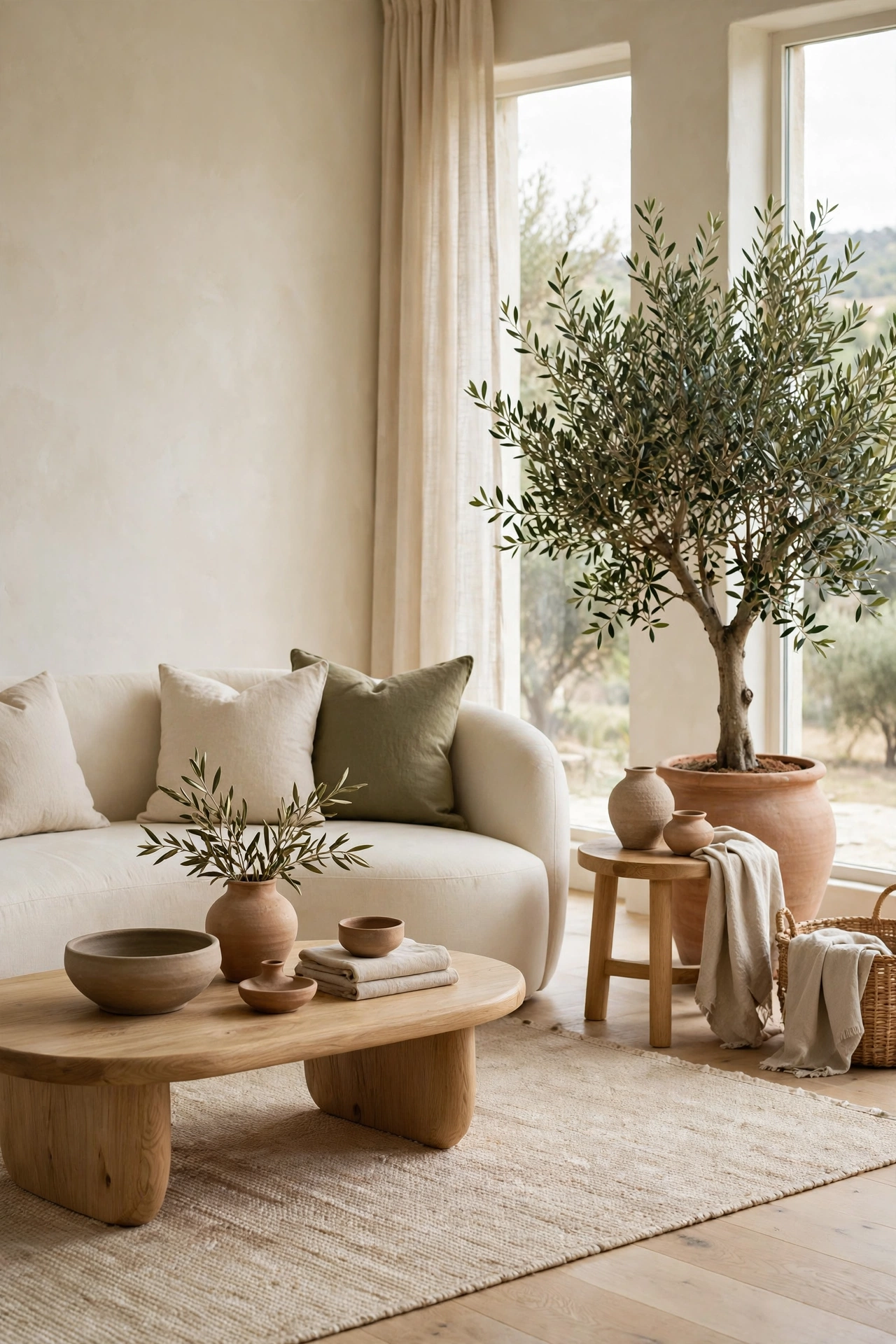
The elegance of modern organic is a discipline of closeness. Cream sits beside sand, sand beside clay, clay beside olive, no step larger than a whisper. That nearness is what makes the room feel expensive and calm at once, like a landscape in soft light where nothing jars.
How to do it: Lay every new purchase against the sofa fabric before buying. If it sits within two tones of something already in the room, it may enter. Ban pure white, pure black, and any colour with a name from a paint chart’s bright page. Pro Tip: Photograph the room and turn the photo to black and white. If the tones still separate gently, the palette is right. Common mistake: One statement colour, a rust sofa or teal chairs. The room stops being a landscape and becomes a colour scheme.
15. Choose a Low Natural Console for the Media Wall
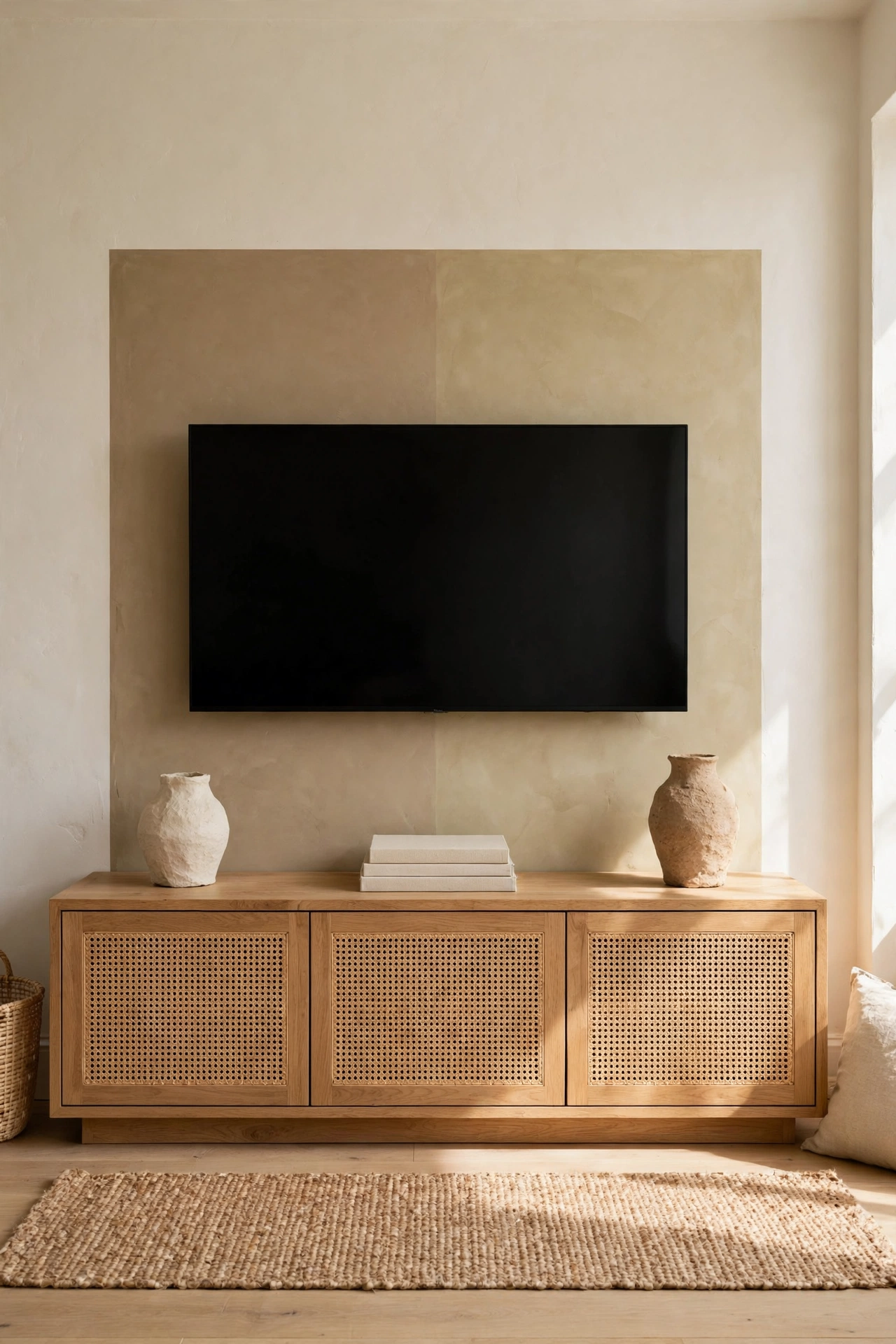
The television wall is where organic rooms usually surrender, all black glass and plastic boxes. A low console in natural oak with cane or slatted doors keeps the wall inside the style, hiding equipment behind woven texture while the screen floats above like a dark window when off.
How to do it: Pick the longest low console the wall allows, in oak with cane fronts and no visible handles. Keep its top styled with ceramics and one stack of art books, the same language as the rest of the room. Route every cable out of sight. Pro Tip: Paint the wall section behind the screen a half tone deeper than the rest. The screen blends in by day instead of floating as a black hole. Common mistake: A tall entertainment unit. Height and bulk fight the low horizon the whole room was built on.
16. Style With Branches Instead of Flowers
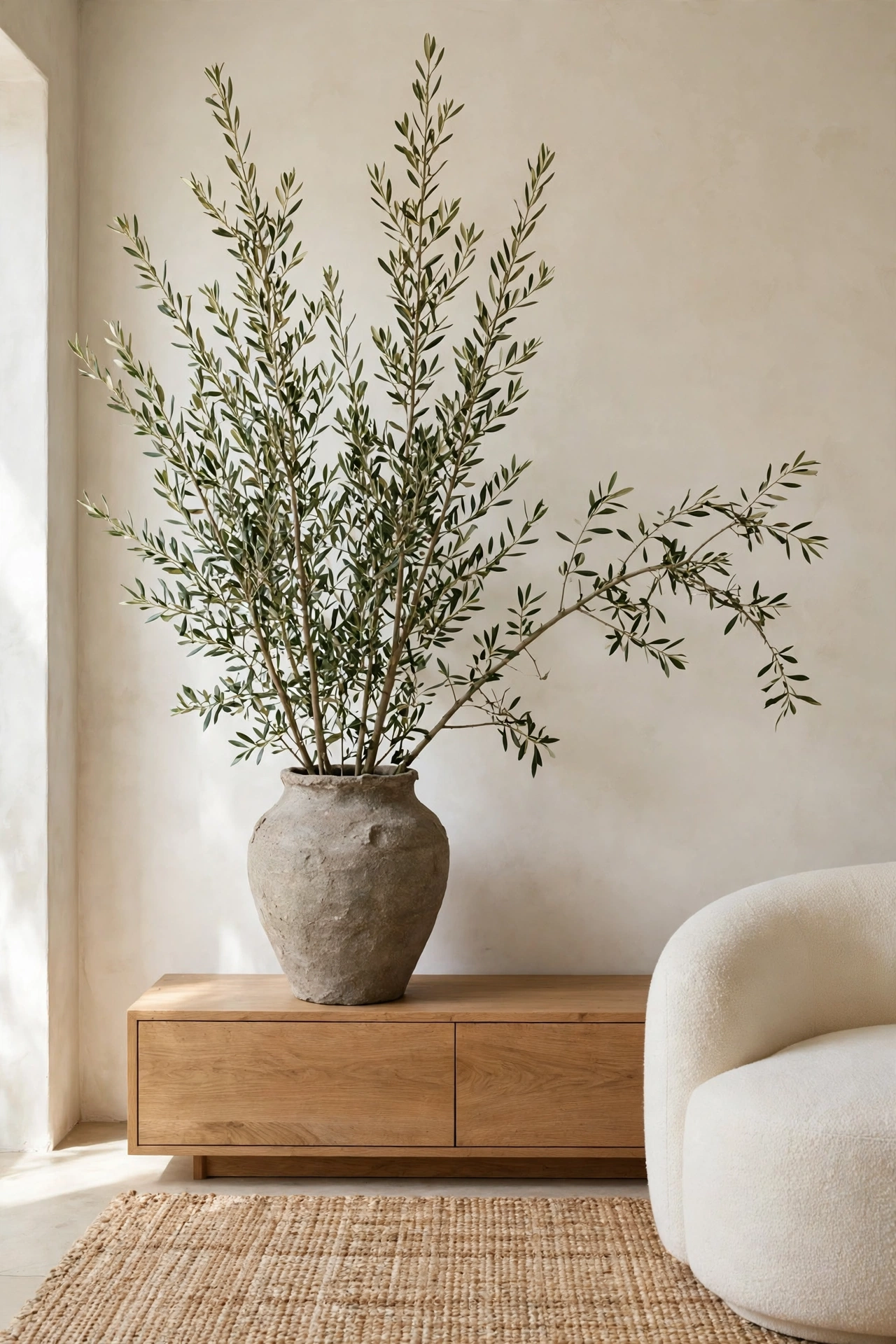
Branches are this style’s bouquet, sculptural, long lasting, and honest about the season. Olive, eucalyptus, or bare architectural branches in a large handmade vase give the room height and movement without colour noise or weekly replacement.
How to do it: Choose one tall vase and branches at least twice its height. Place the arrangement where it can silhouette against a plain wall or window. Change branches with the seasons, blossom in spring, olive in summer, bare in winter. Pro Tip: Cut branches a little wild, with one wayward stem left in. Perfect symmetry is for hotels. Common mistake: Bright flower bouquets. Their colours are a small festival the tonal room did not invite.
17. Light the Room With Organic Shapes
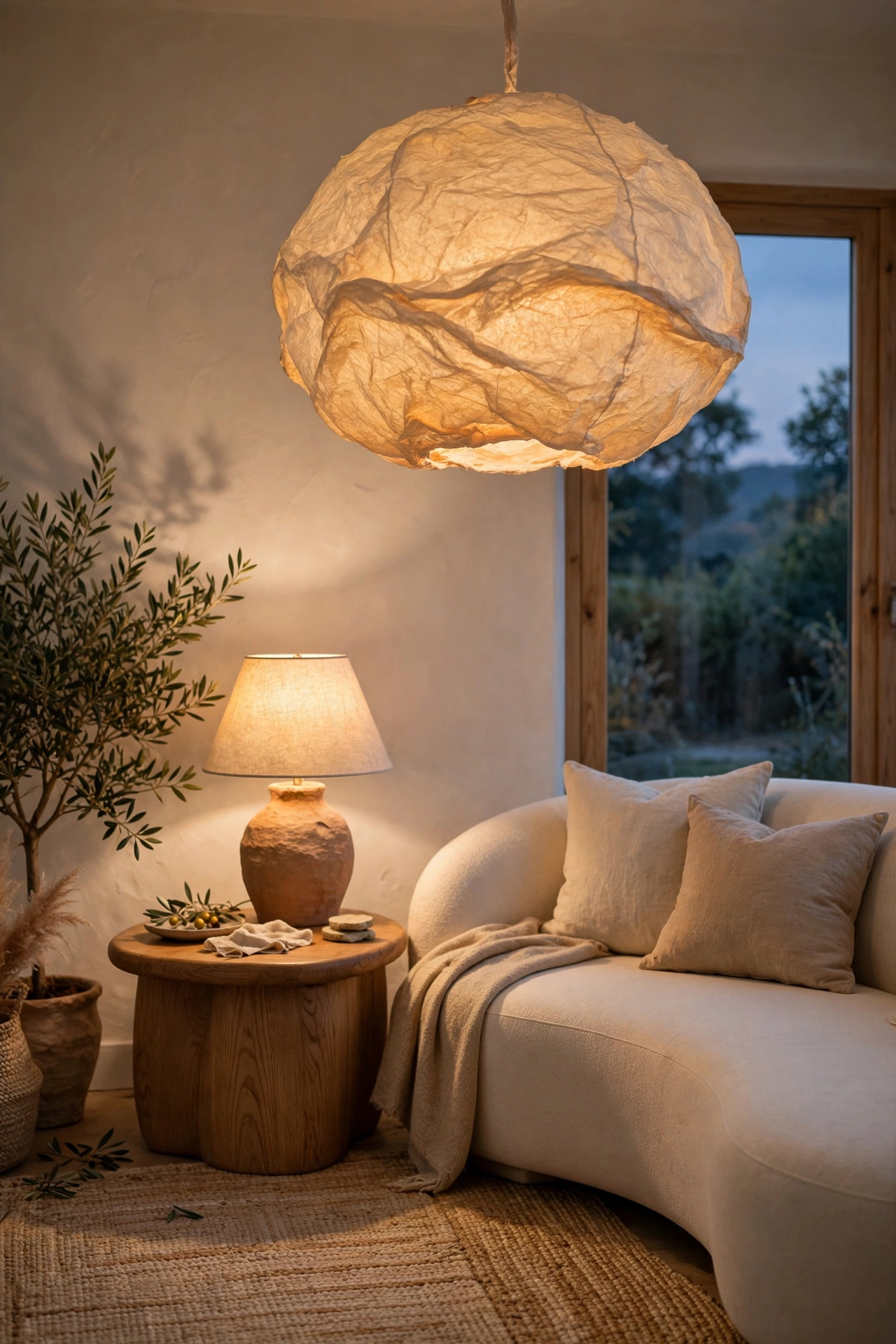
Light fixtures are sculptures in this room, and their shapes follow the same law as the furniture, curved, soft, and made of honest material. Woven pendants, paper globes, clay lamps, and linen shades turn evening light warm and keep the ceiling inside the design.
How to do it: Choose one large soft pendant or woven shade as the ceiling’s single statement. Add a clay or stone table lamp and one floor lamp with a linen shade for the lower layers. Keep every bulb warm and matched in tone. Pro Tip: Put the pendant lower than instinct suggests, over the coffee table zone. Organic rooms gather around low warm light. Common mistake: Chrome or crystal fixtures. Both are glam materials, and one can undo a whole room of matte earth.
18. Mix Rough and Smooth Textures on Purpose
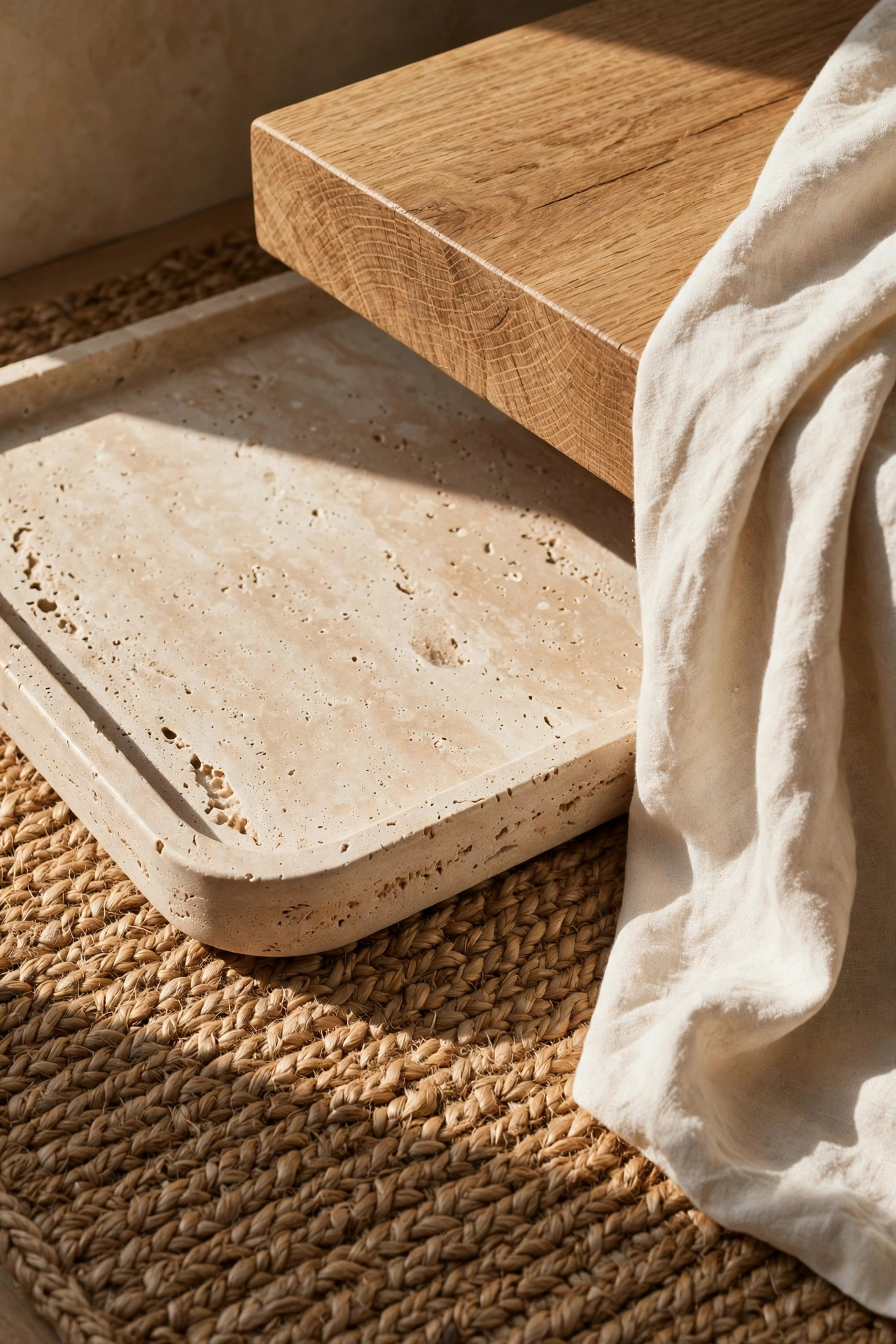
Left alone, an organic room can go all rough and read as rustic. The elegant half of the style comes from contrast, rough jute against smooth stone, open oak grain beside fine linen, matte clay next to polished cotton. The hand should meet a new feeling at every surface.
How to do it: Audit the room by touch, listing each surface as rough or smooth, and balance the count. Add smooth where everything is woven, a stone tray on a jute rug, and rough where everything is flat, a woven basket beside a smooth console. Keep colour constant while texture varies. Pro Tip: Texture is the pattern of this style. If a corner feels dull, it almost always needs a new texture, not a new colour. Common mistake: All soft everything, boucle on boucle with plush rugs. Without one hard note, the room turns to porridge.
19. Add One Curved Floor Lamp
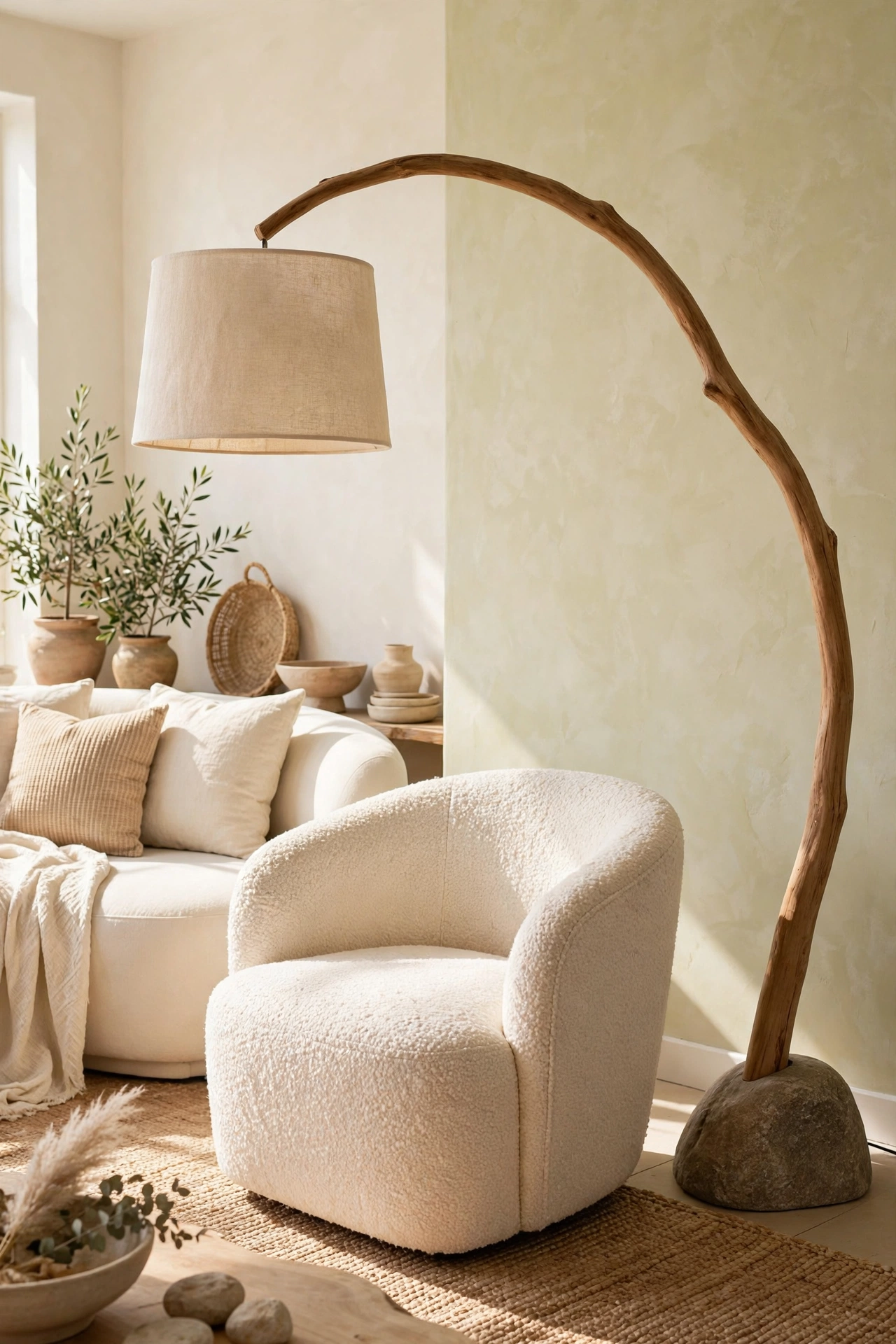
A curved floor lamp completes the room’s arch language and solves a real problem, light that reaches the reading chair without another table. In wood, rattan, or matte stone finishes, the arc becomes a piece of the landscape, like a branch leaning over the seat.
How to do it: Place the arc so its shade hangs over the chair’s shoulder, at seated head height. Choose a base heavy in stone or wood, and a shade in linen or woven fibre. Keep its curve echoing the sofa and chairs, not competing with them. Pro Tip: Test the swing of the arc against the walkway. A beautiful lamp in a walking path becomes an enemy within a week. Common mistake: A chrome arc lamp. The shape is right and the material is wrong, and in this style the material always wins.
20. Decorate in Odd Groups and Leave Air Between
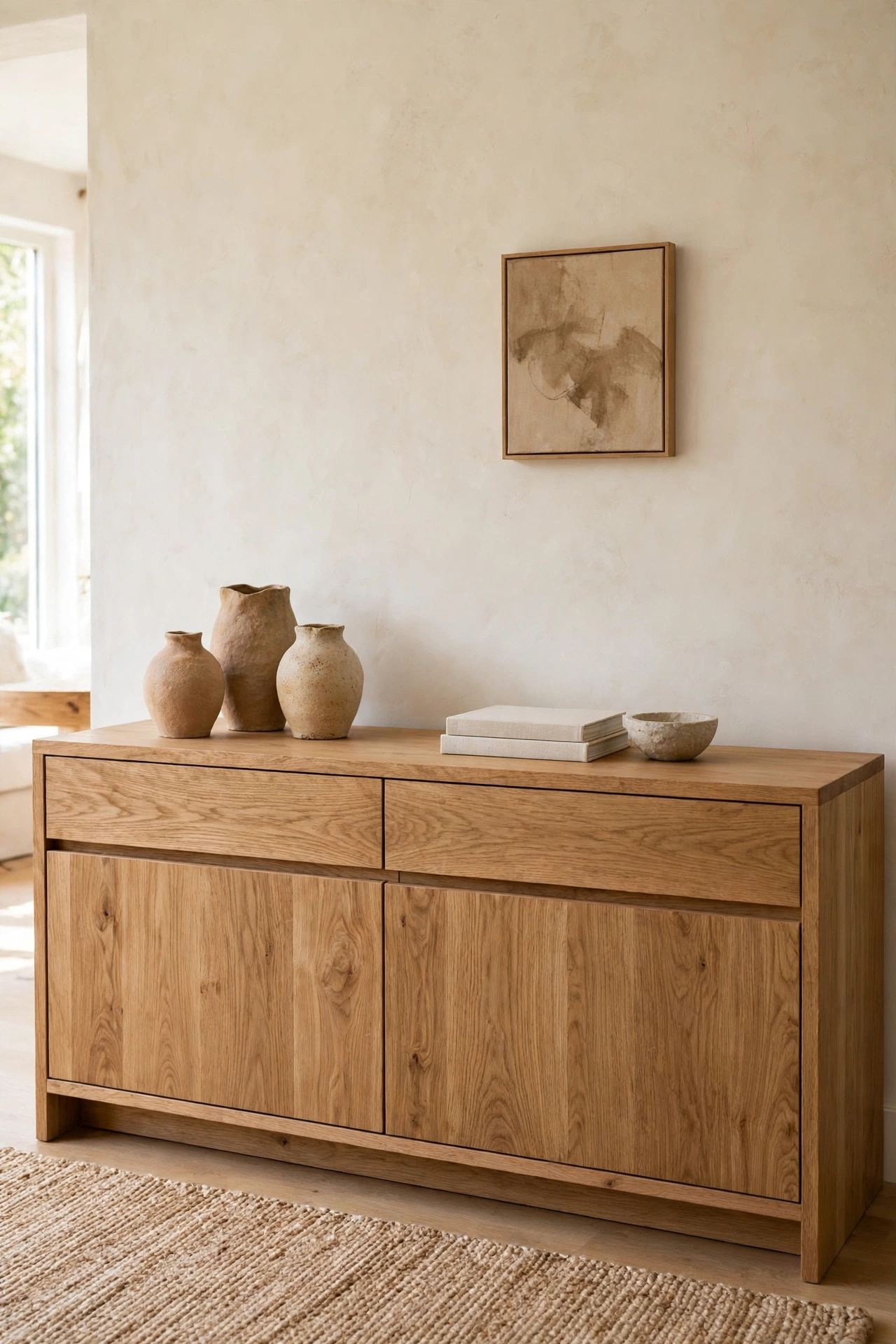
Organic styling breathes. Objects gather in odd numbered groups with visible air around them, the way stones sit in a stream, close but never crowded. The empty space is not leftover, it is the ingredient that makes the groups look chosen.
How to do it: Style each surface in groups of three or five, then remove one object from every group and see if it improves. It usually does. Keep a third of every shelf and tabletop empty by rule. Pro Tip: The doorway test again, if the room reads calm in a two second glance, the spacing is right. Clutter announces itself instantly. Common mistake: Lining objects in even rows along every surface. Rows belong to shops, groups belong to homes.
21. Finish With the Nature Check
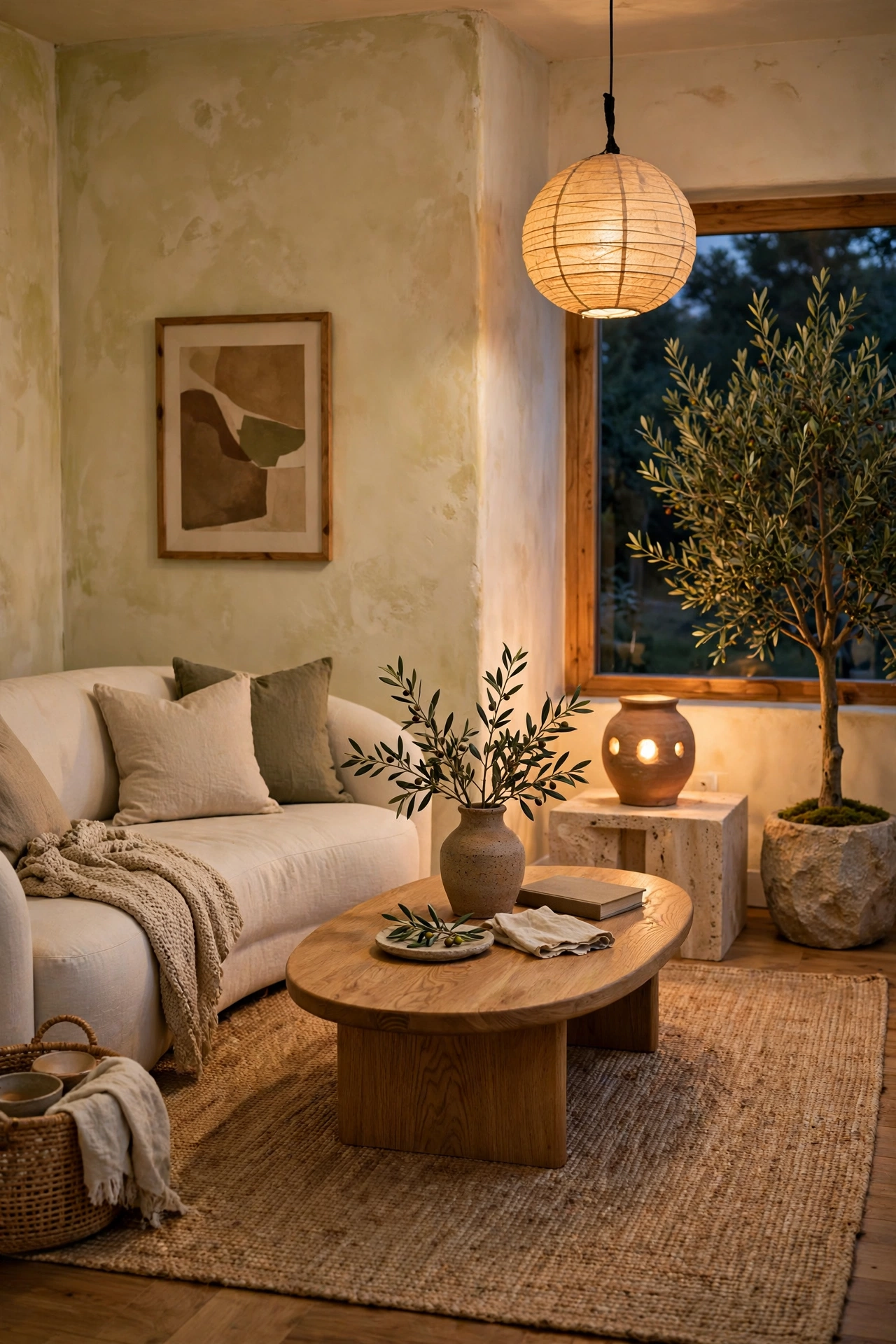
The final idea is a test, not a purchase. Walk the finished room slowly and name the material of everything you touch. Wood, stone, linen, wool, clay, cane, plant. If any answer comes back plastic, glass, or chrome, that piece is a guest in the wrong house, and the room will feel it before you can explain it.
How to do it: Do the walk at evening light, when the room is most itself. Note the two or three pieces that fail the test and replace them over time, not in a panic. Accept patina as it comes, oak darkening, linen softening, stone marking slightly. Pro Tip: Keep one honest imperfection visible, a handmade bowl slightly lopsided, a branch slightly wild. Perfection is manufactured, calm is grown. Common mistake: Chasing the finished photograph forever. This room is meant to age with you, and its second year should look better than its first.
Quick Reference Table
| Room Element | The Organic Choice | Why It Works |
|---|---|---|
| Walls | Warm white limewash | Textured calm behind natural materials |
| Sofa | Low curved linen | The room’s main curve, soft and grounded |
| Coffee table | Solid oak, organic shape | Grain as decoration, no hard angles |
| Rug | Jute or undyed wool | Woven texture under the seating island |
| Plant | One olive tree | Living height in a stone pot |
| Art | Oversized earth pigments | Landscape tones, one quiet focus |
| Deep note | One walnut piece | Shadow that makes pale wood glow |
| Chairs | Curved boucle or cane | Curves continue the sofa’s language |
| Decor | Handmade ceramics | Slight unevenness, human touch |
| Stone | One travertine piece | Cool weight against warm wood |
| Curtains | Natural flax linen | Daylight filtered through real fibre |
| Weave | One rattan or cane hero | Nature’s pattern, air and detail |
| Soft layers | Natural fibre throws | Tonal colours, honest textures |
| Palette | Cream, sand, clay, olive | Close tones, nothing jars |
| Media wall | Low oak cane console | Equipment hidden behind weave |
| Arrangement | Branches in a tall vase | Sculpture that follows the season |
| Lighting | Paper, clay, woven shapes | Warm light inside soft forms |
| Texture plan | Rough balanced with smooth | Contrast keeps organic elegant |
| Floor lamp | One curved arc | Light that leans like a branch |
| Styling | Odd groups with air | Chosen, never crowded |
| Final test | Name every material | Only earth answers allowed |
The Modern Organic Checklist
- Walls warm white with texture, no bright gloss anywhere
- Sofa low, curved, natural linen
- Coffee table solid oak with visible grain
- Rug natural fibre, sized to the whole seating group
- One living tree in a stone or clay pot
- One oversized art piece in earth tones
- Walnut present once, as the deep note
- Every seat curved, no straight backed strays
- Ceramics handmade, grouped in threes
- One real stone piece, touched daily
- Curtains natural flax or linen, full length
- One woven hero piece, no more
- Throws and cushions all natural fibre
- Palette steps never larger than two tones
- Media wall low, oak, equipment hidden
- Branches, not bouquets, in the tall vase
- Light fixtures curved and softly shaded
- Rough and smooth surfaces in balance
- Styling in odd groups with air around
- Evening nature check passed, plastic list made
Frequently Asked Questions
Is modern organic the same as Japandi?
They are close cousins. Both love natural materials, low furniture, and calm palettes. Modern organic is warmer and more curved, with more texture and earth pigment, clay, olive, stone, where Japandi is cooler, straighter, and more minimal. If a room feels like a warm landscape, it is organic. If it feels like a quiet temple, it is Japandi.
How do I keep a modern organic room from looking boring?
Texture and tone do the work that colour does in other styles. Mix rough and smooth surfaces, keep the palette close but not identical, curves against one or two straight lines, and one deep walnut note for shadow. A tonal room with rich texture is calm. A tonal room without texture is the boring one.
Can modern organic work with a television and family life?
Yes, and it may suit family life better than most styles. Natural fibres forgive wear, jute hides crumbs, linen covers wash, and stone and oak improve with marks. Use the low cane console to hide equipment, keep one lidded basket for daily clutter, and let the room age honestly instead of defending a showroom.
Conclusion
A modern organic living room is built from a short list of honest materials and one habit, testing every choice against nature. Warm textured walls, a curved linen sofa, solid oak, woven fibre, stone, clay, and one living tree, kept in close earth tones and lit softly, add up to a room that calms people the moment they sit down. Start with the walls and the sofa, add the wood and the tree, and let the room grow the way its materials did, slowly and well.