15 Living Room Corner Ideas to Transform Empty Spaces
15 Living Room Corner Ideas to Transform Empty Spaces
Every living room has one: the corner where two walls meet and nothing earns its place, too small for the sofa, too visible to ignore, often holding one sad plant or a stack of things waiting for a home. Stylists love these corners, because a corner is the only spot in the room that can hold a complete small scene without breaking the main furniture layout.
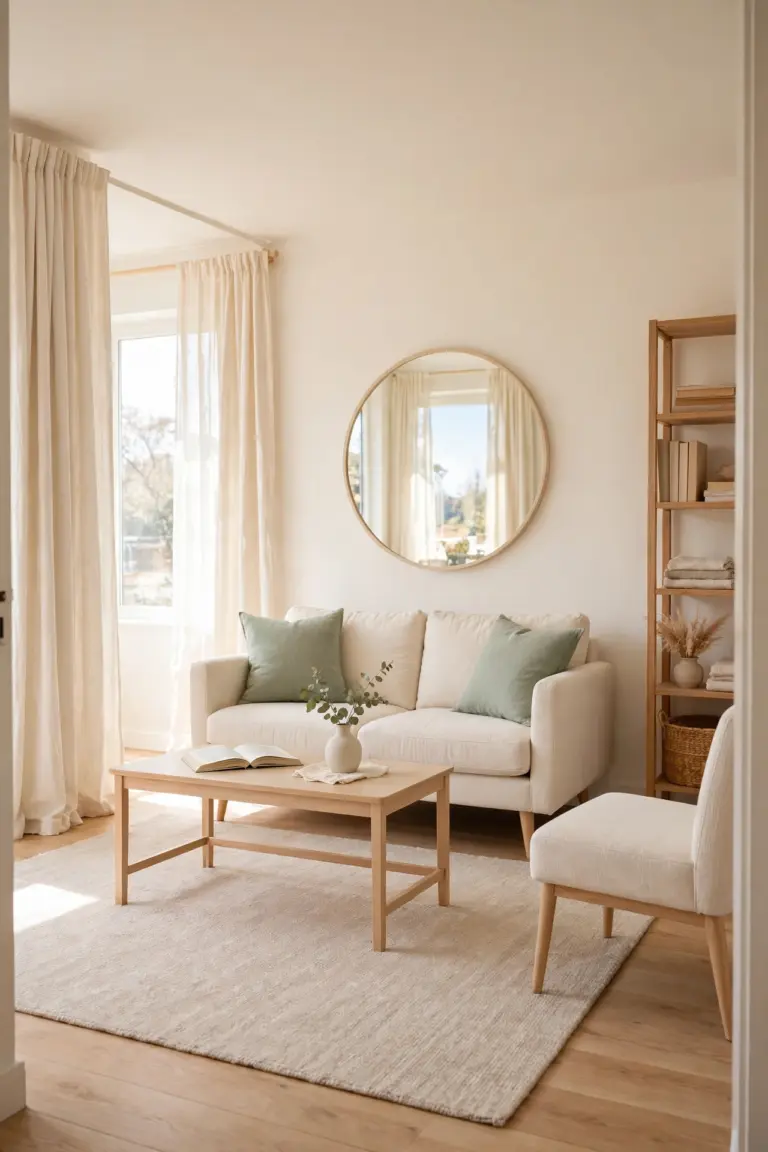
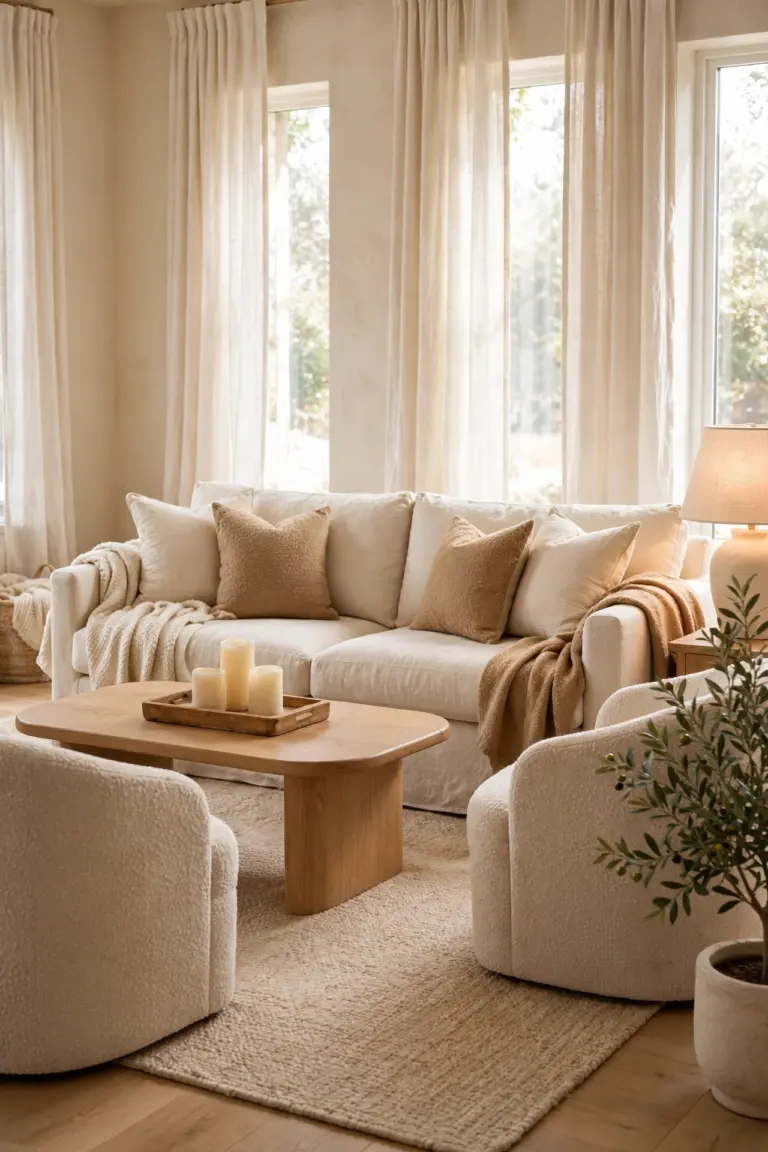
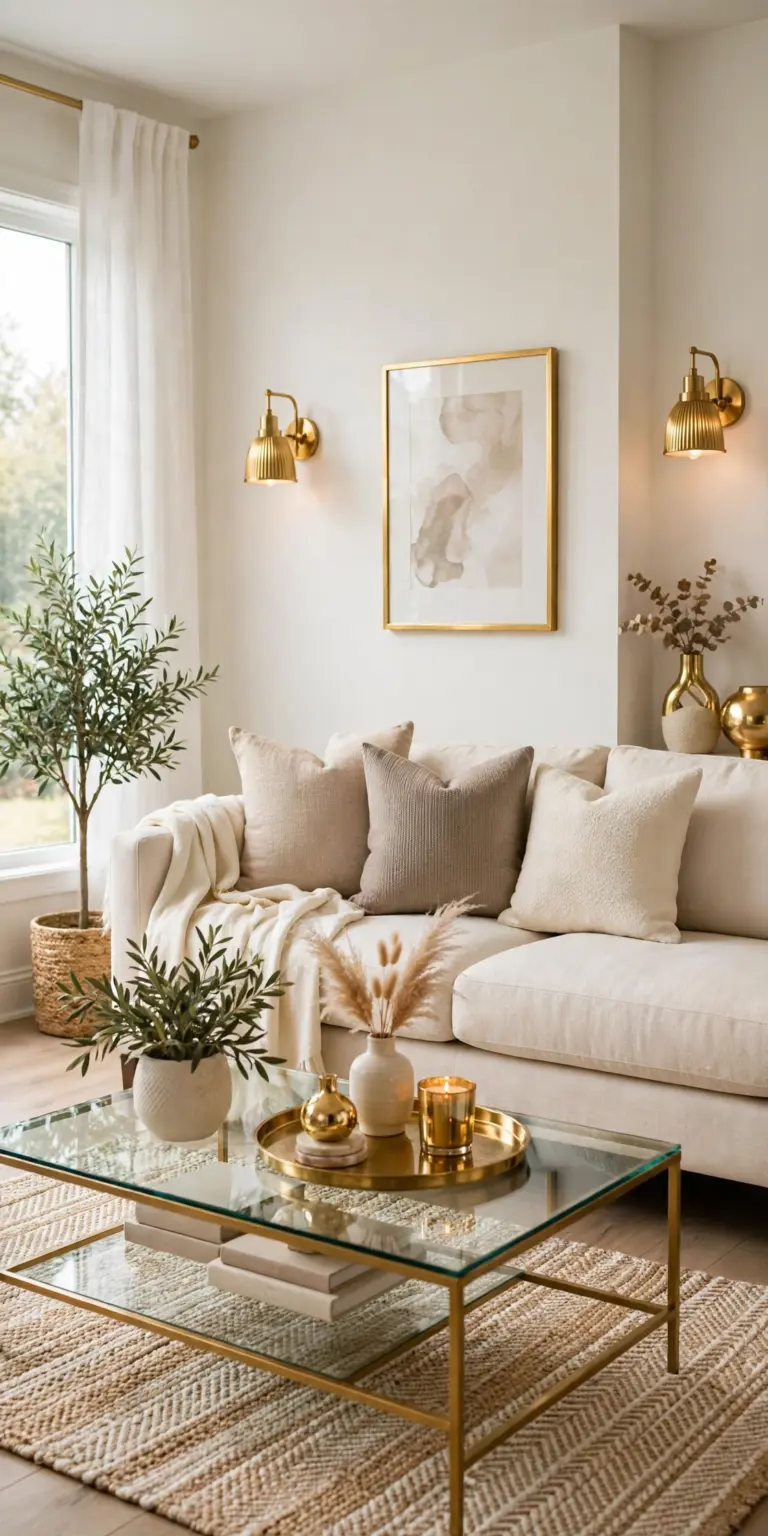
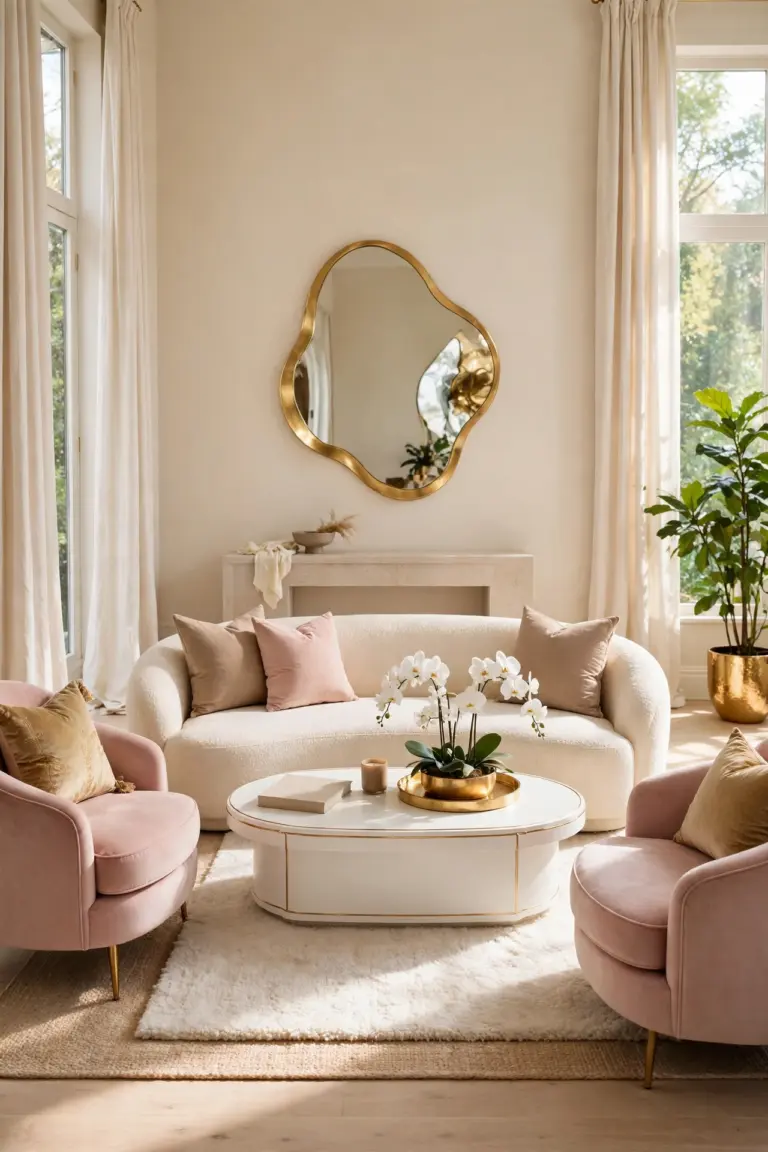
These fifteen living room corner ideas treat each corner as its own tiny room with one clear job: reading, plants, light, music, storage, rest. Every scene uses the same calm glam palette, white, cream, warm taupe, blush pink, and gold, with real room depth around it, so a corner never looks pasted onto the room. Pick the job your room is missing, and build that corner first.
1. Build a Reading Nook Around One Curved Chair
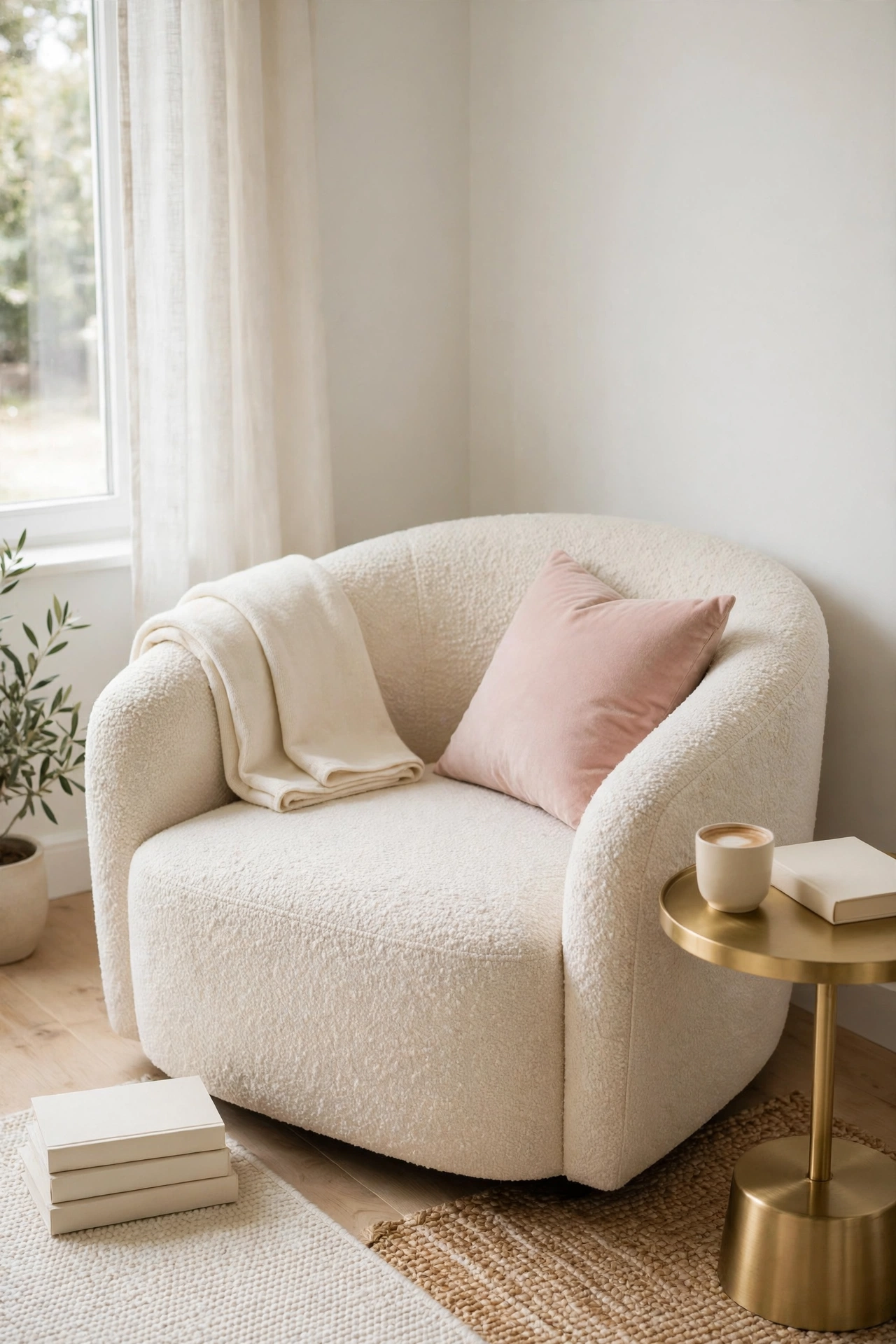
A reading corner works when the chair looks like it was placed for a person, not pushed against a wall. A curved boucle accent chair, angled across the corner at roughly forty five degrees, softens the hard right angle of the walls and turns a dead triangle of floor into the seat everyone quietly fights over. The curve matters: straight backed chairs read as waiting room furniture in a corner, while a rounded chair reads as an invitation.
Give the chair its own small world within arm’s reach: a round gold side table for a cup and the current book, a folded cream throw over one arm, and a short stack of books on the floor or the table to say this seat is used daily. Keep the palette tight, cream chair, blush or taupe cushion, gold table, so the corner photographs as one calm scene from the doorway.
How to do it: Angle the chair so its front legs sit on the rug or just at the rug’s edge, which ties the corner to the main seating instead of floating it. Leave a hand’s width of air between the chair back and both walls. Place the side table on the side away from passing traffic so drinks are never knocked. Pro Tip: A small round footstool in the same cream fabric doubles the comfort and, with a tray on top, becomes a second side table when guests come. Common mistake: Pushing the chair flat into the corner, knees to the wall. The angle is the whole idea, a flat chair in a corner looks stored, not styled.
2. Layer Plants at Three Heights
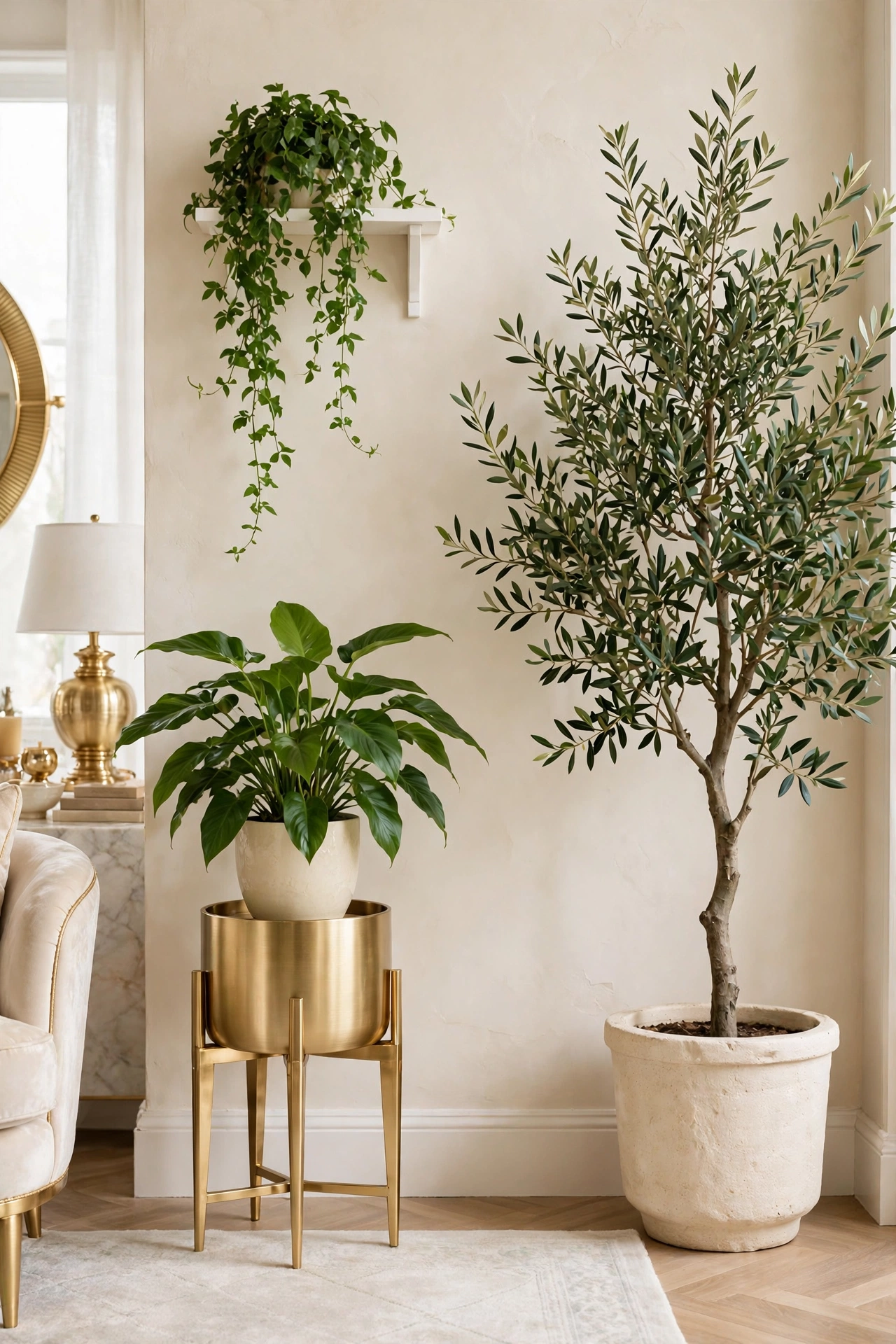
One plant alone in a corner always looks like it was put there to hide something. Three plants at three heights look like a garden the room grew on purpose: a tall olive tree or fiddle leaf on the floor, a medium plant lifted on a stand or a low stool, and a trailing plant falling from a wall shelf or the top of a bookcase. The eye travels up, across, and down, and the corner gains the depth it was missing.
Match the pots before you match the plants. Cream stone, warm terracotta washed pale, or brushed gold pots in one family make three different plants read as one collection, while three random plastic pots read as storage. Keep the tallest plant’s crown below the point where it starts eating the window light for the whole room.
How to do it: Start with the tall plant and place it where its shadow will not darken the nearest seat. Add the middle plant on a stand so its leaves sit near the tall plant’s bare trunk zone, the emptiest band. Finish with the trailing plant high on the short wall, its stems falling into the gap between the other two. Pro Tip: Group plants with the same water needs in the same corner, so the corner is one watering stop and no plant quietly dies behind the tall one. Common mistake: Three plants of the same height and size in a row. That is a garden centre shelf, and it flattens the corner it was meant to deepen.
3. Let an Arched Floor Lamp Own the Corner
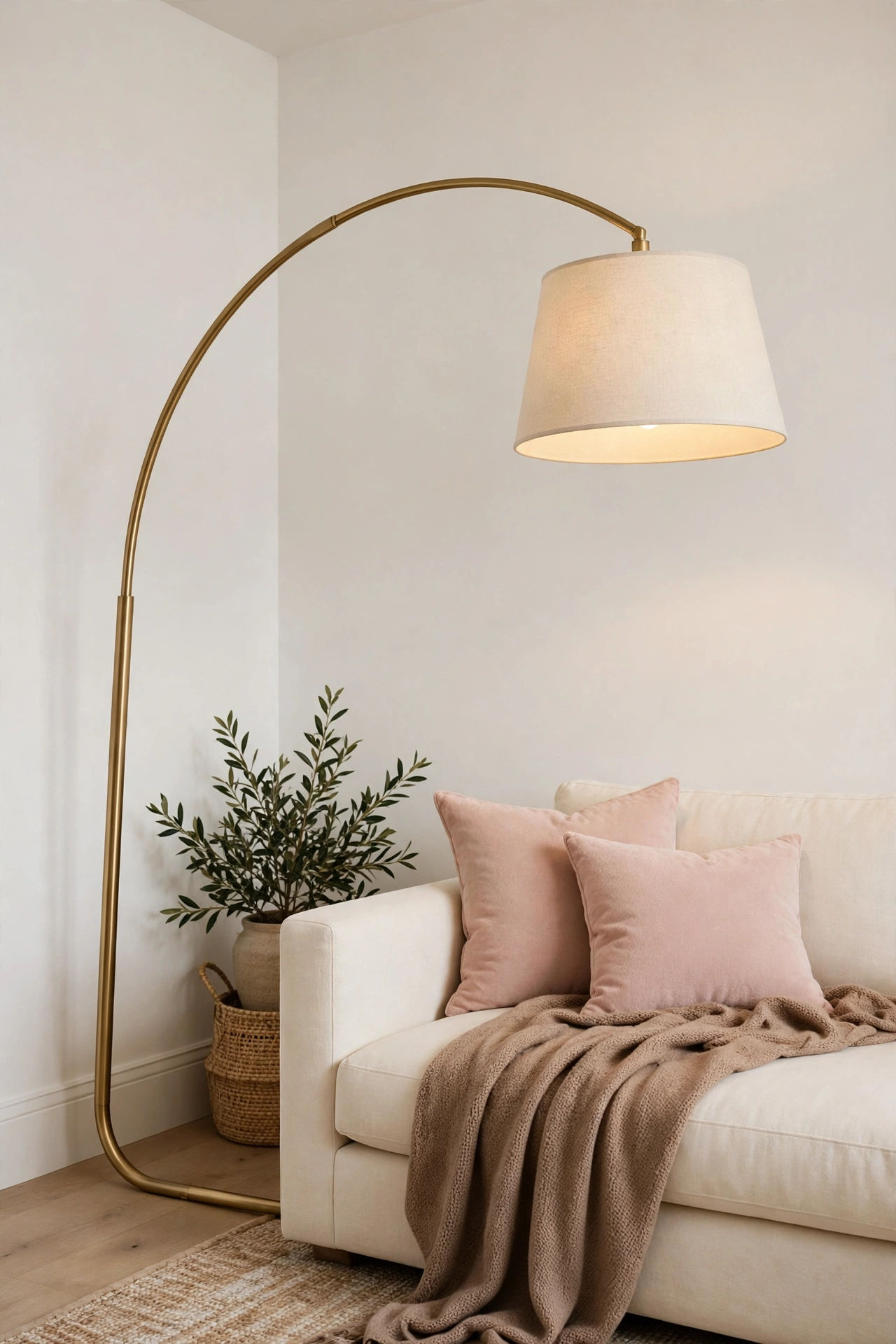
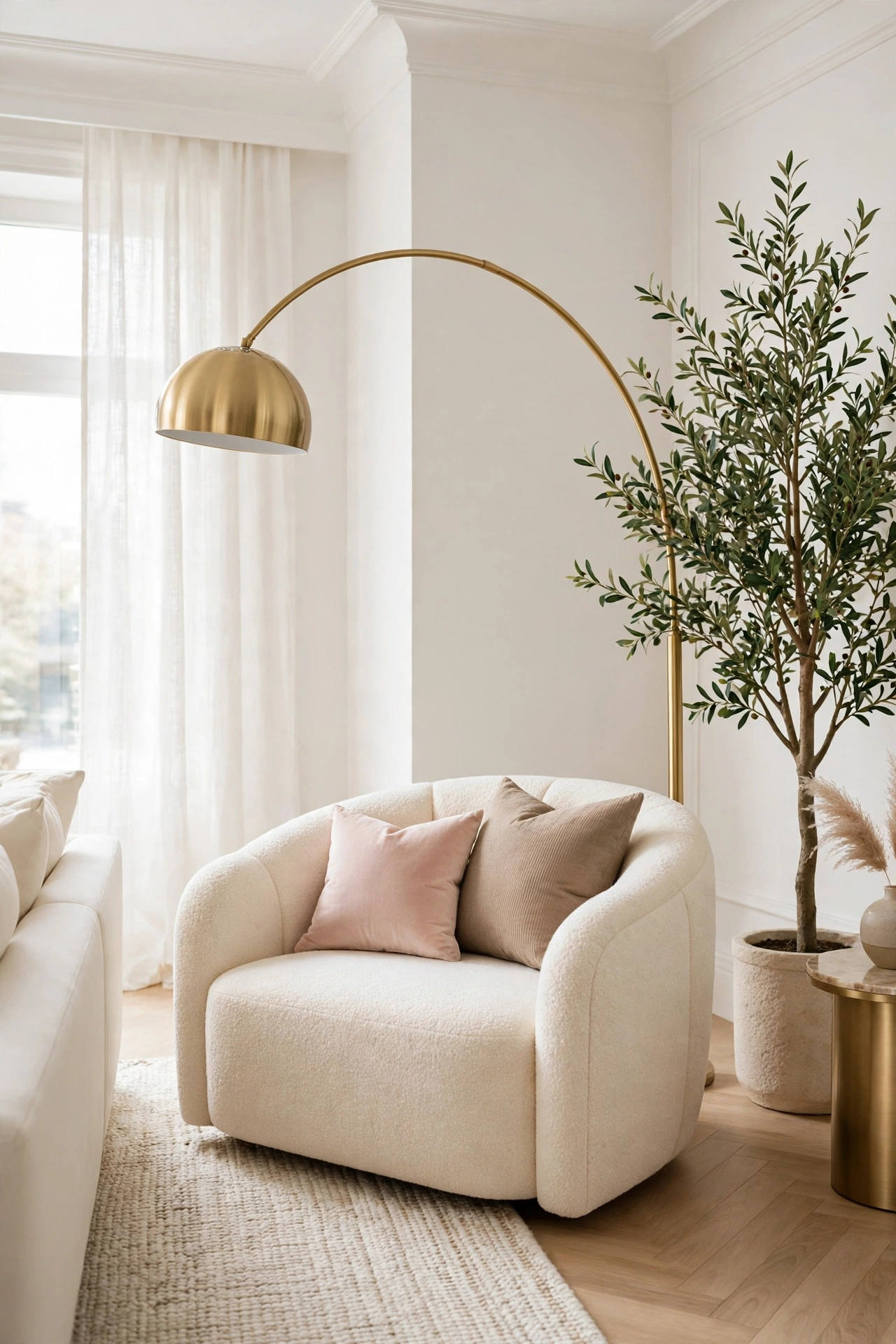
Some corners do not need furniture at all, they need light with a shape. An arched floor lamp, its base standing in the corner and its curve reaching over the end of the sofa or the reading chair, fills the empty vertical space and delivers light exactly where people sit. It solves two problems in one object: the dark corner and the bare wall above the sofa.
Choose the finish from the room, brushed gold for this glam palette, and a shade in cream linen or white glass so the light stays warm and soft. Scale decides success here: the arch must clear the sofa arm and hang its shade roughly above the seat cushion’s edge, close enough to read by, high enough that nobody’s head finds it when they stand up.
How to do it: Slide the base fully into the corner and turn the arch until the shade centres over the seat it serves, then check the line from the doorway, the curve should read as one clean sweep. Put the cord along the skirting and behind the sofa leg so no cable crosses the floor. Use a warm bulb, never a cold white one, which would fight the cream and blush palette. Pro Tip: A lamp on a dimmer turns the corner into the room’s evening setting, one low glow that makes gold finishes and candlelight look richer. Common mistake: A straight floor lamp planted in the corner shining at the ceiling. It lights the walls, not the people, and the corner still reads empty.
4. Lean a Tall Arched Mirror Into the Corner
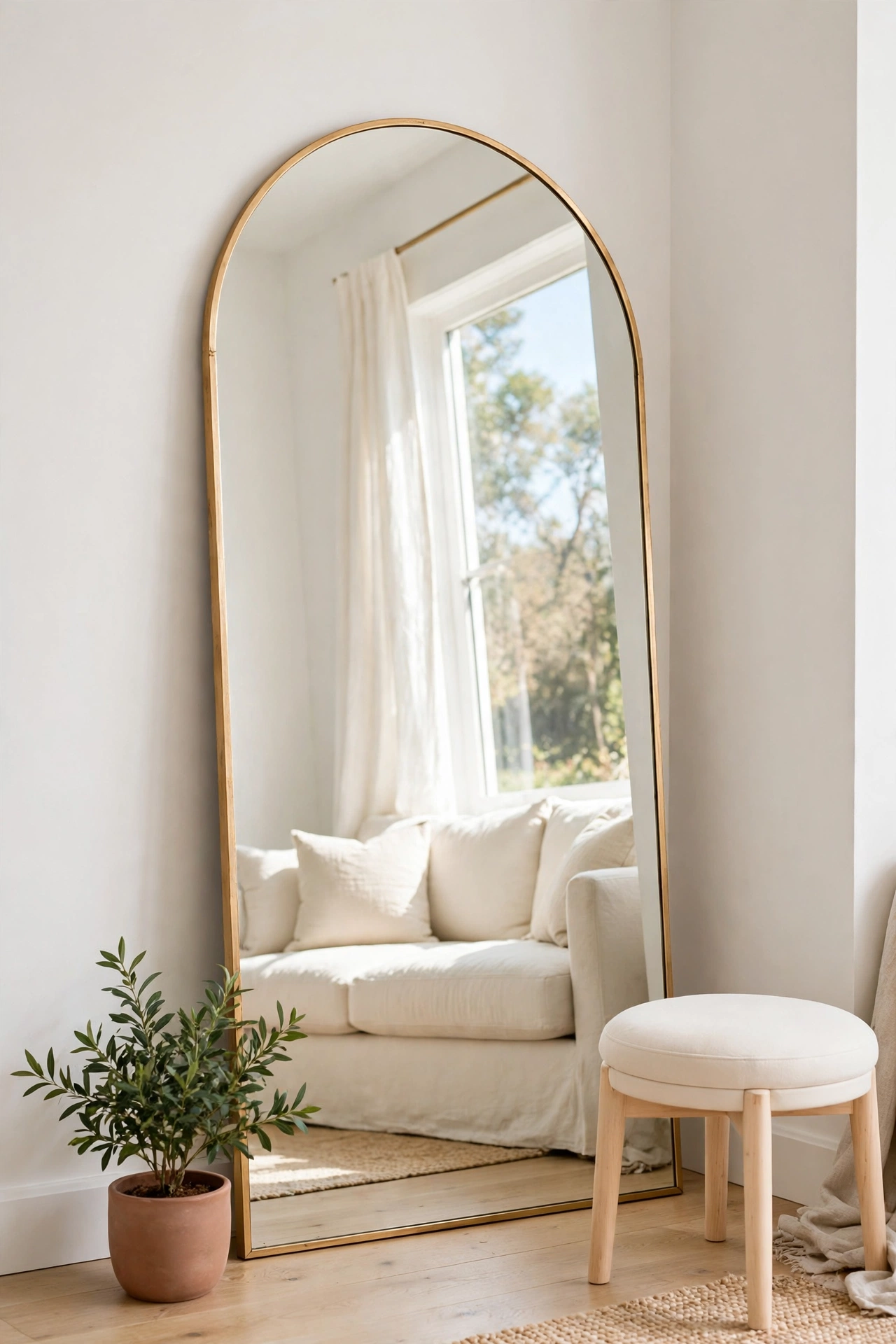
A corner facing a window holds borrowed light all day, and a tall leaning mirror is how you spend it. An arched mirror with a thin gold frame, rested into the corner at a slight angle, reflects the window and the prettiest slice of the room, doubling both in the one spot that used to do nothing. The arch softens the corner’s hard join, the same trick the curved chair plays in Idea 1.
A mirror corner needs almost nothing else, which is its luxury. One small plant or a low stool beside the frame stops the mirror looking like it is waiting to be hung, and a clear floor in front lets the reflection breathe. What the mirror reflects is the real styling decision: it should face greenery, a styled sofa, or the window itself, never the television or a cluttered shelf.
How to do it: Lean the mirror so the top rests on the longer wall and the base sits a short step out from the corner, then anchor the top with a discreet wall strap or anti tip fixing, a leaning mirror must always be secured. Angle it in small turns until the reflection holds light and one good view. Wipe the lower third often, it catches dust and pet noses first. Pro Tip: In a dark corner with no window opposite, place a lamp or a candle cluster where the mirror can catch it, and the mirror still earns its place after dark. Common mistake: Hanging a small round mirror high in the corner instead. It reflects the ceiling, adds no light, and leaves the whole floor corner empty beneath it.
5. Fit a Small Writing Desk Into the Corner
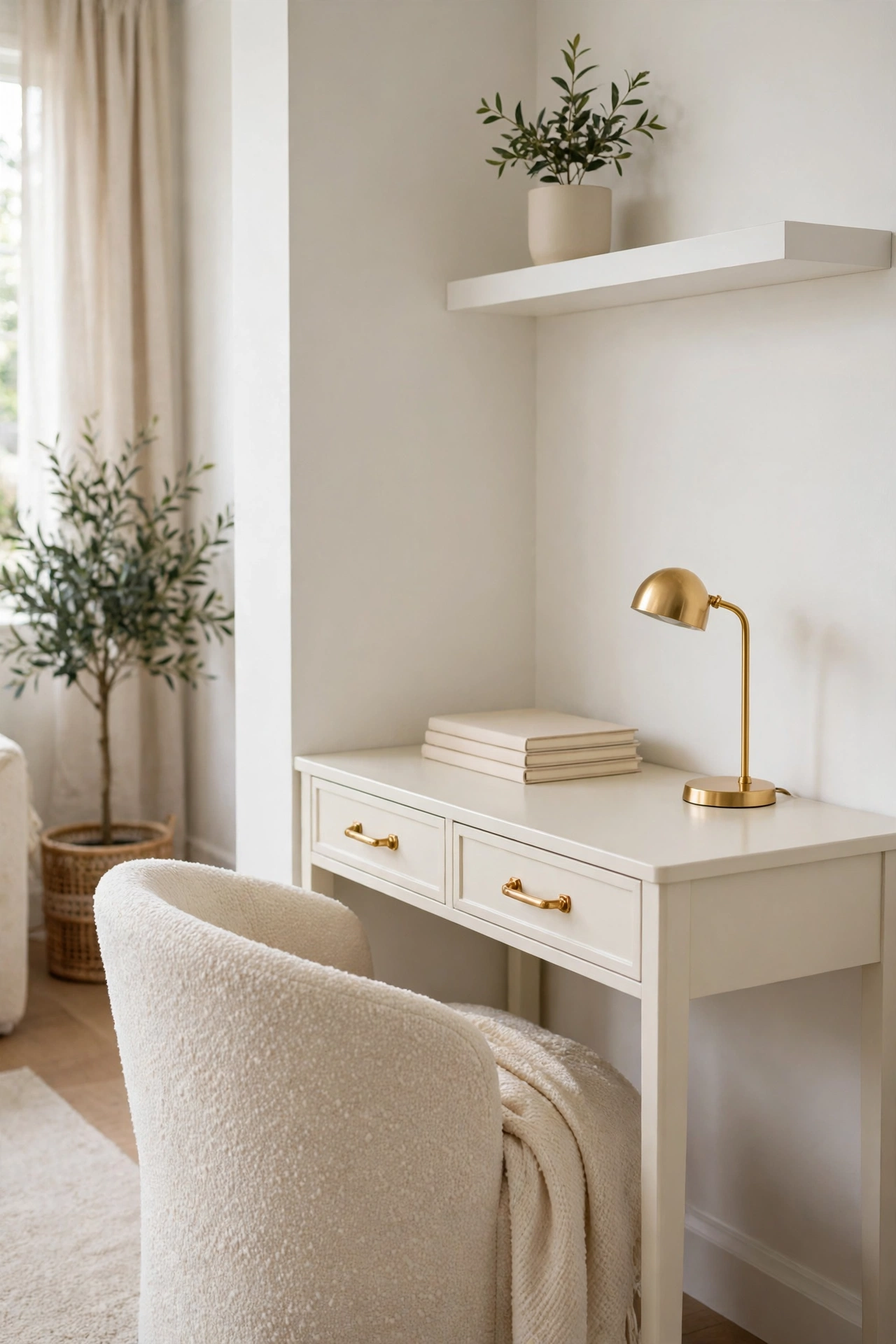
A corner desk done well is not a home office that wandered in, it is a writing table that belongs to the room: slim, light in colour, and styled like furniture first and a workplace second. In a living room corner it takes the laptop, the letter, and the list off the dining table and the sofa, and in the evening it closes back into a pretty scene.
Keep the footprint small, a desk around a metre wide with thin legs, in white, pale oak, or cream with gold handles, and a chair that tucks fully underneath so the corner returns to calm when work ends. Style the surface the way you would a console: a small lamp, one closed notebook stack, a small plant or a candle, and nothing that lives there permanently except those pieces.
How to do it: Run the cable down one desk leg and along the skirting to the socket, fixed with two cable clips, so no wire crosses the corner. Hang one floating shelf or a framed print above the desk at seated eye height to give the workspace its own wall. Keep the chair inside the room palette, boucle or cream upholstery, never a black office chair. Pro Tip: A lidded box or a desk drawer in the corner holds the charger, pens, and paper, so the desk can be cleared in under a minute when guests arrive. Common mistake: Facing the desk into the corner so the user stares at two walls. Angle it along one wall with the chair on the open side, facing the room, and it feels like a window seat for work.
6. Wrap a Gallery Around Both Walls
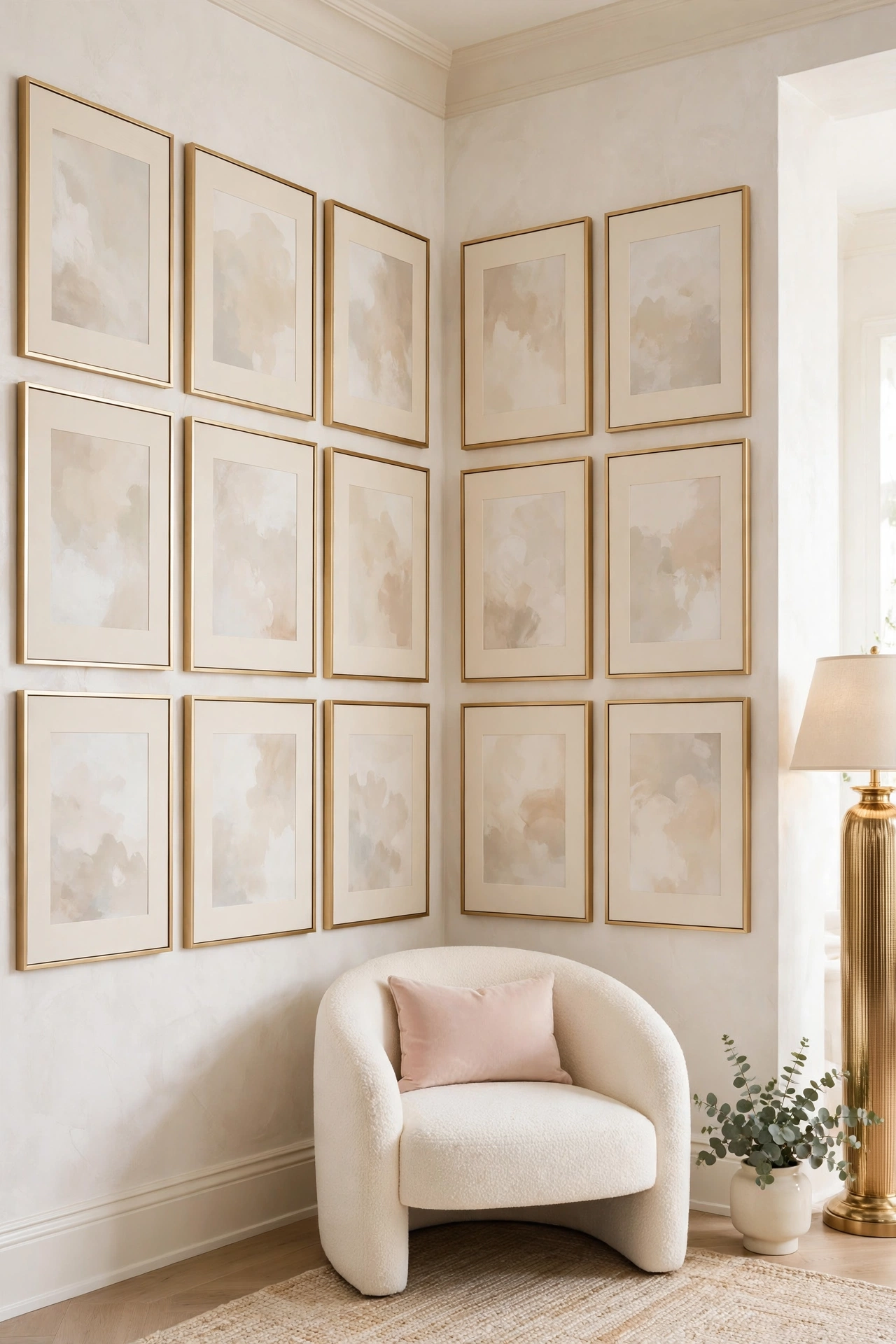
Most gallery walls stop politely before the corner, which is exactly why the corner looks forgotten. A wrap around gallery carries the frames across both walls and lets one frame sit close to the join on each side, so the art, not the empty plaster, becomes what the corner is about. It works best above a low piece, a reading chair, a bench, or a plant group, which grounds the frames.
Build the gallery inside one frame family, thin gold or warm white frames with wide cream mats, and keep the art itself calm: soft abstracts, line drawings, pale landscapes in the room’s blush and taupe range. Mixed loud art in mixed frames is where corner galleries turn into noticeboards. The corner pair should be the two smallest frames, so the join never carries the visual weight.
How to do it: Lay the full arrangement on the floor first, in the same L shape it will hang, and photograph it before any nail goes in. Hang the two corner frames first, one on each wall at the same top height, then work outward, keeping gaps even, roughly a finger’s width wider than feels brave. Leave the lowest frame’s bottom edge a clear hand’s span above the furniture below. Pro Tip: Paper templates taped to both walls for a day will show you the arrangement at morning and evening light, the two times a corner looks its best and worst. Common mistake: One frame hung actually across the join, bent to fit two walls. Frames hang flat on one wall or the other, the wrap is made by the pairing, never by bending art around a corner.
7. Set a Low Bench Under the Corner Windows
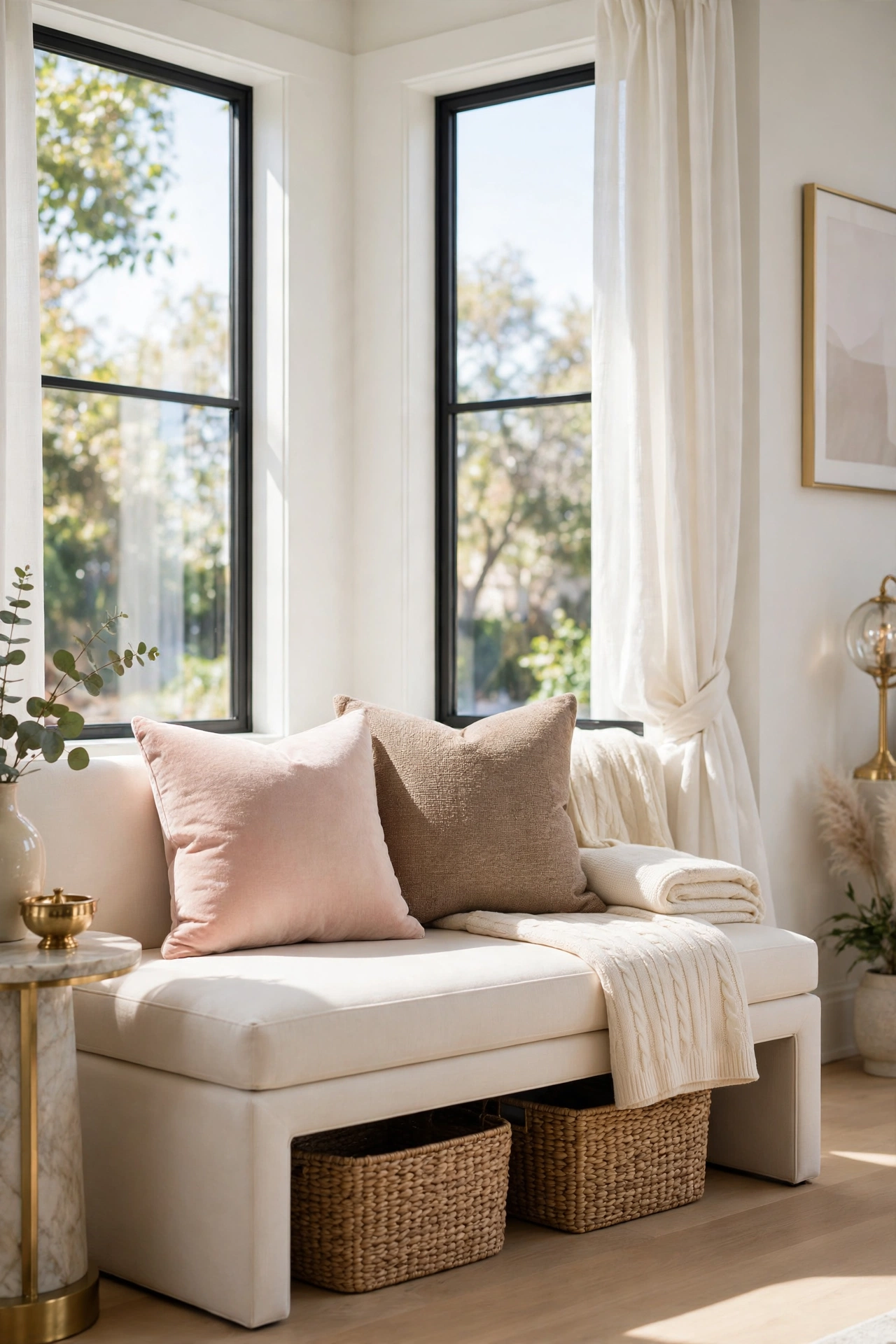
Two windows meeting in a corner make the brightest seat in the house and, in most rooms, a home for nothing at all. A low upholstered bench, set under the windows along one wall of the corner, claims that light for reading, morning coffee, and the cat, without blocking the glass the way a tall chair or bookcase would.
Dress the bench like a daybed in miniature: two or three cushions in blush, cream, and one taupe pattern against the wall, a folded throw at one end, and the bench itself in a fabric that can take sunlight without fading fast, a pale weave rather than a deep dye. The space underneath is honest storage, two woven baskets for blankets, games, or the children’s things that migrate to this room.
How to do it: Measure so the bench top sits just below the window sill, and leave the curtains or blinds free to close without riding over the cushions. Keep plants off the bench itself, a sill plant at one end only, so the seat stays a seat. Turn the bench cushions monthly, corner windows pour light onto one side all year. Pro Tip: In winter this becomes the warmest reading spot in the room once a small cushion is added as a back rest against the side wall, making a true corner seat for one. Common mistake: Putting a tall plant stand in the window corner instead, which spends the best light in the house on one plant while every human seat sits in the dimmer middle of the room.
8. Slide a Slim Bookshelf Into the Corner
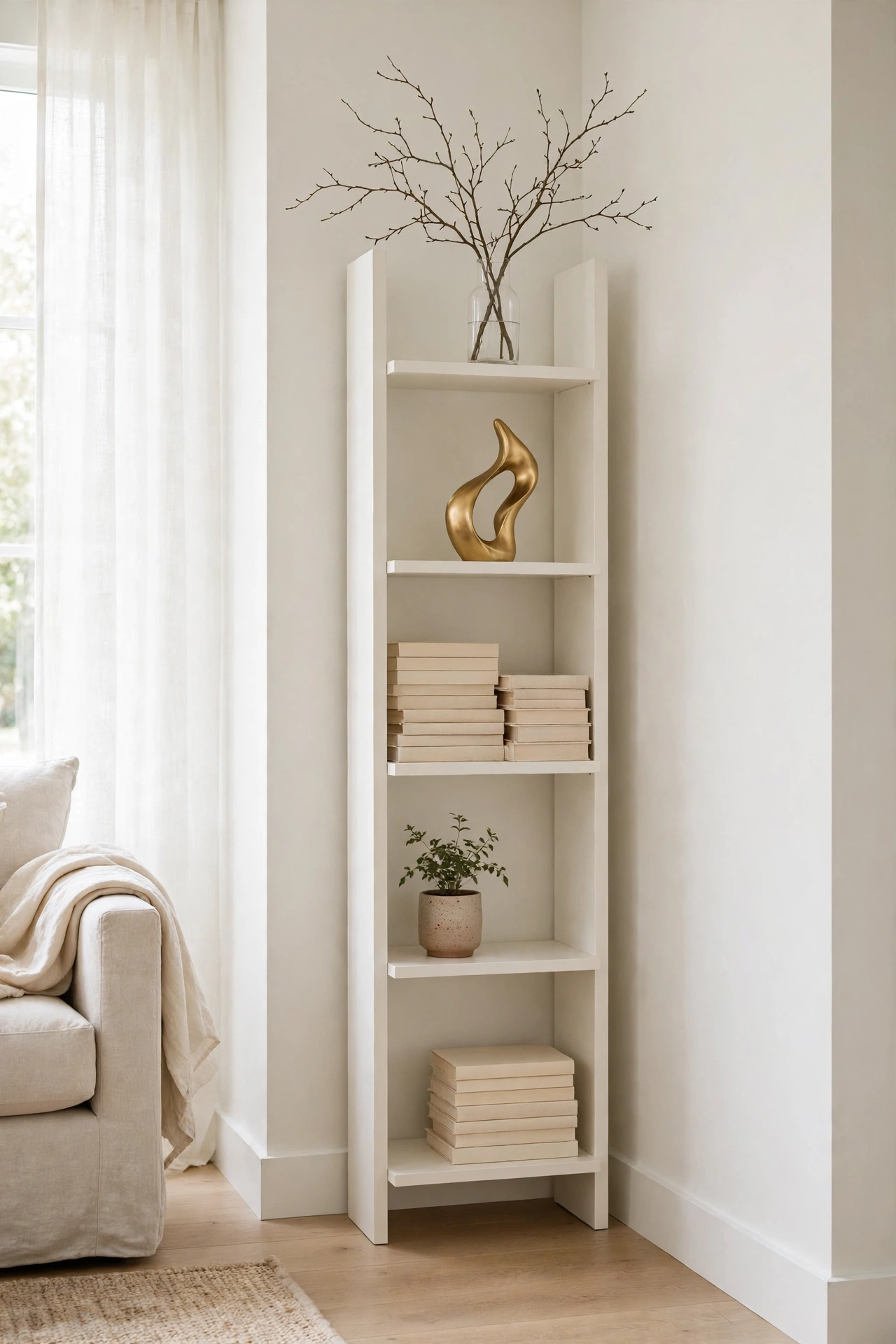
A corner is the safest place in the room for a tall bookshelf, out of every walkway, against two walls that steady it visually. A slim, tall shelf, around sixty to eighty centimetres wide, turns the corner into the room’s library and gives books, a vase, and the small beautiful objects a vertical home that the coffee table cannot.
Style it like a display, not a bookcase in a study: books in short horizontal stacks and one upright run per shelf, covers turned to the palette where you can, with a third of each shelf left as air, a gold object, a small plant, a framed print leaning at the back. In this glam palette, warm white or pale oak shelving keeps the corner bright where a dark bookcase would drink the light.
How to do it: Anchor the shelf to the wall with its anti tip straps, always, tall furniture in a corner still tips forward, never sideways. Put the heaviest books on the lowest shelf and the lightest, prettiest objects at eye level. Leave the top shelf for one tall item only, a vase with branches that nearly reaches the ceiling line and finishes the corner’s height. Pro Tip: Run one warm picture light or a small battery lamp on the middle shelf, and the corner glows at night like a shop window you actually live with. Common mistake: Filling every shelf edge to edge with upright books. Without air and objects, it reads as storage that happens to be in the living room, not a styled corner of it.
9. Park a Gold Drinks Cart in the Corner
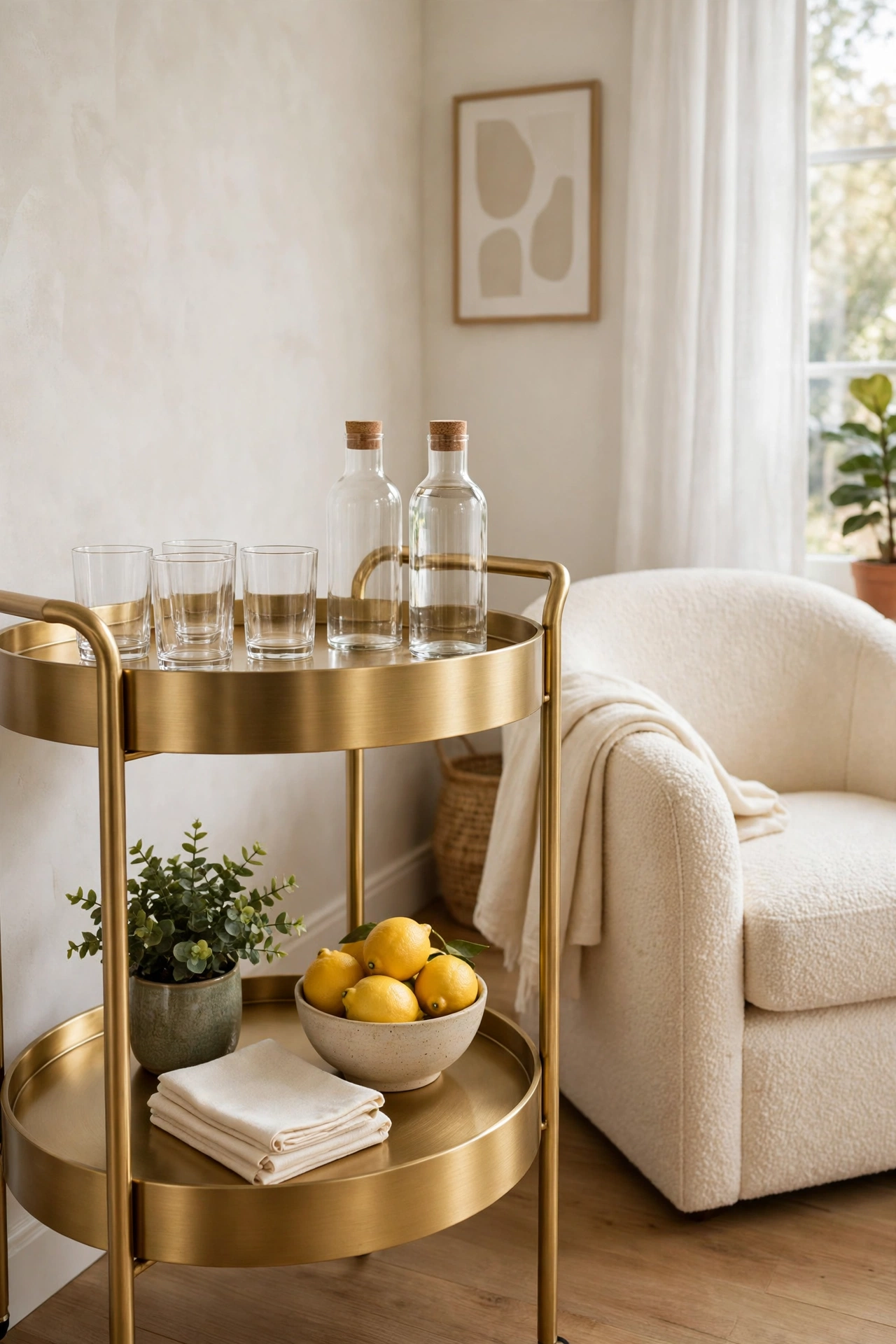
A drinks cart is the corner idea that works hardest at a party and prettiest on a plain Tuesday. Parked at an angle in the corner beside the seating, a two tier gold cart holds glassware and bottles on top, and on the lower tier the things that make it styling rather than storage: a small plant, a stack of cocktail napkins in a holder, a bowl of lemons, a candle.
Restraint is what separates a cart from a bar takeover. Six to eight pieces per tier at most, glasses grouped by type, bottles kept to the few that are actually poured, ideally with labels that sit quietly in the palette. In a family room the same cart works as a coffee and tea station, a small kettle or a cafetiere, cups, and a jar of biscuits, with the same styling rules.
How to do it: Angle the cart across the corner, never flat to one wall, so both tiers can be reached and the corner shape softens. Put the tallest bottle at the back corner of the top tier and glasses forward, where hands go. Lock or chock the wheels once it is placed, a styled cart should not travel during a party. Pro Tip: One small framed print or a tiny plant on the wall above the cart finishes the scene and stops the eye ending at bottle height. Common mistake: Loading every bottle the house owns onto the cart. A crowded cart reads as a cupboard problem, and the gold frame that made it glam disappears under glass.
10. Make a Music Corner Around a Record Player
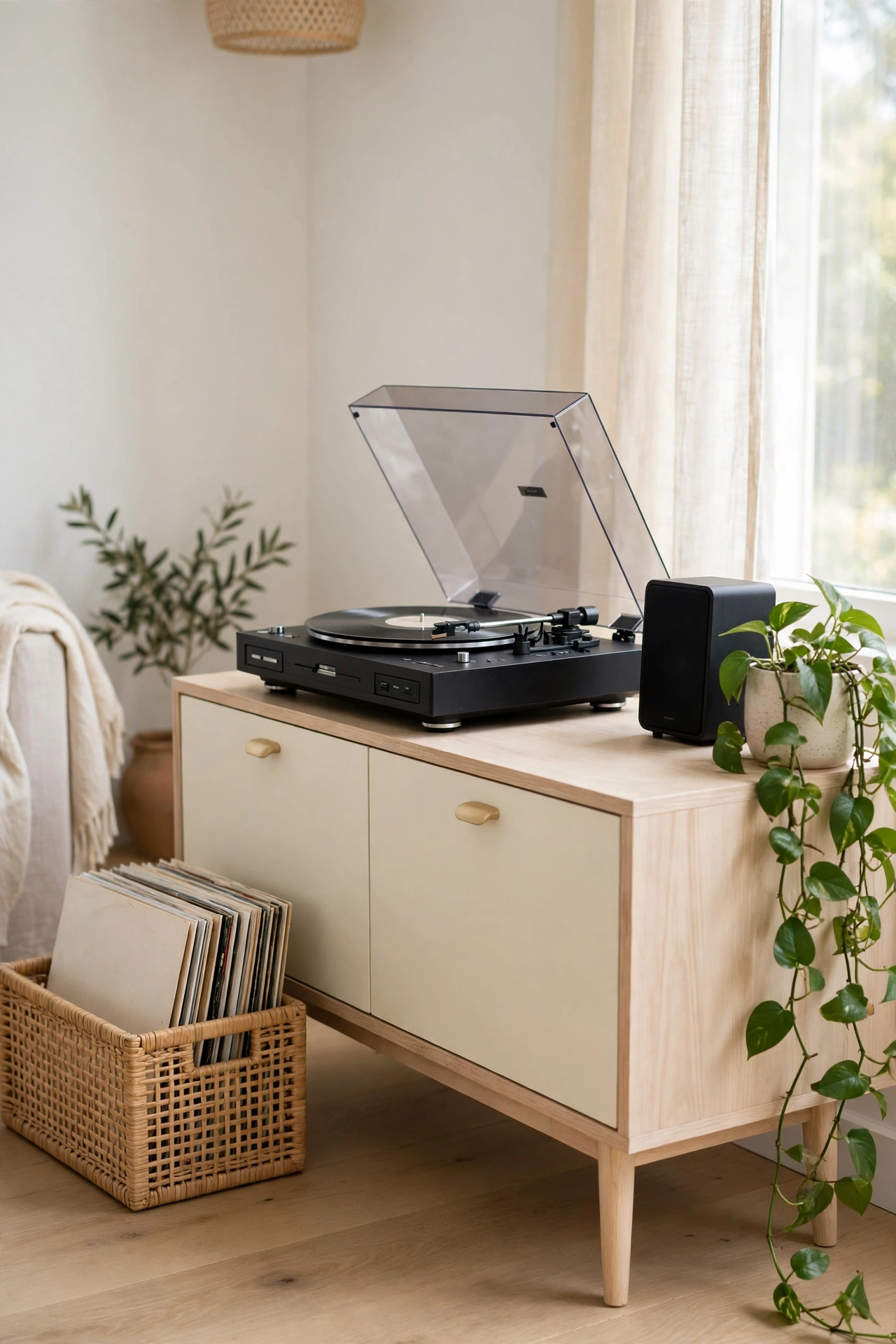
A record player gives a corner a ritual, and rituals are what make corners feel intended. A low console or a sturdy sideboard, just wide enough for the player and a speaker, turns the corner into the room’s music seat, especially paired with the reading chair from Idea 1 pulled a little closer. The look is warm and collected, wood, cream, and gold, with records as the texture.
Keep the records visible but tidy: one woven or pale wood crate beside the console holding the current rotation, spines out, and the rest stored elsewhere. Plain sleeves and calm covers suit this palette best on display. Add one plant on the console’s far end and a small lamp or candle for the evening listening hour.
How to do it: Keep the player on a solid, level surface, never on a wobbling side table, and give the speaker its own corner of the console rather than stacking anything on it. Run the cables down the back leg and along the skirting as with the desk in Idea 5. Keep the crate off the direct sun line from any corner window, records warp quietly in warm light. Pro Tip: A small stack of three art or music books on the console gives guests something to browse while a record plays, and keeps the corner social, not shrine like. Common mistake: Displaying the whole record collection across the floor around the console. A corner of crates stops being a music corner and becomes a sorting project.
11. Raise One Vase on a Pedestal
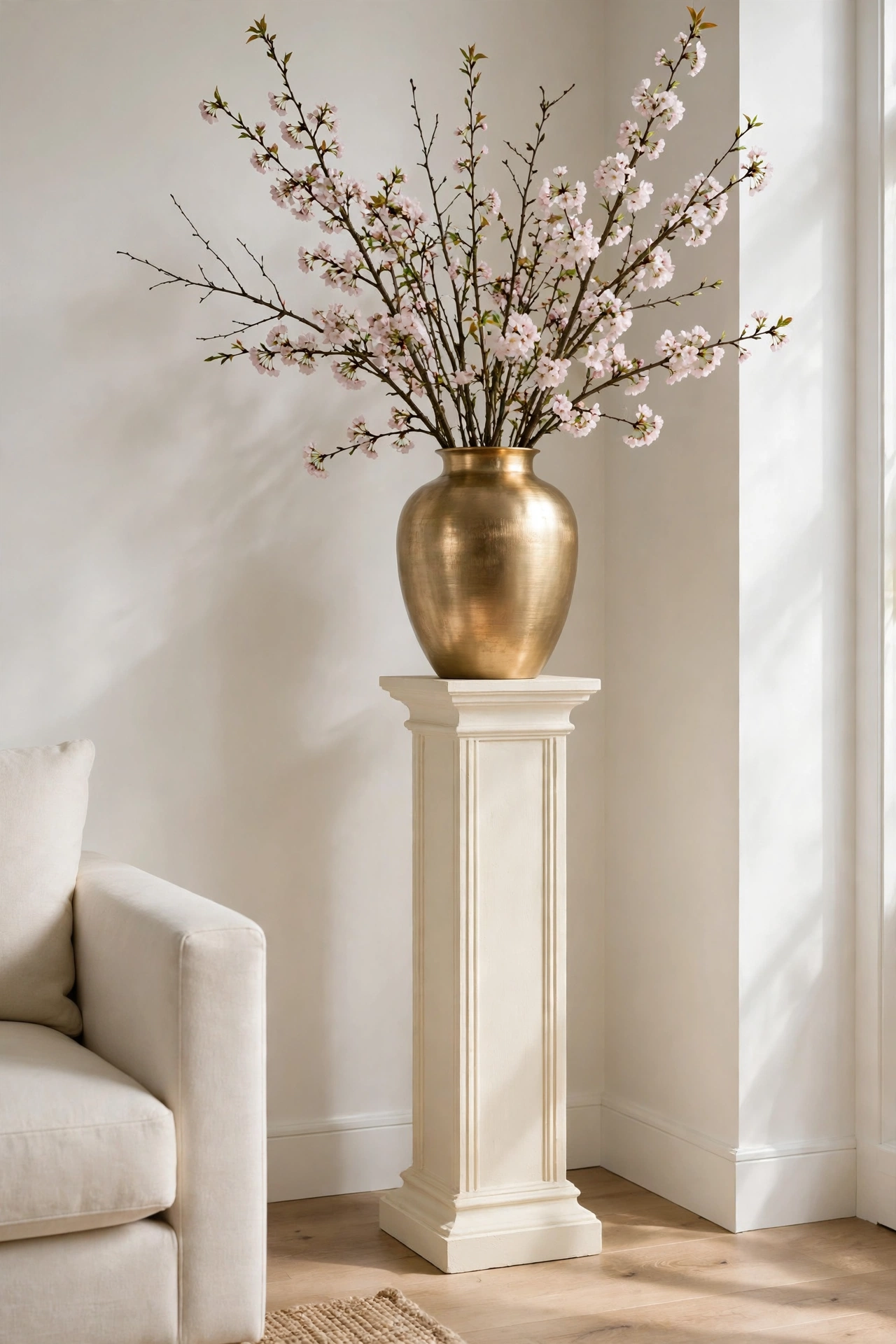
The gallery trick that flatters corners most is the pedestal: a plain plinth, knee to waist high, carrying one large vase of branches. It uses almost no floor, delivers height without furniture, and reads instantly as art rather than decor, which is why it suits the corner beside a sofa end or a doorway, where a chair would block the walkway.
Choose the vase large and simple, gold, cream ceramic, or clear glass, and the branches taller than feels safe on paper: blossom in spring, olive or eucalyptus through the year, bare sculptural branches in winter. Against white and cream walls, the branch silhouette is the whole picture, so one arrangement, generously scaled, beats three small ones sharing the plinth.
How to do it: Set the pedestal a small step out from the corner so the branches never touch either wall, and weight the vase or choose a heavy base so the arrangement cannot be knocked by a passing sleeve. Check the height from the sofa: the branch tips should finish somewhere between picture height and the ceiling line, never at eye level of a seated guest. Pro Tip: This is the easiest corner in the room to season: one branch swap, two minutes, and the corner follows the year, the same one element rule that keeps a styled coffee table fresh. Common mistake: A pedestal so tall and a vase so small that the piece looks like a shop display for one twig. Plinth low, vase big, branches generous is the proportion that works at home.
12. Lay Down a Floor Cushion Calm Corner
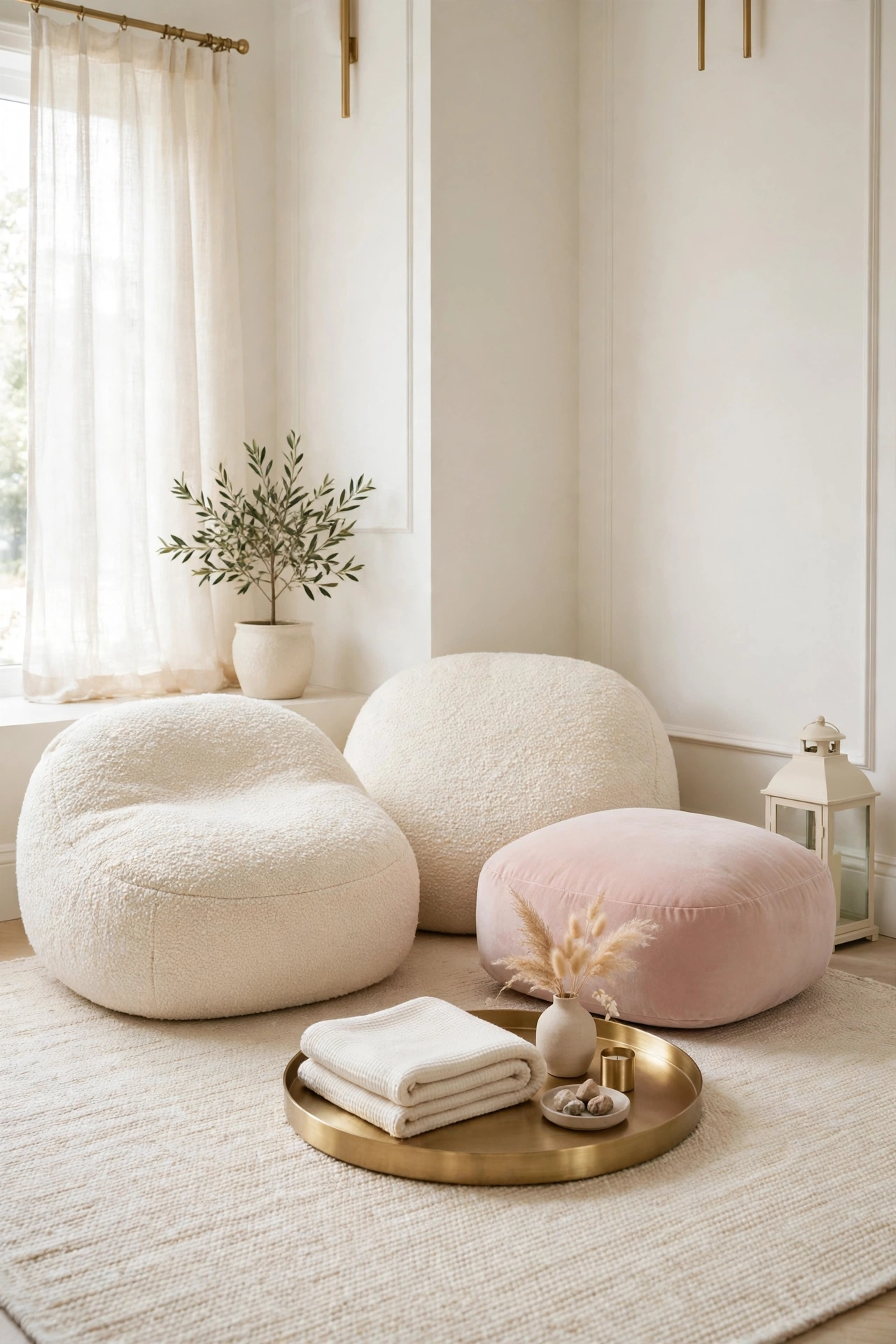
Not every corner needs furniture height. A floor level corner, two large cushions on a soft rug with a low tray table, becomes the room’s calm spot: morning stretches, tea with a friend sitting close, a child reading, a dog supervising. In a glam room it still works, because cream boucle and linen cushions in the palette read as deliberate, not makeshift.
Build it in layers from the floor up, which is the order the eye reads it: a small pale rug to claim the zone, two oversized floor cushions in cream with one blush cushion in front, a folded throw over the cushion edge, and one low round table or large tray for cups and a book. A lantern or a chunky candle holder at the wall edge gives the corner its evening version.
How to do it: Choose cushions with removable, washable covers, a floor corner lives closer to shoes, paws, and crumbs than any chair. Keep the pile low enough that the corner never blocks a doorway swing or a curtain. Fold the throw back to the same line each night, the nightly reset is what stops a floor corner sliding into a laundry corner. Pro Tip: In a small room this corner replaces a second armchair entirely, giving a full extra seat that stores flat against the wall when the room needs its floor back. Common mistake: Throwing loose sofa cushions on the bare floor and calling it a corner. Without the rug, the tray, and covers that can be washed, it reads as overflow seating, not a designed place.
13. Style a Corner Your Pet Actually Owns
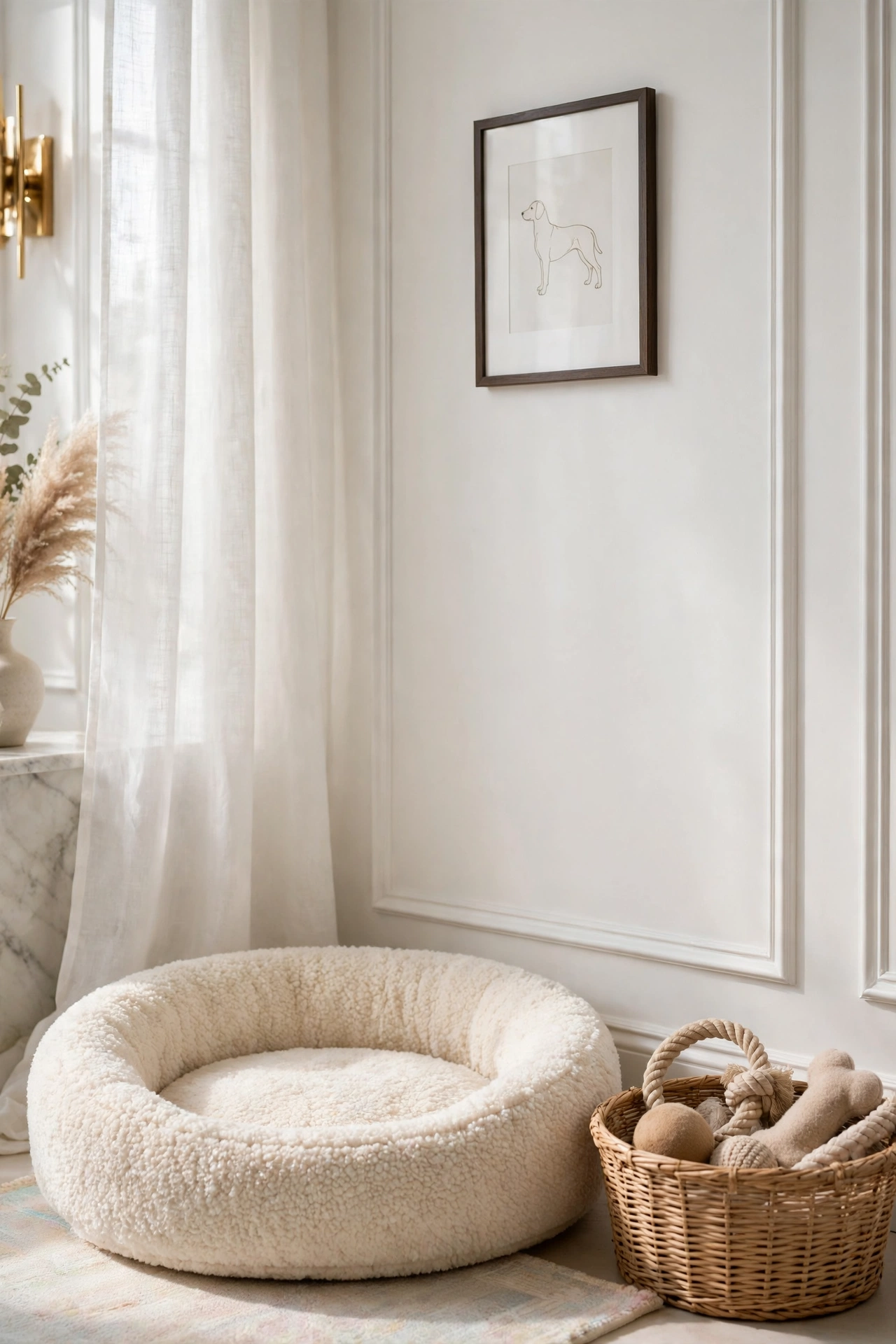
Every pet already has a favourite corner, usually the sunniest one, and the choice is only whether it looks like part of the room or like an accident in it. A round pet bed in cream boucle or a washable pale weave, on a small low pile rug in the corner, with a woven basket for toys beside it, turns the pet’s territory into one of the room’s styled scenes.
Match the pet pieces to the palette the same way you matched pots in Idea 2: cream bed, natural basket, a taupe washable throw over the bed’s edge for the muddy season. Skip novelty prints and bright plastic entirely, they are the fastest way to make a glam room look like a pet shop at one corner.
How to do it: Place the bed where the pet already sleeps, fighting for a different corner wastes the whole idea, and keep the toy basket close enough that toys land there during the nightly tidy. Choose a bed with a removable cover and a rug that fits in the wash, both will be washed often, and pale colours only work here because they can be. Keep food and water bowls in the kitchen, this corner is for rest, not meals. Pro Tip: One hook or a small framed print above the bed, at the height you would hang art over a chair, finishes the scene and signals to guests that this corner is designed, not surrendered. Common mistake: The old blanket on the floor in the corner. It holds hair, holds smells, and visually drags down every styled thing near it, a proper washable bed is the entire upgrade.
14. Hide Real Life in a Storage Corner
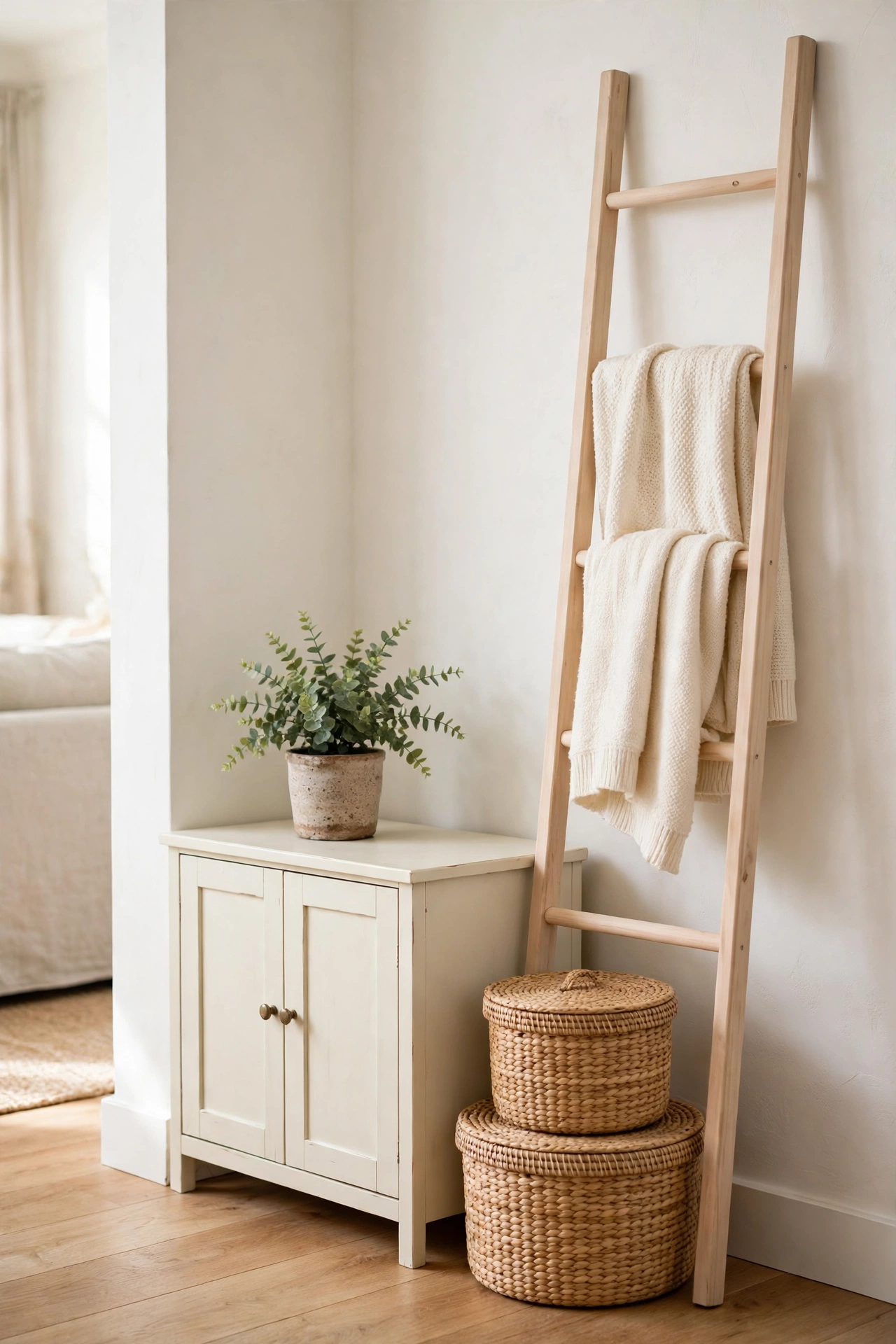
A corner can quietly hold everything the room needs but nobody wants to see: throws, board games, chargers, the children’s current projects. A storage corner built from one small lidded cabinet or a storage ottoman, plus two stacked woven baskets with lids, takes that clutter vertically in the room’s least useful space and gives it a calm, closed face.
The rules are the remote box rules from the coffee table, scaled up: everything has a lid, everything has a fixed place, and nothing lives on top except one styled object, a plant, a candle, or a small stack of books, which tells the eye this is furniture, not storage that escaped. A blanket ladder leaning on one wall of the corner adds the soft layer and earns its place by holding the two best throws, not six.
How to do it: Measure the corner’s diagonal before buying, storage pieces are the most returned furniture in the world because corners are smaller than they look in a shop. Put the most used things in the top basket and the cabinet’s top drawer, seasonal things lowest. Leave the floor in front clear so lids can open fully, a storage corner you cannot open is a statue. Pro Tip: Keep one basket deliberately half empty. It becomes the room’s landing basket, the ten minute tidy before guests arrive, and it protects every other styled surface in the room. Common mistake: Open baskets and open shelves in the storage corner. Open storage displays the clutter it was bought to hide, lids are the whole point of this corner.
15. Turn Two Swivel Chairs Into a Conversation Corner
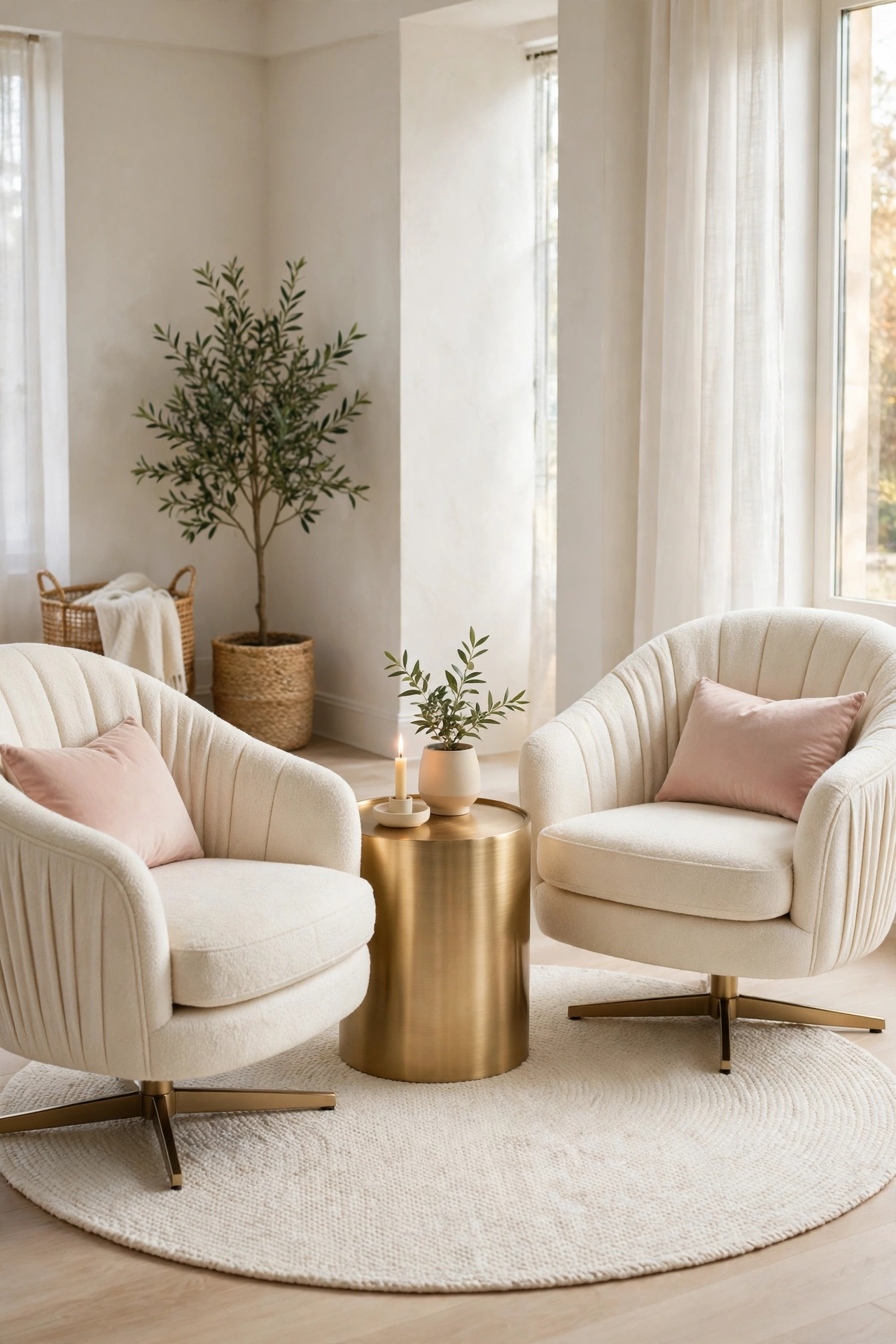
The most generous corner of all is a conversation corner: two swivel chairs angled toward each other across a small round table, on their own round rug. It gives the room a second seating scene for the talks that never happen on a sofa facing a television, coffee with a friend, a teenager after school, a partner at the end of the day.
Swivel chairs earn their price here: turned inward, the corner is private, turned outward, the same chairs join the main room for a party without being dragged an inch. Keep both chairs in the room’s cream family with blush or taupe cushions, and let the shared table carry the corner’s one gold note plus the practical things, two coasters, a candle, a small plant.
How to do it: Angle the chairs so knees can nearly meet across the table, closer than feels formal, this corner is for two people, not for display. Centre the round rug under the table with both chairs’ front feet on it, anchoring the scene to the corner. Give the corner its own light source, the arc lamp of Idea 3 swung this way, or a small table lamp on a stool behind one chair. Pro Tip: This is the corner to place nearest the kitchen if you can, drinks arrive in three steps, and the conversation never has to move for a refill. Common mistake: Two chairs placed side by side facing the room like a waiting area. Conversation corners face each other; the angle between the chairs is the entire difference between sitting together and sitting nearby.
Quick Reference Table
| Corner Idea | What It Adds | Key Rule |
|---|---|---|
| Reading nook | A seat of your own | Angle the chair, never flat to the wall |
| Layered plants | Garden depth | Three heights, one pot family |
| Arc floor lamp | Light and shape | Shade over the seat it serves |
| Leaning mirror | Borrowed light | Secure the top, style the reflection |
| Writing desk | A calm work spot | Chair tucks fully away |
| Wrap gallery | Art as the feature | Corner pair smallest, hung flat |
| Window bench | The brightest seat | Bench top below the sill |
| Slim bookshelf | A library wall | Anchor it, leave a third as air |
| Drinks cart | Party ready styling | Angle it, lock the wheels |
| Music corner | A daily ritual | Solid surface, crate not collection |
| Pedestal vase | Art height | Plinth low, vase big, branches generous |
| Floor cushions | A calm low seat | Rug first, washable covers |
| Pet corner | Their spot, styled | Washable everything, no bowls |
| Storage corner | Hidden real life | Lids on everything, one basket half empty |
| Conversation chairs | A second scene | Chairs face each other |
The Finished Corner Checklist
- One clear job chosen for the corner
- Chair angled, never pushed flat into the corner
- Plants at three heights in one pot family
- One light source serving the corner itself
- Mirror secured at the top and reflecting a good view
- Cables run down a leg and along the skirting
- Tall furniture anchored with anti tip straps
- Window light given to people before plants
- Everything stored in the corner behind a lid
- One styled object on top of any storage piece
- Pet pieces washable and inside the palette
- Floor in front of the corner left clear
- Corner checked from the doorway and from the sofa
Frequently Asked Questions
Which corner should I style first?
The one you see from the doorway and from the main sofa. A styled corner in the sight line lifts the whole room every day, while a styled corner behind the television is seen by nobody. If two corners compete, start with the one nearest a window, because light does half the styling work for free in the mirror, plant, bench, and reading ideas above.
How do I style a corner in a very small living room?
Choose a corner with height instead of a footprint: the pedestal vase, the arc lamp, the leaning mirror, or the wrap gallery all transform a corner using almost no floor. The floor cushion corner is the small room’s second seat, since it stores flat against the wall. What a small room cannot spare is a wide chair in a corner, that is the one idea to skip at small scale.
What if my corner has a radiator, a vent, or an awkward shape?
Work with it the way these ideas work with light: a bench or a low storage cabinet in front of a low radiator cover, with the manufacturer’s clearance kept, turns a problem into a styled surface. Never block a vent, a heater, or a window’s opening path with cushions, curtains, or a bookshelf, and never rest fabric or paper goods on a heat source. Odd angles suit the angled ideas best, the reading chair, the cart, and the conversation pair are all placed across a corner, not into it.
How do I keep a styled corner from sliding back into a dumping corner?
Give the corner a job and a nightly reset, the same two rules that hold a styled coffee table. A corner with a job is defended, a corner without one is available. The half empty landing basket in Idea 14 is the safety valve: everything migrating gets one planned home, and the reset takes the corner back to its photograph in minutes.
Conclusion
An empty corner is not a small problem, it is a whole small room waiting for one clear job. Give it the reading chair, the plants at three heights, the mirror that borrows the window light, the desk, the music, or a place for the dog, in the same cream, blush, taupe, and gold palette as the rest of the room, and the corner stops being where the room ends. It becomes the seat, the view, or the ritual the room is loved for. Start with the corner you see from the doorway, finish it completely, and let it teach the rest of the room how calm it can look.