15 Vibrant Living Room Ideas for a Bold Jewel-Tone Home
15 Vibrant Living Room Ideas for a Bold Jewel-Tone Home
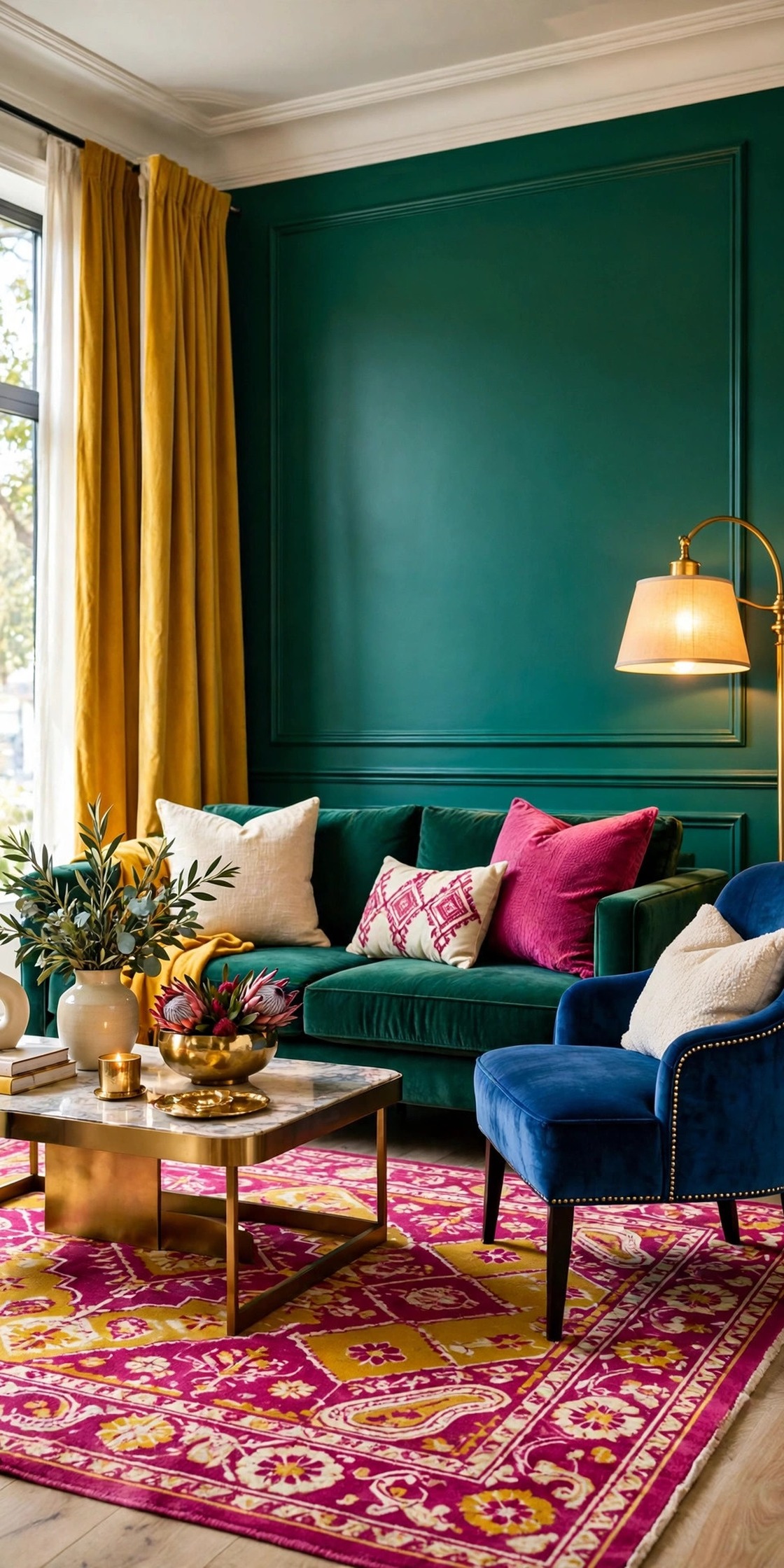
A vibrant living room search usually starts with one worry: strong color will feel loud and tiring the moment the room is finished. It will not, if the color is saturated on purpose and the room is balanced with cream, warm taupe and brushed gold. A vibrant living room works best when the whole room carries jewel tones, emerald, cobalt, fuchsia and mustard, used in large pieces that repeat across the sofa, the chairs, the rug and the walls, while cream cushions, a pale rug border and gold light keep the room soft enough to live in. This is the broad vibrant living room collection, a whole room in jewel tones, not a room where many colors are added one piece at a time on a cream base, which is how the colorful living room works, and not a guide to how colors sit together, which is what the living room color combination covers. Work through the list in order, because the early ideas set the wall, the sofa and the rug, and the later ones add the chairs, the light, the shelves and the soft finishing layers. If you are planning the room around its jewel-tone base, our living room color combination shows how emerald, cobalt, fuchsia and mustard sit together with cream and gold
Disclosure: This article may contain affiliate links. If you buy through a link on this page, GlamNStyle may earn a small commission at no extra cost to you. Product links in this article are plain links; each one is checked on the retailer’s own page before it is added.
1. Paint One Wall Emerald Green
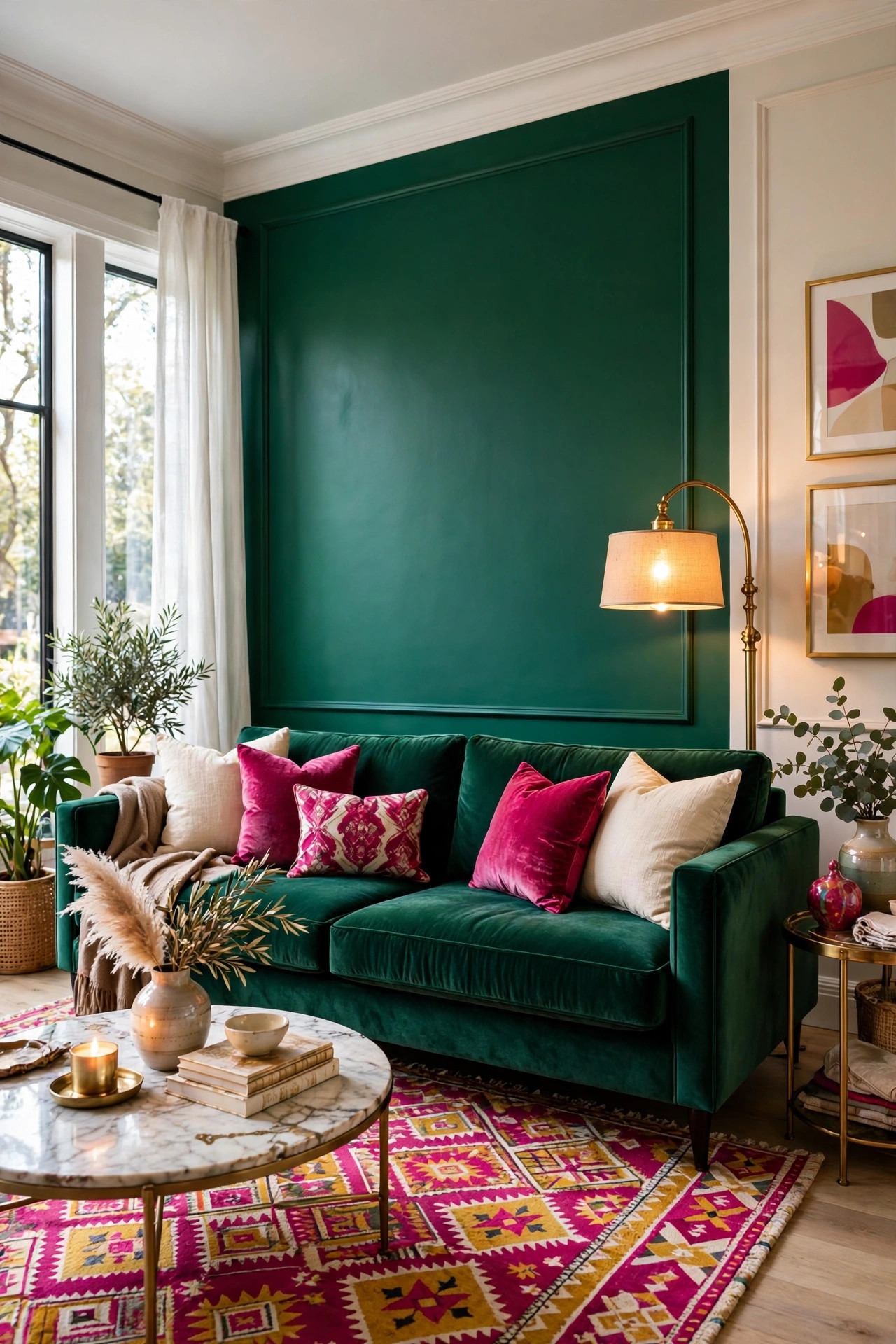
One deep emerald wall is the kindest strong color a living room can hold, and it is the best place to put the jewel tone in this room. Paint the wall behind the sofa in a rich emerald, never a pale sage or a cold teal, and keep the other three walls warm cream, so the green reads as a backdrop rather than a box. The emerald wall makes the cream cushions, the fuchsia cushions, the gold lamp and the framed art stand out, while the pale walls keep the daylight moving through the room. Choose a matte or eggshell finish, because a flat finish softens the green and hides small marks, while a shiny finish turns a jewel wall into a mirror. Test the color on a large board first and look at it at midday and at night, because emerald changes with the light and a warm emerald stays rich and calm after dark, while a blue green can turn cold in the evening.
Best For: Living rooms with good daylight and one clear sofa wall, and anyone who wants a bold color without painting the whole room in jewel tones.
Not Ideal For: Rooms with one small window and low light all day; an emerald sofa on a cream wall is the honest version there.
Estimated Cost: $40-$120 (estimate) for paint, primer, rollers and painter tape for one accent wall.
Budget Note: The paint is the spend; one wall needs one gallon and a weekend afternoon, which costs far less than painting the whole room.
Renter Friendly: With Conditions
Renter Note: Painting needs the landlord’s written permission; a removable emerald peel and stick wall covering is the renter version, or keep the walls cream and let the sofa carry the green.
What You Need
Rich emerald interior paint in matte or eggshell finish, primer, rollers, painter tape, drop cloth, large test board.
Product type to look for: A rich emerald paint with low odor and a matte finish, because a jewel-tone accent wall in a living room is seen at close range and must not shine.
How To Do It
- Test the emerald on a large board, then look at it at midday and under the evening lamp.
- Tape the edges, lay the drop cloth and prime the wall if the old color is pale.
- Roll two thin coats, letting the first coat dry fully before the second.
- Step back and check the wall reads rich and warm from the doorway, then hang one light piece against it to test the contrast.
Pro Tip
Keep the jewel tone to one wall only. A second emerald wall tips the room from bold to heavy, while one emerald wall with cream around it reads as a clear decision.
2. Choose an Emerald Velvet Sofa
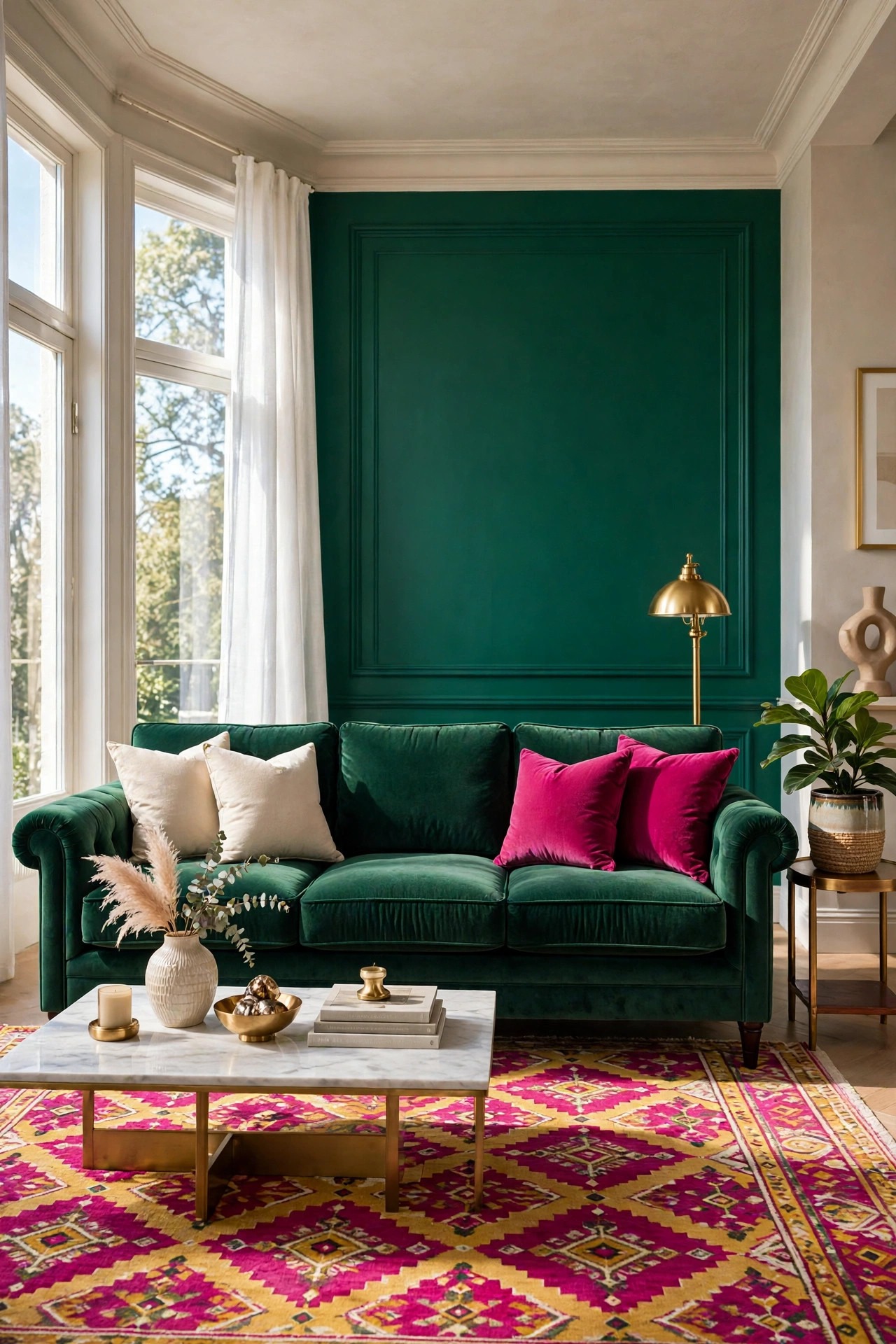
An emerald velvet sofa is the anchor of a vibrant living room, because the sofa is the largest piece in the room and its color sets the whole mood. Choose a deep emerald velvet sofa with clean tailored lines and slim gold legs, then dress it with cream linen cushions, one fuchsia cushion and a warm taupe throw, so the green reads rich rather than flat. Velvet catches the light in a way flat fabric does not, which matters in a jewel-tone room, because the sheen keeps the sofa glowing instead of looking like a dark block. Measure the sofa against the wall and the walkway before ordering, because a sofa one foot too long blocks the path to the window, and a sofa that fits leaves room for a side table and a lamp. Keep the cushions light and the throw folded, never draped over the whole back, so the emerald velvet stays the star.
Best For: Living rooms where the sofa sits against the emerald wall, and anyone who wants the jewel tone in furniture rather than paint.
Not Ideal For: Homes with pets that shed light hair daily; a deep green leather sofa is the honest version there.
Estimated Cost: $600-$1,500 (estimate) for a deep emerald velvet three seat sofa.
Budget Note: The sofa is the big spend in this list; a good velvet sofa in a jewel tone costs more than a pale one, so buy the sofa first and build the rest of the room around it.
Renter Friendly: Yes
Renter Note: Nothing fixed at all; a sofa moves out in one piece on moving day, and the deep green hides small marks between cleans.
What You Need
Deep emerald velvet three seat sofa, cream linen cushions, one fuchsia cushion, warm taupe throw, vacuum with an upholstery head.
Product type to look for: A velvet sofa with a sturdy frame, removable cushion covers and a rub count suited to daily use, because a jewel-tone velvet sofa shows dust and needs a quick weekly vacuum.
How To Do It
- Measure the wall, the walkway and the door swing, then choose a sofa that leaves a clear path.
- Place the sofa against the emerald wall and check the daylight still reaches the seat.
- Add the cream cushions first, then the fuchsia cushion and the folded taupe throw.
- Sit on each seat and check the sofa feels deep enough for an evening, then vacuum the velvet once a week.
Pro Tip
Keep the cushions cream and fuchsia, not emerald. Green cushions on a green sofa disappear, while cream and fuchsia cushions on emerald velvet give the eye a place to rest.
3. Add a Cobalt Blue Velvet Chair
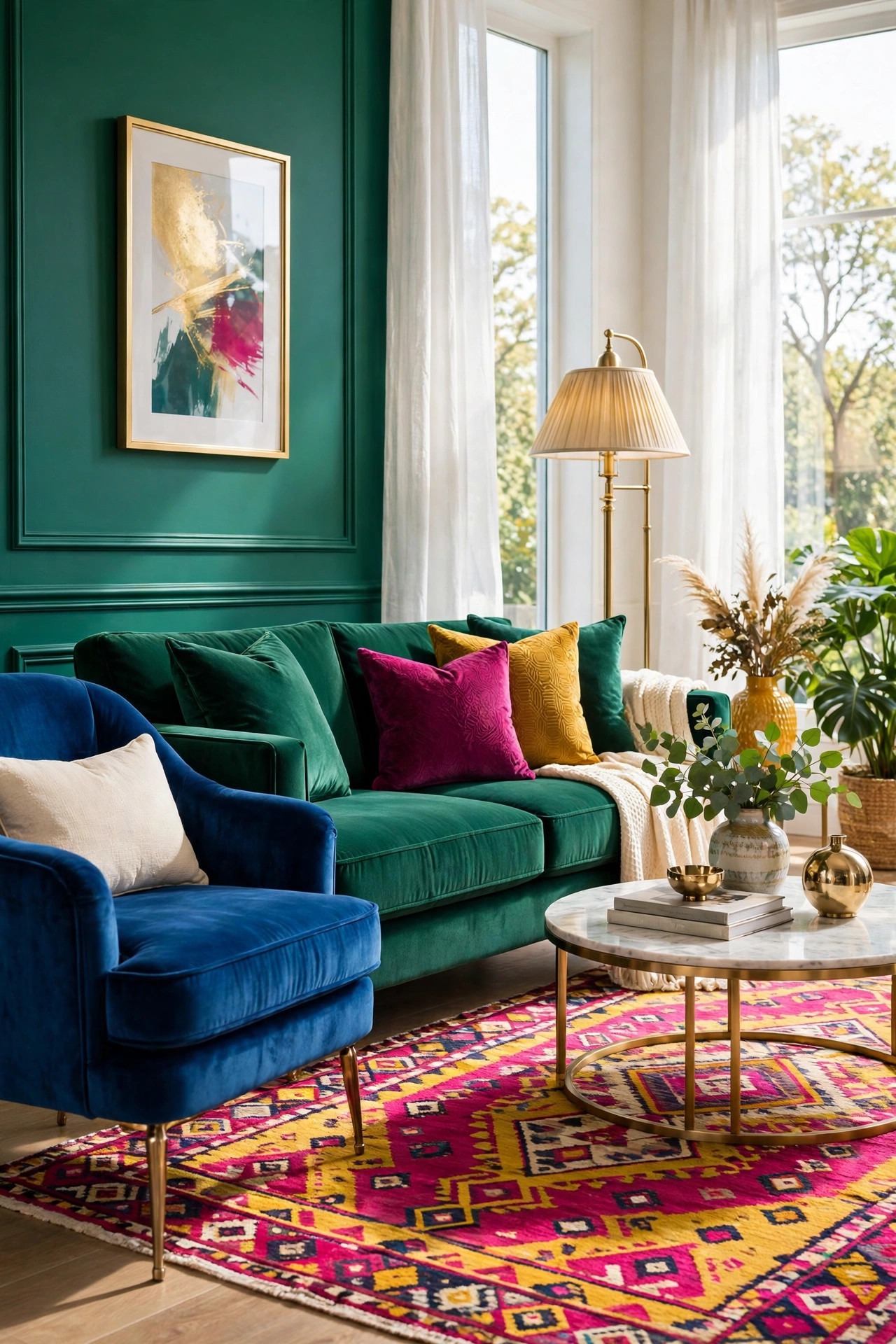
A cobalt blue velvet chair is the second jewel tone a vibrant living room needs, because one jewel tone alone reads as a green room, while emerald and cobalt together read as a jewel-tone room. Choose a cobalt velvet chair with clean lines and slim gold legs, and dress it with one cream cushion, so the pale cushion reads warm against the strong blue. Place the chair at an angle to the sofa, facing into the room, because a chair set square against the wall reads as storage, while a chair turned in invites someone to sit. Check the velvet before buying, because a good velvet glows in daylight and softens with use, while a thin velvet flattens and marks within a year. Keep the chair clear of the walkway, so it holds a book and a cup rather than blocking the path to the window.
Best For: Living rooms with a corner that needs a reading seat, and anyone who wants a second jewel tone that is just as strong as the emerald.
Not Ideal For: Rooms where the seating area is already tight; a slim cobalt side chair without arms is the honest version there.
Estimated Cost: $300-$800 (estimate) for a cobalt blue velvet accent chair with a cream cushion.
Budget Note: The velvet is the spend; a good cobalt velvet chair costs more than a plain fabric one, so check the pile and the stitching before buying.
Renter Friendly: Yes
Renter Note: Nothing fixed at all; a velvet chair moves out in one piece on moving day.
What You Need
Cobalt blue velvet accent chair, one cream cushion, small brass side table if space allows, vacuum with an upholstery head.
Product type to look for: A chair in a rich cobalt velvet with a sturdy frame and removable cushion covers, because a velvet chair in a living room is sat in daily and must clean without losing its color.
How To Do It
- Measure the corner and choose a chair that leaves a clear walkway beside it.
- Set the chair at a slight angle to the sofa, facing into the room.
- Add the cream cushion and check the chair feels steady when sat in.
- Place a small side table within reach, then vacuum the velvet once a week.
Pro Tip
Keep the cushion cream, not patterned. A patterned cushion fights the cobalt, while a plain cream cushion lets the strong blue be the statement.
4. Lay a Fuchsia and Mustard Patterned Rug
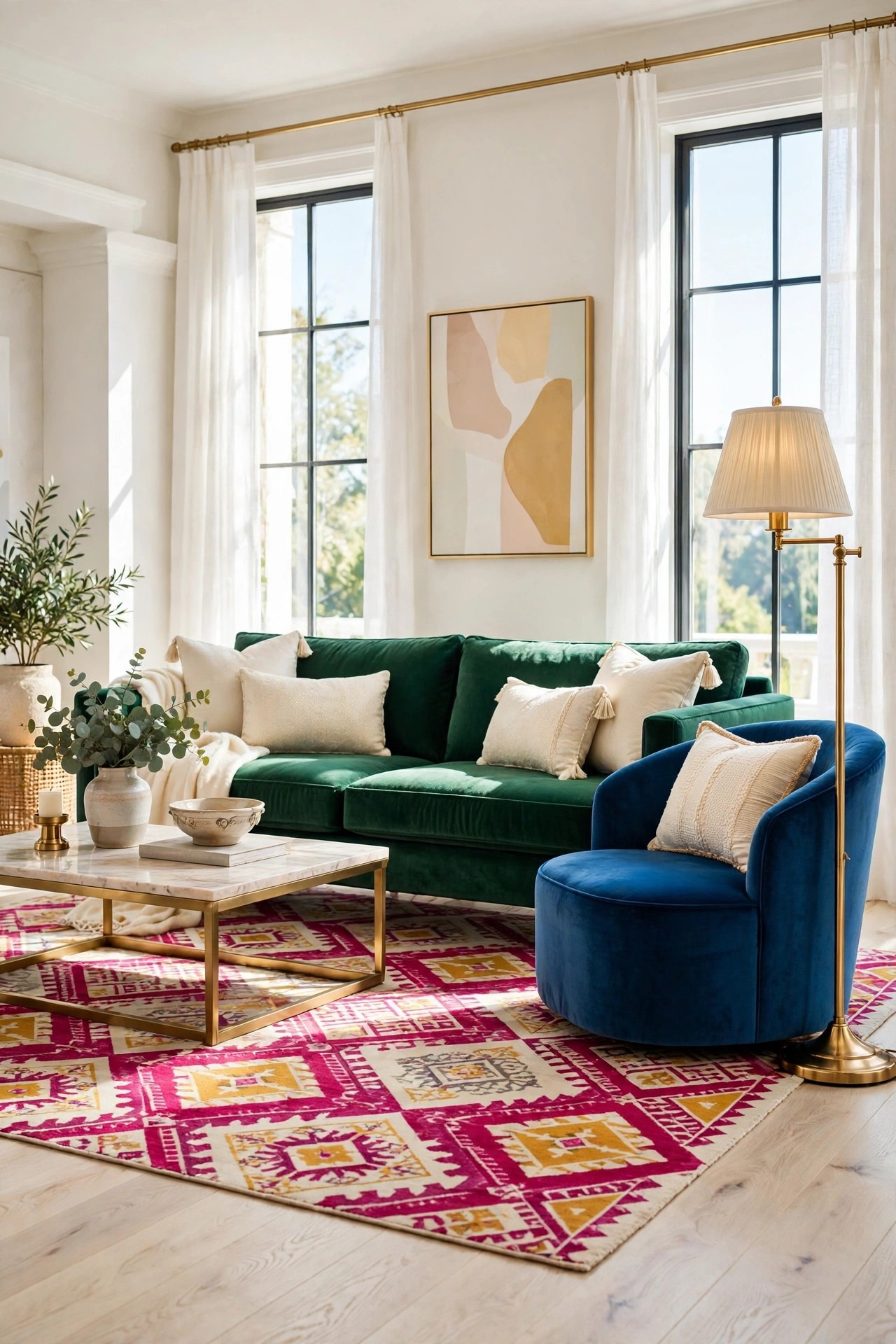
A fuchsia and mustard patterned rug on a pale floor is the fastest way to ground a vibrant living room, because the rug holds two jewel tones at once and sets the seating area in one piece. Choose a rug in fuchsia and mustard with a cream pattern, large enough to reach under the front legs of the sofa and the chairs, so the seating reads as one group rather than loose pieces. The pale wood border around the rug frames the strong pattern, while the pattern itself hides everyday marks far better than a plain bright rug. Choose a low pile rug, because a thick rug under a sofa stops the doors and catches the vacuum, and keep a rug pad underneath, so nothing slides when the sofa is used daily. Measure the seating area before ordering, because a rug that stops short of the sofa legs reads as a mat, and a rug that is too large swallows the pale floor border.
Best For: Living rooms with pale wood or light tile floors and a large sofa area, and anyone who wants pattern and two jewel tones without painting a wall.
Not Ideal For: Rooms where the door swings over the rug area; a single flat rug cut shorter is the honest version there.
Estimated Cost: $150-$450 (estimate) for a fuchsia and mustard patterned rug in low pile with a rug pad.
Budget Note: The size is the spend; a rug large enough to sit under the sofa front legs costs more than a small one, so measure first and buy once.
Renter Friendly: Yes
Renter Note: Nothing fixed at all; the rug rolls up and moves out on moving day, and the rug pad protects the floor beneath.
What You Need
Large patterned rug in fuchsia, mustard and cream in low pile, rug pad sized to the rug, vacuum with a low pile setting.
Product type to look for: A rug with a low pile, a tight weave and a non slip backing, because a rug in a living room is walked on daily and must not bunch or slide.
How To Do It
- Measure the seating area and choose a rug that reaches under the sofa front legs.
- Lay the rug pad, then the rug, and check the pale floor shows as a border on every side.
- Tuck the front legs of the sofa and the chairs onto the rug and check it sits flat.
- Walk across the rug and check nothing slides or bunches, then vacuum it weekly.
Pro Tip
Keep a pale border of floor showing on every side. A bright rug that runs wall to wall closes the room in, while a bright rug with pale floor around it reads as a clear seating zone.
5. Hang Mustard Velvet Curtains
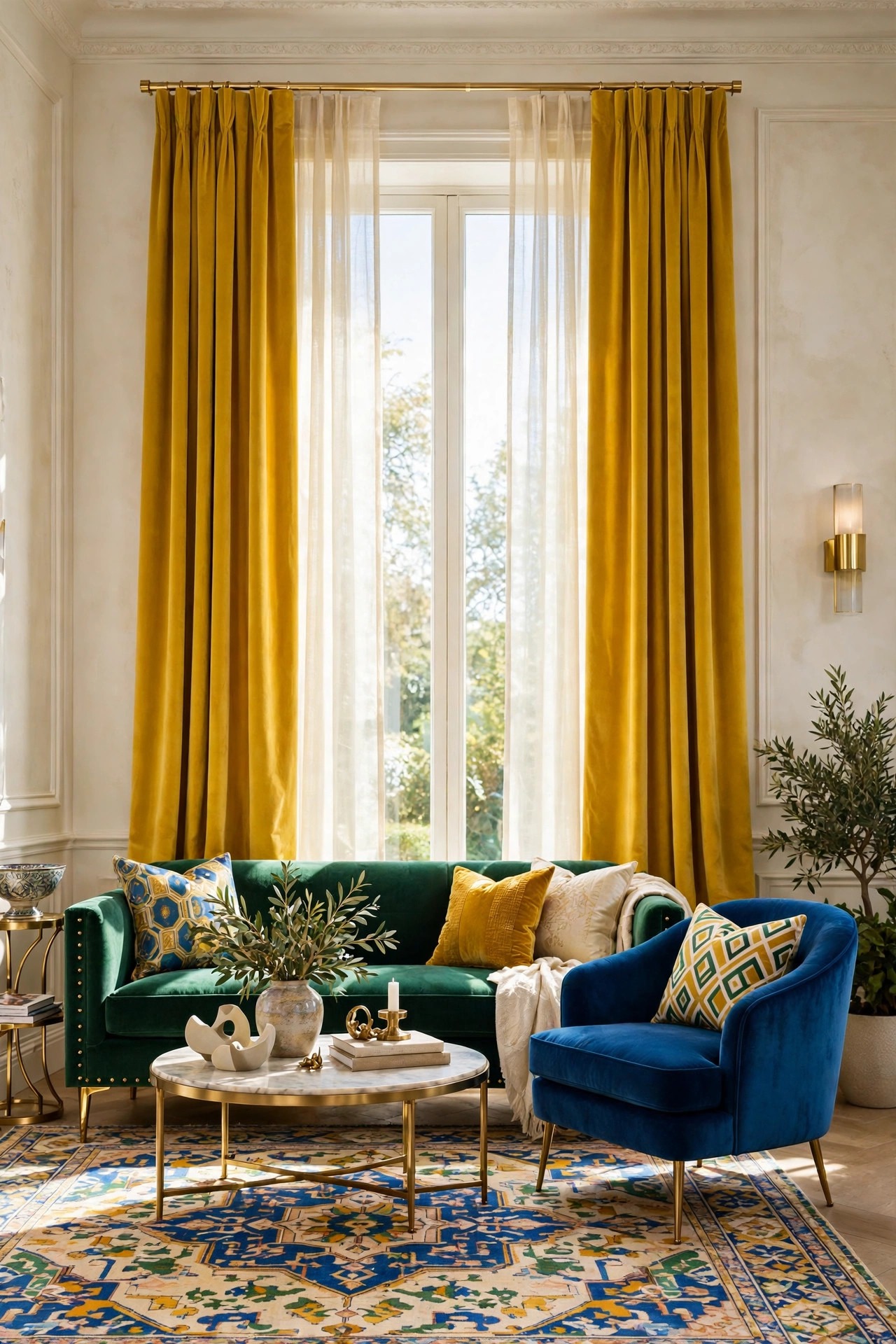
Mustard velvet curtains on a brass rod are the window dressing a vibrant living room needs, because the window is the brightest wall in the room and mustard curtains frame it like a picture in gold. Hang mustard velvet curtains on a slim brass rod, with cream sheers behind them, so the daylight filters soft through the sheers while the mustard gives the window its warmth. Choose velvet with a soft pile, because velvet catches the light and glows at the edges, while a flat curtain in the same color reads dull. Hang the rod high and wide, above the window frame and past its sides, so the curtains hang clear of the glass and the window looks taller. Keep the curtains long enough to brush the floor, never short, because a short curtain in a jewel-tone room reads as a mistake.
Best For: Living rooms with a tall window and an emerald sofa, and anyone who wants the window to carry the warm jewel tone.
Not Ideal For: Windows that face a dark alley; cream curtains with a mustard tieback are the honest version there.
Estimated Cost: $80-$250 (estimate) for mustard velvet curtains, cream sheers and a slim brass rod.
Budget Note: The velvet is the spend; good velvet curtains cost more than cotton ones and hang far better, so buy the curtains first and the rod second.
Renter Friendly: Yes
Renter Note: A curtain rod needs screws the lease allows; a tension rod inside the window frame is the renter version, or use removable rod hooks rated for the weight.
What You Need
Mustard velvet curtains, cream sheer panels, slim brass curtain rod with finials, curtain rings or clips, tape measure.
Product type to look for: Curtains in a lined velvet with a soft pile and a lined back, because mustard curtains in a living room meet strong daylight and must hang straight and not fade quickly.
How To Do It
- Measure the window width and height, then fit the rod high and wide past the frame.
- Hang the sheers first, then the mustard velvet curtains on the same rod or a double rod.
- Pull the curtains to the sides and check they clear the glass and brush the floor.
- Step back and check the window reads tall and framed from the doorway.
Pro Tip
Keep the sheers closed in the daytime and the mustard curtains open. A mustard curtain closed all day blocks the light a bright room needs, while open mustard curtains with closed sheers give privacy and light together.
6. Build a Jewel-Tone Gallery Wall
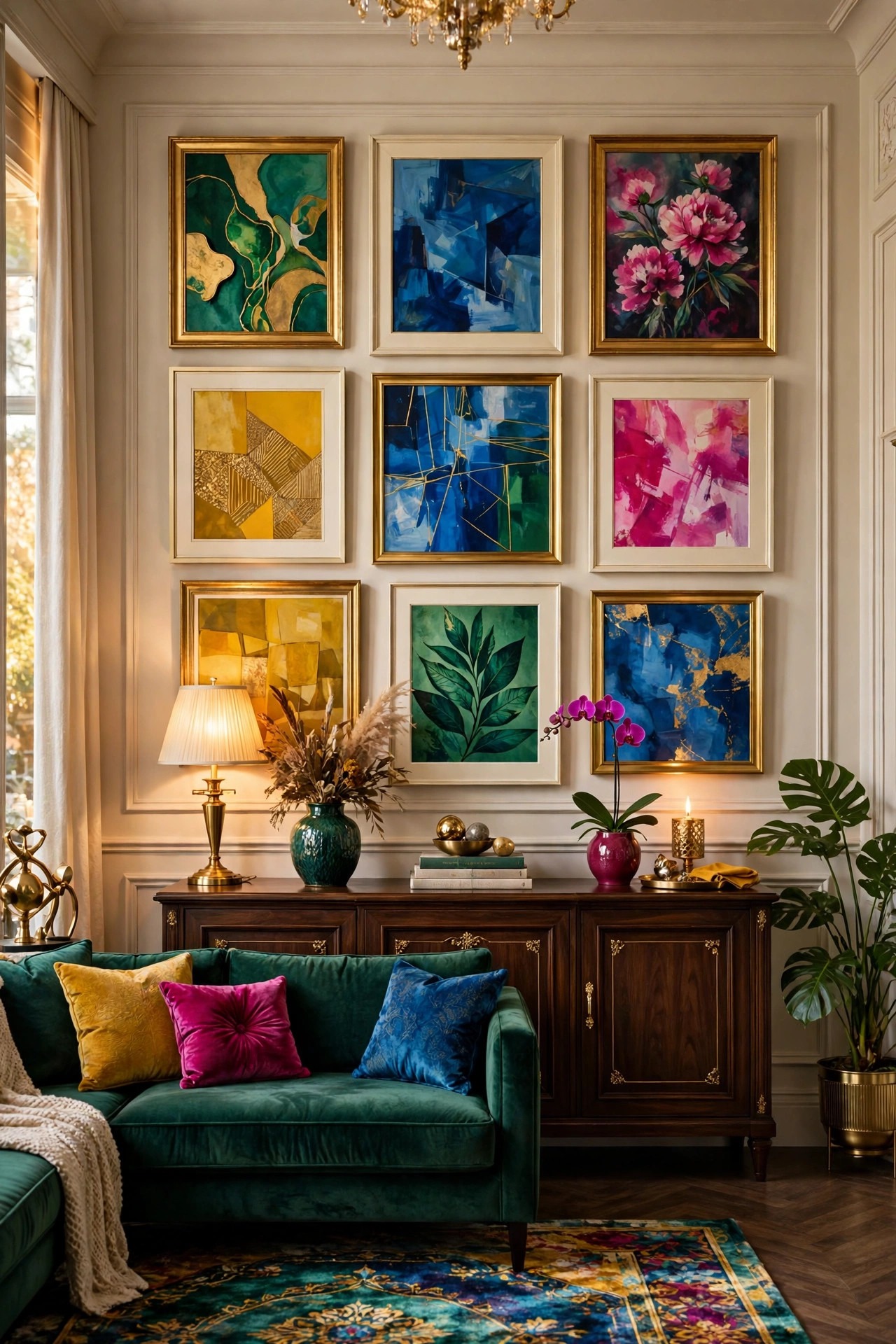
A jewel-tone gallery wall is the art a vibrant living room needs, because small framed pieces in emerald, cobalt, fuchsia and mustard give the room its pictures while repeating every color in the room at once. Mix three or four gold frames with one or two slim cream frames, filled with emerald botanical prints, a cobalt abstract, a fuchsia floral and one small round mirror, and hang them in a loose grid above the sideboard or the sofa. Keep the frames close together, no more than a hand width apart, because a gallery spread too wide reads as separate pictures, while a tight group reads as one wall. Lay the frames on the floor first and photograph the layout, because a gallery planned on the floor is far easier to hang than one planned on the wall. Our minimalist living room shows the same tight gallery idea with pale frames, for readers deciding between jewel-tone and pale frames
Best For: Living rooms with a long empty wall beside the sofa, and anyone who wants art that repeats the whole jewel-tone palette.
Not Ideal For: Walls that already hold a large mirror or a television; one feature per wall keeps the story clear, so choose the gallery or the mirror, not both on one wall.
Estimated Cost: $80-$250 (estimate) for frames, prints and hanging hardware for a small gallery wall.
Budget Note: The frames are the spend; matching gold frames in two sizes cost less than a set of different frames and read as one plan.
Renter Friendly: With Conditions
Renter Note: Hanging needs hooks the lease allows; removable picture strips rated for each frame weight are the renter version, or lean the largest frames on the sideboard instead.
What You Need
Three or four gold frames, one or two slim cream frames, emerald botanical prints, cobalt abstract print, fuchsia floral print, small round mirror, picture hanging strips or hooks.
Product type to look for: Frames with real glass and a sturdy back, because a gallery wall in a living room is dusted often and a thin frame warps when it is handled.
How To Do It
- Lay the frames on the floor and arrange them in a tight grid, photographing the layout.
- Mark the first frame level, then hang the rest using the photograph as the guide.
- Check each frame sits level and the gaps stay even.
- Step back and check the gallery reads as one wall from the doorway, jewel tones leading and gold as the accent.
Pro Tip
Keep one small mirror inside the gallery. A mirror among the prints catches the lamp light and keeps the strong colors from feeling heavy.
7. Style a Cobalt Lacquered Sideboard
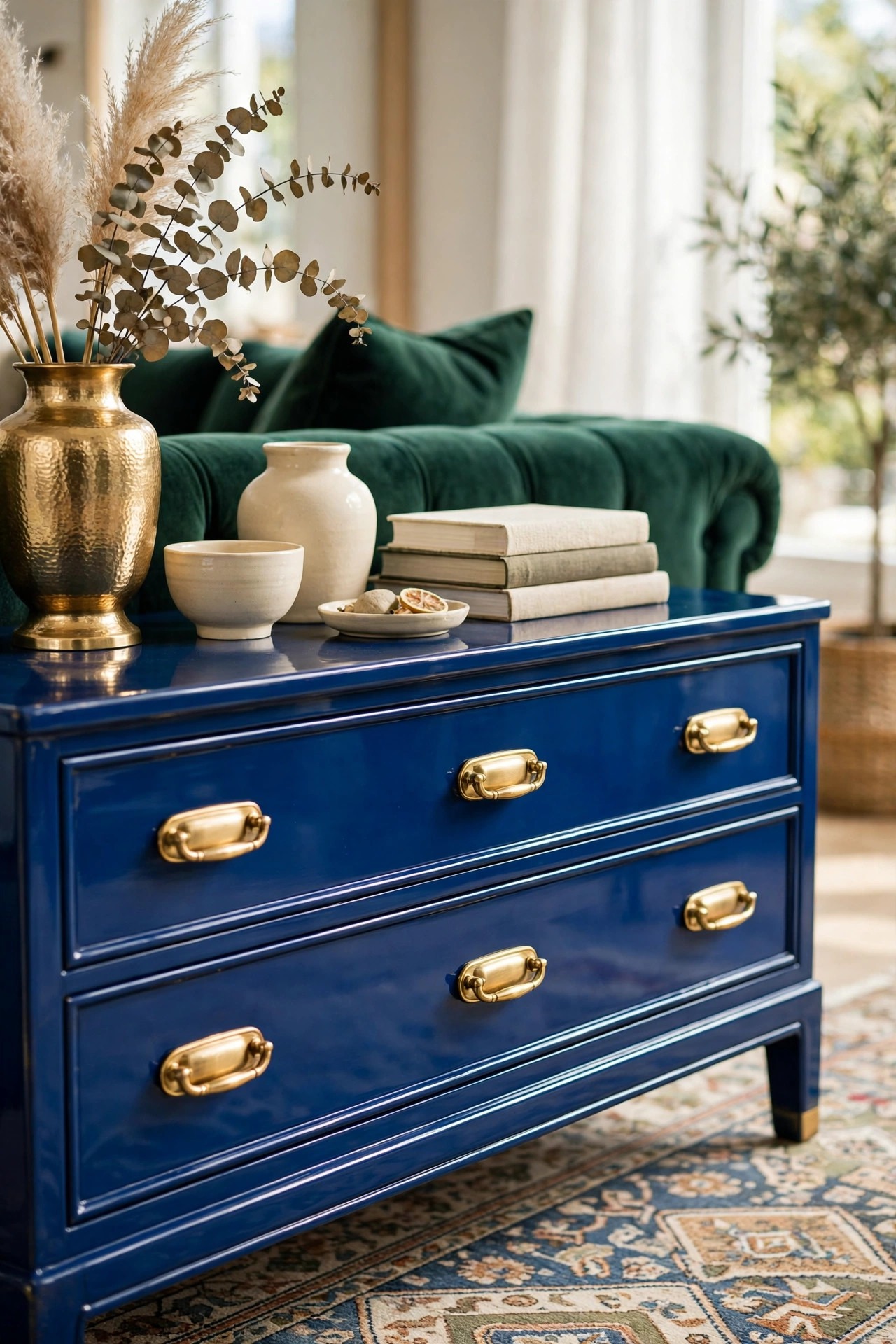
A cobalt lacquered sideboard is the storage a vibrant living room needs, because it holds the everyday pieces while carrying the strongest blue in the room at waist height. Choose a cobalt sideboard with a smooth lacquer finish and slim brass handles, then style the top with a small gold vase, cream ceramics and a stack of two books, so the top reads styled rather than crowded. The pale ceramics lift the strong blue, while the brass repeats the lamp and the frames around the room. Keep the styling to one side of the sideboard, leaving the other side clear for a lamp or a tray, because a top that cannot hold a cup has stopped doing its job. Wipe the lacquer weekly with a soft cloth, because a glossy blue surface shows dust and fingerprints faster than a pale one, and use a tray under the vase so water never marks the finish.
Best For: Living rooms with a long wall that needs storage, and anyone who wants a strong blue that also hides board games and throws.
Not Ideal For: Rooms where the walkway runs tight past the wall; a slim cobalt console table is the honest version there.
Estimated Cost: $250-$700 (estimate) for a cobalt lacquered sideboard with brass handles and styling pieces.
Budget Note: The lacquer is the spend; a well finished sideboard costs more than a painted one, so check the surface is smooth and the doors close evenly before buying.
Renter Friendly: Yes
Renter Note: Nothing fixed at all; a sideboard moves out in one piece on moving day.
What You Need
Cobalt lacquered sideboard with brass handles, small gold vase, cream ceramics, two books, small tray for the vase, soft cloth for dusting.
Product type to look for: A sideboard with a sealed lacquer finish and sturdy hinges, because a sideboard in a living room is opened daily and must wipe clean without scratching.
How To Do It
- Measure the wall and choose a sideboard that leaves a clear walkway beside it.
- Set the sideboard against the wall and check the doors open fully.
- Style one side only, gold vase with the ceramics and the books, and leave the other side clear.
- Step back and check the sideboard reads as one calm group from the doorway, then keep a tray under the vase always.
Pro Tip
Keep the top to three pieces only. A sideboard crowded with objects reads as a shelf, while a vase, ceramics and books read as a plan.
8. Add Fuchsia Cushions to a Cream Sofa
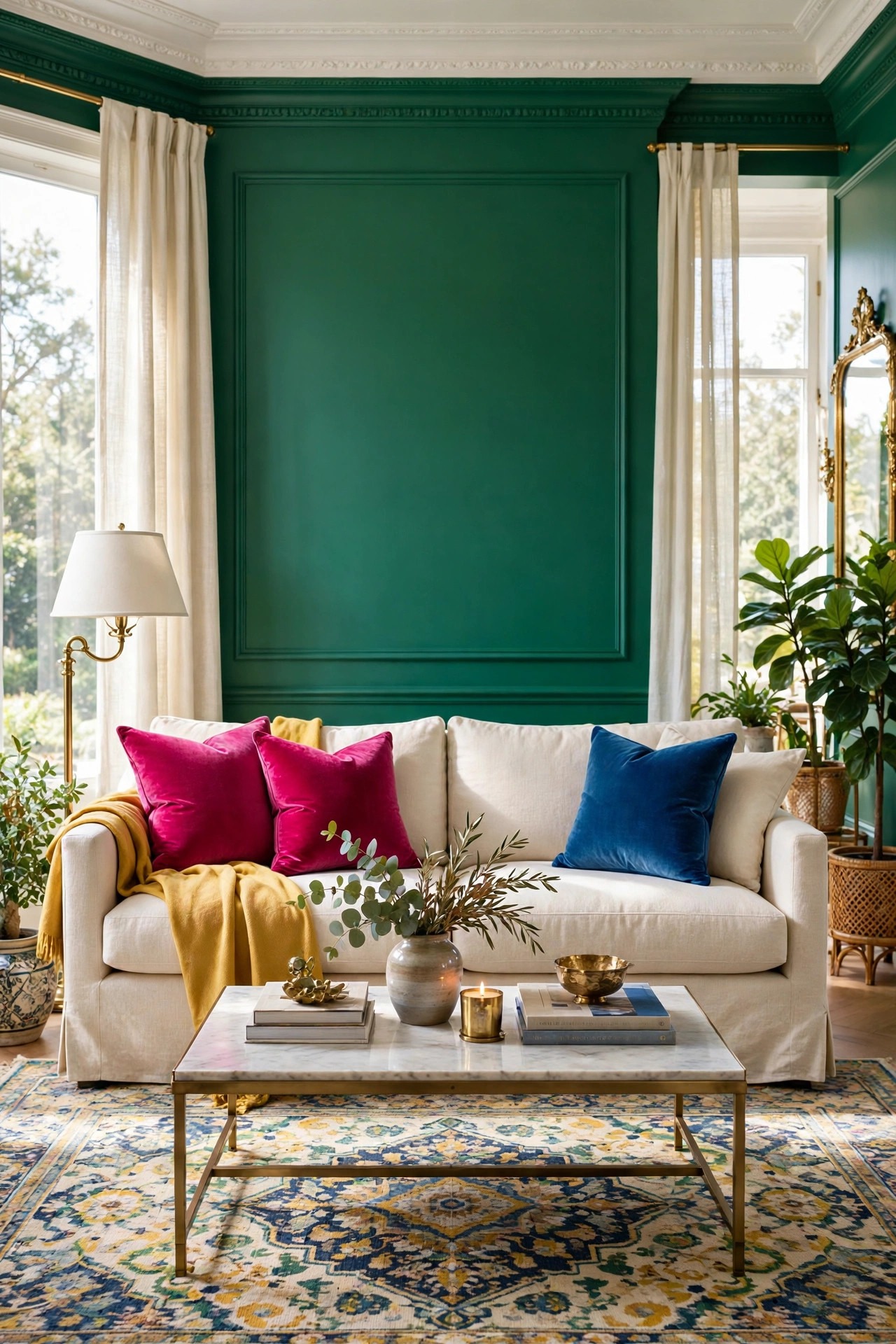
Fuchsia cushions on a cream sofa are the gentlest way into a vibrant living room, because the sofa stays pale while the cushions carry the brightest jewel tone in the room. Choose a cream linen sofa with clean lines, then dress it with two fuchsia velvet cushions, one cobalt cushion and a mustard throw folded over one arm, so the bright colors read as a clear choice rather than an accident. The cream sofa keeps the room calm, while the fuchsia cushions give the eye the strong pink it remembers. Keep the cushions plump and the throw folded, never draped over the whole back, so the sofa reads fresh rather than messy. Our cozy living room ideas show the same cream sofa with soft neutral cushions, for readers deciding between a bright cushion mix and a calm one
Best For: Living rooms where the sofa is already cream, and anyone who wants a vibrant room that can change with the cushions.
Not Ideal For: Homes where the cushions are moved daily by children; a fuchsia throw that washes easily is the honest version there.
Estimated Cost: $60-$180 (estimate) for fuchsia velvet cushions, one cobalt cushion and a mustard throw.
Budget Note: The cushion covers are the spend; good velvet covers cost more than plain ones, so buy the covers first and reuse inserts from old cushions.
Renter Friendly: Yes
Renter Note: Nothing fixed at all; cushions and throws move out in one box on moving day.
What You Need
Cream linen sofa, two fuchsia velvet cushion covers with inserts, one cobalt cushion cover with insert, mustard throw.
Product type to look for: Cushion covers in a rich fuchsia velvet with a hidden zip, because a bright cover in a living room is washed often and must come off easily.
How To Do It
- Dress the cream sofa with the fuchsia cushions first, then the cobalt cushion.
- Fold the mustard throw over one arm and check the three colors sit together.
- Plump the cushions and check they hold their shape when sat against.
- Step back and check the sofa reads bright and calm from the doorway, pink leading and cream behind it.
Pro Tip
Repeat the fuchsia at least twice. One fuchsia cushion looks like an accident, while fuchsia in the cushions and the rug reads as a decision.
9. Tile the Fireplace Wall in Emerald
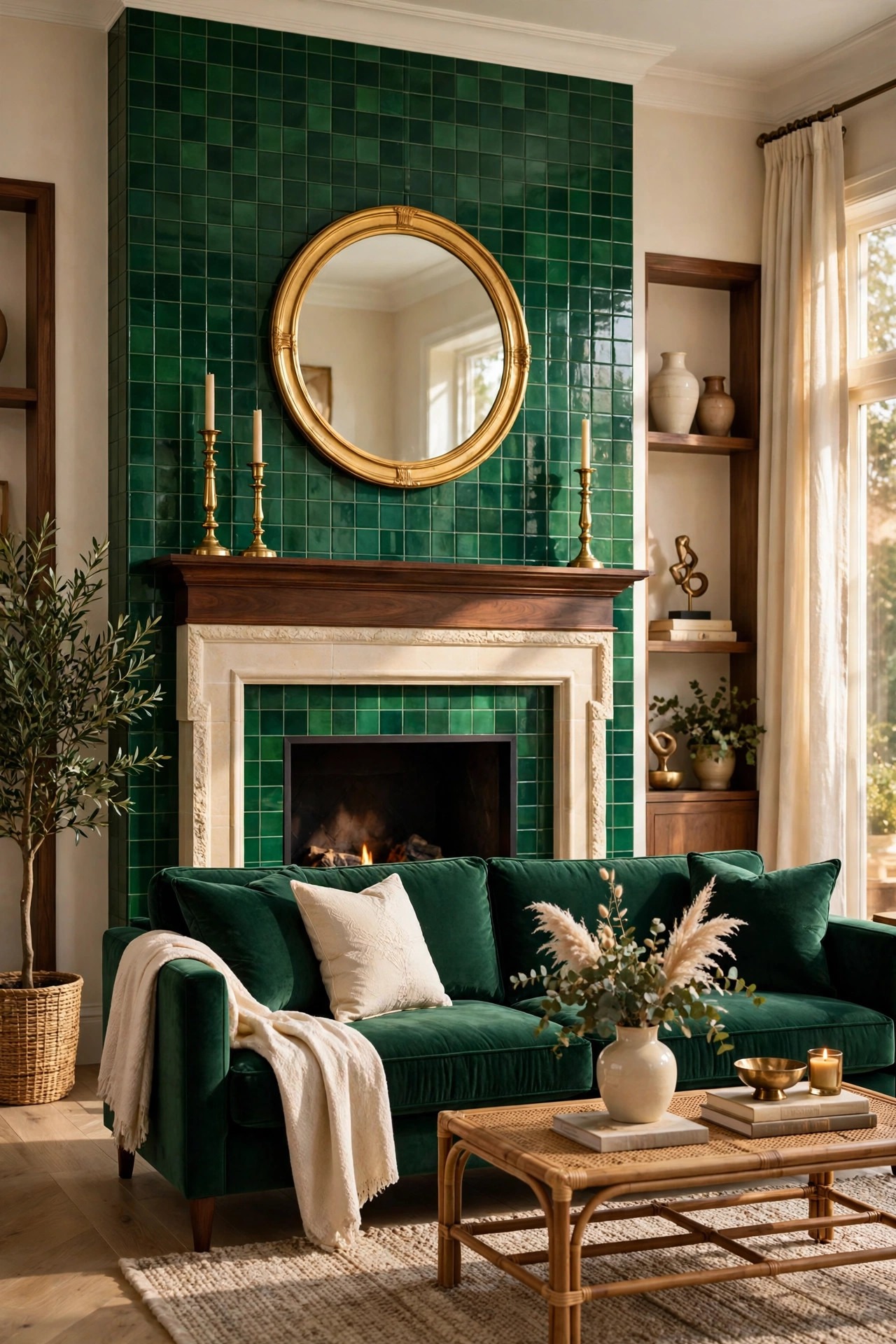
An emerald tiled fireplace wall is the natural focal point of a vibrant living room, because the fireplace already draws the eye and a jewel-tone tile makes it the clear centre of the room. Tile the chimney breast in deep emerald, or paint it emerald and add a tiled hearth, and dress the mantel with brass candlesticks, a small stack of books and a round gold mirror above, so the fire and the gold become the warm notes against the green. Keep the hearth pale, a cream stone or a light rug in front, because a pale hearth stops the green wall from running into the rug. Check the tile and the paint are rated for the heat near the fire opening, and keep candles and throws well clear of the fire.
Best For: Living rooms with a working or decorative fireplace, and anyone who wants one clear jewel-tone focal wall.
Not Ideal For: Rooms with no fireplace; the emerald accent wall in idea 1 is the honest version there.
Estimated Cost: $300-$900 (estimate) for emerald tile or paint, brass candlesticks and a round gold mirror.
Budget Note: The tile is the spend; emerald tile costs more than paint, so buy the tile first and choose the mirror to match its tone.
Renter Friendly: With Conditions
Renter Note: Tiling or painting the fireplace wall needs the landlord’s written permission; renters can still style the mantel with candlesticks and a leaning mirror and leave the wall cream.
What You Need
Emerald tile or emerald paint rated for heat near a fireplace, tile adhesive and grout if tiling, brass candlesticks, round gold mirror, small stack of books, tape measure.
Product type to look for: A mirror with a sturdy gold frame and a secure hanging wire, because a mirror above a fireplace is handled often and must hang safely.
How To Do It
- Check the tile and the paint are rated for the heat near the fire opening, then tape the mantel and the hearth.
- Tile or paint the chimney breast in two thin coats if painting, letting the first coat dry fully.
- Hang the round gold mirror centred above the mantel and check it sits level.
- Style the mantel with the candlesticks at one end, the books in the middle, and step back to check the fire wall reads as the focal point.
Pro Tip
Keep the mantel to three groups only. A mantel crowded with objects splits the focus, while candlesticks, books and a mirror let the emerald wall lead. Never leave a candle burning unattended near a fireplace.
10. Layer Jewel-Tone Lamps and Gold Light
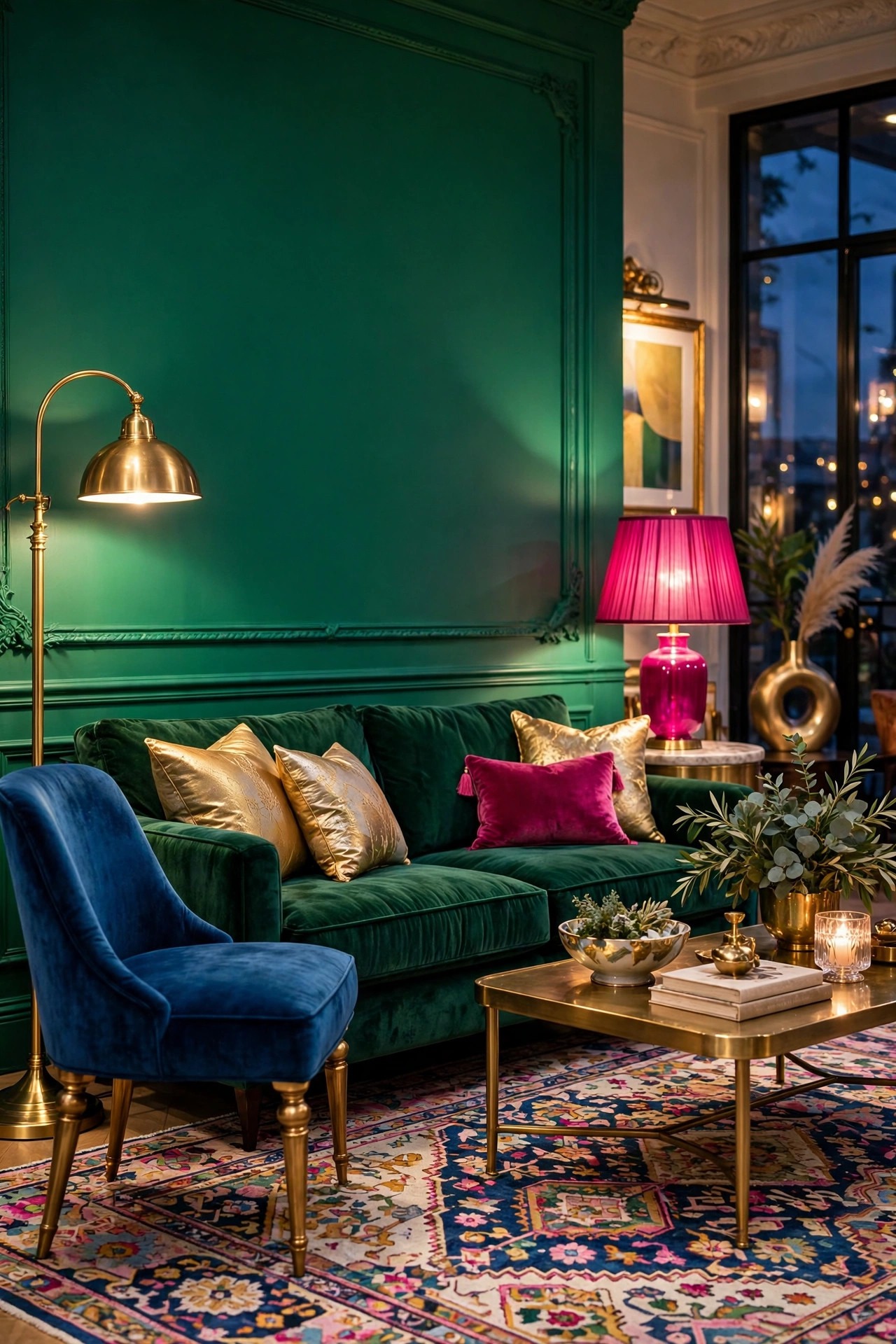
Warm light is what keeps a vibrant living room rich instead of loud, because a jewel-tone wall soaks up light and one ceiling bulb cannot carry the room alone. Layer three warm lights: a brass floor lamp behind the sofa corner, a fuchsia table lamp on the sideboard and a small cluster of candles on the coffee table, all in warm white, never cool white. A cool bulb turns emerald dull and fuchsia harsh, while a warm bulb makes the velvet glow and the brass shine. Put the floor lamp on a dimmer or a smart bulb, so the light can drop low after dinner, and keep the ceiling light off in the evening, because one warm glow at sofa height reads as glam while a bright ceiling light reads as an office. Check the lamp shades before buying, because a dark shade blocks the light and a cream shade spreads it.
Best For: Every vibrant living room, and especially rooms where the jewel-tone wall makes the evenings feel flat.
Not Ideal For: Rooms with strong daylight all day; the lamps then matter only after dark, so spend on the rug first.
Estimated Cost: $80-$250 (estimate) for a brass floor lamp, a fuchsia table lamp and warm white bulbs.
Budget Note: The floor lamp is the spend; a good brass lamp with a cream shade costs more than a plain one and gives the room its evening glow.
Renter Friendly: Yes
Renter Note: Nothing fixed at all; lamps plug in and move out on moving day, and no wiring is touched.
What You Need
Brass floor lamp with a cream shade, fuchsia table lamp with a cream shade, warm white bulbs, small candles in glass holders.
Product type to look for: Lamps with warm white bulbs and shades that spread light, because a jewel-tone room needs light that reaches the sofa, not light trapped in the shade.
How To Do It
- Place the floor lamp behind the sofa corner and the table lamp on the sideboard.
- Fit warm white bulbs in both lamps and switch them on at dusk.
- Add the candles to the coffee table tray and check the glow feels warm against the emerald wall.
- Step back and check the room glows from the doorway, then keep the ceiling light off in the evening.
Pro Tip
Keep the light at sofa height, not at the ceiling. Two warm lamps at seating height make a jewel-tone room feel rich, while one bright ceiling light makes it feel small. Never leave a candle burning unattended.
11. Style Emerald Open Shelves with Brass and Plants
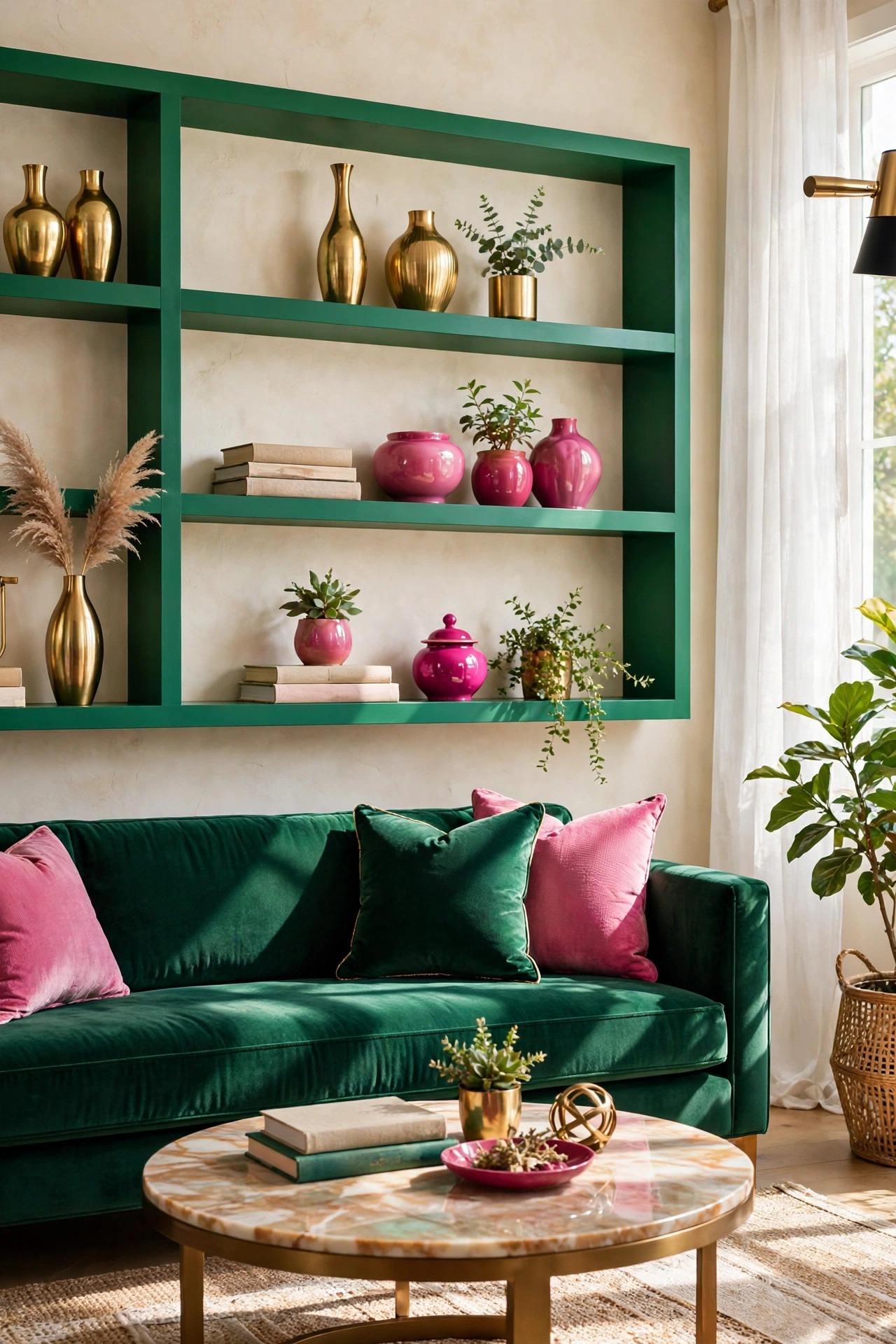
Emerald open shelves with brass and plants are the display a vibrant living room needs, because the shelves give the room its objects without a cupboard door hiding them. Fit two emerald shelves on the cream wall, then style them with small gold vases, a trailing plant, stacked books and fuchsia ceramics, leaving clear space between the groups, so each object reads on its own. Keep the shelves shallow, no deeper than a book, and load the heaviest pieces on the lowest shelf, so the shelves stay steady and the wall stays calm. Mix the materials on purpose, gold with ceramic, plant with books, because a shelf of one material reads as a shop display, while a shelf of mixed materials reads as a home. Check the shelf fixings before loading, because a shelf is heavier than it looks once books are added.
Best For: Living rooms with a cream wall and a collection to show, and anyone who wants display space without a cabinet.
Not Ideal For: Homes with small children who pull at low shelves; a closed cobalt sideboard is the honest version there.
Estimated Cost: $60-$200 (estimate) for two emerald shelves, brackets, gold vases and small plants.
Budget Note: The shelves and brackets are the spend; good emerald shelves cost more than pale ones, so buy the brackets rated for books first.
Renter Friendly: With Conditions
Renter Note: Shelves need screws the lease allows; a leaning ladder shelf in emerald is the renter version, or use a tall emerald bookcase instead.
What You Need
Two emerald shelves with brackets rated for books, small gold vases, trailing plant, stacked books, fuchsia ceramics, level.
Product type to look for: Shelves with brackets rated well above the load, because open shelves in a living room hold books and ceramics and must not sag.
How To Do It
- Mark the shelves level on the cream wall, leaving clear space above the sofa.
- Fit the brackets following the maker instructions, checking the weight rating first.
- Style the lowest shelf heaviest, books and ceramics, and the top shelf lightest, plant and gold vase.
- Step back and check the shelves read as two calm lines from the doorway, with space between the groups.
Pro Tip
Keep one third of each shelf empty. A shelf filled edge to edge reads as storage, while a shelf with clear space reads as display.
12. Add a Mustard Pouf and a Jewel-Tone Throw
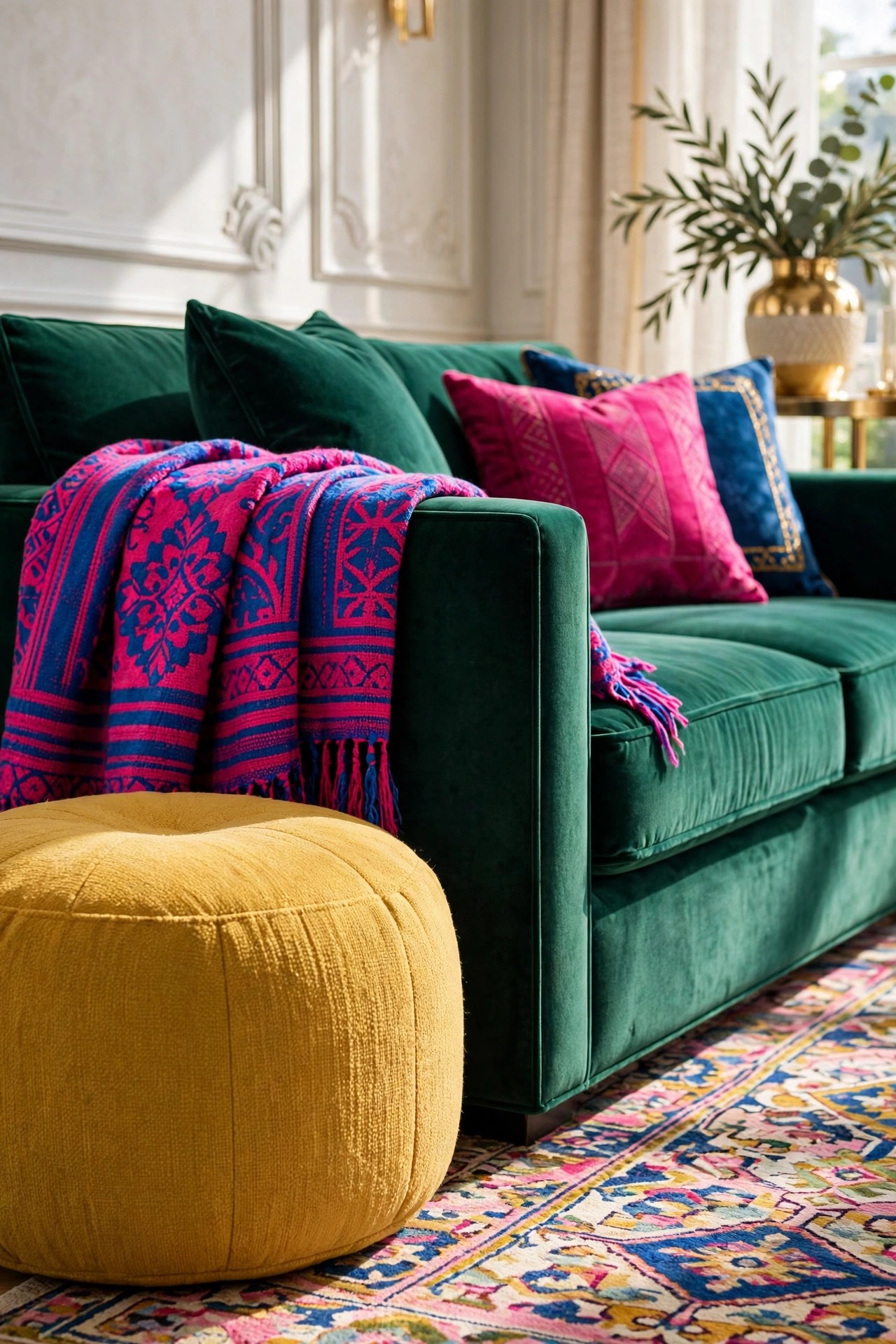
A mustard pouf and a jewel-tone throw are the small bright pieces a vibrant living room needs, because they add mustard and fuchsia at floor and sofa level without another large piece of furniture. Choose a mustard pouf in a soft woven fabric, firm enough to sit on and light enough to move, and place it beside the emerald sofa where it can serve as a footrest, an extra seat or a side table with a tray on top. Drape a fuchsia and cobalt throw over the sofa arm, folded rather than spread, so the bright colors read as a clear accent and the sofa still shows. Move the pouf where it is needed, by the chair for reading or by the coffee table for guests, because a pouf that stays in one corner is wasted. Keep the pouf out of the main walkway, so it holds a book and a cup rather than blocking the path.
Best For: Living rooms that need an extra seat without another chair, and anyone who wants mustard at floor level.
Not Ideal For: Rooms where the floor space is already tight; a folded mustard throw on the sofa arm is the honest version there.
Estimated Cost: $50-$150 (estimate) for a mustard pouf and a fuchsia and cobalt throw.
Budget Note: The pouf is the spend; a well stuffed pouf costs more than a soft one and holds its shape, so press it before buying.
Renter Friendly: Yes
Renter Note: Nothing fixed at all; the pouf and the throw move out in one box on moving day.
What You Need
Mustard pouf in a soft woven fabric, fuchsia and cobalt throw, small tray for the pouf top if used as a table.
Product type to look for: A pouf with a firm fill and a removable washable cover, because a pouf in a living room is sat on and moved daily and must clean easily.
How To Do It
- Place the mustard pouf beside the emerald sofa and check the walkway stays clear.
- Fold the fuchsia and cobalt throw over the sofa arm and check the colors sit together.
- Sit on the pouf and check it holds its shape, then set a tray on top to test it as a table.
- Step back and check the pouf reads as a bright accent from the doorway, mustard leading and the throw behind it.
Pro Tip
Keep the throw folded, not spread. A throw spread over the whole sofa hides the velvet, while a throw folded over one arm adds color and keeps the emerald showing.
13. Balance the Bright with Cream and Gold
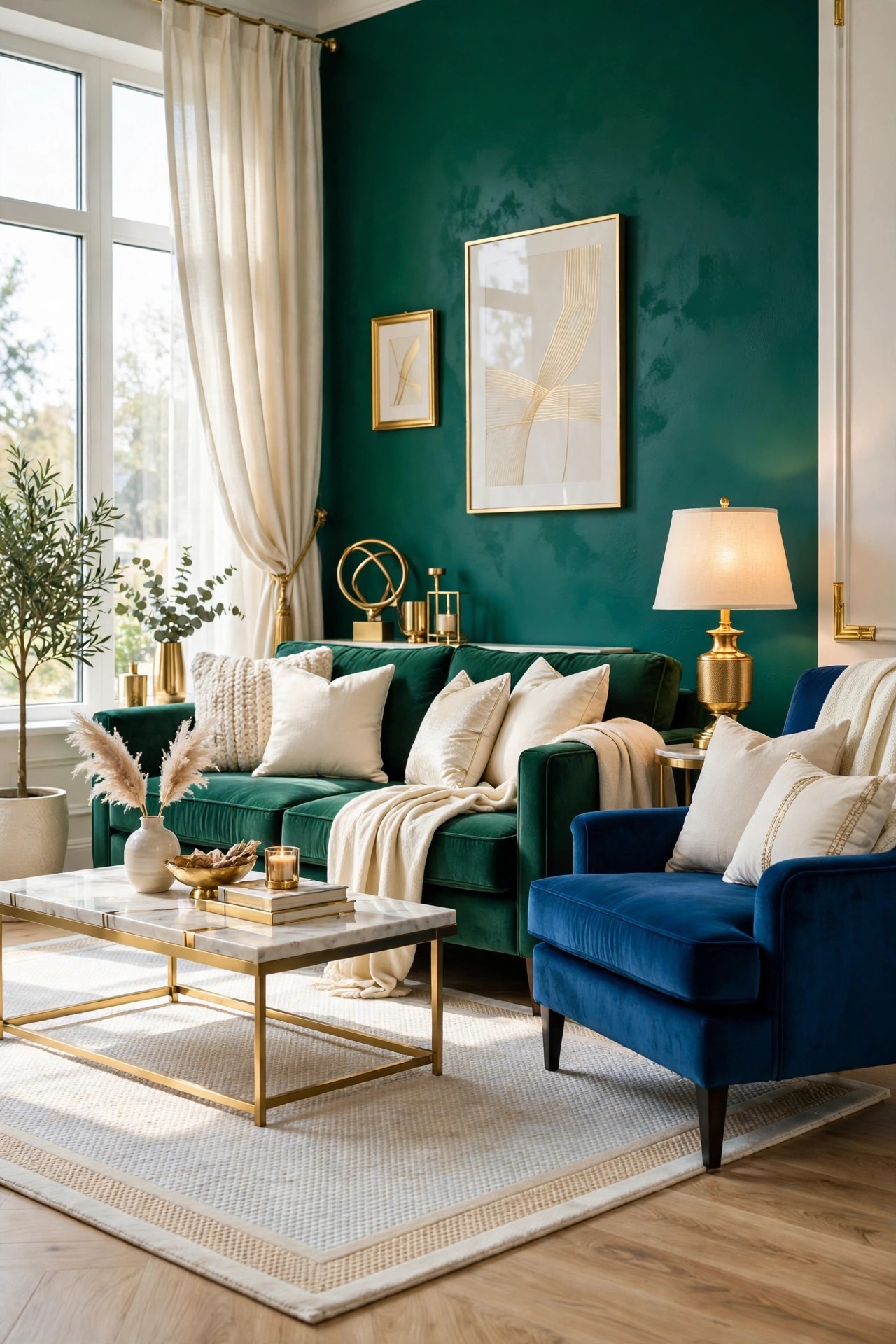
Cream and gold are the balance a vibrant living room needs, because a room that is all jewel tone has nowhere for the eye to rest. Add cream in three places, a folded throw on the sofa arm, cream cushions on the emerald sofa and a pale border on the rug, and add gold in three small places, the lamp base, the tray and the picture frames, so the light notes repeat until they look planned. Keep the gold small, because a large gold piece in a bright room shouts, while small gold notes glow. Choose cream in warm linen and cotton, never bright white, because a cold white against emerald reads harsh, while a warm cream reads soft. Step back and count the pale notes; if the room still feels loud, add one more cream cushion before adding another bright piece. Our scandinavian living room shows the opposite choice, pale walls with dark furniture, for readers who want to compare the two directions
Best For: Every vibrant living room, and especially rooms where the first jewel-tone pieces already feel loud.
Not Ideal For: No real exception; even a lightly bright room needs its pale notes, so this idea works at every budget.
Estimated Cost: $60-$180 (estimate) for cream throws, cream cushions and small gold accents.
Budget Note: The cushions are the spend; good cream linen cushion covers cost more than plain ones, so buy the covers first and reuse inserts from old cushions.
Renter Friendly: Yes
Renter Note: Nothing fixed at all; throws, cushions and trays move out in one box on moving day.
What You Need
Cream linen throws, cream linen cushion covers with inserts, small gold tray, gold picture frames, warm taupe throw.
Product type to look for: Cushion covers in a warm cream linen with a hidden zip, because a cream cover in a living room is washed often and must come off easily.
How To Do It
- Add the cream cushions to the emerald sofa first, then the folded throw on the arm.
- Place the small gold tray on the coffee table and the gold frames on the wall.
- Check the pale rug border still shows around the bright rug.
- Step back and count three cream notes and three gold notes, then add one more cream cushion if the room still feels loud.
Pro Tip
Repeat every accent at least twice. One gold lamp looks like an accident, while gold in the lamp, the tray and the frames reads as a decision.
14. Mix Jewel-Tone Textures: Velvet, Silk and Wool
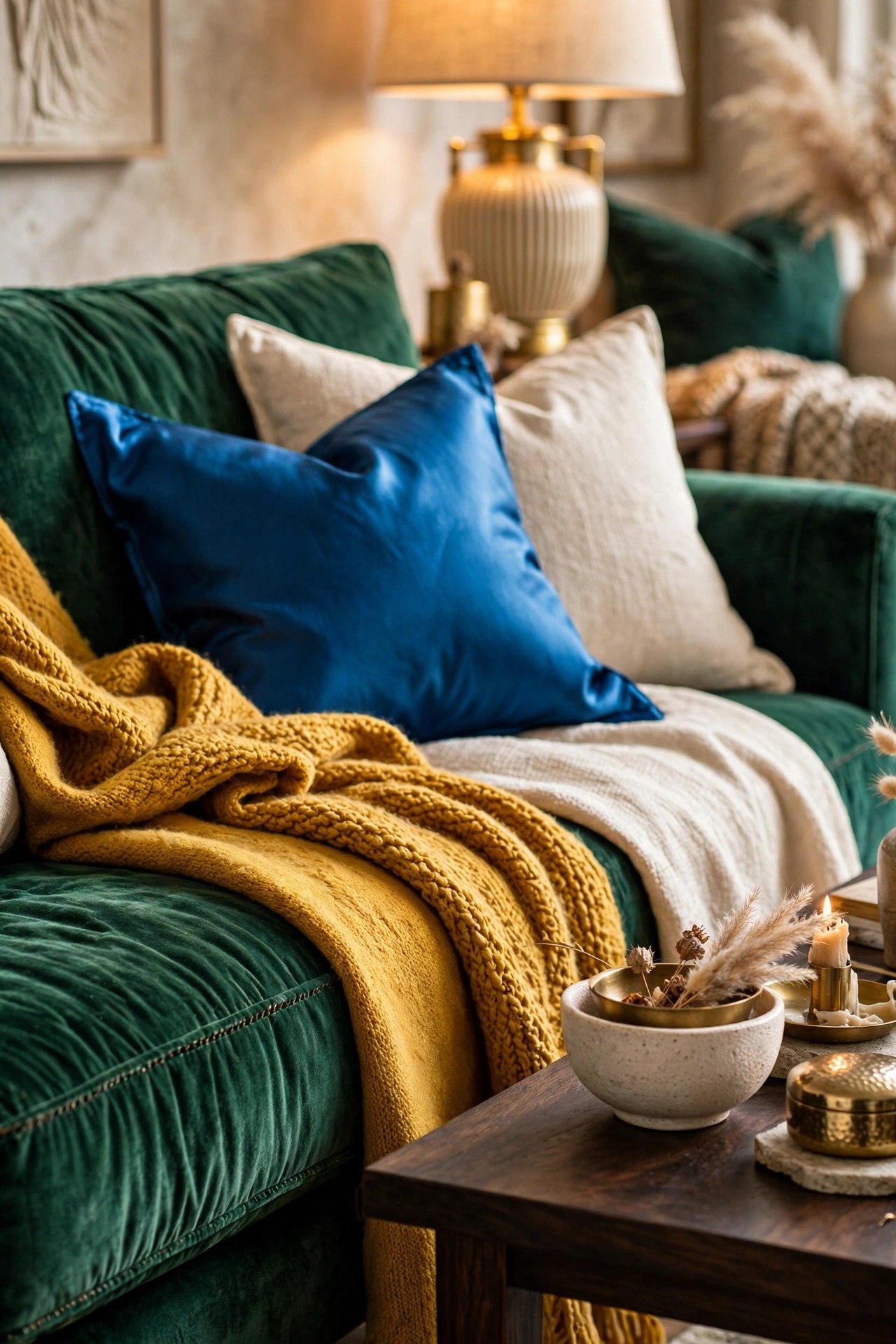
Texture is what keeps a vibrant living room from reading flat, because a room in strong colors with one material looks painted rather than decorated. Layer three textures on purpose: the soft pile of the emerald velvet sofa, the smooth shine of a cobalt silk cushion and the loose weave of a mustard wool throw, with cream linen cushions to soften the edges. Keep the colors close to the jewel-tone family, emerald, cobalt, fuchsia and mustard, so the textures do the talking instead of adding new colors. Touch each piece before buying, because a velvet that feels rough and a wool that feels scratchy will never be used, and a room is only cozy if its textures invite touch. A jewel-tone room with three textures feels rich at dusk, when the lamp light moves across each surface differently.
Best For: Living rooms where the jewel-tone pieces already match in color, and anyone who wants depth without adding another color.
Not Ideal For: Rooms with very little seating; an emerald velvet sofa and one mustard wool throw are the honest version there.
Estimated Cost: $80-$220 (estimate) for a mustard wool throw, cobalt silk cushion covers and leather care for the chair.
Budget Note: The wool throw is the spend; a good wool throw costs more than a synthetic one and lasts far longer, so buy the throw first.
Renter Friendly: Yes
Renter Note: Nothing fixed at all; throws and cushions move out in one box on moving day.
What You Need
Mustard wool throw, cobalt silk cushion covers, cream linen cushion covers, soft cloth for dusting velvet.
Product type to look for: A wool throw in a loose weave that drapes well, because a throw in a living room is folded, draped and washed, and must keep its shape.
How To Do It
- Dress the emerald velvet sofa with the linen cushions and the folded wool throw.
- Place the cobalt silk cushion beside the fuchsia cushion and check the two textures sit side by side.
- Run a hand over each surface and check the velvet, the silk and the wool each feel different.
- Step back at dusk and check the lamp light moves across the textures, giving the bright room its depth.
Pro Tip
Keep the palette to four jewel tones and two lights. A room with three textures in seven colors splits the eye, while three textures in emerald, cobalt, fuchsia, mustard, cream and gold reads as one calm room.
15. Finish with a Jewel-Tone Tray Scene on the Coffee Table
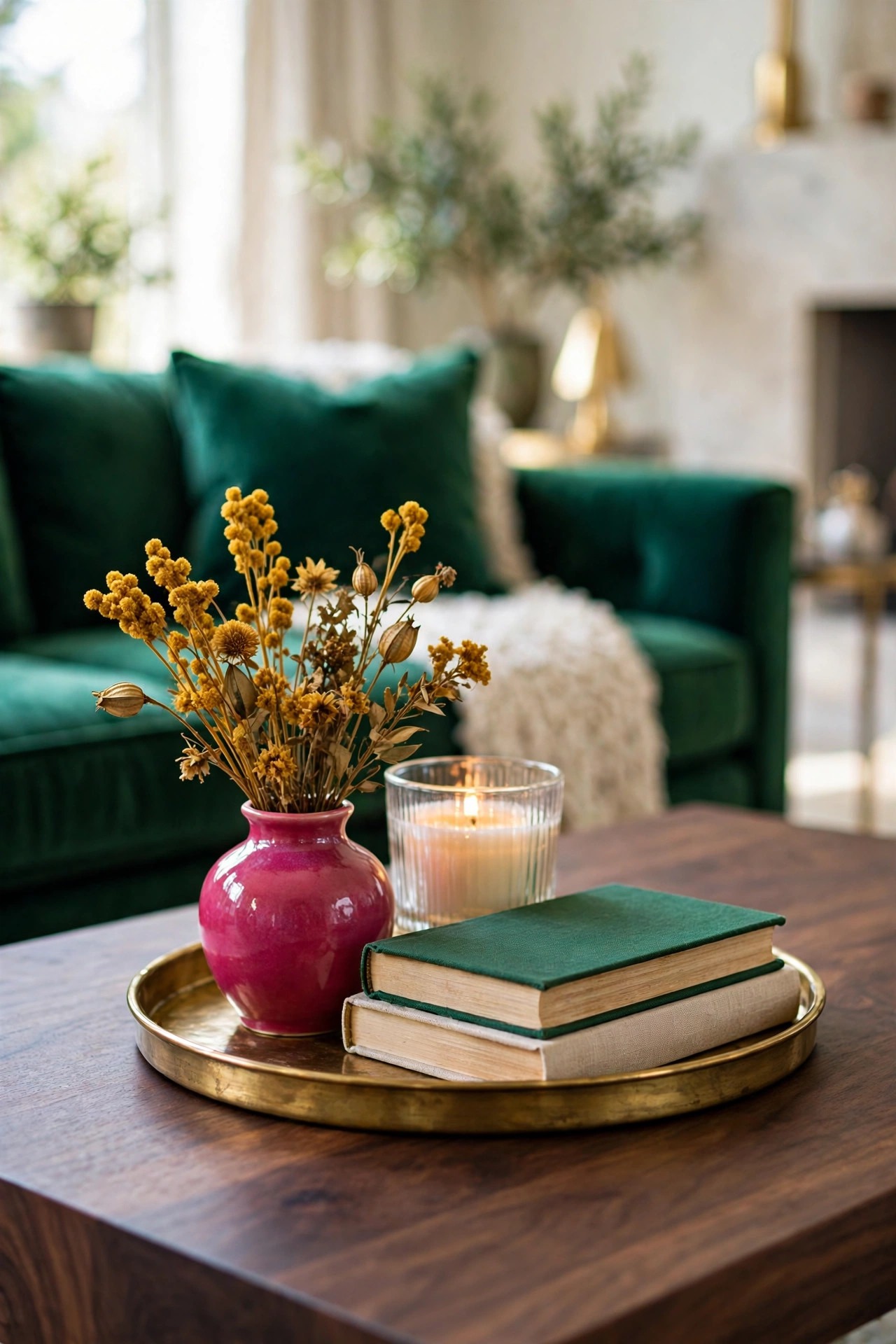
The last styling idea is the smallest, and it is what makes a vibrant living room look finished in photos and in person. A small brass tray on the walnut coffee table, holding a fuchsia ceramic vase with mustard dried stems, a candle in a glass holder and a stack of two books, gathers the daily pieces into one calm group and repeats the jewel tones at the centre of the room. Keep the tray low and the scene honest, sized for what the room actually uses every day, because a styled table that has to be emptied before anyone can set down a cup is a display, not a finish. Change the stems when they fade and wipe the tray when you wipe the table, and the finish keeps itself. Leave room on the table for two cups, because a table that cannot hold a cup has stopped doing its job. Never leave a candle burning unattended, and keep the candle in its glass holder away from the dried stems and the throws.
Best For: Every vibrant living room, and especially rooms that look fine in daylight and unfinished in photos.
Not Ideal For: No real exception, but keep the tray small on a tiny table so the books and the cups still fit.
Estimated Cost: $30-$80 (estimate) for a small brass tray, a fuchsia ceramic vase, mustard dried stems and a candle in a glass holder.
Budget Note: Shop the house first; a tray and a vase moved from another room finish the table for nothing.
Renter Friendly: Yes
Renter Note: Nothing fixed at all; the whole scene can be packed in one box on moving day.
What You Need
Small brass tray, fuchsia ceramic vase, mustard dried stems, candle in a glass holder, two books, soft cloth for dusting.
Product type to look for: A tray with a low rim and a stable, flat base, because a tray on a walnut table must sit flat and not slide when a cup is set down.
How To Do It
- Clear the coffee table fully, then place the tray on one side of the table.
- Set the vase and the candle inside the tray and the books beside it.
- Check two cups still fit on the table without moving the scene.
- Walk to the door and check the table as a guest sees it: walnut leading, gold calm, jewel tones bright, surfaces clear.
Pro Tip
Reset the scene every evening for one week. The habit, not the objects, is what keeps a styled finish: tray grouped, books stacked, stems fresh, table two thirds clear.
Practical Tips for Vibrant Living Room Ideas
Let the jewel tones be the clear notes and repeat the warm notes until they look planned. The wall stays emerald, the sofa stays emerald velvet, the chair stays cobalt, and cream, warm taupe and brushed gold do the supporting work, each used at least twice: gold in the lamp and the tray, cream in the cushions and the throws, fuchsia in the cushions and the rug, mustard in the curtains and the pouf. One note used once looks like an accident; twice or more it looks like a decision. Keep the light layered and warm, because the emerald wall soaks up light and three warm lights at sofa height are what make the room glow after dark. Measure every piece before buying, because a sofa one foot too long and a rug that stops short of the sofa legs both waste a season, and judge the room twice before calling it done, once at midday for the true colors and once under the evening lamps. Start in the order of this list, wall and sofa first, and let the shelves, the plants and the soft layers arrive slowly; a bright room built in a weekend usually has one object too many, and removing a piece is always easier than finding the right one to add. Keep the textures to one family, velvet, silk and wool together, because two competing patterns split a jewel-tone room into two stories. Our farmhouse living room shows the same balance idea with a cream surround and wood tones, for readers who want to compare a bright room with a calm one
Frequently Asked Questions
What is a vibrant living room?
A vibrant living room is a living room with a saturated jewel-tone palette used across the whole room, usually an emerald wall or sofa, a cobalt chair, fuchsia cushions and mustard curtains, softened with cream, warm taupe and gold. It differs from a colorful living room, which adds many colors one piece at a time on a cream base, and it differs from a living room color combination guide, which explains how colors sit together rather than building one whole room in jewel tones. This collection is the broad living room version: emerald, cobalt, fuchsia and mustard in large pieces, with no pale-only palette and no single accent piece carrying the color alone.
How do I keep a vibrant living room from feeling too loud?
Keep the jewel tones to four colors and repeat the cream and gold notes at least twice each. Cream cushions, a pale rug border, a large mirror opposite the window and three warm lamps give the eye pale places to rest, while the emerald wall, the cobalt chair and the mustard curtains carry the color. Judge the room at midday and again under the evening lamps before adding another bright piece.
What colors go with a vibrant living room?
Emerald, cobalt, fuchsia and mustard lead, with cream, warm taupe and brushed gold as the supporting colors. Keep the gold in small notes, the lamp, the tray and the frames, and keep the cream in the cushions and the throws, so the jewel tones stay rich rather than harsh.
Can I do a vibrant living room in a small room?
Yes, if the strong color is kept to a few large pieces. An emerald velvet sofa on a cream wall, or one emerald wall behind a pale sofa, gives a small room the bold feel without closing it in. Keep the rug pale at the edges, the curtains open in the daytime and the floor showing, because a small bright room needs its light and its floor space.
Is a vibrant living room renter friendly?
Most of it is, because the color can live in furniture rather than paint. An emerald sofa, a cobalt chair, a bright rug, mustard curtains on a tension rod and a fuchsia cushion need no permission at all, while the emerald wall, the shelves and the gallery need the landlord’s written permission or a removable version. Choose the furniture first if the lease forbids painting. Our modern luxury living room uses the same furniture first rule for a glam room, for readers planning both rooms
How much does a vibrant living room cost?
It depends on the sofa and the chair, which are the two big spends. A room built around an emerald velvet sofa, a cobalt chair, a bright rug, a walnut table and warm lamps usually sits in the low thousands, while a room built with paint, a bright rug, shelves and a brass tray scene can be done for a few hundred. Start with the wall and the sofa, then add the rest slowly.
Conclusion
A vibrant living room works when the jewel tones are given one clear job: the emerald wall leads, the cobalt chair answers it, and fuchsia and mustard repeat across the rug, the cushions and the curtains. An emerald velvet sofa and a bright patterned rug keep the room rich underfoot, cobalt and mustard keep the color moving around the room, and warm lamps, cream cushions and gold trays keep the light coming in. Start with the wall and the sofa, add the rug and the chair, keep one dark wood, one metal and one soft accent through the whole room, and the boldest corner of the house becomes the one everyone gathers in after dark.