15 Terracotta Living Room Ideas in Cream, Wood and Gold
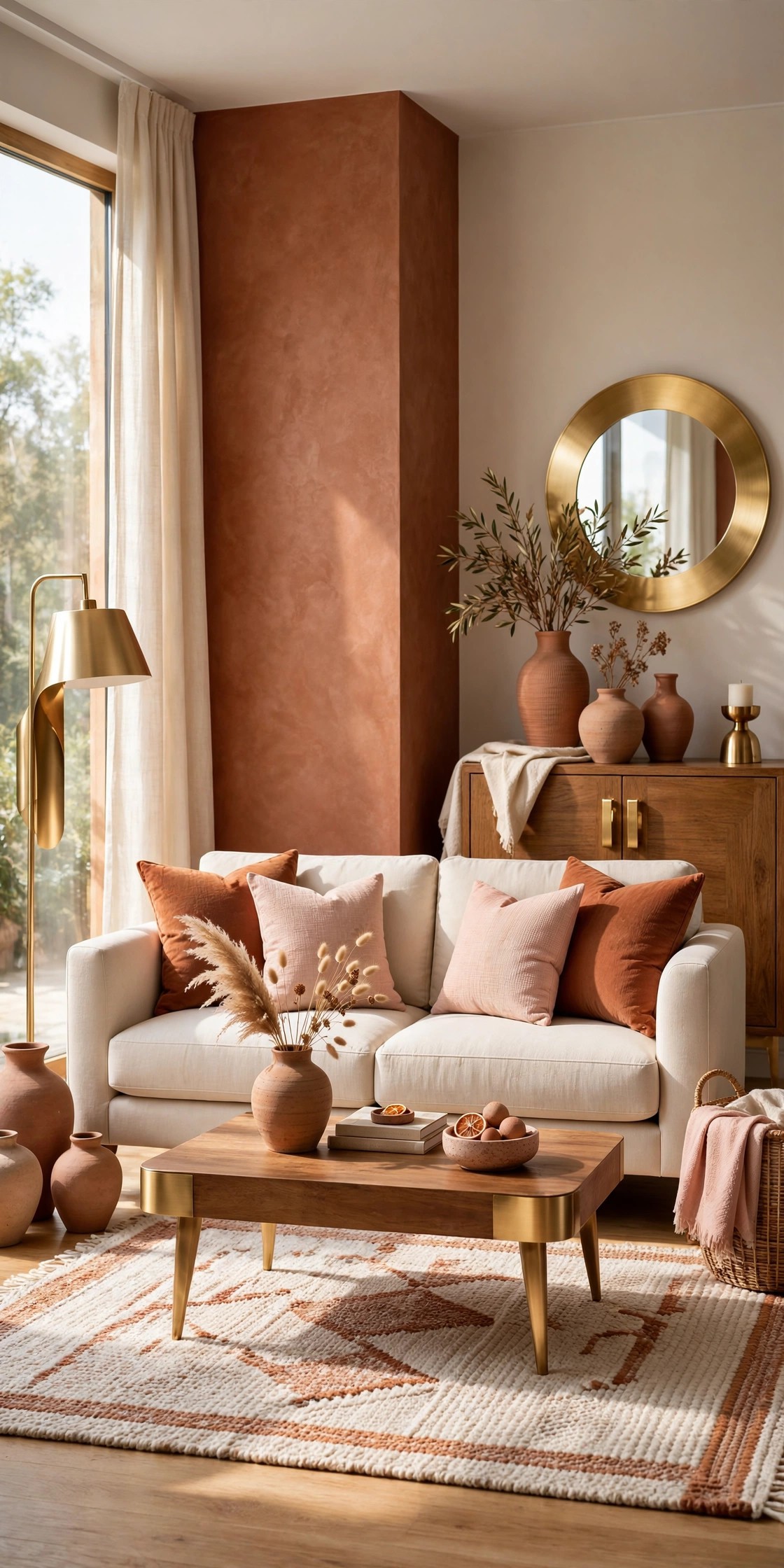
A terracotta living room promises warmth, but it is easy to get the balance wrong. Too much clay colour and the room turns dark and dusty; too little and it reads as a plain cream room with two orange cushions. These terracotta living room ideas build the colour in layers that keep the room bright: one strong surface at a time, a clay accent wall or a terracotta sofa, then rugs, curtains and ceramics in rust and clay tones, all held against cream walls and furniture, warm wood and brushed gold. Blush pink softens the scheme where it needs a lighter note, and daylight does the rest. Work through the ideas in order, because the early ones set the colour strength and the later ones fine-tune it. The same warm, layered approach in an older, softer form appears in our guide to vintage rooms with cream and warm wood
Disclosure: This article may contain affiliate links. If you buy through a link on this page, GlamNStyle may earn a small commission at no extra cost to you. Product links in this article are plain links; each one is checked on the retailer’s own page before it is added.
1. Start With One Terracotta Accent Wall
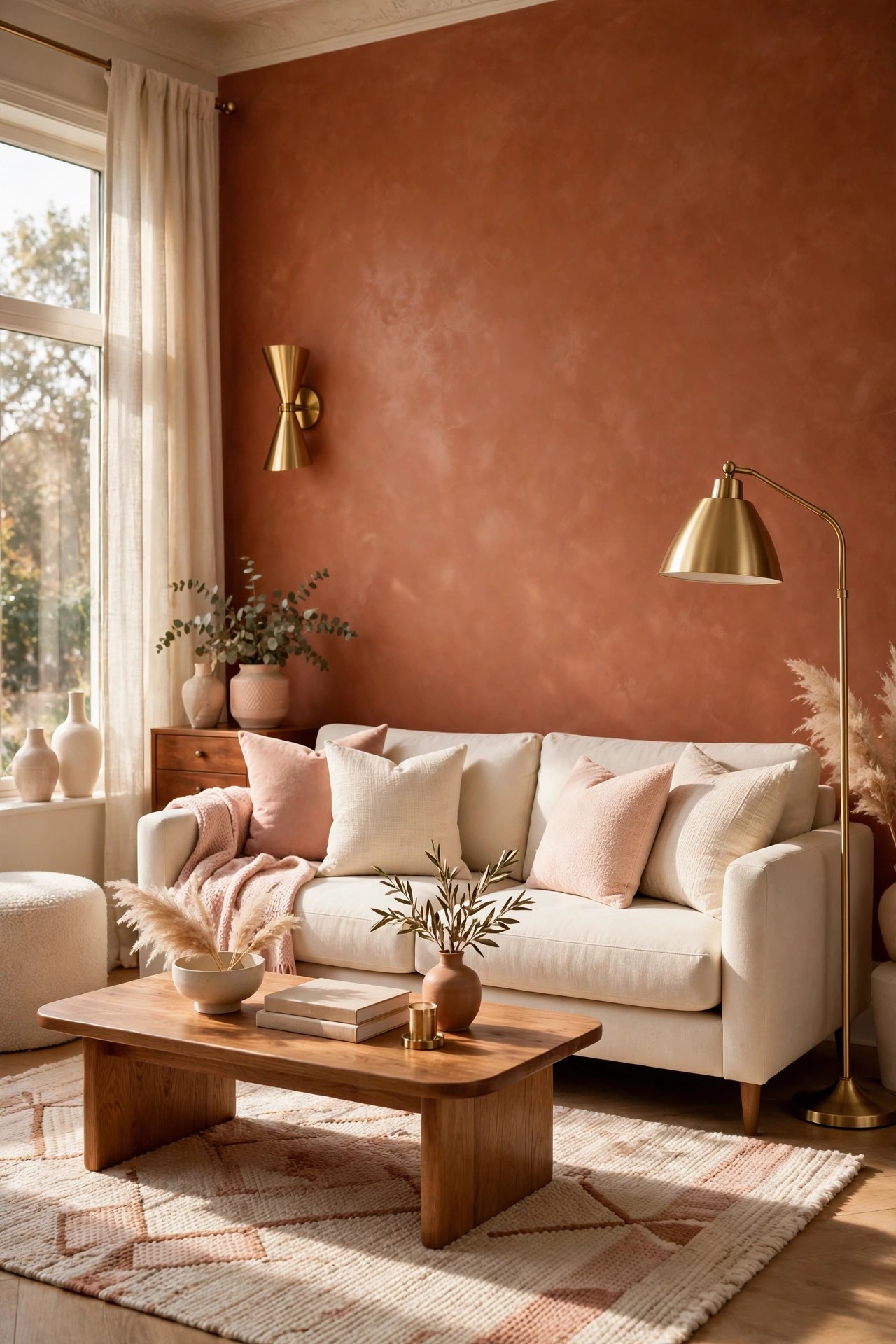
One painted wall is the clearest way to set a terracotta scheme, and the easiest to control. Choose the wall behind the sofa or the fireplace, paint it in a warm clay tone with a soft matte finish, and keep the other walls cream so the room stays bright. Test the colour properly before committing: terracotta deepens as it dries and looks stronger on a full wall than on a card, so paint a large sample area and check it in morning and evening light. Keep the furniture in front of the wall light in tone, cream sofa, pale cushions, warm wood, so the wall reads as a backdrop rather than a weight. More ways to balance one strong colour against neutrals are set out in our guide to pairing colours across a whole room
Best For: A clear sofa or fireplace wall and rooms that face north and feel cool.
Not Ideal For: Rooms with very low light, where a deep clay wall can turn muddy; textiles carry the colour better there.
Estimated Cost: $60-$180 (estimate) for primer, two coats of paint, tape and rollers for one wall.
Budget Note: Paint is the cheapest strong surface in the article; spend the saving on good testers first.
Renter Friendly: With Conditions
Renter Note: Paint only with the landlord’s written permission, and expect to repaint before leaving.
What You Need
Terracotta paint in a matte or soft sheen finish, primer if the wall is marked or dark, sample pots in two clay tones, painter’s tape, rollers and tray, dust sheets.
Product type to look for: A washable matte paint in a warm clay tone, tested as a large sample before the full wall.
How To Do It
- Paint large samples of two clay tones on the chosen wall and check them across a full day of light.
- Wash and fill the wall, tape the edges and ceiling line, and cover the floor and furniture.
- Apply primer where needed, then two coats, keeping a wet edge so the matte finish dries evenly.
- Remove tape while the last coat is still slightly wet, then style light furniture against the wall.
Pro Tip
Choose the tone one shade lighter than the card you love. A full wall of terracotta reads deeper than any sample.
2. Keep the Sofa Cream and Let Textiles Lead
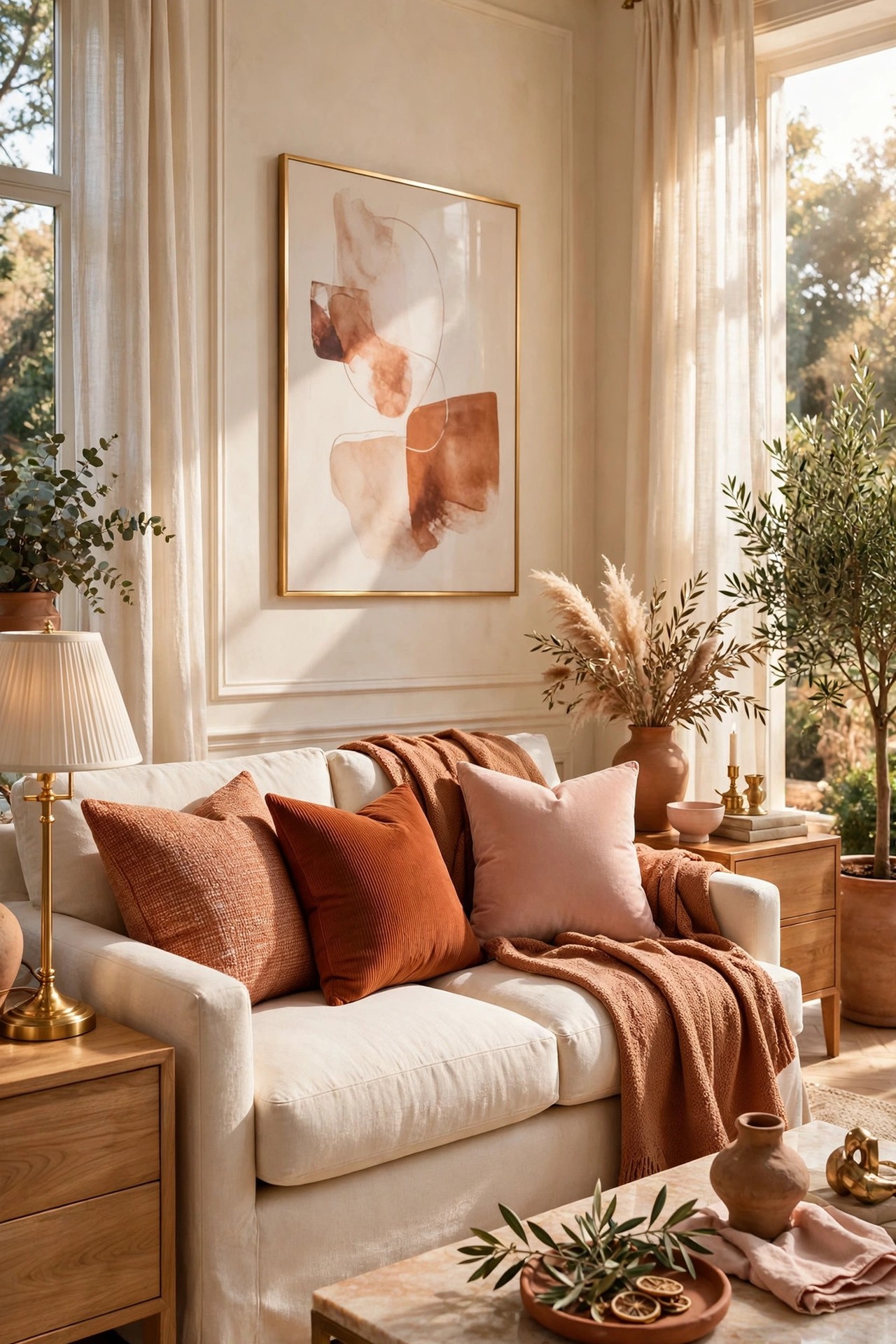
If painting or a coloured sofa feels like too much commitment, the colour can live entirely in textiles. A cream sofa is the calm base; terracotta, rust and blush cushions, one clay-toned throw and a warm patterned cushion or two carry the whole scheme, and any of them can be swapped in an afternoon. The mix matters more than the count: combine one solid clay cushion, one rust pattern and one blush plain per seat group, in fabrics with some texture, linen, woven cotton or a soft velvet. This is also the most practical route for families, because cushion covers wash and a throw hides a multitude of weekday wear.
Best For: Renters, cautious decorators and anyone who likes changing a room with the seasons.
Not Ideal For: Anyone wanting the colour to change the room’s architecture; textiles soften, they do not anchor.
Estimated Cost: $70-$220 (estimate) for cushion covers, inserts and one throw in the terracotta palette.
Budget Note: Covers over good existing inserts give the full look for a fraction of new cushions.
Renter Friendly: Yes
Renter Note: Nothing is fixed and everything is removable in minutes.
What You Need
Cushion covers in terracotta, rust and blush, cushion inserts, one clay-toned throw, a cream sofa or sofa cover as the base.
Product type to look for: Covers with hidden zips in washable linen-look or cotton fabrics, in at least three tones of the palette.
How To Do It
- Start with the cream base clear, then place the largest cushions, in solid clay, at the sofa’s ends.
- Layer rust pattern cushions in front of them and one blush cushion at the centre as the light note.
- Drape the throw over the arm nearest the window so the daylight catches its colour.
- Step back and count the tones: clay, rust and blush should each appear at least twice in the room.
Pro Tip
Keep one cushion plain cream in every group. The empty note stops the mix looking busy.
3. Choose a Terracotta Sofa as the One Strong Piece
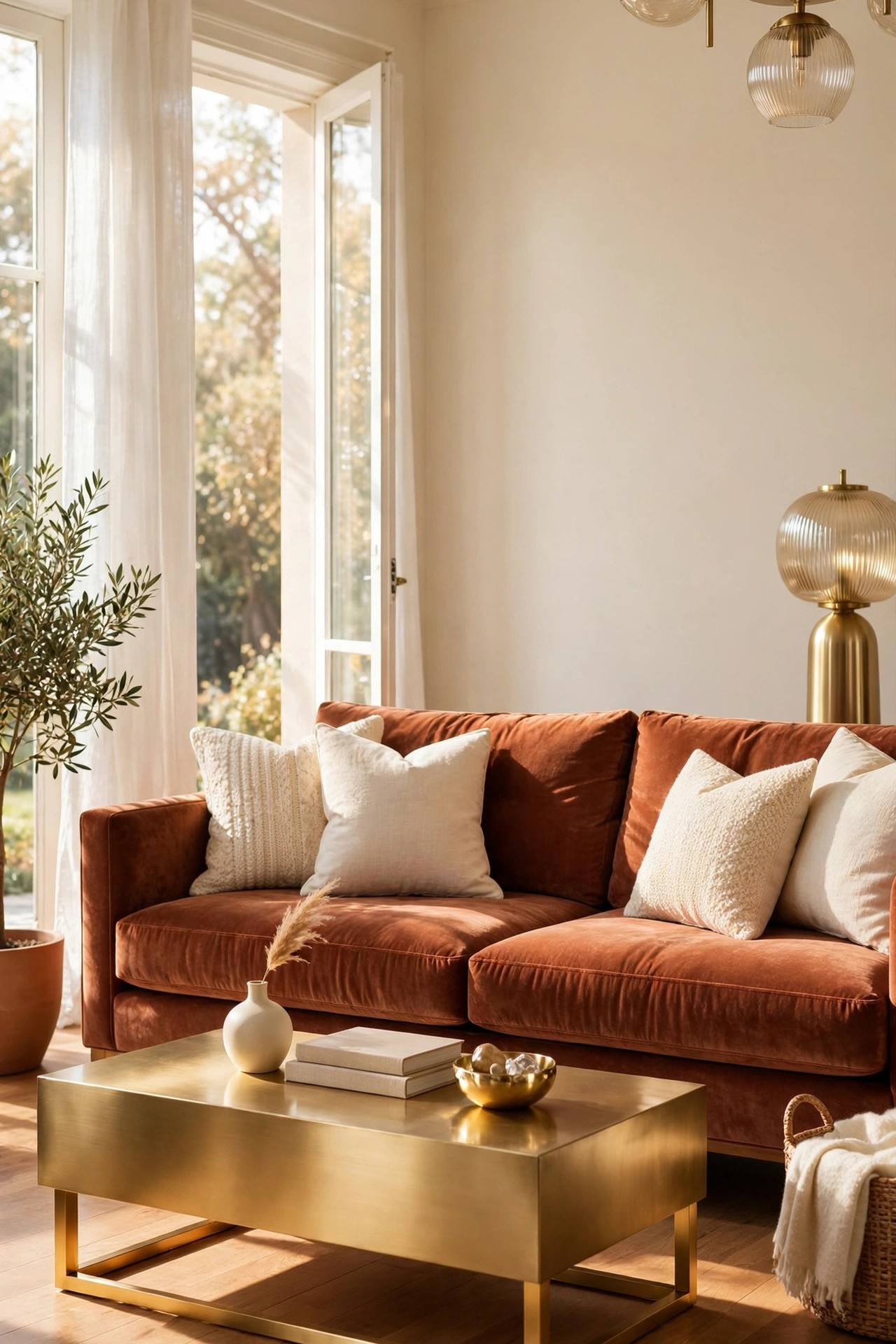
A terracotta sofa does in one piece what an accent wall and textiles do together: it sets the room’s temperature the moment you walk in. It works best against cream walls with the rest of the furniture kept quiet, warm wood, a brushed gold coffee table, cream and blush cushions on the sofa itself. Velvet and woven fabrics both suit the colour; velvet deepens it in the evening, weaves keep it softer in daylight. Be honest about the commitment: a coloured sofa is a five to ten year decision, the fabric must be cleanable, and the tone should be tested against your floor colour before ordering, because clay against cool grey flooring can clash.
Best For: A main living room ready for one confident piece, with cream walls and warm flooring.
Not Ideal For: Rooms with cool grey floors or strong competing colours already fixed in place.
Estimated Cost: $900-$2,400 (estimate) for a two or three seat terracotta sofa in velvet or woven fabric.
Budget Note: Fabric samples against your own floor, in your own light, are the cheapest insurance in this article.
Renter Friendly: Yes
Renter Note: Furniture only; measure doorways and stairs before ordering any large sofa.
What You Need
Terracotta sofa in velvet or woven fabric, fabric samples, cream and blush cushions, a brushed gold or warm wood coffee table, tape measure.
Product type to look for: A sofa with removable, cleanable covers or a performance fabric, in a clay tone tested against your floor.
How To Do It
- Order samples of at least two terracotta fabrics and live with them on the current sofa for several days.
- Tape the new sofa’s footprint on the floor and confirm walkways and the coffee table distance.
- Set the sofa, then keep everything within arm’s reach of it quiet: cream cushions, wood and gold, no second strong colour.
- Anchor it with a cream or warm patterned rug that extends past the front legs.
Pro Tip
If the sofa is the colour, let nothing else in the room match it exactly. Near tones layer; exact matches look staged.
4. Layer Rugs in Clay, Rust and Cream
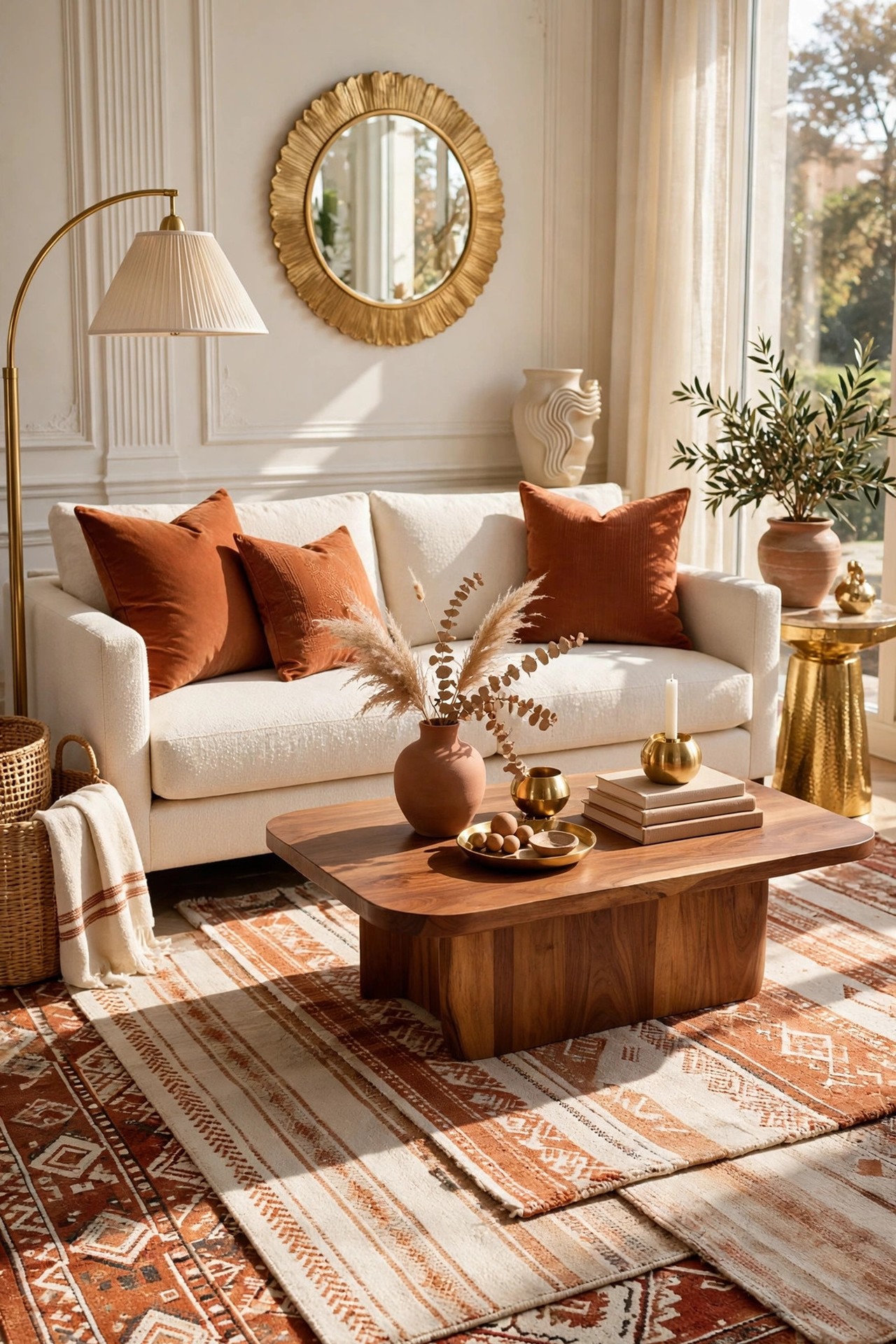
A rug is where the terracotta palette meets the floor, and layering two rugs gives the scheme depth that a single rug cannot. Start with a large, plain cream or warm jute rug that defines the seating area, then lay a smaller patterned rug in clay and rust tones over its centre, under the coffee table. The pattern carries the colour, the plain base keeps the room bright, and the overlap softens hard flooring. Keep the top rug’s pile low enough for the coffee table to sit level, use rug pads under both layers to stop creeping, and check door clearances where a layered edge meets a doorway swing.
Best For: Hard floors, large seating areas and rooms where the palette needs grounding.
Not Ideal For: Doorways with tight under-door clearance, and homes where a layered edge is a trip risk for anyone unsteady.
Estimated Cost: $200-$600 (estimate) for a large base rug, a patterned top rug and pads.
Budget Note: The base rug can be a simple flatweave; the smaller patterned rug carries the design spend.
Renter Friendly: Yes
Renter Note: Rugs and pads only; pick pads that will not mark the floor beneath.
What You Need
Large cream or jute base rug, smaller patterned rug in clay and rust, rug pads, tape measure, painter’s tape.
Product type to look for: A top rug with a low, dense pile and a pattern that repeats the room’s clay and cream tones.
How To Do It
- Tape the base rug’s outline so all front legs of the seating will sit on it, and check the room’s routes.
- Lay the pad and base rug, then centre the patterned rug under the coffee table position.
- Set the furniture with front legs on the base rug and the table level on the top rug.
- Walk the edges for a day; add pad or tape corners anywhere a layer creeps or lifts.
Pro Tip
Let the top rug sit off-centre by a few inches toward the sofa. Perfect centring looks stiff; a slight shift looks lived in.
5. Bring in Warm Wood in Honey and Walnut Tones
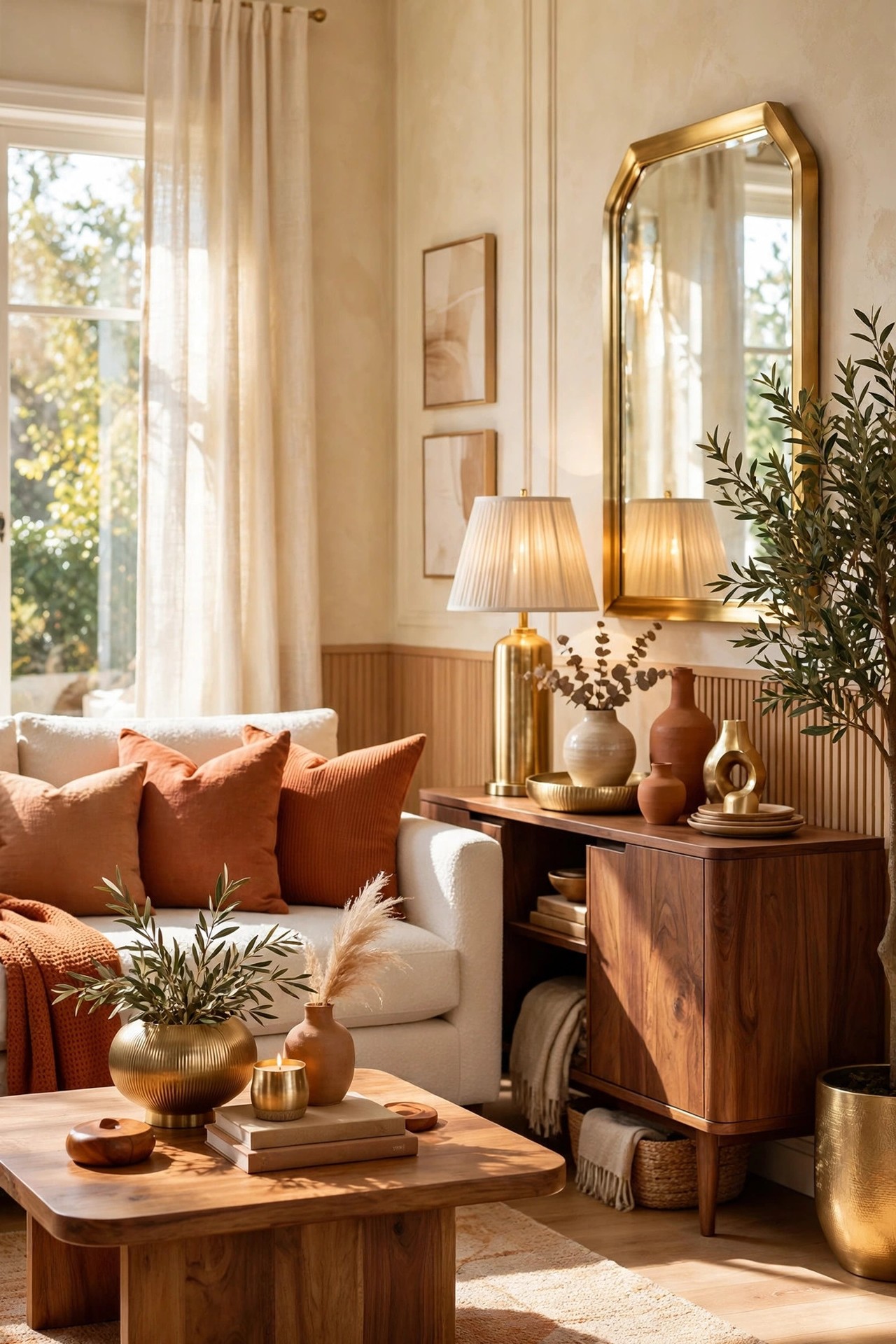
Terracotta needs wood the way it needs cream: the colour sits in the same warm family as honey, oak and walnut tones, so wood furniture makes the palette feel built rather than decorated. A warm wood coffee table, a sideboard or media unit and one or two side tables are enough; the grain does the work, so shapes can stay simple. Keep the wood tones close to each other, within one family of warm mid-tones, and avoid mixing in cool grey-stained pieces, which fight the clay colour. Wood also balances the softness of the textiles, giving the room the mix of hard and soft that a glam scheme needs.
Best For: Rooms that feel flat or overly soft, and schemes built from textiles that need grounding.
Not Ideal For: Rooms already full of dark wood, where more warm timber can tip the room heavy.
Estimated Cost: $300-$1,100 (estimate) for a warm wood coffee table and sideboard or media unit.
Budget Note: One solid coffee table warms the room more than several thin wood-look pieces.
Renter Friendly: Yes
Renter Note: Furniture only; use felt pads under legs to protect the floor.
What You Need
Coffee table in honey or walnut tone wood, sideboard or media unit in a matching warm tone, side tables, felt floor pads, wood care polish.
Product type to look for: Wood or quality veneer in warm mid-tones with a matte or soft sheen finish, not high gloss.
How To Do It
- Pick the wood family first, honey or walnut, and hold samples against the sofa and floor before buying.
- Place the largest wood piece, the sideboard or media unit, on the room’s longest wall.
- Set the coffee table centred on the rug, and side tables where each seat can reach one.
- Style the wood surfaces with ceramics and books, leaving at least half of each surface clear.
Pro Tip
Repeat the wood tone three times at different heights: floor level table, mid sideboard, one high shelf or frame.
6. Add Brushed Gold Lighting and Metal Accents
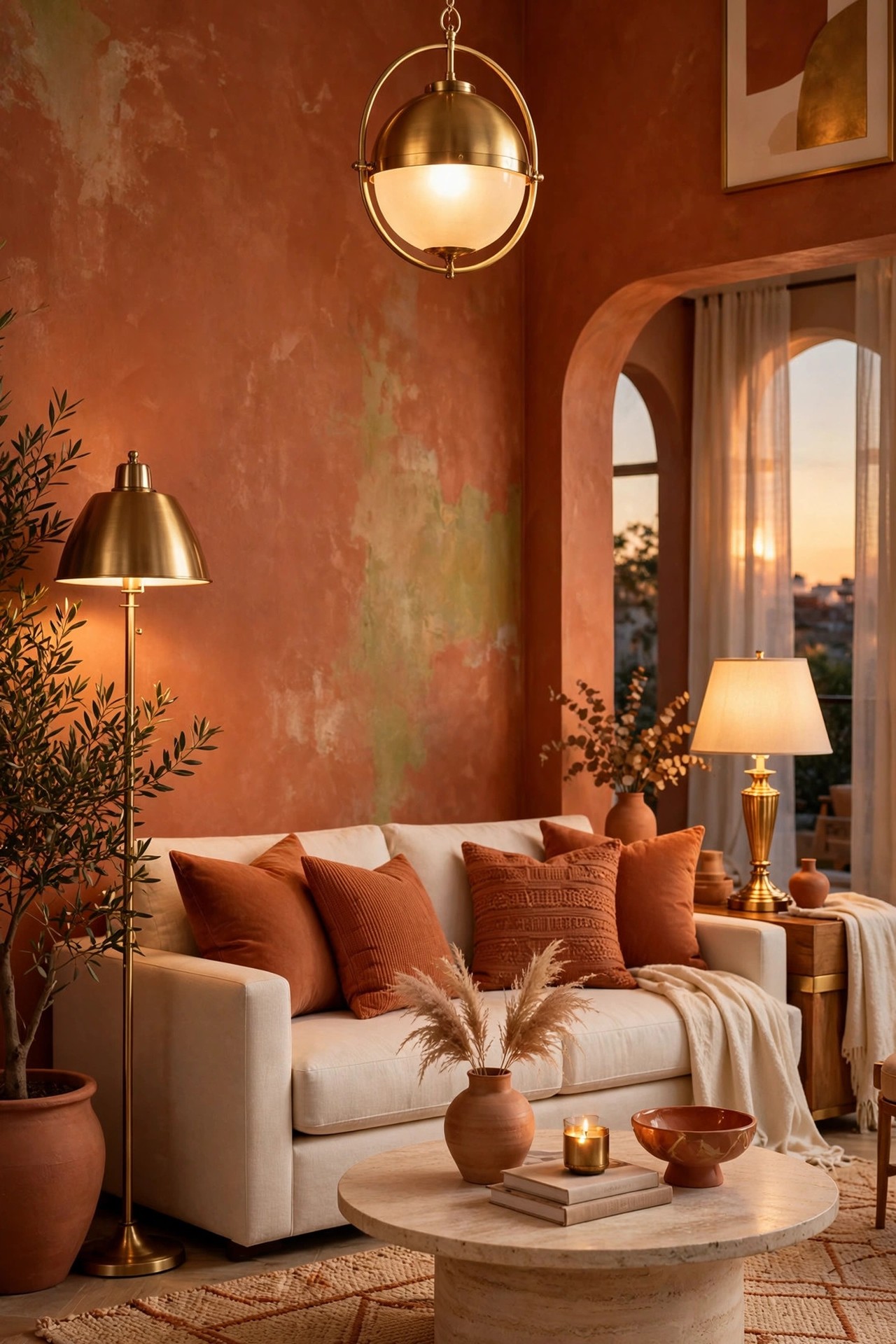
Brushed gold is the metal that keeps terracotta glam instead of rustic. Its warm tone sits inside the palette, and used across lighting, a floor lamp beside the sofa, a table lamp on the sideboard and one pendant or ceiling fitting, it links the room at three heights. Add smaller gold notes to match: a tray, picture frames, the rim of a mirror. Warm bulbs matter as much as the fittings; a cool white bulb will make clay tones look grey and tired, while a warm bulb makes them glow. Keep every bulb in the room at one warm temperature, and let an electrician handle any hardwired fitting or dimmer.
Best For: Rooms that look good by day but flat at night, and schemes drifting too rustic.
Not Ideal For: Rooms with fixed chrome or cool-toned fittings you cannot change; mixed metals need careful balance.
Estimated Cost: $200-$650 (estimate) for a gold floor lamp, table lamp, pendant and warm bulbs.
Budget Note: Bulbs first: one warm temperature across the room is a small spend with a large effect.
Renter Friendly: With Conditions
Renter Note: Plug-in lamps are renter-safe; ceiling fittings and dimmers are owner-only electrical work.
What You Need
Floor lamp and table lamp in brushed gold, pendant or ceiling fitting if used, warm bulbs in one shared temperature, gold tray and frames for accents, electrician for hardwired work.
Product type to look for: Lamps with a true brushed, not polished, gold finish, and bulbs in a warm temperature matched across the room.
How To Do It
- List every light in the room and swap all bulbs to one warm temperature before buying any fitting.
- Place the floor lamp where its pool of light lands on a seat, and the table lamp on the sideboard or console.
- Fit the pendant or ceiling light centrally over the seating, through an electrician if hardwired.
- Add two or three small gold accents, then stop; gold works by repetition, not quantity.
Pro Tip
Test terracotta paint and fabric samples under the evening lamps, not just daylight. Warm light is where this palette lives.
7. Frame the Windows With Terracotta and Cream Curtains
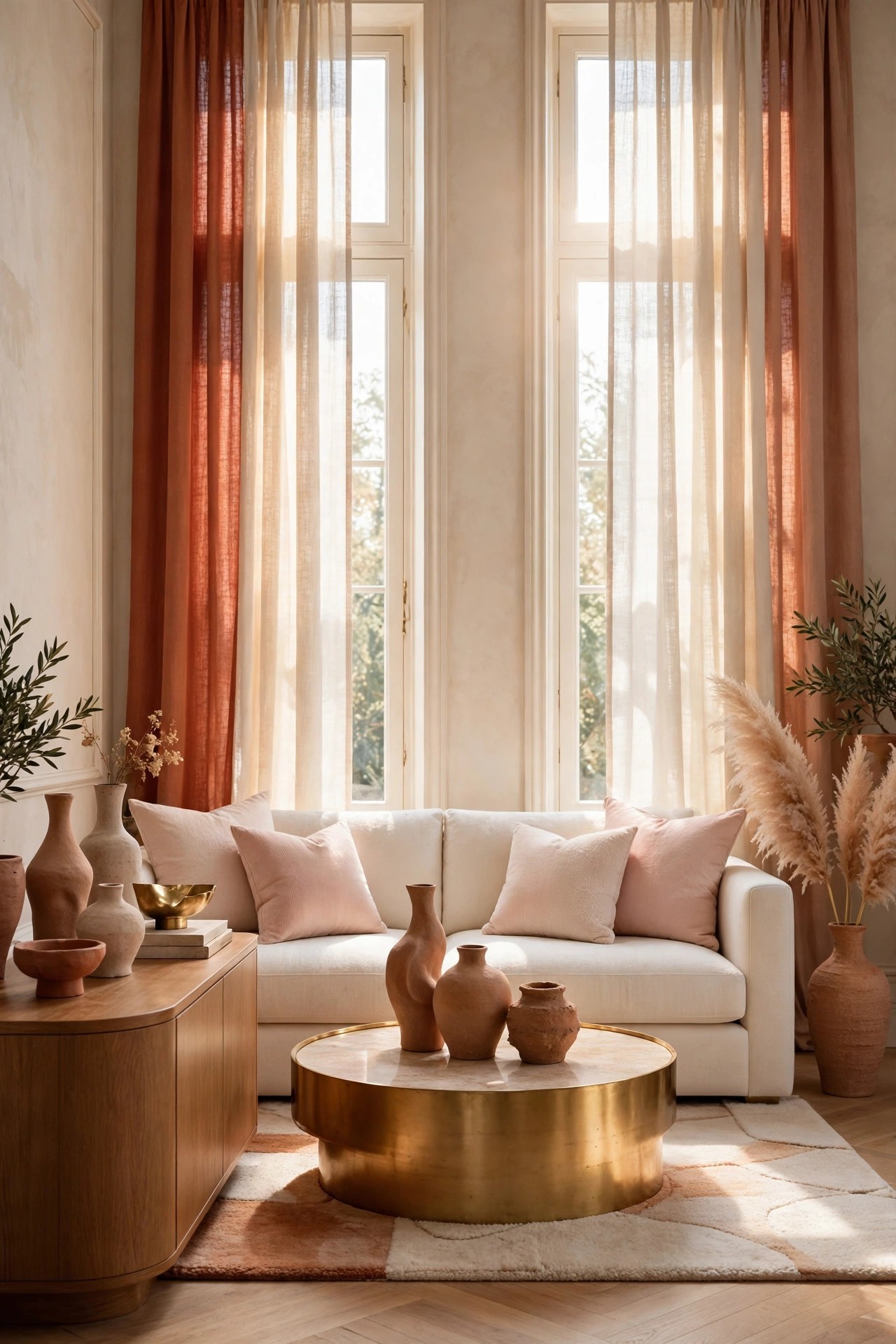
Curtains are the largest textile surface in most living rooms, so they set how much terracotta the room shows at a glance. Two routes work: full terracotta panels for a warm, enclosed feel in a bright room, or cream panels with a terracotta pair at the outer edges for a lighter frame. Hang the rod high and wide so the fabric stacks clear of the glass in the day, and choose lined fabrics, because daylight through unlined clay fabric can turn it thin and pinkish. A brushed gold rod ties the windows to the lamps. Floor-length panels suit the glam look best; measure from the rod, not the frame, before ordering. More lengths and header styles are compared in our guide to current window dressing
Best For: Large or tall windows and rooms where the colour needs a second big surface.
Not Ideal For: Small, low-light rooms, where full terracotta panels can close the space in; choose the cream-led option there.
Estimated Cost: $150-$500 (estimate) for lined panels, a brushed gold rod and brackets for one window wall.
Budget Note: Cream panels with terracotta only at the edges uses less of the costlier coloured fabric.
Renter Friendly: With Conditions
Renter Note: Rod fixings leave screw holes; fit them only with the landlord’s permission.
What You Need
Lined curtain panels in terracotta and cream, brushed gold curtain rod and brackets, tape measure, level, stepladder, fabric steamer.
Product type to look for: Lined panels in a linen-look or woven fabric, long enough to just touch the floor from a high rod.
How To Do It
- Fix the rod position first: just below the ceiling and wider than the window on both sides.
- Measure from the rod to the floor for the panel length, and order samples to check the colour against daylight through the fabric.
- Fit the rod level with rated fixings, hang the panels and arrange the colour order, cream inside or outside, as planned.
- Steam the folds, then check the room from the door at midday and at dusk, when the curtains show most.
Pro Tip
Hold a fabric sample against the window with light behind it before ordering. Backlit terracotta shifts a full shade.
8. Group Clay Pots, Vases and Ceramics
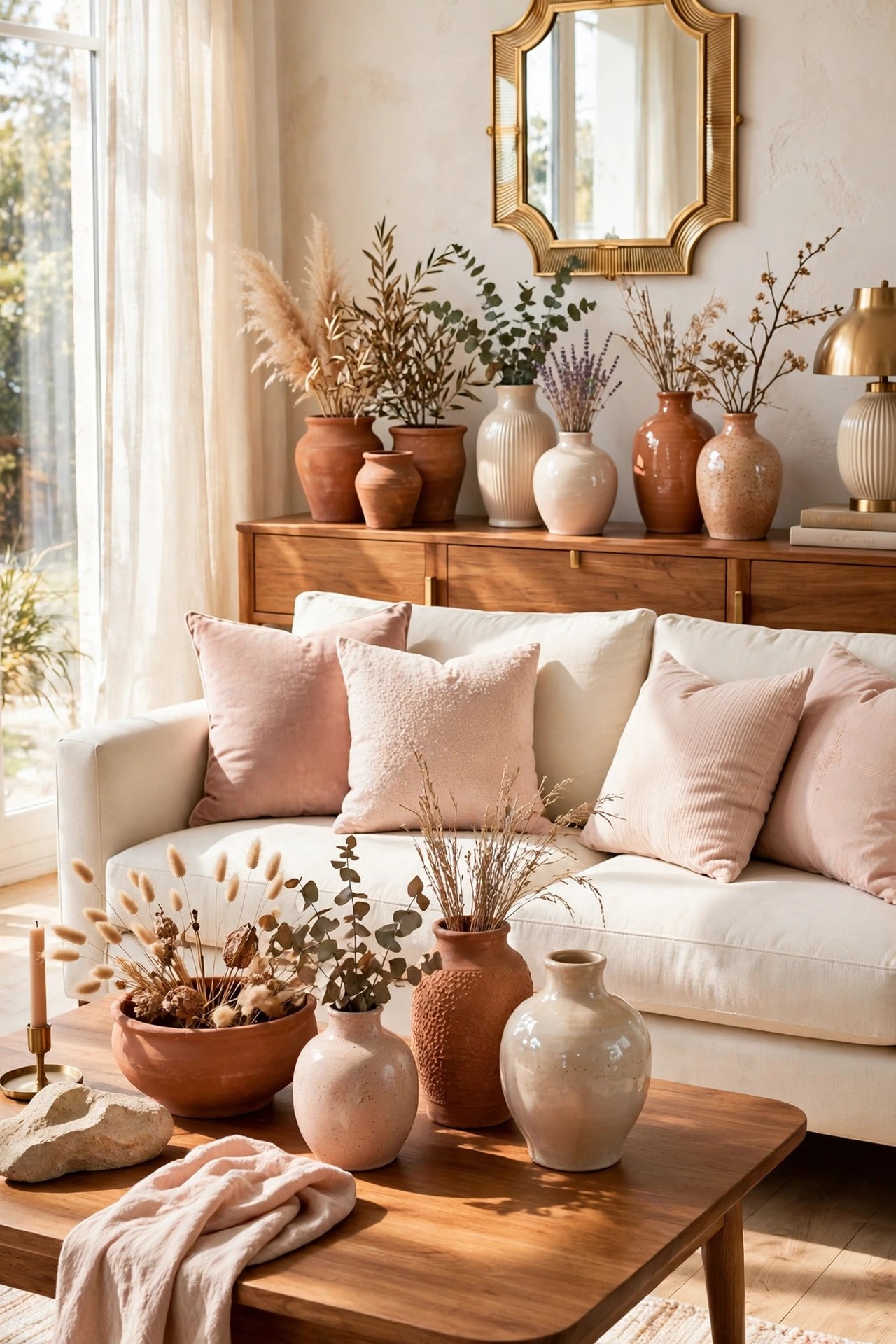
Small terracotta pieces scattered one by one read as clutter; grouped, they read as a collection. Gather clay pots, ceramic vases and bowls in varied heights and finishes, matte, glazed and raw, and place them in groups of three: on the console, the coffee table tray and one shelf. The variation is the point, because handmade-look ceramics in slightly different clay tones layer the palette more richly than matching sets. Add one green sprig or a few dried stems to the tallest vase only. Keep raw unglazed pots on trays or coasters, since they can mark wood, and keep the groups where they will not be knocked by passing traffic.
Best For: Shelves, consoles and coffee tables that need colour without more textiles.
Not Ideal For: Busy family surfaces where ceramics will be moved or knocked daily.
Estimated Cost: $40-$150 (estimate) for a group of clay pots, vases and a bowl across three surfaces.
Budget Note: Garden-centre terracotta pots cost very little and mix well with one or two finer glazed pieces.
Renter Friendly: Yes
Renter Note: Nothing is fixed; protect wood surfaces from raw clay bases with trays or coasters.
What You Need
Three to seven clay and ceramic pieces in varied sizes and finishes, a tray, coasters, dried stems or a green sprig, a soft cloth for dusting.
Product type to look for: Ceramics in a range of clay tones and heights, with at least one glazed piece per group for contrast.
How To Do It
- Collect all the pieces in one place and sort them by height before placing any of them.
- Build the largest group on the console: tallest vase at the back, bowl at the front, one mid piece between.
- Repeat smaller versions on the coffee table tray and one shelf, changing the order so the groups rhyme without matching.
- Add stems to the tallest vase only, and leave the rest empty; restraint is what makes it look collected.
Pro Tip
Mix one raw matte pot into every group. The dull finish makes the glazed pieces beside it look richer.
9. Soften the Scheme With Blush Pink Layers
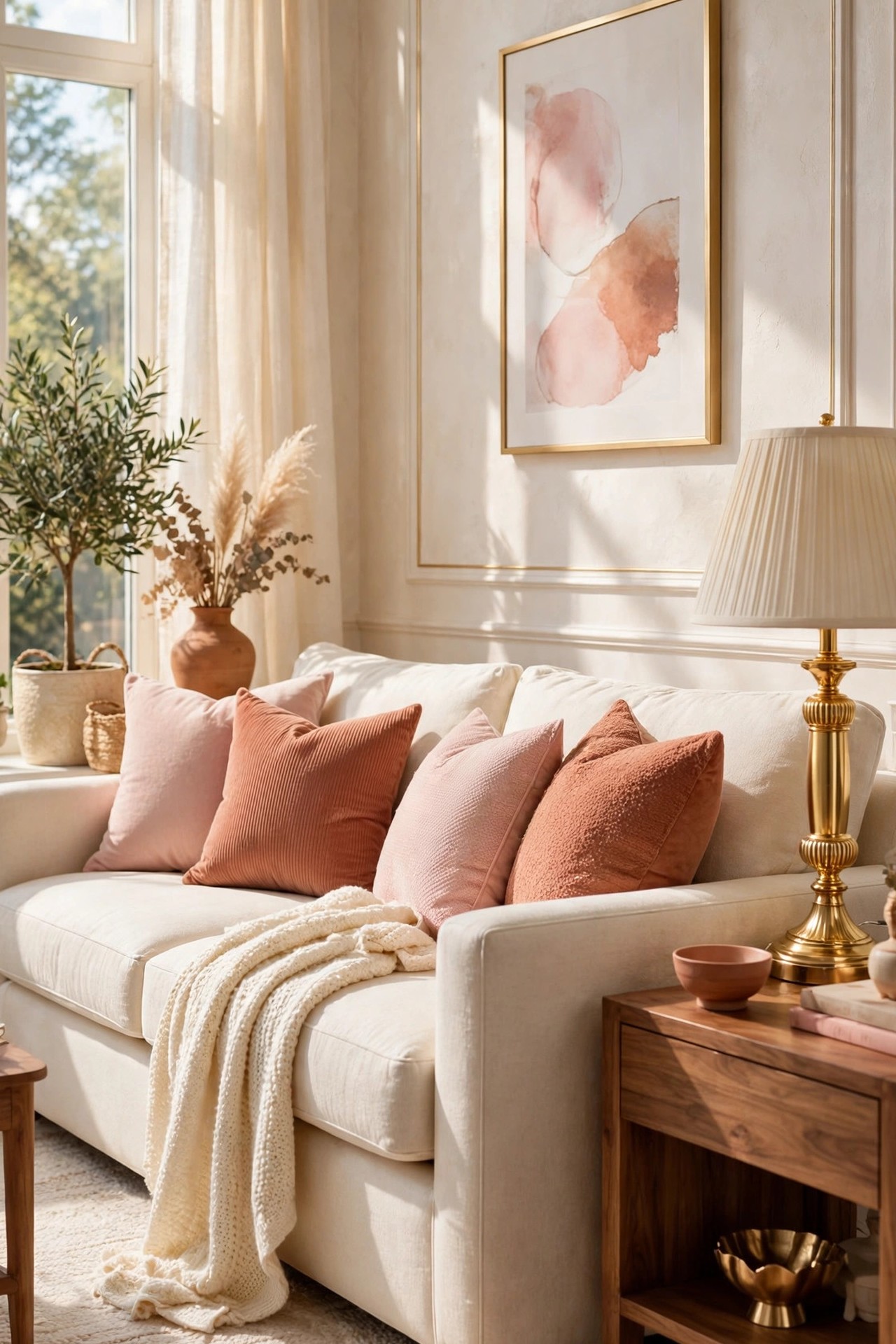
Terracotta on its own can lean heavy and earthy; blush pink is the note that lifts it into glam. Blush sits in the same warm family, a paler cousin of clay, so it softens without cooling the room the way grey or blue would. Use it in the softest places: cushions against the terracotta ones, a throw over the armchair, one lampshade or a pair of candle holders. Keep the blush share to roughly a third of the terracotta amount, so it reads as a highlight rather than a second scheme. In bright daylight blush keeps the room fresh; under warm evening light it stops the clay tones turning muddy.
Best For: Schemes that feel too earthy or masculine and rooms wanting a softer glam finish.
Not Ideal For: Anyone aiming for a strictly rustic clay look; blush deliberately moves it toward glam.
Estimated Cost: $50-$160 (estimate) for blush cushion covers, a throw and small accessories.
Budget Note: Two cushion covers and one throw deliver the whole effect; blush works in small doses.
Renter Friendly: Yes
Renter Note: Textiles and small accessories only, all fully removable.
What You Need
Blush cushion covers, a blush throw, one or two small blush accessories such as candle holders or a lampshade, existing terracotta textiles to layer against.
Product type to look for: Blush in warm, dusty tones rather than cool candy pink, in soft fabrics like velvet or washed linen.
How To Do It
- Place blush cushions directly beside the strongest terracotta cushions, so the pairing reads as intentional.
- Drape the blush throw over the armchair or the sofa’s far end, away from the clay throw.
- Add one small blush accent across the room, on the console or shelf, to carry the note.
- Check the balance from the doorway: blush should appear in two or three places, always next to warmth.
Pro Tip
Choose blush with a brown or clay undertone. Blue-based pinks clash with terracotta and turn both colours sour.
10. Hang a Gallery Wall in Warm Tones
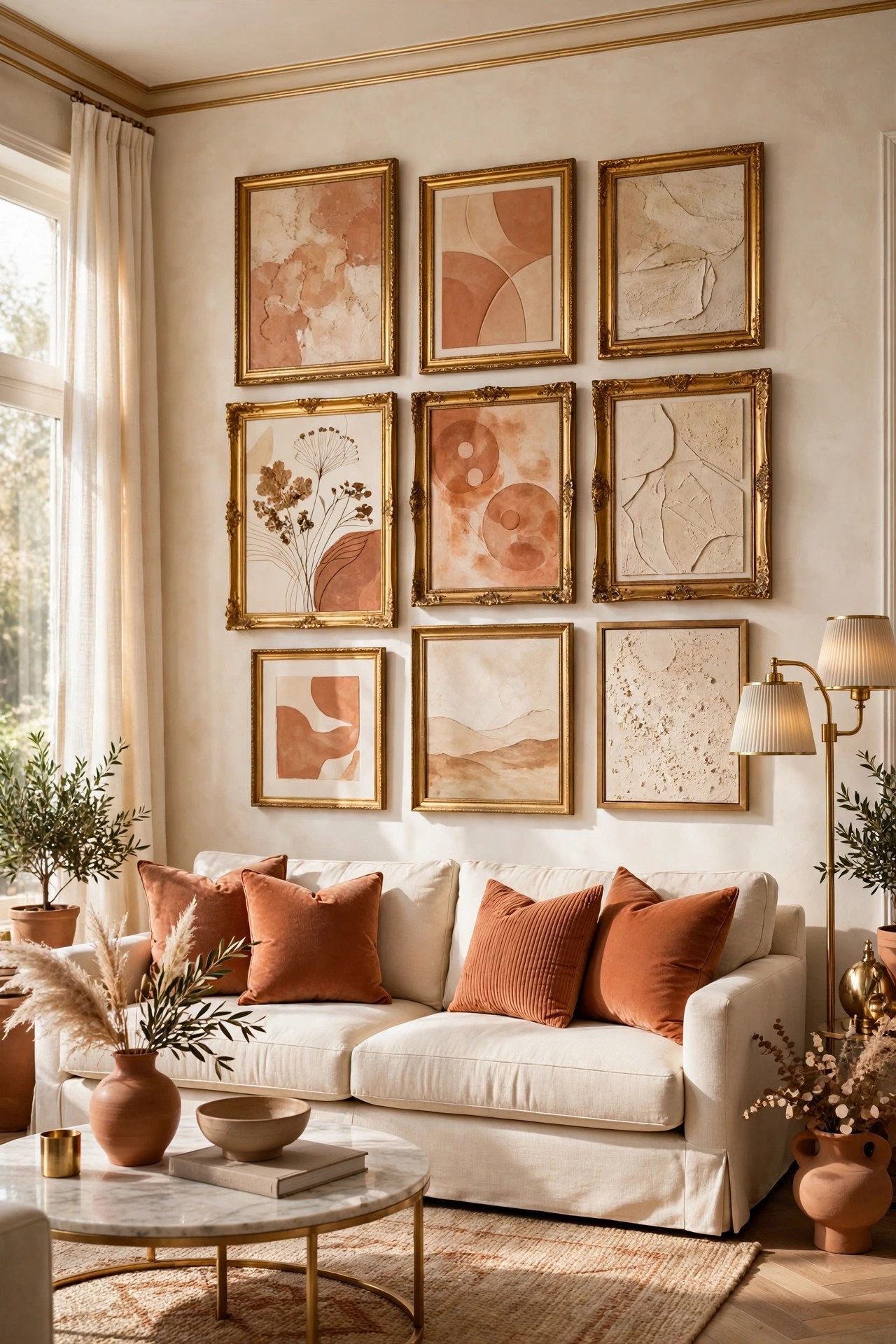
Art is where a terracotta room gets its personality, and a gallery wall in warm tones pulls the palette up the wall without more paint. Choose prints in clay, rust, cream and soft gold, abstract shapes, landscapes or line work, and frame them in slim brushed gold or warm wood so the wall links to the lamps and furniture. Plan the arrangement on the floor inside a taped outline before any fixing goes in, keep gaps even at 2 to 3 inches, and let one larger piece anchor the group. Keep direct sun off the prints where you can, because warm pigments fade unevenly in strong light.
Best For: The wall above the sofa or sideboard, and rooms with the colour only at floor level.
Not Ideal For: Walls already carrying a strong pattern or a very large mirror; one feature per wall is enough.
Estimated Cost: $100-$400 (estimate) for prints, frames and rated picture fixings for one gallery wall.
Budget Note: Downloadable prints in ready-made frames give a full gallery for the price of one custom frame.
Renter Friendly: With Conditions
Renter Note: Use picture strips for light frames or hang from a rail where the lease limits wall fixings.
What You Need
Five to eight prints in warm tones, frames in gold or warm wood, paper templates and painter’s tape, level, rated picture hooks or strips.
Product type to look for: Frames in two or three repeatable sizes with secure fixings, and prints sharing one warm palette.
How To Do It
- Lay the gallery out on the floor inside a taped outline of the wall space, largest print off-centre.
- Tape paper templates in the same positions on the wall and check the arrangement from the sofa and the door.
- Hang the anchor piece first, then work outward, keeping gaps even and frames level.
- Step back after every frame; warm-toned groups show spacing errors quickly against cream walls.
Pro Tip
Include one print with a cream background and almost no colour. The quiet piece gives the warm ones room to register.
11. Tile the Fireplace Surround in Warm Clay Tones
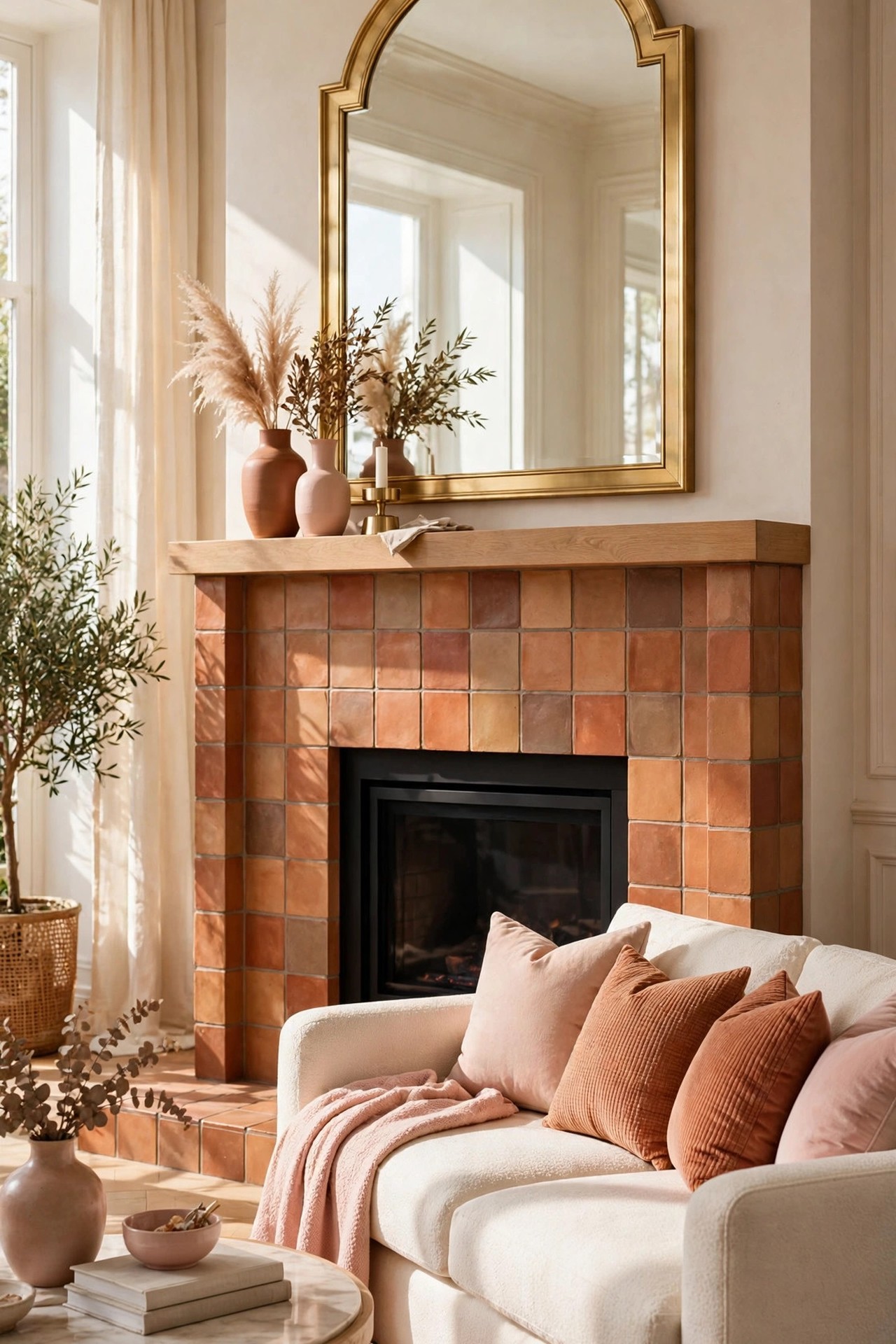
A tiled fireplace surround gives terracotta a permanent, crafted place in the room. Handmade-look tiles in clay and rust tones, with gentle variation from tile to tile, suit both a working fireplace and a decorative one, and a brushed gold mirror above the mantel keeps the glam thread running. Zellige-style and matt ceramic tiles both work; keep grout in a warm sand tone so the grid stays soft. This is professional work around any real firebox: tiles and adhesives must be heat-rated, clearances must follow the fitter’s guidance, and a decorative fireplace with candles needs the same care about what sits near flame.
Best For: Fireplaces that are the room’s natural centre, working or decorative.
Not Ideal For: Surrounds with cracks or movement that tiling would hide rather than fix; repair first.
Estimated Cost: $400-$1,500 (estimate) for tiles, heat-rated adhesive, grout and professional fitting for one surround.
Budget Note: Handmade-look ceramic tiles cost far less than true handmade zellige and vary almost as nicely.
Renter Friendly: No
Renter Note: Permanent tiling, owner only; peel-and-stick tiles are not suitable near a working firebox.
What You Need
Terracotta tiles rated for fireplace use, heat-rated adhesive and warm sand grout, tile trim, a qualified tiler or fireplace fitter, a gold mirror for the mantel.
Product type to look for: Tiles confirmed by the maker or fitter as suitable for the heat level of your fireplace type.
How To Do It
- Have the fitter check the firebox, surround structure and clearances, and confirm the tile choice suits the heat.
- Dry-lay the tiles to plan the colour variation, mixing boxes so tones spread evenly rather than patching.
- Tile from the firebox outward, keeping joints fine and even, then grout in warm sand once set.
- Fit the mantel styling last: the gold mirror and two small objects, nothing crowded.
Pro Tip
Order tiles from one batch and keep spares. Clay tones shift between batches, and a later top-up box will show.
12. Layer Natural Textures in Rattan, Jute and Linen
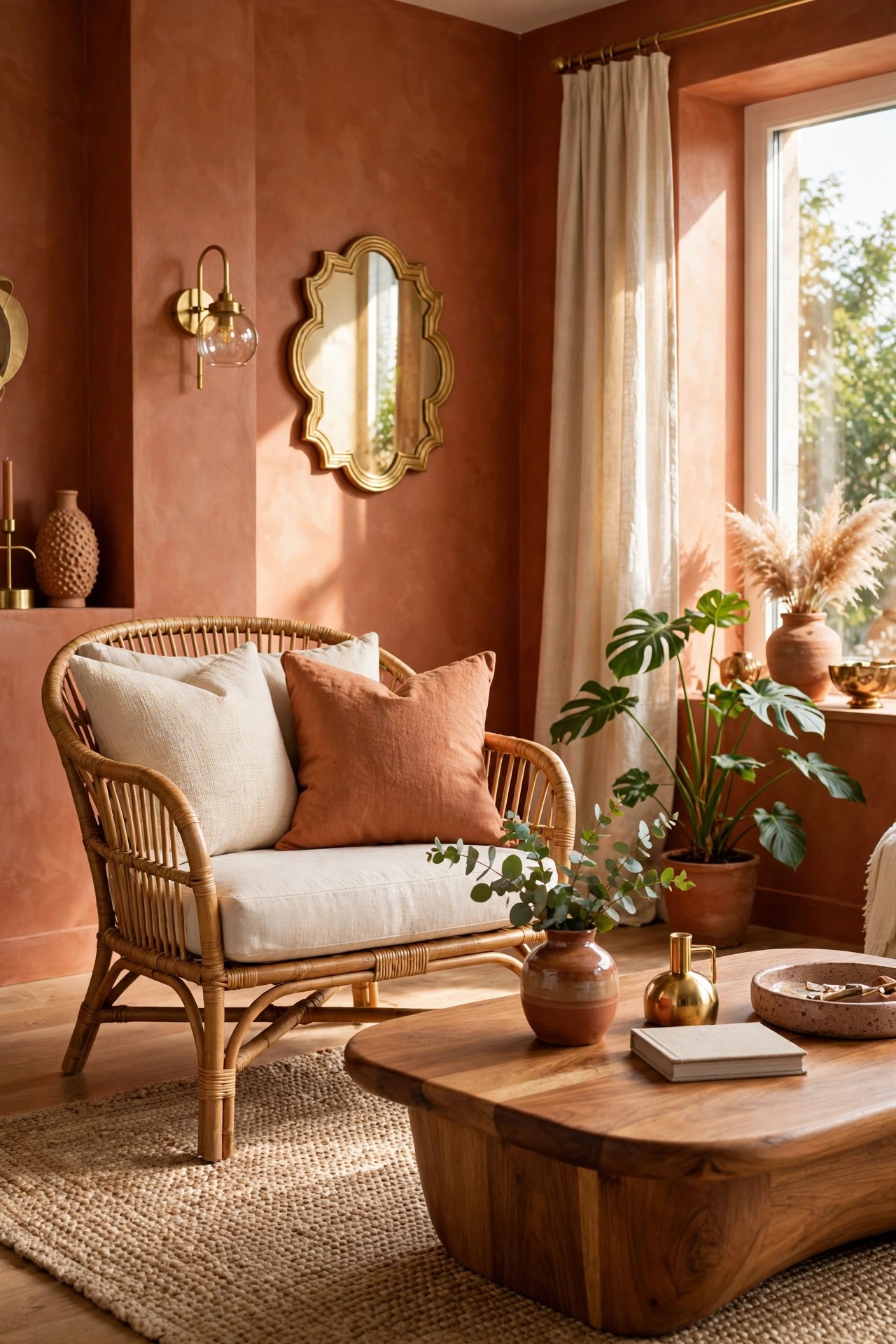
Colour alone can make a room feel flat; texture is what makes terracotta feel rich. Rattan, jute, linen and woven cotton all sit in the same natural family as clay, so they deepen the scheme without adding new colours. A rattan armchair, a jute rug or runner, linen cushion covers and a woven throw cover four different textures, and each catches light differently across the day. Keep the glam balance by pairing every natural piece with something smooth: the rattan chair beside a gold side table, the jute under a marble-look or glass coffee table top. Natural fibres shed and fade a little with use, so choose them where that softness suits the spot.
Best For: Rooms that look good in photos but feel flat in person, and schemes leaning too smooth or shiny.
Not Ideal For: Homes where fibre shedding is a problem, or very formal rooms where rustic texture is unwanted.
Estimated Cost: $150-$500 (estimate) for a rattan chair, a jute rug and linen cushion covers.
Budget Note: Linen-look covers and a jute runner give most of the texture for the least spend.
Renter Friendly: Yes
Renter Note: Furniture and textiles only, all removable without a trace.
What You Need
Rattan or woven armchair, jute rug or runner, linen cushion covers in cream and clay, woven throw, a gold side table for contrast.
Product type to look for: Tightly woven rattan and jute that will not unravel at the edges, and linen covers with neat seams.
How To Do It
- Choose one large texture first, the chair or the rug, and place it where daylight rakes across it.
- Add linen covers to the sofa cushions nearest that piece, so the textures meet.
- Set the gold side table beside the rattan chair to keep the glam contrast.
- Stop at four textures; beyond that the room turns rustic and loses the polished finish.
Pro Tip
Run a hand over display pieces before buying. Texture you can feel is texture that will show in the room.
13. Set Green Plants Against the Warm Palette
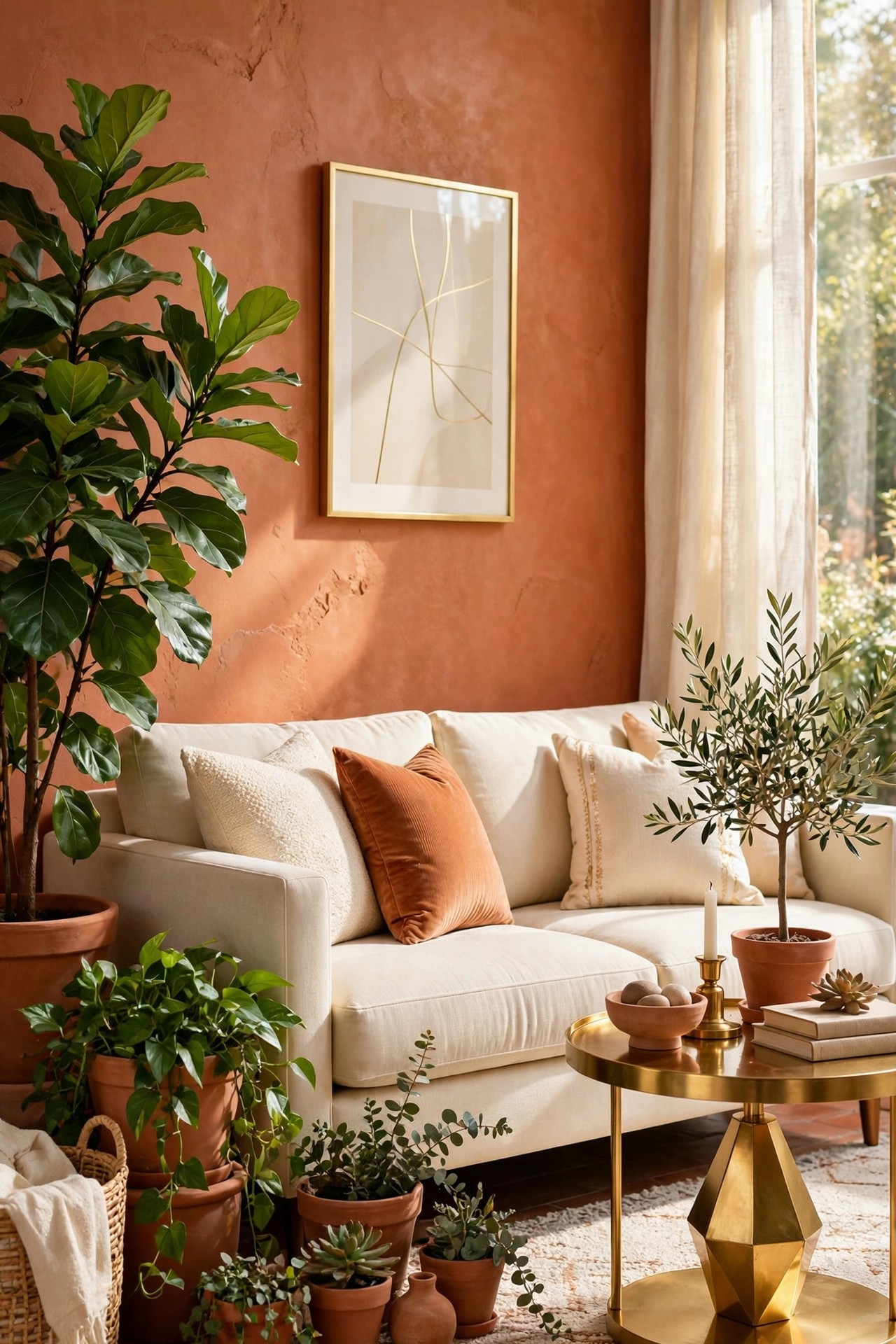
Green is terracotta’s natural partner, the colour of leaves against clay pots and earth, and a room in warm tones can look baked and dry without it. Place plants where the contrast does the most work: a tall plant beside the accent wall, a trailing plant on the sideboard, small pots inside the ceramic groups from idea 8. Terracotta pots are the obvious home for them, and the material suits plants, but unglazed clay dries soil faster, so thirsty plants need a glazed inner pot or more frequent watering. Choose plants for your real light, and check pet safety where animals share the room.
Best For: Rooms that feel dry or flat, accent walls needing a living contrast and bright corners.
Not Ideal For: Very low-light rooms for sun-loving plants; choose shade-tolerant types or good faux plants there.
Estimated Cost: $40-$180 (estimate) for one tall plant, two smaller plants and terracotta pots.
Budget Note: Small plants in handsome pots look collected sooner than one large plant in a plain pot.
Renter Friendly: Yes
Renter Note: Nothing is fixed; keep pots on trays so clay bases cannot mark floors or wood.
What You Need
One tall plant, two smaller or trailing plants, terracotta pots in varied sizes, glazed inner pots or liners, trays, a watering can.
Product type to look for: Plants matched to your light level and confirmed pet-safe where needed, with pots wide enough to sit stably.
How To Do It
- Map the room’s light for a day and assign each plant a spot that suits it, tallest beside the accent wall.
- Pot with liners inside the clay pots so watering does not stain, and set every pot on a tray.
- Group one small plant into the ceramic arrangement on the console, so green appears at two heights.
- Set a weekly check: water, turn each plant a quarter turn, and remove tired leaves before they show.
Pro Tip
If a plant corner keeps failing, switch to one large, good quality faux plant and spend the effort elsewhere. A dead plant undoes the whole palette.
14. Paint Built-Ins or a Bookcase in Deep Terracotta
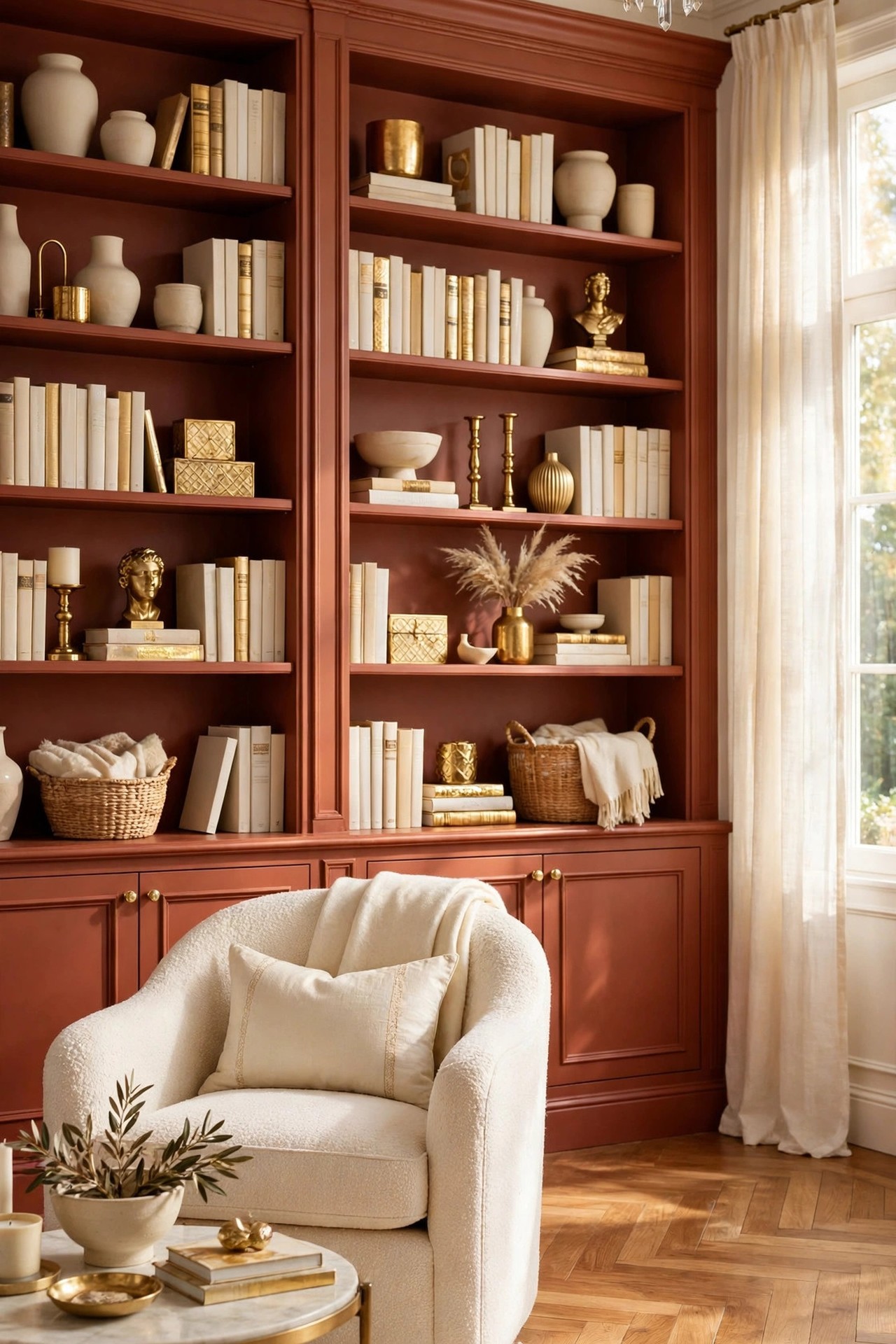
Where an accent wall feels too broad, painted joinery gives terracotta a contained, tailored place. Built-in shelves, a bookcase wall or a media unit painted in a deeper clay tone than the walls creates a rich backdrop for cream ceramics, gold frames and pale book spines, which all read brighter against it. Use a satin or eggshell finish on woodwork, because matte paint scuffs on shelves, and paint the backs of the shelves the same colour so objects sit inside one deep field. Style with restraint: light objects, space between groups, and nothing terracotta on terracotta shelves, where it disappears.
Best For: Rooms with existing built-ins or a large bookcase, and anyone finding an accent wall too much.
Not Ideal For: Pale, fine furniture you may want to resell; paint is a commitment on joinery too.
Estimated Cost: $80-$300 (estimate) for primer, satin paint, brushes and sundries for one bookcase wall.
Budget Note: Painting one freestanding bookcase gives the same effect for the price of paint alone.
Renter Friendly: No
Renter Note: Painting furniture or joinery belongs to the owner; a freestanding bookcase you own is your own call.
What You Need
Deep terracotta paint in satin or eggshell, primer suited to painted or varnished wood, fine sandpaper, brushes and a small roller, dust sheets.
Product type to look for: A durable furniture or woodwork paint in a deep clay tone, one shade deeper than the room’s textiles.
How To Do It
- Empty, clean and lightly sand the unit, then mask the wall and floor edges.
- Prime any varnished or dark surface and let it dry fully; paint over gloss without primer will chip.
- Apply two thin coats of the terracotta, including shelf backs and inner sides, sanding lightly between coats if the finish needs it.
- Restyle with cream and gold pieces only, leaving a third of each shelf empty so the colour shows.
Pro Tip
Paint a large card in the chosen tone and stand it inside the shelves first. Colour reads deeper inside a bookcase than on a wall.
15. Finish With Warm Evening Styling
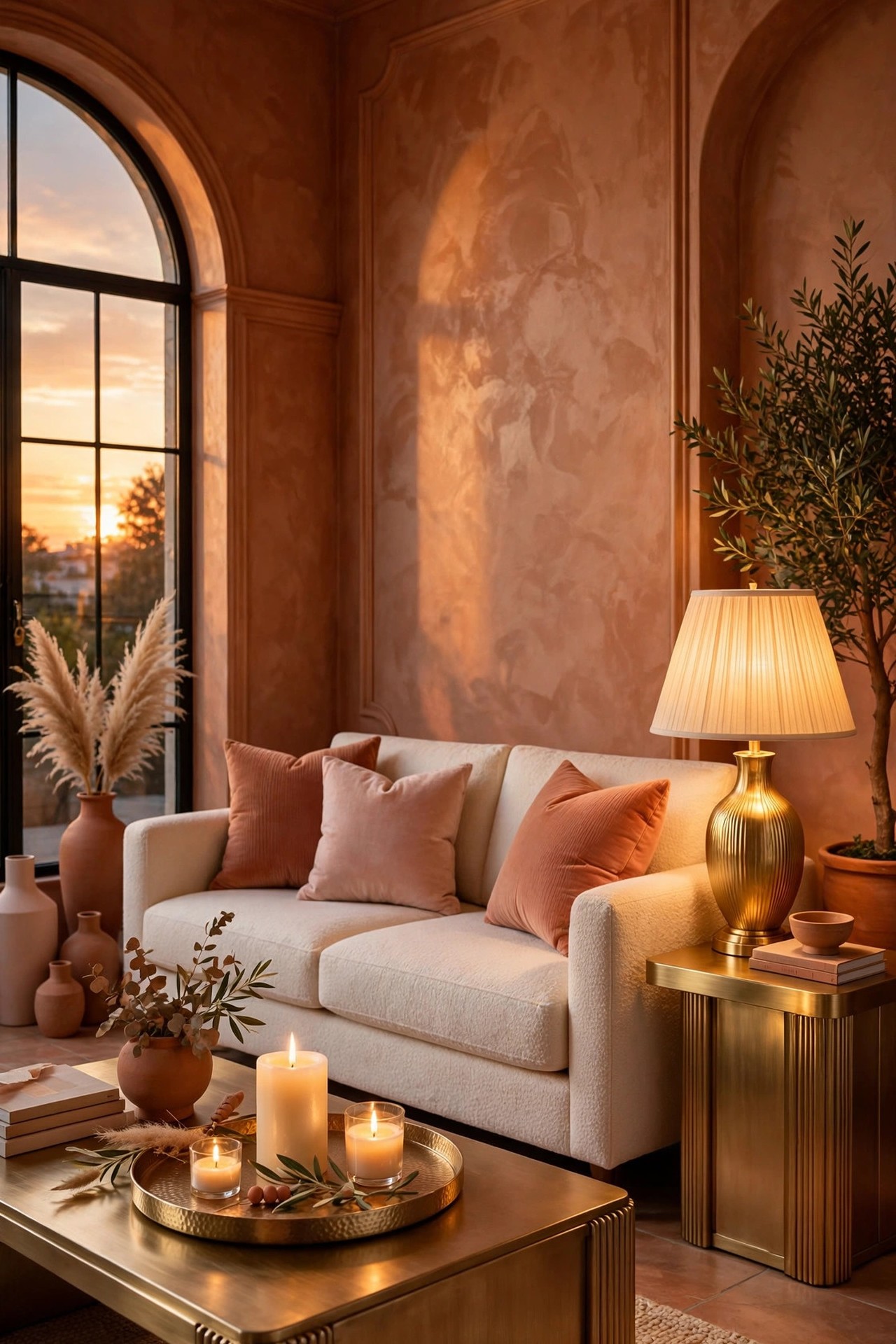
Terracotta rooms are at their best in the evening, when warm light deepens the clay tones, and a few finishing pieces make that hour feel planned. Set a brushed gold tray on the coffee table with candles in glass holders, group one clay vase and the remote controls inside it, and let the lamps from idea 6 do the rest. Add one soft throw within reach of each main seat and keep the styling to what the tray and one side table can hold, because a warm palette turns cluttered faster than a pale one. Use LED candles where real flames would sit near throws or curtains, and never leave real candles burning in an empty room.
Best For: Finished rooms used mainly in the evening and anyone whose scheme photographs better than it feels.
Not Ideal For: Anyone who has not settled the main pieces yet; styling is the last step, not the first.
Estimated Cost: $50-$140 (estimate) for a gold tray, candles or LED candles, glass holders and one throw.
Budget Note: The cheapest idea in the list, and the one guests notice most.
Renter Friendly: Yes
Renter Note: Nothing is fixed; keep flames in glass holders and away from soft furnishings.
What You Need
Brushed gold tray, candles or LED candles in glass holders, one clay vase, throws for the main seats, a small basket for remotes and clutter.
Product type to look for: A tray large enough for the coffee table’s daily items, and candles in warm ivory tones that suit the palette.
How To Do It
- Clear the coffee table and side tables completely, then place the tray as the single styling centre.
- Group the candles and vase on the tray, tallest at the back, and add the basket for remotes beside the sofa.
- Fold one throw over each main seat’s arm, ready to use rather than arranged stiffly.
- Light or switch on the candles and lamps at dusk and check the room from the doorway; adjust anything that glares or crowds.
Pro Tip
Keep one surface in the room completely empty. In a warm, layered scheme, the empty surface is what reads as calm.
Practical Tips for Terracotta Living Rooms
Build the colour in a fixed order: one strong surface first, wall, sofa or joinery, then textiles, then ceramics and small pieces. Rooms go wrong when every layer arrives at full strength at once. Test every tone in the room’s own light, morning and evening, because terracotta shifts more than most colours, deepening at dusk and paling in hard sun. Keep the balance near a third warm colour, two thirds cream, wood and light neutrals, and the room stays bright even with a painted wall. Repeat each tone at least twice, ideally three times, at different heights, so nothing looks like a lone accident. Finally, keep one cool note out entirely: grey and blue fight this palette, while green plants and blush give contrast without cooling it.
Frequently Asked Questions
What colours go best with a terracotta living room?
Cream and warm white are the main partners, with warm wood, brushed gold and blush pink as the supporting layers. Green from plants gives the natural contrast. Cool greys and blues are the tones to avoid, because they make clay colours look muddy.
Will a terracotta accent wall make my room look smaller?
One wall in a warm tone can make that wall feel closer, which usually reads as cosier rather than smaller when the other walls stay cream and the furniture in front is light. In a small, dark room, carry the colour in textiles instead of paint.
How much terracotta is too much?
A useful balance is around one third of the room’s visible surfaces in clay tones and two thirds in cream, wood and neutrals. Past that point the room starts to feel dark and heavy, especially in the evening.
Does terracotta work in a north-facing living room?
Yes, it is one of the best palettes for cool northern light, because the warm tones correct the grey cast. Keep the cream share high, choose lighter clay tones, and use warm bulbs so the colour stays lively after dark.
Can I mix terracotta with blush pink?
Yes. Blush is a paler tone from the same warm family, so it softens terracotta without cooling it. Keep blush to about a third of the terracotta amount, in cushions, a throw and one small accent, so it reads as a highlight.
What flooring suits a terracotta living room?
Warm wood in honey or walnut tones is the easiest partner, followed by warm stone or a large cream rug over cooler floors. Avoid cool grey flooring against clay walls where you can; a big warm rug fixes most clashes.
Conclusion
A terracotta living room works when the colour is built in layers and the bright base is protected. Set one strong surface, a clay wall, a terracotta sofa or painted shelves, then add rugs, curtains and ceramics in the same warm family, warming everything with wood and brushed gold. Soften the scheme with blush, freshen it with green plants, and finish with warm evening light on a gold tray. Keep two thirds of the room cream and light, and the terracotta will feel rich and bright rather than heavy, every hour of the day.