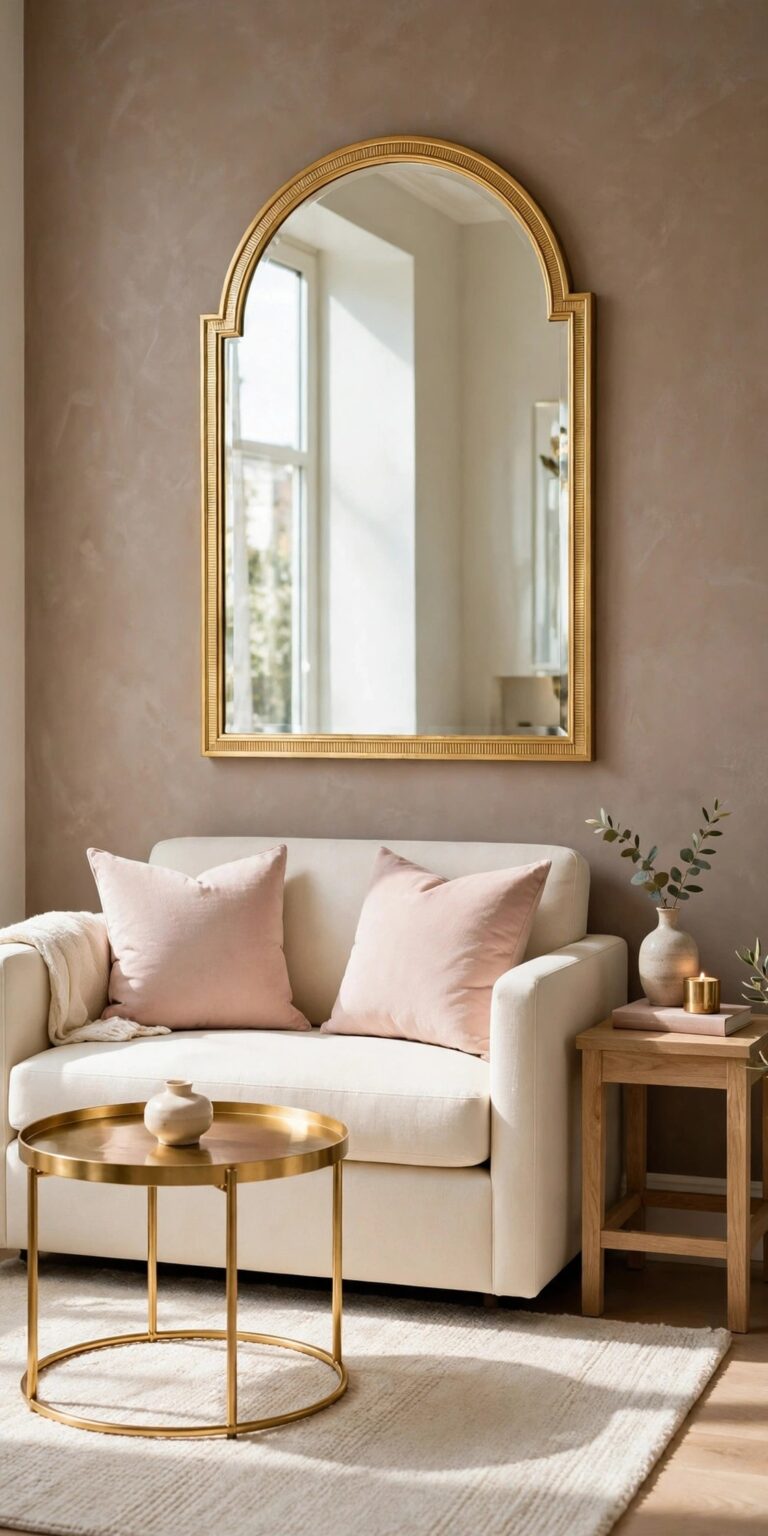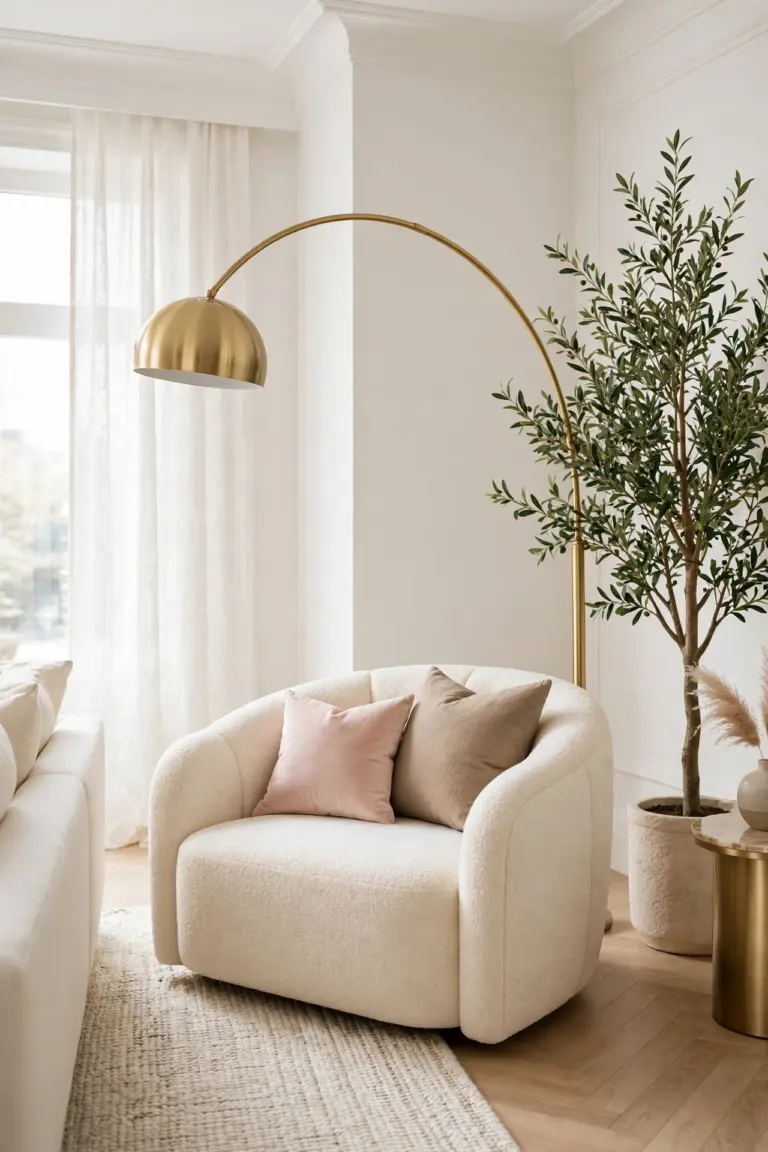
15 Japandi Living Room Design Ideas for a Calm Home
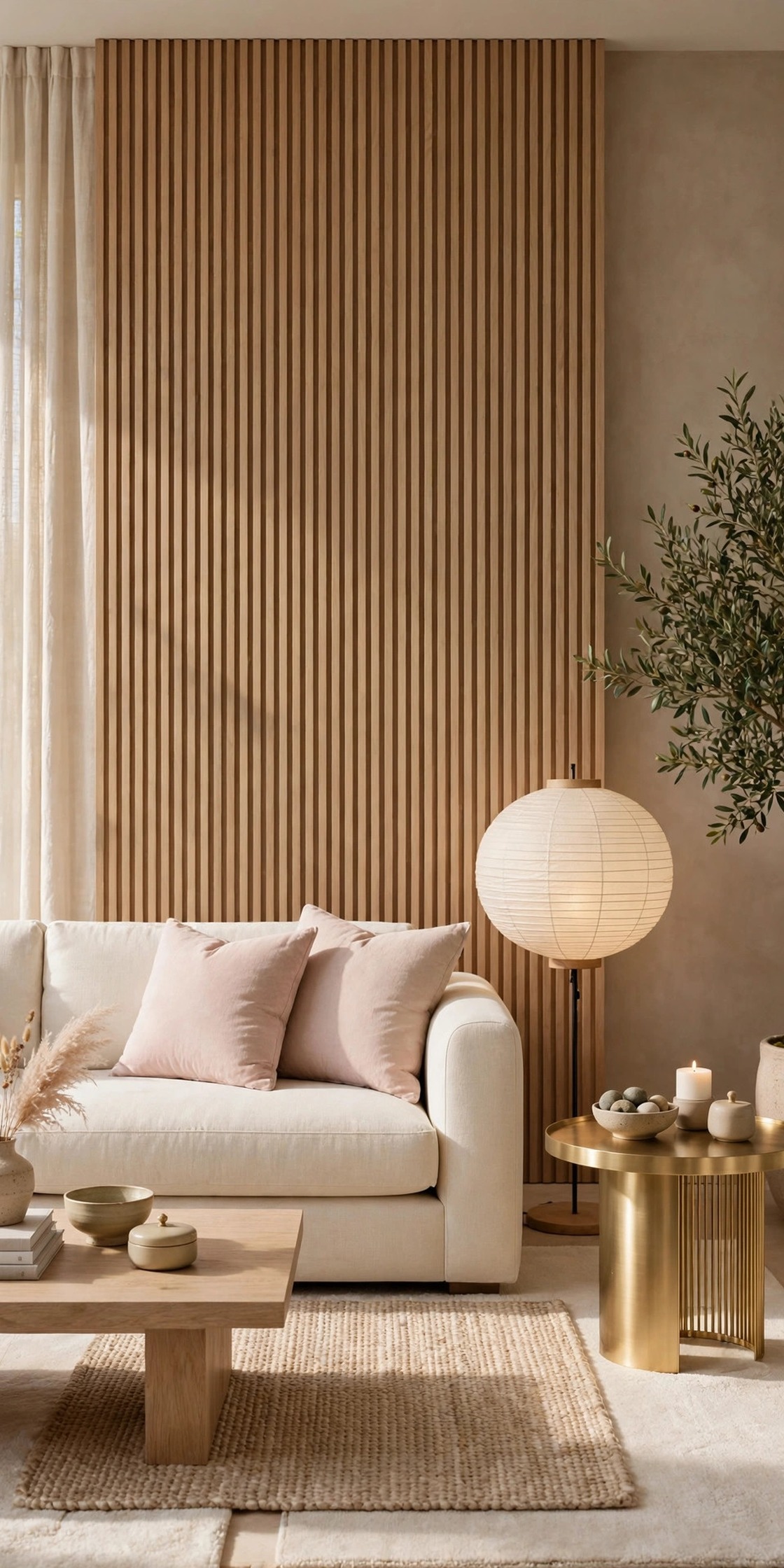
A japandi living room design search usually starts with one worry: calm will read as empty. It will not, if the calm is built from warm materials and the room keeps its soft glam notes. Japandi joins Japanese simplicity with Scandinavian warmth, so the room stays low, pale and uncluttered, while light oak, warm taupe, cream linen and brushed gold keep it feeling rich rather than bare. These japandi living room design ideas keep every surface warm and natural, never cold and never stark, and they keep the walls, the sofa and the rug pale so the room reads bright and restful. Work through the list in order, because the early ideas set the sofa, the walls and the floor, and the later ones add the light, the shelves and the soft finishing layers. If you are planning the room around its calm base, our living room decor shows how the sofa, the rug and the small styling pieces work together.
Disclosure: This article may contain affiliate links. If you buy through a link on this page, GlamNStyle may earn a small commission at no extra cost to you. Product links in this article are plain links; each one is checked on the retailer’s own page before it is added.
1. Start with a Low Cream Sofa on a Light Wood Frame
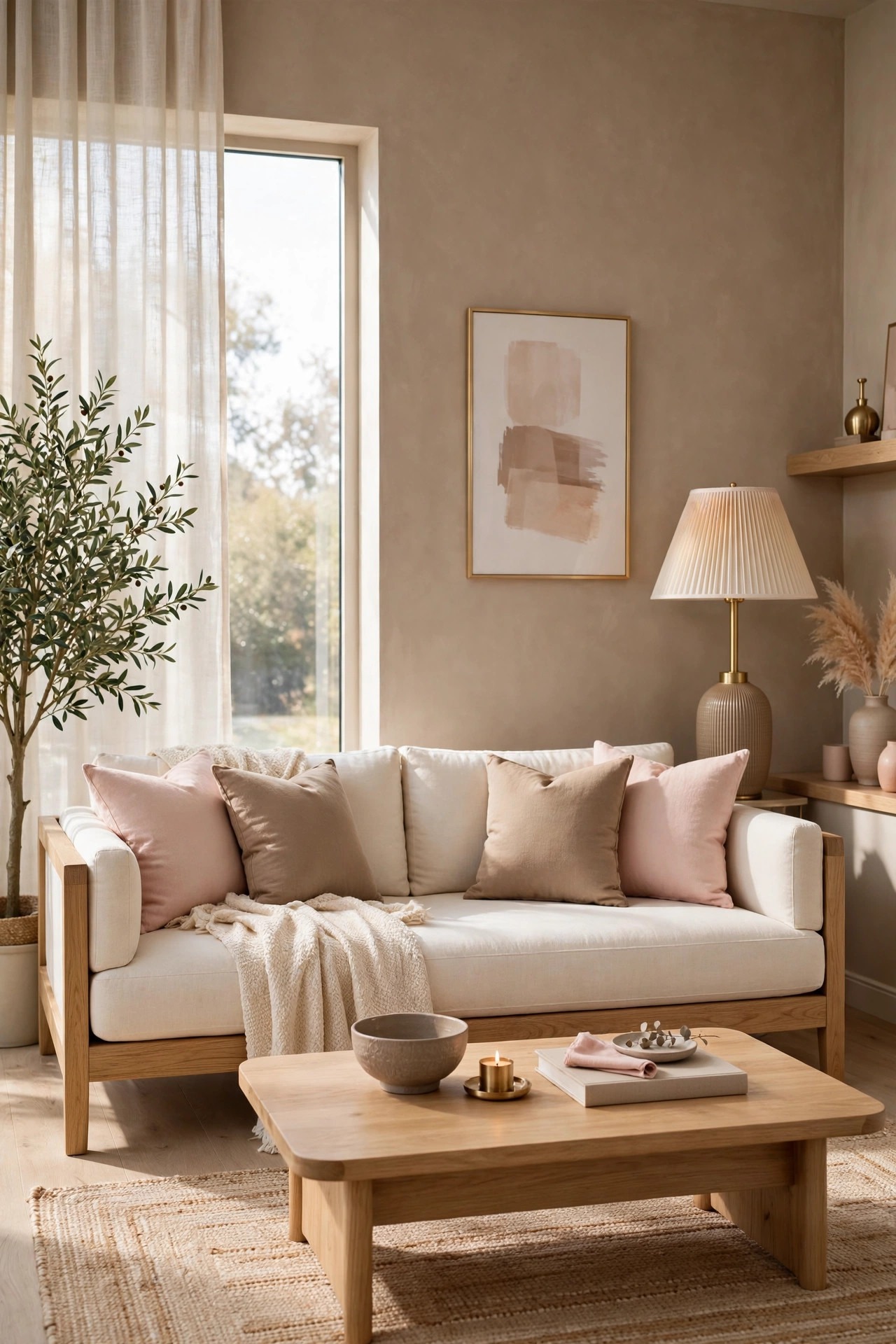
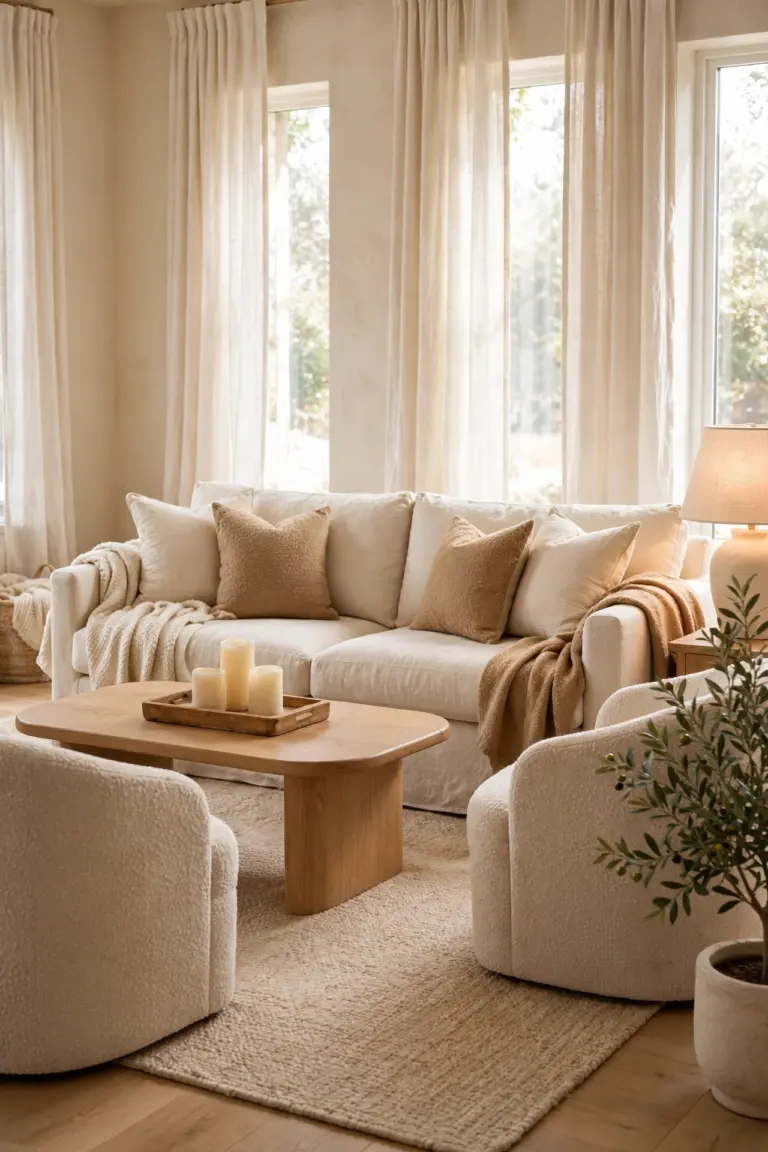
A low cream sofa is the calmest anchor a Japandi living room can hold, and it is the best place to put the cream in this room. The low seat and the light oak frame keep the room feeling open and grounded at the same time, and the pale linen stops a beige room from feeling flat or washed out. Choose a sofa with a simple straight back and deep seats, so the shape stays quiet and the linen does the work, and keep the legs visible in light oak, so the sofa reads light rather than heavy. Pick a washable linen or a performance fabric in warm cream, because a pale sofa meets daily life and a cover that can be cleaned keeps the calm. Our brown couch living room ideas show the same low sofa shape with a deeper color, for readers deciding between cream and a warm brown.
Best For: Living rooms that feel busy or overfilled, and anyone who wants the calm base set in one piece.
Not Ideal For: Homes with muddy paws or small children who eat on the sofa daily; a washable slipcover is the honest version there.
Estimated Cost: $900-$2,800 (estimate) for a low cream linen sofa on a light oak frame.
Budget Note: The frame and the fabric are the spend; a simple low sofa in a good linen costs far less than a shaped designer piece and reads calmer.
Renter Friendly: Yes
Renter Note: Nothing fixed at all; a low sofa moves out in one piece on moving day.
What You Need
Low-profile cream linen sofa on a light oak frame, two blush cushions, one warm taupe cushion, washable fabric cleaner.
Product type to look for: A sofa with removable, washable covers and a solid light oak frame, because a pale sofa needs cleaning and a light frame keeps the low shape from looking heavy.
How To Do It
- Measure the wall and leave at least a hand’s width of space behind the sofa, so the low back breathes.
- Set the sofa level and centred on the rug, following the maker instructions for the legs.
- Dress it with the blush cushions at the ends and the taupe cushion in the middle.
- Sit in every seat and check the low back supports you, then step back and check the cream reads warm, not stark, from the doorway.
Pro Tip
Keep the sofa cushions to three only. A low Japandi sofa earns its calm from the empty space beside the cushions, while a sofa crowded with pillows reads as a different style altogether.
2. Add a Light Oak Slat Accent Wall
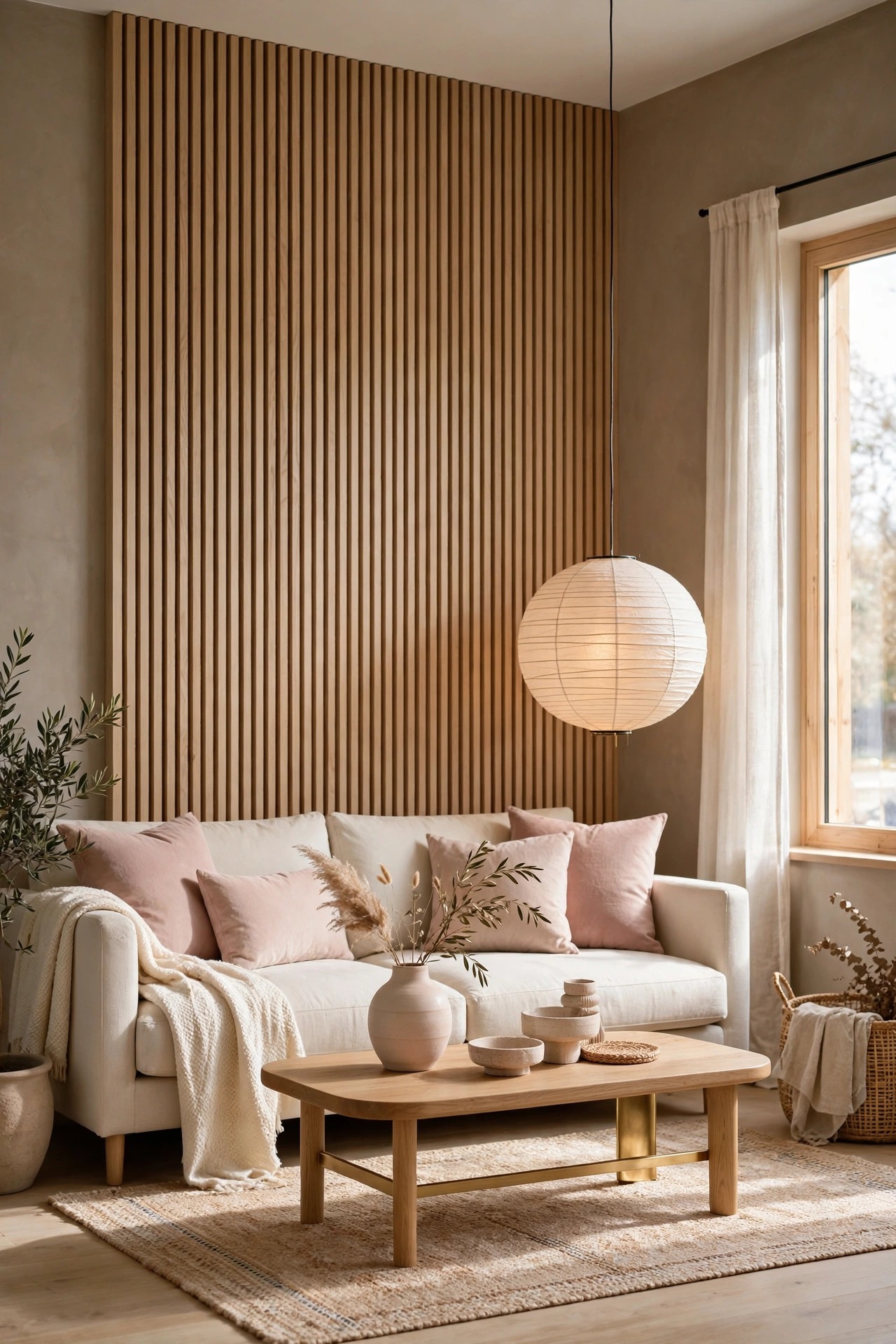
One slat wall is the warmest texture in this list, and it works because it is only one wall. Run thin light oak slats vertically behind the sofa, with a narrow gap between each slat, and keep the other walls warm taupe plaster, so the wood reads as a calm backdrop and the sofa glows against it. Choose pale oak with a matte finish, never glossy, because a matte slat wall catches the daylight softly while a shiny one sparkles and fights the calm. Keep the slats evenly spaced and stop them cleanly at the ceiling and the floor, so the wall reads built rather than stuck on. A slat wall also hides a plain wall behind the sofa, which matters in a room where the sofa is the main view.
Best For: Plain living rooms where the sofa wall feels bare, and anyone who wants wood warmth without painting.
Not Ideal For: Very narrow rooms where a slat wall eats the little depth there is; a single oak shelf is the lighter version there.
Estimated Cost: $250-$900 (estimate) for light oak slats and fixings for one wall.
Budget Note: The slats are the spend; thin pre-cut oak slats cost far less than wide custom panels and read calmer in a small room.
Renter Friendly: With Conditions
Renter Note: Slats need fixings the lease allows; a freestanding slat panel behind the sofa is the renter version, weighed at the base.
What You Need
Light oak wood slats in a matte finish, fixings rated for the wall type, level, pencil for marking, wood glue if the maker suggests it.
Product type to look for: Pre-cut slats in pale oak with a matte, sealed finish and even spacing, because an uneven gap is the first thing the eye catches on a slat wall.
How To Do It
- Mark the wall centre behind the sofa and plan the slat spacing on paper first, so the gaps stay even.
- Fix the first slat perfectly level, because every slat after it follows the first one.
- Work outward from the centre, checking the gap with a spacer as you go.
- Step back and check the wall reads as one calm rhythm from the doorway, then restyle the sofa against it.
Pro Tip
Stop the slats a hand’s width short of the side walls. A slat wall that runs edge to edge looks like a box, while a narrow margin of taupe plaster on each side frames it like a picture.
3. Wash the Walls in Warm Taupe Limewash
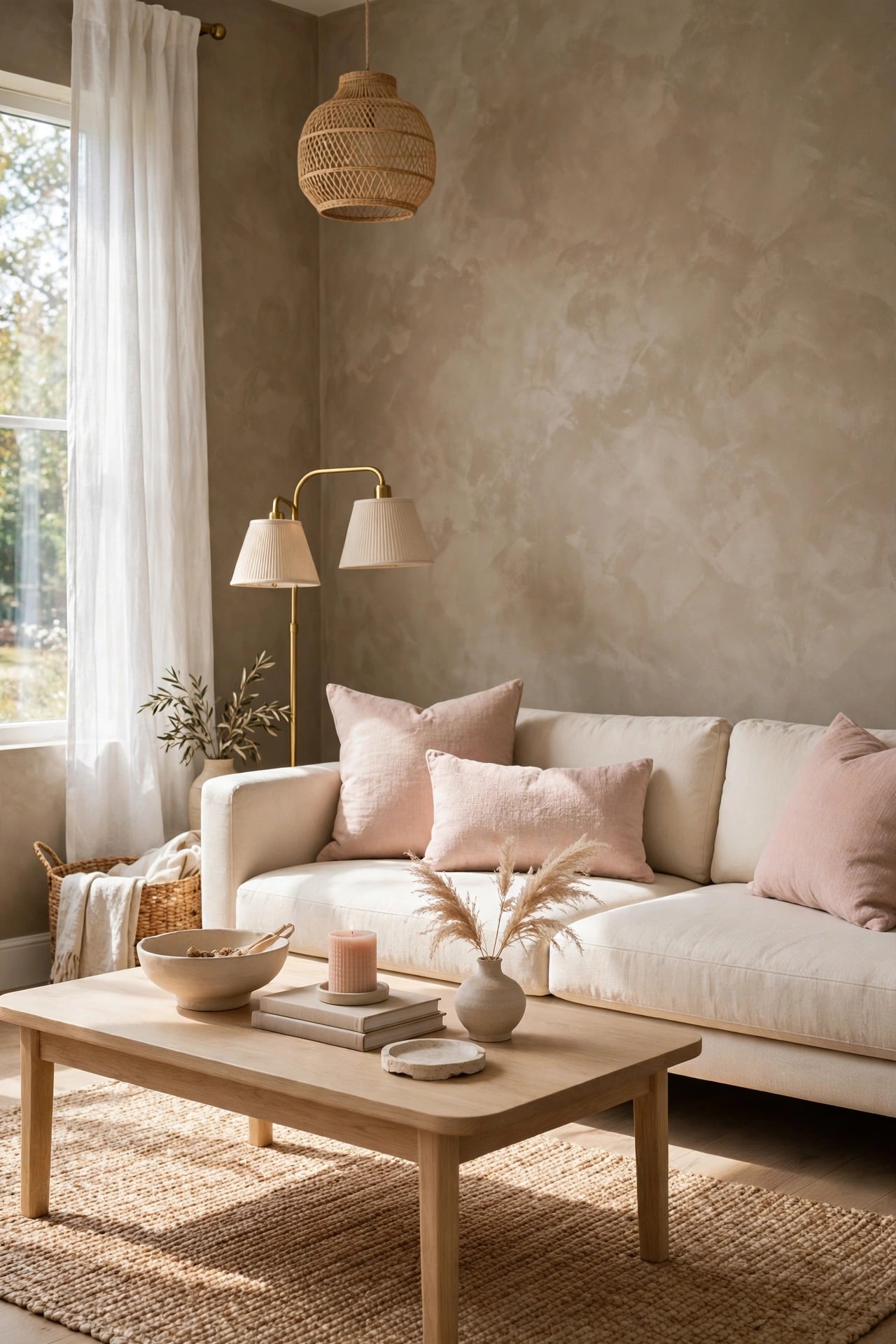
Warm taupe limewash is the gentlest color in this list, and it is the safest way to make a whole living room Japandi. Limewash dries with a soft cloudy movement, so the walls never read flat, and the warm taupe sits between cream and brown, flattering both the pale sofa and the light oak. Choose a taupe with a warm caramel or blush undertone, never a grey one, because a grey taupe turns cold under evening light and the whole point of this palette is warmth. Paint all four walls the same taupe, keep the ceiling warm cream, and let the cream sofa, the oak and the gold do the brightening. Test the color on every wall, because a taupe that glows on the window wall can look dull on the wall opposite the light.
Best For: Living rooms where the owner wants warmth everywhere but gently, and rooms with good daylight.
Not Ideal For: Very dark rooms with one small window; taupe on all four walls there can feel close, so one taupe wall and cream elsewhere is the lighter version.
Estimated Cost: $200-$600 (estimate) for limewash paint and supplies for a living room.
Budget Note: Limewash is a small spend with the largest effect in this list; sample two warm taupes on each wall before buying the full cans, because taupe shifts the most with the light.
Renter Friendly: No
Renter Note: Paint is a landlord decision; renters can borrow the taupe note with cushions, a throw and a rug in the same warm tone.
What You Need
Limewash paint in warm taupe, primer suited to the wall surface, large brush for the limewash finish, painter’s tape, drop cloths.
Product type to look for: A limewash paint in a warm taupe with a caramel or blush undertone, checked on every wall in daylight before buying.
How To Do It
- Paint two taupe samples on each wall and look at them in daylight and at night.
- Clean the walls, tape the edges, and prime where the old color shows through.
- Apply the limewash in loose crossing strokes, letting each coat dry fully before the next.
- Refit the art and the shelves, and check the taupe reads warm from the doorway.
Pro Tip
Keep the curtains and the rug cream against taupe walls. Taupe curtains on taupe walls disappear, while pale curtains give the eye a bright place to land.
4. Choose a Low Tatami-Style Coffee Table
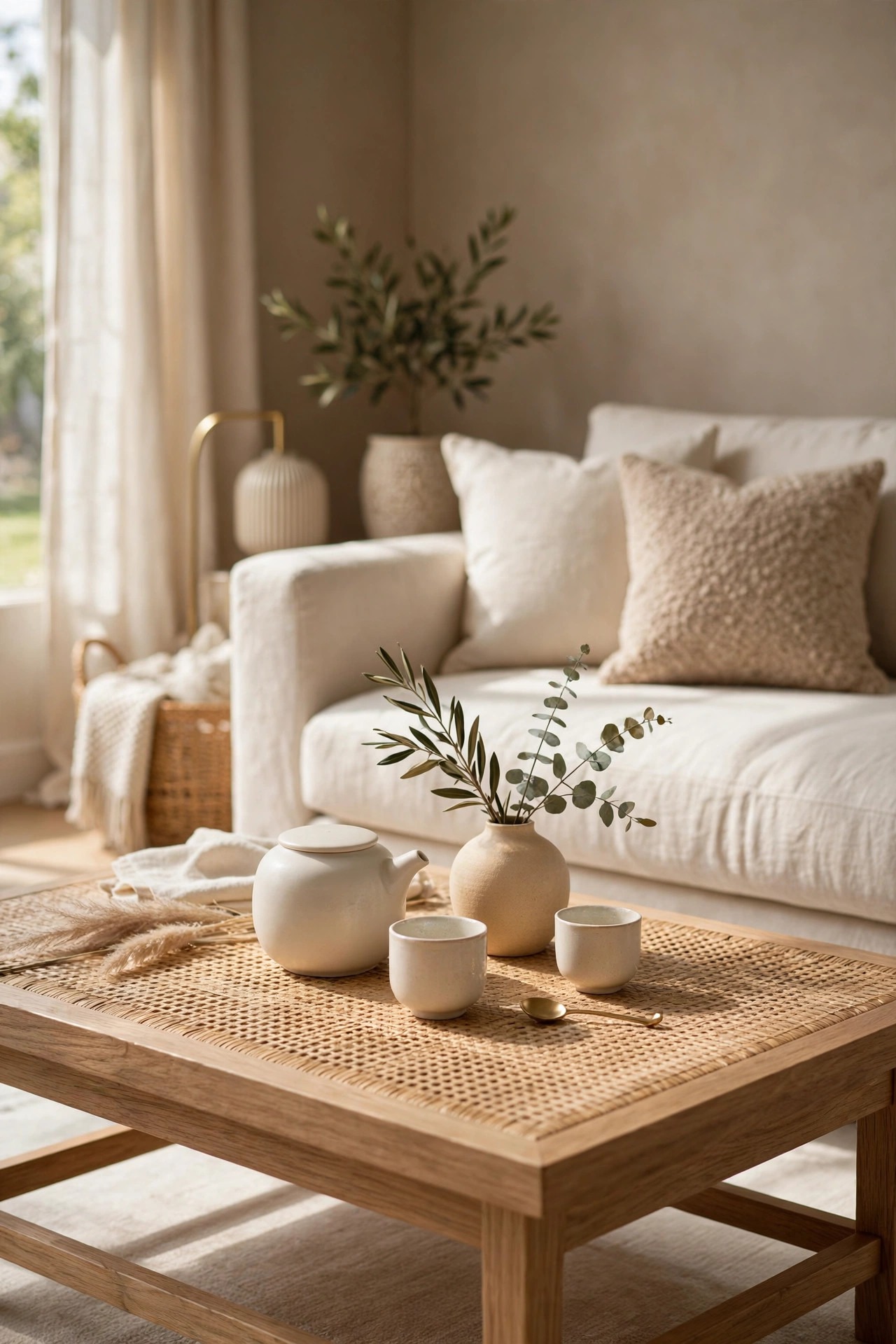
A low coffee table is the piece that sets the Japandi height for the whole room, and it is the one the eye meets first from the sofa. Choose a low rectangular table in light oak, with a simple slab top and short legs, so the table sits below the sofa seat and the room reads calm and grounded. A woven or textured top, in a tatami-style weave, adds the Japanese note without adding a color, and it keeps the table from looking like plain furniture. Keep the tabletop nearly clear, one tea set or one book and one small vase, because a low table crowded with objects stops reading as calm and starts reading as storage. Measure the gap to the sofa first, because a low table too close to the sofa is hard to walk around.
Best For: Living rooms built around a low sofa, and anyone who wants the Japanese note in one honest piece.
Not Ideal For: Homes where the coffee table holds board games and homework daily; a taller table with a shelf below is the honest version there.
Estimated Cost: $200-$700 (estimate) for a low light oak coffee table.
Budget Note: The oak top is the spend; a simple slab table in pale oak costs far less than a shaped designer table and reads calmer beside a low sofa.
Renter Friendly: Yes
Renter Note: Nothing fixed at all; a low table moves out in one piece on moving day.
What You Need
Low rectangular light oak coffee table, ceramic tea set, one small vase with a single stem, one book.
Product type to look for: A table with a solid oak top and short, sturdy legs, because a low table takes knees and feet and must not wobble.
How To Do It
- Measure the gap between the sofa and the table, and leave enough room to walk past comfortably.
- Set the table level and centred on the rug, following the maker instructions for the legs.
- Style the top with the tea set on one end and the vase on the other, and leave the middle clear.
- Sit on the sofa and check the table height feels easy to reach without leaning.
Pro Tip
Keep the middle of the table empty on purpose. A low table with a clear centre reads as a calm surface, while a table filled edge to edge reads as a shelf.
5. Light It with a Washi Paper Lantern Lamp
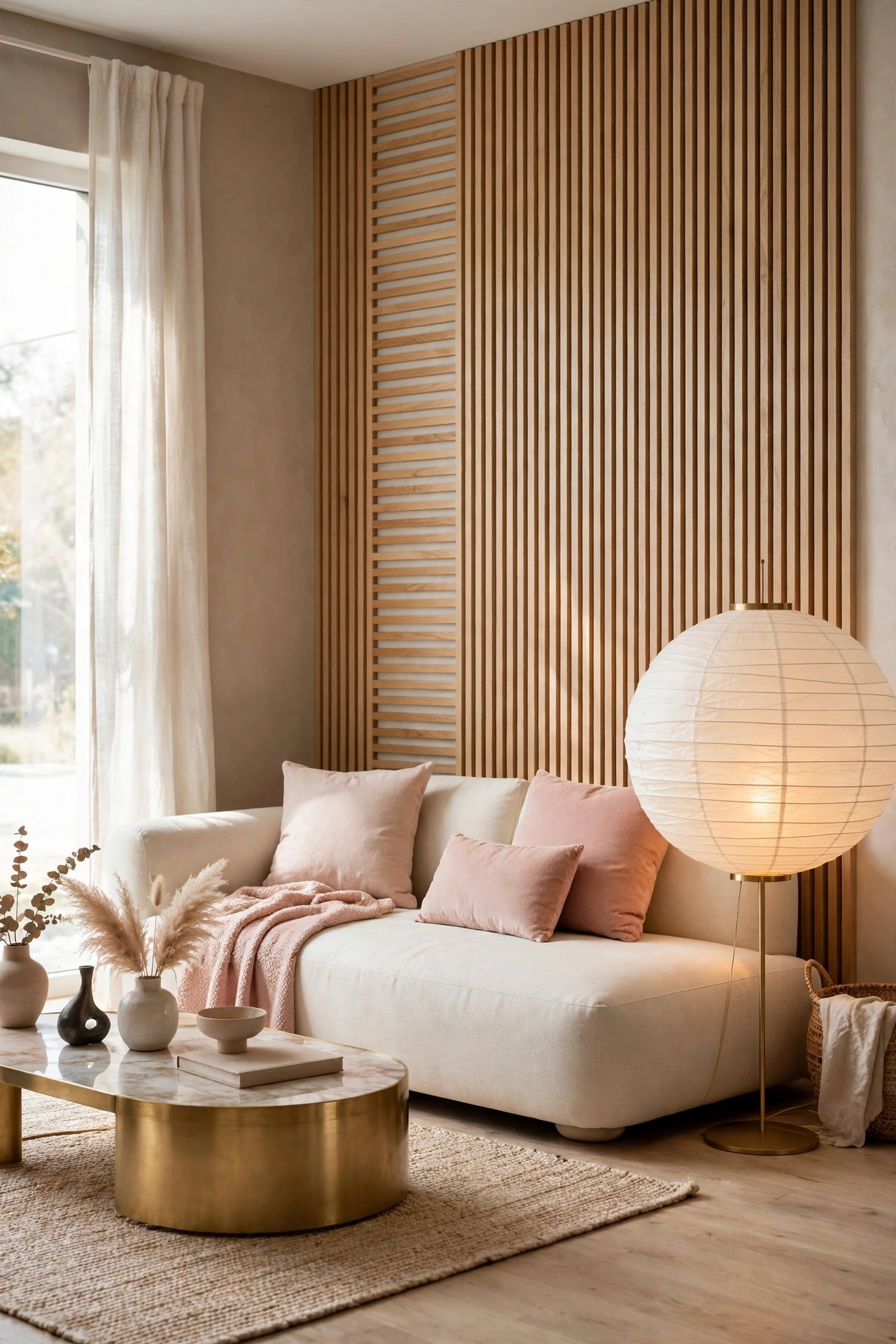
A paper lantern lamp is the softest light a Japandi living room can hold, and it is the piece that makes the room glow at dusk. Choose a large round lantern in white washi paper on a light wood or thin black stand, and place it beside the sofa or in an empty corner, so the light spreads evenly instead of pointing down. Use a warm bulb, never a cool one, because a cool bulb turns the paper blue. Keep the lantern away from the walkway and from radiators, because paper and heat do not mix, and dust it gently with a dry cloth, because a dusty lantern glows grey. Our elegant living room decor shows the same soft glow paired with gold and glass, for readers who want the lamp to read glam as well as calm.
Best For: Living rooms that feel harsh under ceiling lights, and anyone who wants one soft light for the evening.
Not Ideal For: Homes with climbing toddlers or large dogs; a paper lantern at floor level is fragile, so a hanging paper pendant is the safer version there.
Estimated Cost: $60-$250 (estimate) for a washi paper lantern floor lamp with a warm bulb.
Budget Note: The lantern is a small spend; a good paper shade on a simple stand glows as softly as a costly designer lamp.
Renter Friendly: Yes
Renter Note: Nothing fixed at all; the lamp plugs in and moves out in one box on moving day.
What You Need
Round white washi paper lantern floor lamp, warm white bulb, small dimmer plug if the lamp has none.
Product type to look for: A paper shade with a sturdy stand and a warm bulb included, because a cool bulb turns the paper blue and ruins the glow.
How To Do It
- Choose the corner beside the sofa or the empty corner, and check the lantern clears the walkway.
- Fit the warm bulb and switch the lamp on at dusk to check the glow.
- Add a dimmer plug if the lamp has none, so the light can drop low in the evening.
- Step back and check the lantern glows warm against the taupe wall from the doorway.
Pro Tip
Keep the lantern the only paper light in the room. Two paper lanterns split the glow, while one large lantern with a low warm light reads as the room’s evening heart.
6. Divide the Room with a Shoji-Style Sliding Panel
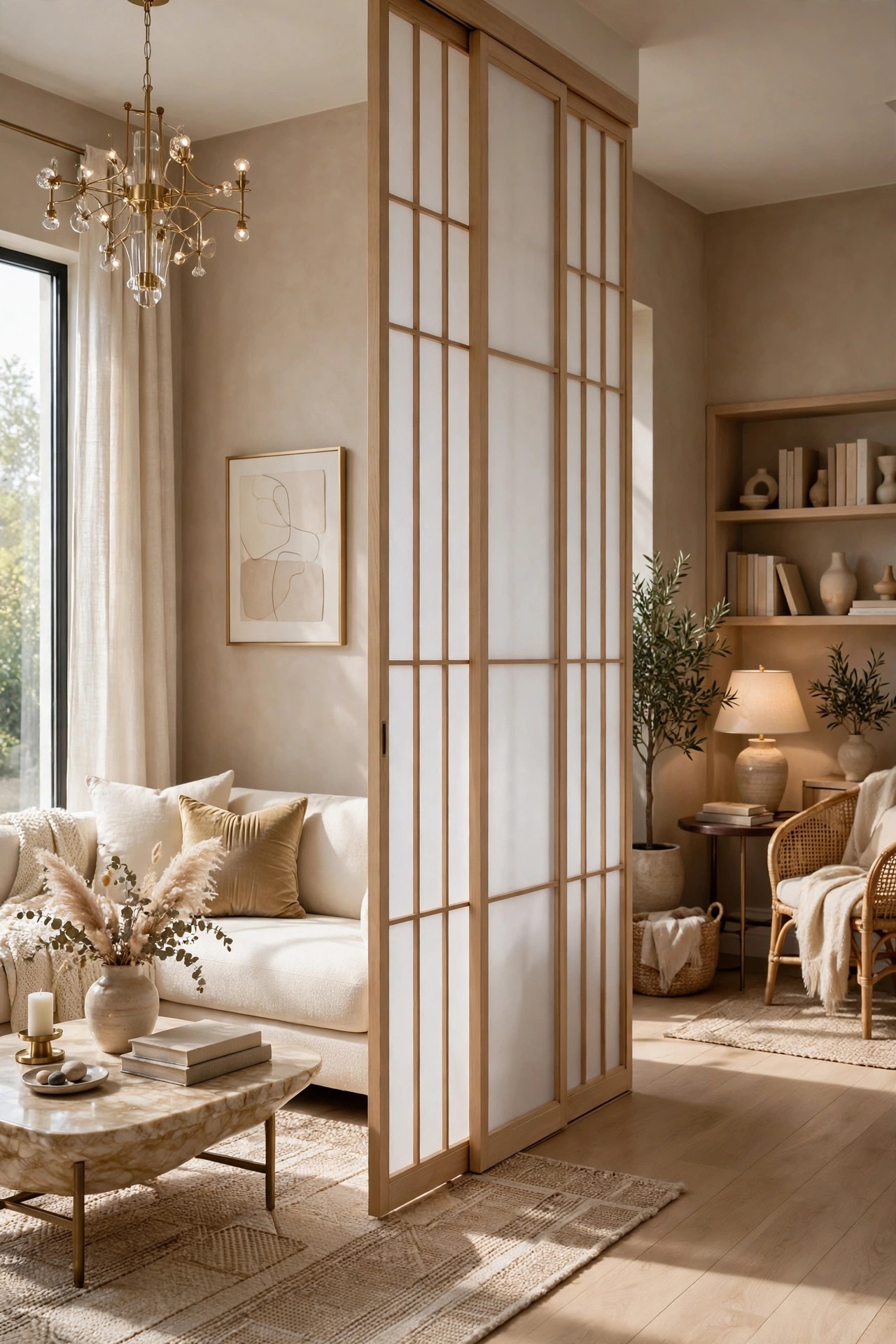
A shoji-style panel divides a living room without closing it, and it is the most Japanese idea in this list. Choose a light wood frame with translucent white panels, on a sliding track, and use it to separate the sofa area from a reading corner or a dining space, so each zone keeps its calm while the light still passes through. Keep the frame pale oak and the panels plain white, never patterned, because a plain panel glows softly while a patterned one reads busy. Fit the track level and keep the floor under it clear, because a sliding panel that sticks is worse than no panel at all. Open the panel fully in the daytime, so the room reads as one bright space, and slide it closed only when the zones need their quiet.
Best For: Open-plan living rooms that need a soft divide, and anyone who wants privacy without a wall.
Not Ideal For: Very small living rooms where a panel eats the walkway; a low open shelf is the lighter divider there.
Estimated Cost: $300-$1,200 (estimate) for a shoji-style sliding panel with a track.
Budget Note: The track and the frame are the spend; a single panel costs far less than a full wall of panels and still divides the room.
Renter Friendly: With Conditions
Renter Note: A track needs fixings the lease allows; a freestanding shoji screen in the same light wood is the renter version.
What You Need
Shoji-style sliding panel in a light wood frame with translucent white panels, sliding track rated for the panel weight, level, fixings.
Product type to look for: A panel with a smooth sliding track and shatter-resistant translucent panels, because a panel that sticks or cracks is a daily frustration.
How To Do It
- Measure the opening and choose a panel that covers it with a little overlap on each side.
- Fit the track level, following the maker instructions for the ceiling or wall fixings.
- Hang the panel and slide it back and forth several times to check it runs smoothly.
- Open it fully in daylight and check the room still reads as one bright space.
Pro Tip
Keep the panel plain white and let the wood frame do the talking. A patterned panel fights the calm, while a plain glowing panel makes the whole room feel lit from within.
7. Layer a Jute Rug over a Cream Wool Rug
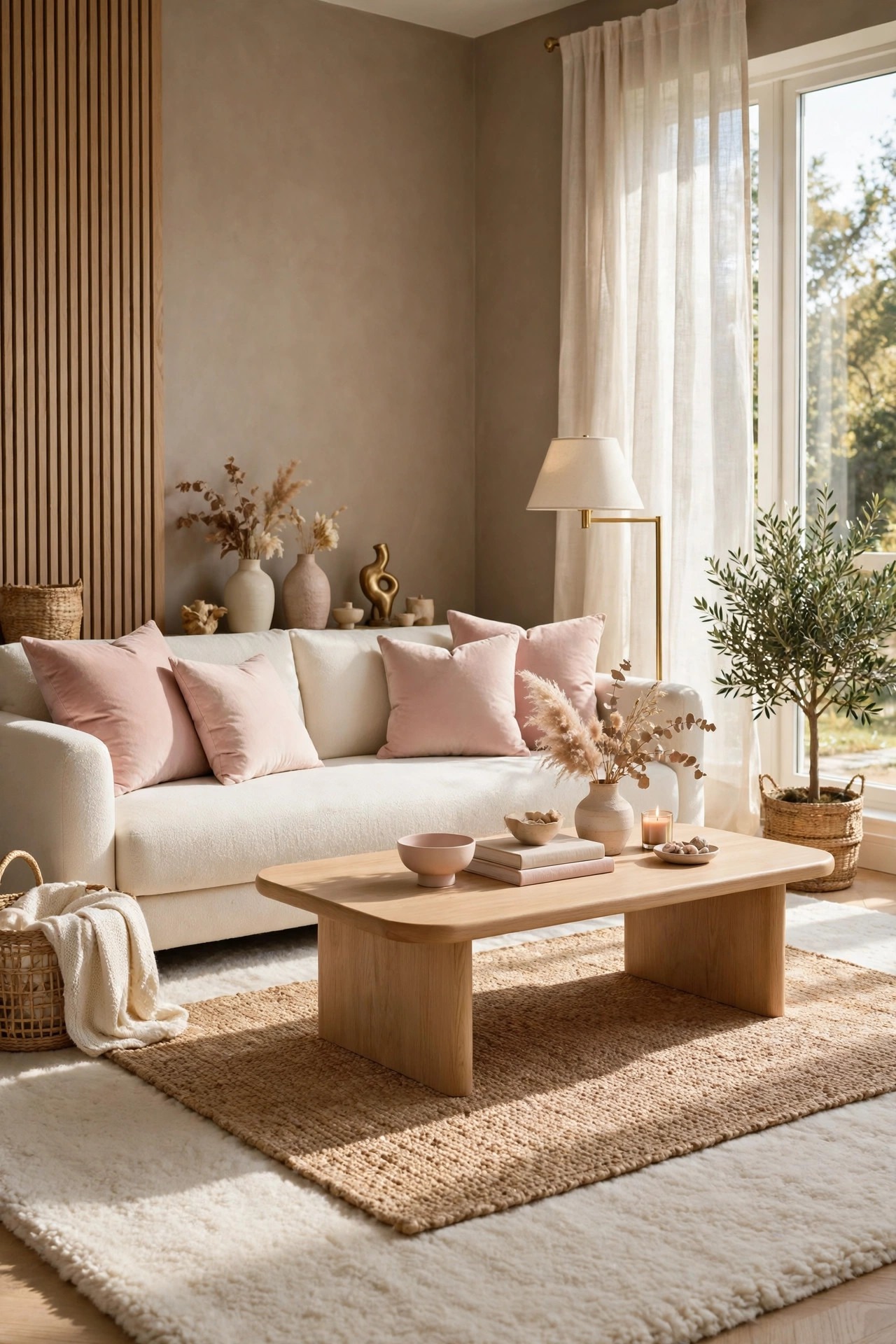
Layered rugs give a Japandi living room its texture in one move, and they are the softest idea in this list. Lay a large cream wool rug under the sofa and the coffee table, then layer a smaller natural jute rug on top, slightly off centre, so the jute sits under the table and the cream shows at the edges. Choose a jute with a tight weave and a flat edge, because a loose jute sheds and a curled edge trips bare feet. Keep the rug sizes generous, the wool rug reaching under the sofa front legs and the jute rug reaching under the coffee table, so the layers read as one planned floor. Our cozy living room ideas show the same layered rug with deeper colors, for readers who want the texture with more warmth.
Best For: Living rooms where the floor feels bare or cold, and anyone who wants texture without adding a color.
Not Ideal For: Homes with a robot vacuum that struggles on layered edges; a single flat wool rug is the honest version there.
Estimated Cost: $250-$900 (estimate) for a cream wool rug and a natural jute rug.
Budget Note: The wool rug is the spend; a good jute rug costs little and adds the texture, so buy the wool first and the jute second.
Renter Friendly: Yes
Renter Note: Nothing fixed at all; both rugs roll up and move out on moving day.
What You Need
Large cream wool rug, smaller natural jute rug, rug pad under each layer, rug tape for the corners if needed.
Product type to look for: A jute rug with a tight weave and a flat, bound edge, plus a rug pad that grips, because a layered rug must not slide under the coffee table.
How To Do It
- Lay the wool rug first, centred on the sofa and reaching under its front legs.
- Lay the rug pad under the jute rug, then set the jute rug slightly off centre under the coffee table.
- Walk across both layers and check nothing slides or curls at the edges.
- Step back and check the jute reads as a warm centre and the cream as a bright border.
Pro Tip
Keep the jute rug smaller than the wool rug by at least a hand’s width on every side. A jute layer that nearly matches the wool layer looks like a mistake, while a clear border reads as a plan.
8. Style with Handmade Stoneware and Ceramic Vases
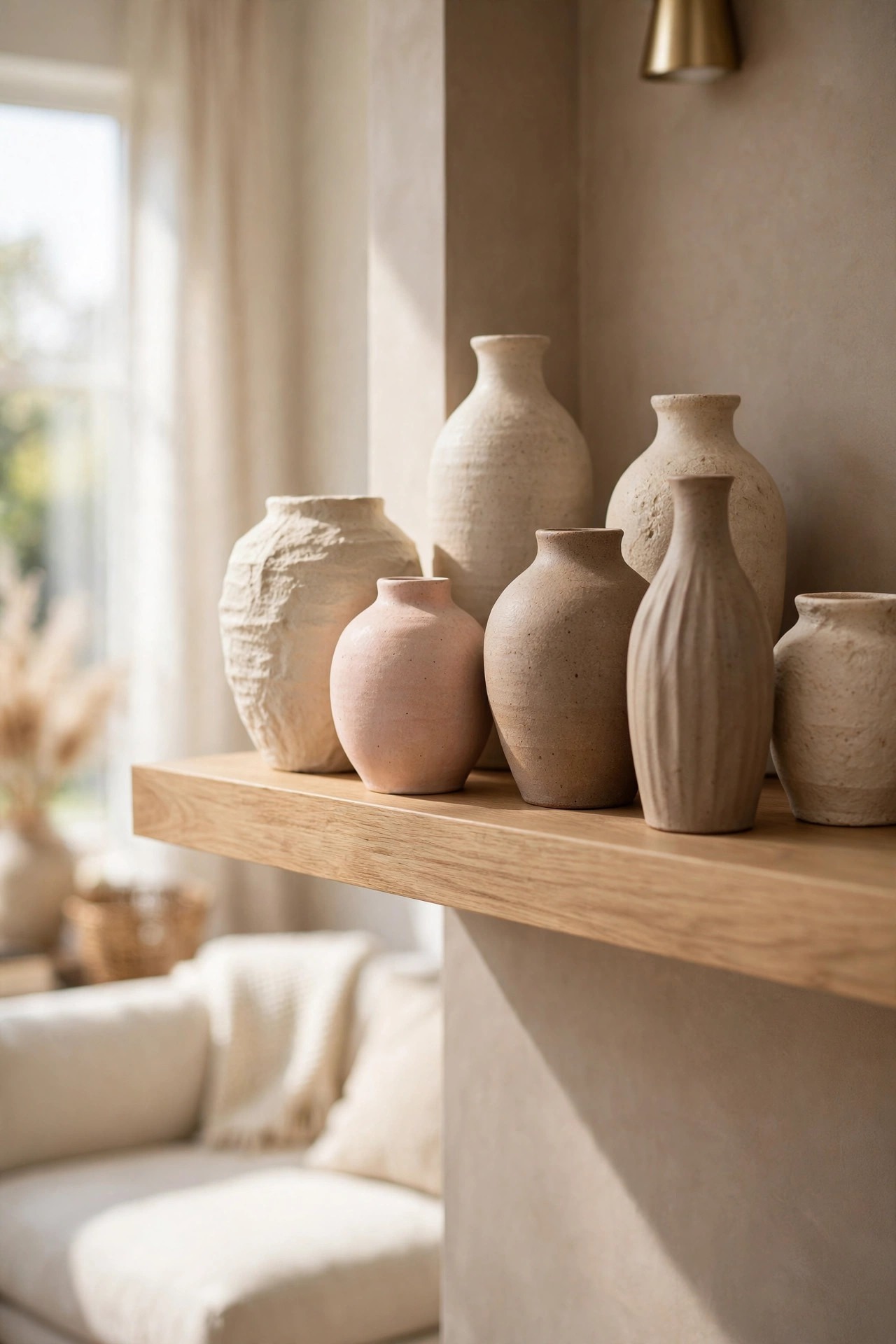
Handmade stoneware is the quiet glamour of a Japandi living room, and it is the styling layer that keeps the room from feeling like a showroom. Set three ceramic vases on the oak shelf or the side table, in warm cream, taupe and one soft blush, with different heights and one single stem in the tallest, so the group reads collected rather than bought as a set. Choose pieces with a matte glaze and a slightly uneven shape, because a handmade look softens the straight lines of the sofa and the slat wall. Keep the group to three pieces and leave breathing space around them, because a shelf crowded with ceramics reads as a shop, not a home. Buy one piece at a time if the budget is tight, because a collection built slowly looks more honest than a set bought in one afternoon.
Best For: Living rooms that look finished but feel cold, and anyone who loves objects with a handmade feel.
Not Ideal For: Homes with small children who reach for shelves; keep the ceramics high and the low surfaces clear, or choose unbreakable stoneware.
Estimated Cost: $80-$350 (estimate) for three handmade stoneware or ceramic vases.
Budget Note: The tallest vase is the spend; smaller handmade pieces cost little, and one piece a month builds the group without a big outlay.
Renter Friendly: Yes
Renter Note: Nothing fixed at all; the vases pack in one box on moving day.
What You Need
Three handmade stoneware or ceramic vases in cream, taupe and blush, one single stem for the tallest vase, soft cloth for dusting.
Product type to look for: Vases with a matte glaze and a stable, flat base, because a glossy or tippy vase on an oak shelf is a spill waiting to happen.
How To Do It
- Clear the shelf fully, then place the tallest vase first, off centre.
- Set the second vase a little lower and beside it, and the third smaller one in front.
- Add one single stem to the tallest vase and leave the other two empty.
- Step back and check the three heights read as a calm group from the doorway.
Pro Tip
Keep the vases to three colors only: cream, taupe and blush. A fourth color on the shelf splits the palette, while three colors in the same warm family read as one decision.
9. Keep Shelving Low and Open in Light Oak
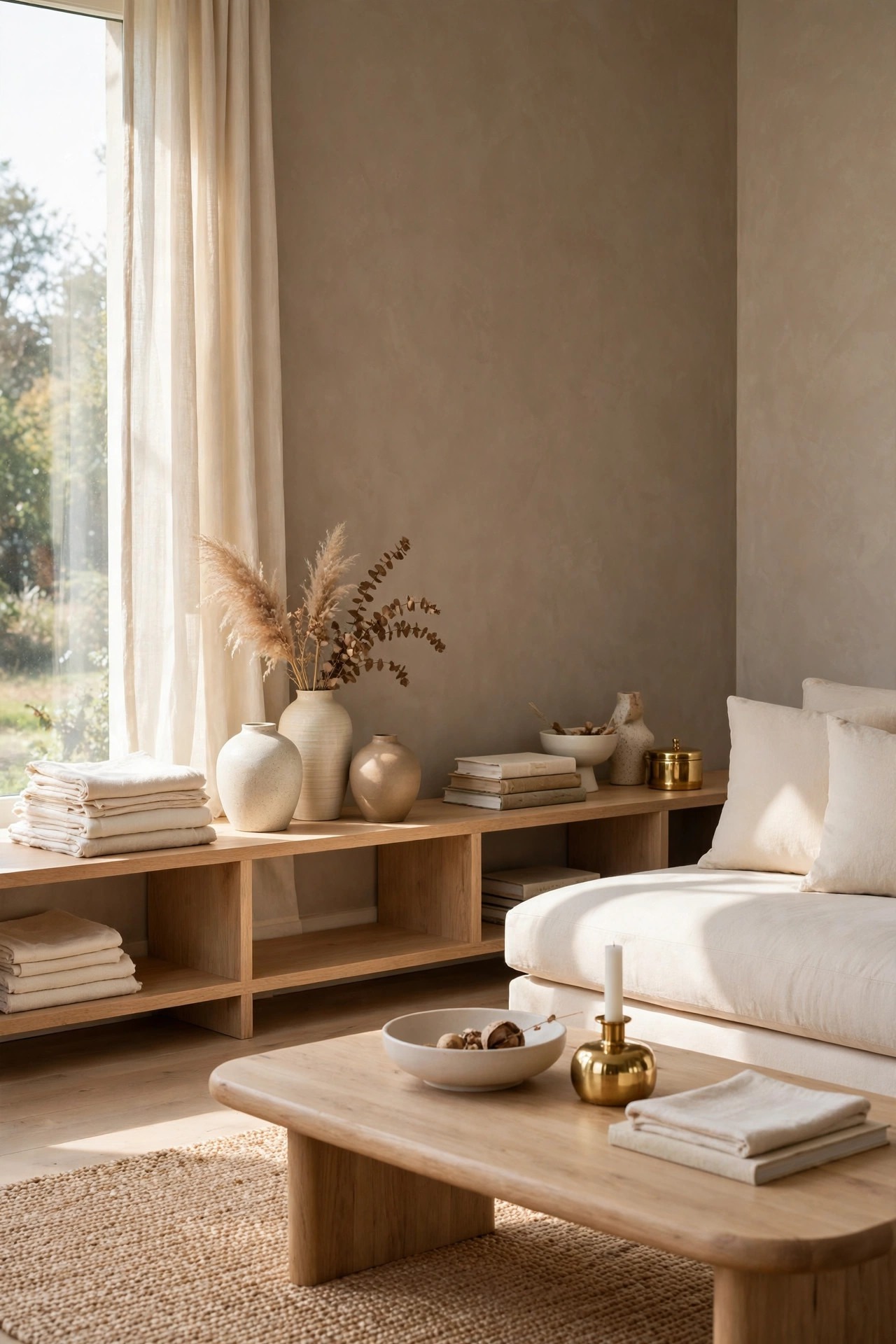
Low open shelving keeps a Japandi living room grounded, because the storage sits at the same calm height as the sofa and the coffee table. Fit two or three low oak shelves along the taupe wall, holding folded cream linen, three ceramic vases and a few books laid flat, so the wall has a useful layer without rising above the sofa back. Keep the shelves shallow, so they hold a folded throw and a vase without jutting into the walkway, and fix them into studs or rated anchors, because a shelf of books and ceramics is heavier than it looks. Style them lightly: one stack, one group of vases, one row of books per shelf, and leave breathing space between the groups, because a crowded shelf beside a low sofa reads as storage, not design. Match the shelf oak to the slat wall oak, so the two woods read as one family.
Best For: Living rooms where the books and throws have no home, and anyone who likes their calm pieces in reach.
Not Ideal For: Very dusty homes or homes with cats that climb shelves; closed low storage is the honest version there.
Estimated Cost: $150-$500 (estimate) for two or three low light oak shelves with brackets.
Budget Note: The brackets are the lasting spend; simple oak shelves in a pale finish cost little and can be cut to fit the wall.
Renter Friendly: With Conditions
Renter Note: Shelves need fixings the lease allows; a low freestanding oak shelf unit against the wall is the renter version.
What You Need
Two or three low light oak shelves, brackets rated for the loaded weight, folded cream linen throw, three ceramic vases, a few books.
Product type to look for: Brackets rated well above the shelf load, because a shelf of books and ceramics is heavier than it looks.
How To Do It
- Measure the wall beside the sofa and choose shelves that leave a clear walkway.
- Fit the brackets level into studs or rated anchors, following the maker instructions.
- Set the shelves and load the heaviest pieces, books and folded linen, on the lowest shelf.
- Style the top shelf lightest, one vase group and one book, and step back to check the groups breathe.
Pro Tip
Keep one shelf for display only, the vases and one book. A shelf that holds only useful pieces fills up in a week, while one calm display shelf keeps the whole wall looking styled.
10. Bring In One Sculptural Olive Tree
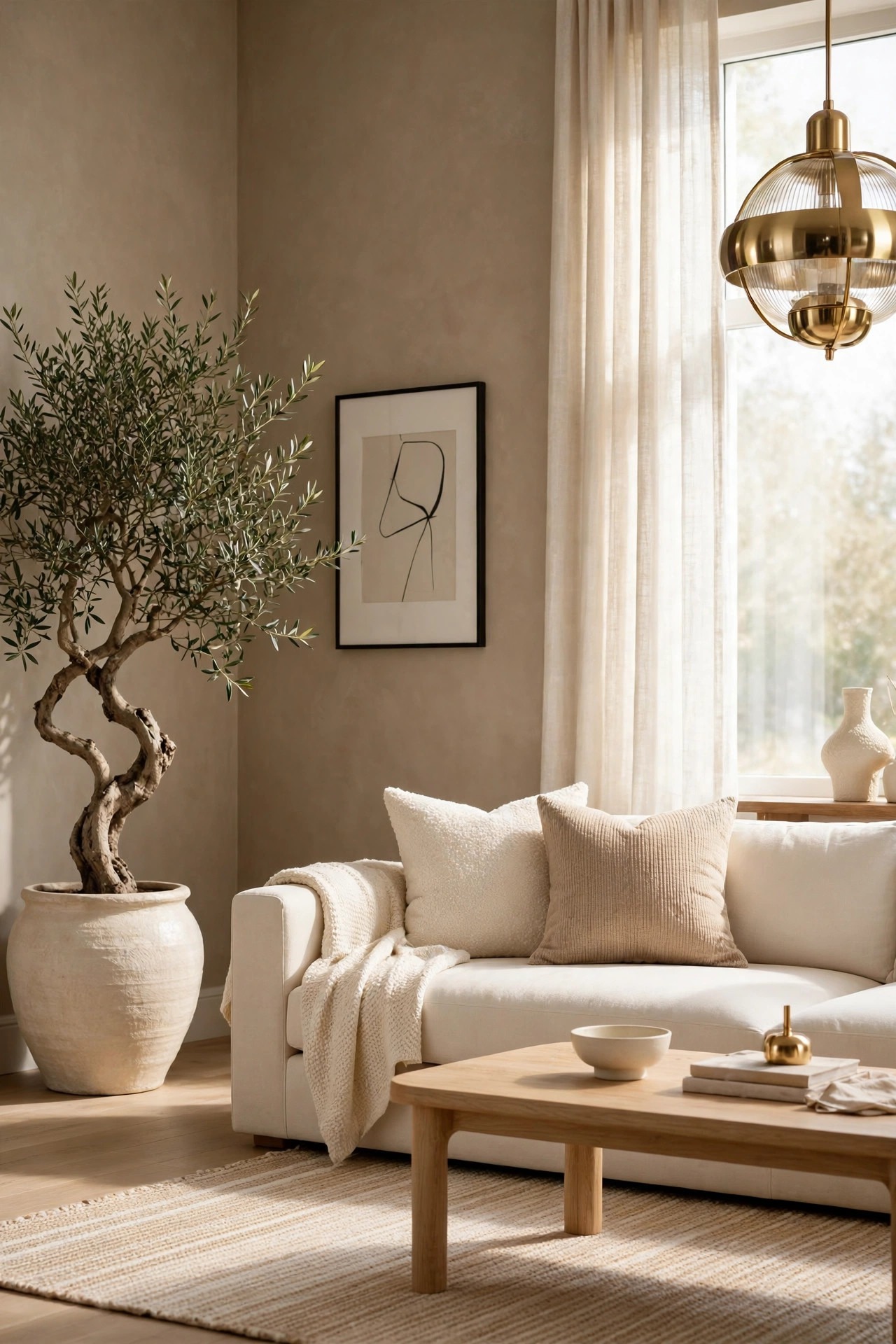
One olive tree is the living note a Japandi room needs, and it is the only plant this list asks for. Choose a young olive tree with a slim trunk and a light, airy crown, and set it in a large cream pot in the corner by the window, so the silvery leaves catch the daylight. Keep the pot cream and plain, so the tree does the talking. Water it only when the top soil is dry and turn the pot a quarter turn each week, so the crown grows evenly toward the light. An olive tree is slow and forgiving, and it asks for far less care than a fiddle leaf fig. Our modern luxury living room shows the same single-tree idea with a taller plant, for readers deciding between an olive tree and a larger statement tree.
Best For: Living rooms with a bright corner that feels empty, and anyone who wants one plant rather than a jungle.
Not Ideal For: Dark corners with no direct light; an olive tree needs sun, so a dried olive branch in a vase is the honest version there.
Estimated Cost: $80-$300 (estimate) for a young olive tree in a large cream ceramic pot.
Budget Note: The pot is the lasting spend; a young olive tree costs little and grows slowly, so buy small and let it grow into the room.
Renter Friendly: Yes
Renter Note: Nothing fixed at all; the tree and its pot move out together on moving day.
What You Need
Young olive tree with a slim trunk, large cream ceramic pot with drainage, potting soil, small watering can.
Product type to look for: A pot with a drainage hole and a matching saucer, because an olive tree hates wet roots and standing water rots them fast.
How To Do It
- Choose the brightest corner by the window and check the pot clears the walkway.
- Pot the tree in fresh soil, leaving a finger’s width below the rim for watering.
- Water it once, let it drain fully, and set the pot on its saucer.
- Turn the pot a quarter turn each week and check the crown stays even toward the light.
Pro Tip
Keep the tree the only plant in the room. One sculptural tree reads as a decision, while five small plants split the calm into clutter.
11. Hang Warm White Linen Curtains from the Ceiling
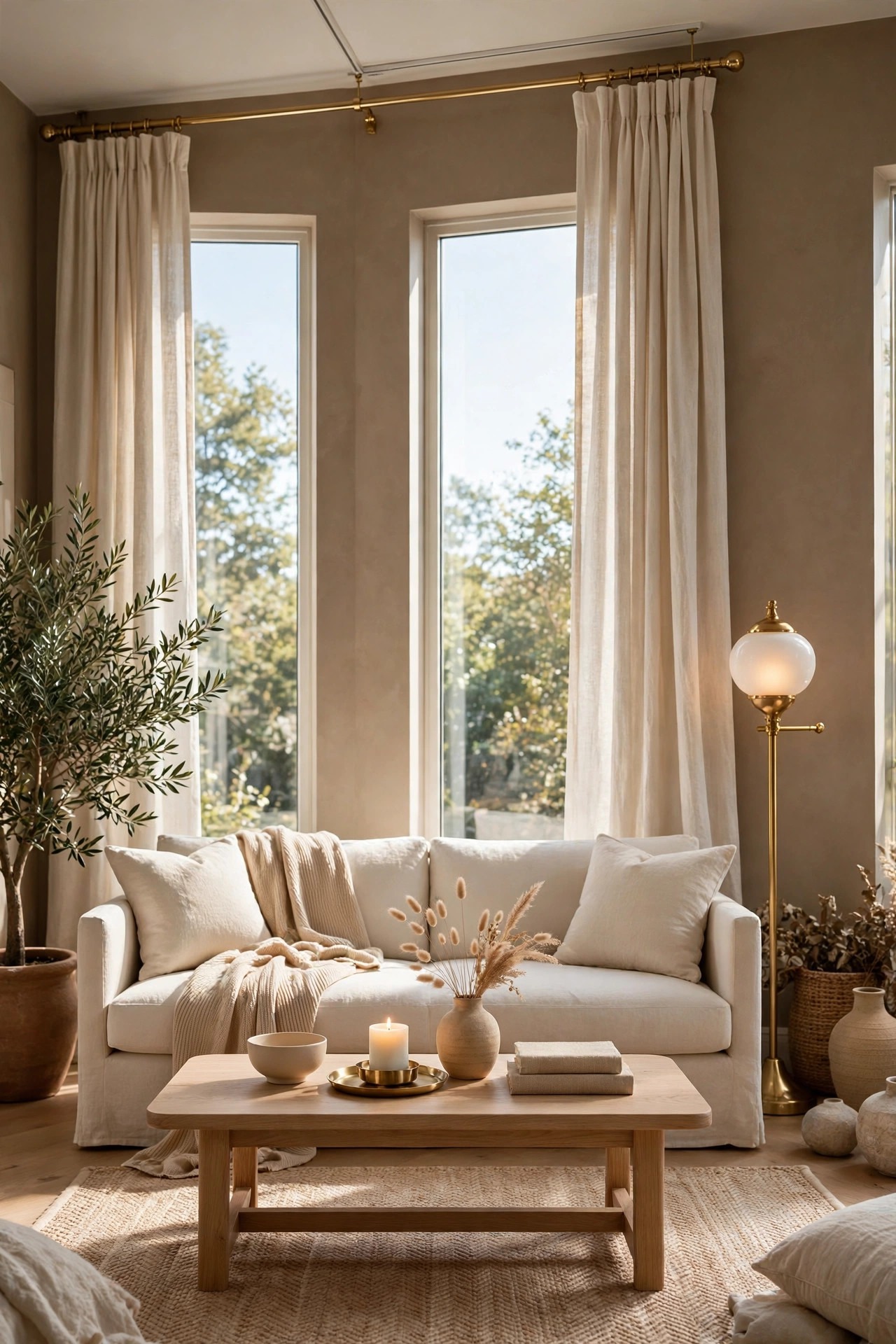
Linen curtains hung from the ceiling make a Japandi living room feel taller, and they are the softest wall in the room. Hang warm white linen panels from a slim ceiling track, so the fabric falls from the ceiling to just above the floor, and keep the panels wide enough to cover the window with a gentle fold, never stretched flat. Choose a warm white linen, not a bright white, because warm white glows beside taupe walls while bright white reads stark. Steam the panels once after hanging, so the linen falls cleanly, and let the fabric pool very slightly at the floor, because a linen curtain that stops short looks unfinished. A ceiling track also hides the curtain hardware, which keeps the calm unbroken from the floor to the ceiling.
Best For: Living rooms with tall windows or low ceilings, and anyone who wants the room to feel taller without building anything.
Not Ideal For: Windows that open inward daily; a ceiling track panel can block the handle, so a simple rod at the window top is the honest version there.
Estimated Cost: $150-$600 (estimate) for warm white linen curtain panels and a ceiling track.
Budget Note: The linen is the spend; a slim ceiling track costs little and can be cut to fit the window, so buy the fabric first and the track second.
Renter Friendly: With Conditions
Renter Note: A ceiling track needs fixings the lease allows; a tension rod inside the window frame is the renter version, with the same warm white linen.
What You Need
Warm white linen curtain panels, slim ceiling track with fixings, curtain hooks, steamer or iron.
Product type to look for: Linen panels with a lined or weighted hem, because unlined linen flaps in a draught and a weighted hem keeps the fall calm.
How To Do It
- Measure from the ceiling to just above the floor and order panels a little longer than the drop.
- Fit the ceiling track level, following the maker instructions for the fixings.
- Hang the panels with even folds and steam them once so the fabric falls cleanly.
- Step back and check the curtains read as one soft wall from the doorway.
Pro Tip
Keep the curtains warm white, never the same taupe as the walls. Warm white curtains against taupe walls give the eye a bright frame, while taupe curtains on taupe walls disappear.
12. Add Thin Black Accents for Contrast
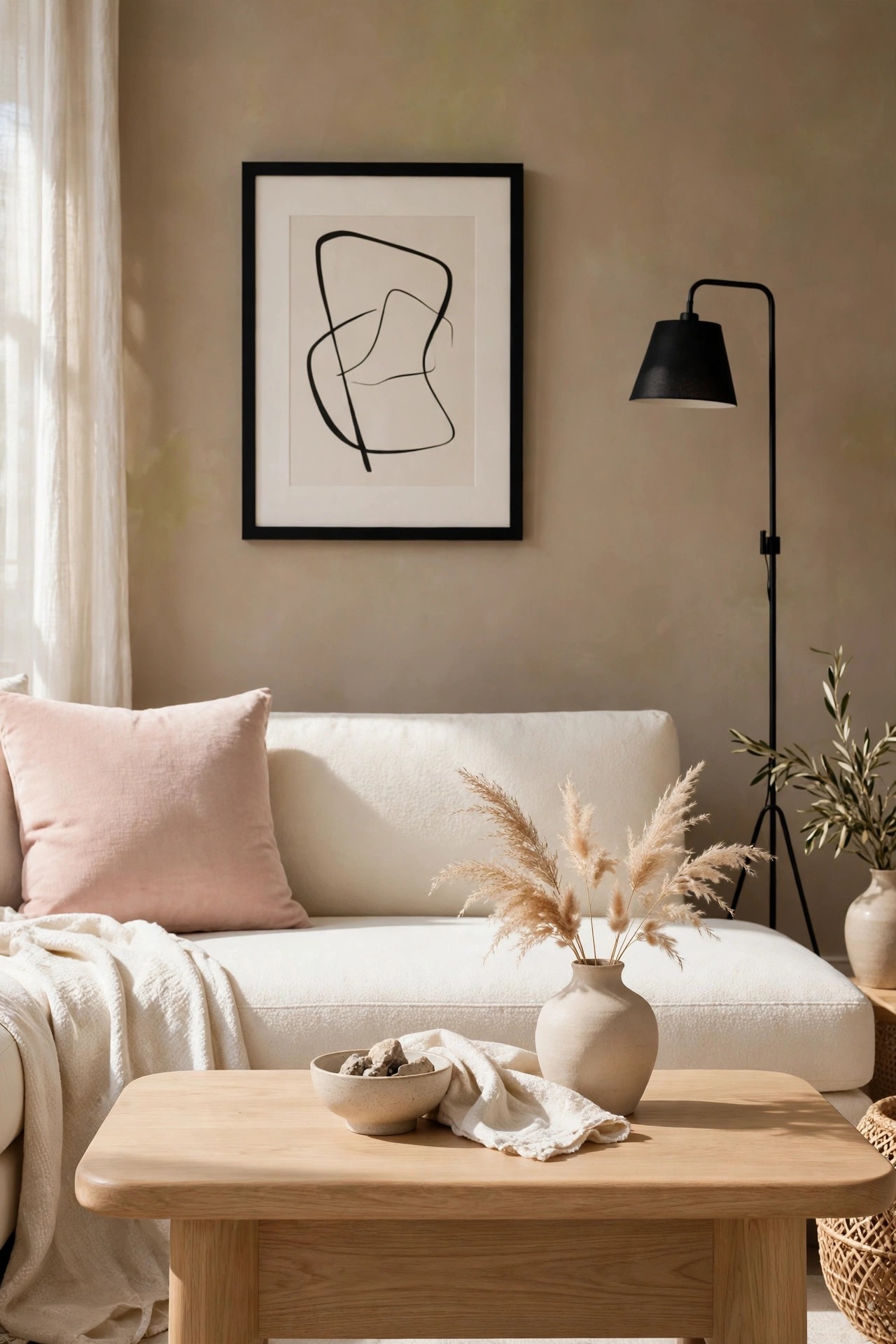
Thin black accents are the sharp note that keeps a pale Japandi room from looking washed out, and they are the smallest contrast in this list. Add black in three thin places only: a slim black floor lamp, a thin black frame on one piece of art, and a black handle or two on the oak shelf, so the eye meets the same dark line as it moves around the room. Keep the black thin and matte, never thick and glossy, because a thin matte line reads as a drawn edge while a thick glossy one reads as furniture. Match the black tone across the pieces as closely as you can; blacks vary, and a warm black beside a blue black reads as a mistake, especially against warm taupe. One black accent alone looks like a spare part, so the rule is three thin touches or none at all.
Best For: Pale living rooms that look washed out in photos, and anyone updating a calm room without repainting.
Not Ideal For: Rooms already committed to gold or brass throughout; one dark metal per room keeps the story clear.
Estimated Cost: $100-$400 (estimate) for a thin black floor lamp, one black frame and black shelf handles.
Budget Note: The lamp is the spend; black frames and handles are cheap and can arrive one piece at a time.
Renter Friendly: Yes
Renter Note: Nothing fixed at all; the lamp, the frame and the handles all move out on moving day.
What You Need
Thin black metal floor lamp, one black framed art print, two black shelf handles, screwdriver.
Product type to look for: A matte black finish in one consistent tone across the lamp, frame and handles, checked side by side in daylight before buying the third piece.
How To Do It
- Start with the floor lamp and live with its black tone for a week.
- Hang the black framed art at eye height on the taupe wall, centred on the sofa.
- Swap the shelf handles for the matching black ones, keeping the originals in a labelled bag.
- Step back and check the three blacks read as one thin line in daylight; swap the odd one out if not.
Pro Tip
Keep black at three heights only: low on the handles, middle on the lamp, high on the art frame. Black scattered at every height stops reading as a plan and starts reading as clutter.
13. Build a Low Window Seat Reading Nook
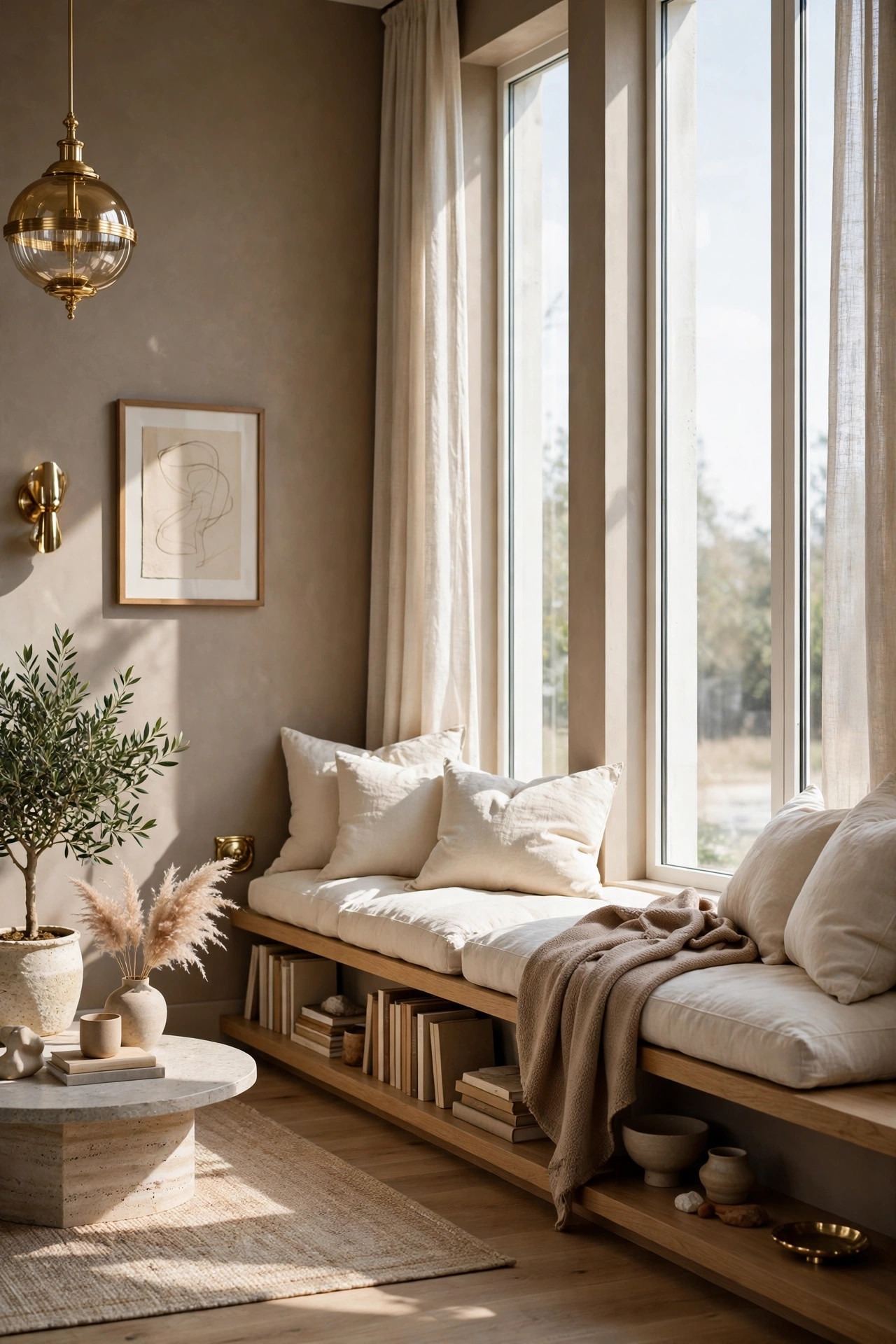
A low window seat turns the brightest corner of a Japandi living room into its quietest one, and it is the most lived-in idea in this list. Build or buy a low bench under the window, dress it with a cream linen cushion, one blush cushion and a folded warm taupe throw, and keep a small oak shelf of books within arm’s reach, so the nook invites a reader without asking for a whole chair. Keep the bench low, at the same height as the sofa seat, so the room stays on one calm level, and keep the cushion washable, because a window seat meets sunlight and daily use. Leave the window itself clear, so the daylight falls on the reader and the nook reads bright rather than tucked away. A window seat also gives the room a second seat without adding another sofa.
Best For: Living rooms with a wide window and an empty corner, and anyone who reads or drinks tea by the light.
Not Ideal For: Windows that are the only escape route or that open fully inward; a bench under such a window blocks the way, so a floor cushion is the honest version there.
Estimated Cost: $250-$1,000 (estimate) for a low window seat bench with linen cushions and a throw.
Budget Note: The bench is the spend; a simple low bench in pale oak costs far less than a built-in seat, and the cushions can arrive one at a time.
Renter Friendly: With Conditions
Renter Note: A built-in seat needs the landlord’s word; a freestanding low bench in the same pale oak is the renter version.
What You Need
Low bench in pale oak, cream linen seat cushion, one blush cushion, warm taupe throw, small oak shelf with a few books.
Product type to look for: A bench with a solid frame and a removable, washable cushion cover, because a window seat meets sun and daily use.
How To Do It
- Measure the window width and choose a bench a little narrower than the window, centred on it.
- Set the bench level under the window and check it clears the window handle.
- Dress it with the cream cushion, the blush cushion and the folded throw.
- Sit in the nook at midday and check the daylight falls on the reader, not in the eyes.
Pro Tip
Keep the nook to one throw and two cushions only. A window seat crowded with pillows stops being a seat and starts being a display, while two cushions and one throw invite a reader to sit.
14. Set a Calm Coffee Table Scene
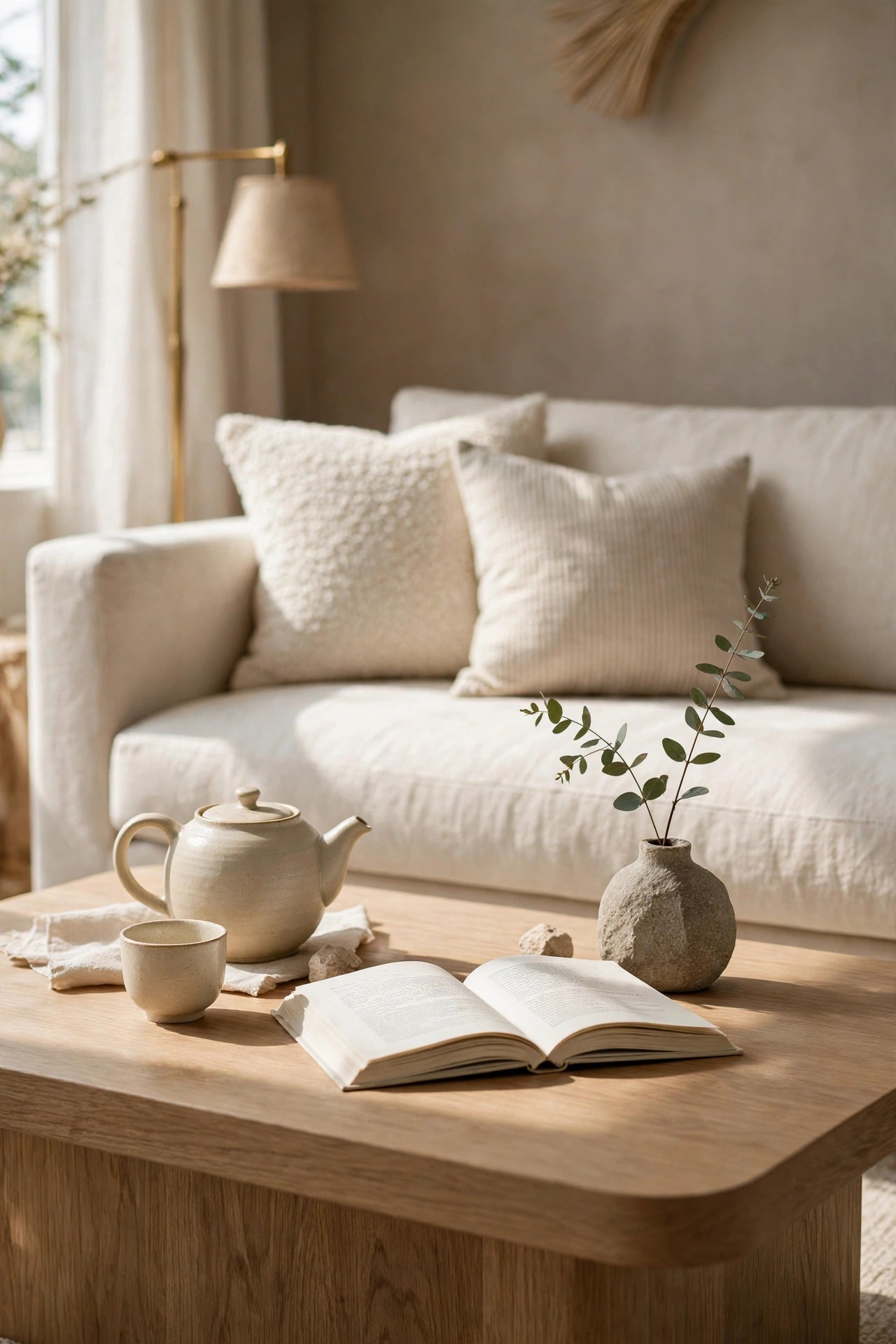
The last styling idea is the smallest, and it is what makes a Japandi living room look finished in photos and in person. A ceramic tea set on one end of the low coffee table, one open book in the middle and a small stone vase with a single stem on the other end gathers the daily pieces into one calm group and repeats the handmade note at the centre of the room. Keep the scene honest, sized for what the room actually uses every day, because a styled table that has to be emptied before anyone can sit down is a display, not a finish. Change the stem weekly and wipe the table when you wipe the top, and the finish keeps itself. Leave the middle of the table clear enough for a cup, because a coffee table that cannot hold a cup has stopped doing its job.
Best For: Every Japandi living room, and especially rooms that look fine in daylight and unfinished in photos.
Not Ideal For: No real exception, but keep the scene small on a slim table so the oak top from idea 4 still shows.
Estimated Cost: $60-$200 (estimate) for a ceramic tea set, a book and a small stone vase.
Budget Note: Shop the house first; a tea set and a vase moved from another room finish the table for nothing.
Renter Friendly: Yes
Renter Note: Nothing fixed at all; the whole scene can be packed in one box on moving day.
What You Need
Ceramic tea set, one book, small stone vase, single stem, soft cloth for dusting.
Product type to look for: A tea set in warm cream or taupe stoneware with a stable, flat base, because a tippy teapot on a low table is a spill waiting to happen.
How To Do It
- Clear the coffee table fully, then place the tea set on one third of the top.
- Set the open book in the middle and the stone vase on the other end.
- Check a cup still fits on the table without moving the scene.
- Walk to the door and check the table as a guest sees it: oak leading, ceramics calm, surfaces clear.
Pro Tip
Reset the scene every evening for one week. The habit, not the objects, is what keeps a styled finish: tea set grouped, book open, stem fresh, top two thirds clear.
15. Finish with Layered Warm Lighting
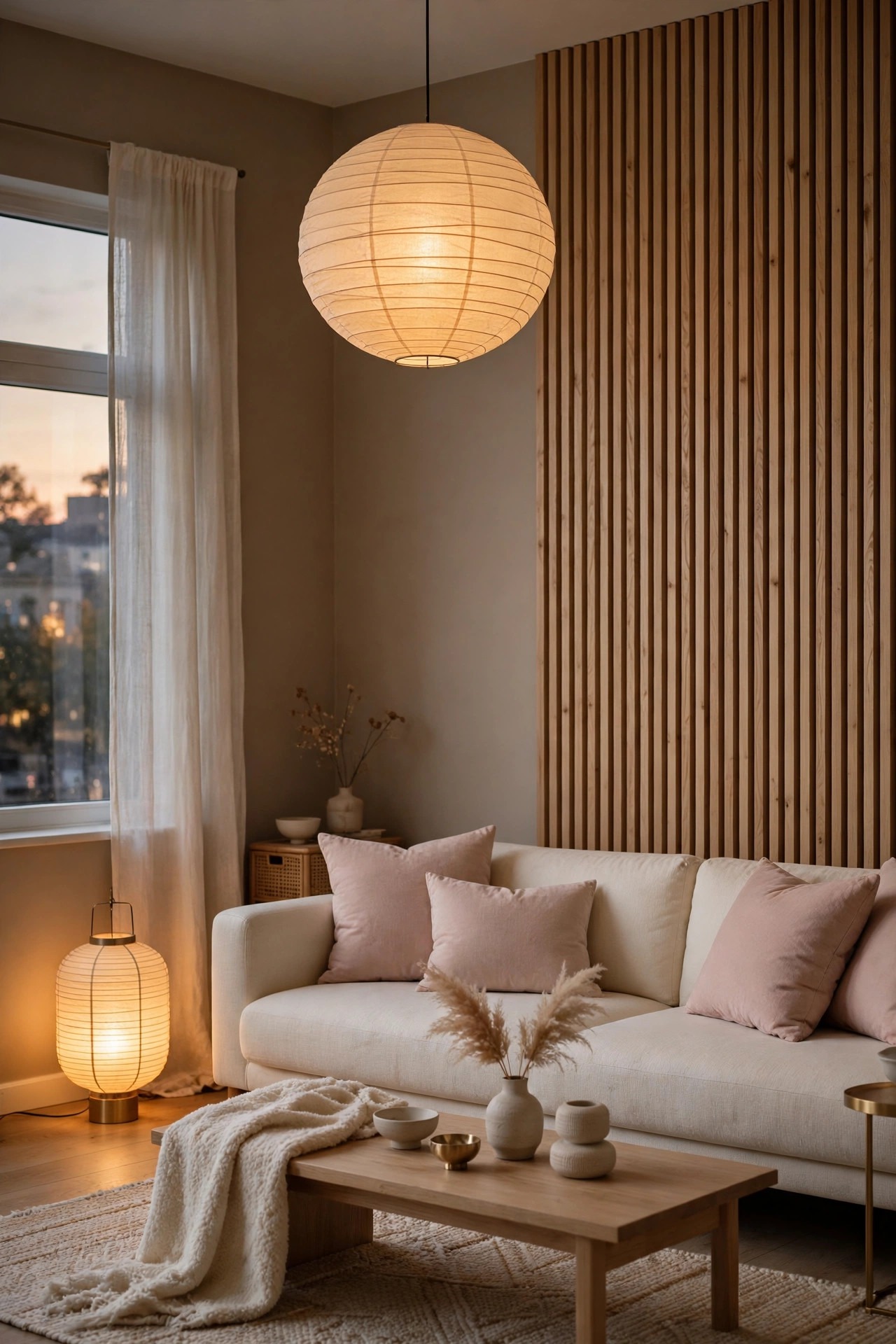
Layered warm lighting is the finish that makes a Japandi living room glow after dark. Hang one round paper pendant above the coffee table, keep the washi lantern lamp from idea 5 glowing in the corner, and add one small warm lamp on the low shelf, so the room has three low lights and no ceiling glare. Use warm bulbs in every lamp, never cool ones, because a cool bulb turns the taupe walls grey and the whole point of the palette is warmth. Put the pendant and the lantern on dimmers, so the light can drop low after dinner, and keep the three lights at three heights, high on the pendant, middle on the lantern, low on the shelf lamp, so the eye moves gently around the room. Judge the room twice before calling it done, once at midday for the true taupe and once under the evening light.
Best For: Living rooms that look calm by day and flat by night, and anyone who wants the evening room to feel as calm as the daytime one.
Not Ideal For: Rooms with a single ceiling light and no spare outlets; a plug-in dimmer on one warm lamp is the honest version there.
Estimated Cost: $120-$450 (estimate) for a paper pendant, a small warm shelf lamp and dimmer plugs.
Budget Note: The pendant is the spend; dimmer plugs and a small warm lamp are cheap and can arrive one piece at a time.
Renter Friendly: With Conditions
Renter Note: A pendant needs the landlord’s word if it replaces a fitting; plug-in lamps and dimmer plugs need no fixing at all.
What You Need
Round paper pendant with a warm bulb, small warm shelf lamp, two dimmer plugs, warm bulbs for every lamp.
Product type to look for: Warm bulbs in the same color temperature across all three lamps, because mixed bulb colors split the evening glow into patches.
How To Do It
- Fit the paper pendant above the coffee table, centred on the rug, following the maker instructions.
- Place the small warm lamp on the low shelf and the lantern in the corner.
- Fit a dimmer plug on the pendant and the lantern, and set both low at dusk.
- Walk to the door and check the three lights read as one warm glow from the doorway.
Pro Tip
Keep all three lights warm and dim, never bright and white. A Japandi evening is lit like a lantern, not like an office, and the dimmest setting that still lets you read is usually the right one.
Practical Tips for Japandi Living Room Design
Let the calm be the one clear note and repeat the warm notes until they look planned. The sofa stays low and cream, the walls stay warm taupe, and light oak, blush and warm white do the supporting work, each used at least twice: oak in the slat wall and the shelves, blush in the cushions and one vase, warm white in the curtains and the lantern. One note used once looks like an accident; twice or more it looks like a decision. Keep the room low, because the low sofa, the low table, the low shelves and the low window seat are what make the room feel grounded, and one tall piece, the olive tree, is enough to give it height. Choose every taupe and every oak by daylight, because a taupe that glows at noon can turn grey under a cool bulb at night, and judge the room twice before calling it done, once at midday for the true colors and once under the evening light. Start in the order of this list, sofa and walls first, and let the light, the shelves and the soft layers arrive slowly; a living room built in a weekend usually has one object too many, and removing a piece is always easier than finding the right one to add.
Frequently Asked Questions
What is a Japandi living room?
Japandi joins Japanese simplicity with Scandinavian warmth. The room stays low, pale and uncluttered, with light oak, warm taupe, cream linen and natural textures, and it keeps one soft glam note, such as brushed gold or blush, so the calm reads rich rather than bare.
Will a Japandi living room look empty?
Not if the calm is built from warm materials. Layered rugs, a slat wall, handmade ceramics, linen curtains and one olive tree give the room texture and life, while the low furniture keeps it grounded. Empty is what happens when the room has pale colors and nothing to touch.
What colors work in a Japandi living room?
Warm cream, warm taupe, pale oak, soft blush and thin black are the natural palette. Keep the walls taupe or cream, the sofa cream, and the wood pale oak, and let blush and black appear only in small notes, so the room stays bright and calm.
Can I do Japandi in a small living room?
Yes, and a small room suits Japandi well, because the low furniture and the pale palette make it feel larger. Keep the sofa low, the shelves low, the rug light and the styling to three pieces per surface, so the small room reads calm rather than crowded.
What is the best wood for a Japandi living room?
Pale oak is the safest wood, because it glows in daylight and flatters cream linen and warm taupe. Keep all the wood in one pale family, so the slat wall, the coffee table and the shelves read as one decision, and avoid dark woods, which turn the calm heavy.
How do I keep a Japandi living room from looking cold?
Choose warm undertones everywhere, caramel in the taupe, honey in the oak, blush in the cushions, and use warm bulbs in every lamp. Keep the textiles soft, linen, wool and jute, and let one plant and one warm light glow in the room at all times.
Conclusion
A japandi living room design list works when the calm is given one clear job: the low cream sofa leads, and everything else supports. Light oak in the slat wall and the shelves keeps the room warm, warm taupe walls and layered rugs keep it soft, and a paper lantern, handmade ceramics and one olive tree keep it feeling lived in rather than staged. Start with the sofa and the walls, add the light and the shelves, keep one wood and one soft accent through the whole room, and the calmest style in the house becomes the one the living room is proud of.