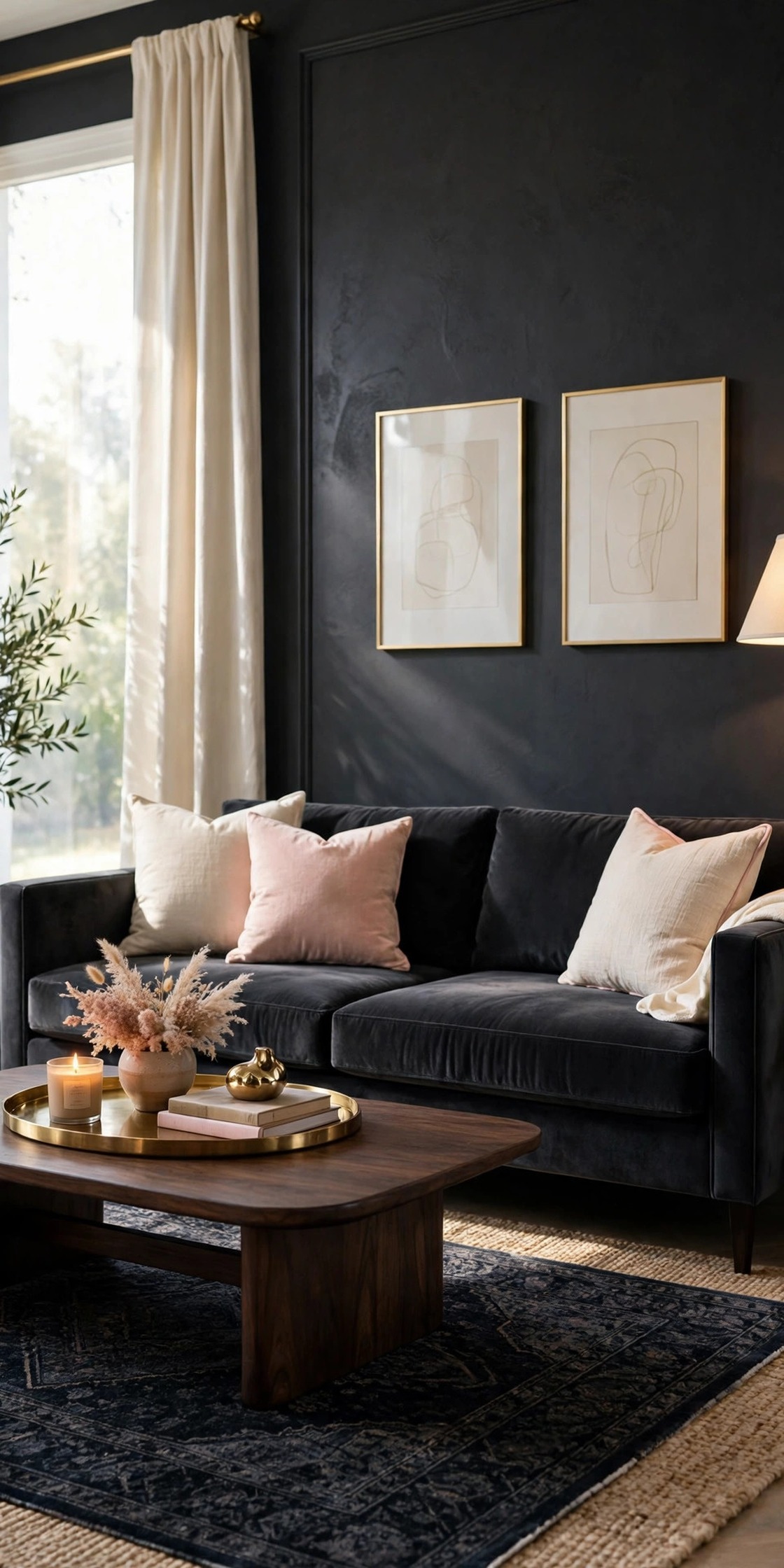
15 Dark Living Room Ideas for a Cozy Moody Home
15 Dark Living Room Ideas for a Cozy Moody Home
A dark living room search usually starts with one worry: a dark room will feel small and heavy the moment it is decorated. It will not, if the dark is kept warm and the light is layered on purpose. Dark living room ideas work best when one wall, one sofa or one floor carries the deep color, while cream, warm taupe, blush pink and brushed gold keep the room soft and bright enough to live in. This is the broad dark living room collection, not a boho room, so you will find dark paint, dark wood, dark leather and moody light here, without rattan, macrame or kilim, and not a bedroom idea, because a living room needs seating, light and storage first. Work through the list in order, because the early ideas set the wall, the sofa and the rug, and the later ones add the light, the mirrors and the soft finishing layers. If you are planning the room around its warm dark base, our living room color combination shows how deep charcoal, cream and gold sit together
Disclosure: This article may contain affiliate links. If you buy through a link on this page, GlamNStyle may earn a small commission at no extra cost to you. Product links in this article are plain links; each one is checked on the retailer’s own page before it is added.
1. Paint One Wall Deep Charcoal
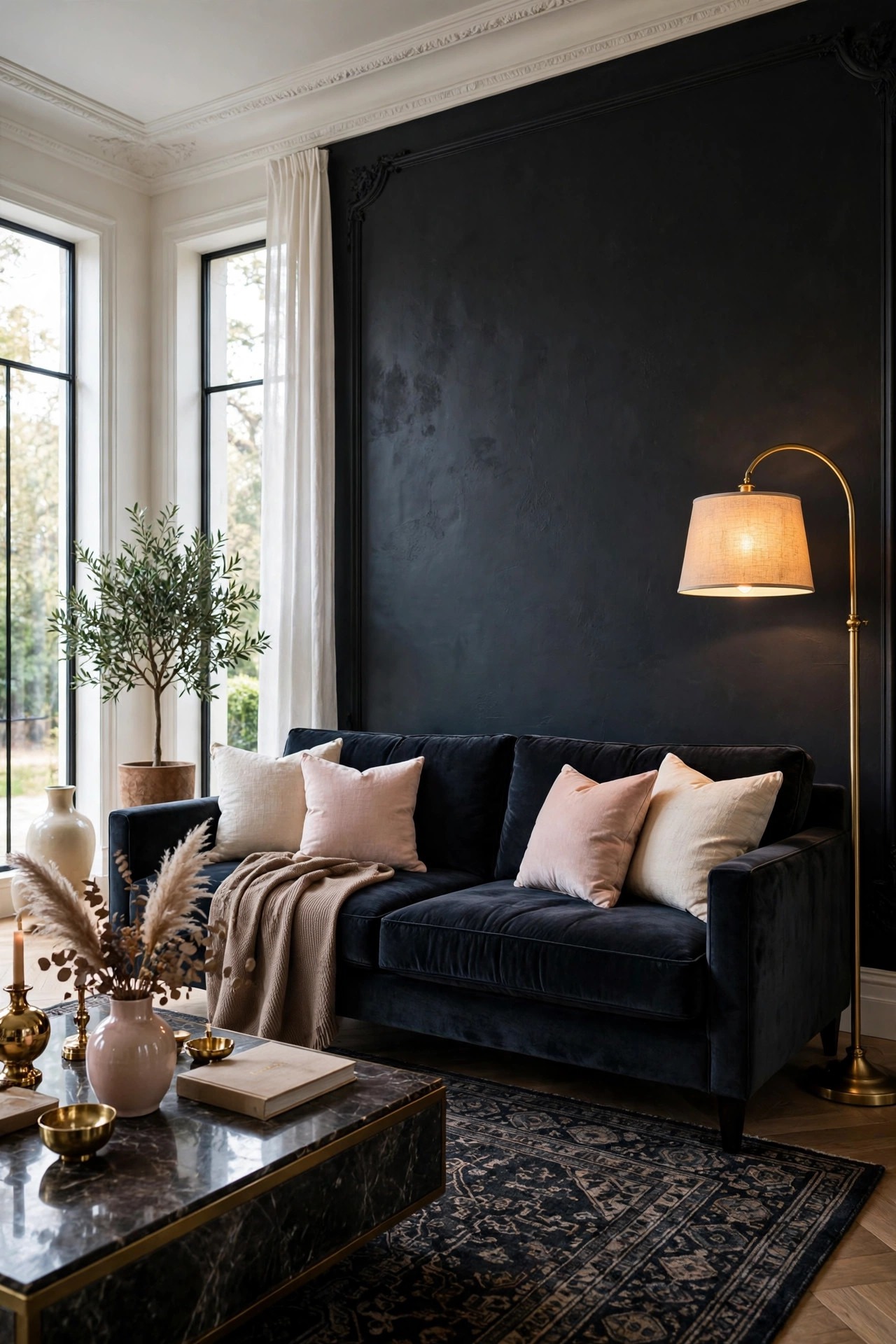
One deep charcoal wall is the kindest dark a living room can hold, and it is the best place to put the moody color in this room. Paint the wall behind the sofa in a warm charcoal, never a cold blue grey, and keep the other three walls warm cream, so the dark reads as a backdrop rather than a box. The dark wall makes the cream cushions, the gold lamp and the framed art stand out, while the pale walls keep the daylight moving through the room. Choose a matte or eggshell finish, because a flat finish softens the dark and hides small marks, while a shiny finish turns a dark wall into a mirror. Test the color on a large board first and look at it at midday and at night, because charcoal changes with the light and a warm charcoal stays cozy after dark.
Best For: Living rooms with good daylight and one clear sofa wall, and anyone who wants a moody look without painting the whole room dark.
Not Ideal For: Rooms with one small window and low light all day; a dark sofa on a cream wall is the honest version there.
Estimated Cost: $40-$120 (estimate) for paint, primer, rollers and painter tape for one accent wall.
Budget Note: The paint is the spend; one wall needs one gallon and a weekend afternoon, which costs far less than painting the whole room.
Renter Friendly: With Conditions
Renter Note: Painting needs the landlord’s written permission; a removable dark peel and stick wall covering in charcoal is the renter version, or keep the walls cream and let the sofa carry the dark.
What You Need
Warm charcoal interior paint in matte or eggshell finish, primer, rollers, painter tape, drop cloth, large test board.
Product type to look for: A warm charcoal paint with low odor and a matte finish, because a dark accent wall in a living room is seen at close range and must not shine.
How To Do It
- Test the charcoal on a large board, then look at it at midday and under the evening lamp.
- Tape the edges, lay the drop cloth and prime the wall if the old color is pale.
- Roll two thin coats, letting the first coat dry fully before the second.
- Step back and check the wall reads warm and deep from the doorway, then hang one light piece against it to test the contrast.
Pro Tip
Keep the dark to one wall only. A second dark wall tips the room from moody to heavy, while one charcoal wall with cream around it reads as a clear decision.
2. Choose a Charcoal Velvet Sofa
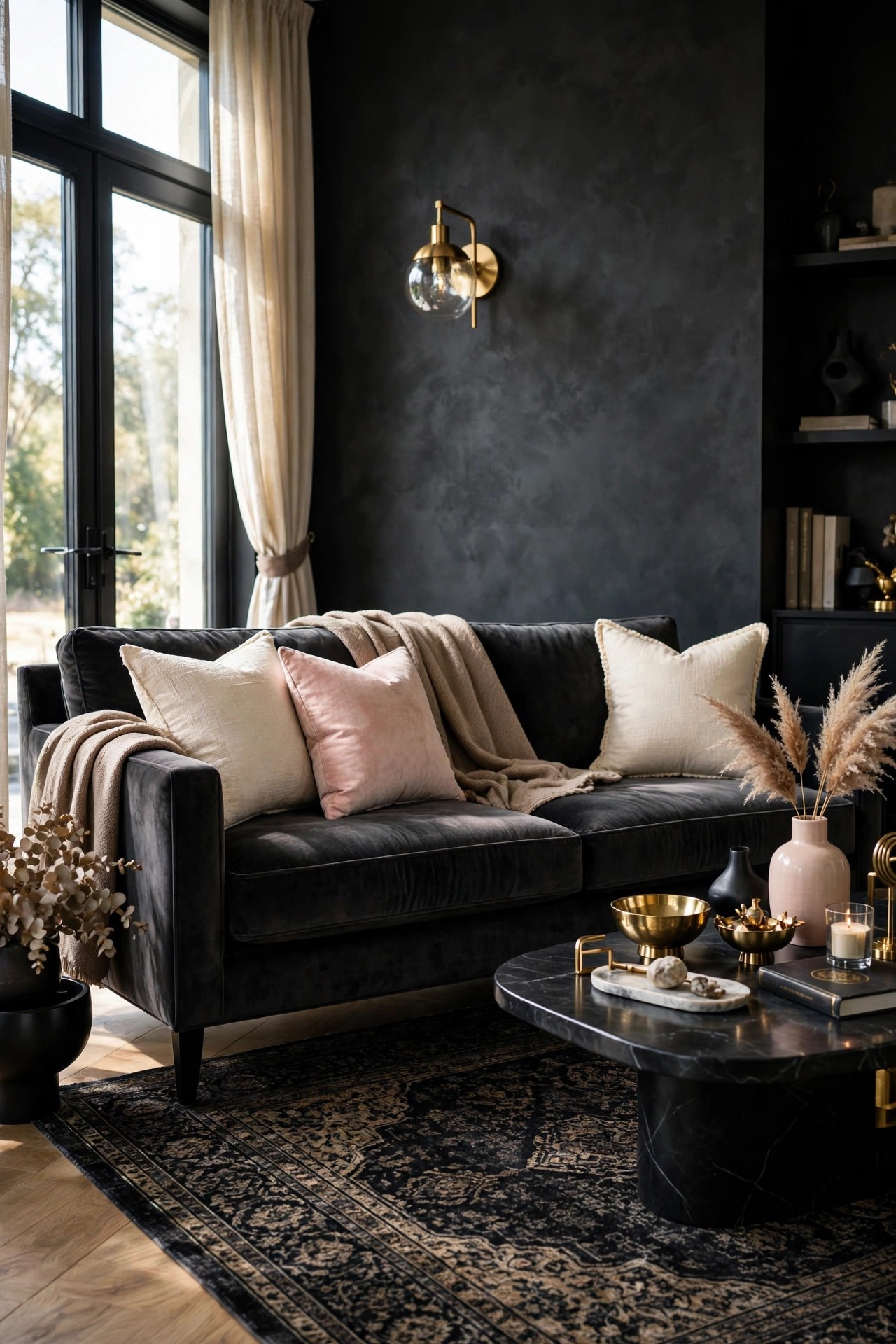
A charcoal velvet sofa is the anchor of a dark living room, because the sofa is the largest piece in the room and its color sets the whole mood. Choose a deep charcoal velvet sofa with clean tailored lines and slim black legs, then dress it with cream linen cushions, one blush cushion and a warm taupe throw, so the dark reads soft rather than flat. Velvet catches the light in a way flat fabric does not, which matters in a dark room, because the sheen keeps the sofa from looking like a black block. Measure the sofa against the wall and the walkway before ordering, because a sofa one foot too long blocks the path to the window, and a sofa that fits leaves room for a side table and a lamp. Keep the cushions light and the throw folded, never draped over the whole back, so the velvet stays the star.
Best For: Living rooms where the sofa sits against the dark wall, and anyone who wants the moody color in furniture rather than paint.
Not Ideal For: Homes with pets that shed light hair daily; a dark leather sofa is the honest version there.
Estimated Cost: $600-$1,500 (estimate) for a dark charcoal velvet three seat sofa.
Budget Note: The sofa is the big spend in this list; a good velvet sofa in a deep color costs more than a pale one, so buy the sofa first and build the rest of the room around it.
Renter Friendly: Yes
Renter Note: Nothing fixed at all; a sofa moves out in one piece on moving day, and the dark color hides small marks between cleans.
What You Need
Dark charcoal velvet three seat sofa, cream linen cushions, one blush cushion, warm taupe throw, vacuum with an upholstery head.
Product type to look for: A velvet sofa with a sturdy frame, removable cushion covers and a rub count suited to daily use, because a dark velvet sofa shows dust and needs a quick weekly vacuum.
How To Do It
- Measure the wall, the walkway and the door swing, then choose a sofa that leaves a clear path.
- Place the sofa against the charcoal wall and check the daylight still reaches the seat.
- Add the cream cushions first, then the blush cushion and the folded taupe throw.
- Sit on each seat and check the sofa feels deep enough for an evening, then vacuum the velvet once a week.
Pro Tip
Keep the cushions cream, not dark. Dark cushions on a dark sofa disappear, while cream cushions on charcoal velvet give the eye a place to rest.
3. Lay a Dark Patterned Rug on a Pale Floor
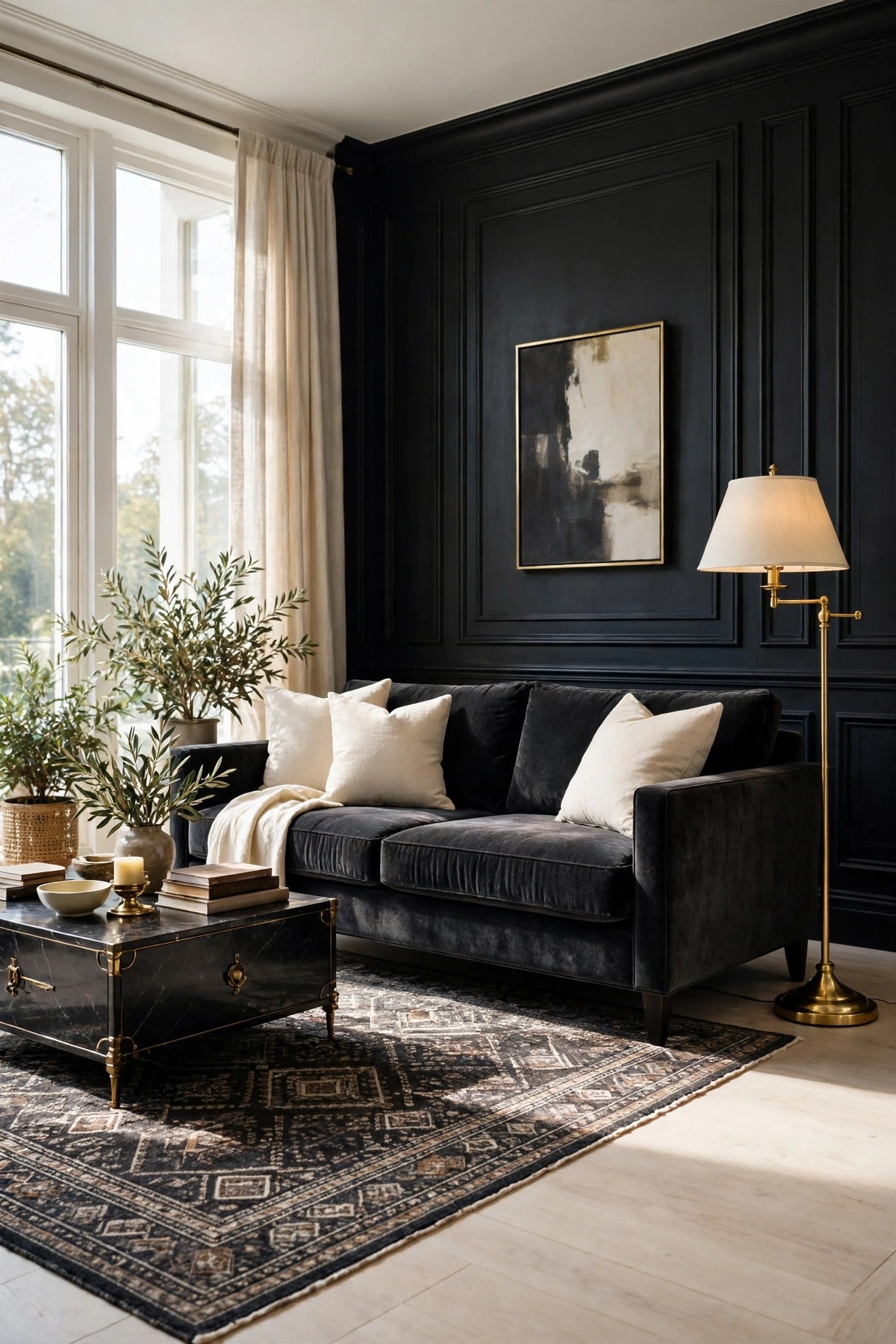
A dark patterned rug on a pale floor is the fastest way to ground a dark living room, because the rug sets the seating area and the pale floor around it keeps the room bright. Choose a rug in charcoal with a cream and warm taupe pattern, large enough to reach under the front legs of the sofa and the chairs, so the seating reads as one group rather than loose pieces. The pale wood border around the rug frames the dark pattern, while the pattern itself hides everyday marks far better than a plain dark rug. Choose a low pile rug, because a thick rug under a sofa stops the doors and catches the vacuum, and keep a rug pad underneath, so nothing slides when the sofa is used daily. Measure the seating area before ordering, because a rug that stops short of the sofa legs reads as a mat.
Best For: Living rooms with pale wood or light tile floors and a large sofa area, and anyone who wants pattern without painting a wall.
Not Ideal For: Rooms where the door swings over the rug area; a single flat rug cut shorter is the honest version there.
Estimated Cost: $150-$450 (estimate) for a dark patterned rug in low pile with a rug pad.
Budget Note: The size is the spend; a rug large enough to sit under the sofa front legs costs more than a small one, so measure first and buy once.
Renter Friendly: Yes
Renter Note: Nothing fixed at all; the rug rolls up and moves out on moving day, and the rug pad protects the floor beneath.
What You Need
Large dark patterned rug in low pile, rug pad sized to the rug, vacuum with a low pile setting.
Product type to look for: A rug with a low pile, a tight weave and a non slip backing, because a rug in a living room is walked on daily and must not bunch or slide.
How To Do It
- Measure the seating area and choose a rug that reaches under the sofa front legs.
- Lay the rug pad, then the rug, and check the pale floor shows as a border on every side.
- Tuck the front legs of the sofa and the chairs onto the rug and check it sits flat.
- Walk across the rug and check nothing slides or bunches, then vacuum it weekly.
Pro Tip
Keep a pale border of floor showing on every side. A dark rug that runs wall to wall closes the room in, while a dark rug with pale floor around it reads as a clear seating zone.
4. Paint the Trim, Doors and Ceiling a Deep Tone
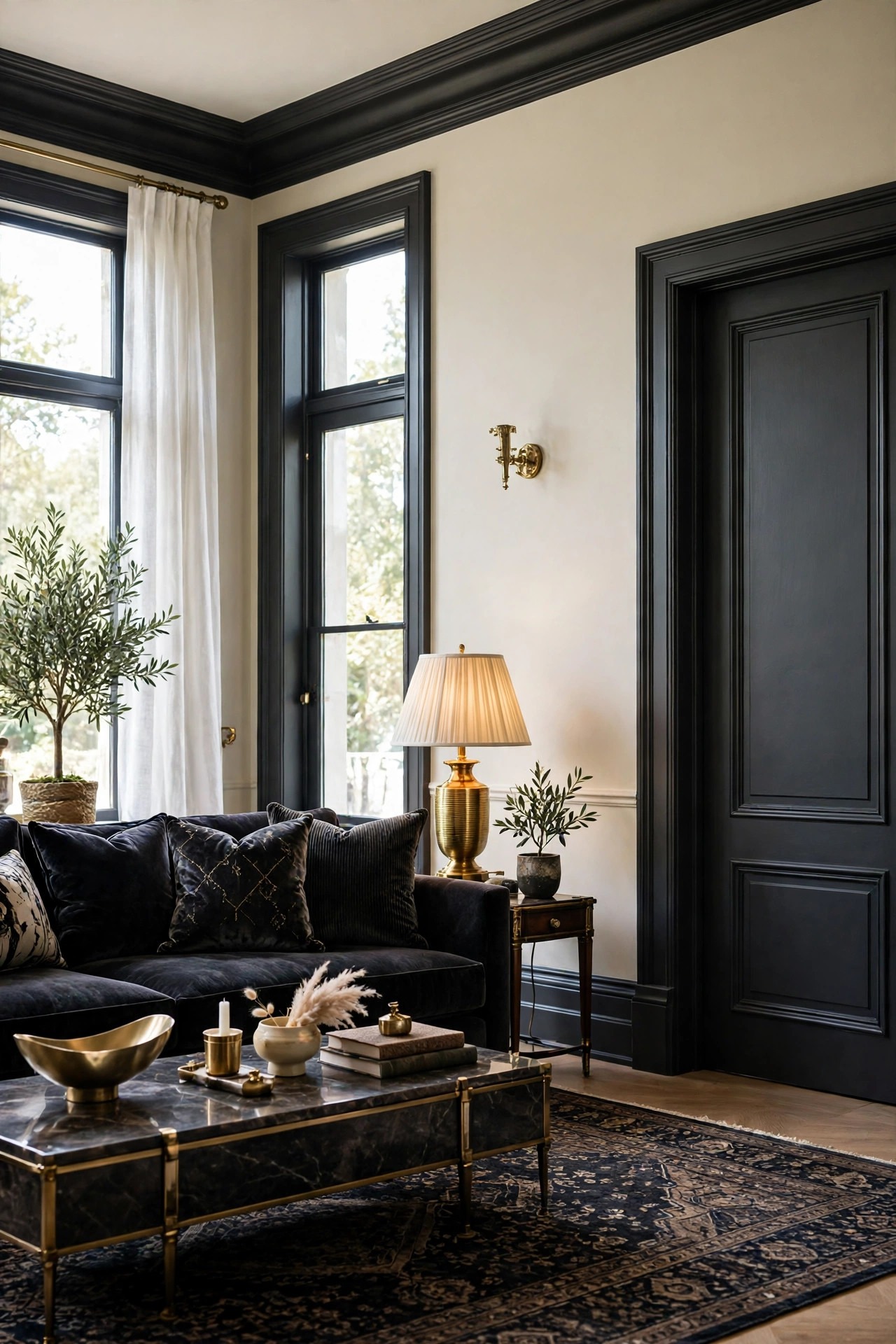
Dark trim is the quiet way to make a living room moody, because the deep color frames the room instead of filling it. Paint the skirting, the door frames and the doors in the same warm charcoal as the accent wall, and keep the walls themselves warm cream, so the dark reads as a crisp outline around every opening. In a room with a tall ceiling, paint the ceiling in the same deep tone too, because a dark ceiling lowers a tall room to a cozy height, but leave the ceiling cream in a low room, because a dark ceiling there presses the room down. Use a satin finish on trim, because trim is touched and cleaned often, while the walls stay matte. Tape carefully and paint the trim after the walls, so the lines stay sharp.
Best For: Living rooms with tall ceilings and classic trim, and anyone who wants a dark note without a dark wall.
Not Ideal For: Low rooms with little trim; a dark sofa on a cream wall is the honest version there.
Estimated Cost: $60-$180 (estimate) for paint, primer, brushes and painter tape for trim, doors and skirting.
Budget Note: The labor is the spend; painting trim takes patience rather than paint, so a weekend and one quart of paint go a long way.
Renter Friendly: With Conditions
Renter Note: Painting trim needs the landlord’s written permission; a dark door can be swapped back only if the original is kept, so keep the walls cream and let the furniture carry the dark if the lease forbids paint.
What You Need
Warm charcoal interior paint in satin finish for trim, primer, angled brushes, painter tape, drop cloth, sandpaper for smoothing old paint.
Product type to look for: A satin paint made for trim and doors, because trim in a living room is touched and wiped often and must clean without shining.
How To Do It
- Clean and lightly sand the trim, then tape the wall edge and lay the drop cloth.
- Prime the trim if the old color is pale or glossy, then let it dry fully.
- Paint two thin coats of the deep charcoal, letting the first coat dry before the second.
- Pull the tape while the last coat is still slightly damp, then step back and check the dark outline reads sharp from the doorway.
Pro Tip
Use the same charcoal on the trim as on the accent wall. Two different darks fight each other, while one dark repeated in the trim, the wall and the sofa reads as a plan.
5. Style a Dark Wood Coffee Table with Marble and Brass
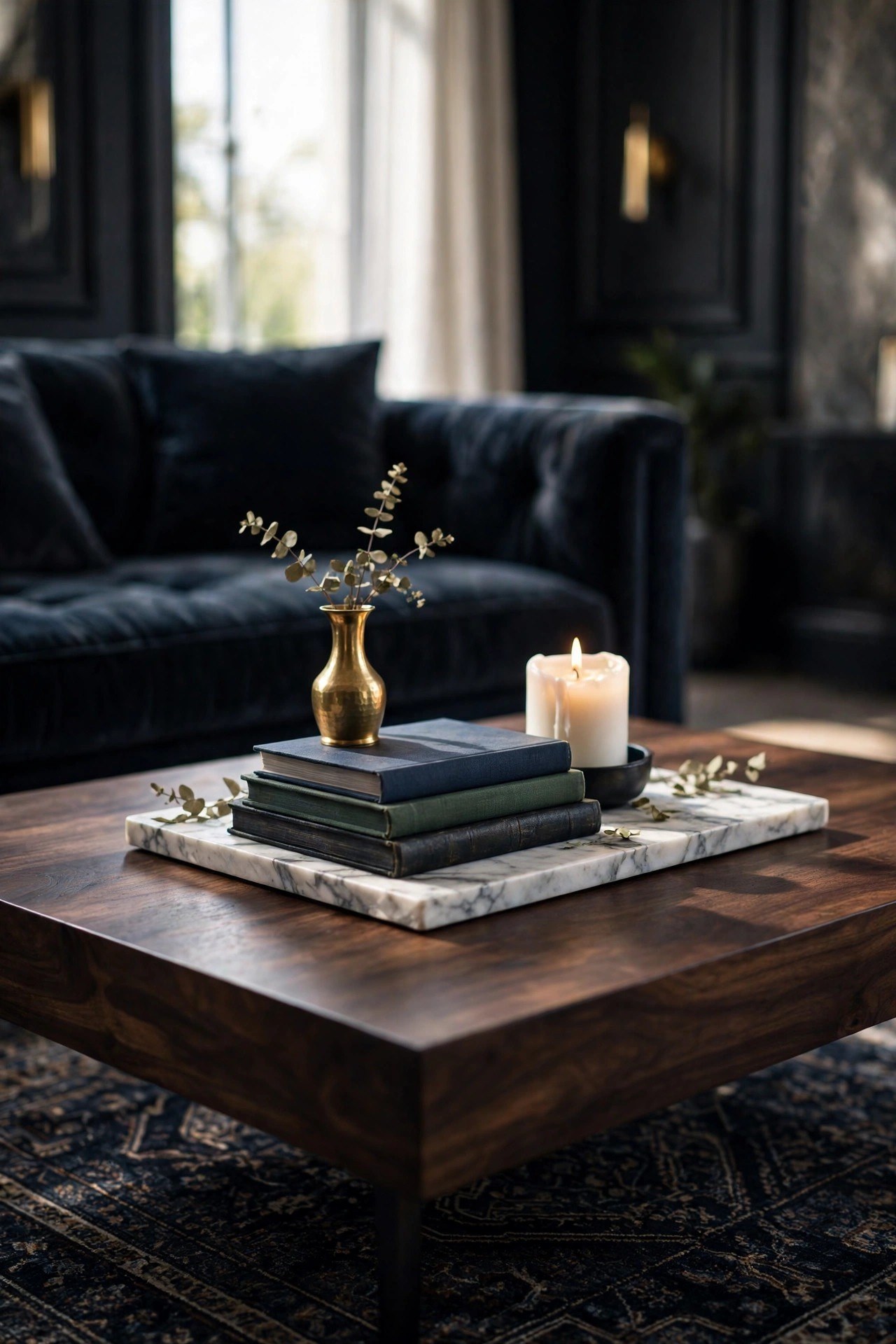
A dark wood coffee table with marble and brass is the centre of a dark living room, because the table sits between the sofa and the chairs and its wood sets the warm dark tone at knee height. Choose a walnut table with a clear grain and rounded corners, then style it with a small white marble tray, a brass vase, a stack of two books and one candle in a glass holder, so the table reads styled rather than crowded. The pale marble tray lifts the dark wood, while the brass repeats the lamp and the frames around the room. Keep the styling to one side of the table, leaving the other side clear for cups, because a table that cannot hold a cup has stopped doing its job. Wipe the walnut weekly with a soft cloth, because a dark wood table shows dust and water rings faster than a pale one, and use coasters every time.
Best For: Living rooms where the sofa and chairs face each other across a table, and anyone who wants warm wood beside dark velvet.
Not Ideal For: Rooms where children play on the floor daily; a soft ottoman tray is the honest version there.
Estimated Cost: $150-$500 (estimate) for a dark walnut coffee table with a marble tray and styling pieces.
Budget Note: The walnut is the spend; a solid walnut table costs more than a veneer one, so check the grain and the weight before buying.
Renter Friendly: Yes
Renter Note: Nothing fixed at all; a coffee table moves out in one piece on moving day.
What You Need
Dark walnut coffee table, small white marble tray, small brass vase, two books, candle in a glass holder, coasters.
Product type to look for: A table with a sealed walnut finish and sturdy legs, because a coffee table in a living room holds cups daily and must wipe clean.
How To Do It
- Measure the space between the sofa and the chairs and choose a table that leaves a clear walkway.
- Centre the table on the rug and check the sofa seats can reach it easily.
- Style one side only, marble tray with the vase and the books, and leave the other side clear.
- Step back and check the table reads as one calm group from the doorway, then keep coasters on it always.
Pro Tip
Keep the tray to three pieces only. A tray crowded with objects reads as a shelf, while a tray with a vase, books and a candle reads as a plan. Never leave a candle burning unattended.
6. Build a Moody Gallery Wall in Black and Gold Frames
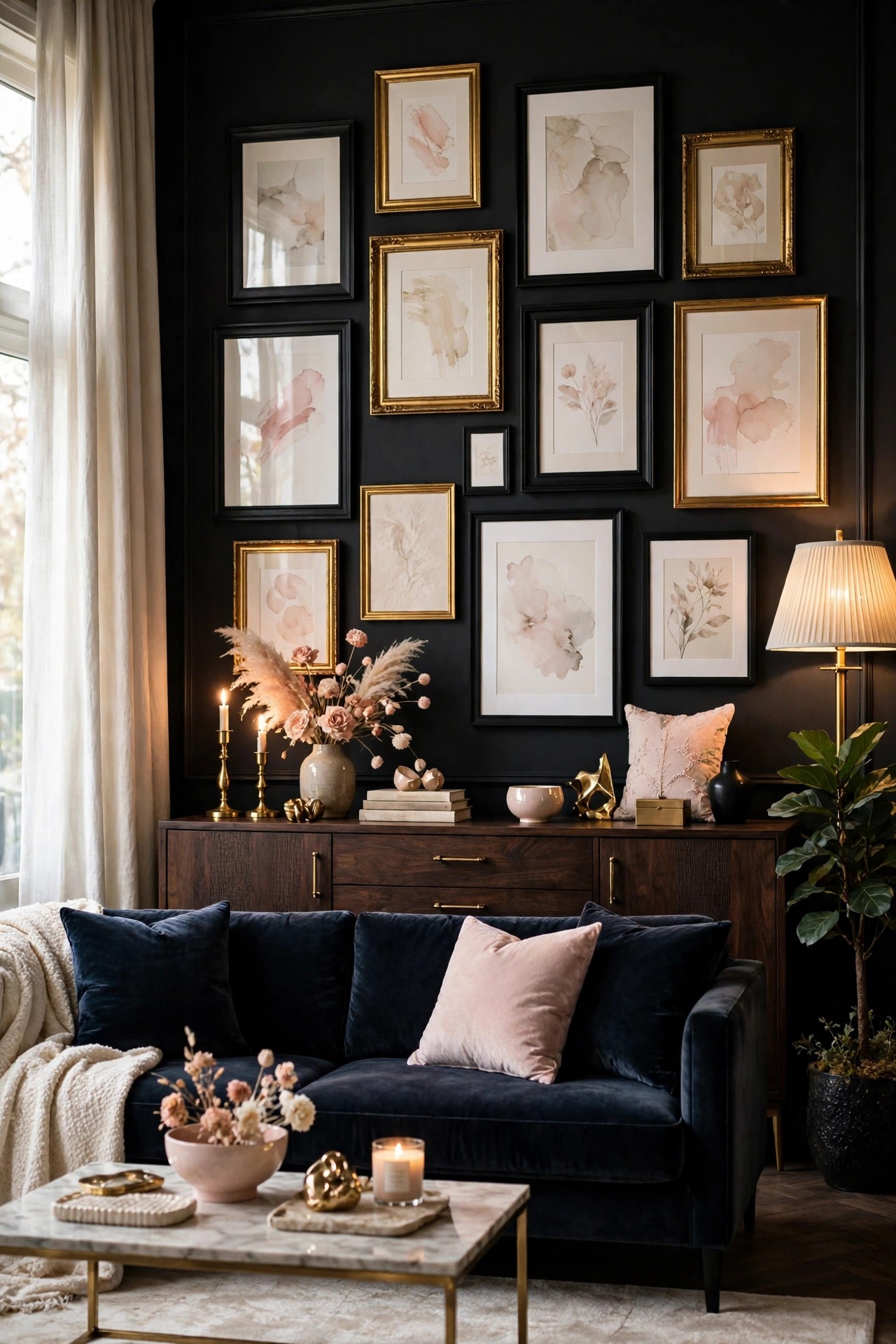
A moody gallery wall in black and gold is the art a dark living room needs, because small dark frames with gold edges give the room its pictures without breaking the moody palette. Mix three or four black frames with one or two slim gold frames, filled with cream, blush and warm taupe art, botanical prints and one small mirror, and hang them in a loose grid above the sideboard or the sofa. Keep the frames close together, no more than a hand width apart, because a gallery spread too wide reads as separate pictures, while a tight group reads as one wall. Lay the frames on the floor first and photograph the layout, because a gallery planned on the floor is far easier to hang than one planned on the wall. Our minimalist living room shows the same tight gallery idea with pale frames, for readers deciding between dark and light frames
Best For: Living rooms with a long empty wall beside the sofa, and anyone who wants art that matches a dark palette.
Not Ideal For: Walls that already hold a large mirror or a television; one feature per wall keeps the story clear, so choose the gallery or the mirror, not both on one wall.
Estimated Cost: $80-$250 (estimate) for frames, prints and hanging hardware for a small gallery wall.
Budget Note: The frames are the spend; matching black frames in two sizes cost less than a set of different frames and read as one plan.
Renter Friendly: With Conditions
Renter Note: Hanging needs hooks the lease allows; removable picture strips rated for each frame weight are the renter version, or lean the largest frames on the sideboard instead.
What You Need
Three or four black frames, one or two slim gold frames, cream and blush art prints, botanical print, small round mirror, picture hanging strips or hooks.
Product type to look for: Frames with real glass and a sturdy back, because a gallery wall in a living room is dusted often and a thin frame warps when it is handled.
How To Do It
- Lay the frames on the floor and arrange them in a tight grid, photographing the layout.
- Mark the first frame level, then hang the rest using the photograph as the guide.
- Check each frame sits level and the gaps stay even.
- Step back and check the gallery reads as one wall from the doorway, dark frames leading and gold as the accent.
Pro Tip
Keep one small mirror inside the gallery. A mirror among the prints catches the lamp light and keeps the dark frames from feeling heavy.
7. Hang Dark Velvet Curtains on a Brass Rod
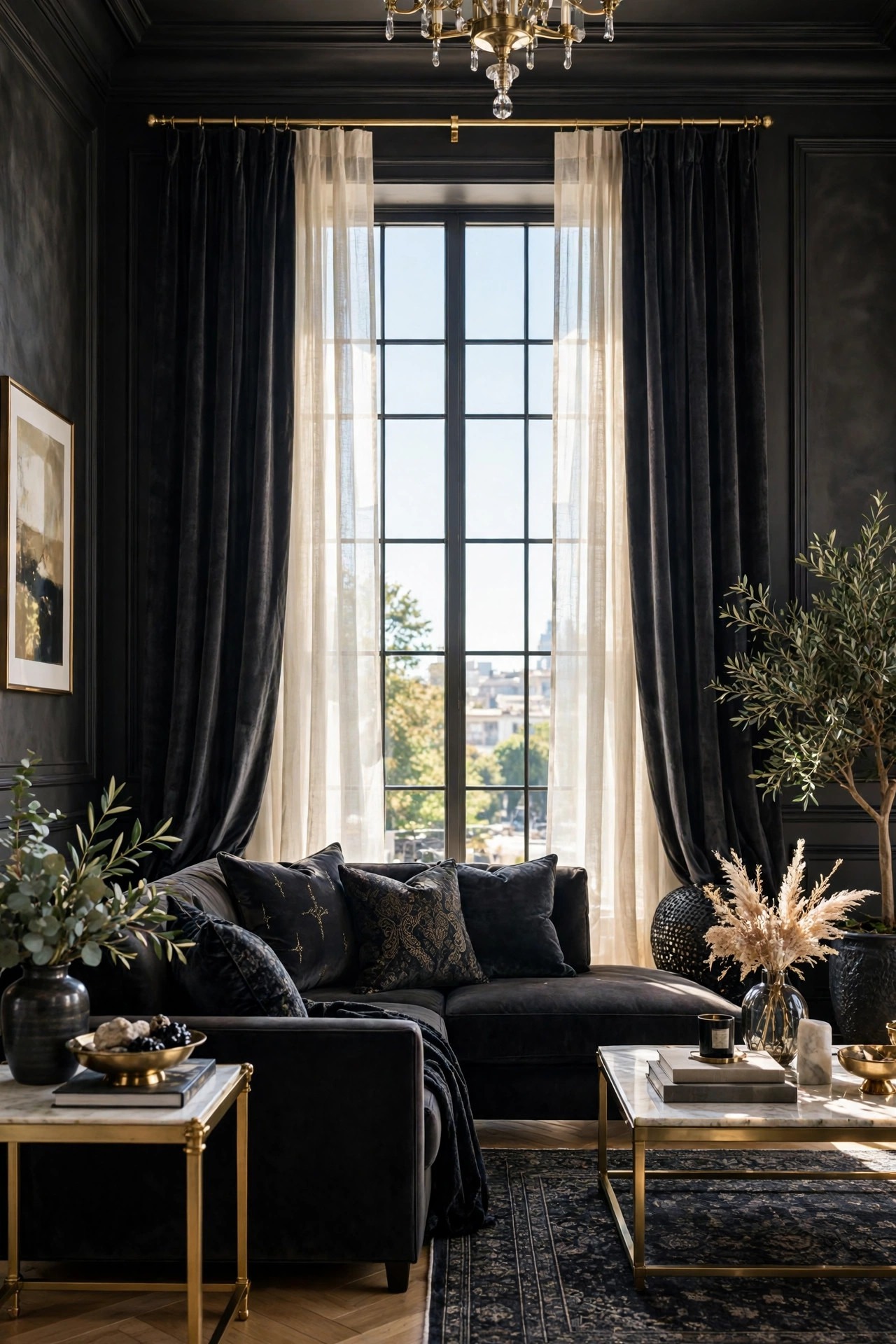
Dark velvet curtains on a brass rod are the window dressing a dark living room needs, because the window is the brightest wall in the room and dark curtains frame it like a picture. Hang charcoal velvet curtains on a slim brass rod, with cream sheers behind them, so the daylight filters soft through the sheers while the dark velvet gives the window its weight. Choose velvet with a soft pile, because velvet catches the light and glows at the edges, while a flat curtain in the same color reads dull. Hang the rod high and wide, above the window frame and past its sides, so the curtains hang clear of the glass and the window looks taller. Keep the curtains long enough to brush the floor, never short, because a short curtain in a dark room reads as a mistake.
Best For: Living rooms with a tall window and a dark sofa, and anyone who wants the window to match the moody palette.
Not Ideal For: Windows that face a dark alley; cream curtains with a dark tieback are the honest version there.
Estimated Cost: $80-$250 (estimate) for dark charcoal velvet curtains, cream sheers and a slim brass rod.
Budget Note: The velvet is the spend; good velvet curtains cost more than cotton ones and hang far better, so buy the curtains first and the rod second.
Renter Friendly: Yes
Renter Note: A curtain rod needs screws the lease allows; a tension rod inside the window frame is the renter version, or use removable rod hooks rated for the weight.
What You Need
Dark charcoal velvet curtains, cream sheer panels, slim brass curtain rod with finials, curtain rings or clips, tape measure.
Product type to look for: Curtains in a lined velvet with a soft pile and a lined back, because dark curtains in a living room meet strong daylight and must hang straight and not fade quickly.
How To Do It
- Measure the window width and height, then fit the rod high and wide past the frame.
- Hang the sheers first, then the dark velvet curtains on the same rod or a double rod.
- Pull the curtains to the sides and check they clear the glass and brush the floor.
- Step back and check the window reads tall and framed from the doorway.
Pro Tip
Keep the sheers closed in the daytime and the dark curtains open. A dark curtain closed all day blocks the light a dark room needs, while open dark curtains with closed sheers give privacy and light together.
8. Layer Warm Light with Brass Lamps and a Dimmer
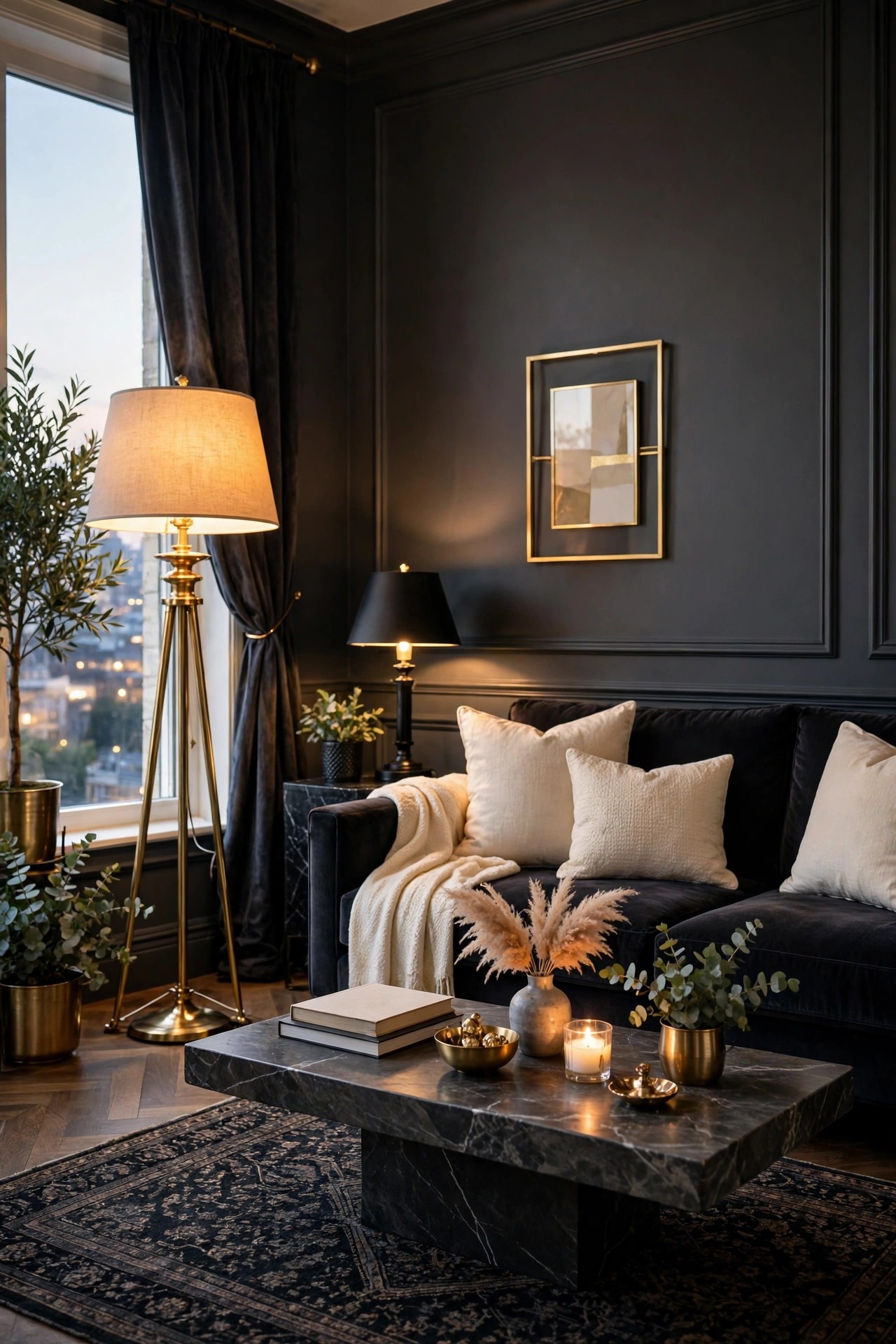
Warm light is what keeps a dark living room cozy instead of dim, because a dark wall soaks up light and one ceiling bulb cannot carry the room alone. Layer three warm lights: a brass floor lamp behind the sofa corner, a black table lamp on the sideboard and a small cluster of candles on the coffee table, all in warm white, never cool white. A cool bulb turns charcoal grey and blush dull, while a warm bulb makes the velvet glow and the brass shine. Put the floor lamp on a dimmer or a smart bulb, so the light can drop low after dinner, and keep the ceiling light off in the evening, because one warm glow at sofa height reads as glam while a bright ceiling light reads as an office. Check the lamp shades before buying, because a dark shade blocks the light and a cream shade spreads it.
Best For: Every dark living room, and especially rooms where the dark wall makes the evenings feel flat.
Not Ideal For: Rooms with strong daylight all day; the lamps then matter only after dark, so spend on the rug first.
Estimated Cost: $80-$250 (estimate) for a brass floor lamp, a black table lamp and warm white bulbs.
Budget Note: The floor lamp is the spend; a good brass lamp with a cream shade costs more than a plain one and gives the room its evening glow.
Renter Friendly: Yes
Renter Note: Nothing fixed at all; lamps plug in and move out on moving day, and no wiring is touched.
What You Need
Brass floor lamp with a cream shade, black table lamp with a cream shade, warm white bulbs, small candles in glass holders.
Product type to look for: Lamps with warm white bulbs and shades that spread light, because a dark room needs light that reaches the sofa, not light trapped in the shade.
How To Do It
- Place the floor lamp behind the sofa corner and the table lamp on the sideboard.
- Fit warm white bulbs in both lamps and switch them on at dusk.
- Add the candles to the coffee table tray and check the glow feels warm against the charcoal wall.
- Step back and check the room glows from the doorway, then keep the ceiling light off in the evening.
Pro Tip
Keep the light at sofa height, not at the ceiling. Two warm lamps at seating height make a dark room feel cozy, while one bright ceiling light makes it feel small. Never leave a candle burning unattended.
9. Add a Dark Leather Accent Chair
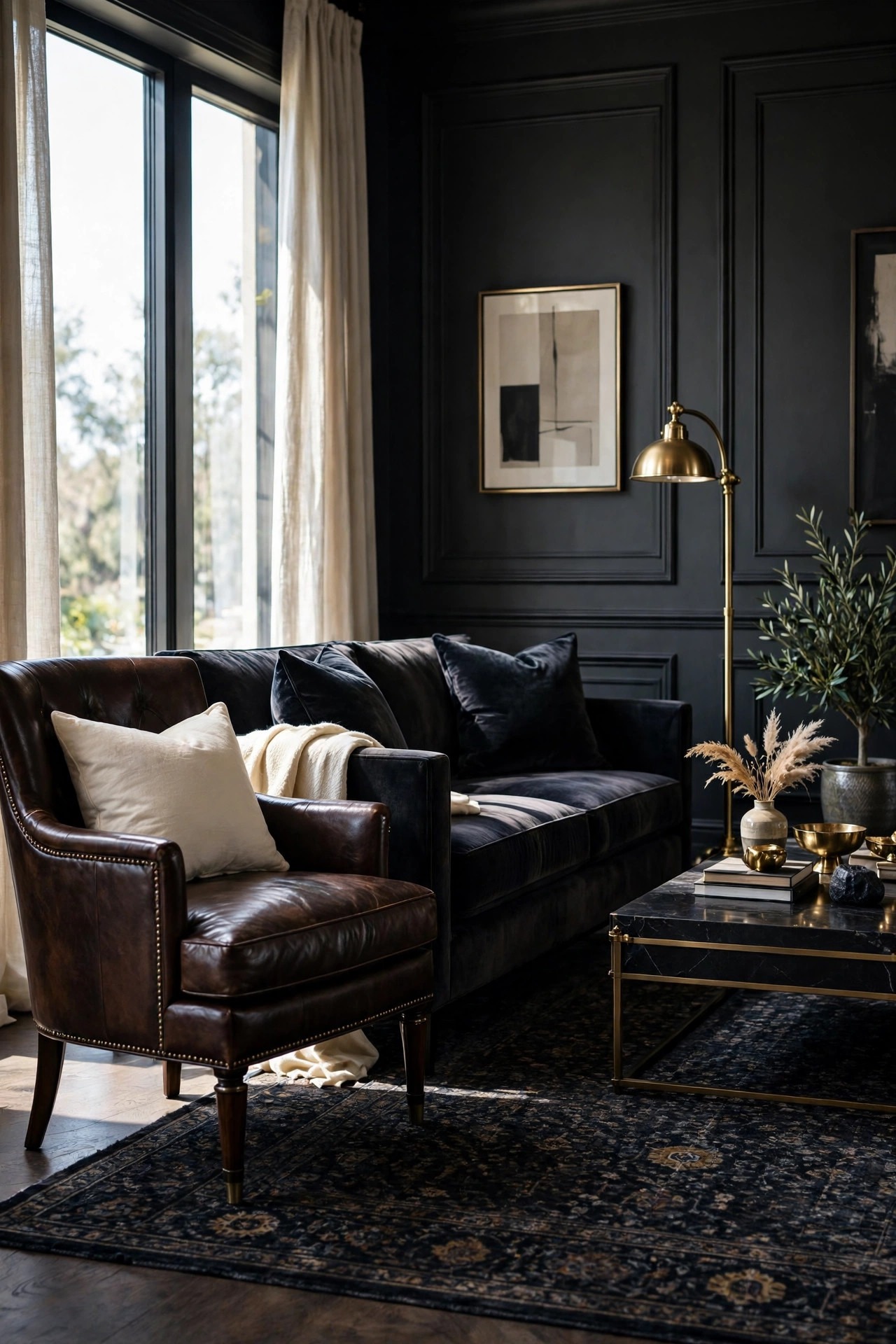
A dark leather accent chair is the strong seat a dark living room needs, because leather brings a smooth dark surface that balances the soft velvet of the sofa. Choose a dark brown or black leather chair with clean lines and slim dark wood legs, and dress it with one cream cushion, so the pale cushion reads warm against the dark leather. Place the chair at an angle to the sofa, facing into the room, because a chair set square against the wall reads as storage, while a chair turned in invites someone to sit. Check the leather before buying, because a good leather chair softens with use, while a thin bonded leather cracks and peels within a year. Keep the chair clear of the walkway, so it holds a book and a cup rather than blocking the path.
Best For: Living rooms with a corner that needs a reading seat, and anyone who wants a dark chair that wipes clean.
Not Ideal For: Rooms where the seating area is already tight; a slim dark wood side chair is the honest version there.
Estimated Cost: $300-$800 (estimate) for a dark leather accent chair with a cream cushion.
Budget Note: The leather is the spend; a good leather chair costs more than a fabric one, so check the hide and the stitching before buying.
Renter Friendly: Yes
Renter Note: Nothing fixed at all; a leather chair moves out in one piece on moving day.
What You Need
Dark brown or black leather accent chair, one cream cushion, small dark wood side table if space allows, leather conditioner.
Product type to look for: A chair in full grain or top grain leather with a sturdy frame, because a leather chair in a living room is sat in daily and must age well rather than crack.
How To Do It
- Measure the corner and choose a chair that leaves a clear walkway beside it.
- Set the chair at a slight angle to the sofa, facing into the room.
- Add the cream cushion and check the chair feels steady when sat in.
- Place a small side table within reach, then condition the leather every few months.
Pro Tip
Keep the cushion cream, not patterned. A patterned cushion fights the leather, while a plain cream cushion lets the dark leather be the statement.
10. Style Dark Open Shelves with Books, Brass and Plants
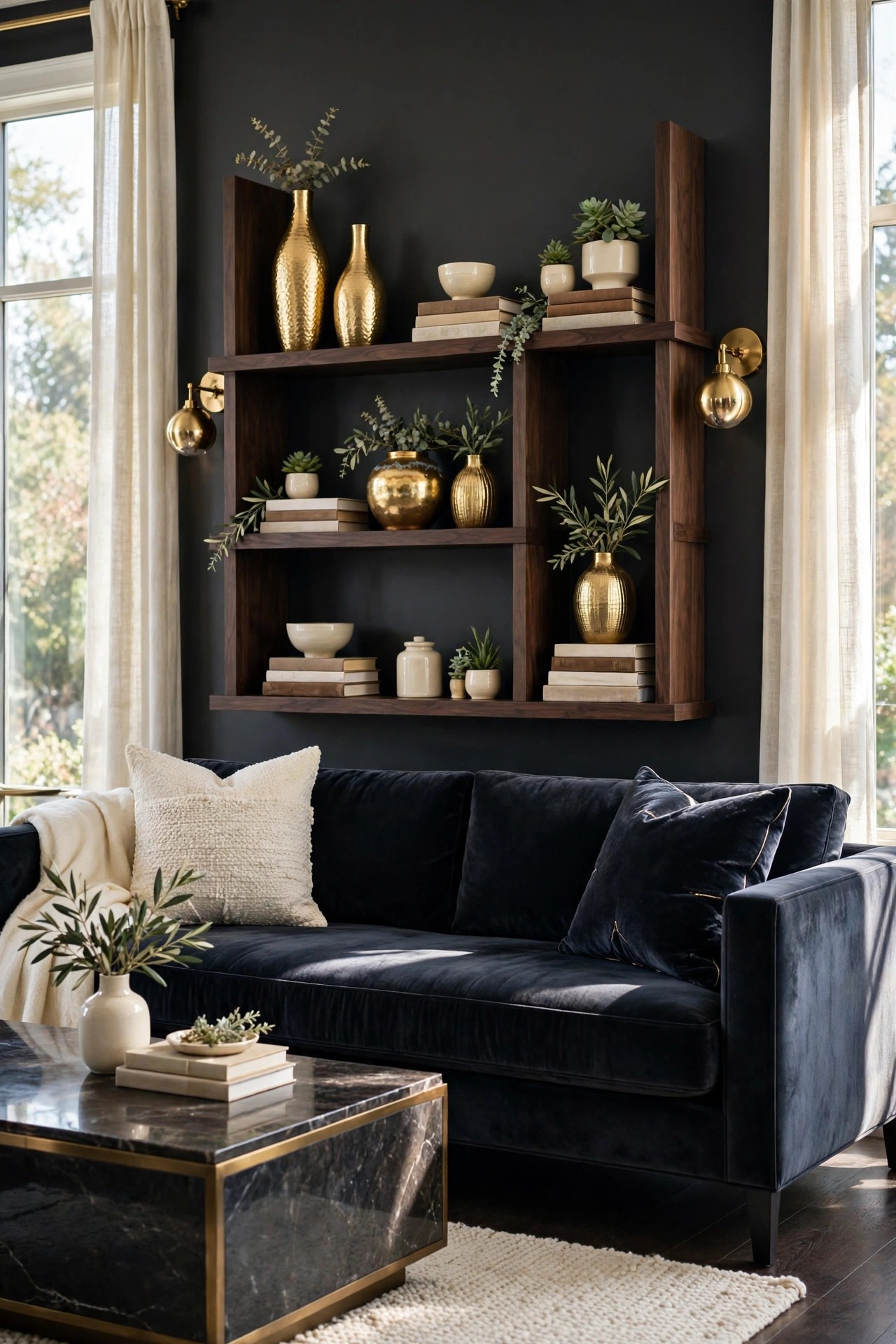
Dark open shelves with books, brass and plants are the display a dark living room needs, because the shelves give the room its objects without a cupboard door hiding them. Fit two dark wood shelves on the charcoal wall, then style them with small gold vases, a trailing plant, stacked books and cream ceramics, leaving clear space between the groups, so each object reads on its own. Keep the shelves shallow, no deeper than a book, and load the heaviest pieces on the lowest shelf, so the shelves stay steady and the wall stays calm. Mix the materials on purpose, gold with ceramic, plant with books, because a shelf of one material reads as a shop display, while a shelf of mixed materials reads as a home. Check the shelf fixings before loading, because a shelf is heavier than it looks once books are added. Our living room furniture shows the same open shelf idea beside a dark sofa, for readers choosing between shelves and a sideboard
Best For: Living rooms with a charcoal wall and a collection to show, and anyone who wants display space without a cabinet.
Not Ideal For: Homes with small children who pull at low shelves; a closed sideboard is the honest version there.
Estimated Cost: $60-$200 (estimate) for two dark wood shelves, brackets, gold vases and small plants.
Budget Note: The shelves and brackets are the spend; good dark wood shelves cost more than pale ones, so buy the brackets rated for books first.
Renter Friendly: With Conditions
Renter Note: Shelves need screws the lease allows; a leaning ladder shelf in dark wood is the renter version, or use a tall dark bookcase instead.
What You Need
Two dark wood shelves with brackets rated for books, small gold vases, trailing plant, stacked books, cream ceramics, level.
Product type to look for: Shelves with brackets rated well above the load, because open shelves in a living room hold books and ceramics and must not sag.
How To Do It
- Mark the shelves level on the charcoal wall, leaving clear space above the sofa.
- Fit the brackets following the maker instructions, checking the weight rating first.
- Style the lowest shelf heaviest, books and ceramics, and the top shelf lightest, plant and gold vase.
- Step back and check the shelves read as two calm lines from the doorway, with space between the groups.
Pro Tip
Keep one third of each shelf empty. A shelf filled edge to edge reads as storage, while a shelf with clear space reads as display.
11. Warm Up a Dark Fireplace Wall
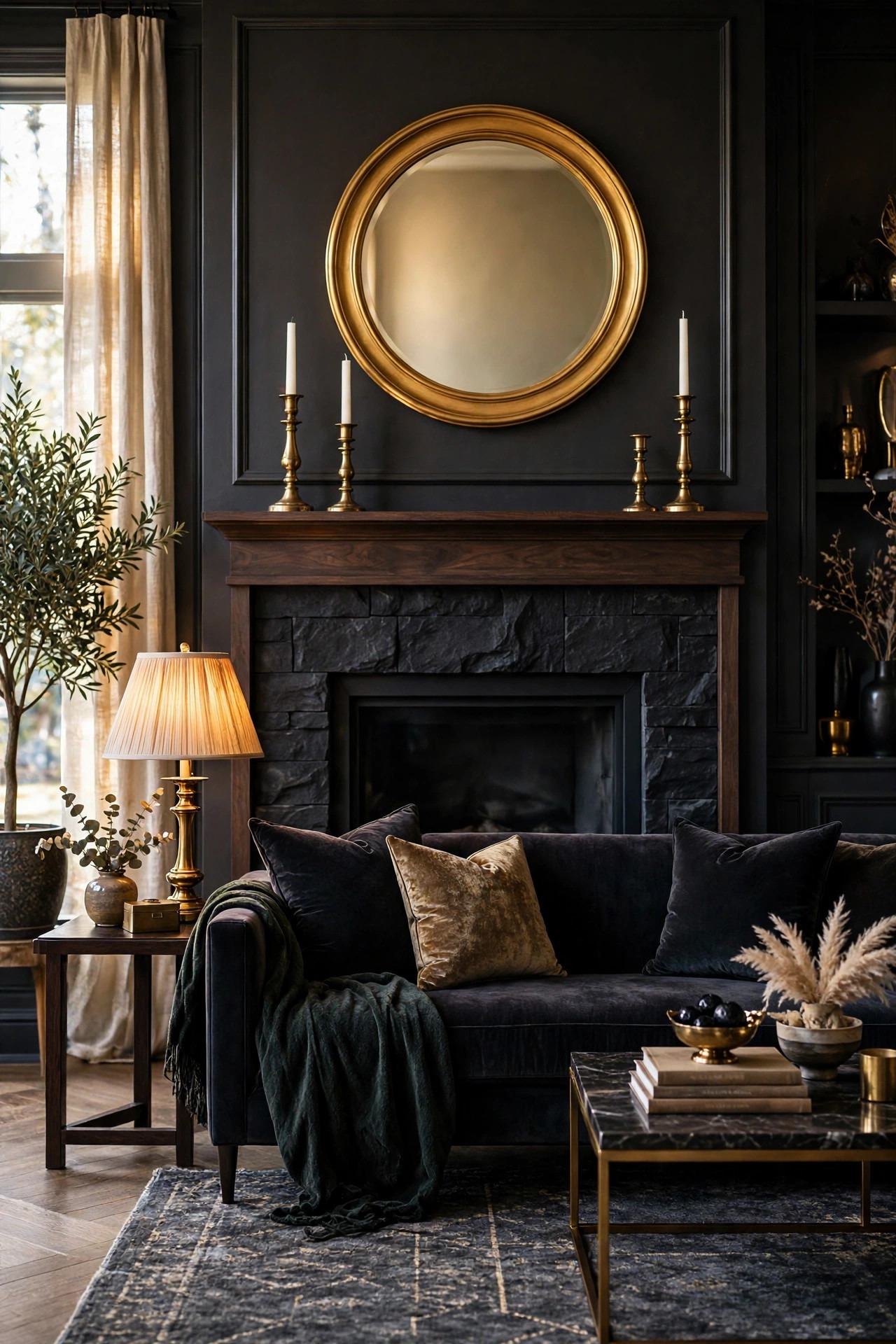
A dark fireplace wall is the natural focal point of a dark living room, because the fireplace already draws the eye and a deep color makes it the clear centre of the room. Paint the chimney breast in warm charcoal, or clad it in dark stone, and dress the mantel with brass candlesticks, a small stack of books and a round gold mirror above, so the fire and the gold become the warm notes against the dark. Keep the hearth pale, a cream stone or a light rug in front, because a pale hearth stops the dark wall from running into the dark floor. Check the paint is rated for the heat near the fire opening, and keep candles and throws well clear of the fire. Our farmhouse living room shows the same mantel styling with a cream surround, for readers deciding between a dark and a pale fireplace
Best For: Living rooms with a working or decorative fireplace, and anyone who wants one clear focal wall.
Not Ideal For: Rooms with no fireplace; the charcoal accent wall in idea 1 is the honest version there.
Estimated Cost: $100-$400 (estimate) for paint or dark stone cladding, brass candlesticks and a round gold mirror.
Budget Note: The mirror is the spend; a good round gold mirror costs more than the paint, so buy the mirror first and paint to match its tone.
Renter Friendly: With Conditions
Renter Note: Painting the fireplace wall needs the landlord’s written permission; renters can still style the mantel with candlesticks and a leaning mirror and leave the wall cream.
What You Need
Warm charcoal paint rated for heat near a fireplace, or dark stone cladding, brass candlesticks, round gold mirror, small stack of books, tape measure.
Product type to look for: A mirror with a sturdy gold frame and a secure hanging wire, because a mirror above a fireplace is handled often and must hang safely.
How To Do It
- Check the paint is rated for the heat near the fire opening, then tape the mantel and the hearth.
- Paint the chimney breast in two thin coats, letting the first coat dry fully.
- Hang the round gold mirror centred above the mantel and check it sits level.
- Style the mantel with the candlesticks at one end, the books in the middle, and step back to check the fire wall reads as the focal point.
Pro Tip
Keep the mantel to three groups only. A mantel crowded with objects splits the focus, while candlesticks, books and a mirror let the dark wall lead. Never leave a candle burning unattended near a fireplace.
12. Balance the Dark with Cream and Gold
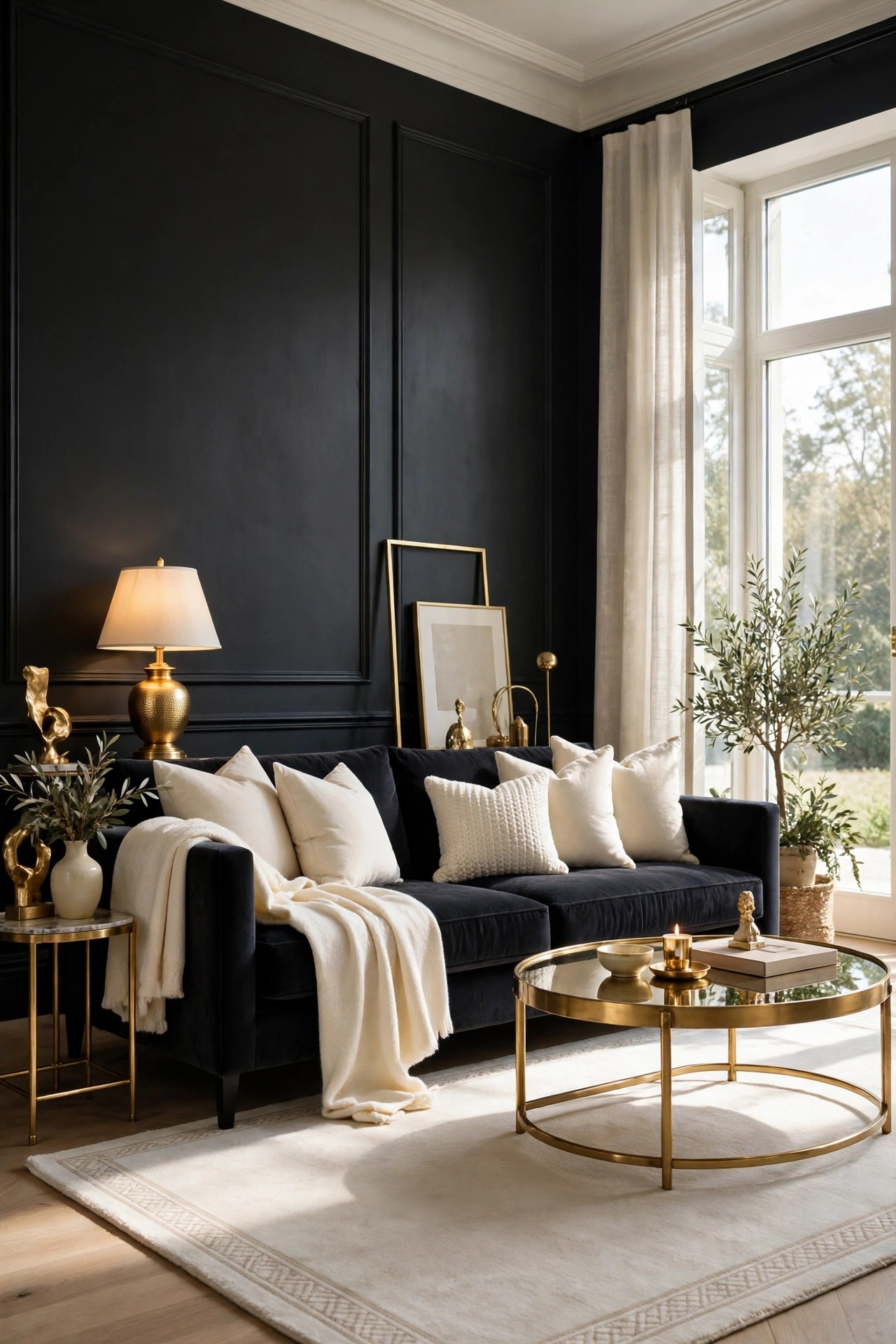
Cream and gold are the balance a dark living room needs, because a room that is all dark has nowhere for the eye to rest. Add cream in three places, a folded throw on the sofa arm, cream cushions on the dark sofa and a pale border on the rug, and add gold in three small places, the lamp base, the tray and the picture frames, so the light notes repeat until they look planned. Keep the gold small, because a large gold piece in a dark room shouts, while small gold notes glow. Choose cream in warm linen and cotton, never bright white, because a cold white against charcoal reads harsh, while a warm cream reads soft. Step back and count the pale notes; if the room still feels heavy, add one more cream cushion before adding another dark piece.
Best For: Every dark living room, and especially rooms where the first dark pieces already feel heavy.
Not Ideal For: No real exception; even a lightly dark room needs its pale notes, so this idea works at every budget.
Estimated Cost: $60-$180 (estimate) for cream throws, cream cushions and small gold accents.
Budget Note: The cushions are the spend; good cream linen cushion covers cost more than plain ones, so buy the covers first and reuse inserts from old cushions.
Renter Friendly: Yes
Renter Note: Nothing fixed at all; throws, cushions and trays move out in one box on moving day.
What You Need
Cream linen throws, cream linen cushion covers with inserts, small gold tray, gold picture frames, warm taupe throw.
Product type to look for: Cushion covers in a warm cream linen with a hidden zip, because a cream cover in a living room is washed often and must come off easily.
How To Do It
- Add the cream cushions to the dark sofa first, then the folded throw on the arm.
- Place the small gold tray on the coffee table and the gold frames on the wall.
- Check the pale rug border still shows around the dark rug.
- Step back and count three cream notes and three gold notes, then add one more cream cushion if the room still feels heavy.
Pro Tip
Repeat every accent at least twice. One gold lamp looks like an accident, while gold in the lamp, the tray and the frames reads as a decision.
13. Layer Velvet, Leather and Wool Textures
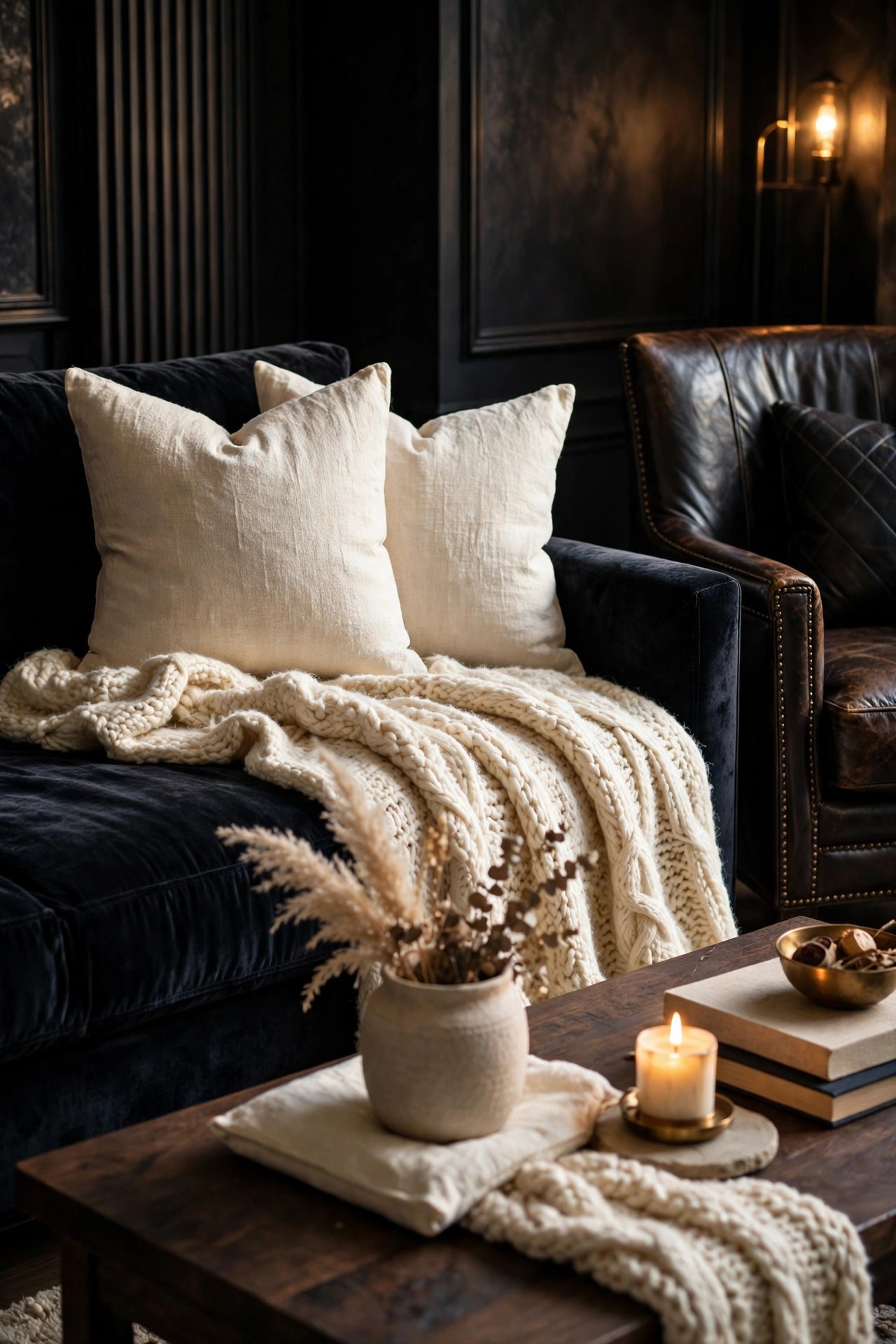
Texture is what keeps a dark living room from reading flat, because a room in one dark color with one material looks painted rather than decorated. Layer three textures on purpose: the soft pile of the velvet sofa, the smooth surface of the leather chair and the loose weave of a cream wool throw, with linen cushions to soften the edges. Keep the colors close, charcoal, espresso and warm taupe, so the textures do the talking instead of the colors. Touch each piece before buying, because a velvet that feels rough and a wool that feels scratchy will never be used, and a room is only cozy if its textures invite touch. A dark room with three textures feels rich at dusk, when the lamp light moves across each surface differently.
Best For: Living rooms where the dark pieces already match in color, and anyone who wants depth without adding another color.
Not Ideal For: Rooms with very little seating; a velvet sofa and one wool throw are the honest version there.
Estimated Cost: $80-$220 (estimate) for a cream wool throw, linen cushions and leather care for the chair.
Budget Note: The wool throw is the spend; a good wool throw costs more than a synthetic one and lasts far longer, so buy the throw first.
Renter Friendly: Yes
Renter Note: Nothing fixed at all; throws and cushions move out in one box on moving day.
What You Need
Cream wool throw, linen cushion covers, leather conditioner for the chair, soft cloth for dusting velvet.
Product type to look for: A wool throw in a loose weave that drapes well, because a throw in a living room is folded, draped and washed, and must keep its shape.
How To Do It
- Dress the velvet sofa with the linen cushions and the folded wool throw.
- Place the leather chair at an angle and check the two textures sit side by side.
- Run a hand over each surface and check the velvet, the leather and the wool each feel different.
- Step back at dusk and check the lamp light moves across the textures, giving the dark room its depth.
Pro Tip
Keep the palette to three darks and two lights. A room with three textures in five colors splits the eye, while three textures in charcoal, espresso, warm taupe, cream and gold reads as one calm room.
14. Add Mirrors to Bounce Light Around a Dark Room
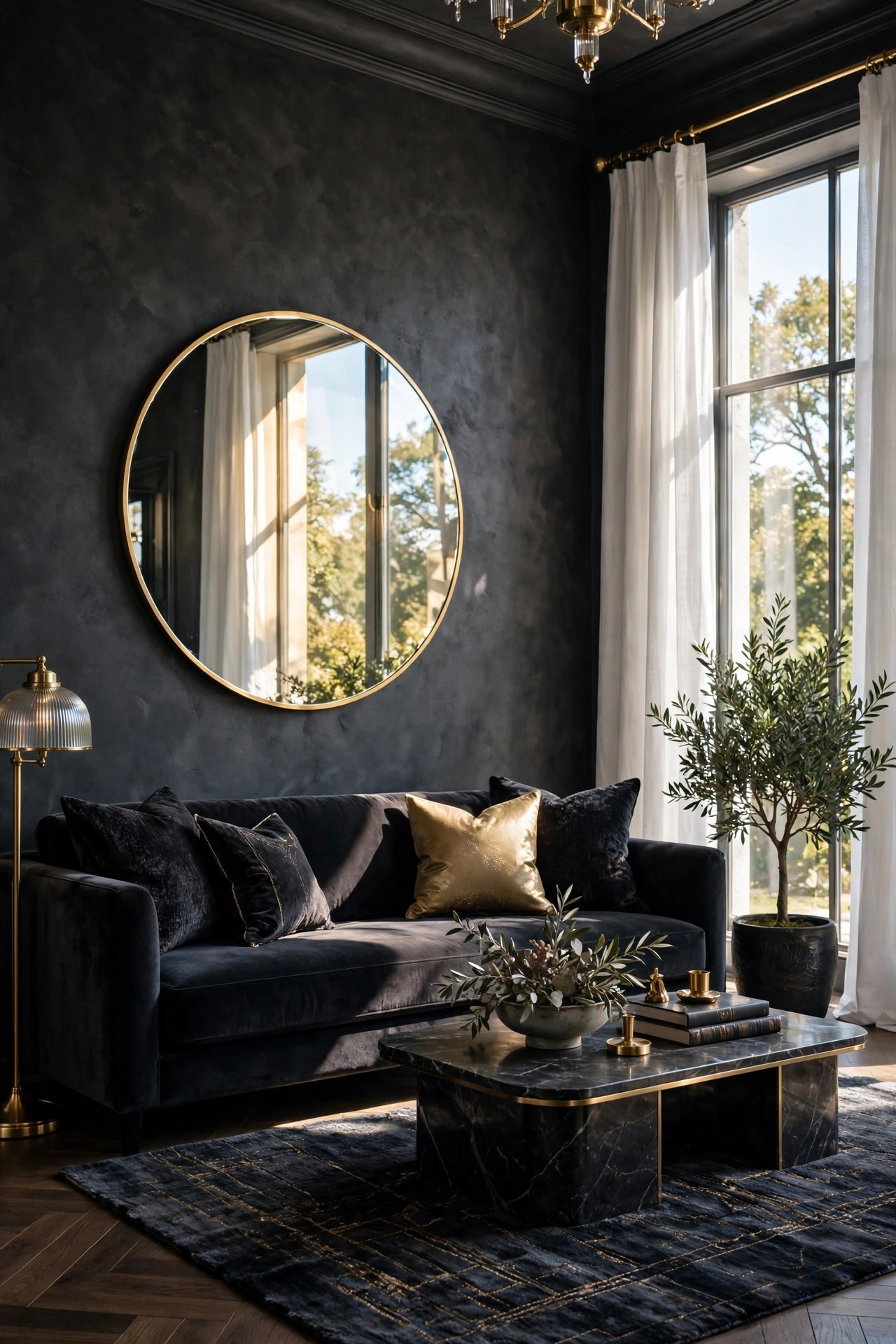
Mirrors are the light a dark living room borrows, because a mirror opposite a window doubles the daylight the room already has. Hang one large round mirror in a slim gold or black frame on the charcoal wall opposite the window, so it reflects the daylight and the lamp glow back into the seating area. Choose a mirror large enough to matter, at least two feet across, because a small mirror in a dark room reads as a picture, while a large mirror reads as a second window. Check what the mirror reflects before hanging it, because a mirror that reflects a blank wall wastes its light, while a mirror that reflects the window and the lamp doubles both. Keep the mirror clean, because a dusty mirror in a dark room dulls the very light it is meant to borrow.
Best For: Living rooms with one good window and a dark wall opposite it, and anyone who wants more light without another lamp.
Not Ideal For: Rooms where the mirror would reflect a television; a mirror on a side wall is the honest version there.
Estimated Cost: $80-$300 (estimate) for a large round mirror in a slim gold or black frame with secure hanging hardware.
Budget Note: The size is the spend; a large mirror costs more than a small one, so buy the largest mirror the wall can hold safely.
Renter Friendly: With Conditions
Renter Note: Hanging needs a hook the lease allows; a large leaning mirror against the wall is the renter version, secured at the top so it cannot tip.
What You Need
Large round mirror in a slim gold or black frame, hook or picture wire rated for its weight, level, pencil for marking.
Product type to look for: A mirror with a sturdy frame and a secure hanging wire rated well above its weight, because a large mirror in a living room must never fall.
How To Do It
- Hold the mirror against the wall opposite the window and check it reflects the daylight.
- Mark the hook level and fit it following the maker instructions, checking the weight rating first.
- Hang the mirror and check it sits level and reflects the window, not a blank wall.
- Step back at dusk and check the lamp glow doubles in the mirror, then wipe the glass weekly.
Pro Tip
Hang the mirror opposite the window, not beside it. A mirror beside a window catches little light, while a mirror opposite the window doubles the daylight the room already has.
15. Finish with a Brass Tray Scene on the Coffee Table
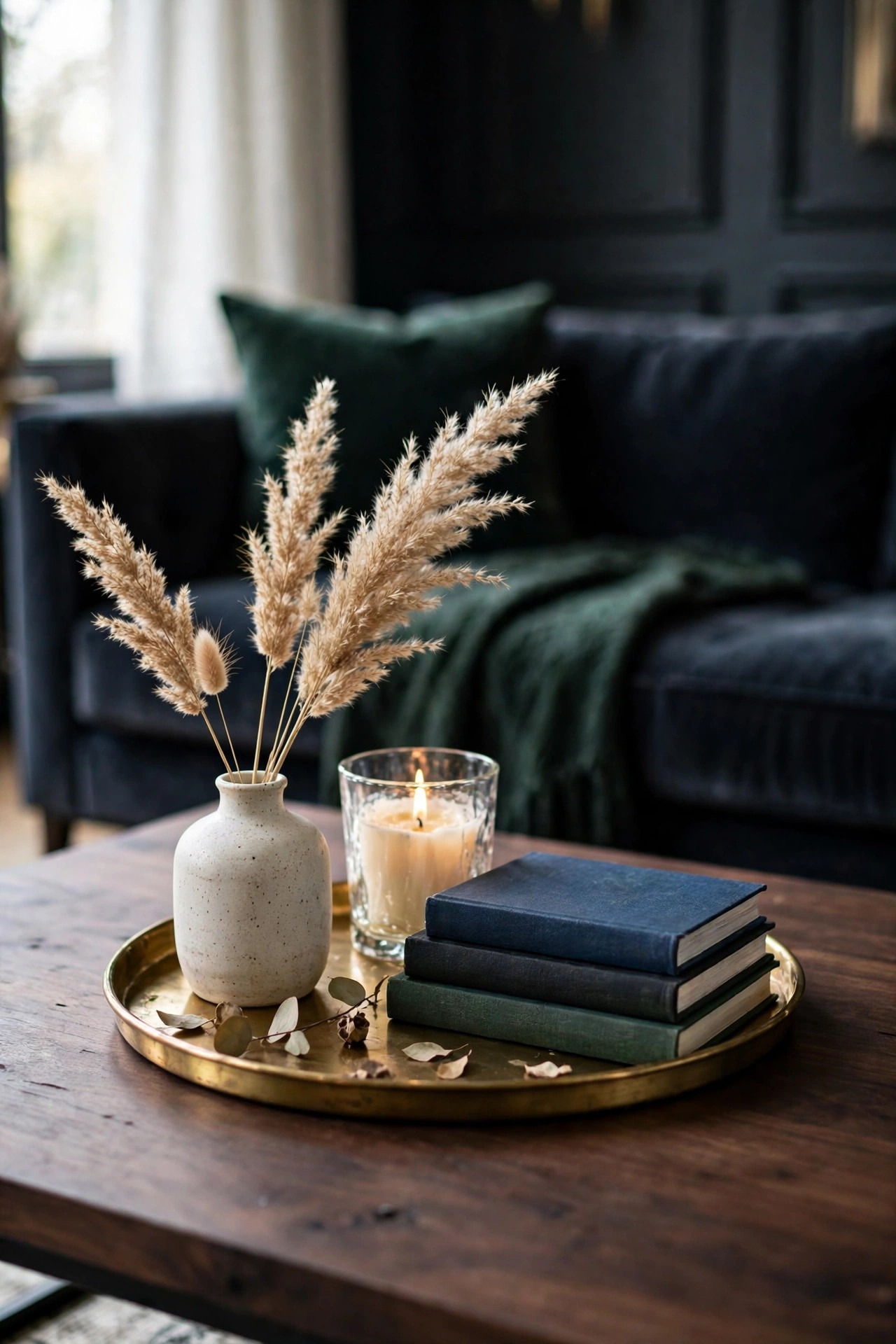
The last styling idea is the smallest, and it is what makes a dark living room look finished in photos and in person. A small brass tray on the walnut coffee table, holding a small ceramic vase with dried pampas stems, a candle in a glass holder and a stack of two books, gathers the daily pieces into one calm group and repeats the gold note at the centre of the room. Keep the tray low and the scene honest, sized for what the room actually uses every day, because a styled table that has to be emptied before anyone can set down a cup is a display, not a finish. Change the stems when they fade and wipe the tray when you wipe the table, and the finish keeps itself. Leave room on the table for two cups, because a table that cannot hold a cup has stopped doing its job. Never leave a candle burning unattended, and keep the candle in its glass holder away from the pampas stems and the throws.
Best For: Every dark living room, and especially rooms that look fine in daylight and unfinished in photos.
Not Ideal For: No real exception, but keep the tray small on a tiny table so the books and the cups still fit.
Estimated Cost: $30-$80 (estimate) for a small brass tray, a ceramic vase, dried pampas stems and a candle in a glass holder.
Budget Note: Shop the house first; a tray and a vase moved from another room finish the table for nothing.
Renter Friendly: Yes
Renter Note: Nothing fixed at all; the whole scene can be packed in one box on moving day.
What You Need
Small brass tray, small ceramic vase, dried pampas stems, candle in a glass holder, two books, soft cloth for dusting.
Product type to look for: A tray with a low rim and a stable, flat base, because a tray on a walnut table must sit flat and not slide when a cup is set down.
How To Do It
- Clear the coffee table fully, then place the tray on one side of the table.
- Set the vase and the candle inside the tray and the books beside it.
- Check two cups still fit on the table without moving the scene.
- Walk to the door and check the table as a guest sees it: dark wood leading, gold calm, surfaces clear.
Pro Tip
Reset the scene every evening for one week. The habit, not the objects, is what keeps a styled finish: tray grouped, books stacked, stems fresh, table two thirds clear.
Practical Tips for Dark Living Room Ideas
Let the dark be the one clear note and repeat the warm notes until they look planned. The wall stays charcoal, the sofa stays dark velvet, and cream, warm taupe, blush and brushed gold do the supporting work, each used at least twice: gold in the lamp and the tray, cream in the cushions and the throws, dark wood in the table and the shelves. One note used once looks like an accident; twice or more it looks like a decision. Keep the light layered and warm, because the charcoal wall soaks up light and three warm lights at sofa height are what make the room glow after dark. Measure every piece before buying, because a sofa one foot too long and a rug that stops short of the sofa legs both waste a season, and judge the room twice before calling it done, once at midday for the true colors and once under the evening lamps. Start in the order of this list, wall and sofa first, and let the shelves, the plants and the soft layers arrive slowly; a dark room built in a weekend usually has one object too many, and removing a piece is always easier than finding the right one to add. Keep the textures to one family, velvet, leather and wool together, because two competing patterns split a moody room into two stories. Our scandinavian living room shows the opposite choice, pale walls with dark furniture, for readers who want to compare the two directions
Frequently Asked Questions
What is a dark living room?
A dark living room is a living room with a warm dark base, usually a charcoal wall, a dark sofa or dark wood furniture, softened with cream, warm taupe, blush and gold. It differs from a dark boho living room, which leads with boho texture such as rattan, macrame and kilim, and it differs from a dark bedroom, which is planned around sleep and a bed rather than seating, light and storage. This collection is the broad living room version: dark paint, dark wood, dark leather and moody light, with no boho pieces and no bedroom pieces.
How do I keep a dark living room from feeling too dark?
Keep the dark to one wall, one sofa or one floor, and layer warm light at sofa height. Cream cushions, a pale rug border, a large mirror opposite the window and three warm lamps give the eye pale places to rest, while the charcoal wall and the dark sofa carry the mood. Judge the room at midday and again under the evening lamps before adding another dark piece.
What colors go with a dark living room?
Warm charcoal, espresso and dark walnut lead, with cream, warm taupe, blush pink and brushed gold as the supporting colors. Keep the gold in small notes, the lamp, the tray and the frames, and keep the blush in the cushions and the art, so the dark stays warm rather than cold.
Can I do a dark living room in a small room?
Yes, if the dark is kept to one piece. A dark velvet sofa on a cream wall, or one charcoal wall behind a pale sofa, gives a small room the moody feel without closing it in. Keep the rug pale at the edges, the curtains open in the daytime and the floor showing, because a small dark room needs its light and its floor space.
Is a dark living room renter friendly?
Most of it is, because the dark can live in furniture rather than paint. A dark sofa, dark rugs, dark curtains on a tension rod and a leather chair need no permission at all, while the charcoal wall, the shelves and the gallery need the landlord’s written permission or a removable version. Choose the furniture first if the lease forbids painting. Our dark bedroom ideas use the same furniture first rule for a bedroom, for readers planning both rooms
How much does a dark living room cost?
It depends on the sofa and the leather chair, which are the two big spends. A room built around a dark velvet sofa, a dark rug, a walnut table and warm lamps usually sits in the low thousands, while a room built with paint, a dark rug, shelves and a brass tray scene can be done for a few hundred. Start with the wall and the sofa, then add the rest slowly.
Conclusion
A dark living room works when the dark is given one clear job: the charcoal wall leads, and everything else supports. A charcoal velvet sofa and a dark patterned rug keep the room soft underfoot, dark wood and leather keep the texture rich, and warm lamps, mirrors and gold trays keep the light coming in. Start with the wall and the sofa, add the rug and the chair, keep one dark wood, one metal and one soft accent through the whole room, and the moodiest corner of the house becomes the one everyone gathers in after dark.