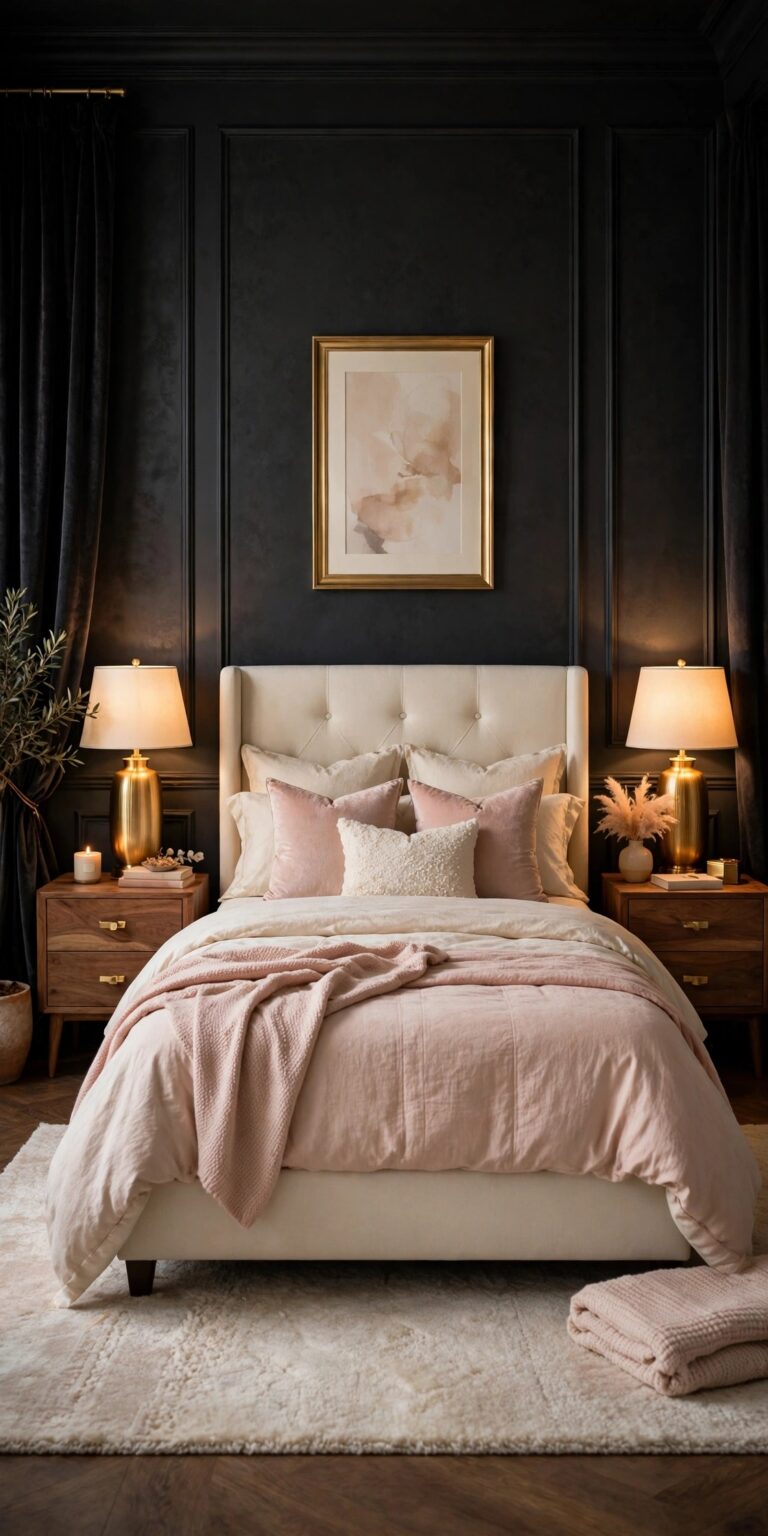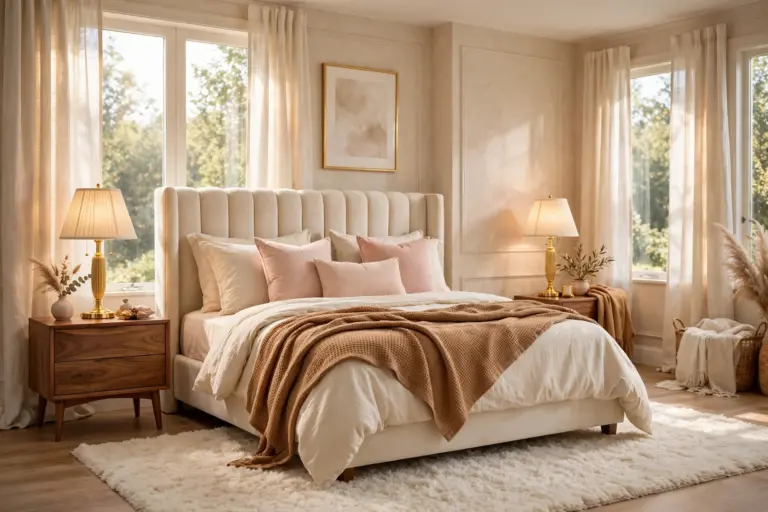
15 Bedroom Accent Wall Ideas for a Bright Glam Bedroom
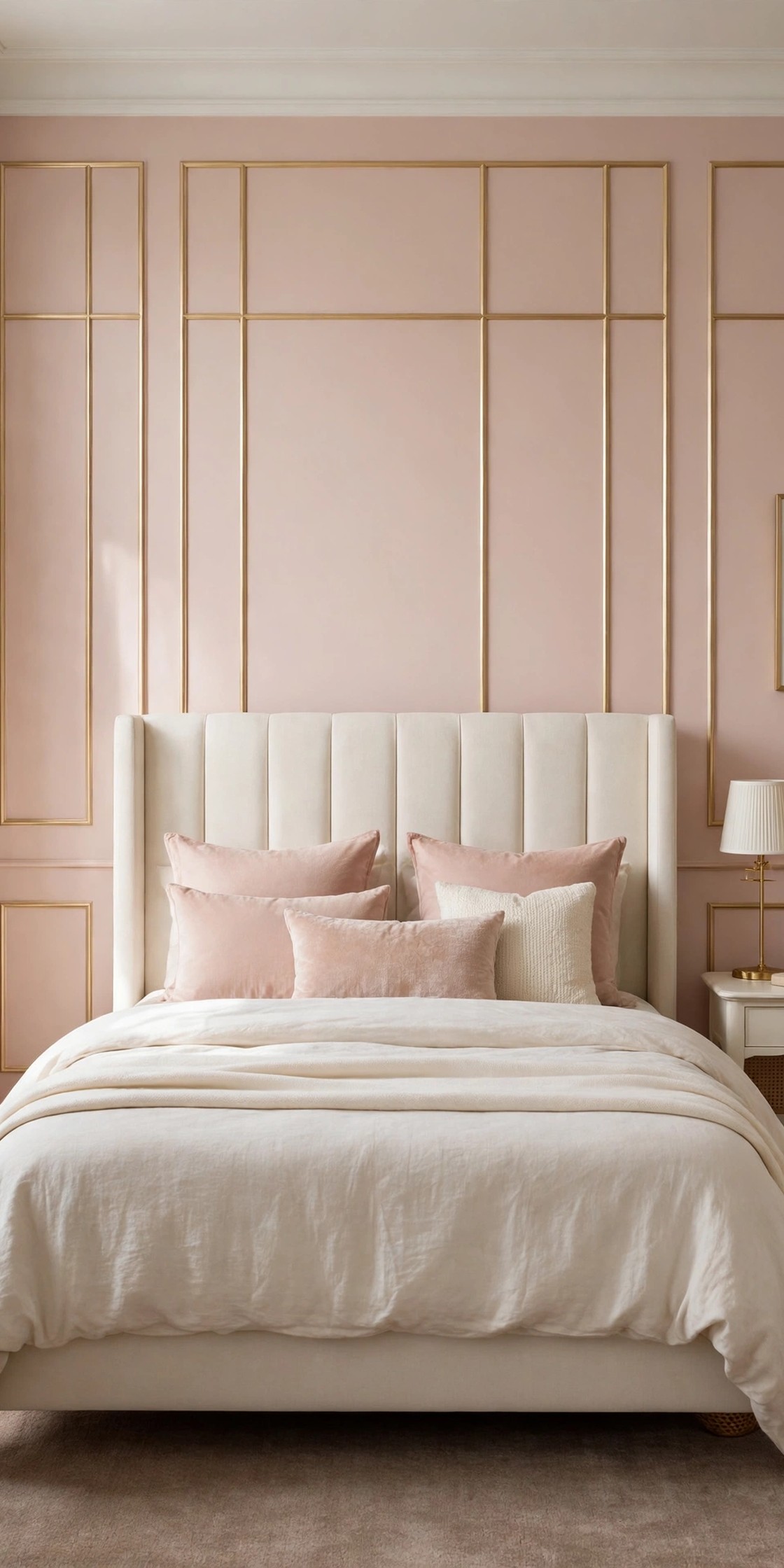
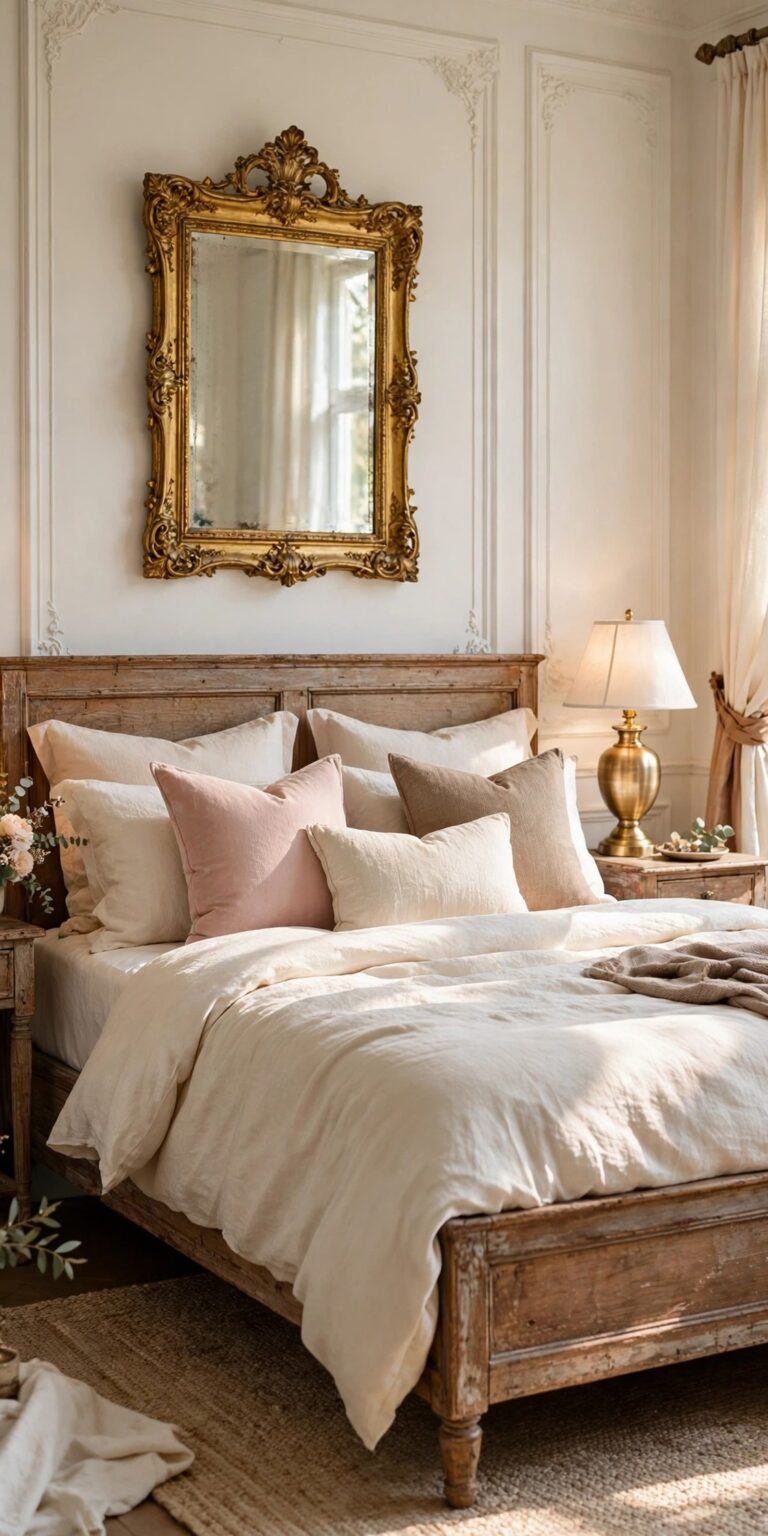
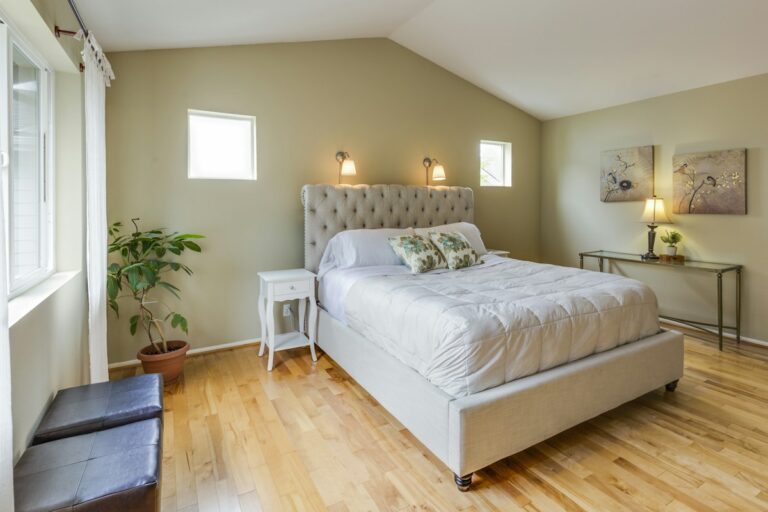
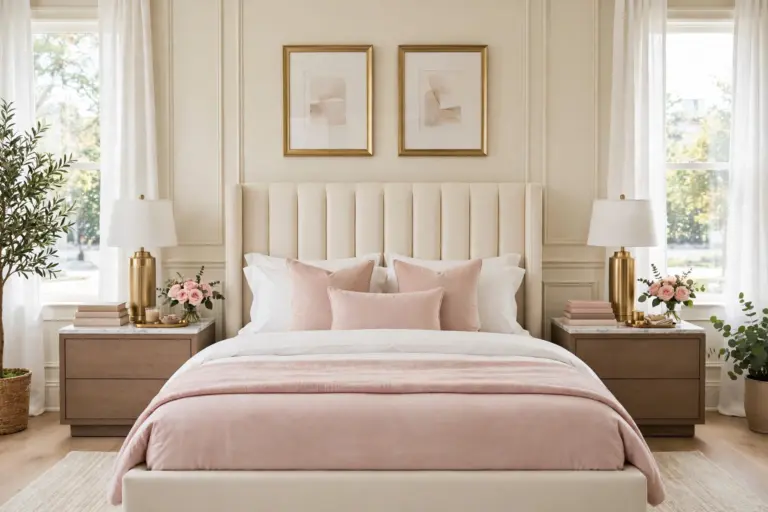
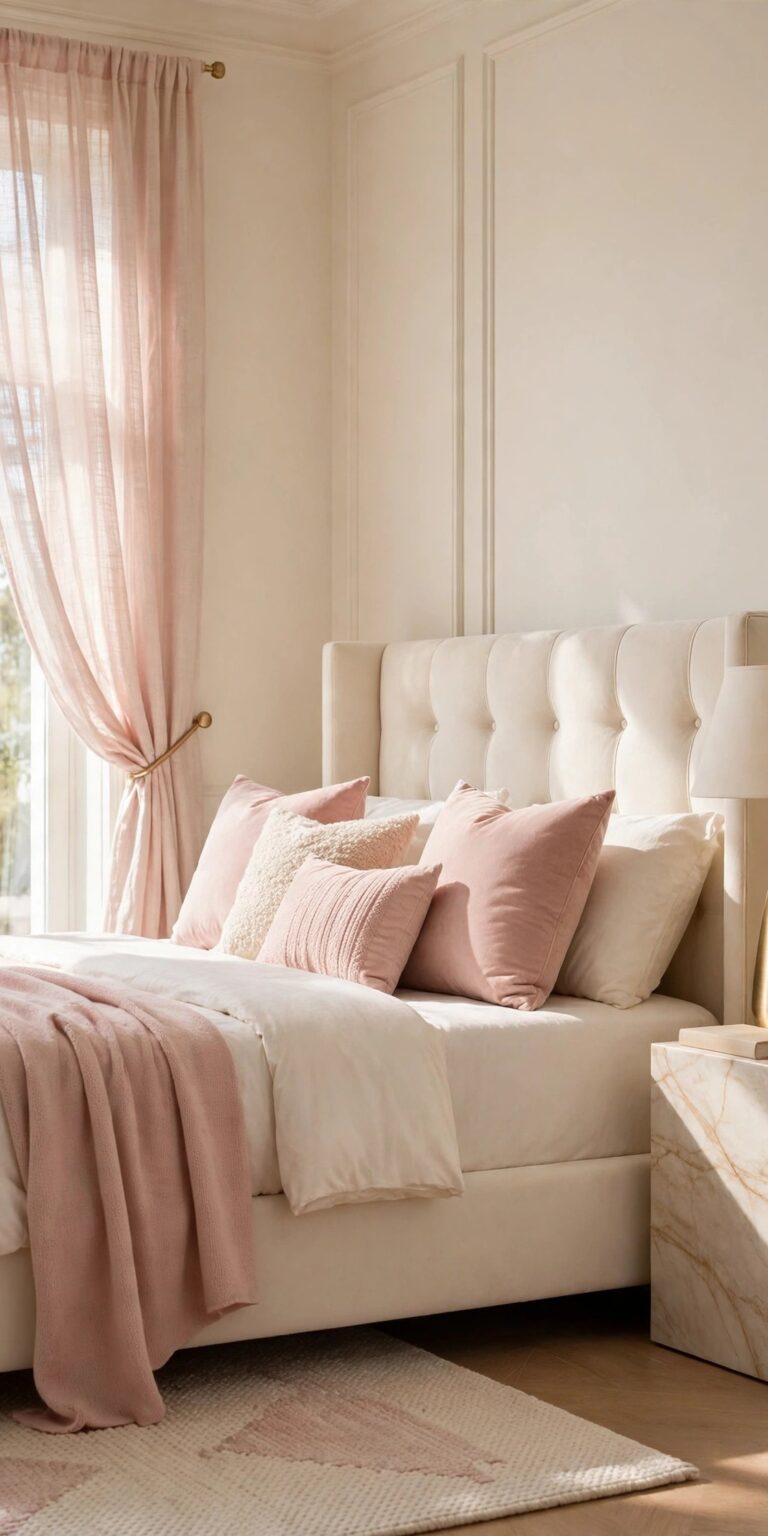
A bedroom accent wall ideas search usually starts with one question: which wall should carry the color, and how much of it is enough. The answer is almost always the wall behind the bed, because it is the wall you see first in the morning and last at night, and one finished wall there gives the whole room a centre. Bedroom accent wall ideas work best when that one wall does the decorating and the other three stay calm, so the bed reads as the heart of the room. These bedroom accent wall ideas keep the glam notes Sofia loves, cream linen, warm taupe, blush pink and brushed gold, in soft paint, cream wood slats, gold moulding, floral wallpaper and warm light behind the bed. If you are planning the room around its main wall, our bedroom ideas show how the bed, the bedding and the small styling pieces work together
Disclosure: This article may contain affiliate links. If you buy through a link on this page, GlamNStyle may earn a small commission at no extra cost to you. Product links in this article are plain links; each one is checked on the retailer’s own page before it is added.
1. Paint One Wall Soft Blush Pink Behind the Bed
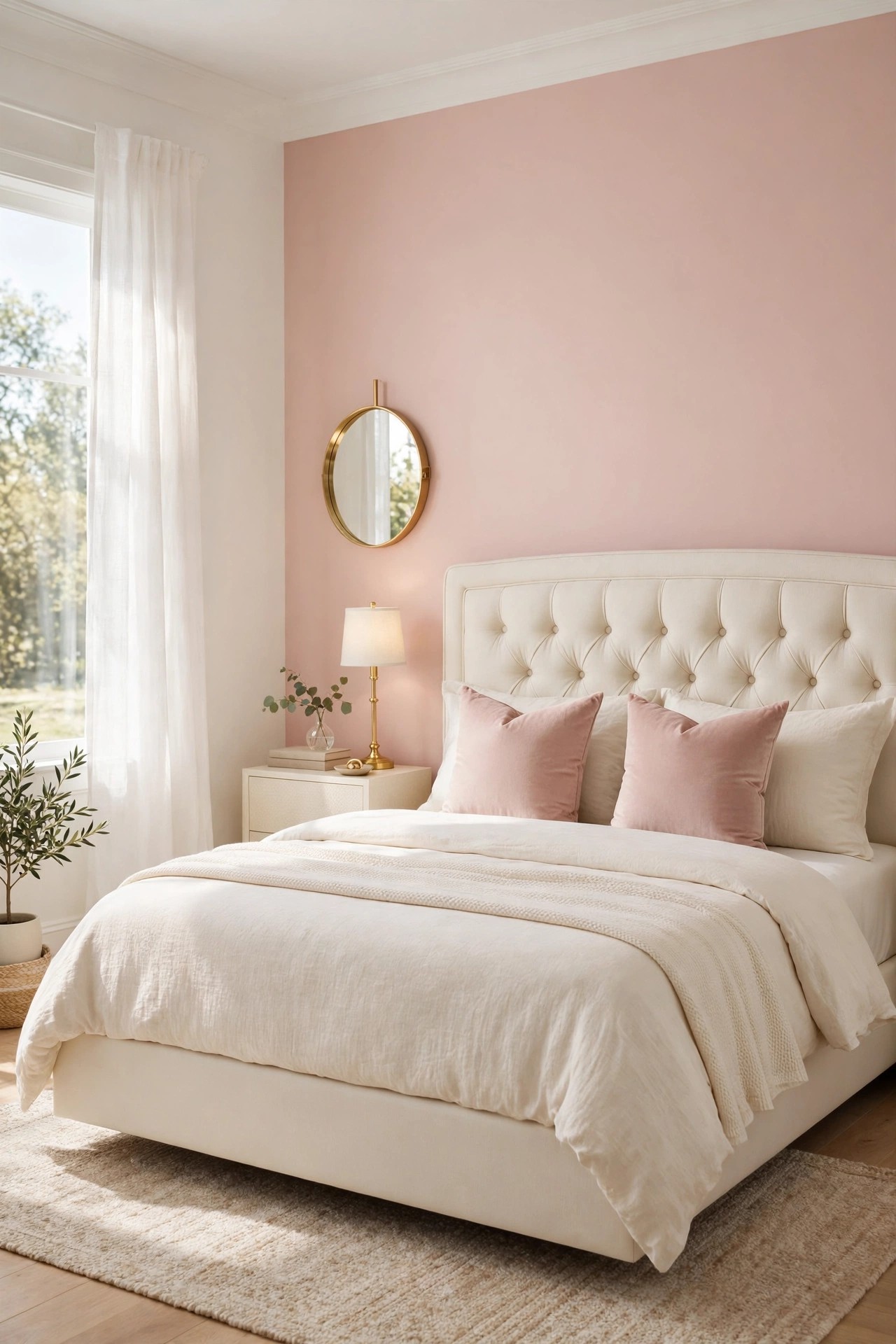
A soft blush painted wall is the simplest accent wall a bedroom can hold, and it is the best place to start if you have never painted a feature wall before. Paint the wall behind the bed in a soft blush, keep the other three walls warm white, and the bed gains a calm pink glow that reads as glam without shouting. Choose a blush with a warm base, never a cool pink, because a cool pink turns grey under evening light while a warm blush stays soft. Paint two coats and let each coat dry fully, because a pale pink shows every thin patch, and keep the ceiling and the skirting warm white, so the blush reads as one clear decision. Style the bed in cream with one blush pillow and a gold lamp, because a blush wall with cream bedding reads as a plan, while a blush wall with patterned bedding splits the calm.
Best For: First time accent walls, and bedrooms where the bed needs a centre without new furniture.
Not Ideal For: Bedrooms with very little daylight; a pale blush can read grey there, so a warm taupe wall is the honest version.
Estimated Cost: $40-$120 (estimate) for paint, primer, a roller and painter tape for one wall.
Budget Note: The paint is the spend; one wall needs only a small tin, so buy a sample pot first and test a large patch in daylight and at night.
Renter Friendly: With Conditions
Renter Note: Paint needs the landlord’s permission in most rentals; a removable blush wallpaper panel is the renter version, or ask first and keep the original paint shade on record.
What You Need
Soft blush wall paint with a warm base, primer, roller and tray, painter tape, drop cloth, cream bedding, one blush pillow.
Product type to look for: A paint with a warm blush base in a matte or eggshell finish, because a bedroom accent wall is seen up close and a soft finish hides small wall marks.
How To Do It
- Test a large blush patch on the wall behind the bed and check it in daylight and at night.
- Tape the edges, cover the floor and the bed, then prime the wall if the old color is strong.
- Roll on two thin coats, letting each coat dry fully before the next.
- Remove the tape while the last coat is still slightly damp, then style the bed in cream with one blush pillow.
Pro Tip
Keep the blush to one wall only. A second blush wall turns a soft accent into a pink room, while one blush wall with cream bedding reads as glam and calm.
2. Try Warm Taupe Limewash for Soft Texture
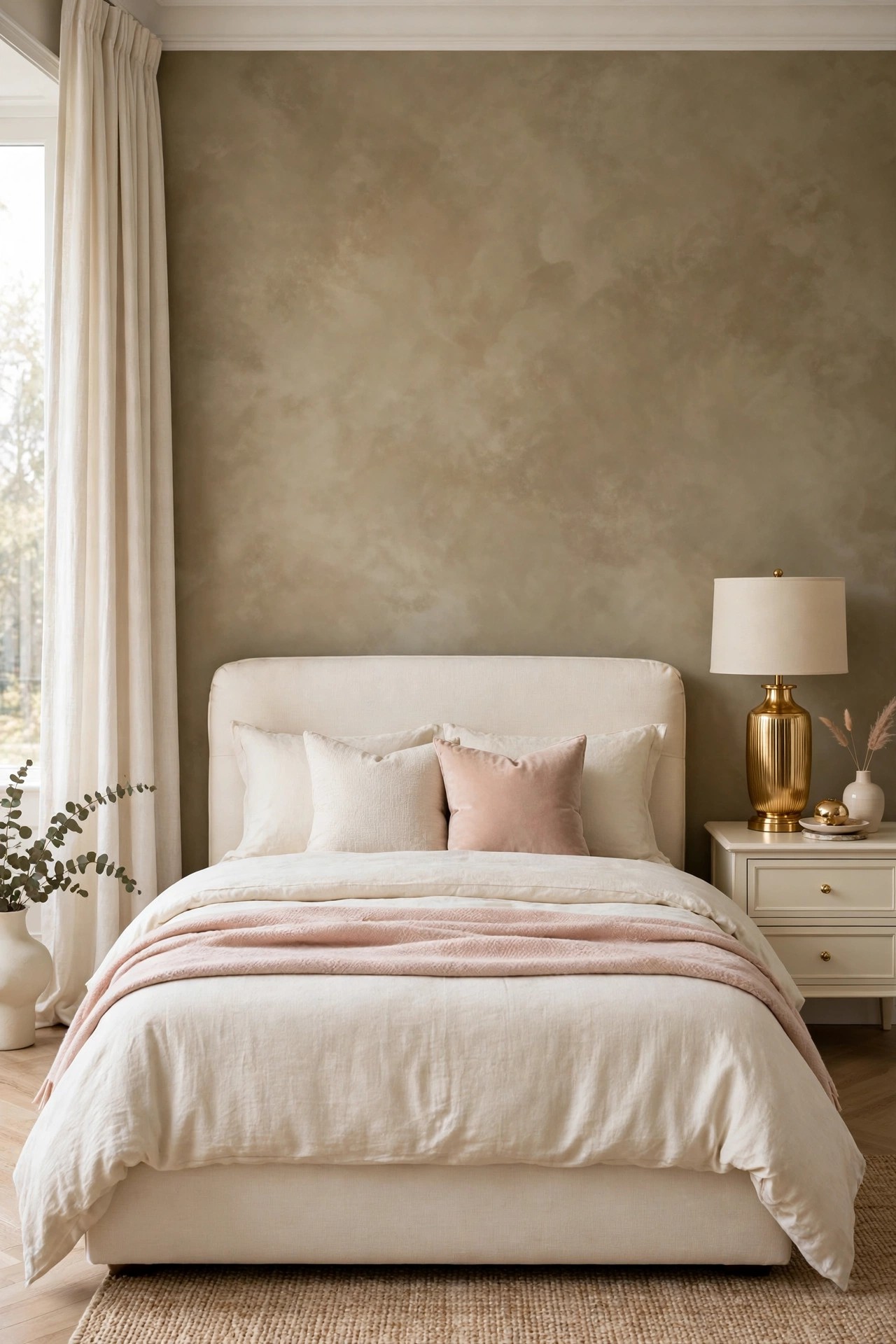
A warm taupe limewash wall is the accent wall for a bedroom that wants texture without pattern, because the cloudy finish moves with the light and never looks flat. Brush the limewash onto the wall behind the bed in loose crossing strokes, keep the other walls warm white, and the bed gains a soft taupe depth that reads as luxury rather than paint. Choose a warm taupe, never a grey taupe, because a grey taupe turns cold under evening light while a warm taupe stays soft. Work in small sections and keep a wet edge, because limewash dries fast and a dry edge leaves a hard line. Style the bed in cream with a blush throw and a gold lamp, because a taupe wall with cream bedding reads as warm, while a taupe wall with dark bedding reads as heavy.
Best For: Bedrooms that feel flat with plain paint, and anyone who wants texture without wallpaper.
Not Ideal For: Walls with cracks or rough patches; limewash shows every bump, so a smooth painted wall is the honest version there.
Estimated Cost: $60-$180 (estimate) for limewash paint, a block brush, primer and drop cloths for one wall.
Budget Note: The limewash is the spend; one wall needs only a small tin, so practise on a spare board first and buy the brush the maker suggests.
Renter Friendly: No
Renter Note: Limewash is a permanent finish, so it is not a renter choice; a taupe peel and stick panel is the renter version.
What You Need
Warm taupe limewash paint, block brush, primer if the maker suggests it, drop cloths, painter tape, cream bedding, blush throw.
Product type to look for: A limewash in a warm taupe with a soft matte finish, because a bedroom accent wall is seen in changing light and the finish must stay soft, not shiny.
How To Do It
- Clean the wall and fill any holes, then practise the crossing strokes on a spare board.
- Tape the edges and cover the floor and the bed.
- Brush the limewash in loose crossing strokes, working in small sections with a wet edge.
- Let the wall dry fully, check it in daylight and at night, then style the bed in cream with a blush throw.
Pro Tip
Keep the strokes loose and uneven on purpose. A limewash wall that is brushed too evenly looks like flat paint, while loose crossing strokes give the soft cloudy texture that makes the wall worth doing.
3. Add Cream Wood Slats Behind the Bed
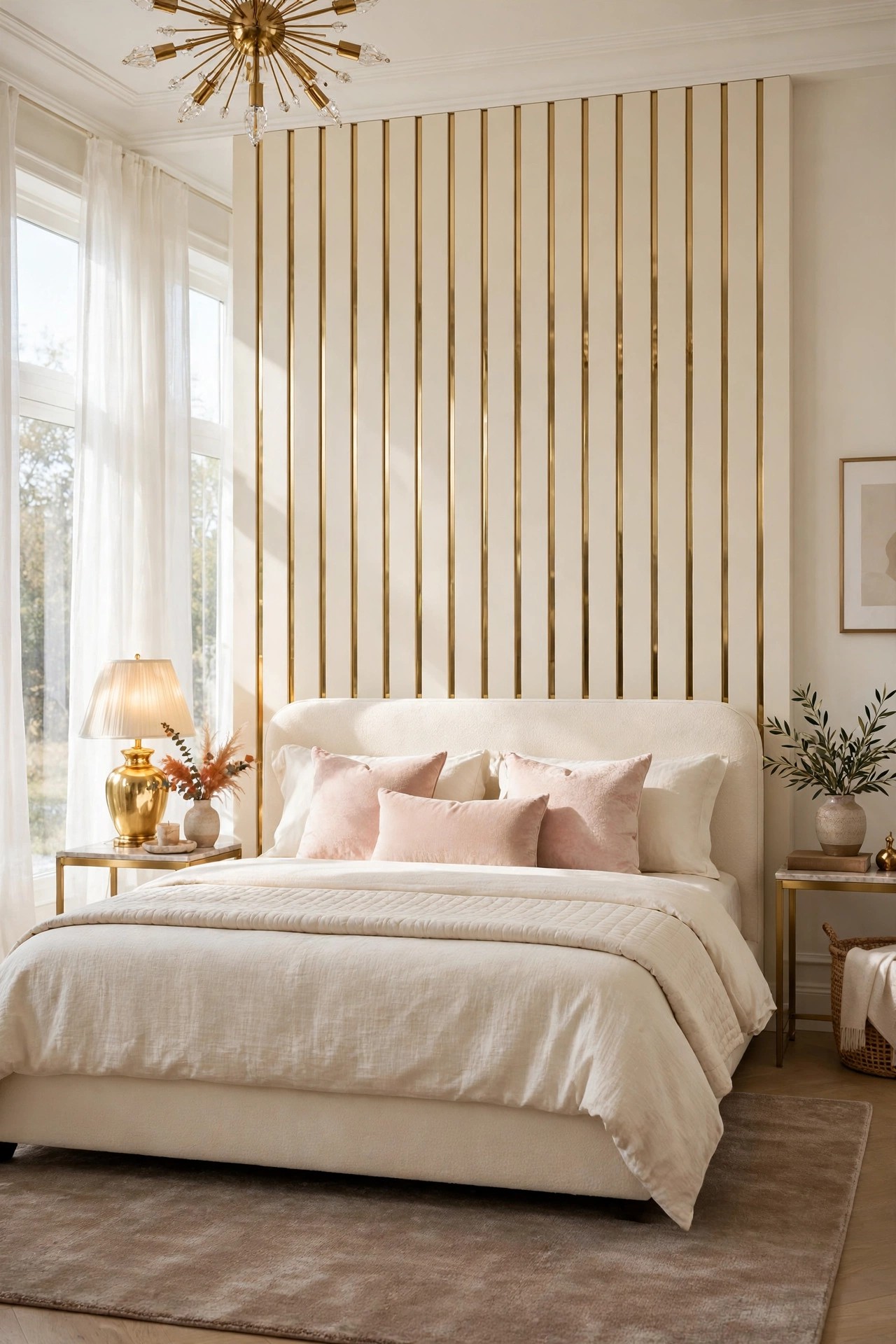
A cream wood slat wall is the accent wall that gives a bedroom height and rhythm, because the vertical lines draw the eye upward and make a low ceiling feel taller. Fix slim cream slats to the wall behind the bed, leave a slim shadow gap between each one, and the bed gains a soft architectural back that reads as custom rather than decorated. Choose slats in warm cream, never bright white, because bright white slats look stark against cream bedding while warm cream slats read as one family. Keep the slats straight and level, because a slat wall with one leaning slat is the first thing the eye finds, and stop the slats at the ceiling or at the headboard height, never halfway, so the wall reads as finished. Style the bed in cream with blush pillows, because a slat wall with cream bedding reads as calm, while a slat wall with a busy pattern fights the lines.
Best For: Bedrooms with a low ceiling, and anyone who wants an accent wall with shape rather than color.
Not Ideal For: Very narrow bedrooms; a slat wall adds depth, so a painted blush wall is the honest version there.
Estimated Cost: $150-$450 (estimate) for cream wood slats, adhesive or fixings, a level and paint for touch ups.
Budget Note: The slats are the spend; prefinished slat panels cost more per piece but save hours of cutting and painting, so count your time before choosing loose slats.
Renter Friendly: With Conditions
Renter Note: Slats need fixings or strong adhesive, so check the lease first; a freestanding slat headboard panel that leans is the renter version.
What You Need
Cream wood slats or prefinished slat panels, adhesive or fixings rated for the slat weight, level, saw if cutting loose slats, cream bedding, blush pillows.
Product type to look for: Slats in warm cream with a smooth finish and a slim profile, because a slat wall behind a bed is touched daily and must not snag bedding.
How To Do It
- Measure the wall behind the bed and mark the centre line, then plan the slat spacing with even gaps.
- Fix the first slat dead level, because every other slat follows it.
- Fix the remaining slats with even shadow gaps, checking level every few slats.
- Touch up any cut ends in cream, then style the bed in cream with blush pillows.
Pro Tip
Keep the gaps even and slim, about a finger width. Wide gaps show the wall behind and read as unfinished, while slim even gaps read as one calm panel.
4. Frame the Bed with Gold Panel Moulding
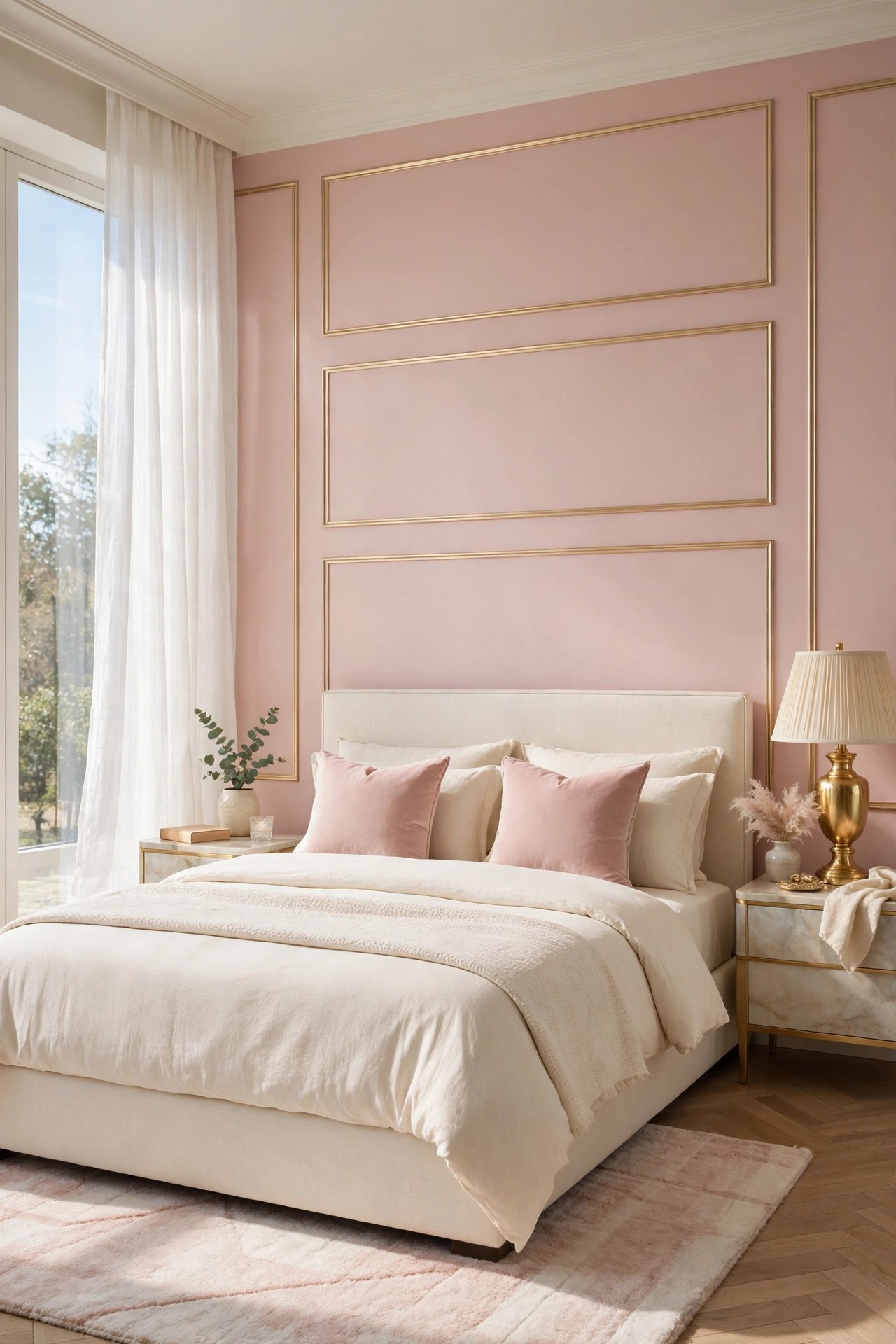
Gold panel moulding is the accent wall that makes a plain bedroom look like a hotel suite, because the slim gold frames turn one painted wall into architecture. Paint the wall behind the bed soft blush or warm taupe, then fix slim gold moulding into two or three tall rectangles, and the bed gains a frame that reads as luxury without a single new piece of furniture. Choose slim moulding, never a thick heavy frame, because thick moulding crowds a bedroom wall while slim gold lines read as jewellery. Keep the rectangles even and centred on the bed, because moulding that misses the bed centre looks like a mistake, and paint the wall first, so the gold sits on a finished color. Our modern luxury bedroom shows the same gold frame idea with a taller headboard, for readers deciding between moulding and a statement headboard
Best For: Bedrooms that feel plain even with good bedding, and anyone who wants a glam look without wallpaper.
Not Ideal For: Walls with a sloping ceiling or a low window behind the bed; a painted arch is the honest version there.
Estimated Cost: $80-$300 (estimate) for slim gold moulding, adhesive or small fixings, paint and a mitre box if cutting by hand.
Budget Note: The moulding is the spend; lightweight moulding costs far less than solid wood and is easier to fix, so choose the light version for a bedroom wall.
Renter Friendly: With Conditions
Renter Note: Moulding needs adhesive or small fixings, so check the lease first; removable gold trim tape is the renter version, though it reads softer than real moulding.
What You Need
Slim gold panel moulding, adhesive or small fixings, mitre box or pre-cut corners, soft blush or warm taupe paint, level, cream bedding.
Product type to look for: Slim lightweight moulding with a brushed gold finish, because a bedroom moulding frame must sit flat and stay light enough for adhesive.
How To Do It
- Paint the wall behind the bed and let it dry fully.
- Mark two or three even rectangles centred on the bed, using a level for every line.
- Cut the moulding corners at 45 degrees and fix each frame, starting with the centre frame.
- Touch up any small gaps in gold, then style the bed in cream with blush pillows.
Pro Tip
Keep the frames tall and slim, never square and small. Tall rectangles follow the bed and the wall height, while small squares read as picture frames hung too low.
5. Hang Blush Floral Wallpaper Behind the Bed
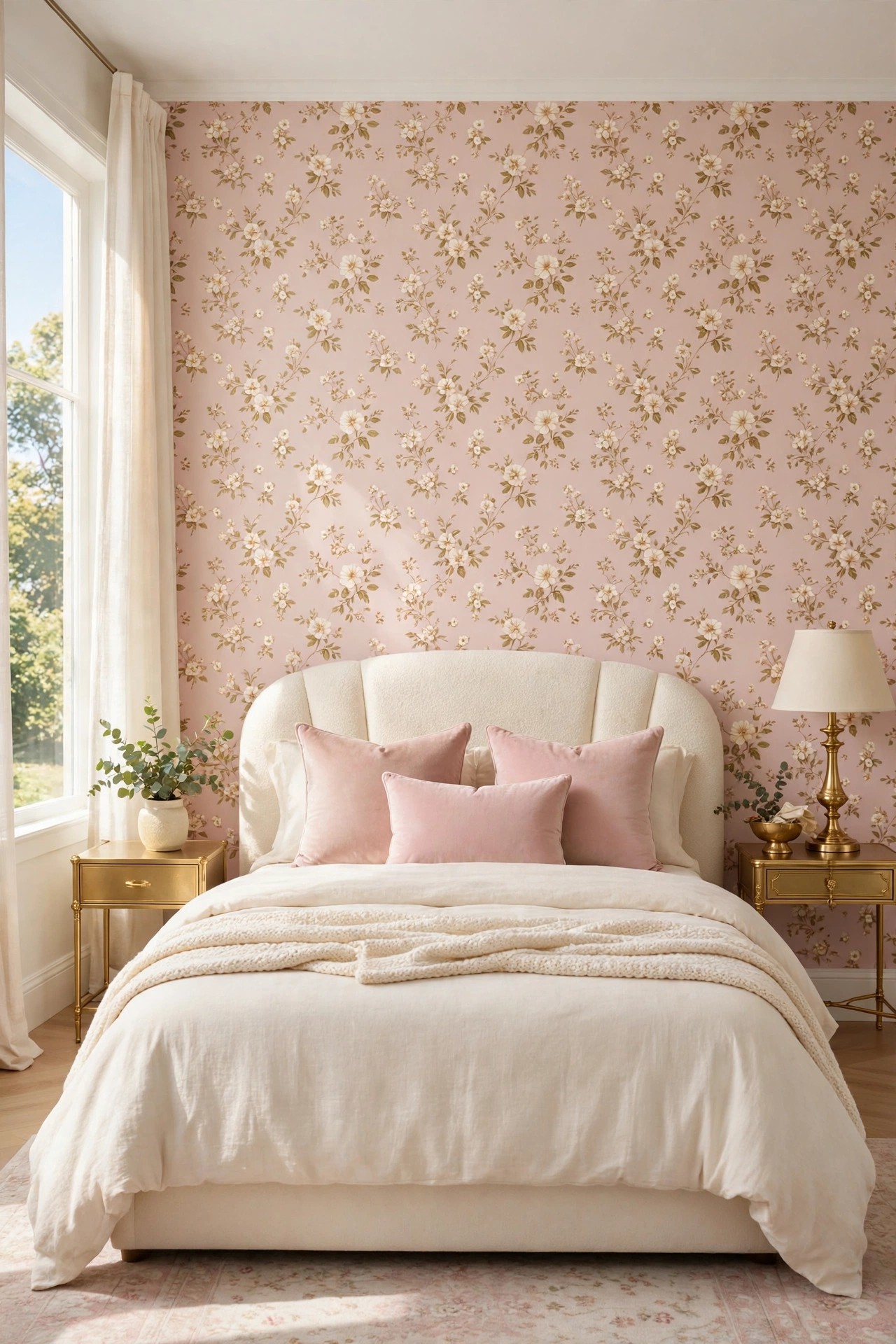
Blush floral wallpaper is the accent wall for a bedroom that wants pattern without noise, because the flowers do the decorating and the rest of the room can stay calm. Hang a soft blush wallpaper with small cream and gold flowers on the wall behind the bed, keep the other walls warm white, and the bed gains a garden note that reads as romantic rather than busy. Choose a small scale flower, never a large bold bloom, because a large bloom on one wall crowds a bedroom while a small flower reads as texture from the door. Match the pattern at every seam, because a wallpaper seam that misses by a petal is the first thing the eye finds, and keep the bedding cream, so the wallpaper stays the one pattern in the room. Order one extra roll, because a short roll at the last strip wastes a weekend.
Best For: Bedrooms that feel plain in plain paint, and anyone who wants pattern in one place only.
Not Ideal For: Bedrooms with a lot of patterned bedding or curtains already; a painted blush wall is the honest version there.
Estimated Cost: $120-$400 (estimate) for blush floral wallpaper, paste or peel and stick, a smoothing tool and a sharp blade.
Budget Note: The paper is the spend; peel and stick paper costs more per roll but removes cleanly, so count the removal saving before choosing pasted paper.
Renter Friendly: With Conditions
Renter Note: Pasted paper is not a renter choice; peel and stick floral paper is the renter version and lifts off cleanly if the wall is smooth.
What You Need
Blush floral wallpaper with small cream and gold flowers, paste or peel and stick backing, smoothing tool, sharp blade, level, cream bedding, blush pillows.
Product type to look for: A paper with a small scale flower and a matte finish, because a bedroom wallpaper is seen up close and a shiny paper shows every seam.
How To Do It
- Measure the wall and order one extra roll, then check the pattern repeat on the roll.
- Mark a level starting line at the centre of the wall behind the bed.
- Hang the first strip level, then match the pattern at every seam as you hang the rest.
- Trim the top and bottom with a sharp blade, then style the bed in cream with blush pillows.
Pro Tip
Keep the bedding plain cream and the curtains plain cream. A floral wall with plain bedding reads as one decision, while a floral wall with floral bedding reads as two patterns fighting.
6. Choose Taupe Grasscloth Wallpaper for Texture
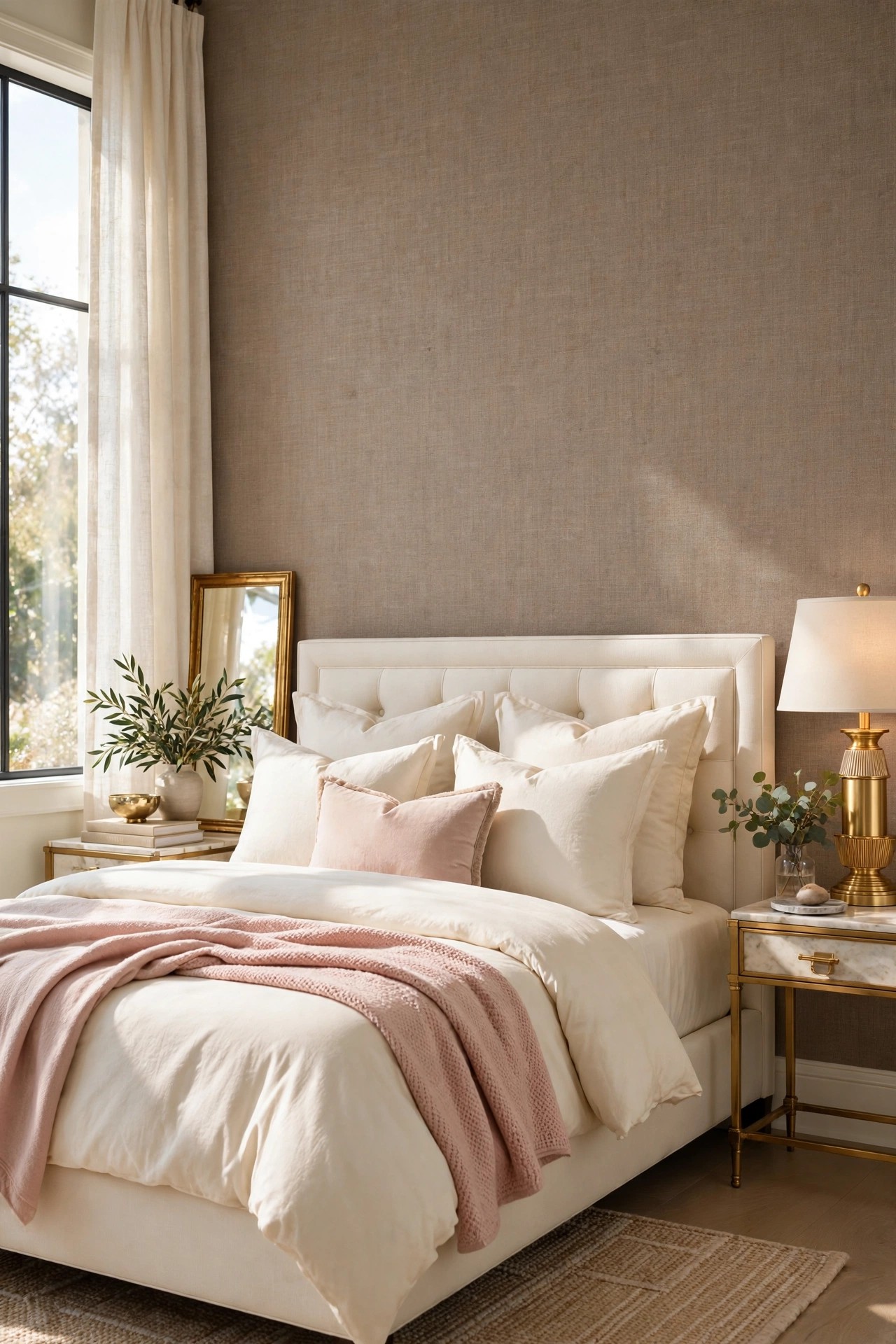
Taupe grasscloth wallpaper is the accent wall for a bedroom that wants warmth without color, because the woven texture catches the light and gives the wall depth all day. Hang a warm taupe grasscloth on the wall behind the bed, keep the other walls warm white, and the bed gains a soft woven back that reads as quiet luxury rather than decoration. Choose a fine weave, never a coarse one, because a coarse weave sheds and reads as rough while a fine weave reads as silk from the bed. Keep the seams tight and the panels in the same dye lot, because grasscloth changes shade between lots and a seam that changes color is the first thing the eye finds. Style the bed in cream with a blush throw and a gold lamp, because a taupe wall with cream bedding reads as warm, while a taupe wall with grey bedding reads as cold.
Best For: Bedrooms that need warmth without pink, and anyone who wants texture that changes with the light.
Not Ideal For: Bedrooms with damp walls or a bathroom next door; grasscloth hates moisture, so a painted taupe wall is the honest version there.
Estimated Cost: $150-$500 (estimate) for taupe grasscloth wallpaper, paste, a smoothing tool and a sharp blade.
Budget Note: The paper is the spend; grasscloth costs more per roll than printed paper, so measure twice and order one extra roll from the same dye lot.
Renter Friendly: No
Renter Note: Grasscloth is pasted and permanent, so it is not a renter choice; a taupe textured peel and stick panel is the renter version.
What You Need
Warm taupe grasscloth wallpaper from one dye lot, paste, smoothing tool, sharp blade, level, cream bedding, blush throw.
Product type to look for: A grasscloth with a fine even weave and a warm taupe tone, because a bedroom wall is seen in changing light and an uneven weave shows every seam.
How To Do It
- Measure the wall and order from one dye lot, with one extra roll.
- Mark a level starting line at the centre of the wall behind the bed.
- Hang the first strip level, keeping the weave direction the same on every strip.
- Trim the top and bottom with a sharp blade, then style the bed in cream with a blush throw.
Pro Tip
Keep the light warm in the evening. A taupe grasscloth wall under cool white bulbs turns grey, while warm light keeps the weave soft and golden.
7. Paint a Soft Arch Behind the Bed
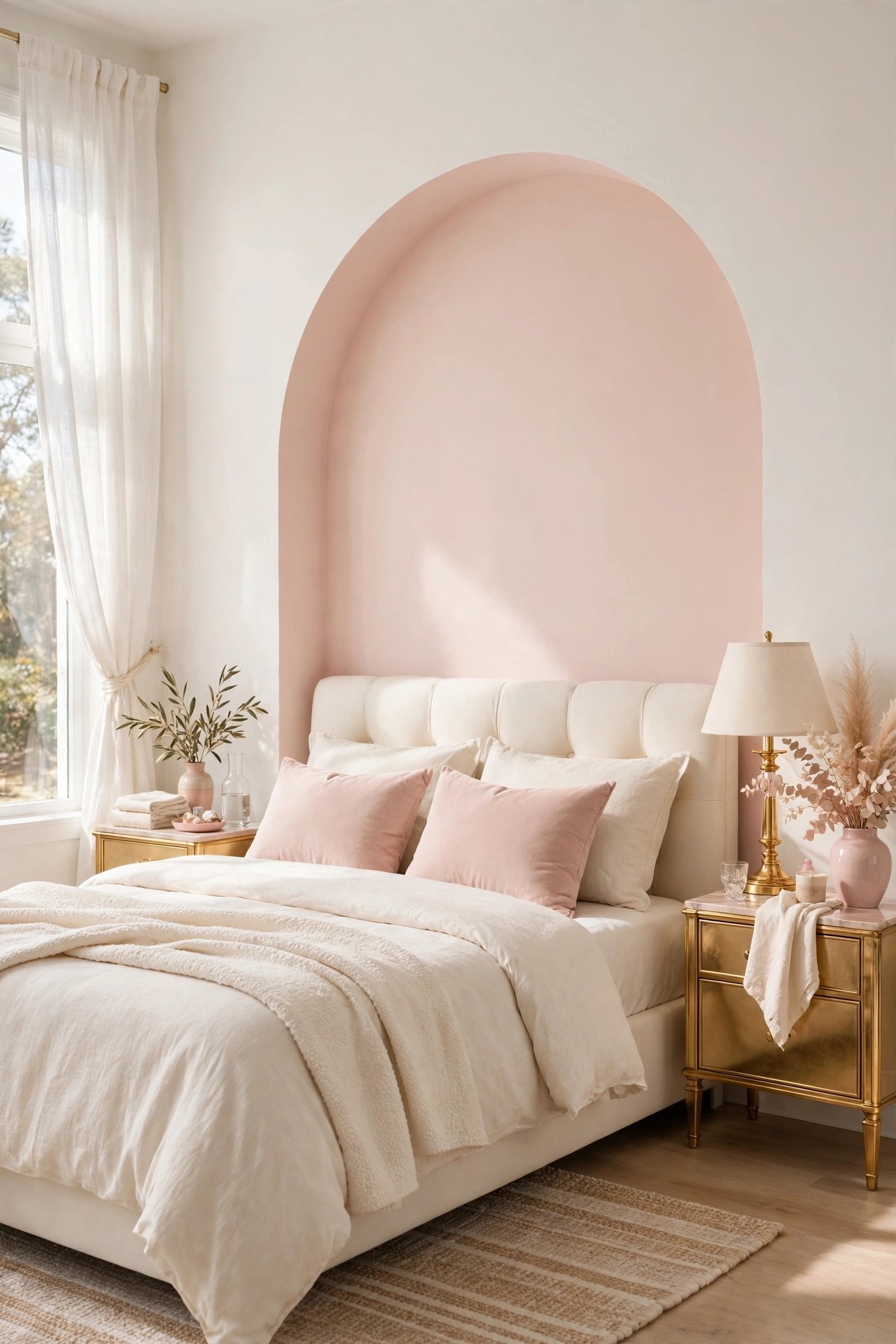
A painted arch is the accent wall for a bedroom that wants shape without building anything, because one curved shape gives the bed a frame and the wall a focal point. Paint a soft blush arch on the warm white wall behind the bed, wide enough to frame the headboard and tall enough to clear it, and the bed gains a gentle curve that softens every straight line in the room. Choose a blush with a warm base, never a bright pink, because a bright arch shouts while a soft blush arch reads as calm. Draw the arch with a pencil on a string, because a freehand arch wobbles and a string arch stays true, and tape the curve in short pieces, so the tape follows the bend. Style the bed in cream with blush pillows, because an arch with cream bedding reads as one soft shape, while an arch with patterned bedding fights the curve.
Best For: Bedrooms with a low headboard, and anyone who wants an accent wall in an afternoon.
Not Ideal For: Bedrooms where the bed sits under a window; the arch then belongs on the opposite wall or as a painted panel instead.
Estimated Cost: $30-$90 (estimate) for soft blush paint, painter tape, a pencil and string, and a small brush for the edge.
Budget Note: The paint is the spend; one arch needs only a sample pot, so test the blush on a spare board first and buy the small tin.
Renter Friendly: With Conditions
Renter Note: Paint needs the landlord’s permission in most rentals; a removable blush arch decal is the renter version and peels off cleanly.
What You Need
Soft blush wall paint with a warm base, painter tape, pencil and string, small brush for the edge, roller, cream bedding, blush pillows.
Product type to look for: A paint with a warm blush base in a matte finish, because a painted arch is seen up close and a soft finish hides the tape edge.
How To Do It
- Mark the centre of the bed on the wall, then draw the arch with a pencil on a string from that centre point.
- Tape the curve in short pieces and cover the bed and the floor.
- Paint inside the arch with a roller, then neaten the edge with a small brush.
- Remove the tape while the paint is still slightly damp, then style the bed in cream with blush pillows.
Pro Tip
Keep the arch wider than the bed by a hand width on each side. An arch narrower than the bed crowds the headboard, while a slightly wider arch frames it like a picture.
8. Build an Upholstered Fabric Panel Wall
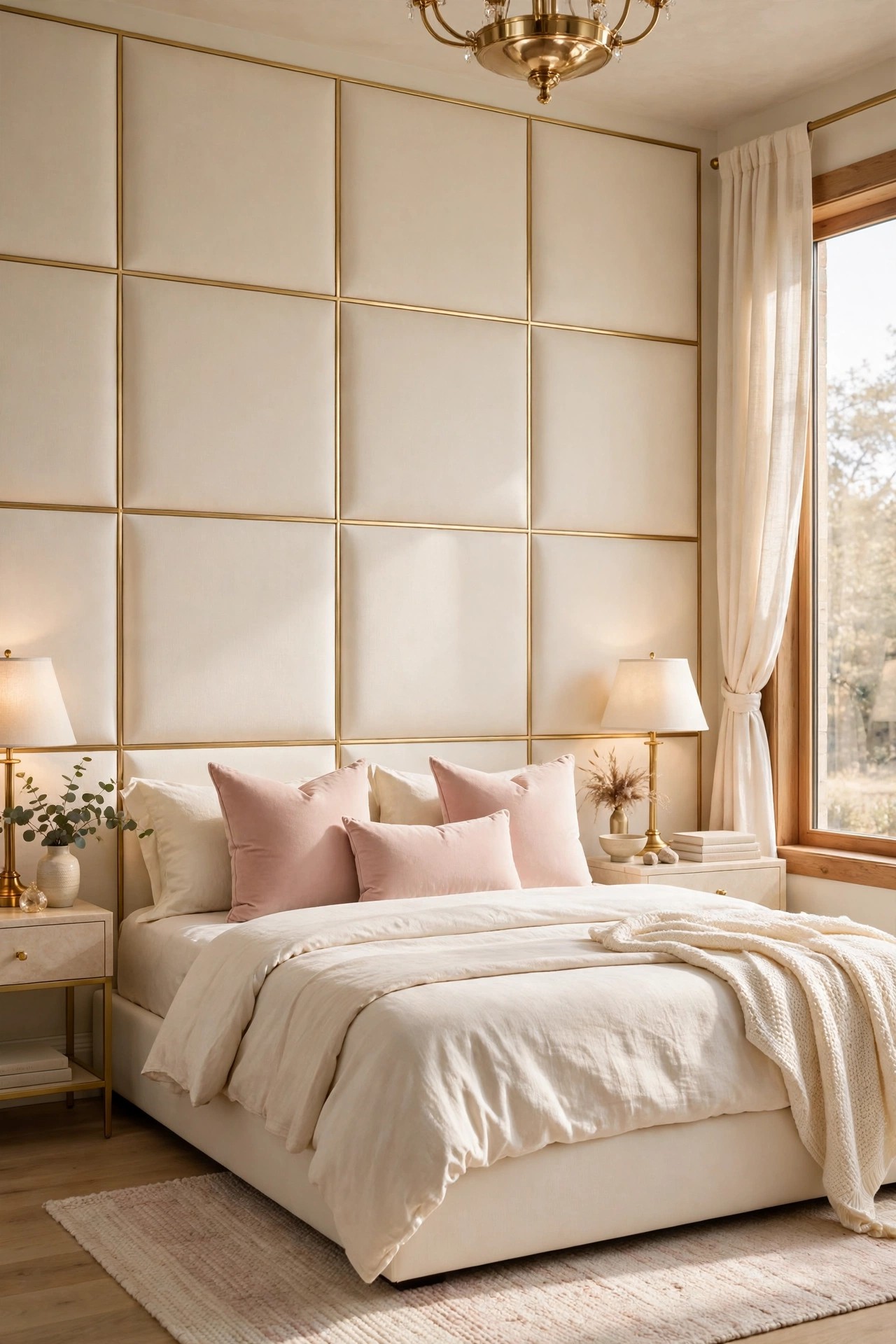
An upholstered fabric panel wall is the accent wall for a bedroom that wants softness you can feel, because the padded panels hush the room and make the bed feel like a cocoon. Fix cream padded panels to the wall behind the bed, keep the seams straight and the fabric taut, and the bed gains a soft back that reads as a hotel suite rather than a bedroom. Choose a cream fabric with a soft weave, never a shiny satin, because satin shows every mark while a soft weave stays calm. Keep the panels even and the gold trim slim, because an upholstered wall with one crooked panel is the first thing the eye finds, and vacuum the panels monthly, because fabric behind a bed meets dust daily. Our japandi bedroom shows the same soft panel idea with pale wood and linen, for readers deciding between padded panels and plain wood
Best For: Bedrooms that feel echoey or cold, and anyone who wants a soft wall behind the bed.
Not Ideal For: Bedrooms with pets that scratch fabric, or a bed that is pushed hard against the wall daily; a wood slat wall is the honest version there.
Estimated Cost: $200-$600 (estimate) for padded fabric panels, fixings, slim gold trim and a level.
Budget Note: The panels are the spend; ready made padded panels cost more per piece but arrive even and taut, so count the making time before choosing fabric and foam.
Renter Friendly: With Conditions
Renter Note: Panels need fixings, so check the lease first; a freestanding padded headboard panel that leans is the renter version.
What You Need
Cream padded fabric panels, fixings rated for the panel weight, slim gold trim, level, cream bedding, blush pillows.
Product type to look for: Panels in a soft cream weave with even padding and a firm backing, because a panel wall behind a bed is leaned on daily and must not sag.
How To Do It
- Measure the wall behind the bed and mark the centre line, then plan the panel grid with even seams.
- Fix the first panel dead level, because every other panel follows it.
- Fix the remaining panels with even seams, adding the slim gold trim last.
- Check every panel sits flat and taut, then style the bed in cream with blush pillows.
Pro Tip
Keep the fabric one shade deeper than the bedding. Panels in the same cream as the bedding blend into one pale block, while panels one shade deeper read as a soft wall behind a bright bed.
9. Fit White Vertical Panelling Behind the Bed
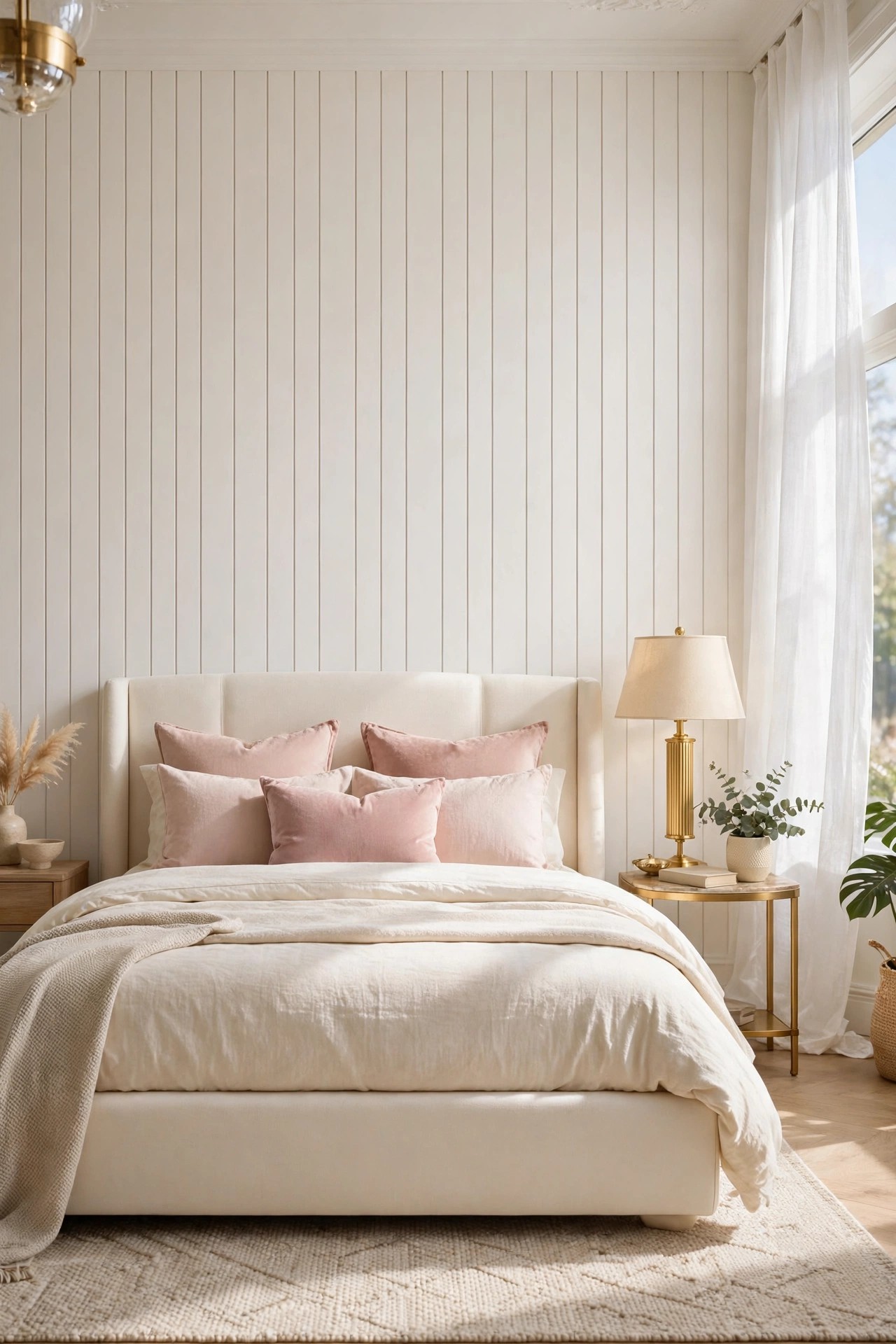
White vertical panelling is the accent wall for a bedroom that wants a classic look without color, because the slim boards give the wall order and the bed a calm back. Fix warm white vertical boards to the wall behind the bed, keep the joints tight and the boards level, and the bed gains a tidy panelled back that reads as finished rather than decorated. Choose warm white boards, never bright white, because bright white boards look stark against cream bedding while warm white boards read as one family. Paint the boards before fixing them, because painting in place leaves the joints bare, and stop the boards at the ceiling, so the wall reads as one panel. Style the bed in cream with blush pillows and a gold lamp, because a white panel wall with cream bedding reads as fresh, while a white panel wall with grey bedding reads as cold.
Best For: Classic bedrooms, and anyone who wants an accent wall that suits any bedding change.
Not Ideal For: Bedrooms with a very low ceiling; the boards add height, but a painted wall is the honest version if the ceiling is under eight feet and the room is tiny.
Estimated Cost: $120-$400 (estimate) for warm white panelling boards, fixings, paint and a level.
Budget Note: The boards are the spend; prepainted boards cost more per piece but save a full day of painting, so count your time before choosing raw boards.
Renter Friendly: With Conditions
Renter Note: Boards need fixings, so check the lease first; a freestanding panelled headboard that leans is the renter version.
What You Need
Warm white vertical panelling boards, fixings rated for the board weight, paint for touch ups, level, cream bedding, blush pillows.
Product type to look for: Boards in warm white with a smooth finish and straight edges, because a panelled wall behind a bed is seen up close and a warped board shows at once.
How To Do It
- Measure the wall behind the bed and mark the centre line, then plan the board spacing with even joints.
- Paint the boards first, then fix the first board dead level.
- Fix the remaining boards with tight even joints, checking level every few boards.
- Touch up any small gaps in warm white, then style the bed in cream with blush pillows.
Pro Tip
Keep the joints tight and the paint warm white. A panelled wall with wide joints reads as fencing, while tight joints in warm white read as one calm wall.
10. Hang a Gold Mirror Gallery on the Accent Wall
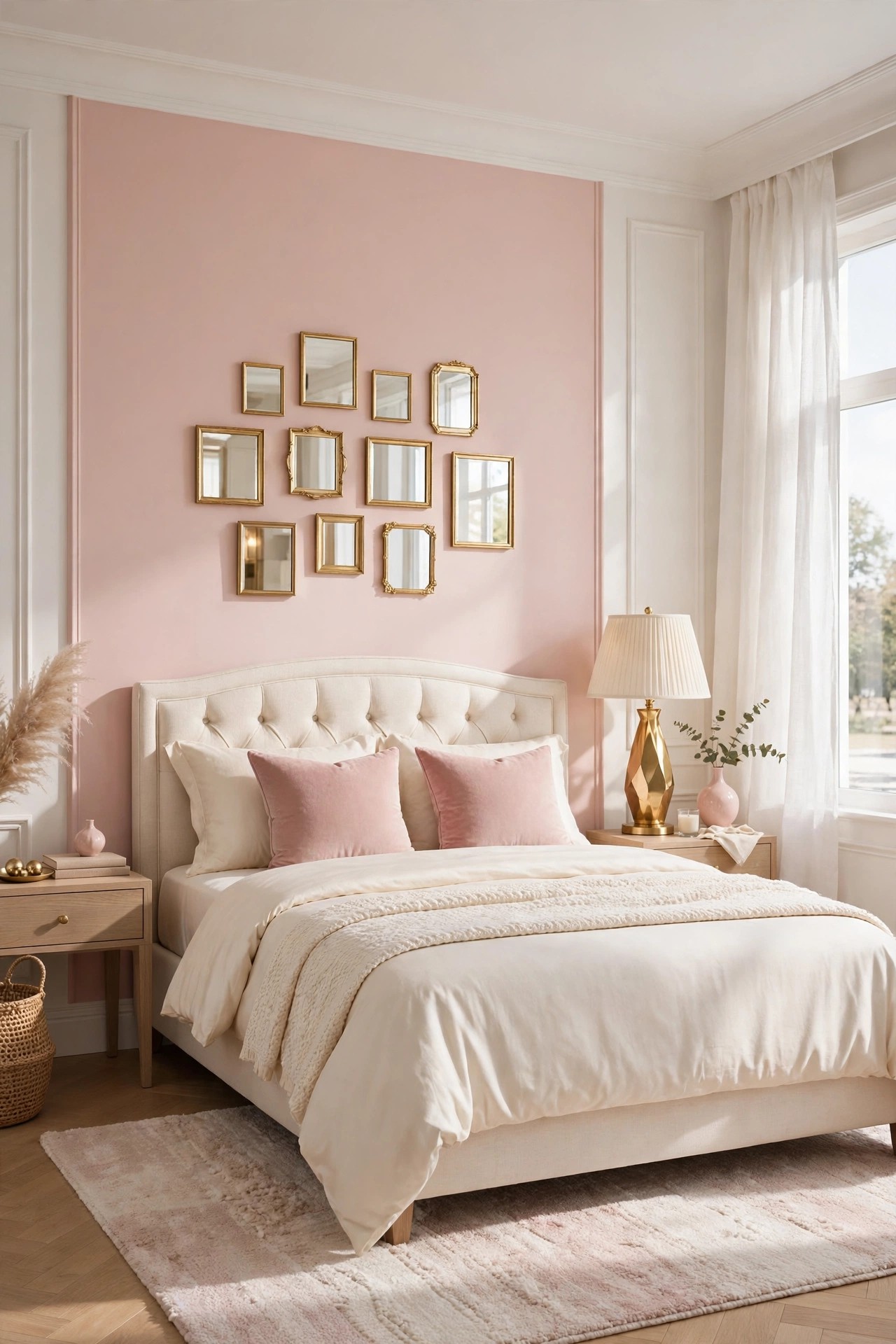
A gold mirror gallery is the accent wall for a bedroom that wants light as well as color, because the small mirrors catch the daylight and throw it back across the bed. Paint the wall behind the bed soft blush or warm taupe, then hang a gallery of small gold framed mirrors above the headboard, and the bed gains a sparkling back that reads as glam without a single new piece of furniture. Choose mirrors in the same gold finish, never mixed metals, because mixed metals split the gallery into clutter while one gold reads as a set. Keep the gallery tight and centred on the bed, because a gallery that spreads across the whole wall reads as a shop display, and hang every mirror with a fixing rated for its weight, because a mirror is heavier than it looks. Style the bed in cream with blush pillows, because a mirror gallery with cream bedding reads as bright, while a mirror gallery with dark bedding reads as heavy.
Best For: Bedrooms with one good window, and anyone who wants more light without adding a lamp.
Not Ideal For: Bedrooms where the mirrors face a cluttered view; a mirror doubles whatever it reflects, so aim the gallery at the window or the prettiest corner.
Estimated Cost: $80-$350 (estimate) for small gold framed mirrors, fixings rated for each mirror weight, paint and a level.
Budget Note: The mirrors are the spend; small mirrors in one gold finish cost far less than one large designer mirror, so buy the set together and check the finish matches.
Renter Friendly: With Conditions
Renter Note: Mirrors need fixings rated for their weight, so check the lease first; removable hooks rated for each mirror are the renter version, or lean one large mirror instead.
What You Need
Small gold framed mirrors in one finish, fixings or removable hooks rated for each mirror weight, soft blush or warm taupe paint, level, cream bedding.
Product type to look for: Mirrors with a slim sturdy gold frame and a fixing rated well above the mirror weight, because a mirror above a bed is bumped daily and must not fall.
How To Do It
- Paint the wall behind the bed and let it dry fully.
- Lay the mirrors on the floor first and plan a tight gallery centred on the bed.
- Mark each hanging point level and fix the mirrors, starting with the centre mirror.
- Check every mirror sits level and steady, then style the bed in cream with blush pillows.
Pro Tip
Keep the gallery to one shape family, all round or all arched. A gallery of mixed shapes reads as a collection, while one shape in gold reads as a planned wall.
11. Paint One Wall Deep Forest Green for Contrast
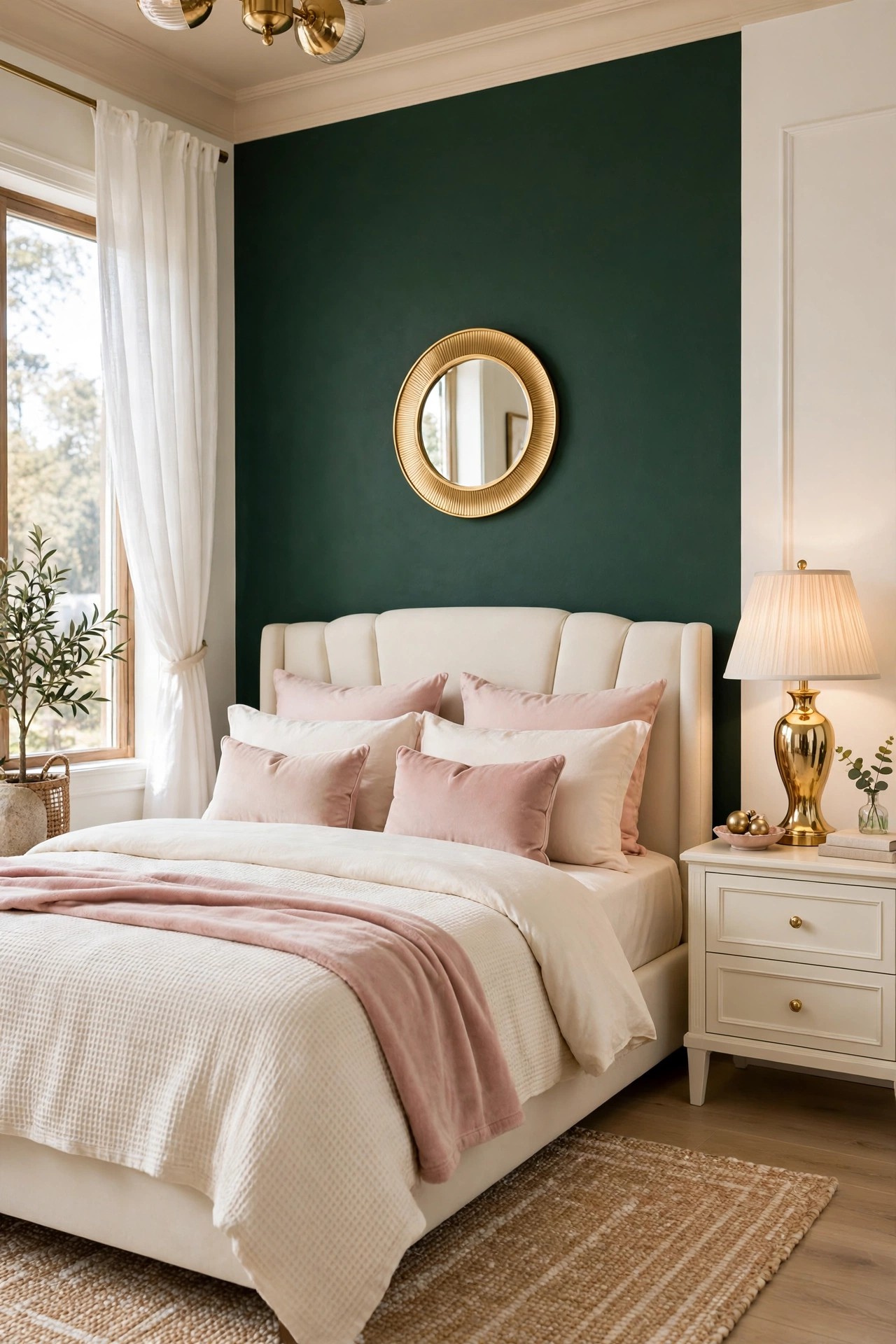
A deep forest green wall is the accent wall for a bedroom that wants drama without losing its glam, because the dark green makes the cream bed glow and the gold lamp shine. Paint the wall behind the bed deep forest green, keep the other three walls warm white, and the bed gains a rich back that reads as luxury rather than dark. Choose a green with a warm base, never a blue green, because a blue green turns cold under evening light while a warm forest green stays soft. Paint two coats and let each coat dry fully, because a dark green shows every thin patch, and keep the bedding cream with blush pillows, so the green reads as a frame rather than a cave. Add a gold lamp and a warm rug, because a green wall with gold and cream reads as glam, while a green wall with grey bedding reads as heavy.
Best For: Bedrooms with good daylight, and anyone who wants one bold wall without repainting the whole room.
Not Ideal For: Bedrooms with very little daylight; a dark green can read black there, so a soft blush wall is the honest version.
Estimated Cost: $40-$120 (estimate) for deep forest green paint, primer, a roller and painter tape for one wall.
Budget Note: The paint is the spend; a dark green needs a tinted primer so two coats cover, and a sample pot first saves a whole tin of the wrong green.
Renter Friendly: With Conditions
Renter Note: Paint needs the landlord’s permission in most rentals; a removable forest green wallpaper panel is the renter version, or ask first and keep the original paint shade on record.
What You Need
Deep forest green wall paint with a warm base, tinted primer, roller and tray, painter tape, drop cloth, cream bedding, blush pillows.
Product type to look for: A paint with a warm forest green base in a matte or eggshell finish, because a dark bedroom wall is seen up close and a soft finish hides small wall marks.
How To Do It
- Test a large green patch on the wall behind the bed and check it in daylight and at night.
- Tape the edges, cover the floor and the bed, then prime with a tinted primer.
- Roll on two thin coats, letting each coat dry fully before the next.
- Remove the tape while the last coat is still slightly damp, then style the bed in cream with blush pillows and a gold lamp.
Pro Tip
Keep the green to one wall only and the bedding cream. A second green wall turns a bold accent into a dark room, while one green wall with cream bedding reads as rich and bright.
12. Add Blush and Gold Geometric Wallpaper
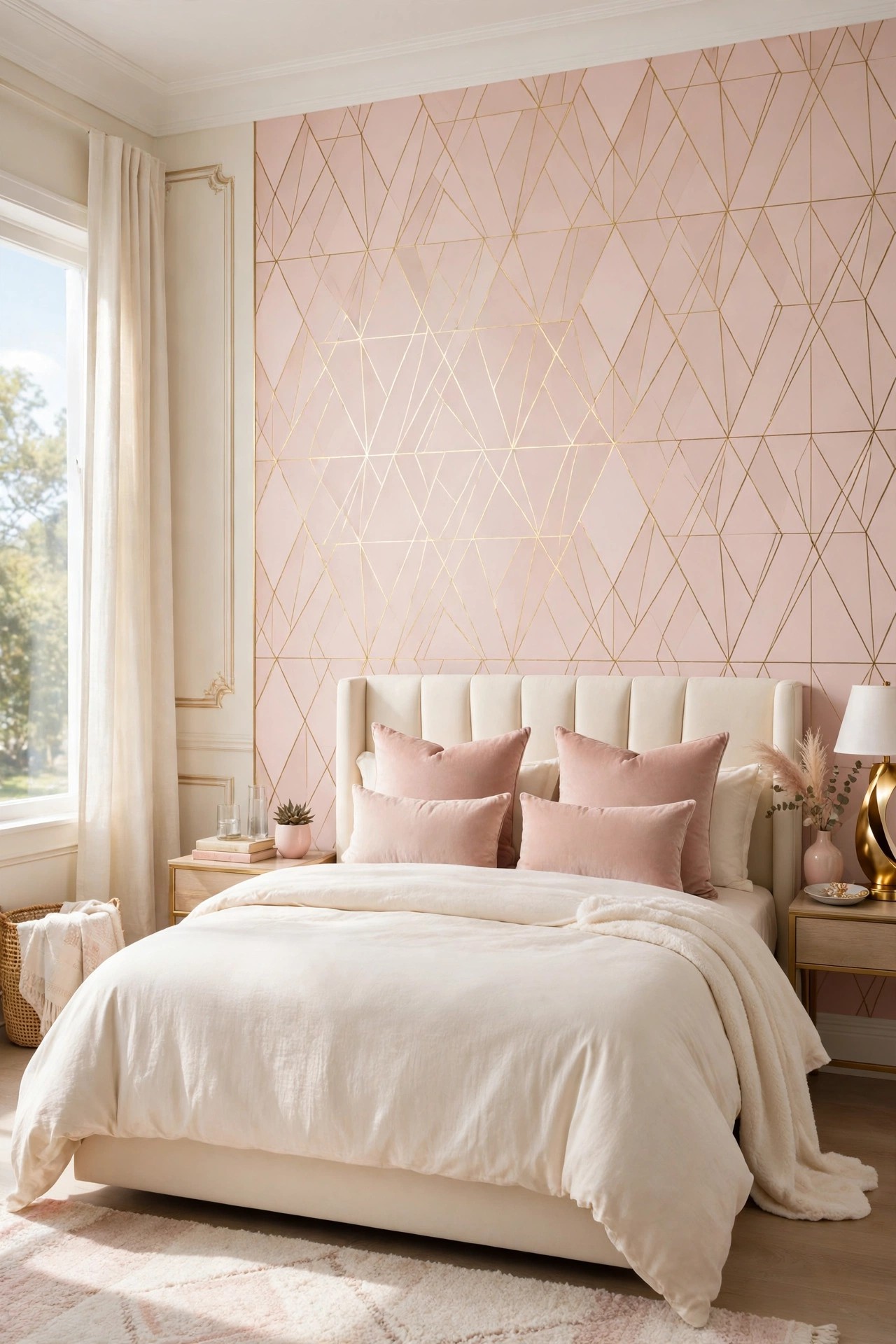
Blush and gold geometric wallpaper is the accent wall for a bedroom that wants pattern with order, because the fine gold lines give the wall structure and the blush keeps it soft. Hang a blush wallpaper with a fine gold geometric pattern on the wall behind the bed, keep the other walls warm white, and the bed gains a tailored back that reads as modern glam rather than busy. Choose a fine geometric, never a large bold one, because a large pattern crowds a bedroom while a fine gold line reads as texture from the door. Match the pattern at every seam, because a geometric seam that misses by a line is the first thing the eye finds, and keep the bedding cream, so the wallpaper stays the one pattern in the room. Order one extra roll, because a short roll at the last strip wastes a weekend.
Best For: Modern glam bedrooms, and anyone who wants pattern that still feels calm.
Not Ideal For: Bedrooms with a lot of patterned bedding or curtains already; a painted blush wall is the honest version there.
Estimated Cost: $120-$400 (estimate) for blush and gold geometric wallpaper, paste or peel and stick, a smoothing tool and a sharp blade.
Budget Note: The paper is the spend; peel and stick paper costs more per roll but removes cleanly, so count the removal saving before choosing pasted paper.
Renter Friendly: With Conditions
Renter Note: Pasted paper is not a renter choice; peel and stick geometric paper is the renter version and lifts off cleanly if the wall is smooth.
What You Need
Blush and gold geometric wallpaper with a fine pattern, paste or peel and stick backing, smoothing tool, sharp blade, level, cream bedding, blush pillows.
Product type to look for: A paper with a fine gold geometric and a matte finish, because a bedroom wallpaper is seen up close and a shiny paper shows every seam.
How To Do It
- Measure the wall and order one extra roll, then check the pattern repeat on the roll.
- Mark a level starting line at the centre of the wall behind the bed.
- Hang the first strip level, then match the pattern at every seam as you hang the rest.
- Trim the top and bottom with a sharp blade, then style the bed in cream with blush pillows.
Pro Tip
Keep the gold in the paper the only strong gold on that wall. A geometric wall with a gold lamp and gold bedding splits the shine, while one gold paper with a cream bed reads as a single decision.
13. Style a Cream Board and Batten Wall
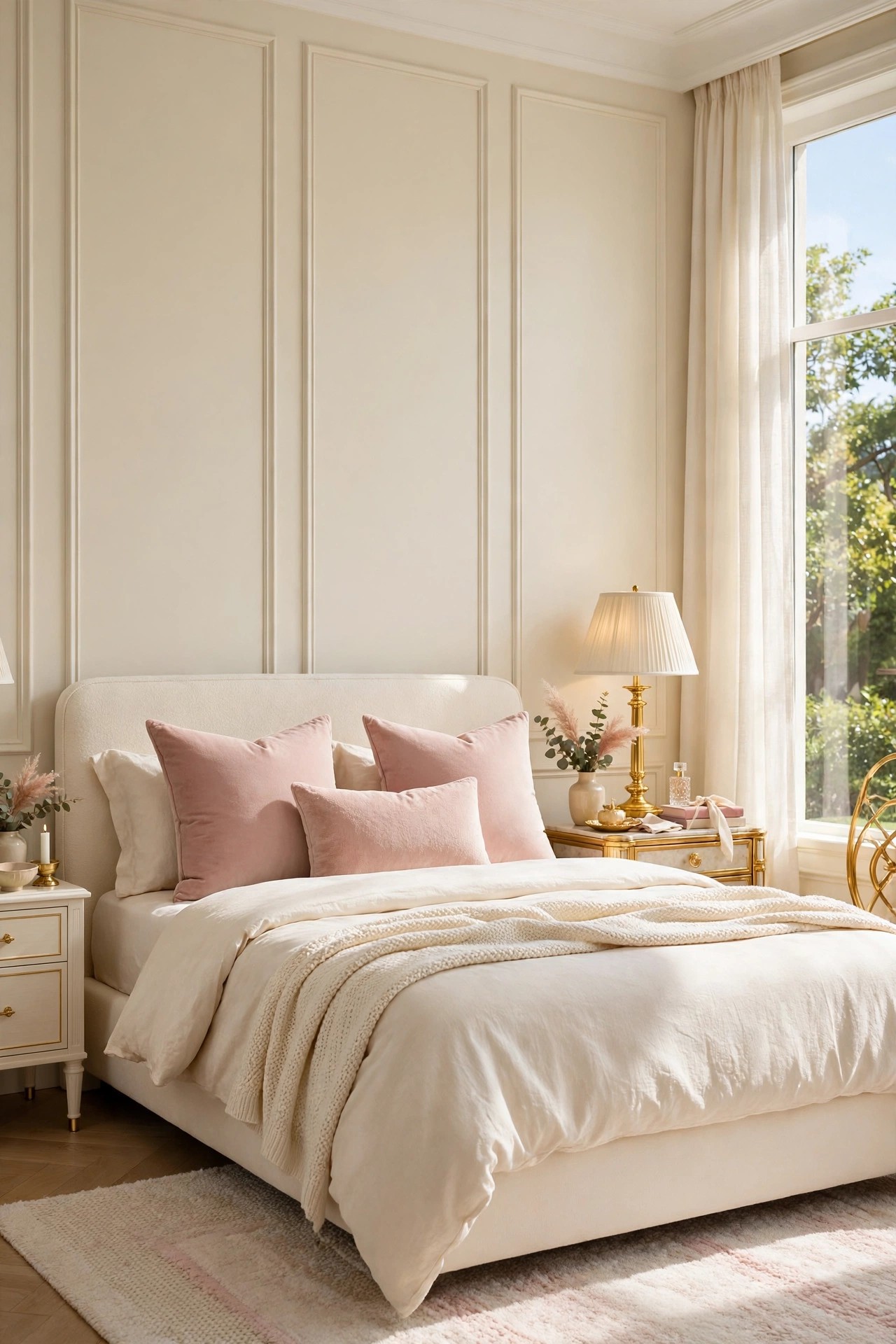
A cream board and batten wall is the accent wall for a bedroom that wants a tailored look without color, because the wide boards and slim battens give the wall a calm grid. Fix wide cream boards to the wall behind the bed, add slim battens over the joints, and the bed gains a neat panelled back that reads as custom rather than decorated. Choose warm cream boards, never bright white, because bright white boards look stark against cream bedding while warm cream boards read as one family. Keep the battens even and centred on the bed, because a board and batten wall that misses the bed centre looks like a mistake, and paint the boards before fixing them, so the joints stay clean. Style the bed in cream with blush pillows and a gold lamp, because a cream grid wall with cream bedding reads as fresh, while a cream grid wall with dark bedding reads as heavy.
Best For: Bedrooms that need order without color, and anyone who wants a classic wall that suits any bedding change.
Not Ideal For: Bedrooms with a sloping ceiling behind the bed; a painted arch is the honest version there.
Estimated Cost: $120-$380 (estimate) for cream boards and battens, fixings, paint and a level.
Budget Note: The boards are the spend; prepainted boards cost more per piece but save a full day of painting, so count your time before choosing raw boards.
Renter Friendly: With Conditions
Renter Note: Boards need fixings, so check the lease first; a freestanding panelled headboard that leans is the renter version.
What You Need
Wide cream boards and slim battens, fixings rated for the board weight, paint for touch ups, level, cream bedding, blush pillows.
Product type to look for: Boards in warm cream with a smooth finish and straight edges, because a board and batten wall behind a bed is seen up close and a warped board shows at once.
How To Do It
- Measure the wall behind the bed and mark the centre line, then plan the board grid with even battens.
- Paint the boards first, then fix the first board dead level.
- Fix the remaining boards and battens with even spacing, checking level every few boards.
- Touch up any small gaps in warm cream, then style the bed in cream with blush pillows.
Pro Tip
Keep the battens slim and the boards wide. Wide boards with slim battens read as a calm grid, while narrow boards with thick battens read as a fence.
14. Layer Warm LED Lighting on the Accent Wall
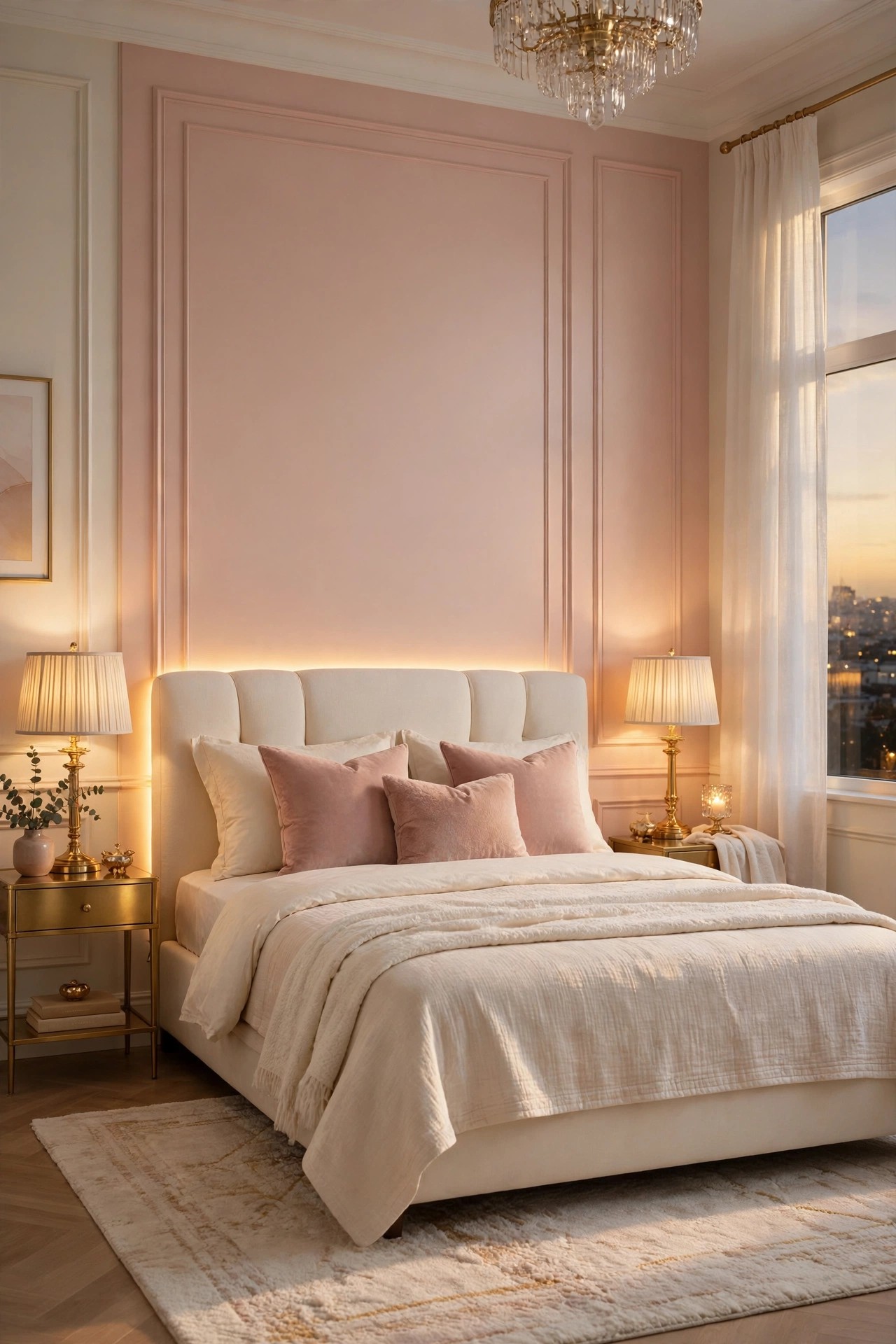
Warm LED lighting is the accent wall idea that makes a bedroom glow at night, because the light behind the headboard turns a plain wall into a soft halo. Fit a slim warm LED strip behind the headboard or along the top of the accent wall, keep the wall soft blush or warm taupe, and the bed gains a warm glow that flatters the cream bedding and the blush pillows. Choose a warm white light, never a cool one, because a cool light turns the cream bedding grey and the blush wall dull. Keep the strip hidden behind the headboard, so the glow reads as light rather than a fitting, and put the light on a small remote or a dimmer, so it can drop low after dinner. Check the strip is rated for the room and the adhesive holds on paint, because a strip that falls in the night is no help at all.
Best For: Bedrooms that look flat at night, and anyone who wants a warm glow without an electrician.
Not Ideal For: Bedrooms where the headboard already has a good reading light; the money then belongs on the bedding or the wall instead.
Estimated Cost: $25-$90 (estimate) for a slim warm LED strip with a remote or dimmer and adhesive rated for paint.
Budget Note: The LED strip is the spend; a simple warm strip costs little and glows as warmly as a wired fitting, so buy the strip first and the remote second.
Renter Friendly: Yes
Renter Note: Nothing fixed at all; a strip with removable adhesive lifts off on moving day, and no wiring is touched.
What You Need
Slim warm white LED strip with a remote or dimmer, adhesive rated for paint, soft blush or warm taupe paint if the wall is bare, cream bedding, blush pillows.
Product type to look for: A strip with warm white light and a dimmer, because a bedroom light must drop low in the evening and a cool light turns the palette grey.
How To Do It
- Clean the wall behind the headboard and check the strip fits the headboard width.
- Fit the strip hidden behind the headboard, following the maker instructions.
- Switch the light on at dusk and check the glow feels warm against the blush wall.
- Step back and check the bed glows warm from the doorway, then keep the ceiling light off in the evening.
Pro Tip
Keep the LED glow the only warm light in the room at night. Two warm lights split the glow, while one slim strip behind the headboard reads as the room’s evening heart.
15. Finish with a Low Gold Shelf and Blush Styling on the Accent Wall
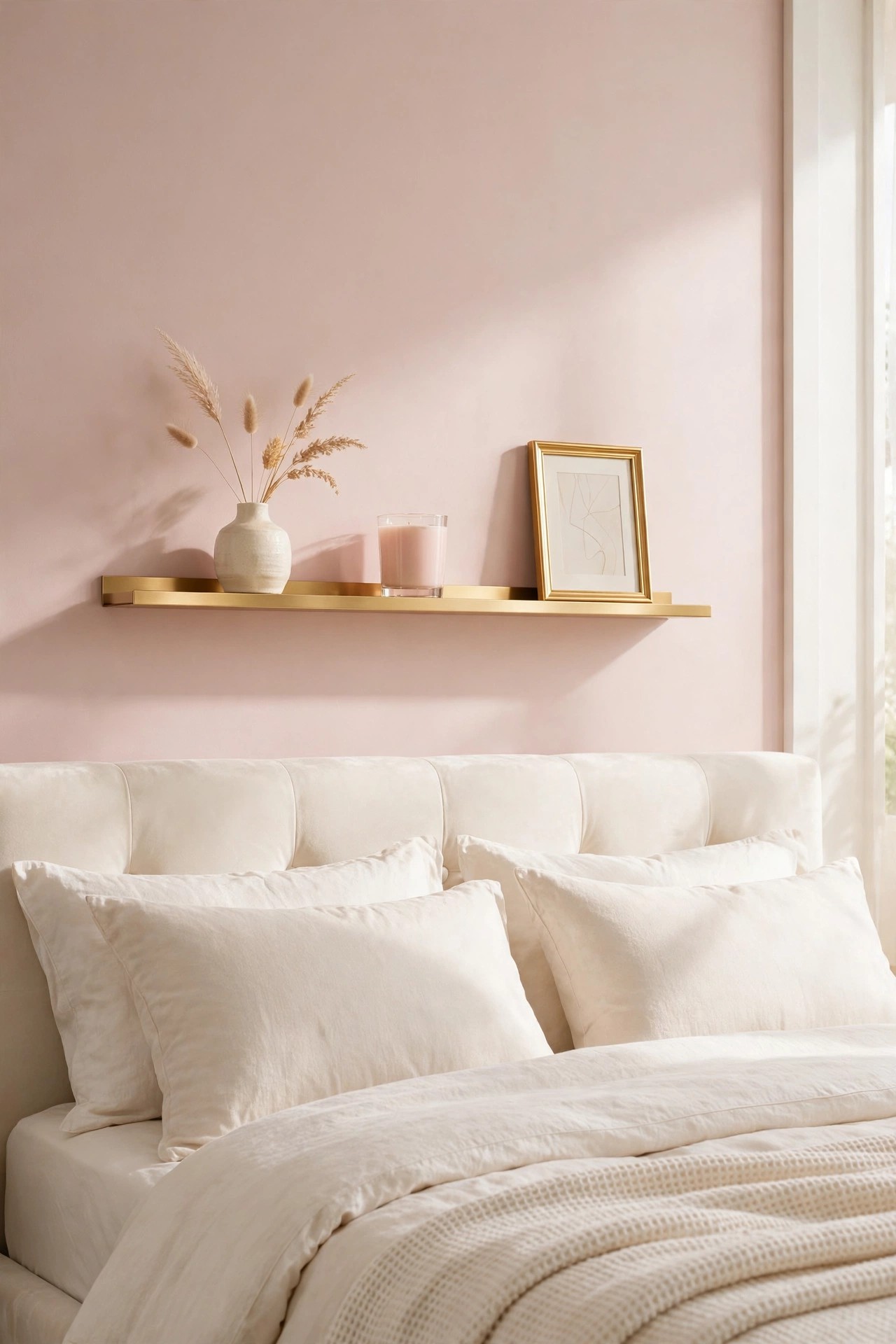
The last styling idea is the smallest, and it is what makes a bedroom accent wall look finished in photos and in person. A low slim gold shelf on the blush accent wall, holding a small cream vase with one stem, a blush candle in a glass holder and a small gold frame, gathers the daily pieces into one calm group and repeats the gold note above the bed. Keep the shelf low and the scene honest, sized for what the room actually uses, because a styled shelf that has to be emptied before anyone can make the bed is a display, not a finish. Fix the shelf with fixings rated for its weight, because a shelf above a bed must not fall, and keep it above head height when sitting up, so no one bumps it in the night. Never leave a candle burning unattended, and keep the candle in its glass holder away from the bedding and the curtains.
Best For: Every bedroom accent wall, and especially rooms that look fine in daylight and unfinished in photos.
Not Ideal For: No real exception, but keep the shelf small on a narrow wall so the wall still reads as one accent.
Estimated Cost: $30-$90 (estimate) for a low slim gold shelf, fixings rated for its weight, a small cream vase and a blush candle in a glass holder.
Budget Note: Shop the house first; a shelf and a vase moved from another room finish the wall for nothing.
Renter Friendly: With Conditions
Renter Note: A shelf needs fixings rated for its weight, so check the lease first; a leaning picture ledge on the nightstand is the renter version.
What You Need
Low slim gold shelf, fixings rated for the shelf weight, small cream vase, single stem, blush candle in a glass holder, small gold frame.
Product type to look for: A shelf with a slim profile and fixings rated well above its loaded weight, because a shelf above a bed is bumped daily and must not fall.
How To Do It
- Mark the shelf level on the blush wall, above head height when sitting up in bed.
- Fix the shelf with fixings rated for its weight, following the maker instructions.
- Set the vase and the candle on the shelf and the small gold frame beside them.
- Sit up in bed and check nothing is within reach of your head, then step back and check the wall reads as one calm accent from the doorway.
Pro Tip
Reset the shelf every week. The habit, not the objects, is what keeps a styled finish: vase fresh, candle in its holder, frame straight, shelf dust free.
Practical Tips for Bedroom Accent Wall Ideas
Let the blush be the one clear note and repeat the warm notes until they look planned. The wall behind the bed stays blush, taupe or forest green, the other walls stay warm white, and cream, blush and brushed gold do the supporting work, each used at least twice: gold in the moulding and the lamp, blush in the wall and the pillows, cream in the bedding and the slats. One note used once looks like an accident; twice or more it looks like a decision. Keep the accent to one wall only, because a second accent wall turns a focal point into a theme, and judge the wall twice before calling it done, once at midday for the true colors and once under the evening light. Measure the bed and the wall before buying, because a slat wall that misses the bed centre and a wallpaper roll that runs short both waste a weekend, and start in the order of this list, paint and slats first, then wallpaper and moulding, and let the light and the soft layers arrive slowly. A bedroom built in a weekend usually has one object too many, and removing a piece is always easier than finding the right one to add.
Frequently Asked Questions
Which wall should be the accent wall in a bedroom?
The wall behind the bed, because it is the wall you see first in the morning and last at night, and one finished wall there gives the whole room a centre. Keep the other three walls warm white, so the bed reads as the heart of the room rather than one piece among many.
What color is best for a bedroom accent wall?
Soft blush, warm taupe and deep forest green work best in a glam bedroom, because each one pairs with cream bedding and brushed gold. Choose blush for a soft calm room, taupe for warmth without color, and forest green for one bold wall in a room with good daylight.
Can I have an accent wall in a rental bedroom?
Yes, with the renter version of the idea. Peel and stick wallpaper, a removable arch decal, a leaning slat panel or a freestanding padded headboard all give the bed a centre without paint or fixings, and every piece lifts off or moves out on moving day.
Is wallpaper or paint better for a bedroom accent wall?
Paint is cheaper and faster, and it suits a first accent wall, while wallpaper adds pattern and texture that paint cannot match. Choose paint if you want a soft color in an afternoon, and wallpaper if you want flowers, grasscloth or a fine gold geometric that makes the wall the star.
How do I stop an accent wall looking too dark or too busy?
Keep the accent to one wall, keep the bedding plain cream, and let blush and gold appear only in small notes. A dark green wall with cream bedding reads as rich, while a dark green wall with dark bedding reads as a cave, and a floral wall with plain bedding reads as one decision.
Should the accent wall match the bedding?
It should pair with the bedding, not match it exactly. A blush wall with cream bedding and one blush pillow reads as a plan, while a blush wall with blush bedding blends into one pink block and loses the bed as the centre of the room.
Conclusion
A bedroom accent wall ideas list works when the wall behind the bed is given one clear job: the blush paint leads, and everything else supports. Cream slats and gold moulding give the wall shape, floral and grasscloth wallpaper give it texture, a painted arch and warm LED light give it glow, and a low gold shelf keeps the finish soft. Start with the paint and the slats, add the wallpaper and the moulding, keep one color, one metal and one soft accent through the whole room, and the plainest bedroom becomes the one that feels finished morning and night.