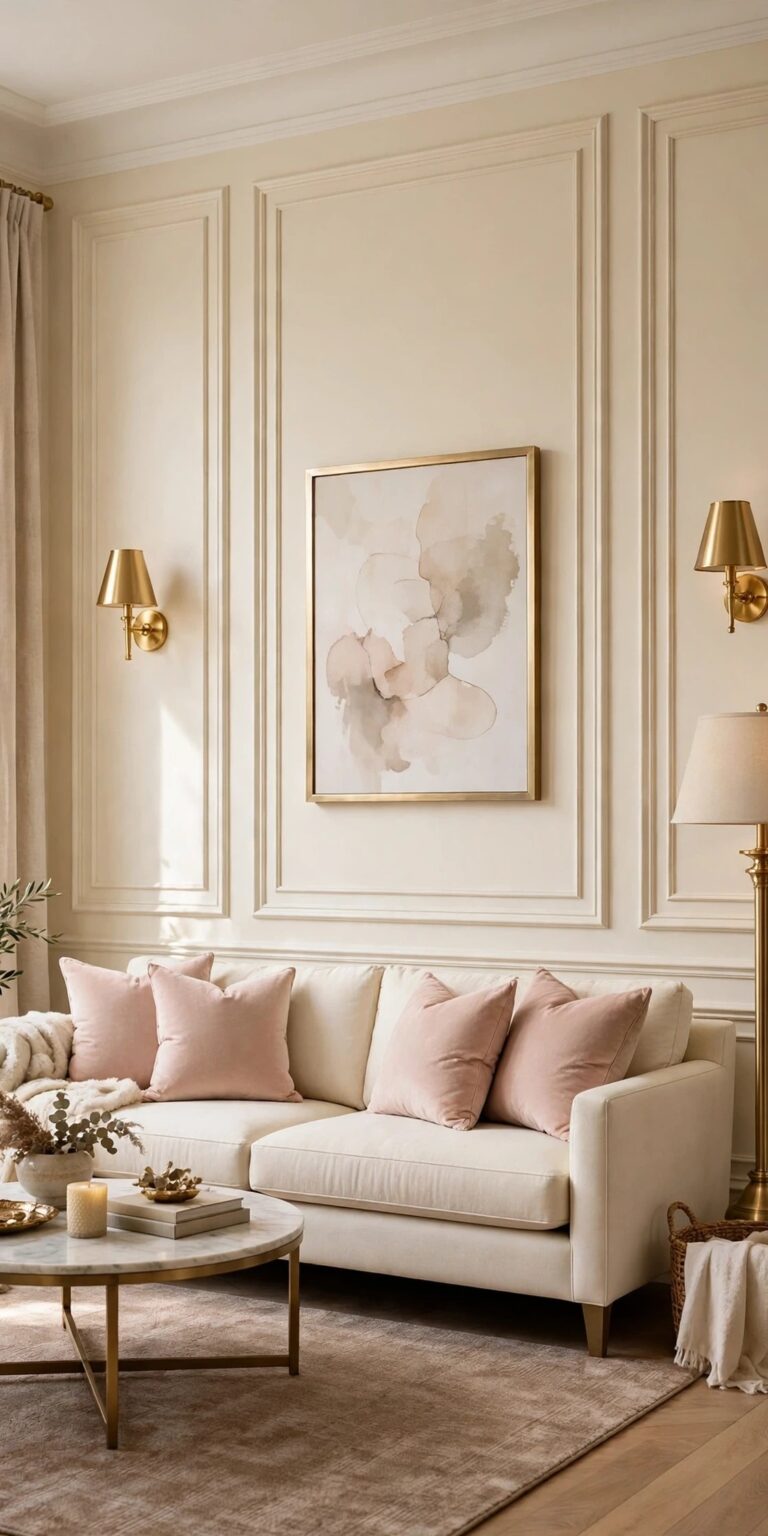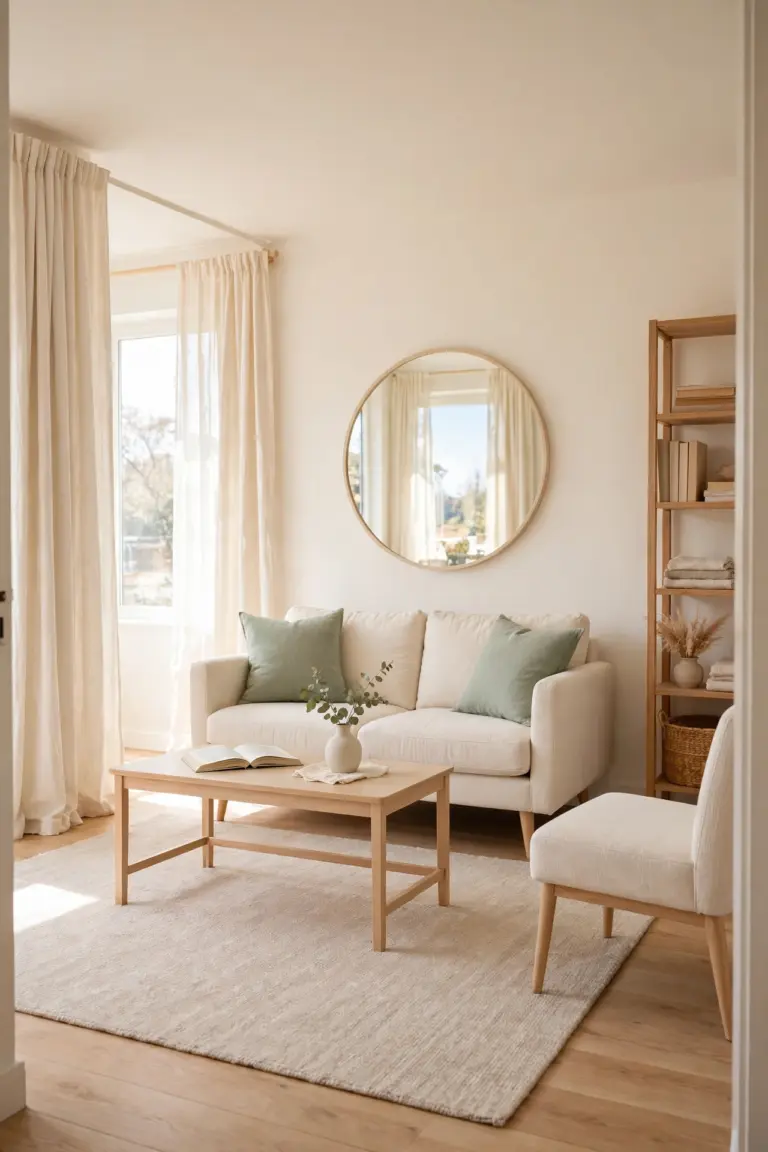
20 Limewash Living Room Ideas for a Soft, Warm Glow
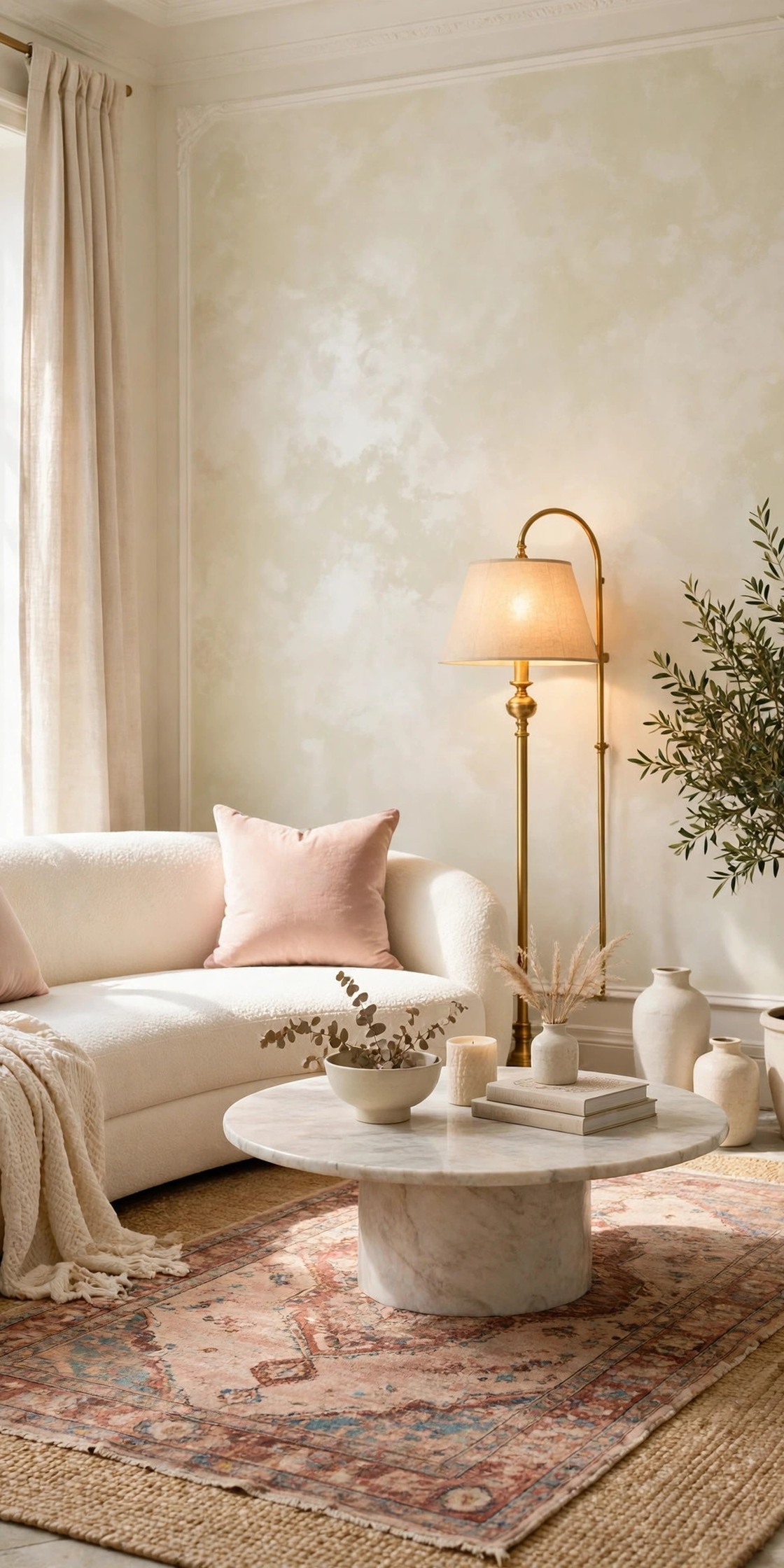
20 Limewash Living Room Ideas for a Soft, Warm Glow
Disclosure: This article may contain affiliate links. If you buy through these links, we may earn a small commission at no extra cost to you.
A limewash living room starts with one simple change: flat paint becomes a soft, cloudy wall that moves with the light. Limewash is a mineral paint brushed on in loose, crossing strokes, and it dries with gentle movement instead of one flat color, so the wall looks alive without any pattern on it. These limewash living room ideas keep the bright glam notes GlamNStyle is known for, white and cream, warm taupe, blush pink and brushed gold, while the walls turn soft and textured. The 20 ideas below work through the whole room in order: the wall colors first, then the fireplace, the arches and the built-ins, then the sofa, the rugs and the light that makes limewash glow. Most of them need only paint, a brush and a free weekend. If you are choosing the wall color first, our living room color combination shows how warm white, taupe and gold sit together
→ [INTERNAL LINK: “living room color combination” / living room color combination]
Table of Contents
- Paint the Main Wall Warm White Limewash
- Try a Warm Taupe Limewash Feature Wall
- Add a Soft Blush Limewash Accent Wall
- Limewash the Fireplace Wall
- Limewash the Wall Behind the Sofa
- Shape a Limewash Arch Niche
- Limewash the Ceiling for a Cloudy Glow
- Limewash a Built-In Shelving Wall
- Limewash the Open-Plan Dining Corner
- Pair Limewash Walls with a Cream Boucle Sofa
- Layer a Vintage Rug Over Natural Jute
- Hang a Gold-Framed Mirror on Limewash
- Dress the Window with Cream Linen Curtains
- Add Warm Brass Lamps and Sconces
- Style Dried Pampas and Cream Ceramics
- Set a Rattan Chair Against the Limewash Wall
- Build a Small Gold-Frame Gallery on Limewash
- Grow an Olive Tree in a Cream Pot
- Make a Limewash Reading Nook
- Finish with a Soft Evening Light Plan
1. Paint the Main Wall Warm White Limewash
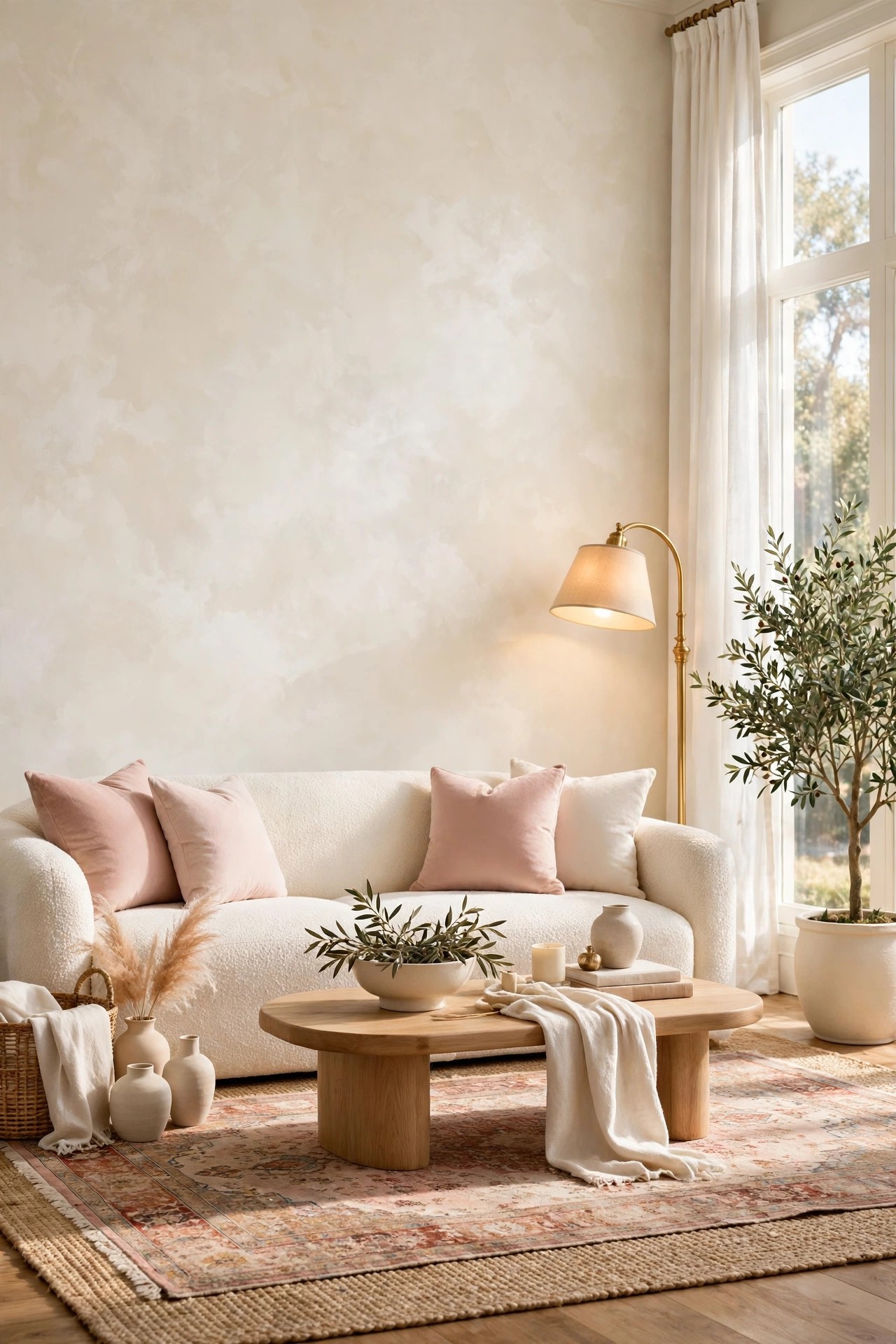
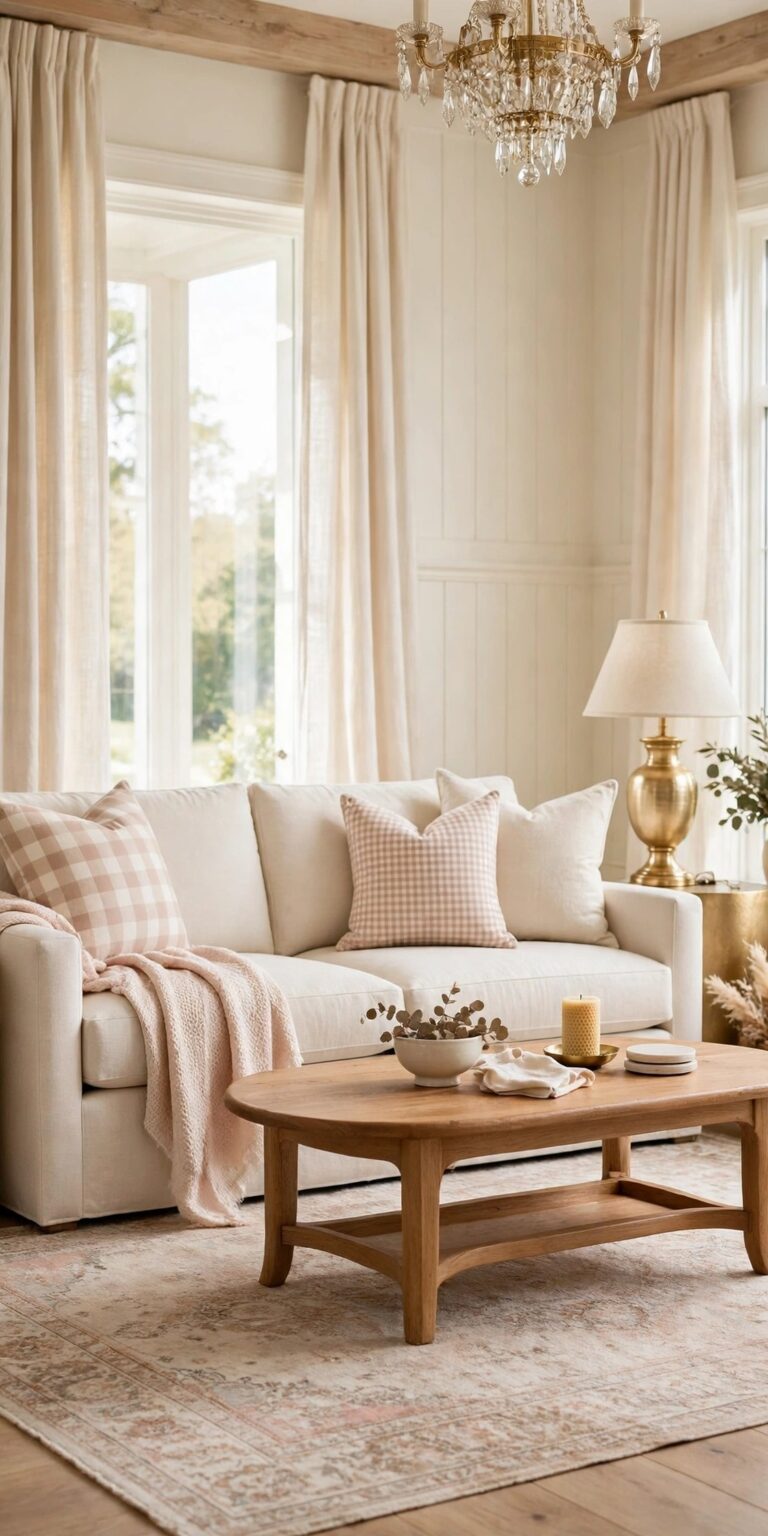
A warm white limewash wall is the calmest base a living room can have, because the cloudy finish gives a plain white wall depth without adding any color to argue with. Brush the limewash onto the main wall in loose crossing strokes and keep a wet edge, because limewash dries fast and a dry edge leaves a hard line. Choose a warm white, never a cold blue white, so the wall stays soft under evening lamps as well as daylight. The movement in the finish catches the light differently through the day, which is what makes the room feel alive.
What You Need
- Warm white limewash paint, 1 gallon — [LINK PENDING]
- Limewash block brush — [LINK PENDING]
- Painter tape and drop cloth — [LINK PENDING]
Quick Steps
- Clean the wall, tape the edges and lay the drop cloth.
- Brush the limewash in loose crossing strokes, keeping a wet edge.
- Let the first coat dry fully, then add a second coat for depth.
Estimated Cost: $60-$140 (estimate)
2. Try a Warm Taupe Limewash Feature Wall
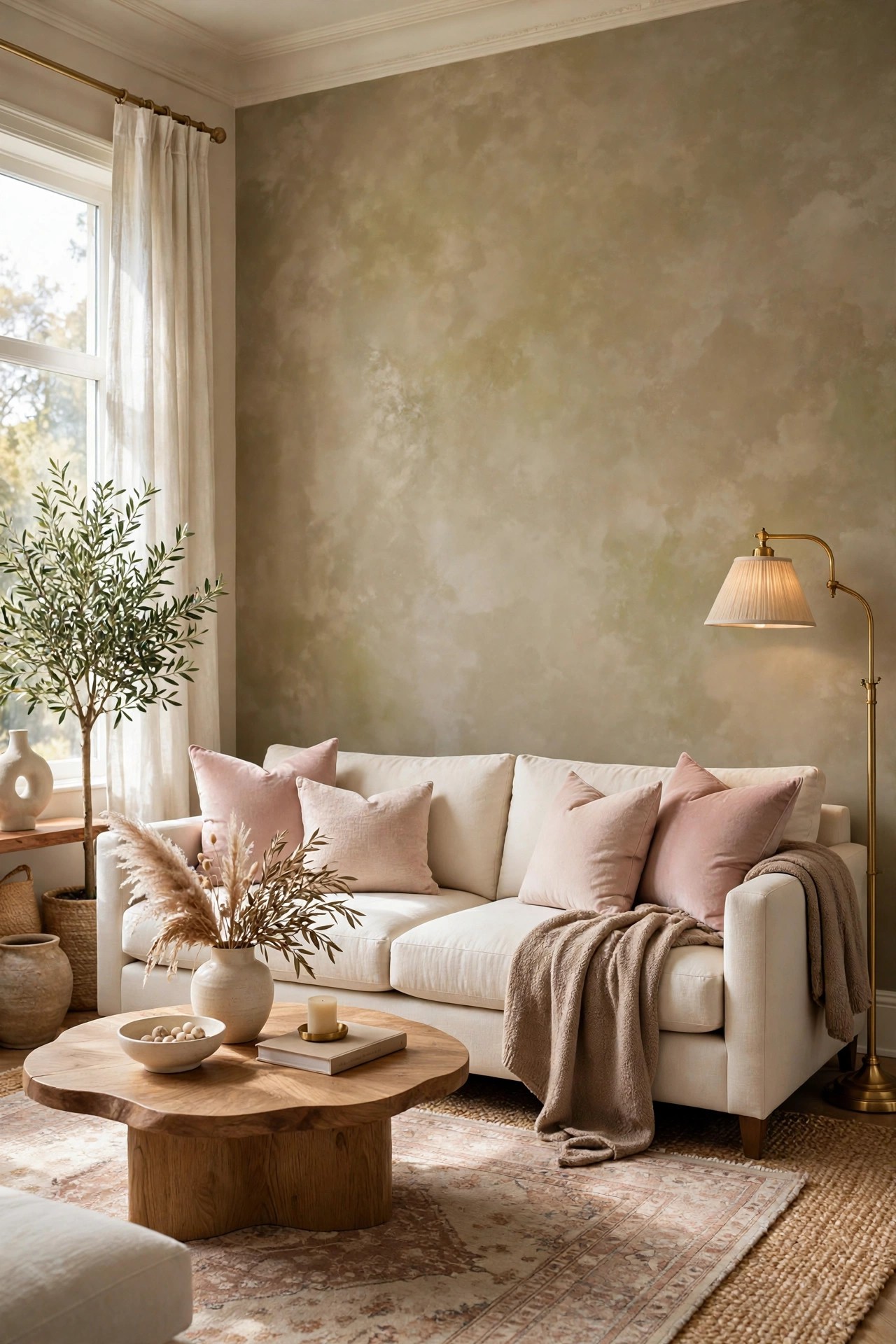
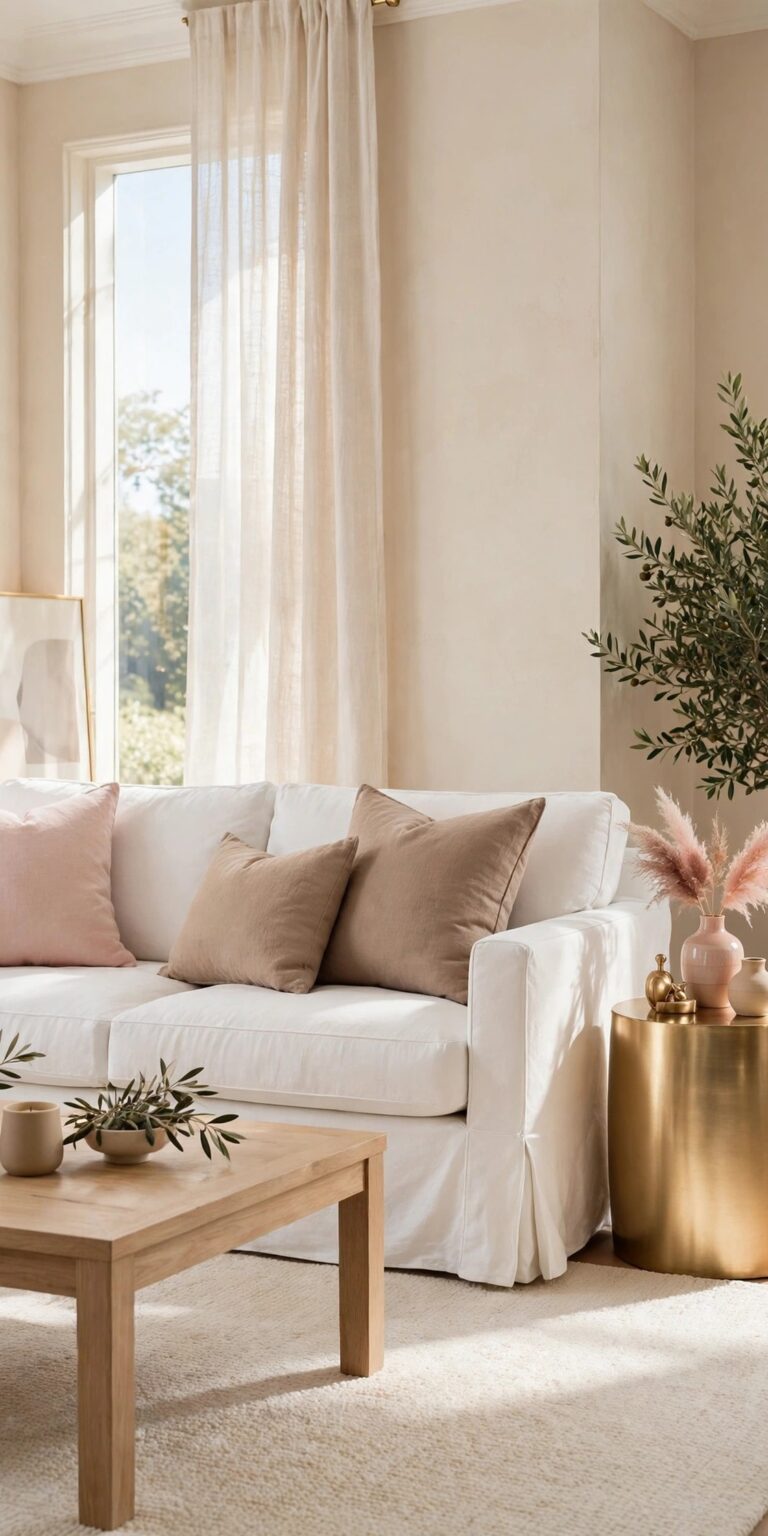
A warm taupe limewash feature wall gives the living room its depth in one move, because taupe flatters cream, blush and gold at once. Paint the wall behind the sofa in warm taupe limewash and keep the other walls warm white, so the dark note reads as a backdrop rather than a box. The cloudy finish stops the taupe from looking flat, the risk with plain taupe paint. Test the color on a large board first, at midday and at night, because a warm taupe stays cozy after dark. Our bedroom accent wall ideas show the same warm taupe limewash behind a bed
→ [INTERNAL LINK: “bedroom accent wall ideas” / bedroom accent wall ideas]
What You Need
- Warm taupe limewash paint, 1 gallon — [LINK PENDING]
- Limewash block brush — [LINK PENDING]
- Large test board — [LINK PENDING]
Quick Steps
- Test the taupe on a large board at midday and under evening light.
- Tape the edges and brush the wall in loose crossing strokes.
- Add a second coat once dry, then check the wall reads warm from the doorway.
Estimated Cost: $60-$140 (estimate)
3. Add a Soft Blush Limewash Accent Wall
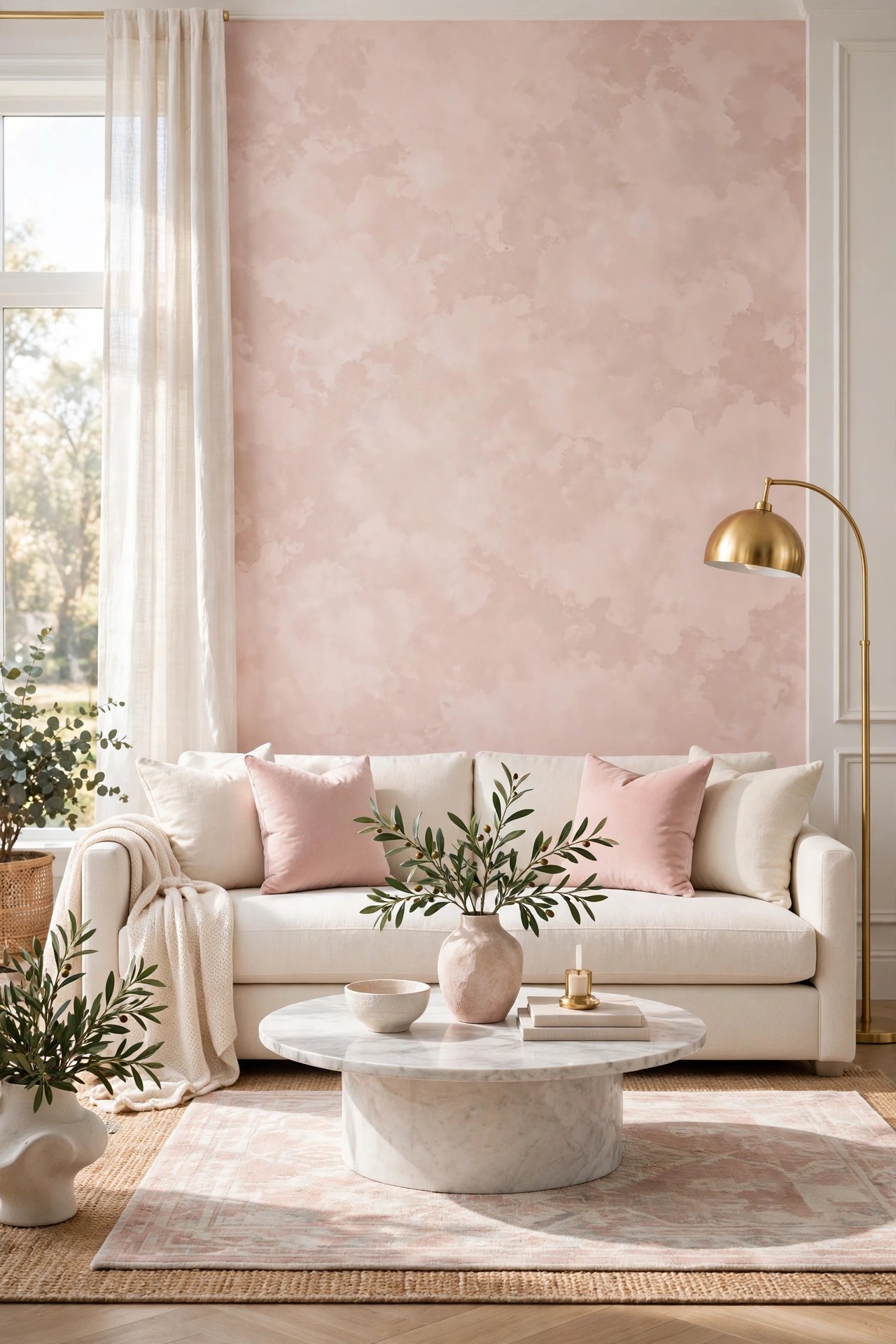
A soft blush limewash accent wall is the gentlest color a living room can carry, because blush reads as warmth rather than pink and the cloudy finish keeps it from looking like a nursery wall. Choose the wall the sofa sits against and keep the blush pale, closer to warm cream than to rose, so the room stays calm in daylight and glows softly under lamps. The limewash movement matters most here, because flat blush paint can look sweet while cloudy blush looks like plaster. Pair the wall with cream cushions and one deeper blush cushion, so the color repeats in the soft furnishings.
What You Need
- Pale blush limewash paint, 1 gallon — [LINK PENDING]
- Limewash block brush — [LINK PENDING]
- Cream and blush cushion covers — [LINK PENDING]
Quick Steps
- Pick the sofa wall and test the blush on a board in daylight.
- Brush two coats in crossing strokes, keeping a wet edge.
- Add cream cushions first, then one deeper blush cushion to repeat the color.
Estimated Cost: $70-$150 (estimate)
4. Limewash the Fireplace Wall
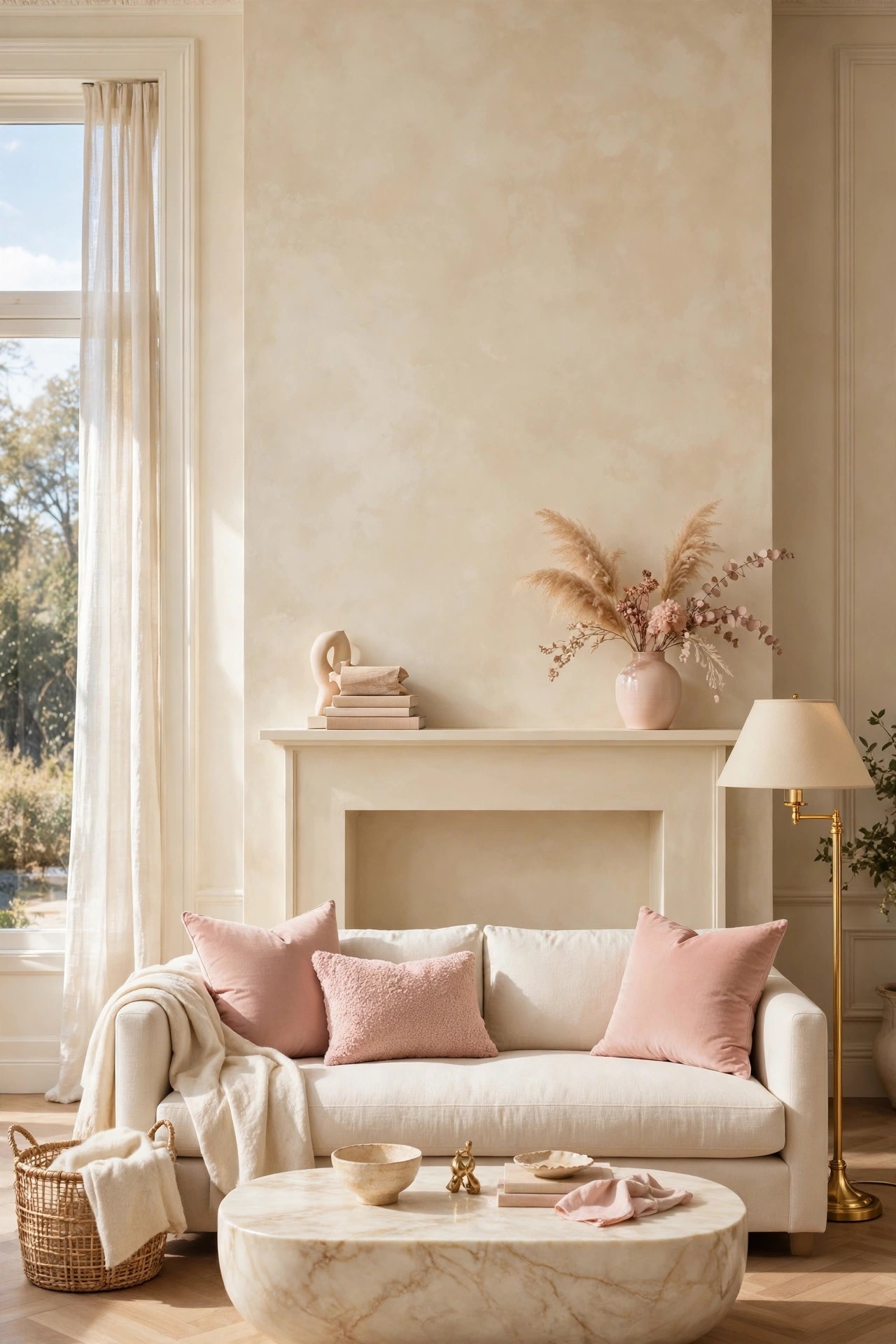
A limewash fireplace wall turns the hearth into the softest focal point in the room, because cloudy plaster suits a fireplace better than flat paint. Brush the limewash over the whole chimney breast in warm cream and keep the mantel slim and pale so the wall does the work. Choose a limewash made for masonry and heat, and check the maker guidance for fireplace use before you start. Style the mantel with two or three pieces only, a vase, a stack of books and a candle in glass, so the plaster stays the star. Our living room furniture shows the seating that faces the fire
→ [INTERNAL LINK: “living room furniture” / living room furniture]
What You Need
- Warm cream limewash paint rated for masonry and fireplace heat — [LINK PENDING]
- Limewash block brush — [LINK PENDING]
- Small vase, stacked books and a candle in a glass holder — [LINK PENDING]
Quick Steps
- Check the limewash is rated for fireplace heat and clean the plaster first.
- Brush two coats over the whole chimney breast in crossing strokes.
- Style the mantel with three pieces only and leave the rest clear.
Estimated Cost: $70-$160 (estimate)
5. Limewash the Wall Behind the Sofa
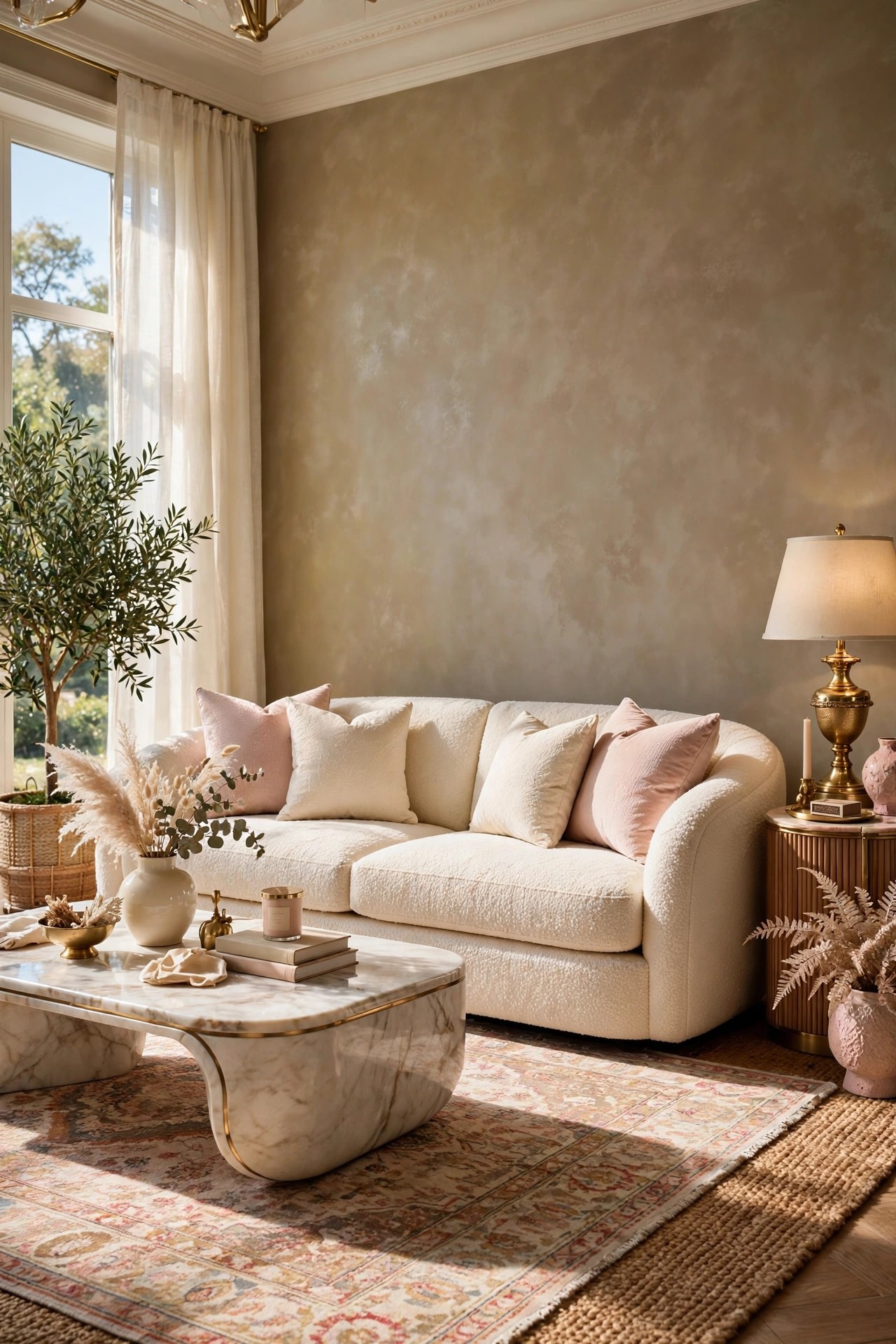
The wall behind the sofa is the one the eye lands on first, so giving it limewash is the highest-impact single wall in the room. A warm taupe or warm white limewash behind a cream sofa makes the sofa look intentional instead of pushed against a blank wall, and the cloudy texture gives the seating area a backdrop that photographs beautifully. Keep the sofa a hand width off the wall so the limewash can breathe and the cushions do not rub the finish. Hang nothing on this wall, because the texture is the decoration, and let the sofa, the cushions and one floor lamp carry the styling.
What You Need
- Warm taupe or warm white limewash paint, 1 gallon — [LINK PENDING]
- Limewash block brush — [LINK PENDING]
- Cream and blush cushions — [LINK PENDING]
Quick Steps
- Move the sofa out and tape the wall edges and the floor.
- Brush two coats of limewash in crossing strokes, keeping a wet edge.
- Push the sofa back a hand width off the wall and dress it with cushions.
Estimated Cost: $60-$140 (estimate)
6. Shape a Limewash Arch Niche
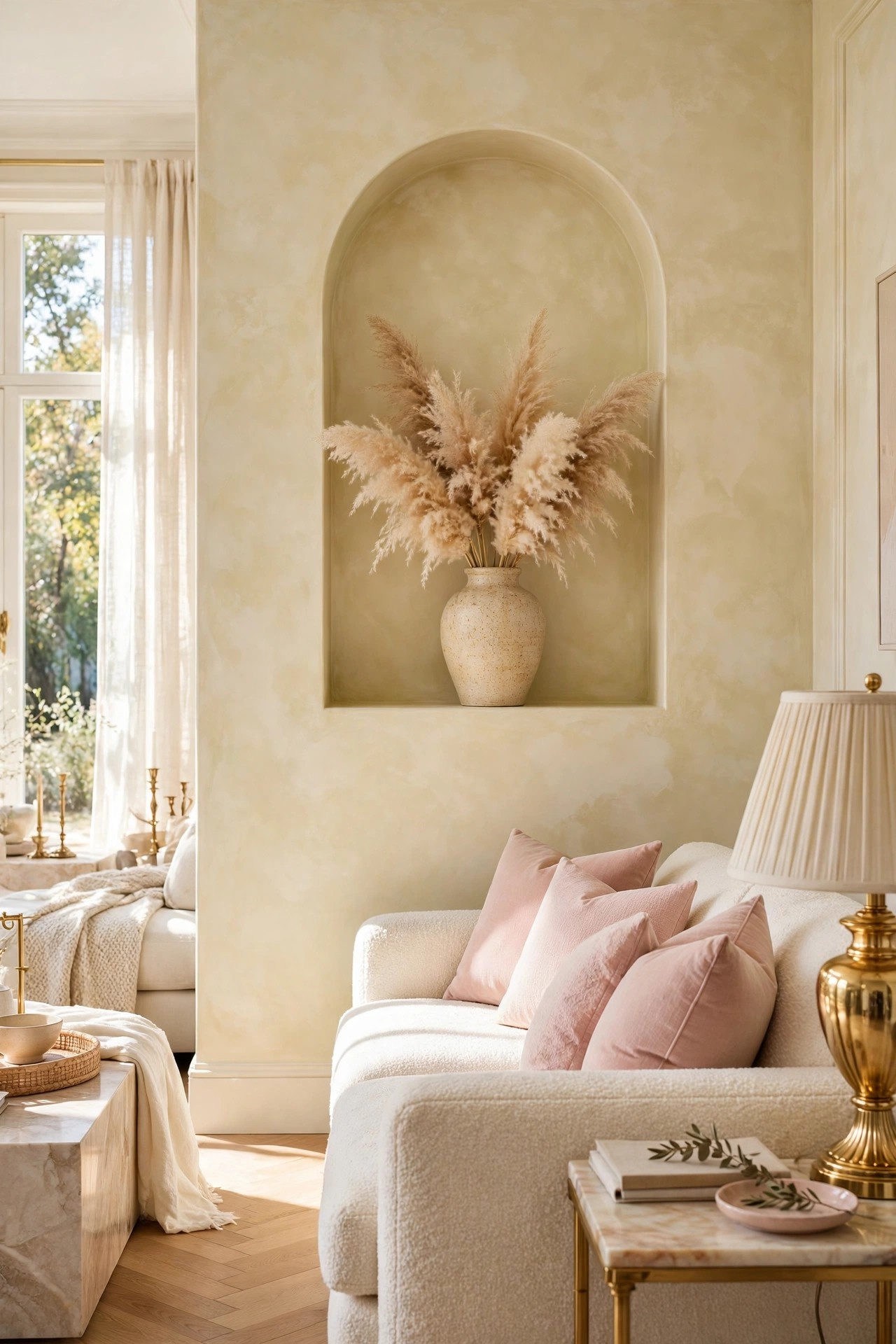
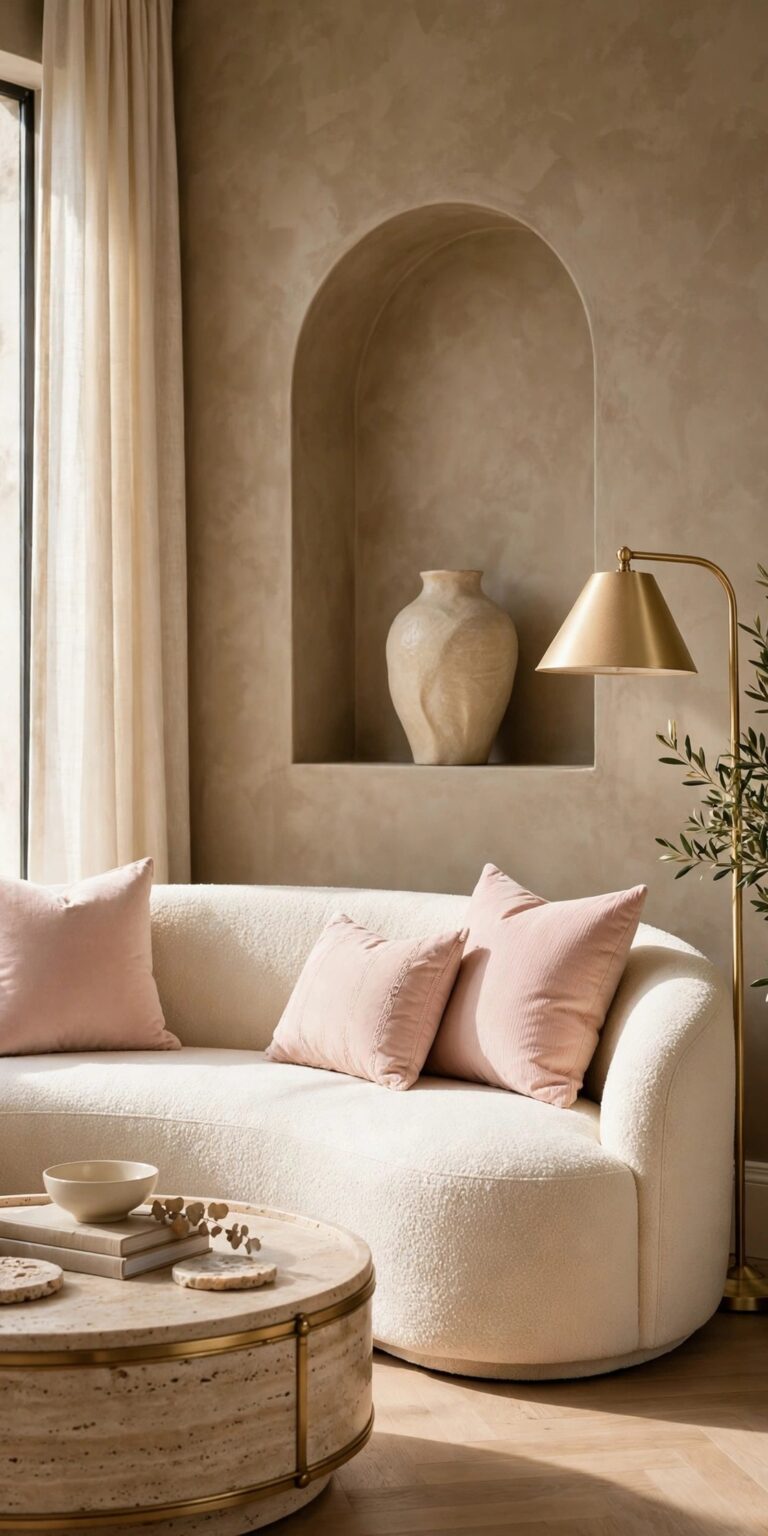
A limewash arch niche gives a plain living room wall the one curved note it is missing, and the cloudy finish makes the curve look plastered by hand rather than painted on. Mark the arch with a pencil and a string as a compass, paint inside the arch in a slightly deeper tone than the wall around it, and the niche reads as a real architectural feature. Keep what sits inside the niche simple, one vase with dried pampas or one small stack of books, because a crowded niche hides the arch shape.
What You Need
- Warm cream and warm taupe limewash paint, small tins — [LINK PENDING]
- Small limewash brush — [LINK PENDING]
- Pencil, string and painter tape for the arch shape — [LINK PENDING]
Quick Steps
- Mark the arch with a pencil and a string compass, then tape the edge.
- Brush the arch in a slightly deeper tone than the wall around it.
- Place one vase with dried pampas inside and leave the rest empty.
Estimated Cost: $30-$80 (estimate)
7. Limewash the Ceiling for a Cloudy Glow
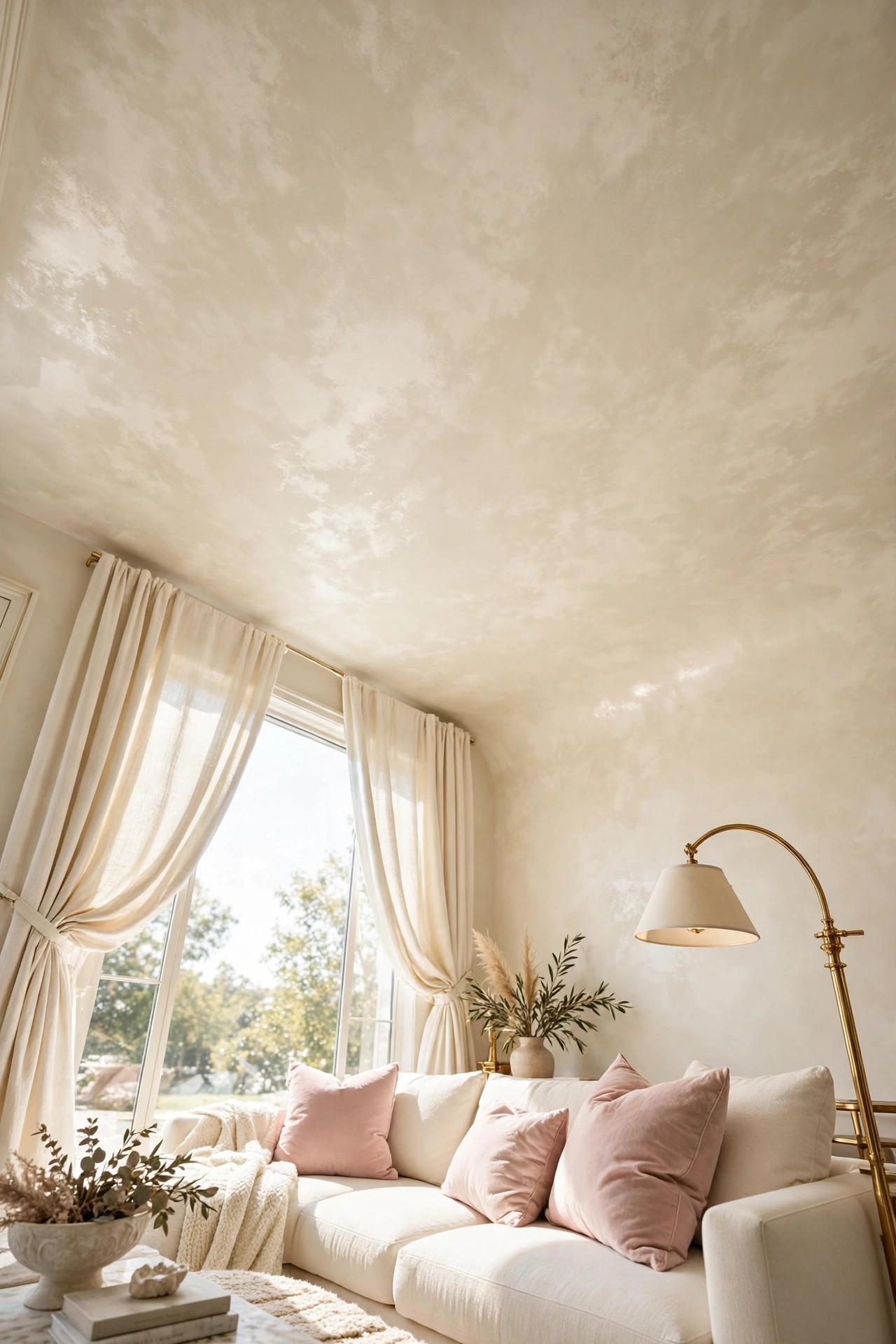
A limewash ceiling is the quietest way to make a living room feel taller and softer, because the cloudy finish takes the flat glare off the ceiling and bounces daylight around the room. Use a warm white limewash and a roller on an extension pole, working in small sections so the wet edge never dries mid-ceiling. Keep the walls warm white too, so the ceiling and the walls read as one soft envelope rather than two competing surfaces. Never paint a ceiling from a wobbly chair; use a stable step ladder and move it often.
What You Need
- Warm white limewash paint, 2 gallons — [LINK PENDING]
- Limewash roller and extension pole — [LINK PENDING]
- Stable step ladder and drop cloths — [LINK PENDING]
Quick Steps
- Cover the floor and furniture, then work the ceiling in small sections.
- Roll the limewash with a wet edge, one person rolling and one keeping the edge wet.
- Let the ceiling dry a full day before moving furniture back.
Estimated Cost: $90-$200 (estimate)
8. Limewash a Built-In Shelving Wall
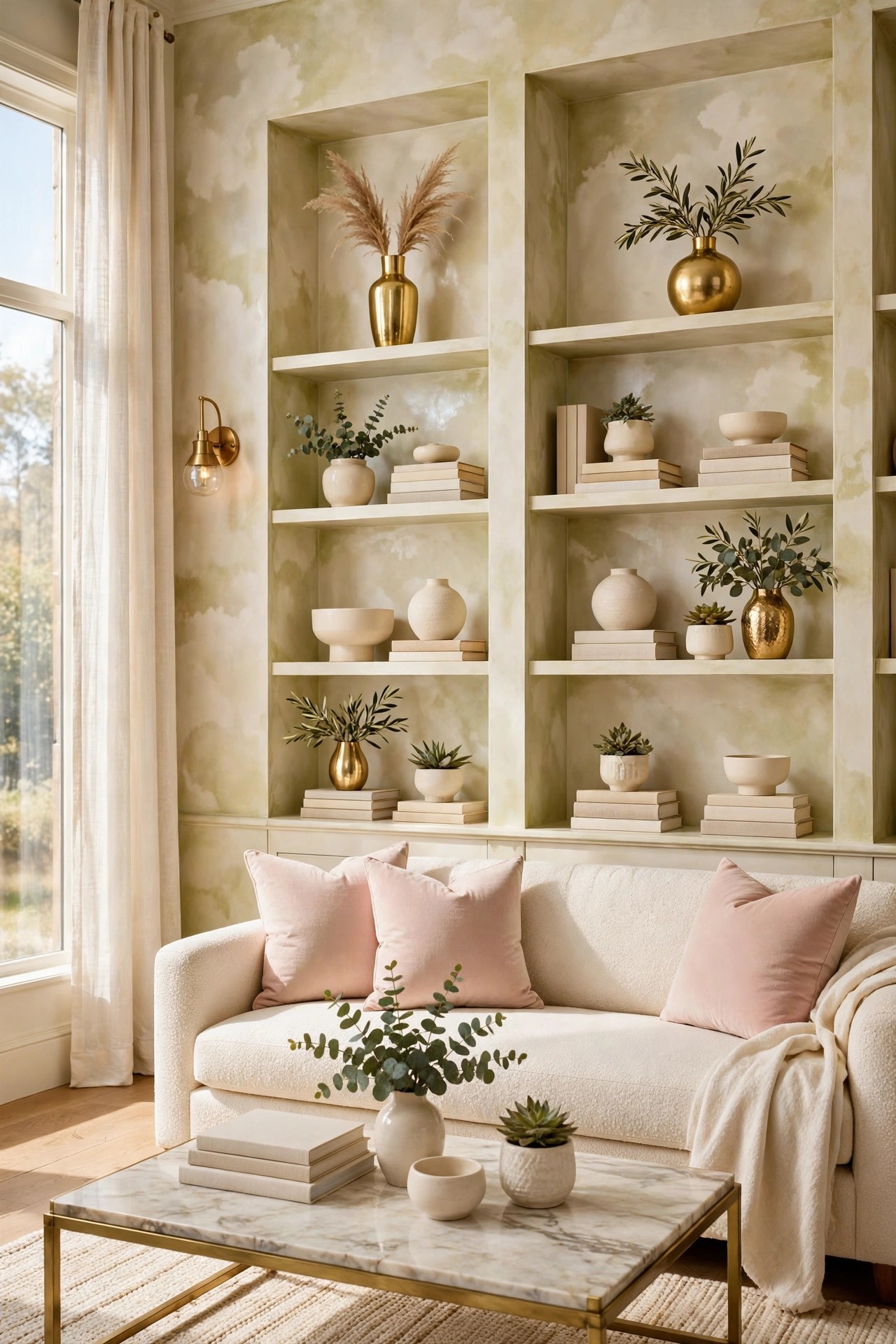
Built-in shelves limewashed in warm white stop looking like storage and start looking like part of the wall, which is what a calm living room needs. Brush the limewash over the shelves and the wall behind them in the same warm white, so the shelves and the wall read as one plastered surface. Style the shelves with breathing room, gold vases, a trailing plant, stacked books and cream ceramics, leaving one third of each shelf empty. Keep the heaviest pieces on the lowest shelf and check the fixings are rated for the load before anything goes up, because a shelf is heavier than it looks once books are added.
What You Need
- Warm white limewash paint, 1 gallon — [LINK PENDING]
- Limewash brush and small roller — [LINK PENDING]
- Gold vases, small plant, stacked books and cream ceramics — [LINK PENDING]
Quick Steps
- Clean the shelves and brush the limewash over shelves and wall alike.
- Let the finish dry fully, then check every fixing is rated for its load.
- Style the lowest shelf heaviest and leave one third of each shelf empty.
Estimated Cost: $70-$180 (estimate)
9. Limewash the Open-Plan Dining Corner
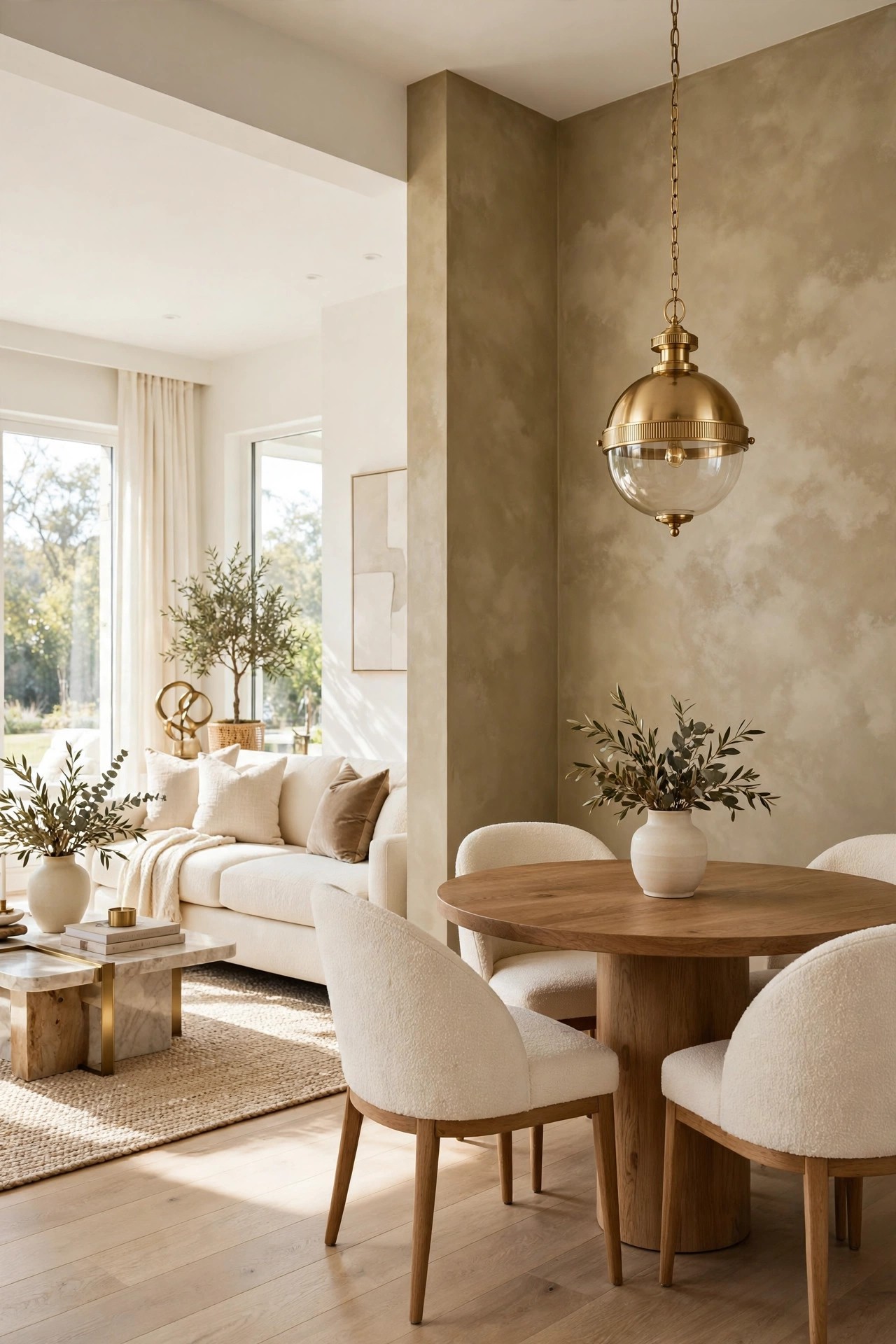
In an open-plan home the dining corner often feels like leftover space, and one limewash wall is the cheapest way to give it its own identity. Paint the dining corner wall in a warm taupe limewash, a tone deeper than the living room walls, so the corner reads as a separate room without any divider. The cloudy texture suits a dining wall especially well, because it softens the hard table and chairs the way a tablecloth softens a table. Hang one brass pendant low over the table and keep the chairs cream, so the taupe wall, the wood table and the brass light form one warm group.
What You Need
- Warm taupe limewash paint, 1 gallon — [LINK PENDING]
- Limewash block brush — [LINK PENDING]
- Brass pendant light and linen table runner — [LINK PENDING]
Quick Steps
- Tape the corner where the dining wall meets the living room wall.
- Brush two coats of taupe limewash in crossing strokes.
- Hang the brass pendant over the table and dress it with a linen runner.
Estimated Cost: $90-$220 (estimate)
10. Pair Limewash Walls with a Cream Boucle Sofa
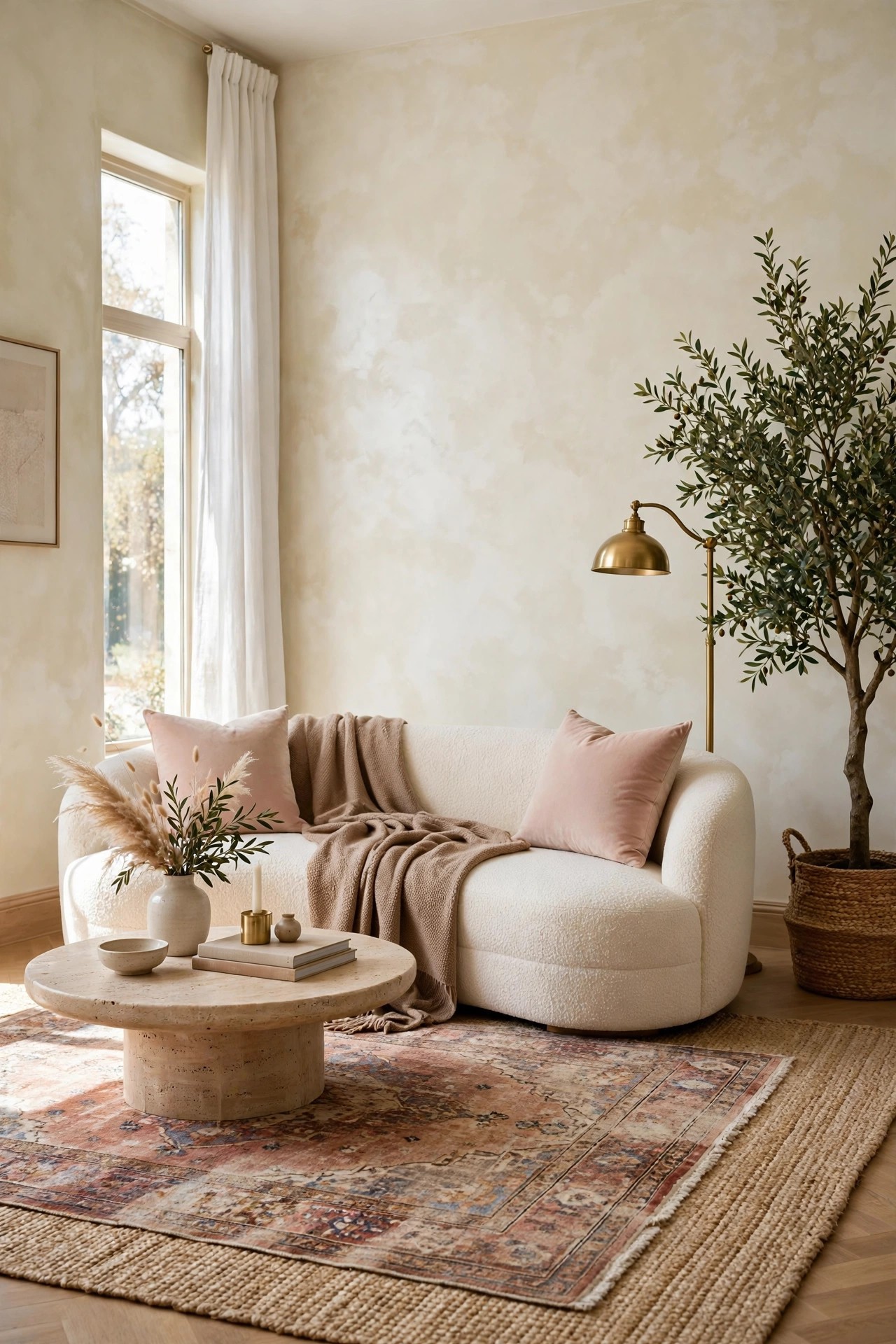
A cream boucle sofa is the best seat against a limewash wall, because the nubby boucle texture and the cloudy plaster texture speak the same soft language. Choose a cream boucle sofa with clean lines and slim wood legs, then dress it with one blush cushion, one cream cushion and a warm taupe throw. The boucle catches the daylight the way limewash does, which is why the pair looks planned rather than matched by accident. Keep the sofa a hand width off the wall and vacuum the boucle weekly, because the texture holds dust. Our minimalist living room shows the same pale sofa idea with flat walls
→ [INTERNAL LINK: “minimalist living room” / minimalist living room]
What You Need
- Cream boucle sofa, three seat — [LINK PENDING]
- Blush and cream cushions, warm taupe throw — [LINK PENDING]
- Vacuum with an upholstery head — [LINK PENDING]
Quick Steps
- Place the sofa a hand width off the limewash wall.
- Add the cream cushions first, then the blush cushion and the folded throw.
- Vacuum the boucle weekly so the texture stays soft and clean.
Estimated Cost: $600-$1,400 (estimate)
11. Layer a Vintage Rug Over Natural Jute
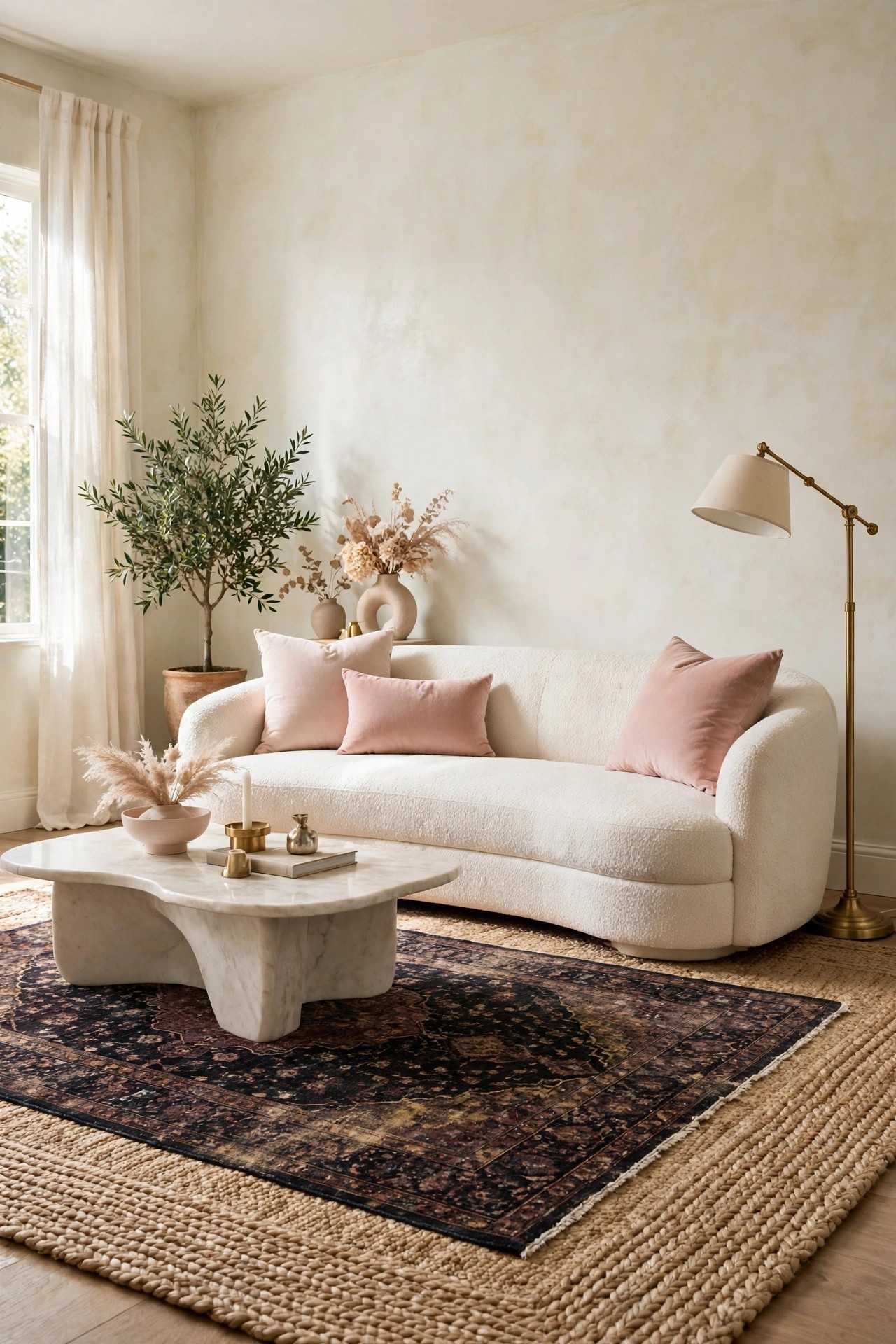
Layered rugs are the floor a limewash living room deserves, because the wall is already soft and textured and the floor should answer it the same way. Lay a large natural jute rug first, then a smaller vintage style rug on top, turned at a slight angle, so the pale jute border frames the deep reds of the top rug. The jute gives the room its natural texture and the vintage rug gives it the color, while the two layers soften the floor under bare feet. Keep the rug pad under both layers so nothing slides, and tuck the front legs of the sofa onto the top rug.
What You Need
- Large natural jute rug — [LINK PENDING]
- Smaller vintage style rug in low pile — [LINK PENDING]
- Rug pad sized to the jute rug — [LINK PENDING]
Quick Steps
- Lay the rug pad, then the jute rug, then the vintage rug at a slight angle.
- Tuck the front legs of the sofa onto the top rug.
- Walk across the layers and check nothing slides or bunches.
Estimated Cost: $150-$450 (estimate)
12. Hang a Gold-Framed Mirror on Limewash
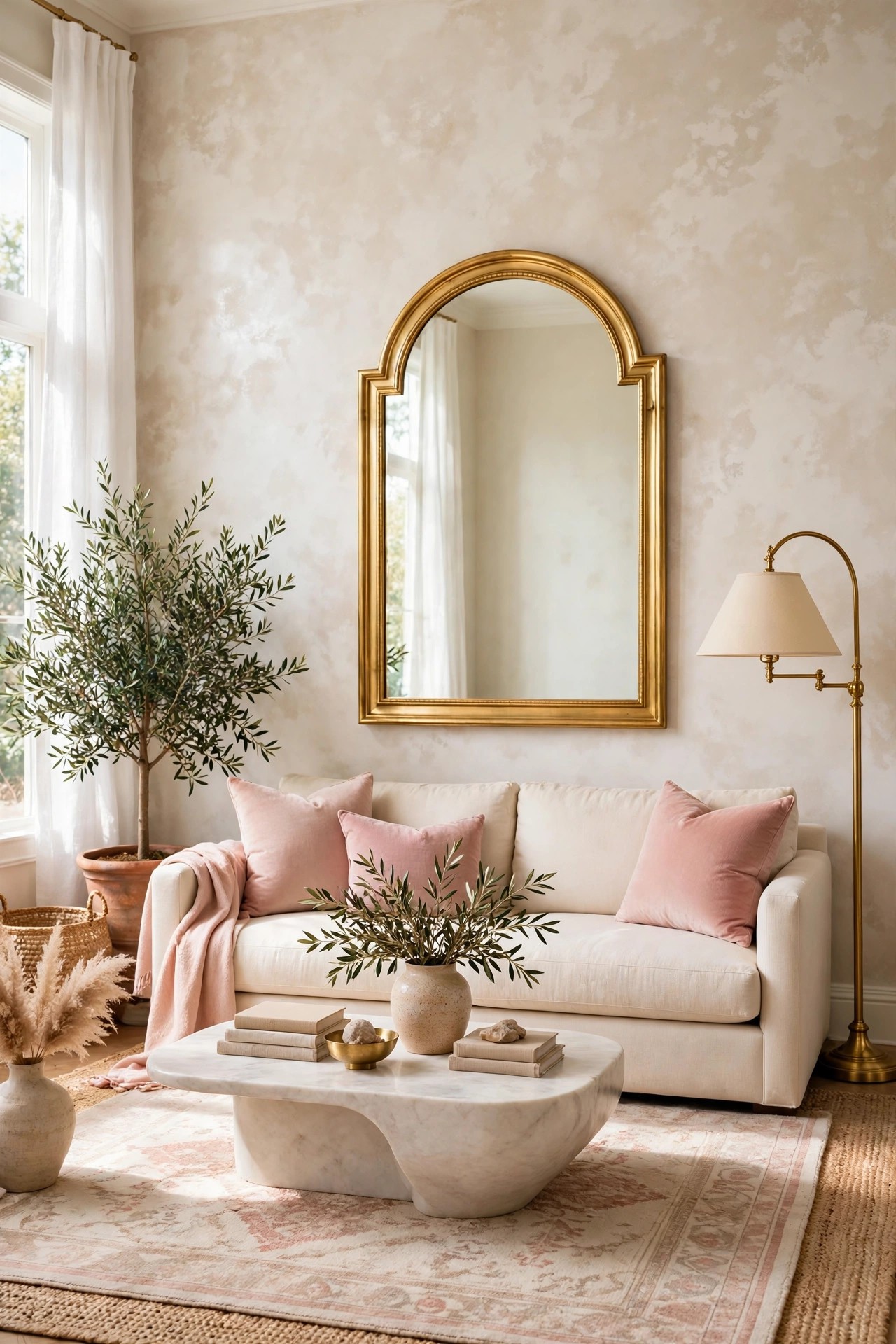
A gold-framed mirror is the one piece of shine a limewash wall needs, because the cloudy plaster is matte and the mirror and its gold frame give the wall its light back. Choose an arched mirror with a slim brushed gold frame and hang it centered above the sofa or the sideboard, so the arch repeats the soft curves of the room. The mirror doubles the daylight and makes the limewash texture glow. Hang it with a fixing rated well above the mirror weight and check it sits level, because a heavy mirror is the one piece in the room that must never be trusted to a light hook.
What You Need
- Large arched mirror with a slim brushed gold frame — [LINK PENDING]
- Heavy-duty wall fixing rated above the mirror weight — [LINK PENDING]
- Level and pencil — [LINK PENDING]
Quick Steps
- Hold the mirror centered above the sofa and mark the fixing height.
- Fit a heavy-duty fixing rated above the mirror weight.
- Hang the mirror and check it sits level and catches the daylight.
Estimated Cost: $120-$350 (estimate)
13. Dress the Window with Cream Linen Curtains
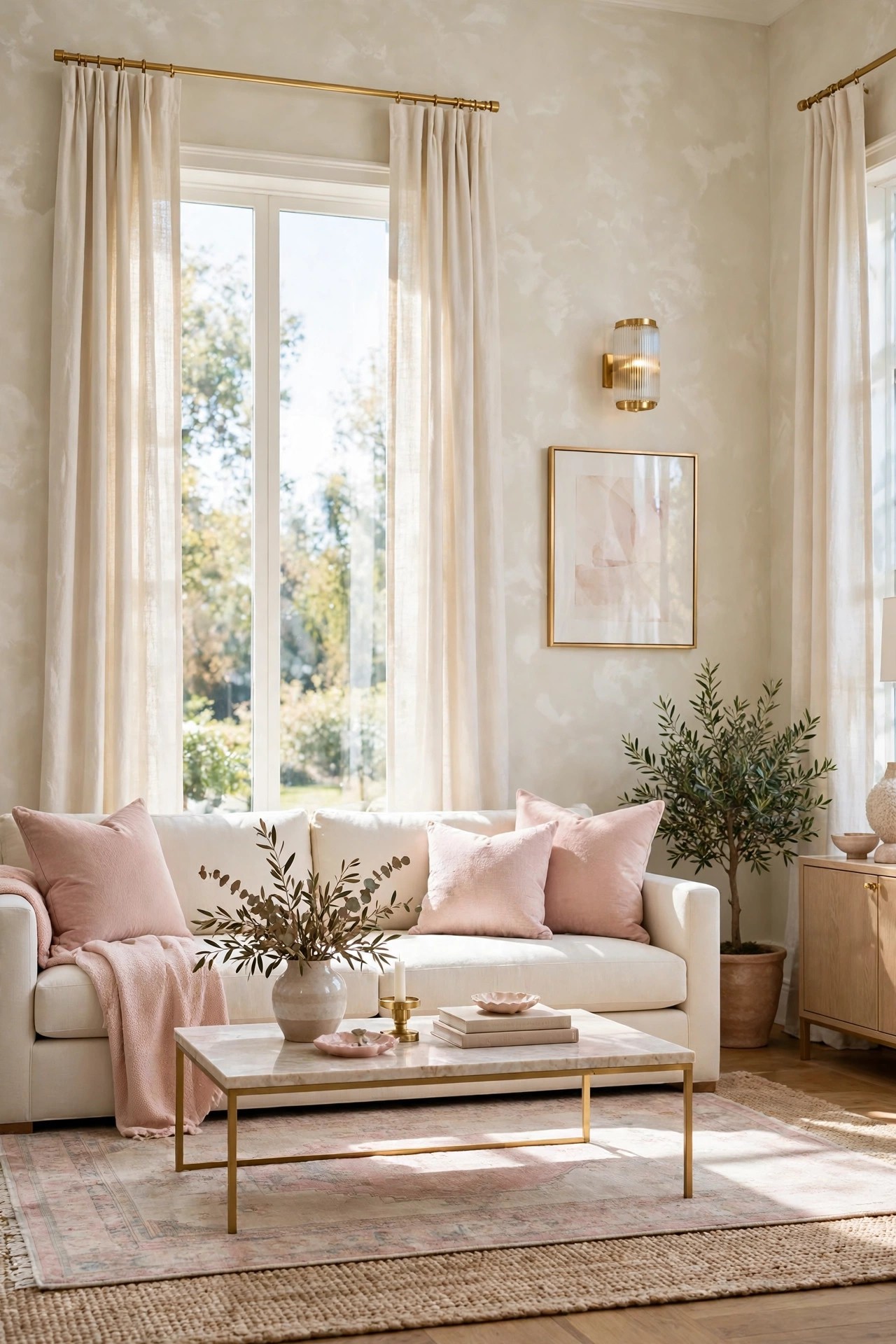
Cream linen curtains are the soft frame a limewash living room window needs, because linen and plaster share the same soft texture and the window becomes part of the wall story. Hang the curtains on a slim gold rod, high and wide past the window frame, with cream sheers behind them, so the daylight filters soft through the sheers while the linen gives the window its weight. Choose linen with a natural slub, because a flat synthetic curtain reads as a hotel drape. Keep the curtains long enough to brush the floor and pull them aside in the daytime, so the light reaches the limewash and the texture glows.
What You Need
- Cream linen curtains, floor length — [LINK PENDING]
- Cream sheer panels — [LINK PENDING]
- Slim gold curtain rod with finials — [LINK PENDING]
Quick Steps
- Fit the rod high and wide past the window frame.
- Hang the sheers first, then the linen curtains.
- Pull the curtains to the sides and check they brush the floor.
Estimated Cost: $60-$200 (estimate)
14. Add Warm Brass Lamps and Sconces
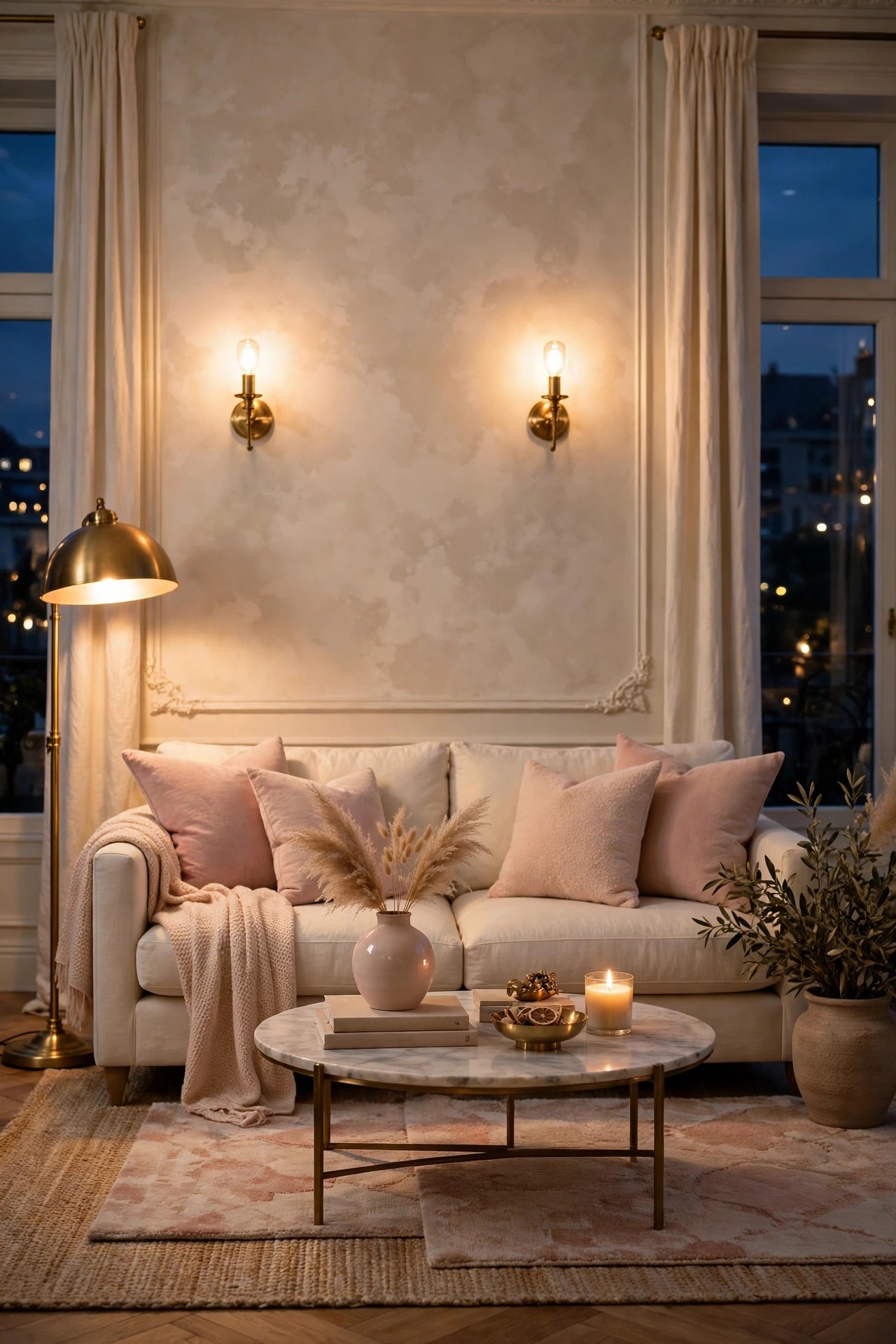
Warm brass light is what makes limewash glow after dark, because the cloudy plaster catches low warm light and the wall seems to shine from inside. Layer three warm lights, a brass floor lamp behind the sofa corner, a brass sconce on the limewash wall and a small table lamp on the sideboard, all in warm white, never cool white. A cool bulb turns warm plaster grey, while a warm bulb makes the texture deepen and the brass shine. Put the floor lamp on a dimmer so the light can drop low after dinner, and keep the ceiling light off, because one warm glow at sofa height reads as glam.
What You Need
- Brass floor lamp with a cream shade — [LINK PENDING]
- Brass wall sconce with a cream shade — [LINK PENDING]
- Warm white bulbs, 2700K — [LINK PENDING]
Quick Steps
- Place the floor lamp behind the sofa corner and the sconce on the limewash wall.
- Fit warm white 2700K bulbs in both.
- Switch the ceiling light off in the evening and let the brass lights carry the room.
Estimated Cost: $90-$280 (estimate)
15. Style Dried Pampas and Cream Ceramics
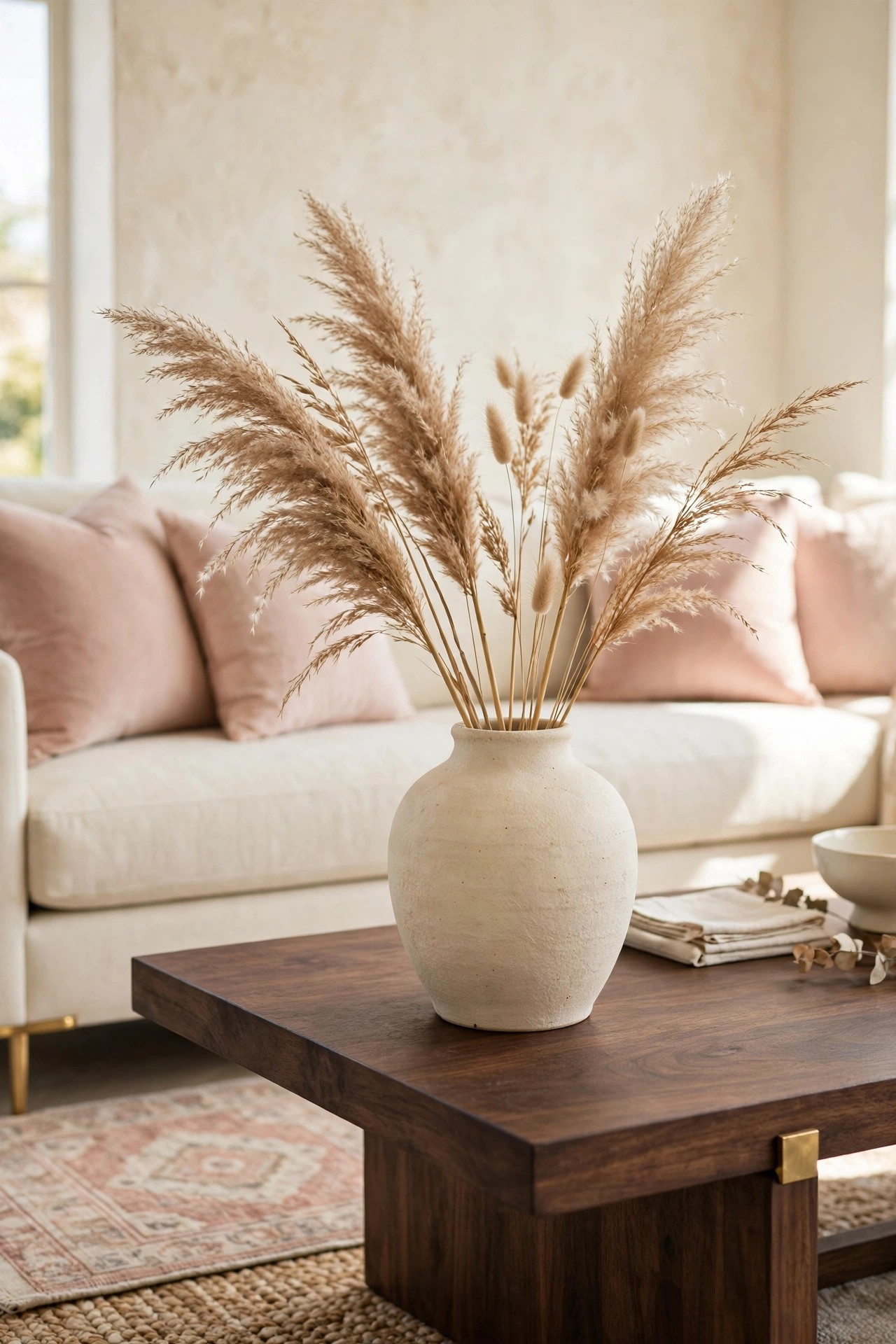
Dried pampas and cream ceramics are the styling a limewash wall asks for, because both are soft, matte and handmade-looking, and nothing shiny should fight the plaster. Set a tall cream ceramic vase with dried pampas stems on the sideboard or the coffee table, and group two smaller cream ceramics beside it, so the styling reads as one calm family. Keep the stems tall and feathery and the ceramics plain, because a patterned vase against a textured wall splits the eye in two directions. Change the stems when they fade and dust the ceramics weekly, and the styling keeps itself.
What You Need
- Tall cream ceramic vase — [LINK PENDING]
- Dried pampas stems — [LINK PENDING]
- Two small cream ceramic pieces — [LINK PENDING]
Quick Steps
- Set the tall vase on the sideboard or coffee table.
- Add the pampas stems and two small cream ceramics beside it.
- Step back and check the group reads as one calm family from the doorway.
Estimated Cost: $40-$110 (estimate)
16. Set a Rattan Chair Against the Limewash Wall
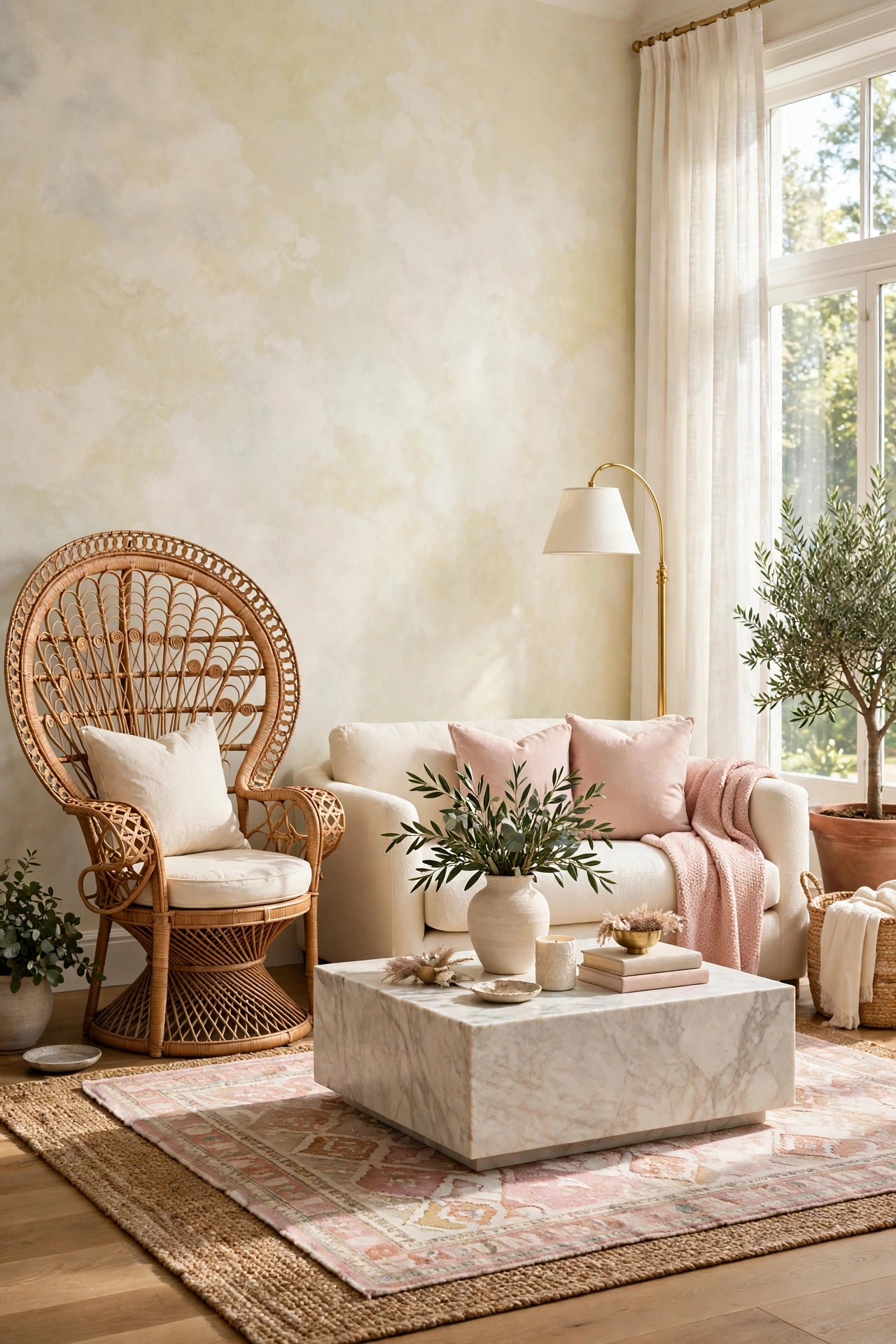
A natural rattan chair is the boho note a limewash living room can hold without breaking its calm, because the woven texture and the plaster texture are both handmade and warm. Choose a rattan chair in its natural tone, a peacock shape or a simple curved armchair, and dress it with a cream seat cushion and a small blush cushion, so the pale cushions glow against the weave. Set the chair at a slight angle to the sofa, facing into the room, because a chair turned in invites someone to sit. Check the weave is tight and the frame feels steady before buying.
What You Need
- Natural rattan chair, peacock or curved armchair shape — [LINK PENDING]
- Cream seat cushion and small blush cushion — [LINK PENDING]
- Small dark wood side table if space allows — [LINK PENDING]
Quick Steps
- Measure the corner and choose a chair that leaves a clear walkway.
- Set the chair at a slight angle to the sofa, facing into the room.
- Add the cream cushion and the blush cushion, then sit and check it feels steady.
Estimated Cost: $150-$400 (estimate)
17. Build a Small Gold-Frame Gallery on Limewash
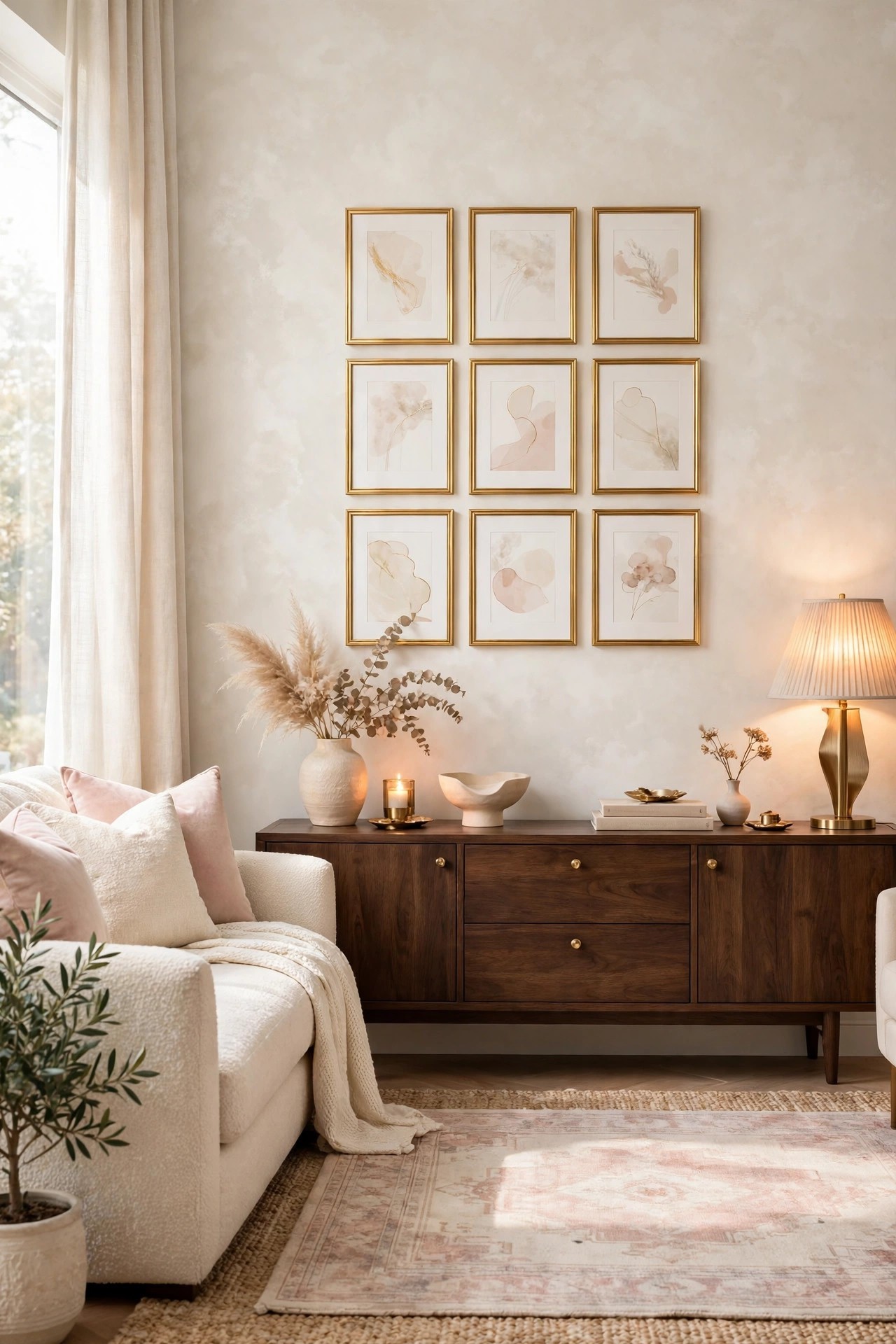
A small gallery of slim gold frames is the art a limewash wall suits best, because the thin gold lines echo the brass in the room and the pale art lets the plaster show between the frames. Mix three or four small gold frames with cream, blush and warm taupe art, dried botanical prints and one small mirror, and hang them in a tight group above the sideboard. Keep the frames close together, no more than a hand width apart, because a gallery spread too wide reads as separate pictures, while a tight group reads as one wall.
What You Need
- Three or four slim gold frames — [LINK PENDING]
- Cream, blush and taupe art prints and one dried botanical print — [LINK PENDING]
- Small round mirror and picture hanging strips or hooks — [LINK PENDING]
Quick Steps
- Lay the frames on the floor in a tight group and photograph the layout.
- Mark the first frame level, then hang the rest using the photograph.
- Check each frame sits level and the gaps stay even.
Estimated Cost: $80-$220 (estimate)
18. Grow an Olive Tree in a Cream Pot
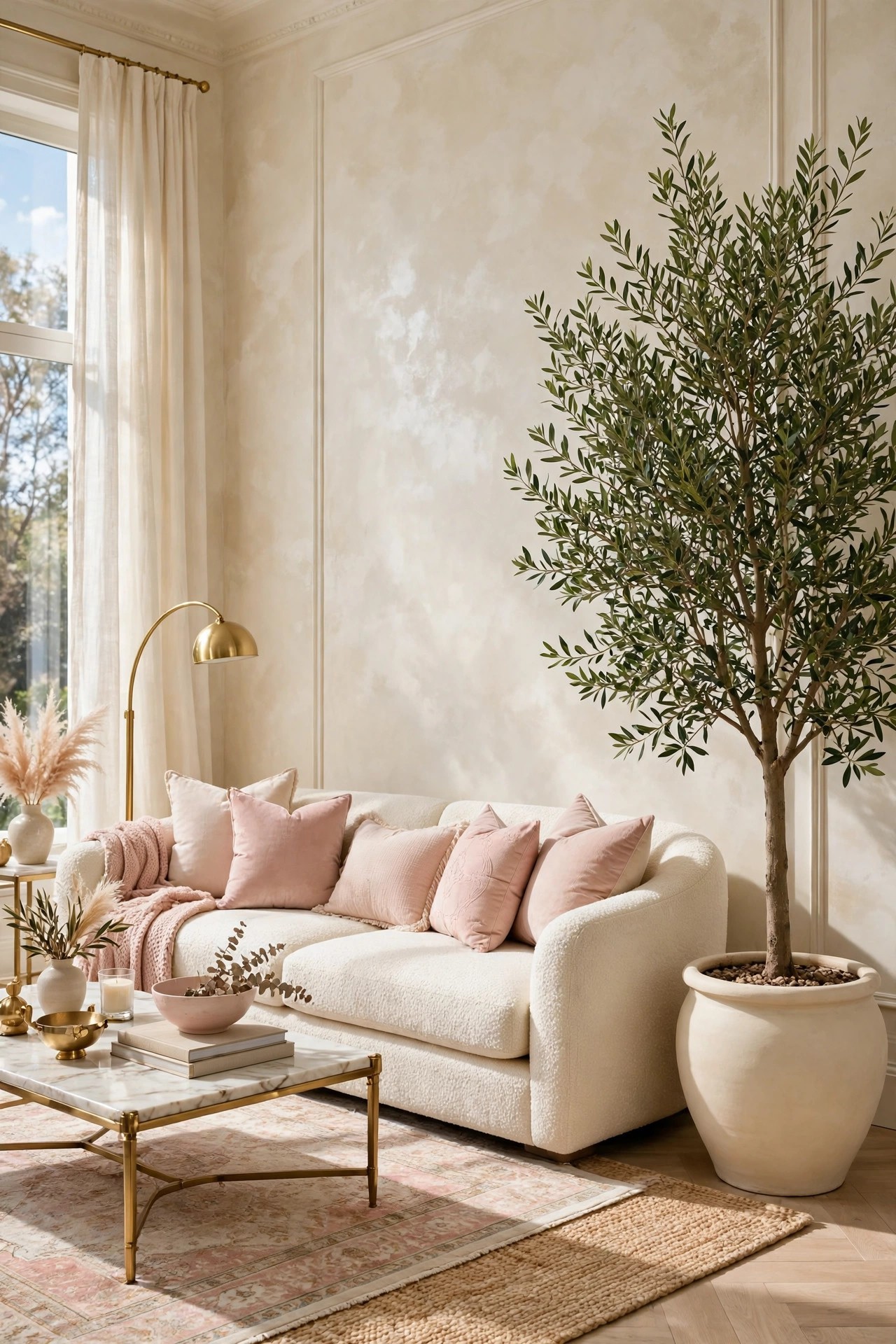
An olive tree in a cream pot is the green note a limewash living room can keep, because the silver green leaves glow against warm white plaster and the cream pot matches the palette. Choose a tall olive tree in a large cream ceramic pot and place it in the brightest corner, so the leaves catch the daylight and soften the furniture lines. Keep the pot large and heavy with a drainage hole and a saucer, so watering does not mark the rug. Water only when the top soil feels dry, and turn the pot a quarter turn each month so the tree grows straight.
What You Need
- Tall olive tree — [LINK PENDING]
- Large cream ceramic pot with a drainage hole and saucer — [LINK PENDING]
- Potting soil and watering can — [LINK PENDING]
Quick Steps
- Choose the brightest corner and check the tree clears the ceiling.
- Pot the tree with fresh soil and a saucer beneath.
- Water only when the top soil feels dry, then let the pot drain fully.
Estimated Cost: $80-$250 (estimate)
19. Make a Limewash Reading Nook
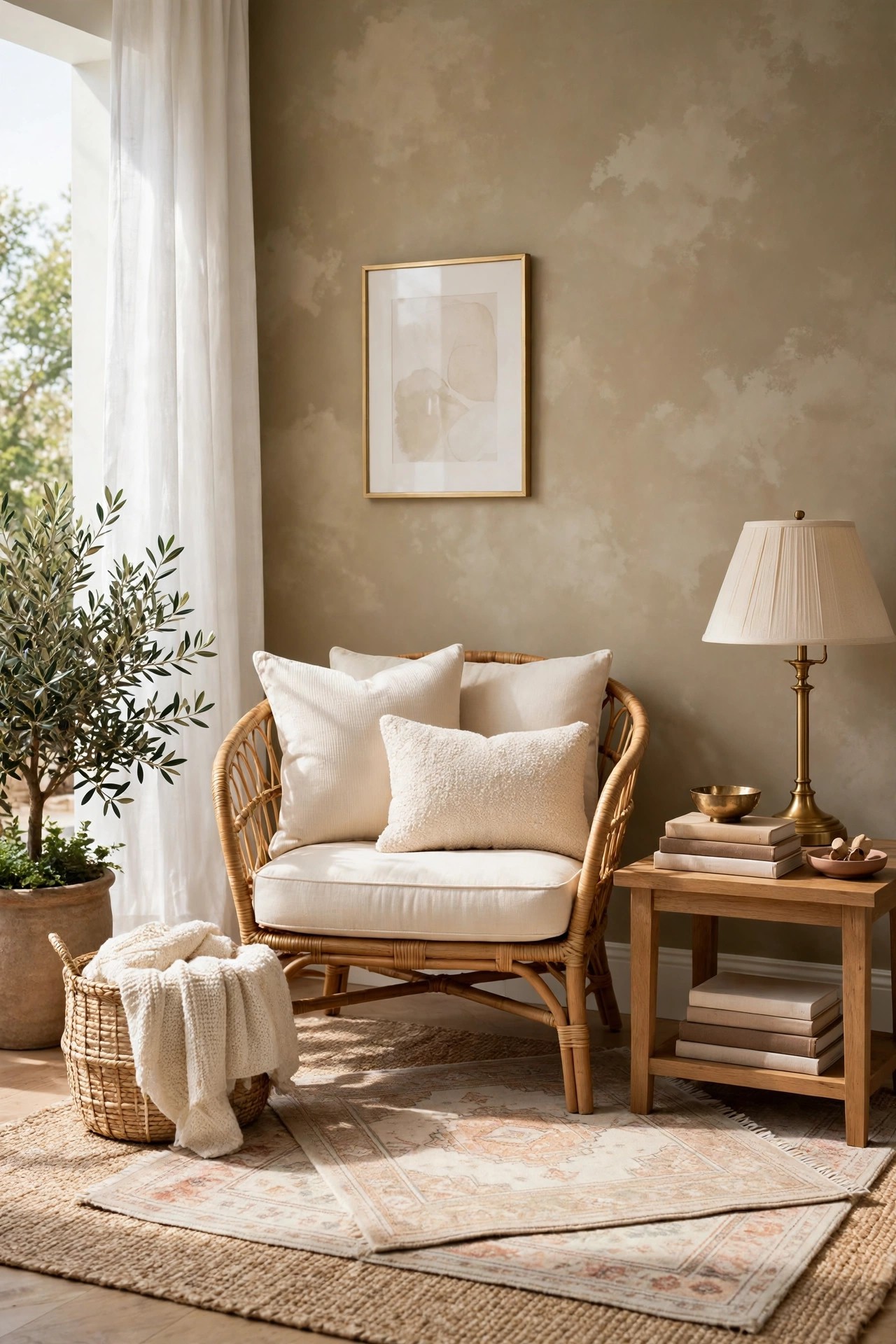
A limewash reading nook turns one quiet corner into the most loved seat in the house, because the cloudy wall wraps the corner in softness the way a blanket wraps a chair. Paint the two walls of the corner in a warm taupe limewash, set a rattan chair at an angle into the corner, and add a small wood side table with a brass lamp and a stack of two books. Keep a folded throw on the chair arm so the seat is ready at any hour, and keep the lamp warm white so the evening reading light flatters the plaster.
What You Need
- Warm taupe limewash paint, small tin — [LINK PENDING]
- Rattan chair with cream cushions — [LINK PENDING]
- Small wood side table, brass lamp and two books — [LINK PENDING]
Quick Steps
- Paint the two corner walls in warm taupe limewash.
- Set the rattan chair at an angle into the corner with the side table beside it.
- Add the brass lamp, the books and a folded throw on the chair arm.
Estimated Cost: $180-$450 (estimate)
20. Finish with a Soft Evening Light Plan
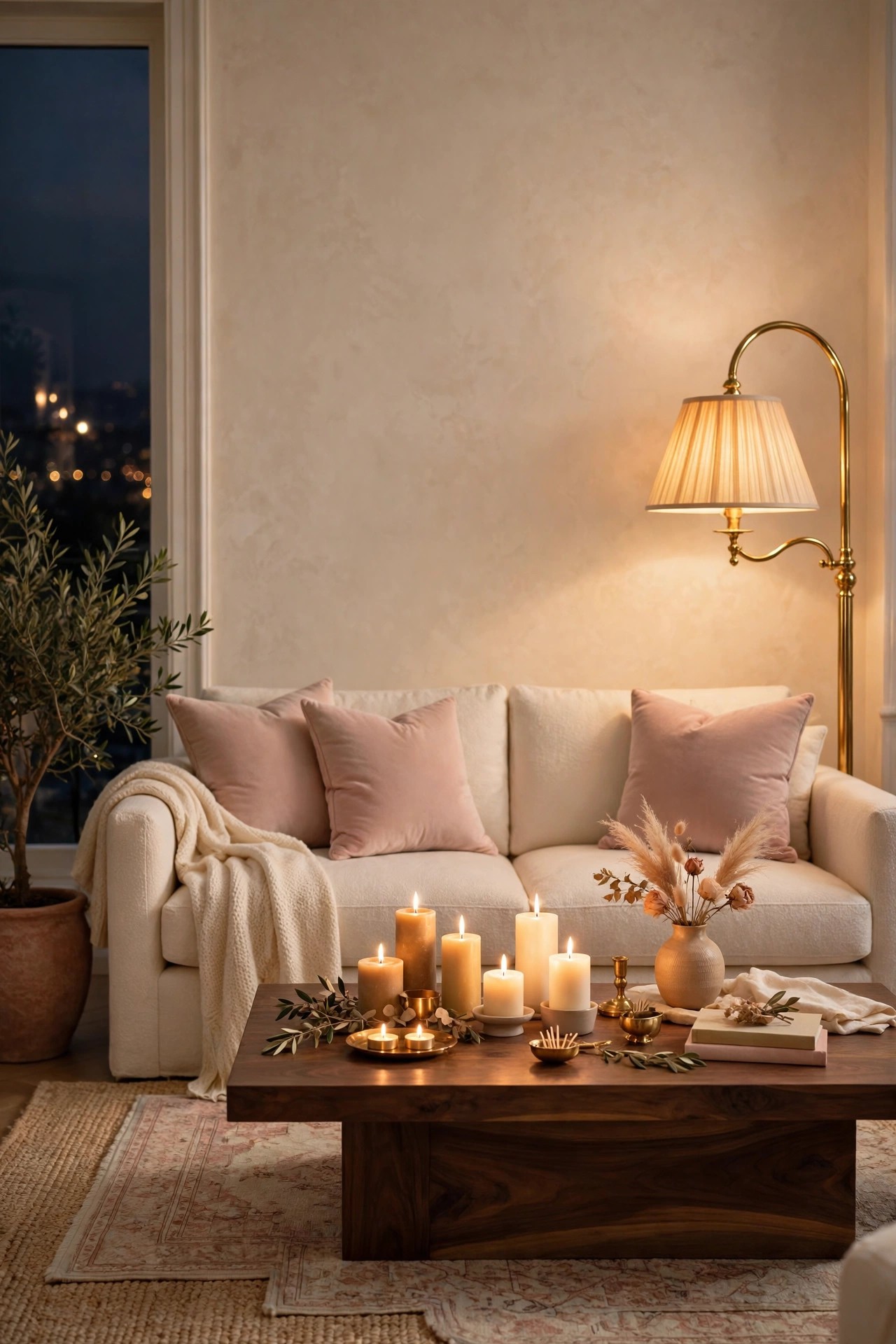
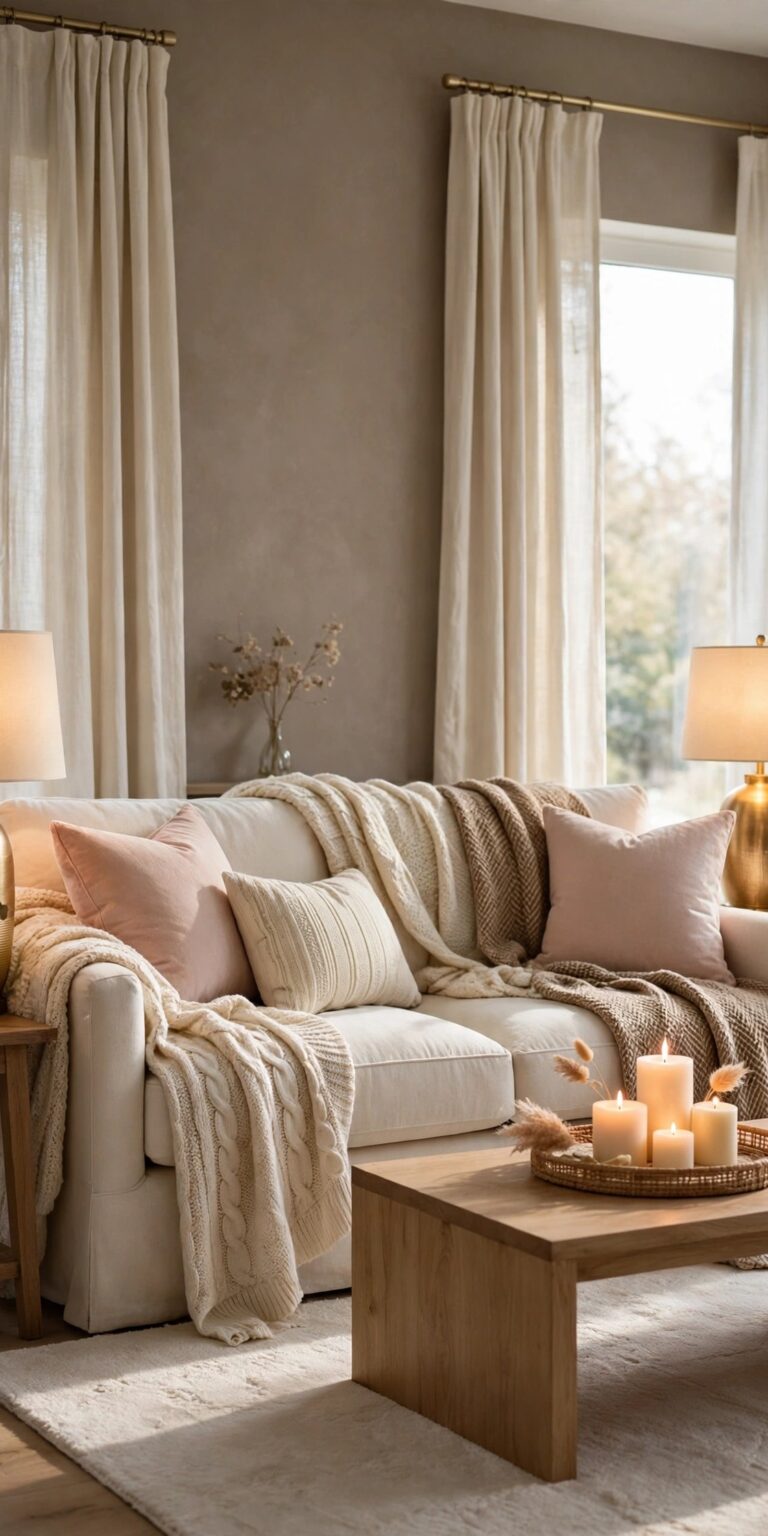
The last idea holds all the others together, because limewash is a finish that lives or dies by its light. Decide how the room lights up after dark: brass lamps at seat height, a candle cluster on the coffee table, and no harsh ceiling light. Walk through the room one evening, note every cold or glaring spot, then fix only those with a bulb change, a moved lamp or a shade. Warm white 2700K bulbs are the whole secret, because they make the plaster glow instead of going grey. Set the same routine every evening, lamps and candles on, ceiling lights off.
What You Need
- Warm white 2700K bulbs for any cold spots left — [LINK PENDING]
- Candle cluster in glass holders for the coffee table — [LINK PENDING]
- One extra brass table lamp if a corner stays dark — [LINK PENDING]
Quick Steps
- Walk the room after dark and list the cold or glaring spots.
- Fix each spot with a warm bulb, a shade or a moved lamp.
- Set the same light routine every evening: lamps and candles on, ceiling lights off.
Estimated Cost: $25-$90 (estimate)
Practical Tips
- Always test limewash on a large board first, at midday and under evening light, because the color changes through the day and a board is cheaper than a wall.
- Keep a wet edge while you brush, working in small sections, because limewash dries fast and a dry edge leaves a hard line that cannot be blended later.
- Stay in one warm family through the room, warm white, taupe, blush and gold, so the limewash walls, the sofa and the rug read as one plan.
- Let the texture be the decoration on the main wall: hang nothing on a limewash feature wall, and put the art, the mirror and the gallery on the other walls.
- Use warm white 2700K bulbs everywhere, because cool light turns warm plaster grey and hides the cloudy movement that makes limewash worth doing.
- Ventilate while painting and let each coat dry fully before the next, and keep candles in glass holders away from pampas stems, throws and curtains, never leaving a real flame alone in a room.
FAQs
What is limewash?
Limewash is a mineral paint made from crushed limestone and water, brushed on in loose crossing strokes. It dries with a soft, cloudy movement instead of one flat color, so the wall looks like old plaster. It suits living rooms because it adds texture without adding pattern or strong color.
Is limewash good for a living room?
Yes, it is one of the best finishes for a living room, because the cloudy texture softens the largest surface in the room and flatters cream, taupe, blush and gold. It works in small rooms too, in warm white, since the texture adds depth without darkening the space.
Can I limewash over painted walls?
Yes, if the old paint is clean, matte and sound. Wash the wall, fix any cracks and prime if the old color is dark or glossy. Limewash grips best on matte mineral surfaces, so a glossy wall needs a suitable primer first; check the maker guidance for your paint.
How much does a limewash living room cost?
One feature wall usually costs $60-$140 in paint and tools, while a whole room with a ceiling can reach $200-$400. The sofa, rug and lamps are the bigger spends, so start with one wall and build the room around it slowly.
Is limewash renter friendly?
Painting always needs the landlord’s written permission, and limewash is harder to paint over than flat paint, so ask first. Renters can get the look without paint: a limewash-effect wallpaper on one wall, or limewash on a large framed board leaned against the wall.
How do I clean a limewash wall?
Dust it gently with a dry soft cloth or a feather duster. Avoid wet scrubbing and harsh cleaners, because limewash is a mineral finish and hard rubbing can mark it. Small marks often blend away with a light touch-up coat brushed over the spot.
Does limewash work with a fireplace?
Yes, if the limewash is rated for masonry and fireplace heat. Check the maker guidance before you start, keep the mantel styling to a few pieces, and keep candles in glass holders away from the fire and from dried stems.
Conclusion
A limewash living room works when the walls are given one clear job: to glow softly, and let everything else support them. A warm white or taupe limewash wall, a cream boucle sofa, layered rugs, brass light and one olive tree are all the room needs to feel calm and finished. Start with the main wall, test the color on a board, brush in loose crossing strokes, and judge the room twice before calling it done, once at midday for the true colors and once under the evening lamps. The cloudy finish will do the rest, changing with the light through the day and making the simplest furniture look considered. A house with limewash walls does not need more decoration. It needs better light, and the plaster takes care of the rest.