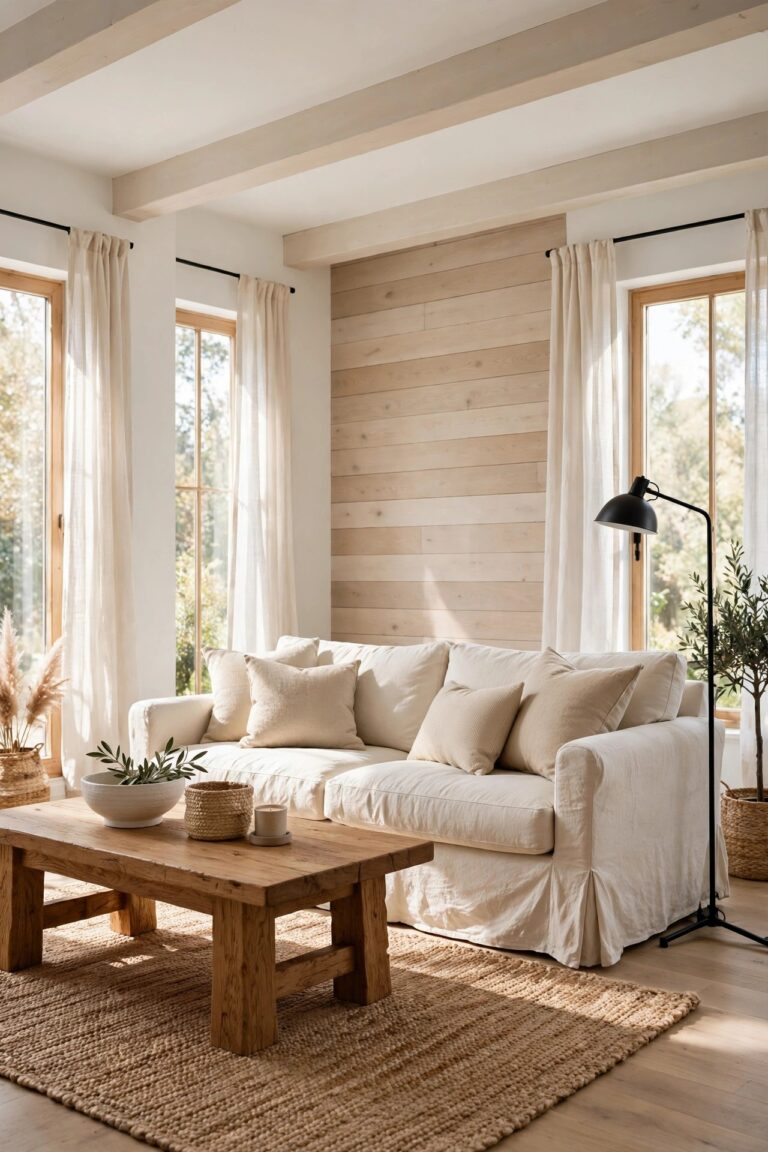
15 Latest Curtain Designs for a Bright Glam Living Room
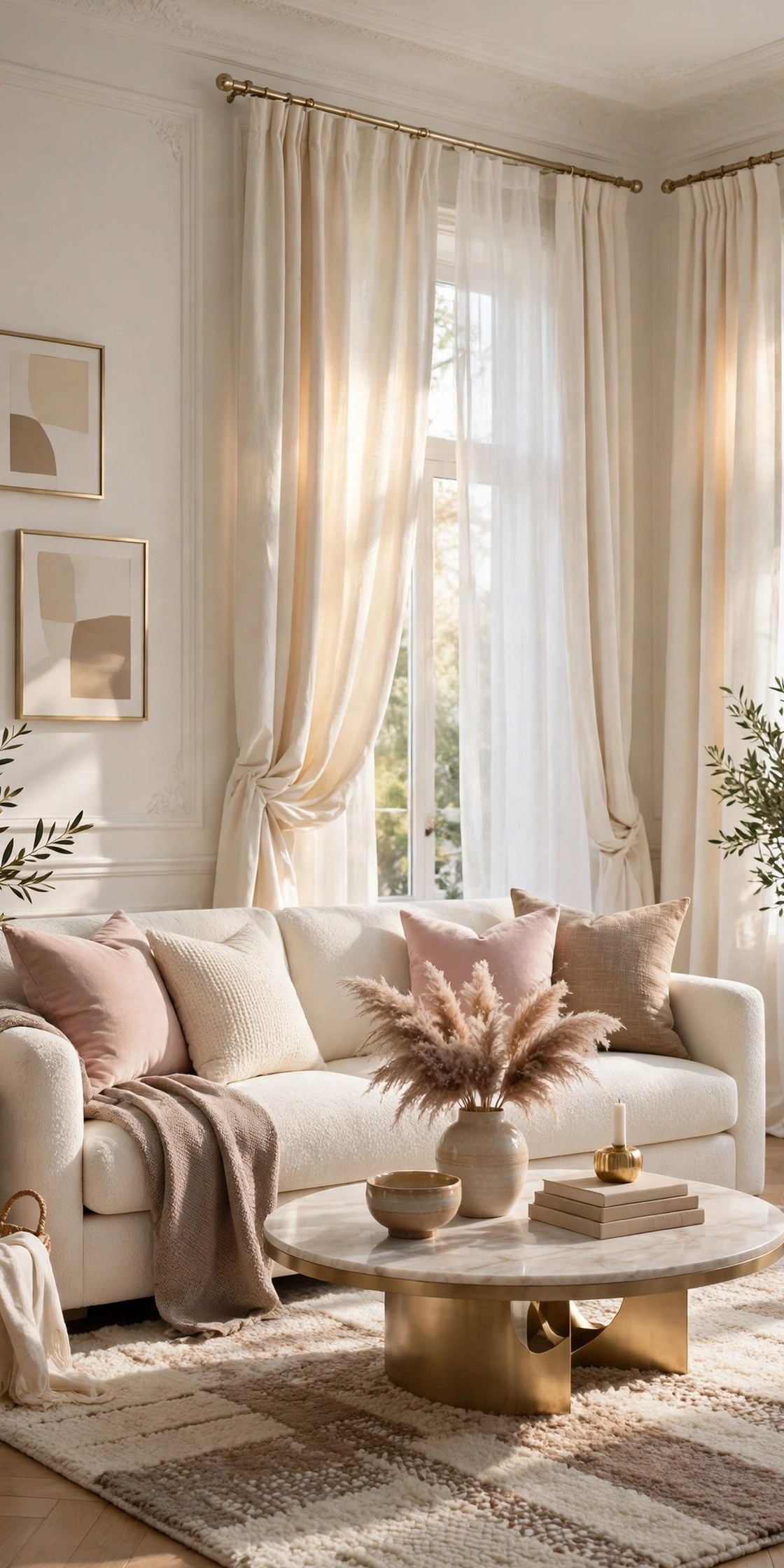
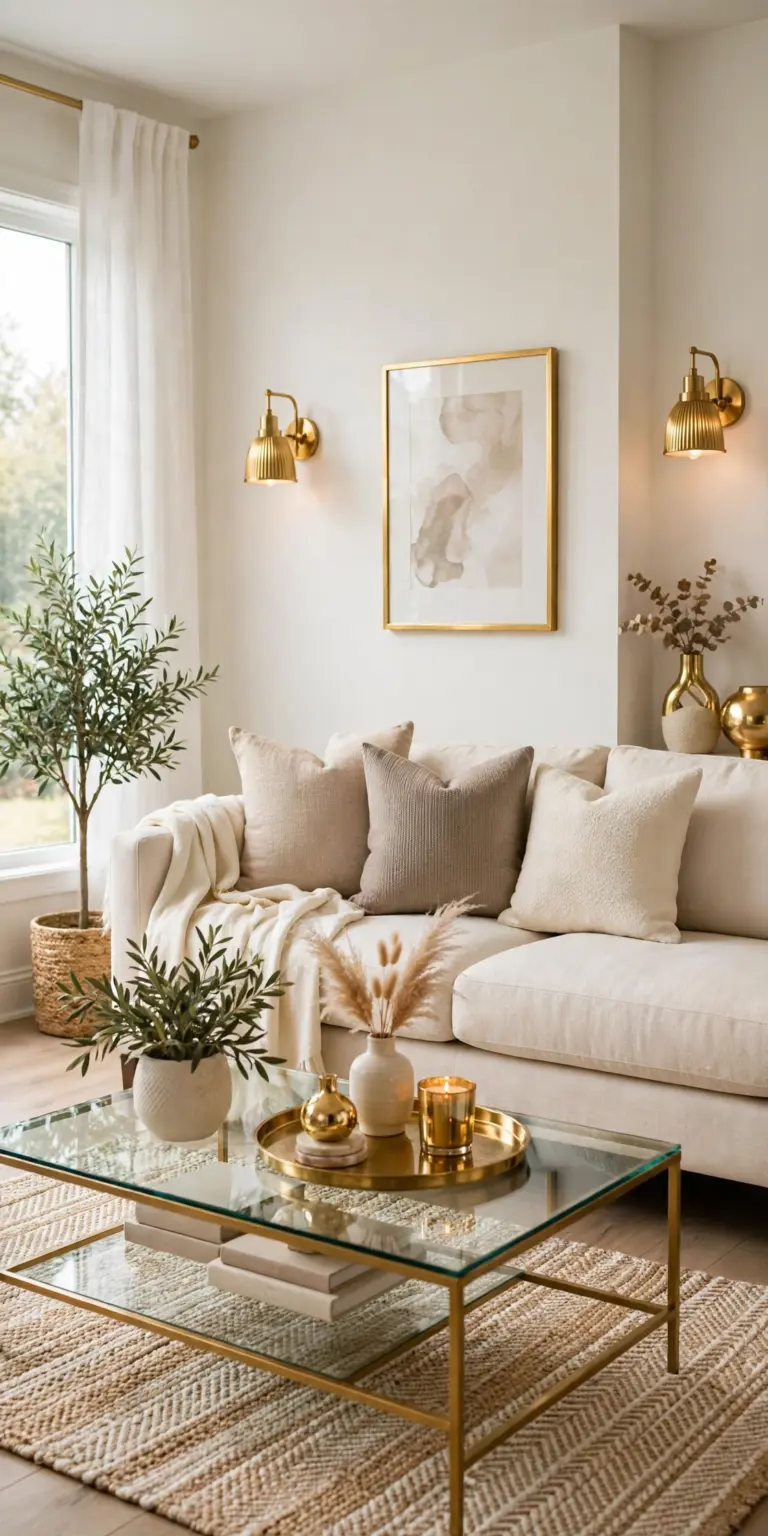
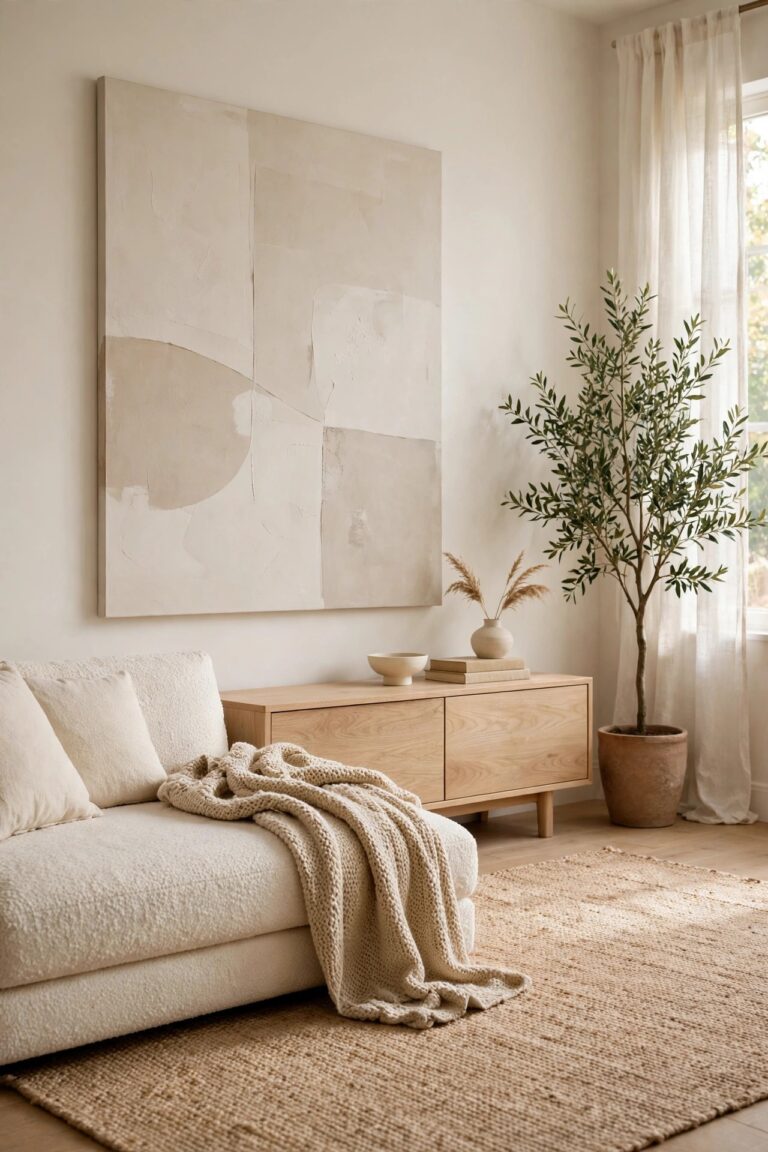
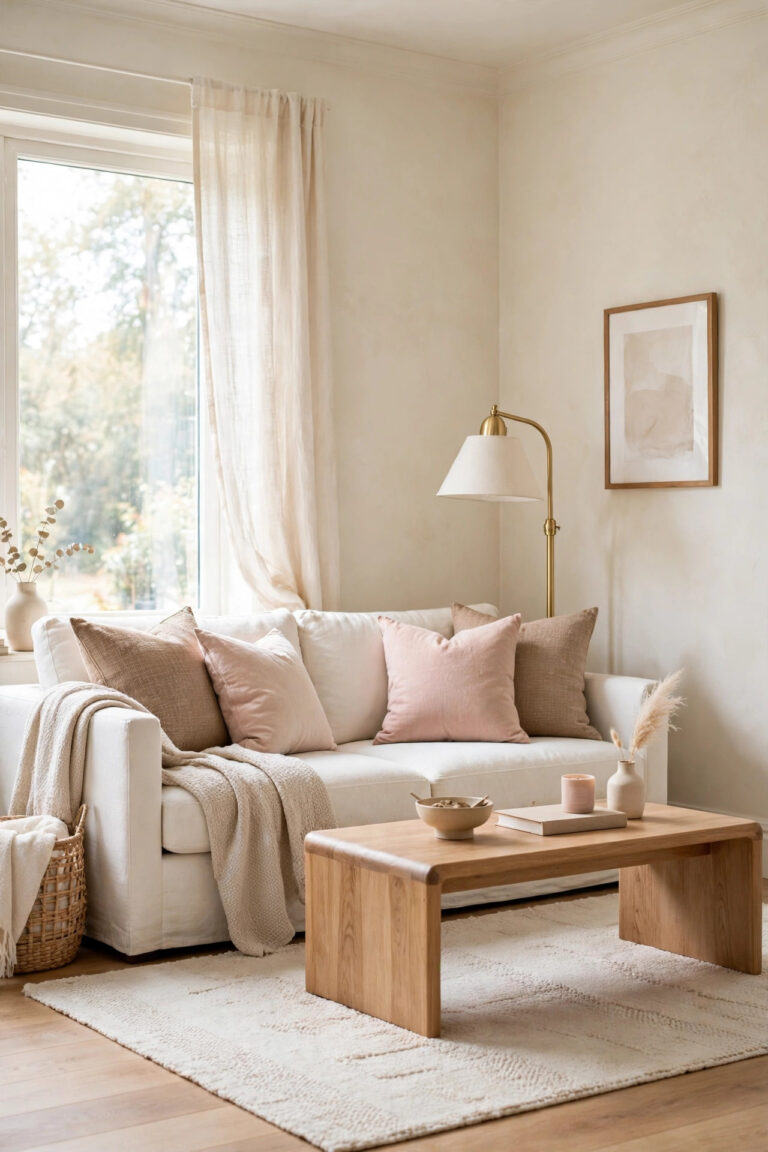
Curtains decide how a room feels before any furniture gets a say. Hang them short and tight to the frame and the window looks mean, the ceiling feels lower, and daylight arrives in one hard block. Hang them high, wide and full, in pale fabrics with soft folds, and the same window looks taller, the light softens, and the whole room settles. These latest curtain designs collect the styles that are working now in bright glam homes: layered sheers, tailored pleats, smooth wave folds, blush velvet, and the hardware and tracks that make fabric hang well. Every design is shown in the same palette, white, cream and warm taupe with blush pink and brushed gold, so the ideas can mix without clashing. If your hardest window is a bay, keep the angled dressing in idea 14 in mind as you read bay window ideas.
Disclosure: This article may contain affiliate links. If you buy through a link on this page, GlamNStyle may earn a small commission at no extra cost to you. Product links in this article are plain links; each one is checked on the retailer’s own page before it is added.
1. Layer Sheer Panels Under Soft Cream Drapes
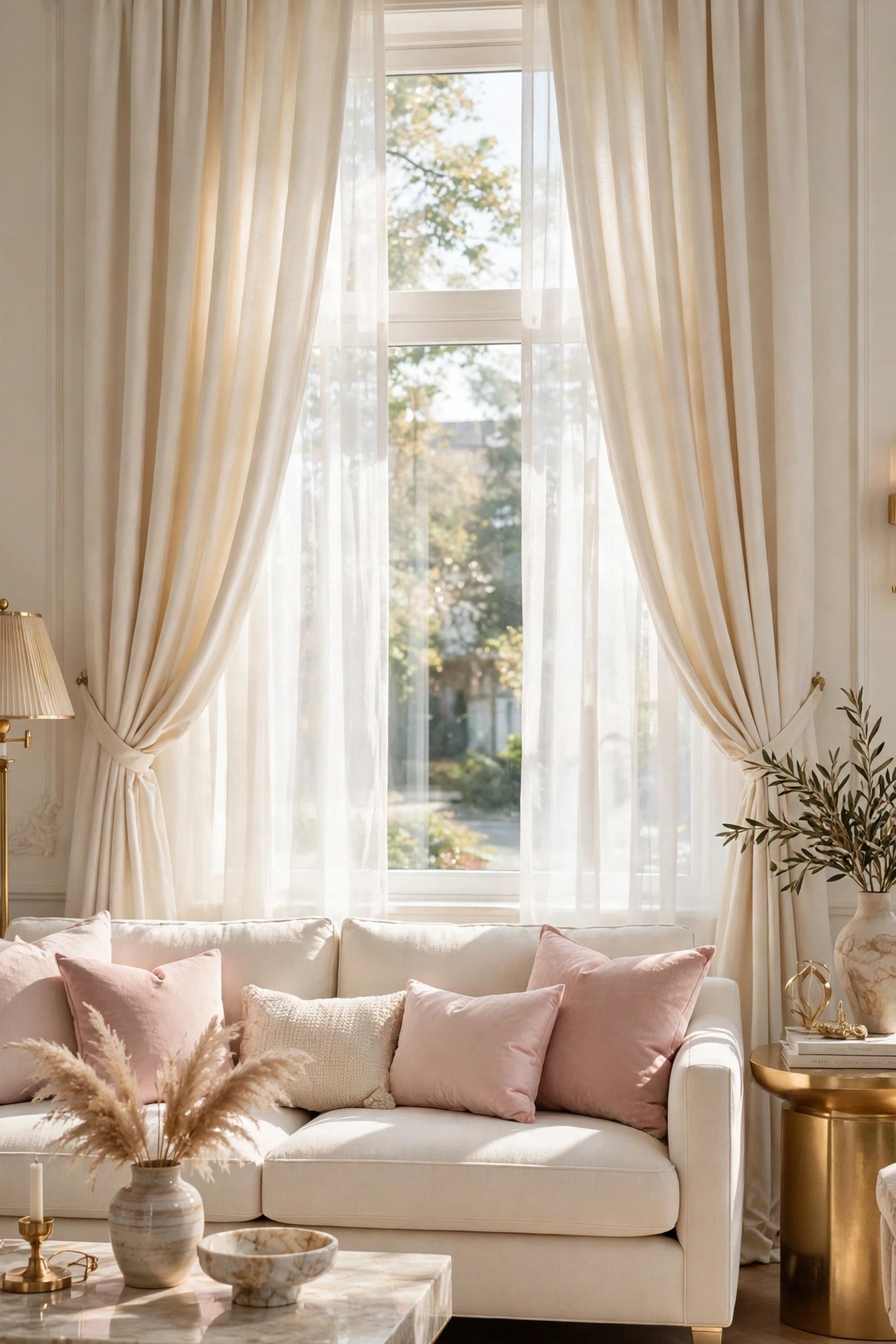
A sheer layer on its own can look unfinished, and a heavy drape on its own can block the light a bright room needs. Layering solves both problems at once. The sheer sits closest to the glass and softens daylight all day, so the room stays private without turning dim.
Best For: Living rooms that face the street or a close neighbour and need daytime privacy without losing light.
Not Ideal For: Windows with radiators directly under the sill that long layered fabric would cover and trap heat against.
Estimated Cost: $90-$220 (estimate) for two sheer panels, two cream drapes and a double rod for one wide window.
Budget Note: Buy the double rod once and well. Sheers are inexpensive to replace, so the hardware is where the lasting value sits.
Renter Friendly: With Conditions
Renter Note: A double rod needs two sets of brackets. Use existing holes where possible, or choose a double tension system for shallow frames.
What You Need
Two sheer panels, two cream drape panels, double curtain rod with brushed gold finish, tape measure, steamer.
Product type to look for: Sheers in a warm white with a soft, linen-like texture rather than a shiny synthetic finish, and drapes wide enough to stack clear of the glass when open.
How To Do It
- Measure the window and choose a double rod at least 12 inches wider than the frame so open drapes cover wall, not glass.
- Hang the sheers on the back rod first and spread them evenly across the full width.
- Hang the cream drapes on the front rod and arrange the folds by hand so they fall in even waves.
- Steam both layers in place, then check the window from outside at night to confirm the privacy level.
Pro Tip
Keep the sheer a half shade warmer than the drape. Two layers in the exact same white can look flat, while a small warmth shift gives the window depth.
2. Choose Pinch Pleat Linen for a Tailored Finish
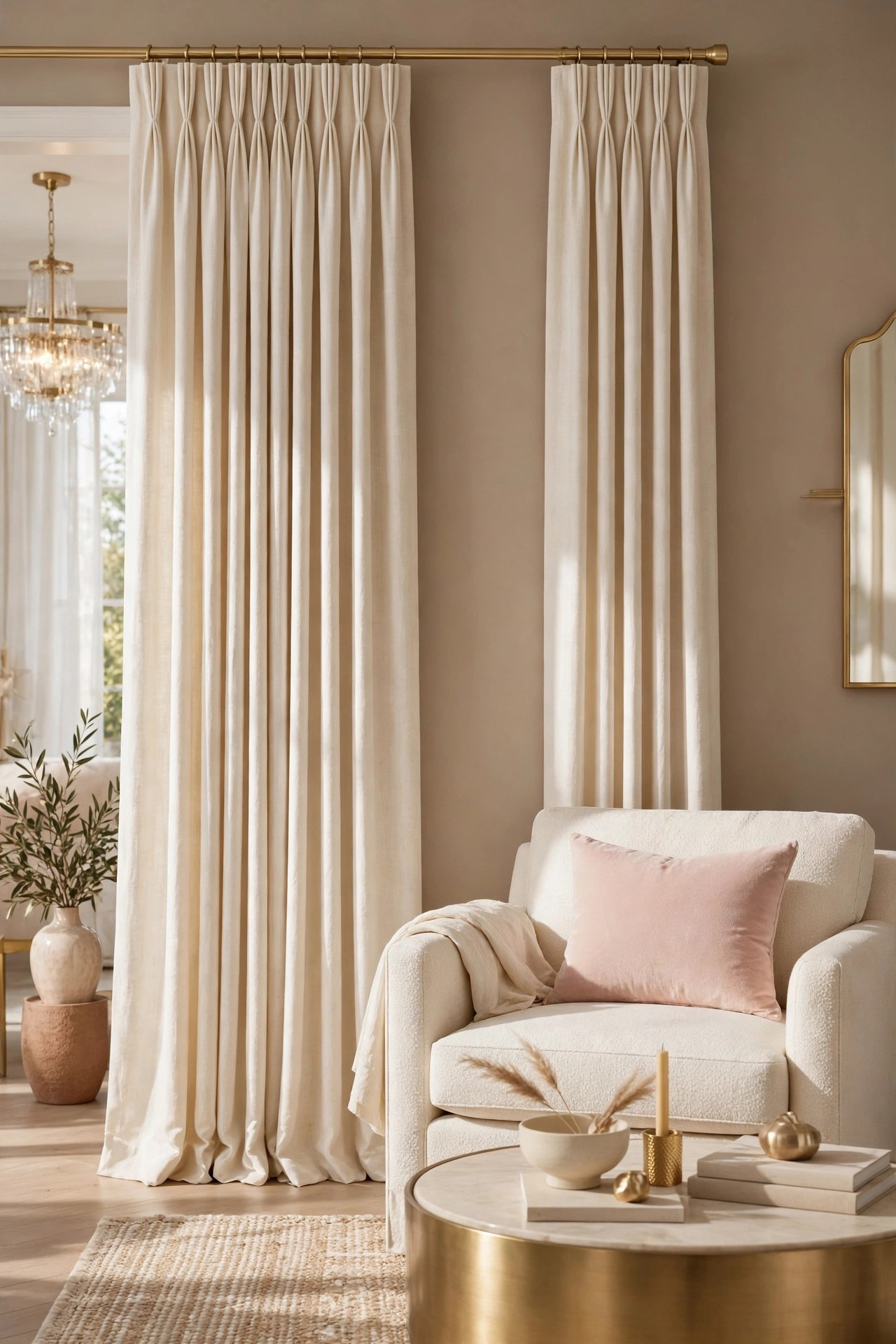
Pinch pleats are the detail that separates curtains that were hung from curtains that were designed. The fabric is gathered into small, even pleats at the top, so the panel falls in regular folds from rod to floor instead of bunching randomly on rings. Linen, or a good linen-look weave, keeps that tailored shape relaxed rather than stiff, and in cream it suits the bright glam palette without competing with the furniture.
Best For: Anyone who wants one classic curtain style that will not date and suits most windows.
Not Ideal For: Very wide windows on a tight budget, because proper pleats need generous fabric width to fold well.
Estimated Cost: $120-$300 (estimate) for a pair of pinch pleat linen-look panels in a standard living room width.
Budget Note: Ready-made pinch pleat panels cost far less than custom pleating and look close when the pleats are dressed by hand after hanging.
Renter Friendly: Yes
Renter Note: The panels hang from a standard rod or track, so nothing about the pleat style itself touches the walls beyond normal rod fixings.
What You Need
Pinch pleat linen or linen-look panels, pleat hooks or rings to suit your rod or track, brushed gold rod, steamer.
Product type to look for: Panels with at least twice the rod width in fabric, stitched or well-formed pleats, and a lining light enough to keep the cream colour bright.
How To Do It
- Measure from the rod to the floor and choose panels that just kiss the floor or clear it by half an inch.
- Fit the pleat hooks evenly, working from the centre of each panel outwards.
- Hang the panels and train the folds by gathering each pleat and smoothing the fabric down its full length.
- Leave the curtains closed for two days so the folds set, then steam lightly to finish.
Pro Tip
Dress the pleats once, properly, on hanging day. Ten minutes of training the folds saves a year of curtains that never quite hang straight.
3. Run Wave Fold Curtains on a Slim Track
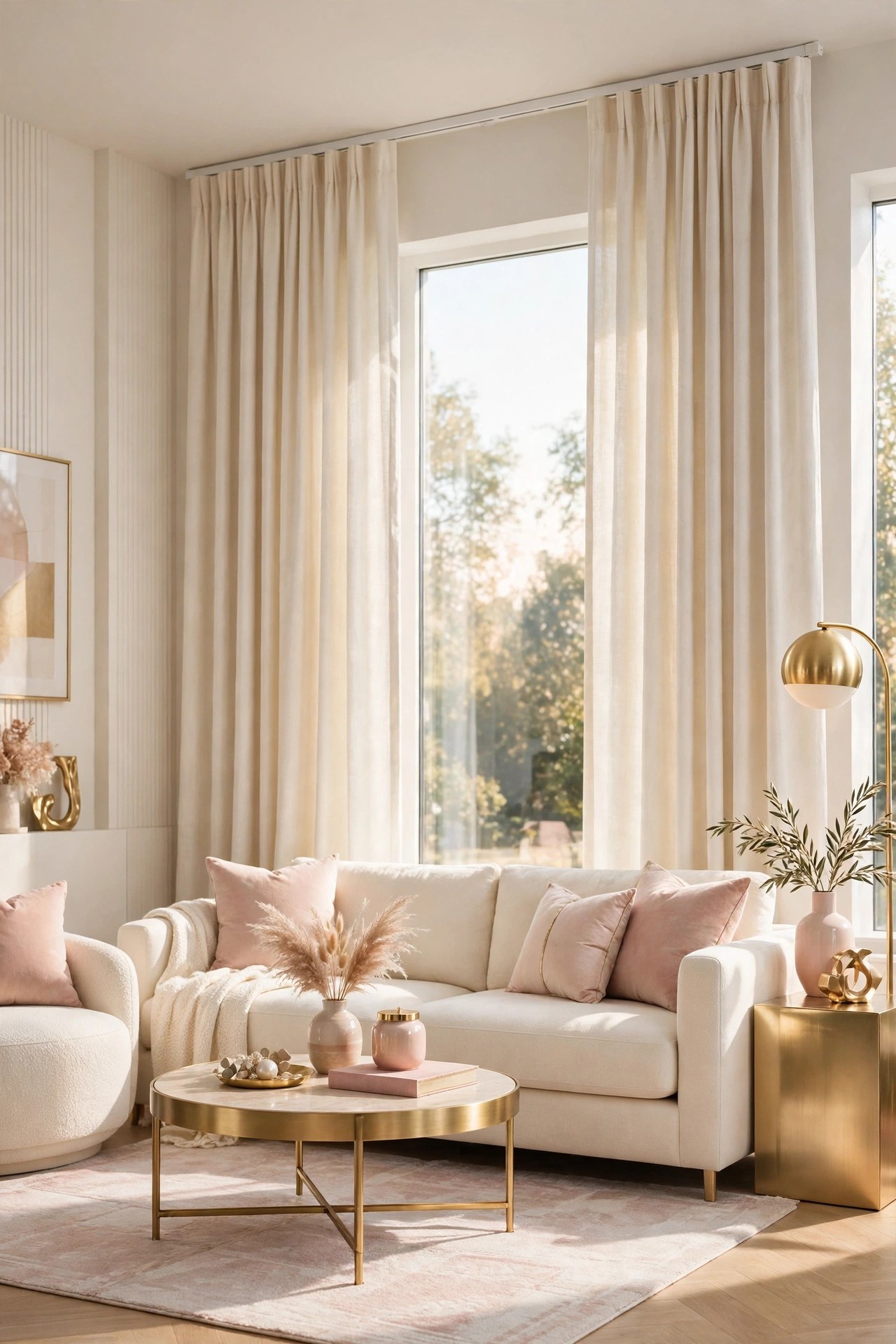
Wave fold curtains move in one smooth, repeating wave from top to bottom, with no pleats, no rings and no bunching. The fabric hangs from a slim track on a cord system that keeps every fold the same width, so the window wall looks calm and architectural. In a bright living room the effect is quiet luxury: a soft, even curtain wall that suits clean-lined furniture and lets the gold and blush accents carry the glamour. See our minimalist living room for the full look.
Best For: Modern living rooms with wide windows or sliding doors and clean, simple furniture lines.
Not Ideal For: Rooms where you want a traditional rod and finials as a visible feature, since the track hides the hardware on purpose.
Estimated Cost: $180-$420 (estimate) for a wave fold track system and panels for one wide window wall.
Budget Note: The track system is the cost, not the fabric. Plain cream panels on a good wave track look more expensive than rich fabric on rings.
Renter Friendly: With Conditions
Renter Note: Ceiling or wall tracks need several screws in a straight line. Agree the fixing with a landlord first, as the holes are more visible than a rod.
What You Need
Wave fold track with gliders and wave cord, cream panels with wave tape header, drill, level, steamer.
Product type to look for: A track with silent gliders and a wave spacing that matches your panel tape, usually 60 or 80 millimetres, confirmed before ordering either part.
How To Do It
- Fix the track level, close to the ceiling, following the maker guide for bracket spacing.
- Thread the gliders and connect the wave cord so the spacing stays even along the whole run.
- Clip or hook the panels onto the gliders, starting from the centre and working out.
- Pull the curtains open and closed several times, then adjust any fold that twists before steaming.
Pro Tip
Order the track and panels as one matched system where you can. Wave fold only looks effortless when the tape, cord and glider spacing were made for each other.
4. Hang Blush Velvet Drapes as the Soft Colour Moment
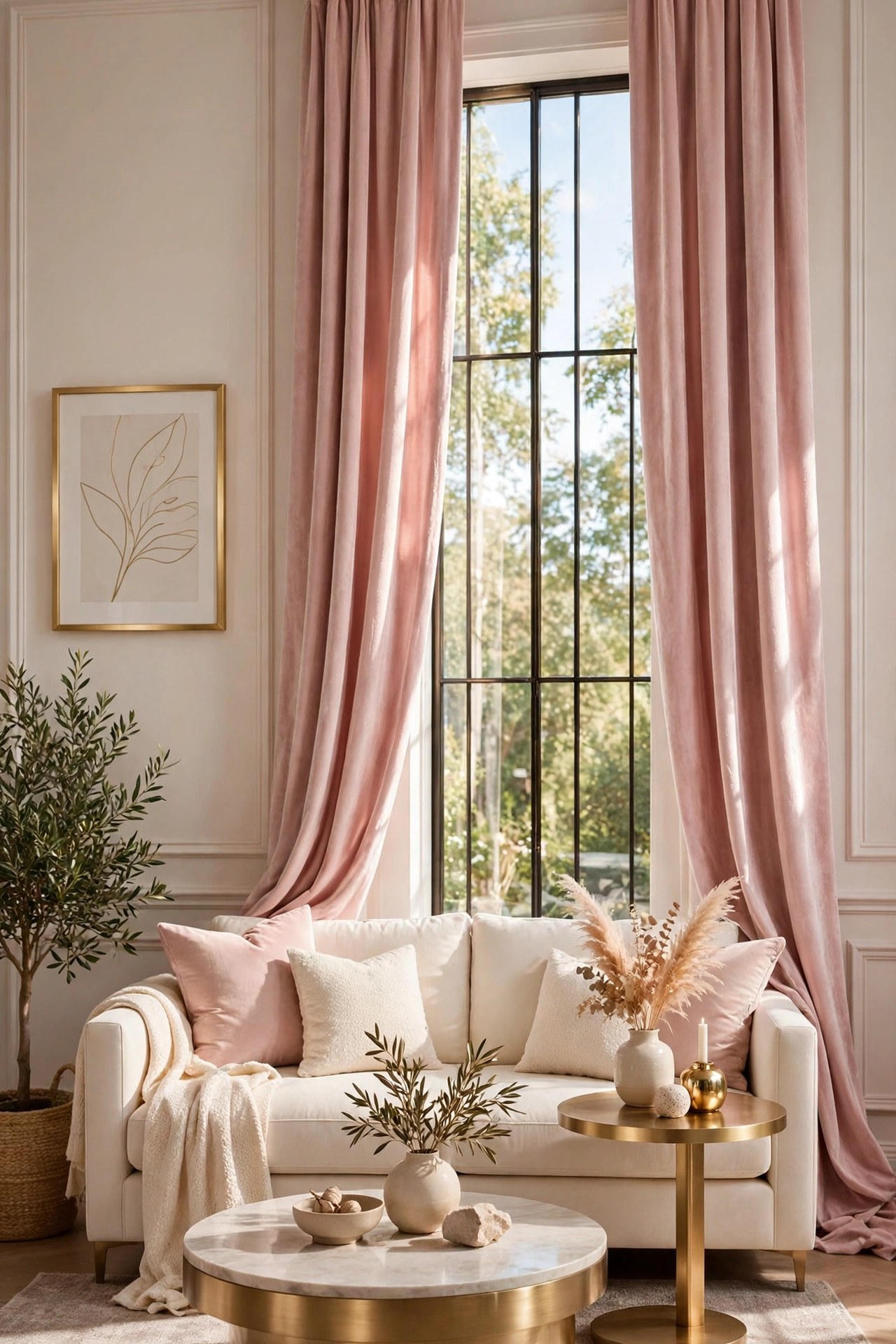
Every bright glam room needs one soft colour moment, and blush velvet drapes do that job at the largest scale in the room. Velvet catches light along its folds, so the blush reads deeper in the shadows and paler at the edges, which gives a plain window wall real depth without pattern. Kept to the window, and balanced by cream furniture and brushed gold hardware, blush stays elegant rather than sweet.
Best For: Neutral living rooms that need warmth and one clear focal point at the window.
Not Ideal For: Dusty or pet-heavy homes where velvet will need frequent gentle cleaning to keep its soft finish.
Estimated Cost: $140-$340 (estimate) for a pair of blush velvet drapes with lining for a standard window.
Budget Note: Velvet-look polyester drapes give most of the light play of cotton velvet at half the price and are easier to wash.
Renter Friendly: Yes
Renter Note: Nothing special is fixed to the room. Velvet is heavier than linen, so check the rod brackets are firmly fixed before hanging.
What You Need
Blush velvet drape panels, sturdy brushed gold rod with strong brackets, fabric brush, steamer on a low setting.
Product type to look for: Velvet with a short, dense pile and a matte finish. Shiny velvet reads cheap in daylight, and a lined back helps the panels hang in clean folds.
How To Do It
- Fix the rod with an extra centre bracket if the window is wide, because velvet weight can bow a long rod.
- Hang the panels and arrange the folds so the light catches each fold edge evenly.
- Brush the pile gently downward with a soft fabric brush to settle the finish.
- Style the room to echo the blush once, in a cushion or throw, and stop there.
Pro Tip
Let the drapes be the only large blush piece. Small repeats in one cushion and one throw are enough, and the window keeps its impact.
5. Dress an Arched Window Without Hiding the Curve
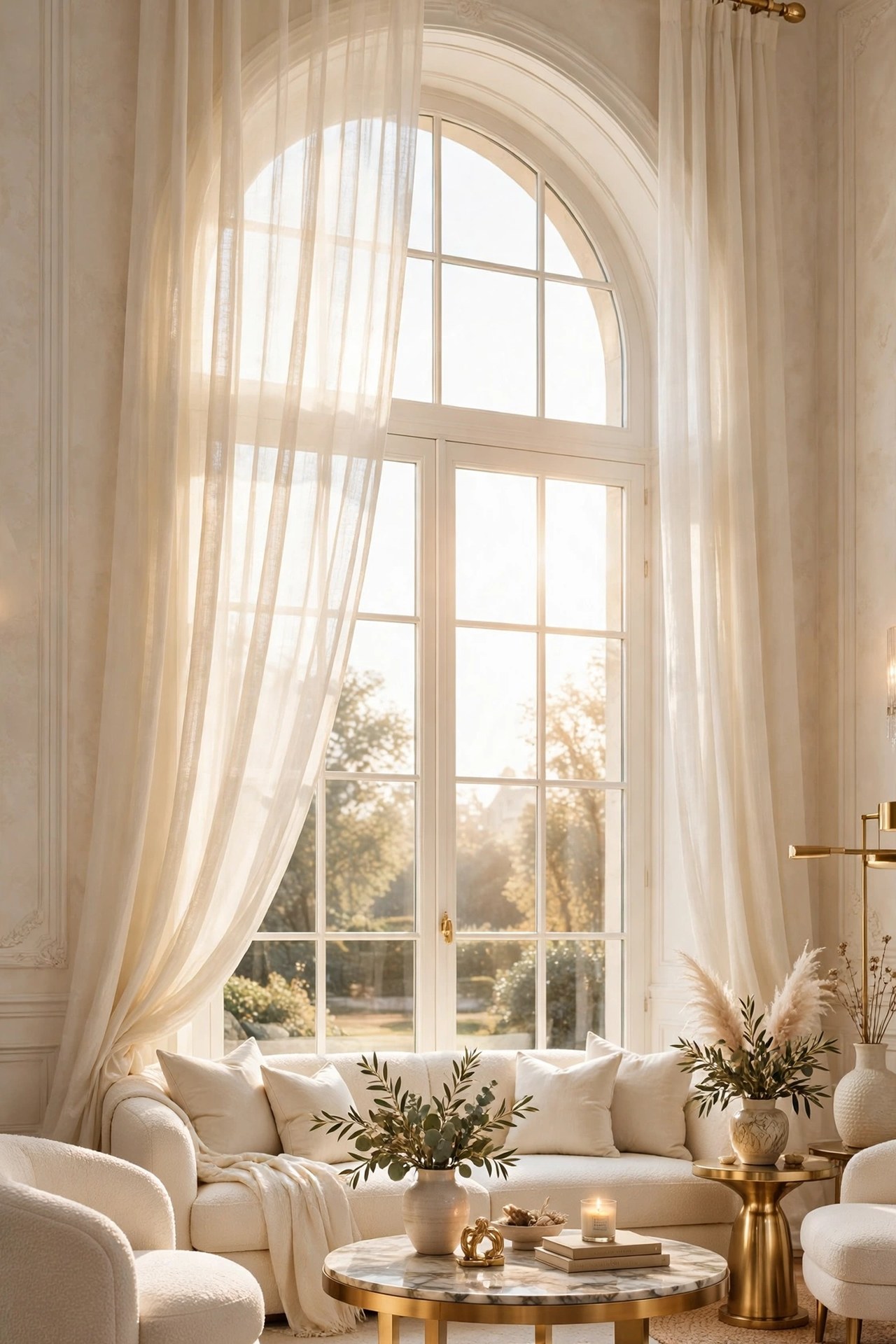
An arched window is architecture, and the most common curtain mistake is covering the curve that makes it special. The current approach is simple: mount a straight rod or track well above the arch, or fit a sheer within the arch itself, so the curved top stays visible and becomes the feature. Full-length cream panels hung from above the arch frame the whole shape and draw the eye up, which suits tall rooms.
Best For: Homes with arched or unusually shaped windows that deserve to stay visible.
Not Ideal For: Arches that are the only source of strong direct sun, where a sheer alone will not control heat or glare.
Estimated Cost: $100-$260 (estimate) for a long rod or track and full-length panels mounted above one arch.
Budget Note: A straight rod above the arch costs a fraction of custom curved hardware and usually looks cleaner in a bright room.
Renter Friendly: With Conditions
Renter Note: Fixings sit higher than usual, above the arch. Check the wall there is solid before drilling, and keep the original holes minimal.
What You Need
Long brushed gold rod or straight track, full-length cream panels, optional fitted sheer for the arch, tall step ladder, level.
Product type to look for: Panels long enough to reach the floor from the higher mounting point. Measure from the new rod height, never from the top of the arch itself.
How To Do It
- Decide the mounting line at least 6 inches above the highest point of the arch.
- Mark and fix the rod or track level across that line, into solid fixing points.
- Hang the panels and check that the full curve of the arch shows between them when open.
- Add the fitted sheer inside the arch only if glare needs softening, cut or chosen to follow the curve.
Pro Tip
Photograph the window from the doorway before fixing anything, with the rod position taped on the wall. The arch should read as one clean shape inside the frame of fabric.
6. Use Cafe Curtains for Privacy on the Lower Half
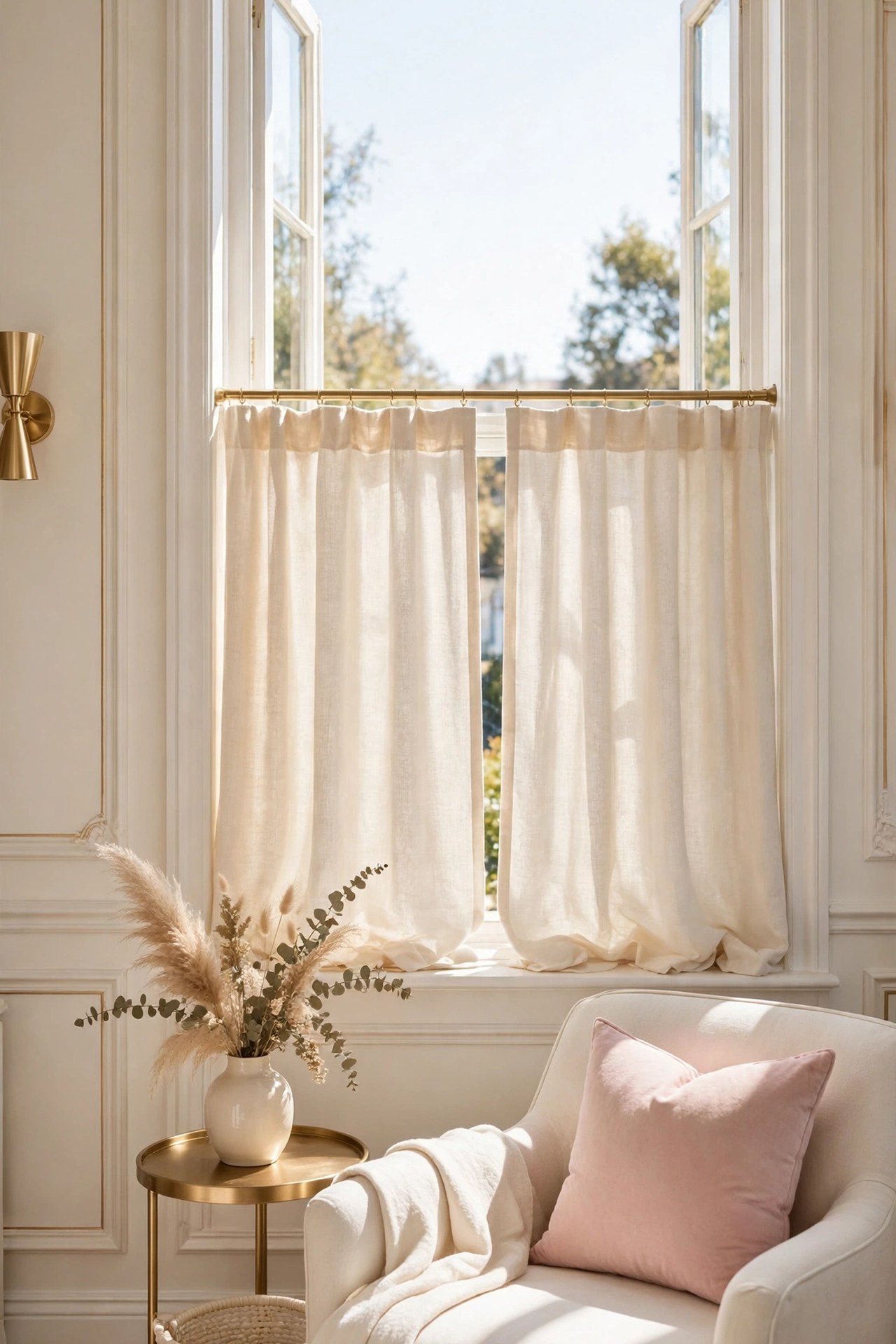
Cafe curtains cover only the lower half of the window, and that simple split solves a specific problem well: privacy at eye level while the top of the window stays open to full daylight. In a street-facing living room, or a bedroom that looks onto a neighbour, the lower panel blocks the view in, while the uncovered top keeps the room bright and the ceiling line clear. Cream linen keeps the look soft and current, and a slim gold rod at mid-window height turns the fixing into a deliberate detail.
Best For: Street-facing living rooms and overlooked bedrooms that need privacy but not darkness.
Not Ideal For: Rooms where privacy is needed at night from above, such as rooms overlooked by taller buildings.
Estimated Cost: $40-$110 (estimate) for cafe panels and a slim mid-window rod for one window.
Budget Note: This is one of the cheapest designs in the list, because the panels use half the fabric of full curtains.
Renter Friendly: Yes
Renter Note: Slim cafe rods can use small screw fixings or, on some frames, clamp and tension options that leave no marks at all.
What You Need
Cafe curtain panels in cream linen or linen-look, slim brushed gold cafe rod, tape measure, small level.
Product type to look for: Panels that finish at the sill or just below it, with enough width for soft gathers rather than a stretched flat look.
How To Do It
- Measure the window and set the rod line just above the mid rail or at seated eye height.
- Fix the slim rod level across the frame or the wall inside the recess.
- Thread or clip the panels on and spread the gathers evenly.
- Check privacy from outside at night with the room lights on, and adjust the gather if any gaps show.
Pro Tip
Pair cafe curtains with a simple blind at the top of the window if night privacy is sometimes needed. The blind stays rolled away by day and the cafe look stays clean.
7. Pair Roman Shades With Floor-Length Panels
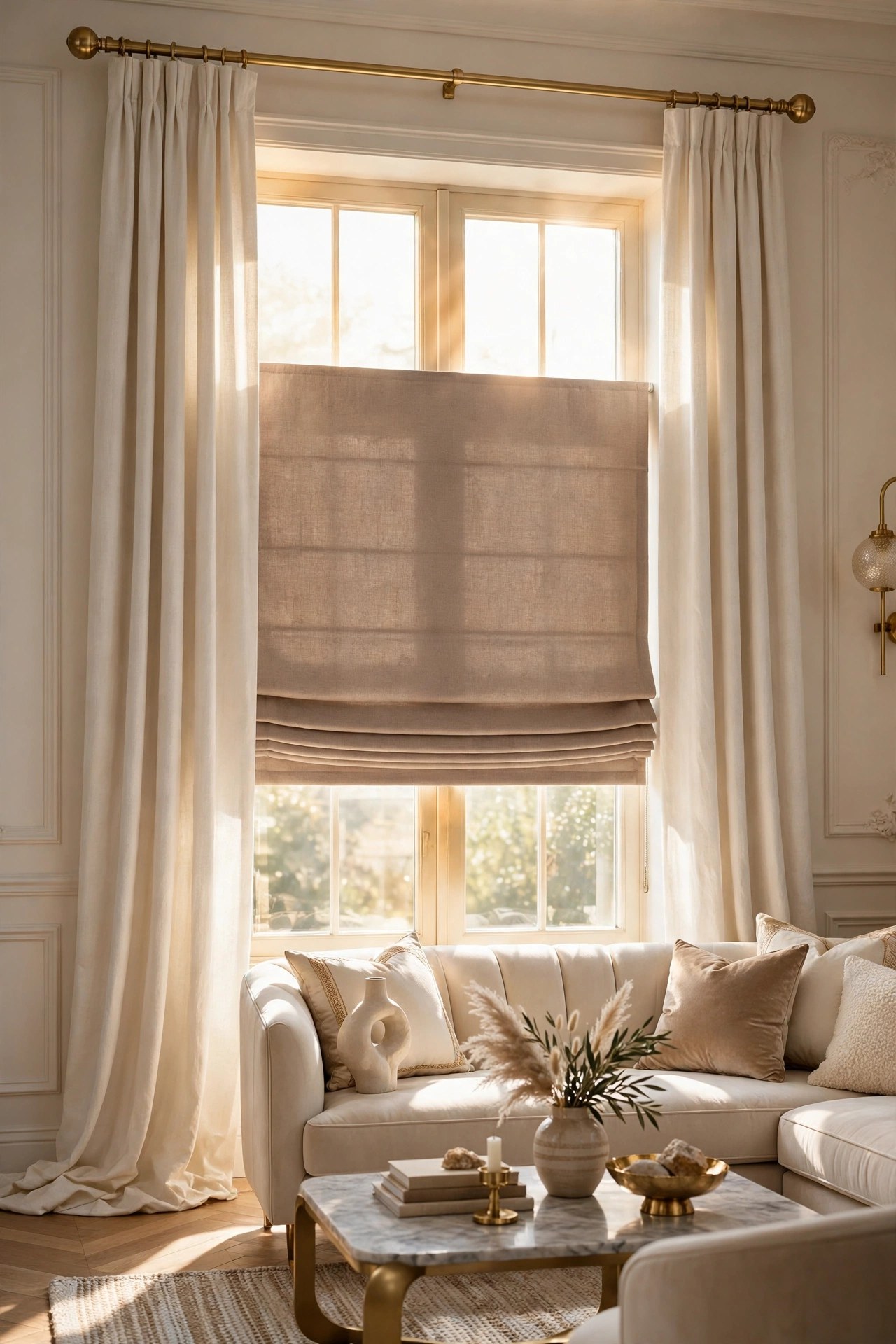
This pairing divides the work of a window between two pieces. The roman shade, fitted inside the frame, does the practical job: privacy, glare control and a neat tailored surface when lowered. The floor-length panels, hanging outside the frame on a gold rod, do the decorative job: height, softness and the glam finish.
Best For: Living rooms and bedrooms that need real light control plus a dressed, finished window look.
Not Ideal For: Renters who cannot fix both a shade and a rod, since this design needs two sets of fixings.
Estimated Cost: $160-$380 (estimate) for one roman shade and a pair of floor-length cream panels with a rod.
Budget Note: Spend on the shade mechanism first. A smooth, well-fitted shade with plain panels looks better than a cheap shade behind rich fabric.
Renter Friendly: With Conditions
Renter Note: Two fixing sets are needed, one for the shade inside the frame and one for the rod. Inside-frame shade brackets leave the smallest marks.
What You Need
Roman shade in warm taupe, floor-length cream panels, brushed gold rod, drill, level, tape measure.
Product type to look for: A shade sized to the inside of the frame with a smooth chain or cordless lift, and panels wide enough to look generous while staying open.
How To Do It
- Fit the roman shade inside the frame first and test the lift through its full range.
- Fix the rod above and beyond the frame so the panels hang clear of the shade.
- Hang the panels and dress them to stack on the wall at each side.
- Set the shade at different heights through the day to find the level that balances light and privacy.
Pro Tip
Keep the shade one tone deeper than the panels. That small step in tone is what makes the layers read as two pieces rather than one blur of cream.
8. Try Soft Botanical Panels for Gentle Pattern
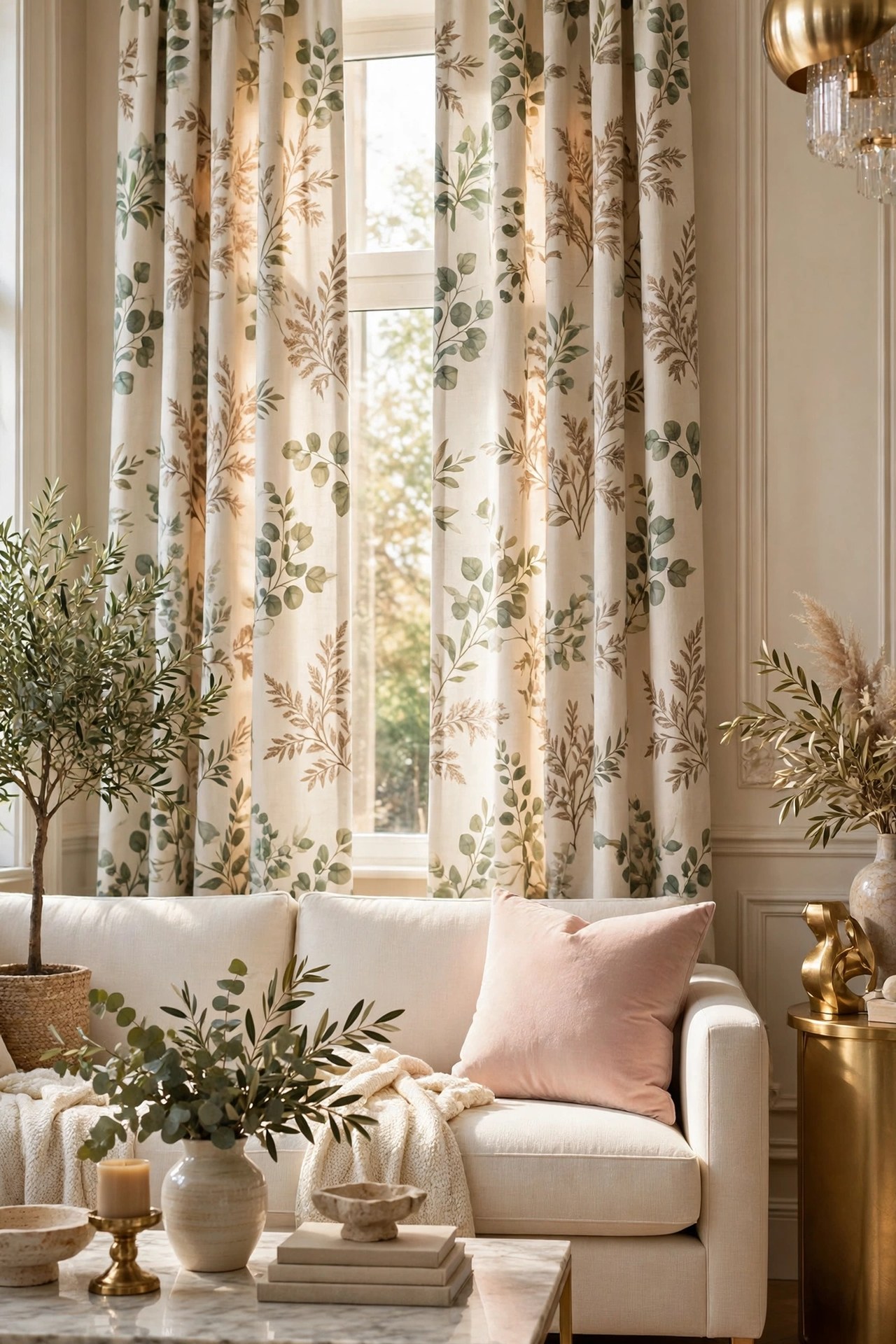
Pattern belongs in a bright glam room when it stays soft, and the newest botanical panels do exactly that: leafy stems and gentle floral lines in warm taupe, cream and muted sage on a pale ground. The print adds movement to a plain window wall without the hard contrast that would fight the palette. Hung full-length and kept to the window, botanical panels suit living rooms that feel a little flat in all plain fabrics, and they pair naturally with plain cream sheers behind them. See our farmhouse living room for more relaxed looks.
Best For: Plain, pale living rooms that need gentle pattern and a softer, garden-led feel.
Not Ideal For: Rooms that already carry pattern in a rug, cushions and art, where printed curtains would compete.
Estimated Cost: $90-$240 (estimate) for a pair of botanical print panels in a standard width.
Budget Note: Printed panels in a linen-look weave are widely available at ready-made prices. Spend the saving on length so the print falls without a break.
Renter Friendly: Yes
Renter Note: Standard hanging with no special fixings. Keep the receipt and the plain sheers as a fallback if a future landlord prefers a plainer look.
What You Need
Botanical print panels, plain cream sheers, brushed gold rod, steamer, sample swatch if ordering online.
Product type to look for: A print in warm taupe, cream and soft sage or blush tones with a pale ground, in a scale that suits the window: larger stems for tall windows, smaller sprigs for small ones.
How To Do It
- Hold the swatch or panel against the sofa and rug in daylight and check the tones sit inside the room palette.
- Hang the sheers first, then the printed panels on the front rod or rings.
- Arrange the folds so the print shows in soft waves rather than stretched flat.
- Step back to the doorway and confirm the curtains still read pale overall, with pattern as the detail.
Pro Tip
Order one panel first if you are unsure. Pattern confidence is hard to judge from a small online photo, and one panel in real daylight settles it.
9. Treat the Gold Rod and Finials as Jewellery
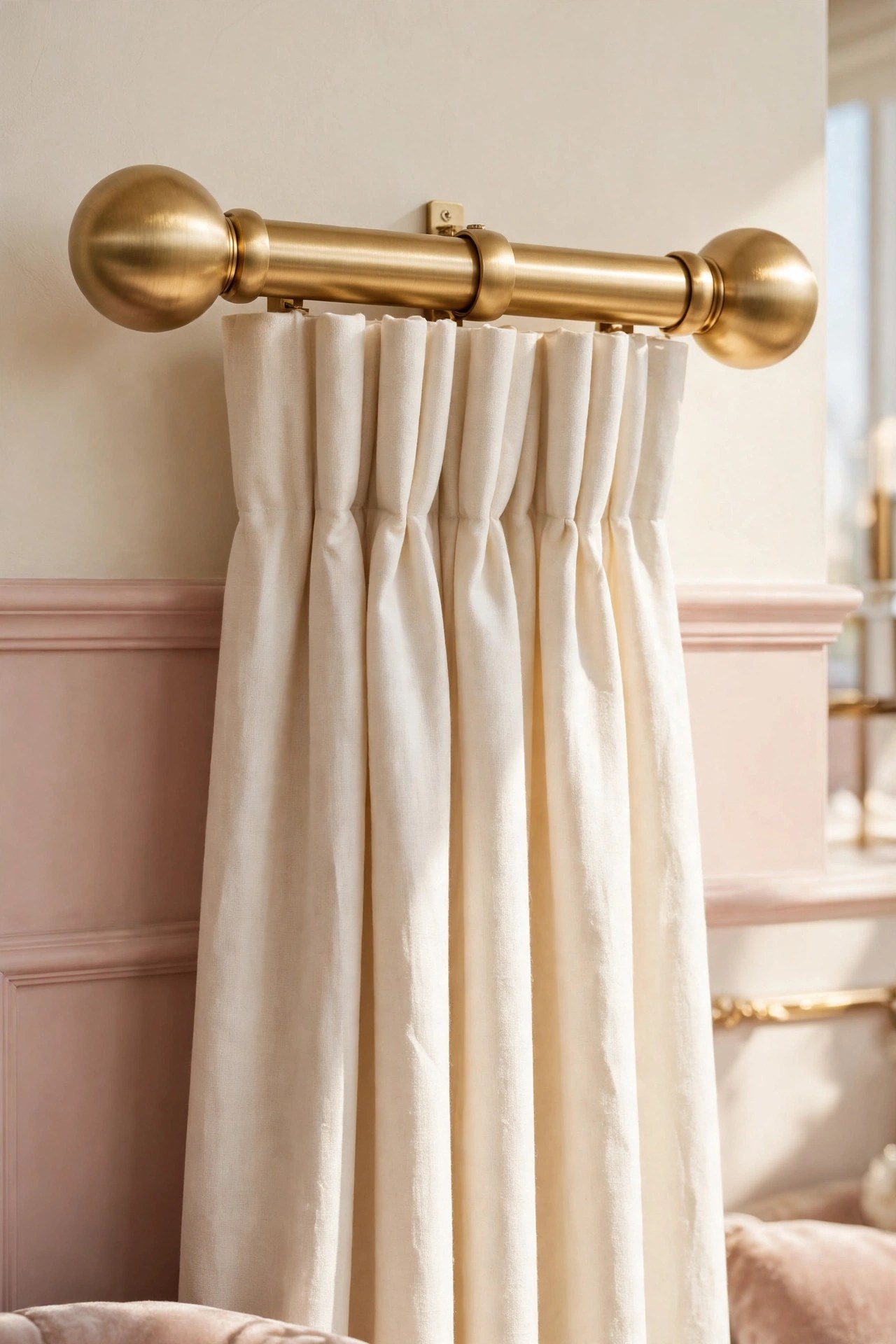
Hardware is the part of a curtain most people buy last and notice first. A brushed gold rod with well-shaped finials sits above the fabric like jewellery above an outfit: a small amount of metal that lifts everything under it. In the bright glam palette, brushed gold is the thread that ties curtains to sconces, mirror frames and table legs, so the window stops being a separate decision and joins the room scheme.
Best For: Rooms where other brushed gold accents already exist and the window needs to join the scheme.
Not Ideal For: Rooms with chrome or black hardware throughout, where one gold rod would sit alone and look accidental.
Estimated Cost: $45-$130 (estimate) for a brushed gold rod with finials and brackets for one window.
Budget Note: Hardware is a small spend with a large effect. A good rod under plain panels looks richer than an unseen cheap rod under costly fabric.
Renter Friendly: With Conditions
Renter Note: Rods need bracket screws, but the hardware itself is fully removable and can move to the next home, which makes it a good renter investment.
What You Need
Brushed gold curtain rod, finials, matching brackets and rings if used, drill, level, tape measure.
Product type to look for: A rod diameter that suits the fabric weight, a brushed or satin finish rather than polished shine, and finials sized in proportion to the window width.
How To Do It
- Choose the rod length so the finials sit beyond the window frame with the curtains stacked clear of the glass.
- Fix the brackets level, checking from across the room rather than close up.
- Thread the curtains, fit the rod, then add the finials last so nothing is scratched during hanging.
- Wipe the rod and finials with a dry cloth to remove fingerprints before the final check.
Pro Tip
Match the gold tone to the nearest other metal in the room, not to a photo online. Brushed gold varies by maker, and side-by-side in daylight is the only honest test.
10. Mount Tracks at the Ceiling for a Hotel Finish
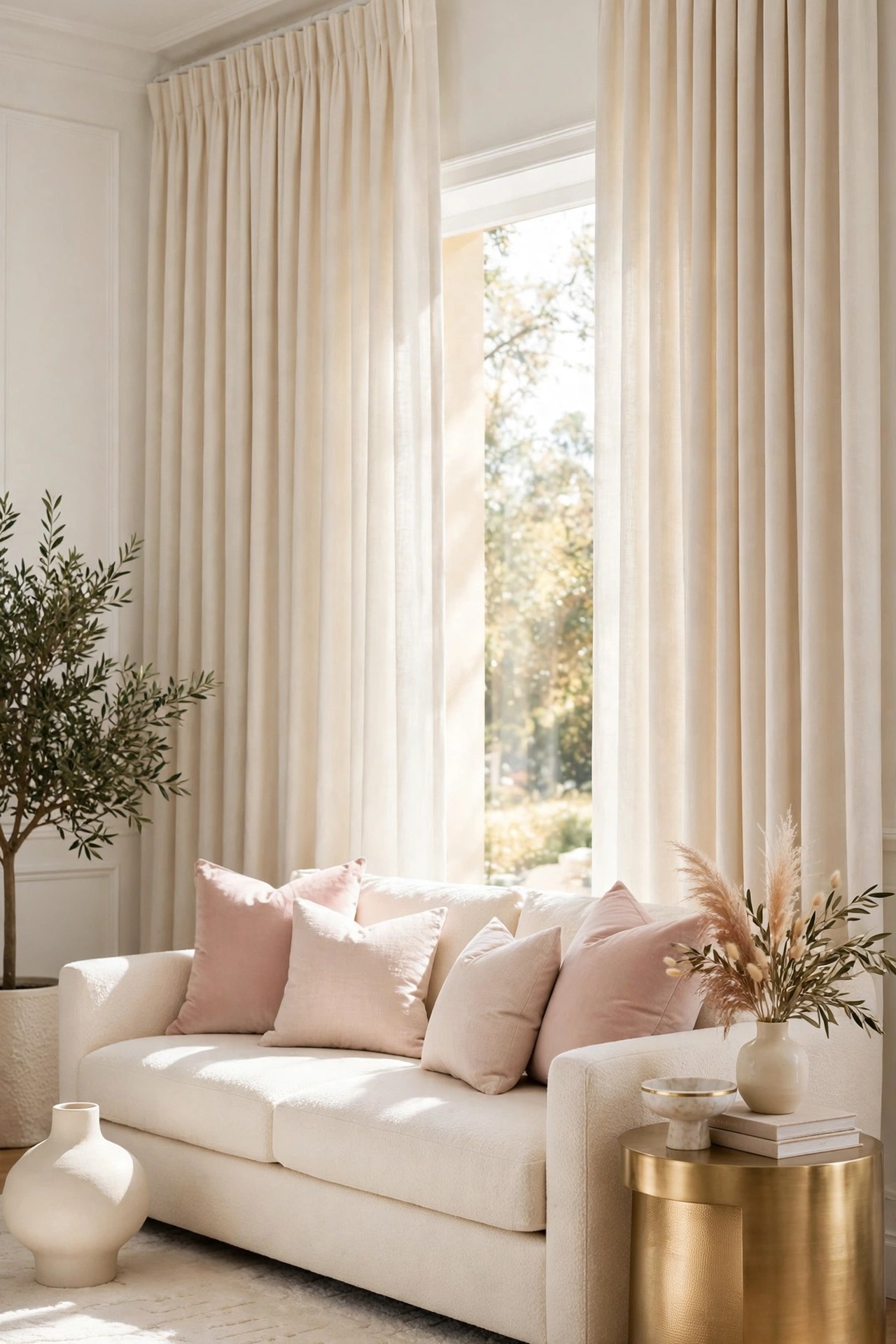
Ceiling-mounted tracks are how good hotels make windows look taller than they are. The curtain starts at the ceiling line and falls in one unbroken length to the floor, so the wall between the top of the window and the ceiling disappears behind fabric and the whole window wall gains height. With the track fixed to the ceiling, there is no rod to see and no gap of wall above the curtains collecting visual clutter.
Best For: Living rooms with low or ordinary ceilings and windows that sit well below the ceiling line.
Not Ideal For: Ceilings that cannot take fixings, such as some ornate plaster or suspended ceilings, until their structure is checked.
Estimated Cost: $120-$300 (estimate) for a ceiling track and full-length panels for one window wall.
Budget Note: Plain cream panels are the right partner here, because the height is the effect. Save patterned or velvet budgets for standard rods.
Renter Friendly: With Conditions
Renter Note: Ceiling fixings leave a line of small holes that are harder to hide than wall holes. This is a landlord-permission design in most rentals.
What You Need
Ceiling curtain track, full-length cream panels, drill, ladder, level or chalk line, steamer.
Product type to look for: A track rated for the full weight of lined panels, with gliders that run quietly, and panels measured from ceiling to floor with no shortfall.
How To Do It
- Mark the track line on the ceiling, parallel to the window wall and far enough out to clear the sill and any radiator.
- Fix the track into joists or with ceiling fixings rated for the load, following the maker spacing guide.
- Hang the panels and check the fall is straight from ceiling to floor along the whole width.
- Steam in place and confirm the hem just touches the floor evenly, with no high corners.
Pro Tip
Take the track wall to wall where the window wall is short. A ceiling track that spans the full wall turns the whole end of the room into curtain, and the effect is striking.
11. Pick Blackout-Lined Panels for a Glam Bedroom
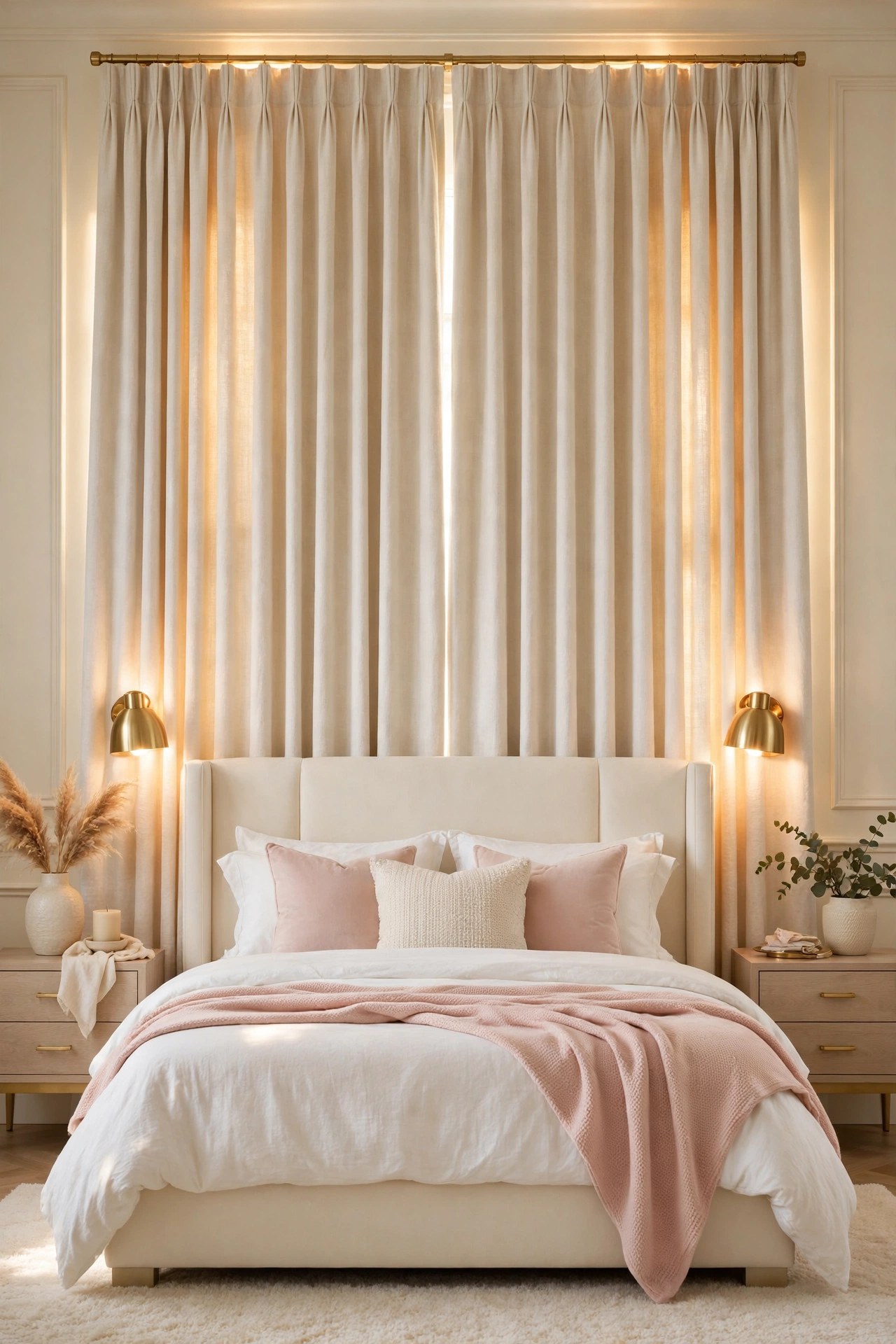
This design is bedroom based, and it starts from sleep rather than looks. A blackout lining behind a cream or blush glam panel blocks early morning light and street light at night, while the face fabric keeps the room in the same bright palette as the rest of the home. The lining also gives the panels body, so they hang in fuller folds and insulate the window against heat and cold.
Best For: Bedrooms that get early sun, street light, or both, where sleep quality is the priority.
Not Ideal For: Living rooms that rely on the window for all their daylight and rarely need darkness.
Estimated Cost: $130-$320 (estimate) for a pair of blackout-lined panels in cream or blush for a bedroom window.
Budget Note: Ready-made blackout-lined panels are good value. Check the lining claim carefully, because dim-out is not the same as blackout.
Renter Friendly: Yes
Renter Note: The panels hang from a normal rod. Their extra weight needs firm brackets, but nothing about the lining changes the fixings.
What You Need
Blackout-lined curtain panels, sturdy rod with firm brackets, torch or phone light for testing, steamer.
Product type to look for: Panels with a separate blackout lining layer rather than a coating on the face fabric, in cream or blush, wide enough to overlap at the centre and the wall edges.
How To Do It
- Hang the panels and close them fully in daylight for the first test.
- Check for light leaks at the centre, sides and top, using a torch from outside if a helper is available.
- Adjust the rod height or add a simple overlap at the centre if light lines show.
- Open the panels wide by day and confirm the room still reads bright and pale with them stacked.
Pro Tip
Return light at the top is the usual leak. A rod fitted closer to the ceiling, or panels hung a little higher, closes most of it without extra products.
12. Let Ombre Panels Fade From Cream to Blush
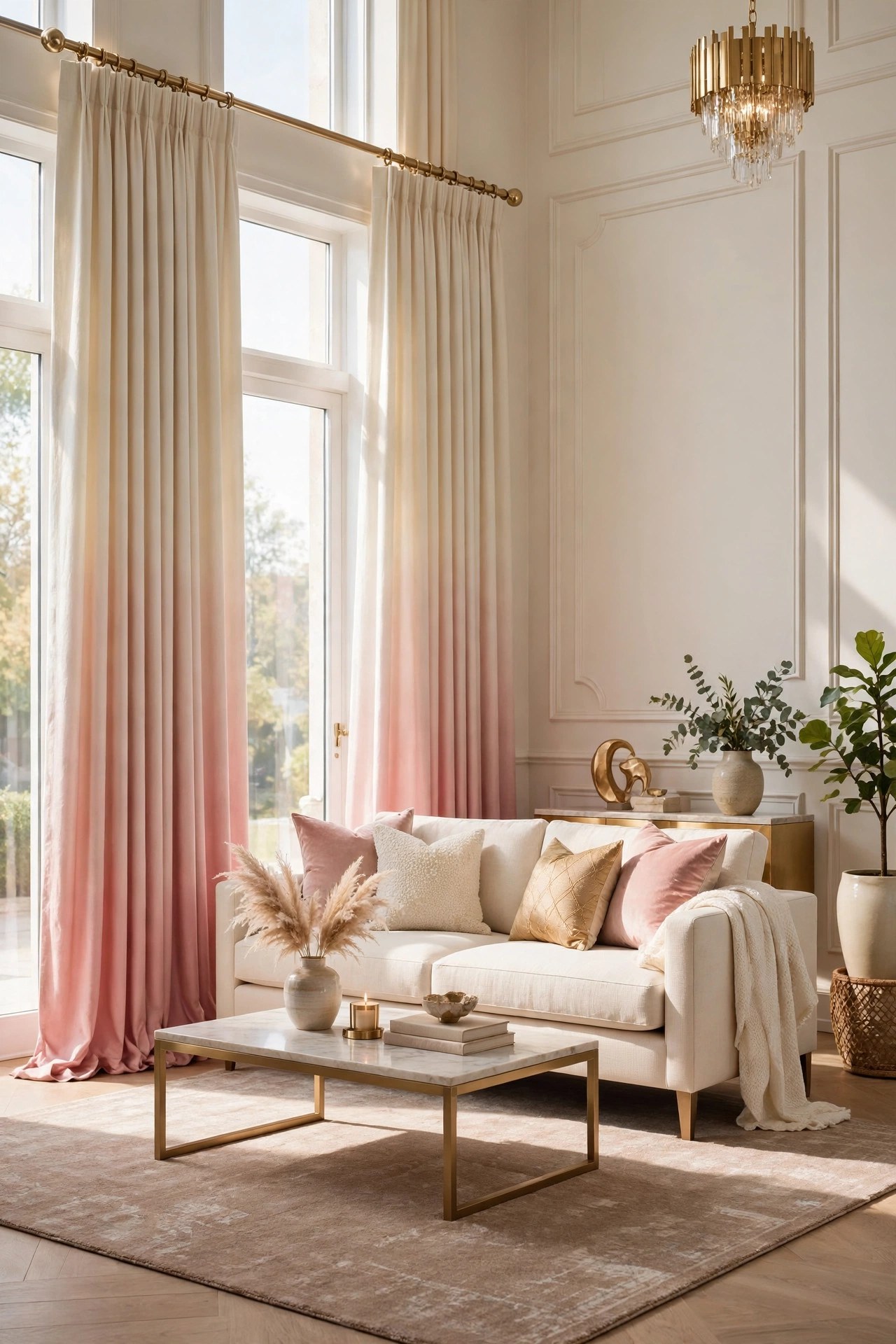
Ombre panels carry a gentle colour fade through the fabric, most often from cream at the top to soft blush at the hem in this palette. The effect puts the colour low, near the floor and the furniture, while the top of the window stays pale and light, which keeps the room bright where the eye meets the daylight. It is a current, playful design that still behaves inside a glam scheme, because the fade is soft and the tones are the room tones.
Best For: Bright living rooms with tall, fully visible windows and pale furniture that needs a soft colour base.
Not Ideal For: Windows mostly hidden behind sofas or cabinets, where the fade would be cut off and read as two-tone instead.
Estimated Cost: $80-$210 (estimate) for a pair of ombre panels in a standard living room size.
Budget Note: Ombre is a print effect, so ready-made prices are fair. Spend care on matching the pair, since uneven fades between panels are obvious.
Renter Friendly: Yes
Renter Note: Standard hanging, no special fixings. Keep the room accents in the same blush family so the fade looks planned if you move the curtains later.
What You Need
Ombre curtain panels, brushed gold rod, steamer, one blush cushion or throw to echo the hem tone.
Product type to look for: A gradual fade with no hard line, in cream to blush or cream to warm taupe, with both panels fading at the same height when hung as a pair.
How To Do It
- Hang both panels before steaming and check the fade levels match at the same height on each side.
- Adjust the rod or panel drop if one fade sits higher than the other.
- Steam gently from the top down, following the gradient.
- Echo the hem colour once in the room, in a cushion or throw at the same end of the space.
Pro Tip
Check the pair in daylight before cutting or hemming anything. A small height difference that is invisible in the packet becomes the first thing you see once they hang.
13. Add a Border Trim for a Custom Look on Plain Panels
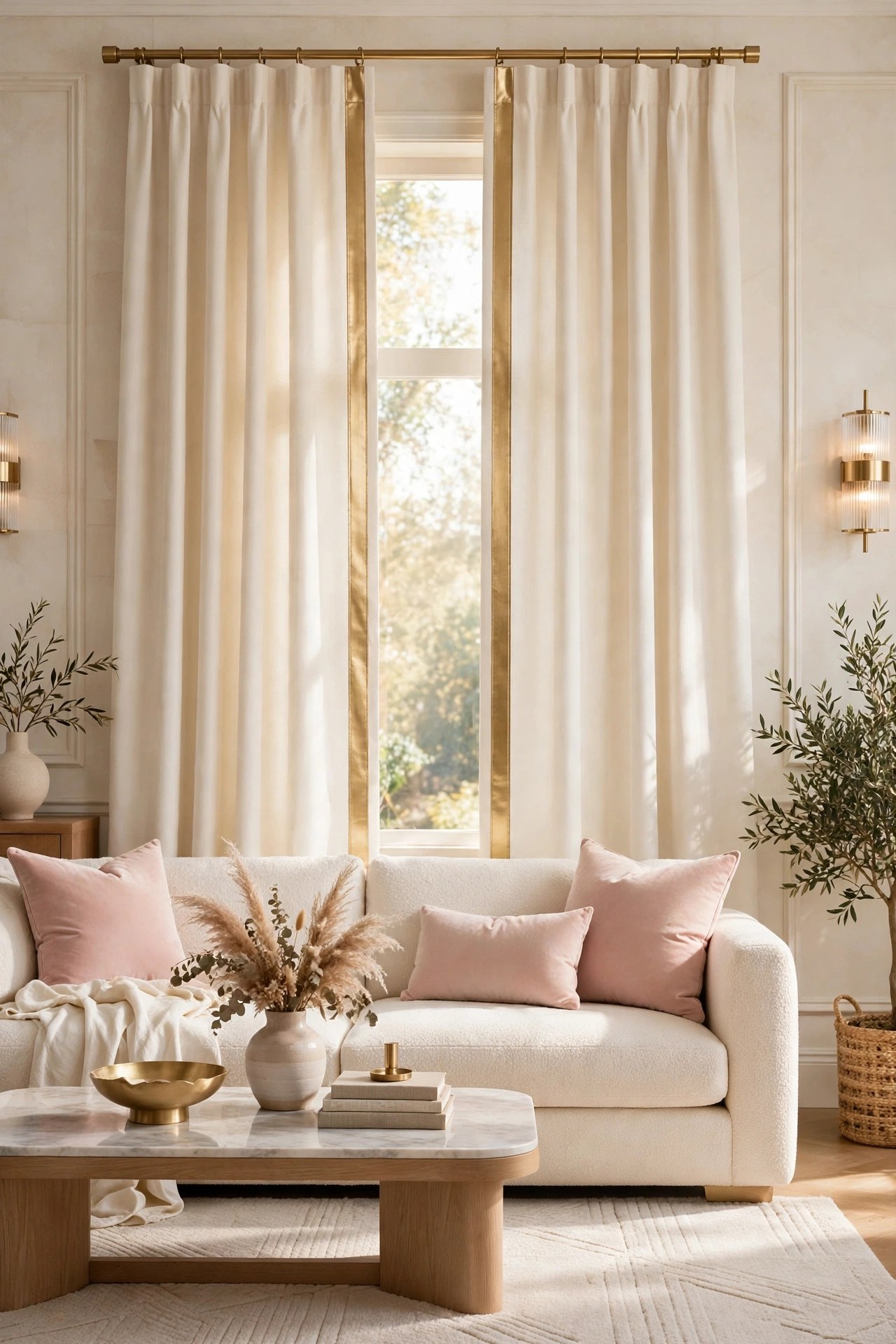
A border trim is the simplest way to make plain panels look custom. A band of fabric or braid, in brushed gold tones, warm taupe or soft blush, is applied along the inner edge or the hem of a cream panel, and that single line gives the curtain a finished, tailored outline when it hangs and when it moves. Trim sharpens plain fabric without the commitment of a full print, and it can be added to ready-made panels, which keeps the cost down.
Best For: Plain cream panels that look almost right but need a finished, deliberate detail.
Not Ideal For: Heavily patterned panels, where a trim line would fight the print instead of framing it.
Estimated Cost: $60-$170 (estimate) for ready-made panels plus trim, or trimmed panels bought ready-finished.
Budget Note: This is the best value custom look in the list. Trim and plain panels together cost far less than fully bespoke curtains.
Renter Friendly: Yes
Renter Note: If you add trim to panels you own, use a stitch or fabric method you can remove before moving or reselling the panels.
What You Need
Plain cream panels, border trim or braid in gold, taupe or blush, fabric tape measure, pins, iron or sewing basics if applying your own.
Product type to look for: A trim no wider than about 2 inches for most windows, in a matte or brushed finish, fixed flat so the panel edge does not pucker or wave.
How To Do It
- Decide the trim position: inner leading edge is the classic choice, hem is the quieter one.
- Pin or tape the trim along one panel and hang it to check the line in real light before fixing both.
- Fix the trim with neat stitching or a suitable fabric method, keeping the line straight.
- Hang the pair and check the two trim lines sit parallel when the curtains are closed.
Pro Tip
Trim the leading edge only. Trimming every edge can look busy, while one clean line at the opening is the detail people actually notice.
14. Dress a Bay Window With Panels at Each Angle
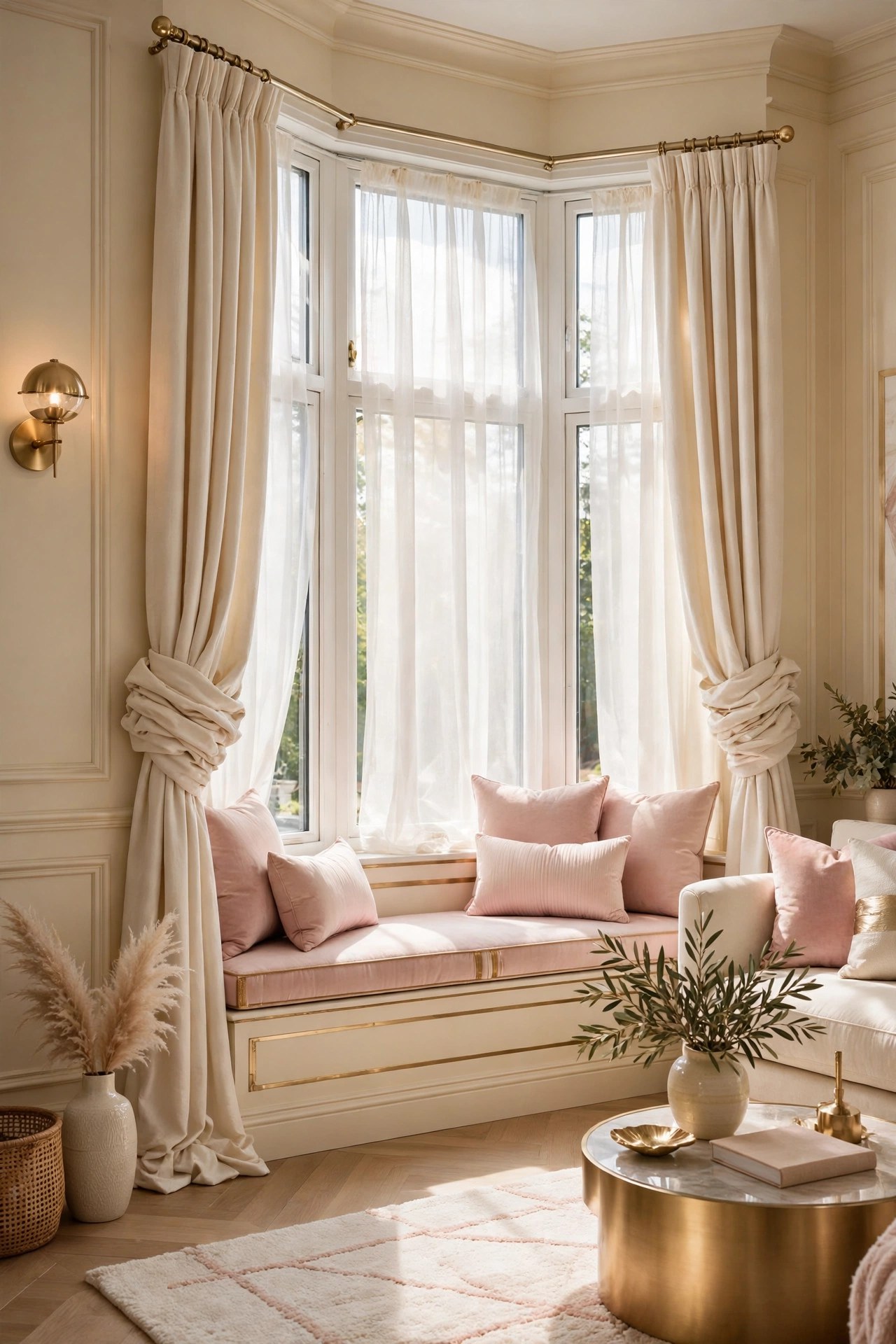
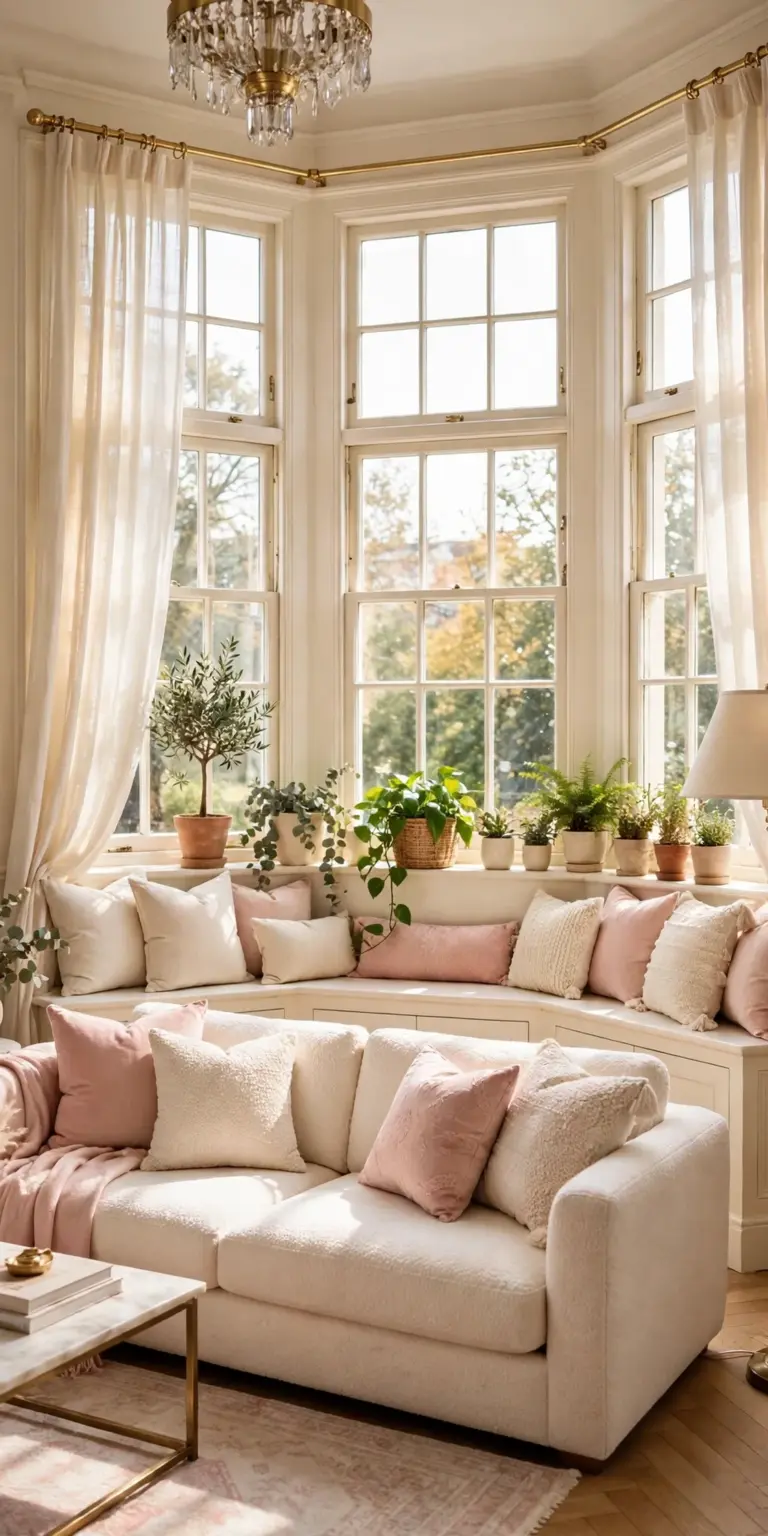
A bay window is a gift of light and a puzzle of angles, and the designs that work treat it as three connected windows rather than one wide one. Sheers run across the whole bay on an angled track or flexible rod, so daylight and privacy stay even around the curve. Heavier cream panels stack at the outer angles and at the joins, framing each section without blocking the glass when open. See our wainscoting ideas for more panelled looks.
Best For: Living rooms with bay windows that feel bare, bright to the point of glare, or hard to furnish.
Not Ideal For: Very shallow bays where stacked panels would take a large share of the glass at each side.
Estimated Cost: $220-$520 (estimate) for an angled track or bay rod, sheers and panels across a three-section bay.
Budget Note: Measure twice and buy the bay hardware once. The angled track is the foundation, and sheers across a bay are inexpensive for the area they cover.
Renter Friendly: With Conditions
Renter Note: Bay tracks need fixings at several angles. It is one of the more involved installs in this list, so landlord agreement matters in a rental.
What You Need
Bay window track or flexible bay rod, sheer panels for the full bay width, cream drape panels, angle connectors, tape measure, steamer.
Product type to look for: Hardware made for bays, with smooth angle bends or connectors that gliders can pass, and sheer fabric wide enough to run the full bay without tight joins.
How To Do It
- Measure each bay section and each angle separately and note them in order around the bay.
- Fit the track or rod following the angles, testing that gliders or rings pass each bend smoothly.
- Hang the sheers across the whole bay and spread them evenly around the curve.
- Add the heavier panels at the outer edges and joins, dress the folds, and steam everything in place.
Pro Tip
Keep panels off the centre section entirely. The middle window is the light source and the view, and framing it from the sides is what makes a bay look generous.
15. Shape the Drape With Brushed Gold Tiebacks
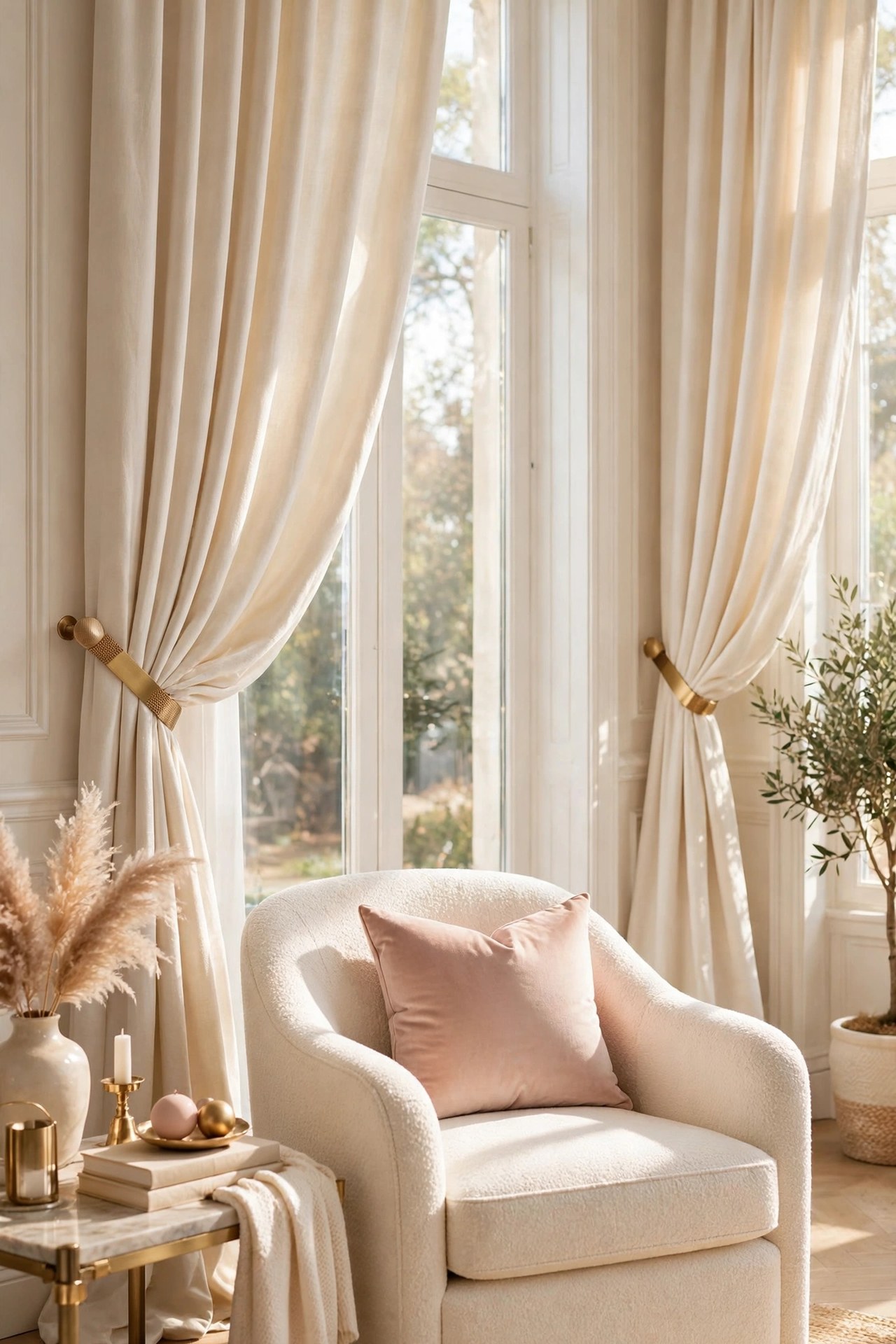
Tiebacks decide the shape of an open curtain, and that shape is a design choice, not an afterthought. A brushed gold holdback or tieback pulls the panel to the side at a chosen height and holds a clean sweep of fabric, which lets more glass show, shapes the light entering the room, and adds one more planned gold detail at the window. High tiebacks give a formal, elongated sweep that suits tall windows.
Best For: Living rooms and bedrooms where curtains stay open most of the day and should look styled while open.
Not Ideal For: Panels in very light sheer fabrics that have no body to hold a sweep, where a tieback only crumples the fabric.
Estimated Cost: $25-$80 (estimate) for a pair of brushed gold holdbacks or tiebacks.
Budget Note: The smallest spend in this list. One pair of good holdbacks can lift curtains you already own, with no new fabric at all.
Renter Friendly: With Conditions
Renter Note: Fixed holdbacks need one screw each into the wall or frame. Rope or fabric tiebacks on existing hooks are the no-fix alternative.
What You Need
Pair of brushed gold holdbacks or tiebacks, drill and fixings if wall-mounted, tape measure, level.
Product type to look for: Holdbacks long enough to hold the full gathered panel without crushing it, in a brushed finish that matches the rod, with fixings rated for the panel weight.
How To Do It
- Open the curtains and gather one panel by hand to find the height where the sweep looks best.
- Mark that height on the wall or frame at both sides, checking the pair is level.
- Fix the holdbacks, or fit the tiebacks to existing hooks, and test with the full panel weight.
- Adjust the fabric folds inside the holdback so the sweep falls in one clean curve on each side.
Pro Tip
Set tieback height by the window, not by habit. As a starting point, hold tall windows at about two thirds down and short windows at half, then judge from the doorway.
Practical Tips for Choosing Curtains
Measure from where the rod or track will actually sit, not from the top of the window frame, and measure twice before ordering anything. Most curtain disappointment is a measuring error: panels that pool too much, stop too short, or stack across the glass because the rod was too narrow. Buy width generously, because fullness is what makes folds look rich, and a stretched panel looks thin however good the fabric is. Keep one palette across every window in the room, and repeat the same gold tone in the rod, the tiebacks and one other piece of furniture so the scheme reads as one decision. Steam curtains after hanging, never before, because folds set in their real position. Finally, judge the finished window at night as well as by day, with the room lights on and the curtains both open and closed, because that is when privacy gaps and uneven hems show themselves.
Frequently Asked Questions
How high should curtains be hung?
As close to the ceiling as the hardware allows, and wider than the frame on both sides. That position makes the window look taller and wider, lets open panels stack on the wall instead of the glass, and brings more daylight into the room.
What curtain length looks most current?
Panels that just kiss the floor, or clear it by half an inch, are the current standard for living rooms. A small break at the hem can work with linen in relaxed rooms, but long pooling fabric suits only rooms where it will not be walked on or gather dust.
Which curtain colour works best in a bright glam room?
Cream is the safest base, with warm white sheers behind it. Blush is the accent colour in this palette, used at the window in velvet or an ombre fade, and brushed gold hardware ties the window to the rest of the room.
Are sheer curtains enough on their own?
Sheers give daytime privacy and soft light, but they do not give night privacy with the lights on, and they do not darken a bedroom. Layer sheers under drapes in living rooms, or pair them with a blind or blackout-lined panels where sleep is involved.
How much fullness do curtain panels need?
As a working rule, the combined panel width should be one and a half to two and a half times the width they cover. Pleated and wave styles sit at the fuller end. Too little fabric is the most common reason curtains look thin and cheap.
Can renters use these curtain designs?
Most of them, yes. Panels, tiebacks and cafe curtains need little or no fixing, and rods use standard bracket holes. Ceiling tracks and bay tracks need more fixings, so those two are worth agreeing with a landlord before starting.
Conclusion
Start with the hanging, not the fabric. A rod or track placed high and wide, with panels long enough to meet the floor, improves every curtain in this list before a single fabric choice is made. Then pick the design that solves your room problem: sheers layered for privacy with light, pleats or wave folds for a tailored finish, blush velvet or an ombre fade for soft colour, and blackout lining where sleep matters. Finish with the details that make curtains look planned, brushed gold hardware, a border trim, shaped tiebacks, and the window becomes the calm, bright frame the rest of the room deserves.