15 Bay Window Ideas for Seats, Curtains and Light

A bay window is the best seat, the best light, and the best view a living room has, all in one bump of glass, and yet most bays end up as a parking place for one chair and a dying plant. The space fails for predictable reasons: curtains hung as if the wall were flat, furniture too tall in front of the glass, and no seat actually built into the shape the architecture is offering.
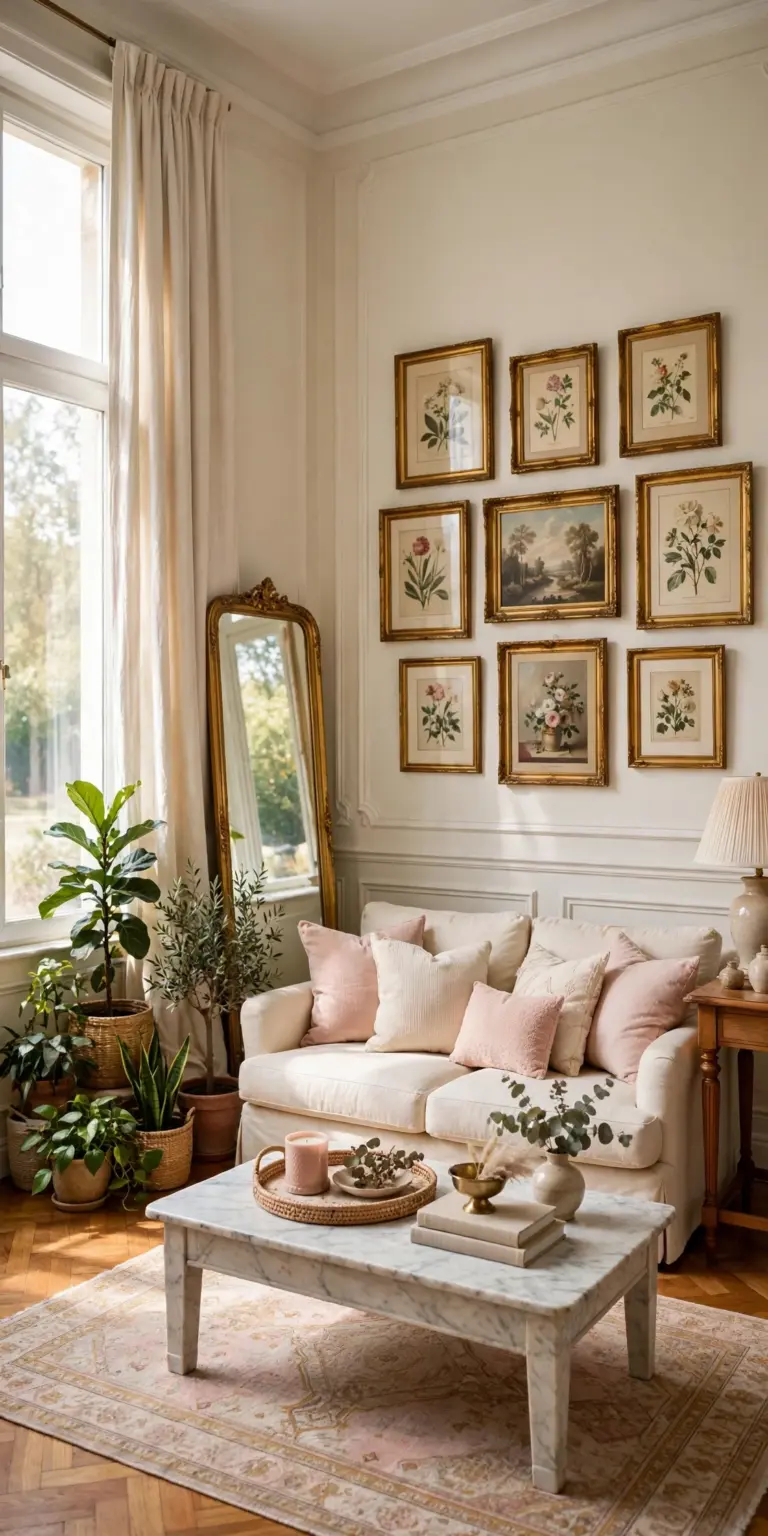
These fifteen bay window ideas all restyle the same bright glam living room, a three-sided bay with cream walls, a cream sofa, warm taupe accents, brushed gold, and blush cushions, so you can see how the seat, the curtains, and the light work together. The order matters: build the seat first, dress the glass second, and style the light last, because each step decides what the next one can do.
1. Build a Real Window Seat Into the Bay
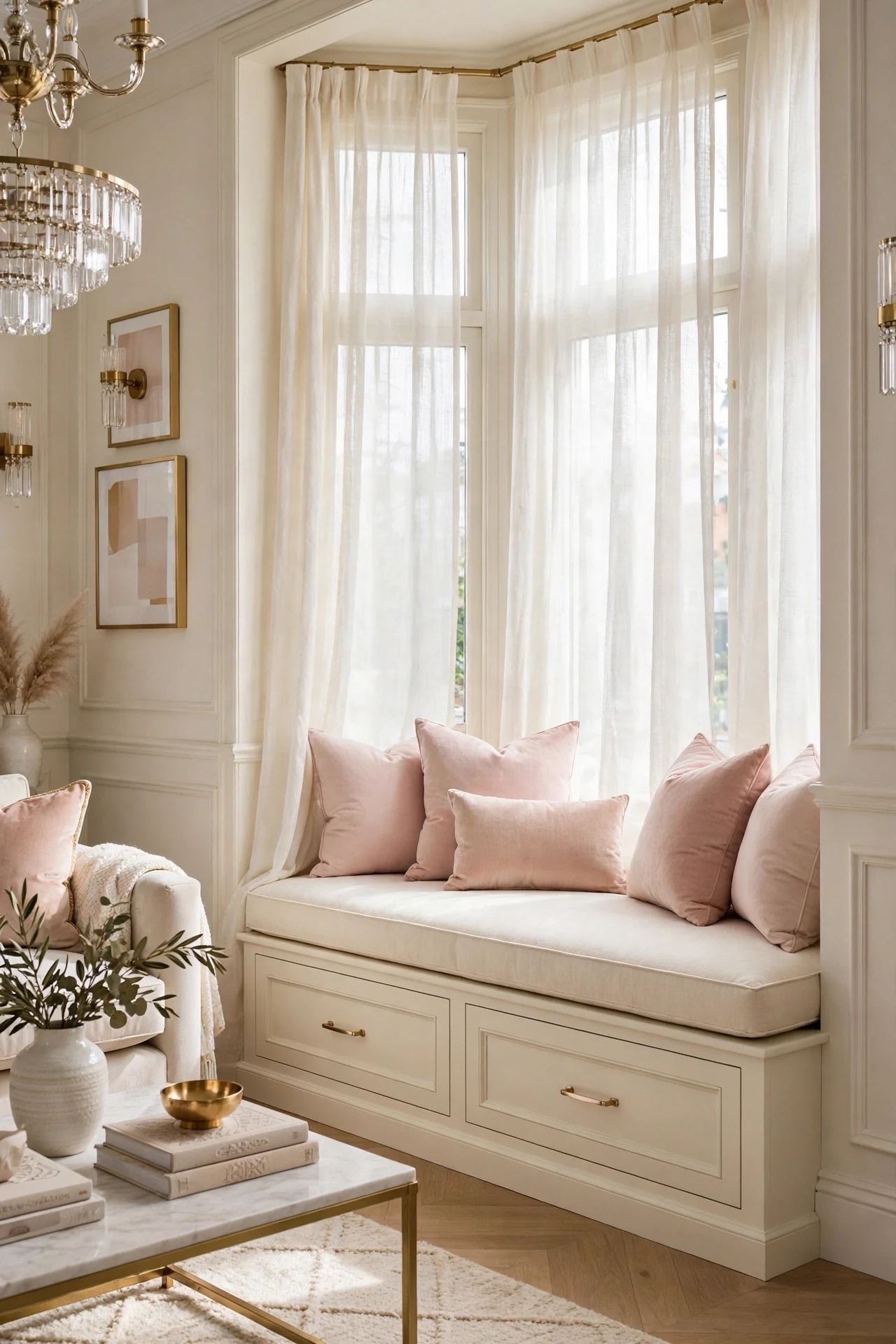
The bay’s shape is an invitation to sit, and a built-in seat is the only answer that fits the angles exactly. A chair pushed into a bay wastes the corners and blocks the glass; a seat built wall to wall turns the whole projection into the room’s favorite place, with storage inside the base as the bonus.
Safety decides how this seat gets built. A window seat is furniture people sit and sometimes stand on, so the base must be a framed box, built like low cabinetry, fixed to the wall studs and the floor, and strong enough for several adults at once. It must never rest its weight on the window sill or the window frame, which are not structure. If your bay has radiators, vents, or any structural doubt under the windows, have a carpenter build or at least check the frame; this is a half-day job for a professional and the wrong place to guess. Keep every window in the bay still able to open as designed, and never let the seat block a window that serves as an emergency exit.
How to do it: Measure each of the bay’s sections separately; angled bays are rarely symmetrical. Build or commission a framed plywood or cabinet base a little below standard chair height so the cushion brings it level, with drawer or lift-top storage inside, fixed back to the studs. Add the cushion from Idea 2 only after the base is solid. Pro Tip: Run the base a few inches short of each end wall and add filler panels; old houses are not square, and filler hides it. Common mistake: A foam pad laid on a hope chest or low bookcase pushed into the bay. If it was not built and fixed as a seat, do not sit guests on it.
2. Top the Seat With One Thick, Washable Cushion
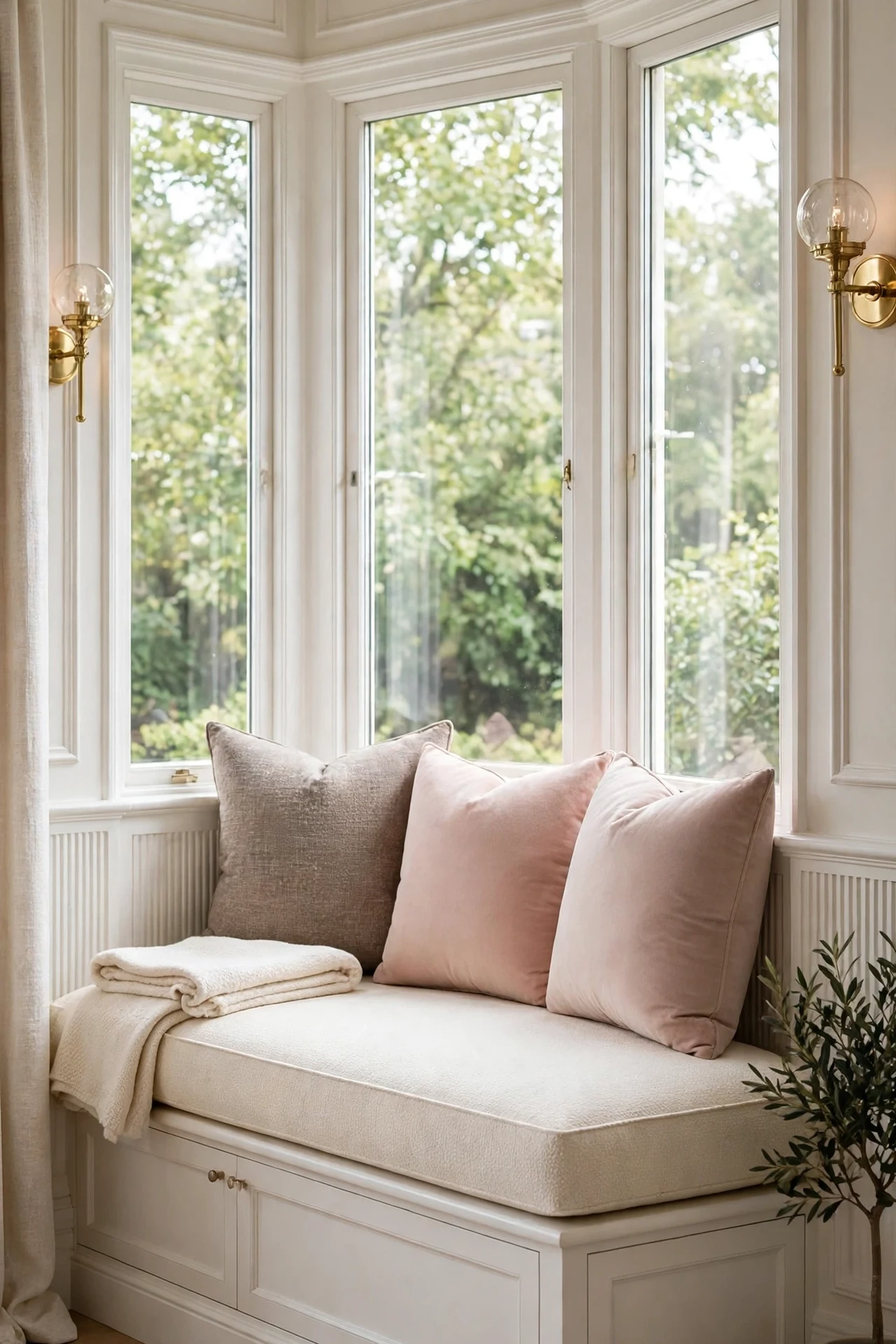
A window seat lives or fails on its cushion. Thin pads slide, bunch, and feel like a waiting room. One thick cushion, cut to the bay’s exact angles, reads as furniture and invites actual sitting, reading, and morning coffee in the light. In a sun-filled spot, the fabric works hard, so washable and fade-resistant matters more than luxury here.
Keep the cushion inside the palette: cream textured weave as the base, and let loose cushions carry the blush and taupe. A fitted cushion in a patterned fabric dates quickly and fights everything placed on it; plain and thick is what photographs and wears well.
How to do it: Template the seat top with paper before ordering or cutting foam; angled corners must be exact or the cushion will creep. Choose foam firm enough to sit on without sinking to the base, with a removable, washable cover. Add cushions in odd numbers, three or five, largest against the glass. Pro Tip: Keep one spare cover; the seat cushion in a sunny bay is the most washed textile in the house. Common mistake: Many small seat pads with gaps between them. Gaps collect crumbs, look makeshift, and make the seat uncomfortable along every seam.
3. Hang Curtains on a Rod That Follows the Bay

The most common bay mistake is one straight rod across the front of the bay, with curtains that chop the projection off from the room. The glass disappears behind a flat curtain wall, the seat sits in a dim tent, and the bay’s whole point, its shape, is lost. A bay rod with corner connectors follows the angles so the curtains dress each window and the shape stays visible.
Mount the rod high, near the ceiling of the bay or just below it, and let panels rest on the angled side sections when open, so the center window stays clear. Cream or warm white panels keep the light quality soft; the blush stays on the cushions below.
How to do it: Measure each section and each angle before ordering; bay rods come as kits with bendable or jointed corners for standard angles, and custom bends for odd ones. Fix brackets into studs or rated anchors, since a full bay of curtains is heavy, and check the corner joints carry the panels’ weight when drawn. If fitting a bay rod is beyond the budget this season, individual short rods per section give the same follow-the-shape effect. Pro Tip: Panels that close across the whole bay need enough fullness to fold, not stretch flat; flat panels read as sheets. Common mistake: Curtains pooling on top of the window seat. Hem them to just clear the seat cushion, or to the floor only where no seat is built.
4. Add Sheers to Soften the Glare
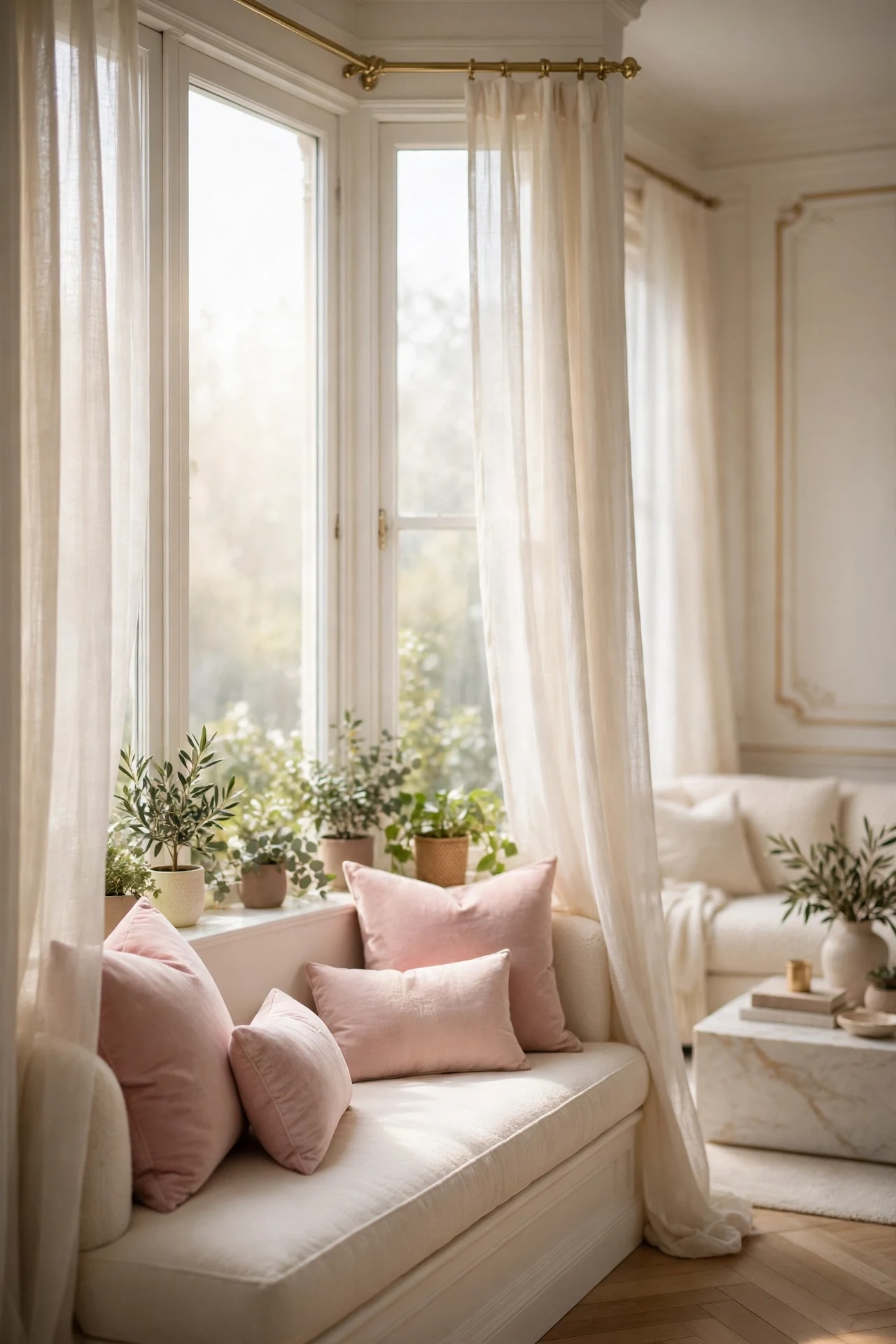
Bay windows face one problem square rooms do not: too much light, from three directions at once. Midday sun through a bay can glare off every surface, fade the seat cushion, and make the seat too hot and bright to use. Sheer panels are the filter that keeps the light and removes the glare, turning hard sun into the soft glow the rest of the room is styled around.
Sheers also give daytime privacy without closing the room down, which matters when the bay faces a street. Hang them on their own slim rod or track inside the main curtains, so each layer works alone: sheers by day, full curtains by night.
How to do it: Choose warm white sheers, not bright blue-white, which reads cold against a cream palette. Let them fall the full height of the glass, to the seat top where a seat is built. Wash or shake them out seasonally; dusty sheers grey the light they are meant to soften. Pro Tip: In a very sunny bay, sheers protect everything behind them; they are the cheapest fade insurance for the seat cushion and rug. Common mistake: Sheers only, in a bay that faces close neighbors. Sheers diffuse a view but do not close it at night when the room is lit; pair them with the shades of Idea 5 or full curtains.
5. Layer Roman Shades for Night Privacy
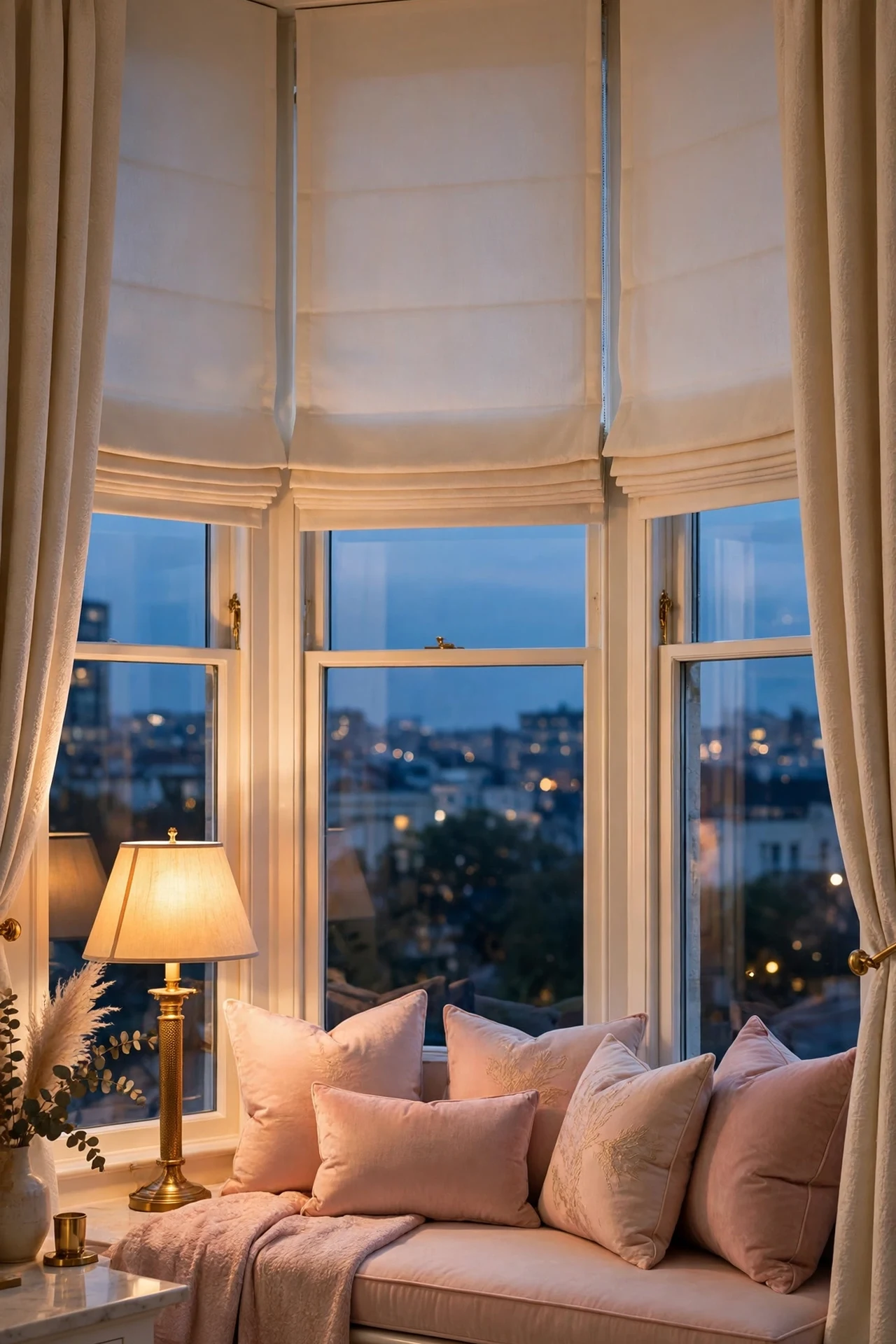
Curtains dress a bay beautifully, but shades do the privacy work with less bulk, and in a bay with a built-in seat they are often the smarter main layer: each section gets its own tailored shade that drops exactly over its glass, no fabric pooling on the seat, no panels fighting the cushions. Cream linen-look Romans keep the palette and fold into soft horizontal lines that suit the glam look.
Safety is specific here. Corded shades are a known strangulation risk for small children and pets, so choose cordless or motorized shades for any home where children visit, and keep any existing cords wound on cleats fixed high and out of reach until shades are replaced. Mount shades inside the frame for a tailored fit where the frame depth allows, and confirm each shade clears the seat and any sill plants as it lowers.
How to do it: Measure each section’s glass separately; angled bays often differ by small amounts that matter. Order all shades in the same fabric batch so the cream matches across the bay. Keep curtains from Idea 3 as the soft outer layer if the room wants the fullness. Pro Tip: Light-filtering rather than blackout fabric suits a living room bay; the evening glow through cream linen is part of the room’s warmth. Common mistake: One wide shade ordered for a three-section bay. It will not fit the angles, and forcing it breaks both the shade and the look.
6. Style the Seat as a Reading Nook
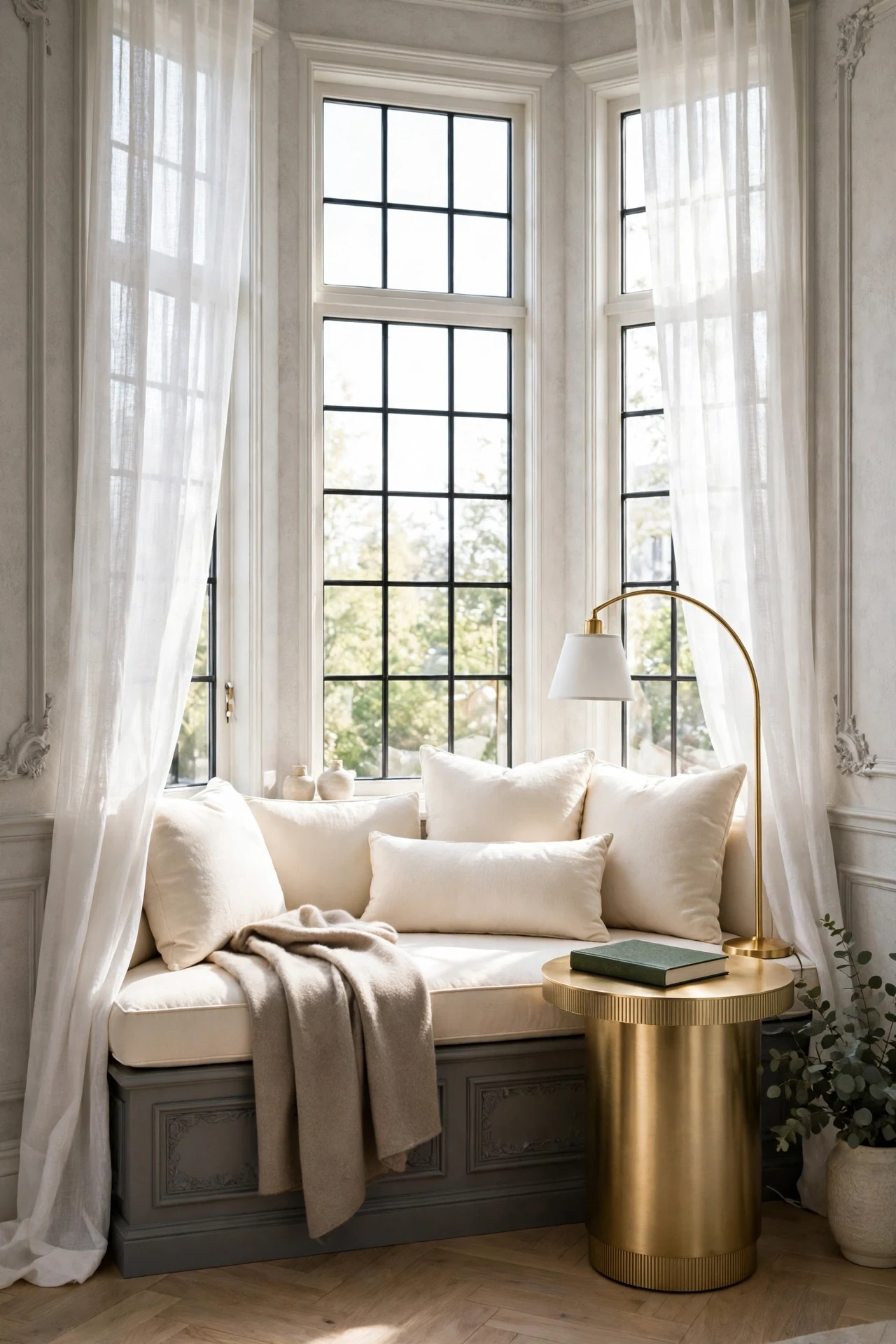
A seat alone is a bench; a seat with light, a surface, and a throw is a destination. The reading nook is the bay’s classic job because everything it needs is already there: daylight by day, a view to rest the eyes on, and a corner shape that naturally holds one person well. Add the two missing pieces, a lamp for evening and a table for a book and a cup, and the seat gets used daily instead of admired.
Keep the furniture footprint tiny. A small round side table at one end of the seat and a slim floor lamp behind it serve the whole nook without crowding the glass. The throw lives folded at the seat’s end, in warm taupe, so it is part of the picture even when nobody is reading.
How to do it: Place the table where a seated hand falls naturally, at the seat’s stronger end near the room. Choose a lamp that can be switched from the seat; a cord run safely along the wall, never across the walkway into the bay. Keep the seat’s other end clear so a second person can still sit. Pro Tip: This is the best light in the house for anything detailed, mending, sketching, a child’s homework; claim it on purpose. Common mistake: Filling the nook with a bookshelf and three lamps until the seat is storage again. Two additions, no more.
7. Line the Sill With Plants in One Pot Family
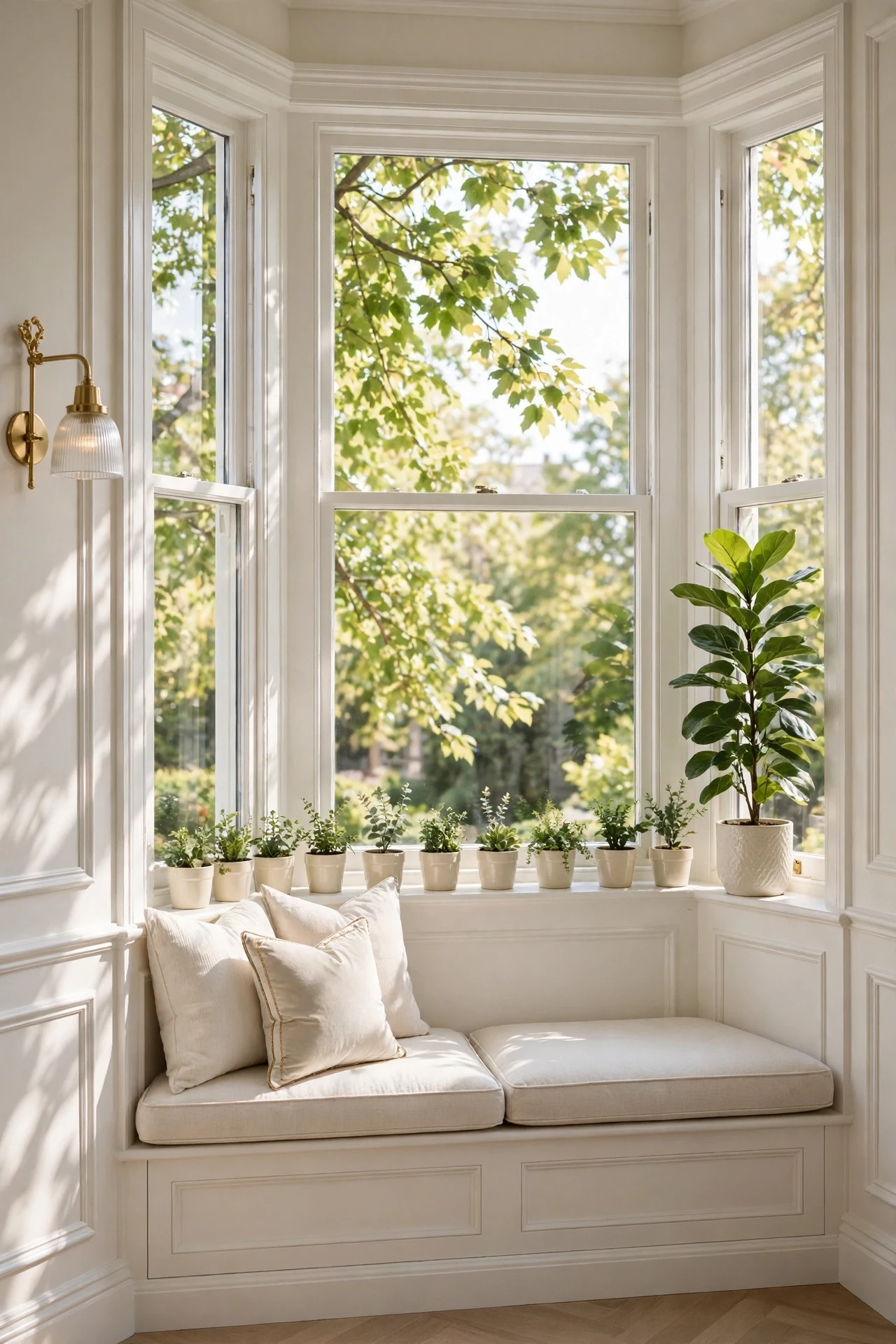
A deep bay sill is a shelf the architecture built for you, and plants are what it was built for: the light is the best in the room, and a green line along the glass softens the boundary between inside and out. The trick is discipline. Random pots collected over years read as a nursery; one pot family in cream or warm terracotta, repeated, reads as a designed garden line.
Group by need as well as looks. Plants on a sunny sill want sun; keep the thirsty ones together at one end so watering is one trip with one small can, and put saucers under every pot, since sill wood and water are enemies.
How to do it: Choose three to five plants of graduated heights, tallest at the bay’s angles where the frame hides the pot’s back. Use matching pots one size up from the nursery pots and always with saucers. Leave real gaps between groups; a sill crowded edge to edge blocks the light the seat is there for. Pro Tip: Rotate each plant a quarter turn weekly; bay light comes from one side and unrotated plants lean and thin toward it. Common mistake: Plants on the seat itself. They migrate, spill, and take the sitting room the seat was built for; the sill is their place.
8. Set a Small Round Table for Coffee in the Bay
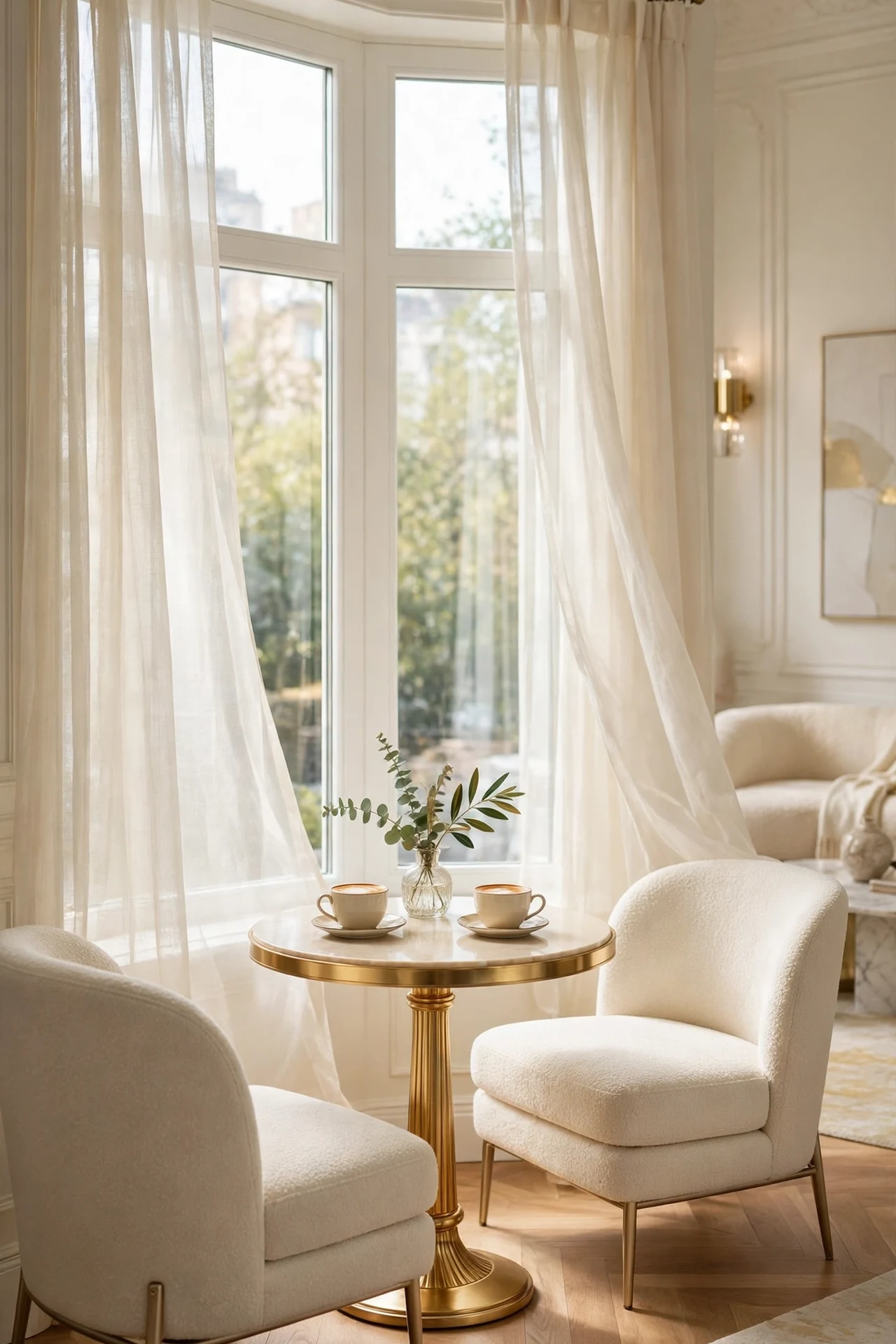
Not every bay should hold a built-in seat. In a dining-leaning living room or a bay off a kitchen, a small round table with two low chairs makes the bay a morning place: coffee, a laptop, a child’s drawing session, all in the best light. Round is the right shape because it respects the bay’s angles and lets people slide in from either side.
Scale is everything. The table should be small enough that both chairs sit mostly inside the bay’s line, and low enough that nothing blocks the glass below its mid-height. A pedestal base beats four legs in a tight angle, since knees and chair legs need the same floor.
How to do it: Measure the bay’s narrowest depth before choosing the table; the chairs pulled out must still clear the room’s walkway. Angle the chairs toward the view and each other, not flat to the window. Keep the table’s styling to one vase or a small tray so it resets in seconds. Pro Tip: This bay earns a pendant from Idea 10 more than any seat does; a light centered over the table finishes the little room inside the room. Common mistake: A full dining set squeezed into the bay. If chairs scrape the walls, the bay shrinks from a feature to a problem.
9. Borrow the Bay as a Desk or Vanity Spot
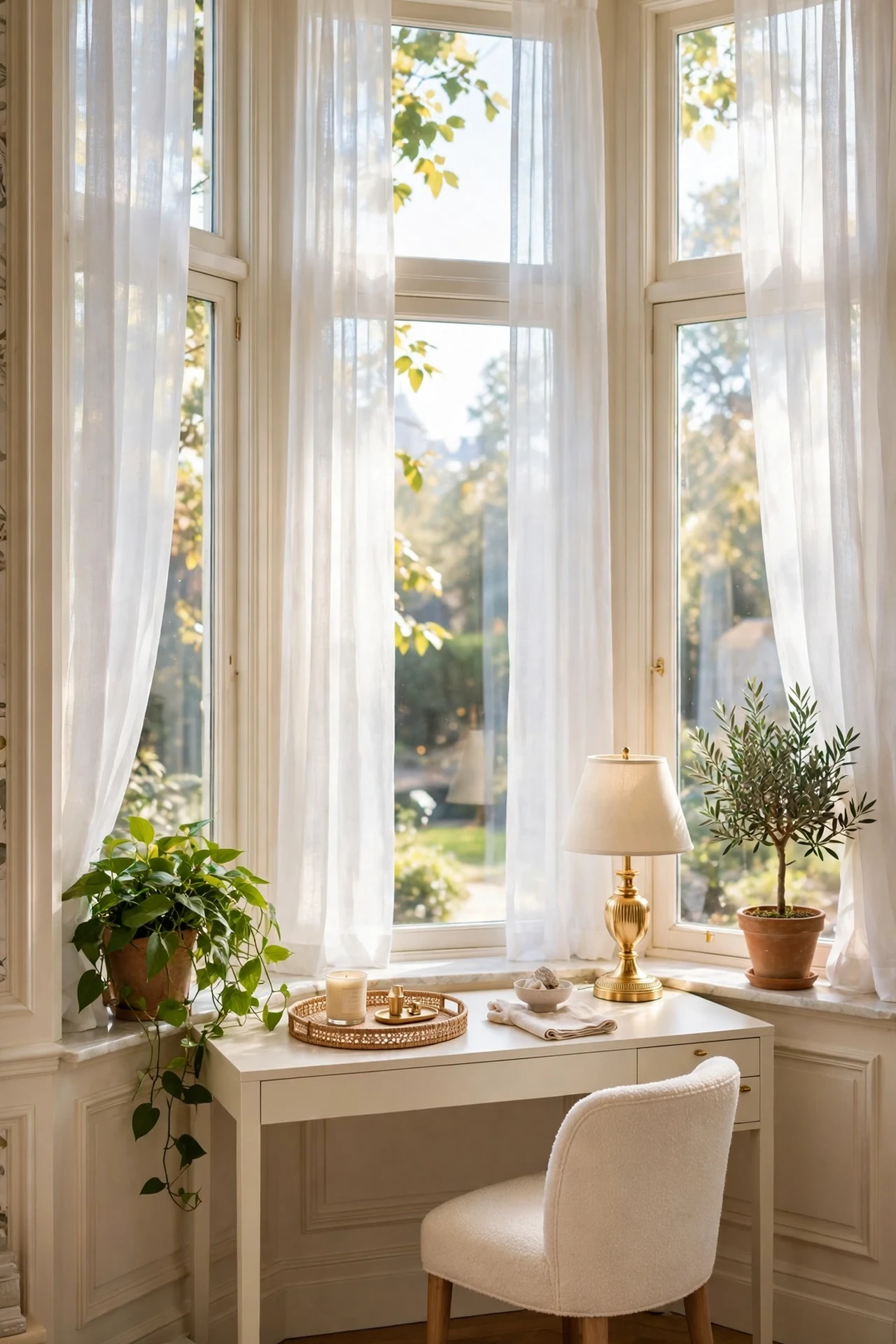
A slim desk across a bay is the home office version of the window seat: the light is superb, the view rests tired eyes, and a shallow desk leaves the glass its role. It also works as a vanity in a bedroom bay, with the same logic; daylight is the most honest makeup light there is. The desk must stay slim, a deep desk pushes the chair out of the bay and the arrangement collapses.
Light needs managing, which is what the sheers of Idea 4 are for: a screen facing the glass wants the glare filtered, and the desk user should sit so the strongest light comes from the side, not straight into the eyes or onto the screen. Keep cables along the wall to one strip; a bay full of glass shows every cord.
How to do it: Choose a desk depth that leaves knee room and chair room inside the bay line. Set the screen or mirror perpendicular to the center window if glare fights you. Keep the desktop to a lamp, a tray, and the day’s work; the bay’s beauty is the backdrop, not storage. Pro Tip: A desk bay doubles as the house’s gift-wrapping and project station at holidays, the best light and a door-closeable mess. Common mistake: A desk so loaded with office storage that the bay reads as a cubicle. Files belong in the room’s real storage; the desk holds today only.
10. Center One Pendant Light in the Bay
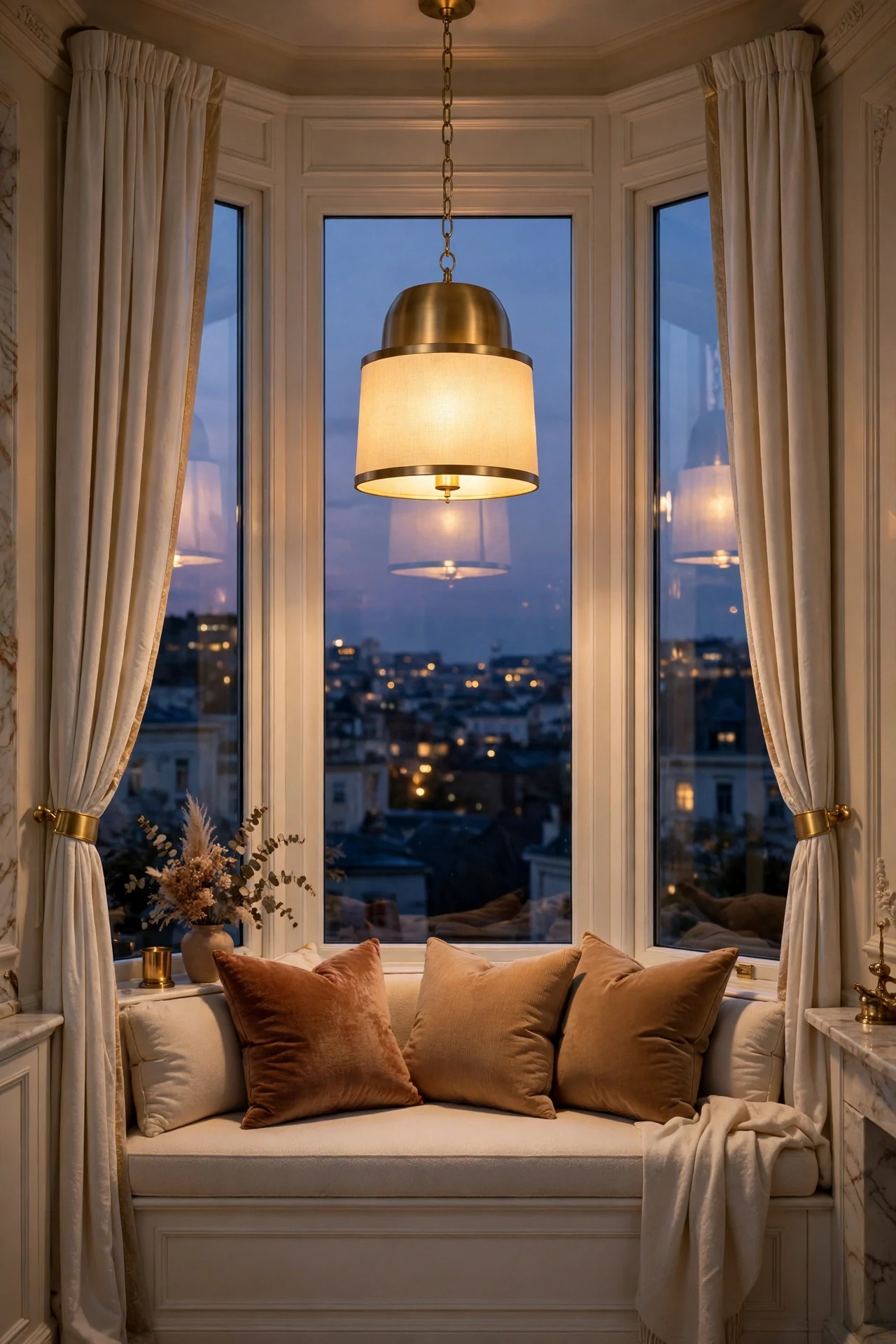
A bay has its own small ceiling, and it asks for its own light. One pendant centered in the bay does three jobs: it marks the bay as a room within the room, it gives the seat or table its evening glow, and after dark it turns the black glass into a warm reflection instead of a cold hole in the wall.
Choose a fixture that suits being seen against glass from inside and out: a cream drum or a brushed gold lantern shape, sized to the bay rather than the whole room. Over a seat, the pendant hangs higher than over a table, since heads pass under it; over the coffee table of Idea 8 it can hang lower, as dining lights do.
How to do it: Find the bay’s true center, which is the center window’s middle, not the room’s center line, and hang the fixture there. This is electrical work on a ceiling; if a junction box is not already present, an electrician installs one, and a plug-in swag pendant is the renter-safe alternative. Put it on a dimmer if the wiring allows. Pro Tip: A warm bulb in the pendant, matched to the room’s other bulbs, keeps the evening bay inside the room’s one light family. Common mistake: A fixture sized for the whole living room. An oversized pendant crowds a small bay ceiling and dominates every photo of it.
11. Put a Low Bookcase Under a Seatless Bay
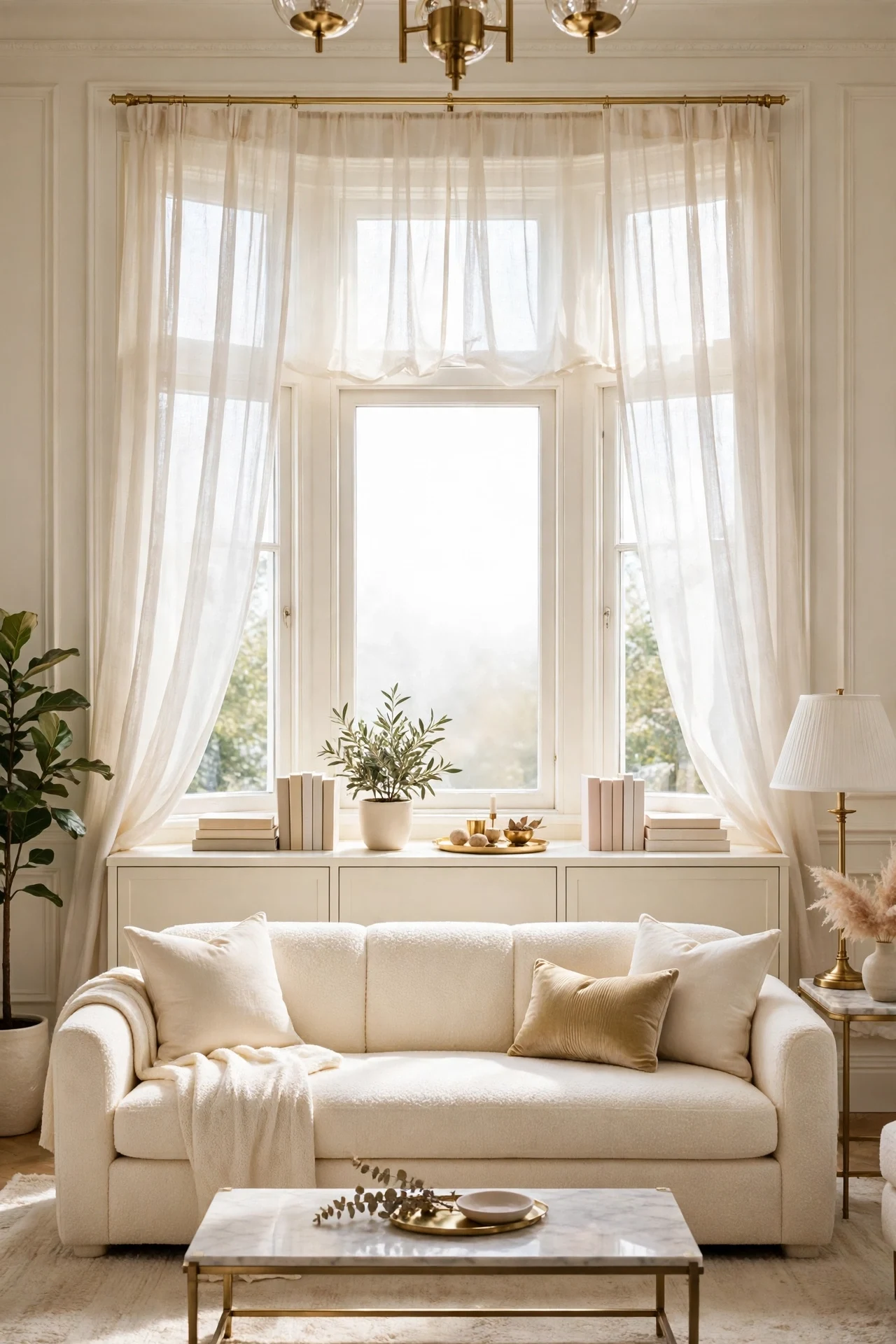
Where a seat is not wanted and a desk is not needed, the wall under a bay’s windows is still valuable: it is the one stretch of living room wall that furniture rarely claims. A low bookcase, built or bought to run just under the sill, turns it into the room’s library wall and gives the bay a grounded base line that tall furniture would steal.
Low is the rule. Nothing on or in the bookcase should climb into the glass; the top surface styles like a long sill, with books below in calm groups and only two or three objects above. Cream cabinetry keeps it inside the palette, and the top can carry the plant overflow from Idea 7 in winter.
How to do it: Measure the sill height and keep the case a few inches below it. Anchor the case to the wall; low and wide is stable, but a case children climb belongs fixed like any bookcase. Arrange books with breathing room, some standing, one short stack lying flat, rather than a packed row. Pro Tip: This is the natural home for the room’s photo albums and art books, the heavy beautiful ones that deserve the good light. Common mistake: A bookcase taller than the sill used anyway. It eats the window’s bottom edge and makes the whole bay look like storage with glass behind it.
12. Keep Everything in Front of the Bay Low

This is the rule that protects all the others: the bay’s light belongs to the whole room, and tall furniture in front of it, a bookcase, a high-backed chair, an armoire, taxes every other idea on this list. Living rooms drift tall objects toward windows because the wall space looks empty; the bay is exactly where that instinct must be refused.
Arrange the room so sight lines from the sofa and the door pass over the furniture and into the bay’s light. Sofas and chairs with backs below the sill line are ideal in front of the glass; tall pieces earn the room’s solid walls, where they do no harm and often look better.
How to do it: Stand at the door and check what cuts the bay’s light. Move one tall piece to a side wall and compare the room for a day before deciding. If a radiator lives under the bay windows, keep even low furniture a safe gap away from it and never drape curtains or throws over it. Pro Tip: Low-in-front also makes the bay itself look bigger, because the eye travels over the furniture and lands on glass. Common mistake: The tallest plant in the house parked in the bay corner at full height. A plant that has outgrown the sill belongs on the floor at the bay’s side, not centered in its light.
13. Lay a Rug That Follows the Bay’s Shape
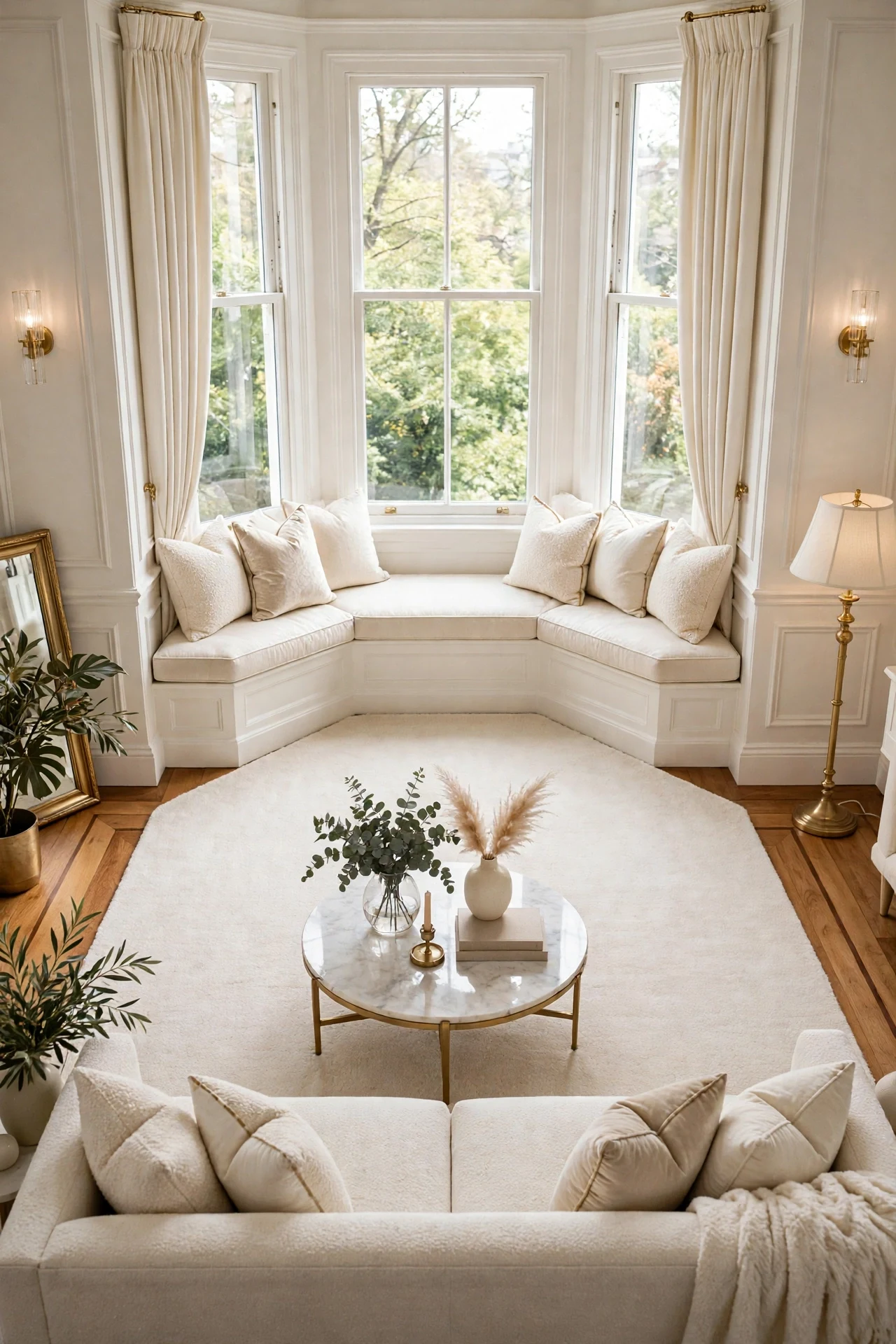
A rectangular rug in front of an angled bay always looks slightly wrong, its corners arguing with the bay’s corners, one edge crowding the seat, the other falling short. A rug cut or chosen to echo the bay, angled front corners or a generous size that runs under the seat base and out into the room, stitches the bay and the seating into one zone.
The practical version is simpler than custom cutting: a large rug whose front edge the seat base sits on, angled chairs arranged to its lines, will read as shaped. True custom cuts suit a bay that is the room’s main seating zone and worth the investment in a rug you will keep for years.
How to do it: Decide the zone first: the rug should hold the seat, the coffee table, and the front legs of the sofa or chairs in one field. Use a rug pad cut to the same shape; a shaped rug that creeps shows its edges within a week. Keep the pattern quiet, cream with texture, so the shape does the work. Pro Tip: Paper the rug’s outline on the floor with painter’s tape and live with it for two days before ordering any cut; angles surprise everyone. Common mistake: A small rug floating inside the bay only. It reads as a mat at a door; the rug must reach out and claim the seating to unify the room.
14. Dress the Bay for the Seasons, Lightly

A bay is the room’s shop window, and it changes with the year whether you style it or not: spring light, summer glare, autumn color outside, winter dark by five. Small seasonal swaps inside the palette keep the bay feeling current without redecorating: deep taupe cushions and a garland in winter, extra sheers and green plants in summer, a bowl of fruit or flowers at harvest time.
Lightness is the discipline. The bay’s architecture is the decoration; seasonal layers sit on the seat and sill and come away in minutes. Battery candles only, as everywhere in this house’s styling, and nothing seasonal dangling near a radiator or blocking a window’s opening.
How to do it: Keep one storage box per season for the bay only, so the swap takes fifteen minutes. Change three things at most: the seat cushions, the sill objects, and the throw. Photograph each season’s version once; next year’s styling is then already decided. Pro Tip: Winter is the bay’s hardest season and its best: a lit, dressed bay at dusk is the warmest view a living room can offer the street and itself. Common mistake: Seasonal decor that covers the glass. If the season hides the window, the room has lost its light to a theme.
15. Leave the View Itself Alone
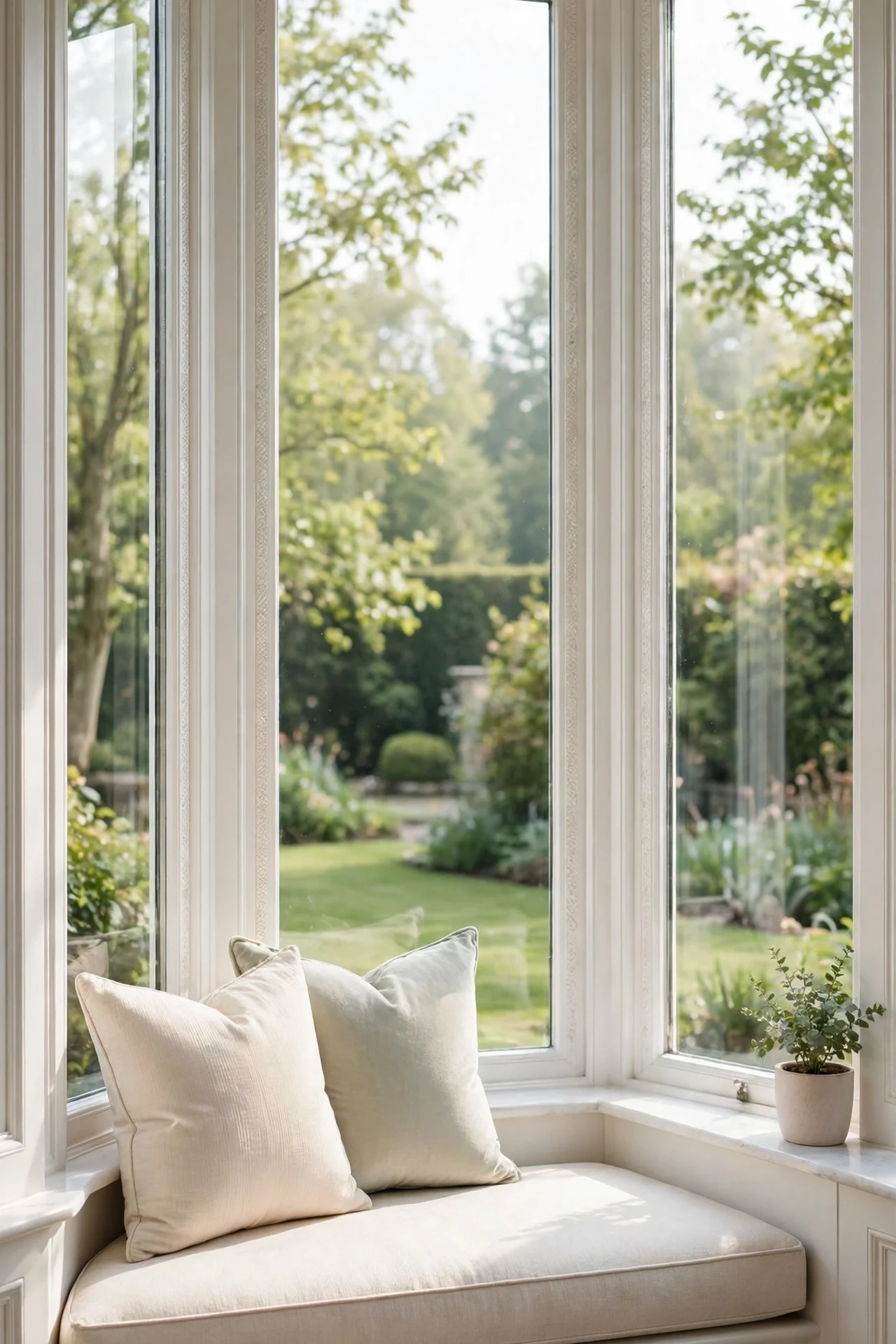
The last idea is a refusal. A bay window’s view, garden, street trees, sky, is the one piece of art in the room that changes daily and costs nothing, and the commonest way to waste it is to fill the glass with stuff: stickers, hanging crystals, shelves of glassware, plants at every height. Every object hung in a window is paid for in light and view.
Keep the glass clean, the sill nearly empty, and the seat styled but uncluttered, and the bay does what it was built to do. If the view is not lovely, a street or a close fence, the sheers of Idea 4 become the view, a soft white glow that still delivers all the light.
How to do it: Wash the glass inside and out on a schedule; bay panes are many and their dirt is cumulative and quiet. Remove one object from the sill each time you clean until only the plant line of Idea 7 remains. Sit in the seat and look out, not at it, once a week; the view is the point of the seat. Pro Tip: Clean glass measurably brightens the whole room, not just the bay; it is the cheapest light upgrade in this entire article. Common mistake: Treating the bay as display shelving because it photographs brightly. Bright is exactly why things should not live there; the light belongs to the room.
Quick Reference Table
| Idea | What It Adds | Key Rule |
|---|---|---|
| Built-in window seat | The bay’s main event | Framed, fixed, never on the sill |
| Thick washable cushion | Real sitting comfort | One fitted cushion, plain fabric |
| Bay curtain rod | Dressed angles | Follow the shape, mount high |
| Sheer panels | Soft, glare-free light | Warm white, full height |
| Roman shades | Tailored night privacy | Cordless where children visit |
| Reading nook | A daily destination | One lamp, one small table |
| Sill plant line | A garden edge | One pot family, saucers always |
| Small round table | A morning coffee spot | Pedestal base, low chairs |
| Slim desk or vanity | Work in the best light | Slim depth, light from the side |
| Centered pendant | A room within the room | Bay’s center, warm bulb |
| Low bookcase | A library base line | Below the sill, anchored |
| Low furniture in front | Light for the whole room | Nothing tall taxes the glass |
| Shaped rug | One stitched zone | Seat, table, and front legs on it |
| Light seasonal dress | A current-feeling bay | Three swaps, glass stays clear |
| The clear view | The room’s living art | Clean glass, nearly empty sill |
The Bay Window Checklist
- Seat base framed, fixed to studs and floor, and load-tested before cushions
- No weight resting on the window sill or frame
- Every bay window still opens as designed, exits unblocked
- Seat cushion templated to the angles, washable cover, spare cover stored
- Curtain rod follows the bay angles and is fixed into studs or rated anchors
- Sheers in warm white, full height, washed each season
- Shades cordless or cords cleated high where children or pets visit
- Reading lamp reachable from the seat, cord run along the wall
- Sill plants in one pot family, all on saucers, rotated weekly
- Table or desk slim enough that chairs stay inside the bay line
- Pendant centered on the bay, fitted by an electrician if no box exists
- Bookcase below the sill line and anchored to the wall
- No tall furniture between the room and the bay’s light
- Radiator under the bay kept clear of furniture, curtains, and throws
- Rug taped out in paper first, pad cut to the same shape
- Glass washed inside and out, sill nearly empty
Frequently Asked Questions
Is a built-in window seat safe to sit on?
Yes, when it is built as a seat: a framed box base, fixed to the wall studs and the floor, that carries sitting loads the way low cabinetry does, and never rests its weight on the window sill or frame. If the bay hides radiators, vents, or anything structural, or if you are unsure what is under the windows, have a carpenter build or inspect it. A chest or bookcase pushed into the bay is not a seat unless it was built and fixed as one.
What curtains work best on a bay window?
Curtains on a rod that follows the bay’s angles, mounted high, with panels resting on the side sections when open. Add sheers on their own rod for daytime glare and privacy, and, where the seat makes pooling fabric awkward, tailored Roman shades per section as the privacy layer. Keep the palette quiet, cream and warm white, so the glass stays the feature.
My bay is small. Which ideas still work?
Most of them, in smaller measure. Sheers, the sill plant line, low furniture in front, and the clear-view rule cost no space at all. A seat still works if it is kept shallow with storage inside, and the coffee table version works with a genuinely small pedestal table. Skip the bookcase and desk if the bay’s depth cannot hold them without pushing chairs into the room’s walkway.
Which of these ideas are renter-friendly?
Sheers on tension or existing rods, the plant line, the reading nook styling, the small table, low furniture placement, seasonal dressing, and a plug-in swag pendant all move out with you. A built-in seat, a fixed bay rod, hardwired pendant, and anchored bookcase change the property and need the landlord’s written permission first; when in doubt, ask before fixing anything to walls or ceilings.
Conclusion
A bay window rewards order: a seat built safely into its shape, curtains that follow its angles, sheers and shades managing its generous light, and furniture kept low so the light reaches the whole room. Do those four things and the styling, plants, a pendant, a small table, becomes easy, because the bay is finally working as the room it always was inside the room. Start with the glass itself: wash it, clear the sill, and sit in the light for one morning coffee before you buy a thing.