15 Midcentury Modern Living Room Ideas With Warm Wood and Clean Lines
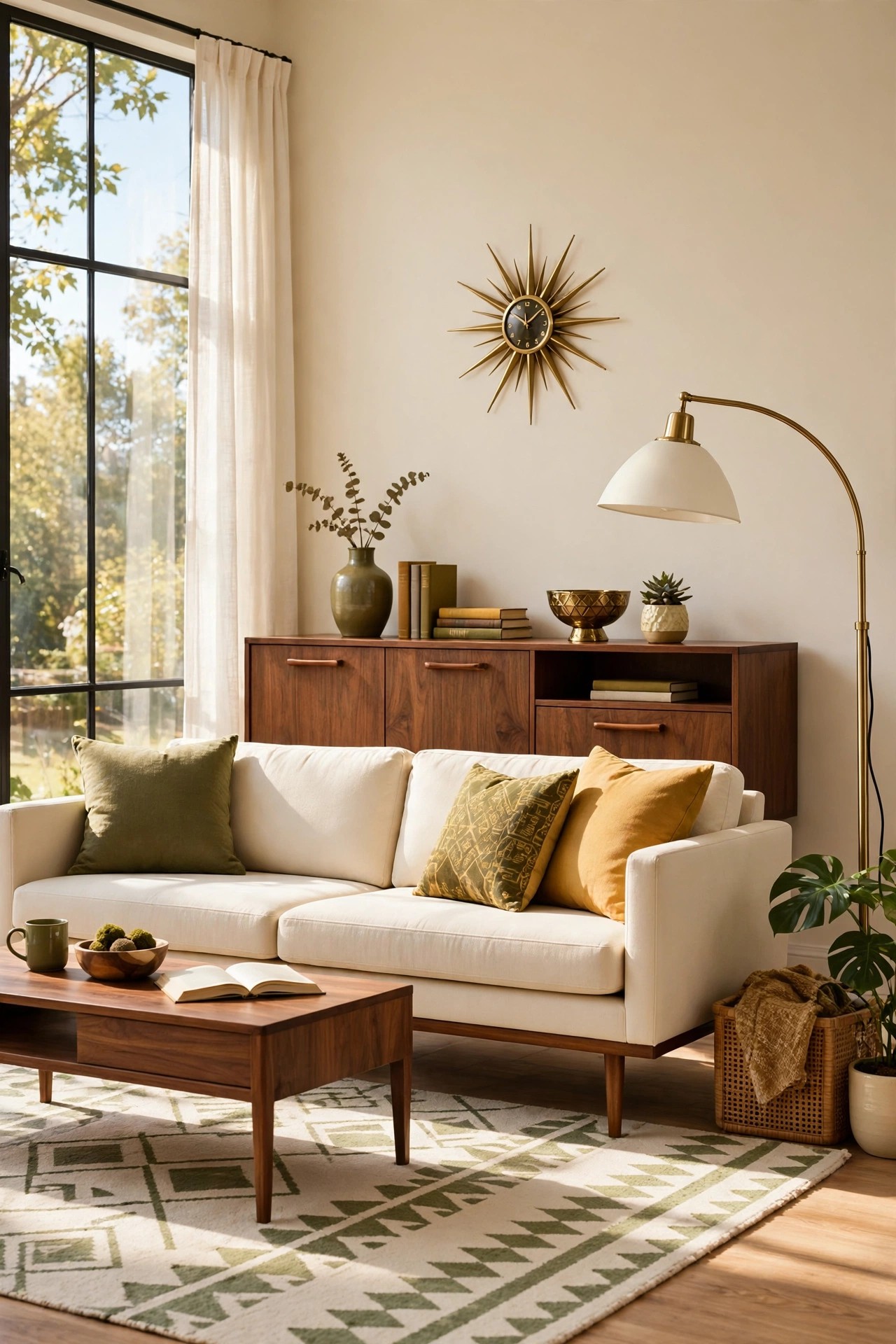
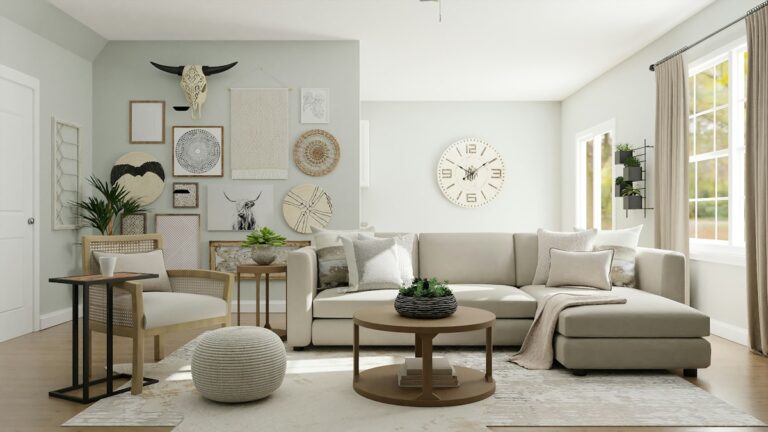
Midcentury modern is easy to recognize and surprisingly easy to overdo: one starburst too many and the room turns into a film set. The 2026 way to use the look is calmer. Warm walnut and teak tones do most of the work, furniture sits low on clean lines, and the atomic shapes stay few and deliberate against plain cream walls. This list builds a living room in that order: credenza and sofa first, then chairs, lighting, textiles and storage. Every idea names the size or finish that makes it work, gives an honest cost estimate, and says plainly what renters can and cannot do. If you are still choosing the big pieces, these living room furniture basics cover the measuring and budget groundwork first.
1. Anchor the Wall With a Low Walnut Credenza
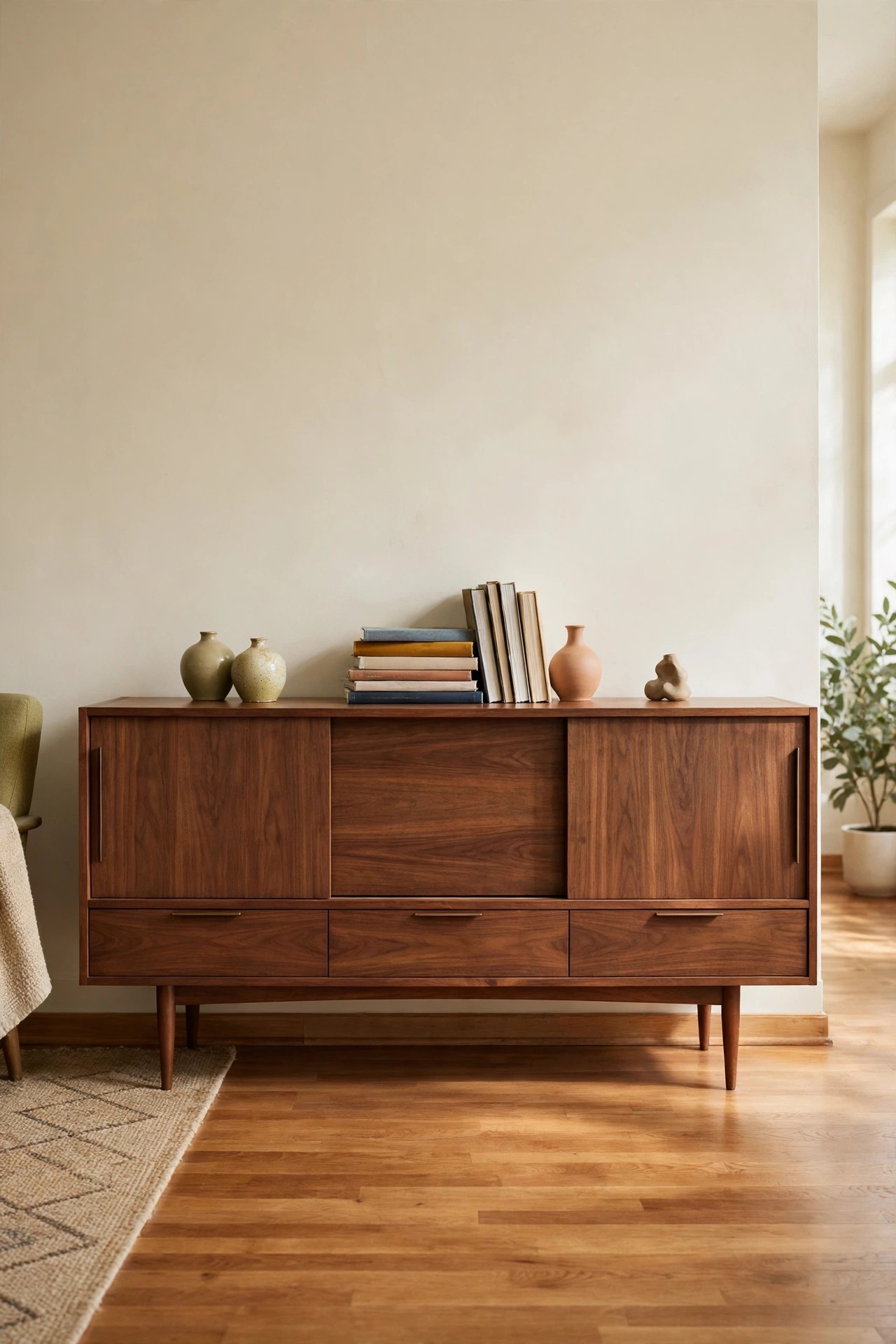
Description: The credenza is the piece the whole room leans on, so it earns the first decision. A low console around 60 inches long and 22 to 26 inches high gives the wall a long horizontal line, hides media boxes and games behind doors, and still leaves the top free for a lamp and ceramics. Walnut is the period-correct tone: warm enough to carry cream walls, dark enough to ground pale upholstery. Keep the top one third empty so the wood itself stays the feature.
Best For: The main TV or media wall in a living room of almost any size.
Not Ideal For: Very narrow rooms where a 16 inch deep console would crowd the walkway.
Estimated Cost: $350-$700 (estimate) for a 58 to 70 inch walnut-finish console.
Budget Note: Flat-pack consoles in walnut veneer cost far less than solid teak and read the same from seating distance.
Renter Friendly: Yes
Renter Note: A credenza is freestanding furniture; nothing is fixed to the wall.
What You Need
A low walnut console around 60 inches long, cable clips or a fabric cable sleeve, felt pads for the legs, a level.
Product recommendation (partially verified): Walker Edison Mid Century Modern TV Stand Console with 3 Drawers and Closed Cabinet Storage, 60 inch, Walnut
Why it fits: A 60 inch low console in a warm walnut finish with three pull-out drawers and adjustable shelving hidden behind doors, made from high-grade MDF with a solid wood veneer, so the media clutter disappears and the top stays clear for styling.
Retailer/product page: https://www.amazon.com/dp/B074WD8PKK
How To Do It
- Measure the wall and leave at least 6 inches of breathing room at each end of the console.
- Assemble on a blanket in the room it will live in; a 60 inch console is awkward to carry through doorways.
- Fit felt pads, level the piece, and route every cable down one leg with clips so no wires cross the floor.
- Style the top in one group of three: a lamp or tall vase, a low stack of books, and one small ceramic, then stop.
Pro Tip
Choose the console length from the sofa, not the TV: about two thirds of the sofa length keeps the wall balanced even if the screen changes size later.
2. Choose a Low Sofa on Tapered Wood Legs
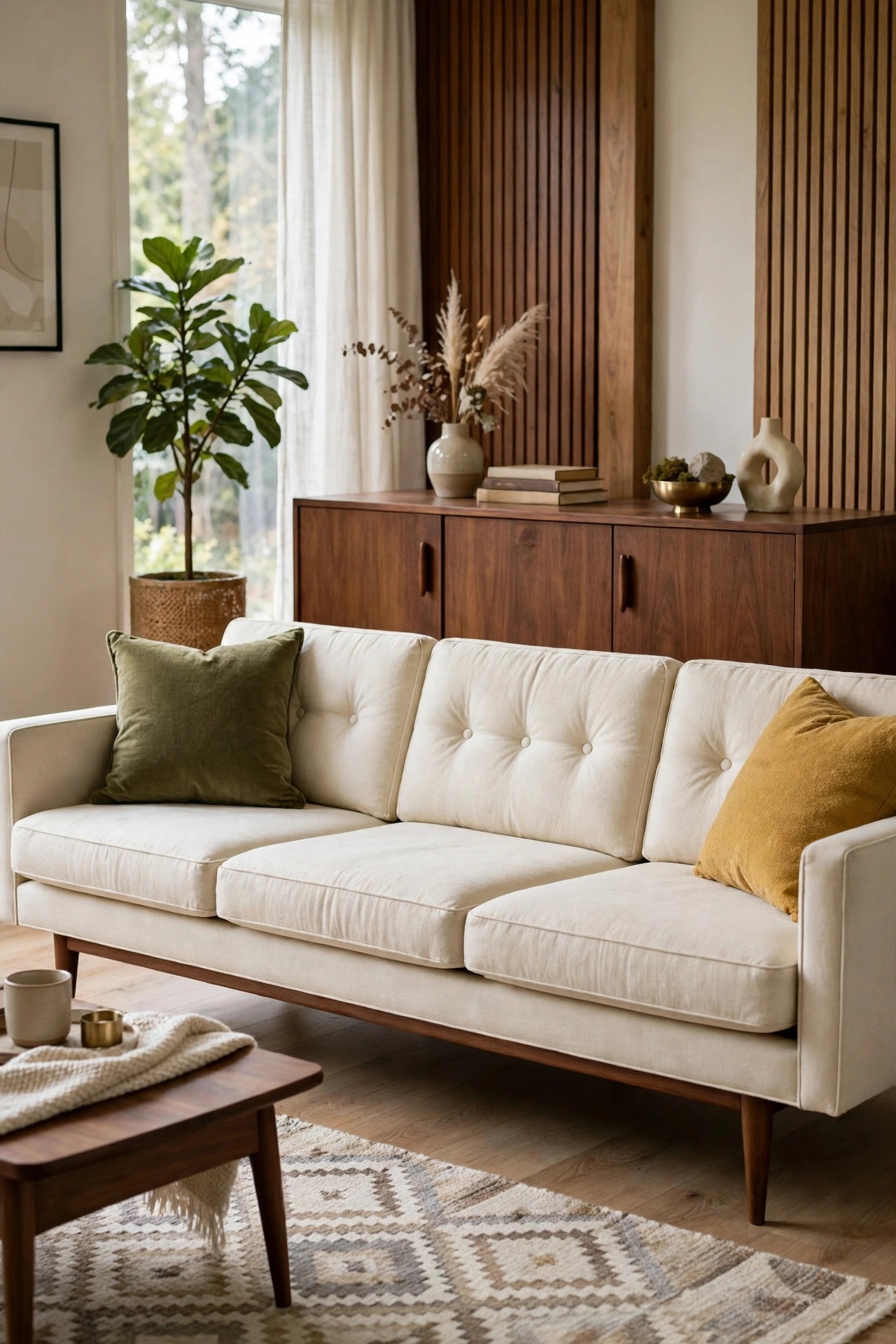
Description: The sofa sets the room’s height line. Midcentury sofas sit low, with a seat height around 17 to 19 inches, a single clean back, and legs that lift the body 6 inches or more off the floor so light passes underneath. That floating gap is what makes the room feel open even with a full three-seater in it. Woven upholstery in cream, oatmeal or soft olive keeps the walnut furniture as the warm element and gives cushions the color job.
Best For: Anyone replacing a bulky high-back sofa that currently dominates the room.
Not Ideal For: Anyone who needs a high seat for easy standing; low seats are harder on knees.
Estimated Cost: $600-$1,200 (estimate) for a three-seat sofa with solid wood legs.
Budget Note: The leg and silhouette details matter more than the fabric grade at this scale; a mid-range weave in the right shape reads more period than expensive leather in the wrong one.
Renter Friendly: Yes
Renter Note: Freestanding furniture. Check the assembled length against your door and hallway turns before ordering.
What You Need
A low three-seat sofa with tapered solid wood legs, a tape measure, painter’s tape to mark the footprint, furniture sliders for hard floors.
Product type to look for: A three-seat sofa with a seat height of 17 to 19 inches, tapered solid wood legs at least 6 inches tall (not plastic or metal), track or gently flared arms, and woven upholstery in cream, oatmeal or olive. Confirm the leg material in the specifications, not the photos, before buying.
How To Do It
- Tape the sofa’s full footprint on the floor and live with the outline for a day.
- Check the seat height against your coffee table: the table should sit within about 2 inches of the seat height.
- Order fabric swatches and check them against the credenza wood in daylight and lamplight.
- Set the sofa on sliders, position it, then remove the sliders so the legs sit firm.
Pro Tip
Photograph your taped outline from the doorway. A sofa that fits the measurements can still block the room’s sightline, and the photo shows it before the delivery does.
3. Add One Sculptural Lounge Chair in a Walnut Frame
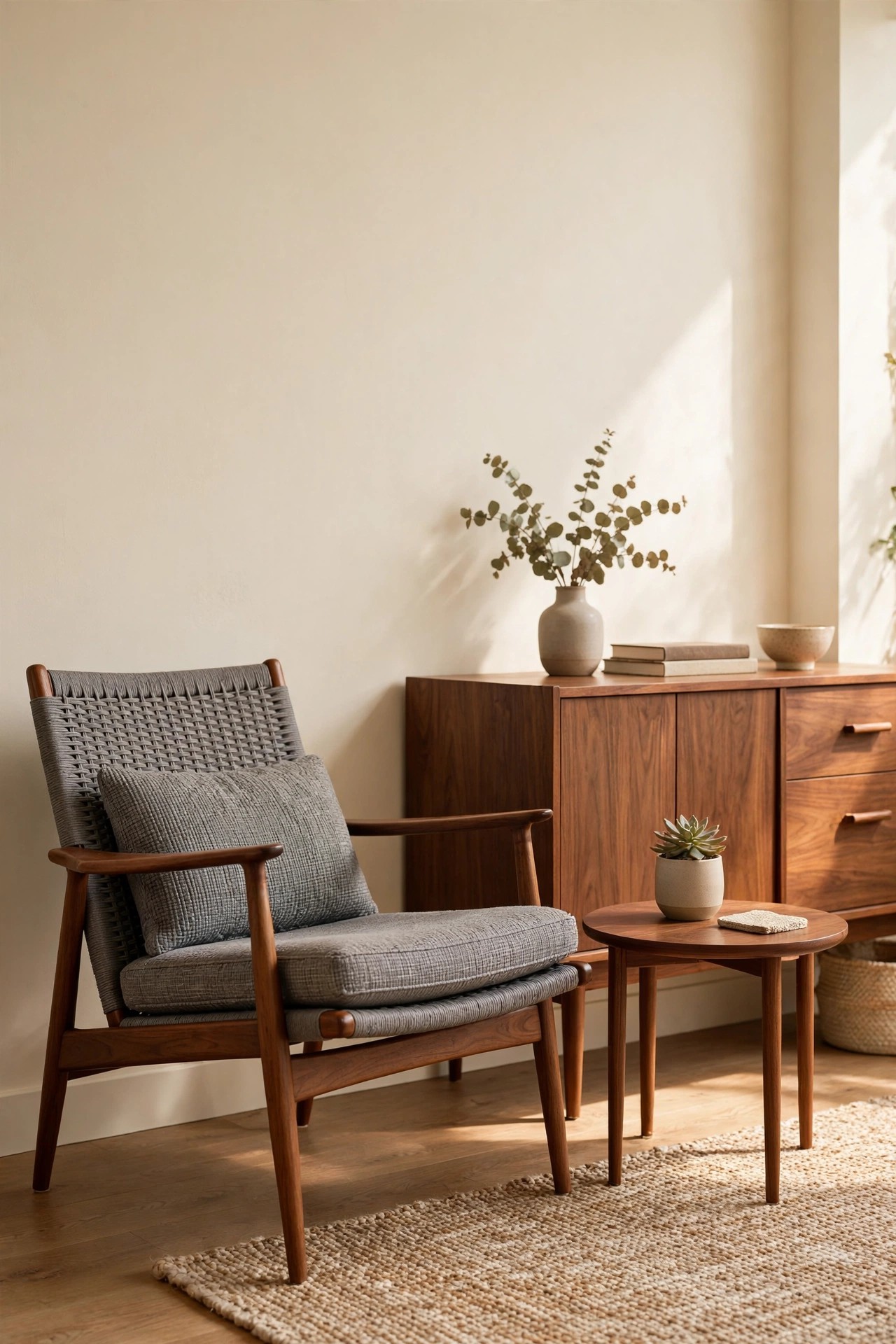
Description: One good lounge chair does more for the midcentury read than any accessory, because the exposed wood frame is the style in miniature: angled back, open arms, cushions that sit inside the frame rather than swallowing it. Place it at an angle to the sofa, not squared against the wall, with a small table within reach. A single chair also solves the small-room problem: it adds a seat without the visual weight of a second sofa or a matched pair.
Best For: A reading corner or the open end of a sofa arrangement in small and medium rooms.
Not Ideal For: Anyone wanting a recliner; the fixed angled back does not adjust.
Estimated Cost: $250-$450 (estimate) for a solid wood frame lounge chair with foam cushions.
Budget Note: The frame is the visible part, so spend on solid wood and replace the cushion covers later if the fabric dates.
Renter Friendly: Yes
Renter Note: Freestanding furniture, and light enough to move for cleaning or a new layout.
What You Need
One walnut-frame lounge chair, a small round side table, a floor protector pad set if the floor is softwood.
Product recommendation (verified): Lexicon Mid Century Modern Accent Chair with Solid Wood Frame in Walnut Finish, Dark Grey, linen-look fabric
Why it fits: A solid rubberwood frame in a walnut finish with an innerspring seat cushion, sized 28.5 inches wide by 32 inches deep by 31.5 inches high with an 18 inch seat height, and a listed capacity of 300 pounds, so it pairs with a low sofa instead of towering over it.
Retailer/product page: https://www.amazon.com/dp/B07P6NLHG1
How To Do It
- Angle the chair about 30 degrees toward the sofa so conversation works without moving it.
- Leave a hand’s width between the chair and any wall; the open frame needs air around it.
- Set the side table on the chair’s dominant-hand side, top level with the chair arm.
- Add one cushion in the room’s accent color and leave the rest of the chair bare.
Pro Tip
Sit in the chair before committing to the corner: the angled back suits reading, but if the seat feels low, a 2 inch thicker cushion pad raises it without changing the silhouette.
4. Hang One Starburst Clock as the Wall Focal Point
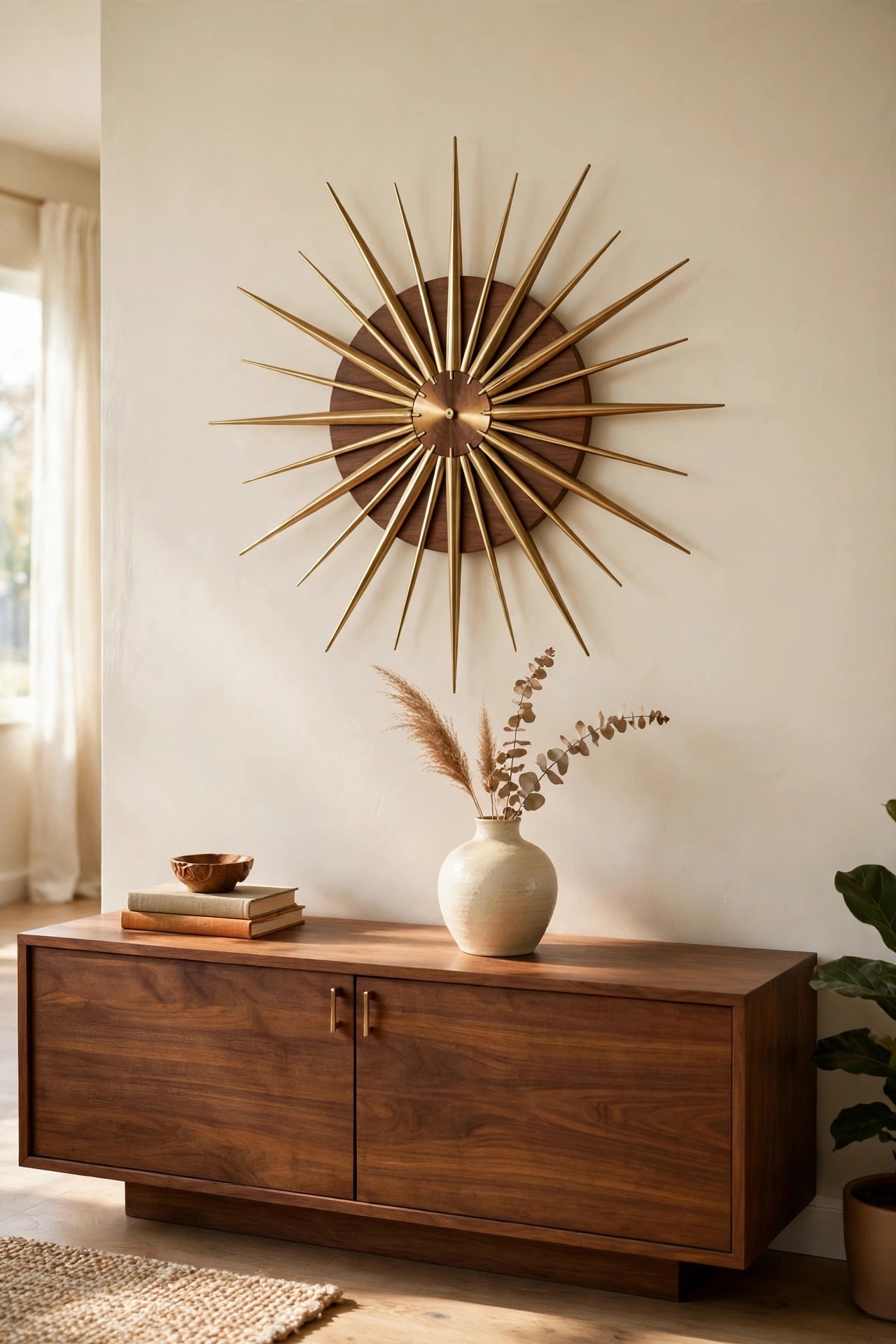
Description: If the room gets one atomic shape, this is the safest place for it: flat against the wall, useful every day, and easy to remove when tastes change. Scale is the whole trick. A starburst around 30 inches across holds a wall above a 60 inch credenza on its own, while a 12 inch version looks lost and needs a gallery around it, which breaks the calm. Walnut rays with simple hands keep it warm rather than novelty, and the rest of the wall stays empty.
Best For: The blank wall above the credenza or sofa in a room with plain walls.
Not Ideal For: Walls already busy with shelving or art; the starburst needs empty space around it.
Estimated Cost: $60-$140 (estimate) for a 28 to 32 inch starburst clock.
Budget Note: Molded wood-finish rays cost much less than solid walnut and are lighter, which also makes hanging simpler.
Renter Friendly: With Conditions
Renter Note: One screw or a rated picture hook is usually enough; use an existing hook where you can, and fill a single small hole when you leave.
What You Need
A starburst clock around 30 inches wide, one wall screw or heavy-duty picture hook, a spirit level, painter’s tape.
Product recommendation (partially verified): Infinity Instruments Orion 30 Inch Walnut Mid-Century Modern Starburst Wall Clock (model 15371WL)
Why it fits: A full 30 inch starburst in a walnut finish, wide enough to hold the wall above a 60 inch credenza alone, from a clock specialist brand; the simpler hands keep it closer to furniture than to novelty decor.
Retailer/product page: https://www.homedepot.com/p/Infinity-Instruments-Orion-Walnut-Look-Wall-Clock-15371WL/323050664
How To Do It
- Tape a paper circle the clock’s full diameter on the wall and live with it for a day to confirm the scale.
- Hang the clock so its center sits about 57 to 60 inches from the floor, or 8 to 10 inches above the credenza top.
- Use one screw into a stud where possible; for plasterboard, use a hook rated well above the clock’s weight.
- Set the time, step back to the doorway, and check the rays sit level against the credenza line.
Pro Tip
Choose the clock before any wall art for that wall. A 30 inch starburst plus pictures reads as clutter; the clock alone reads as design.
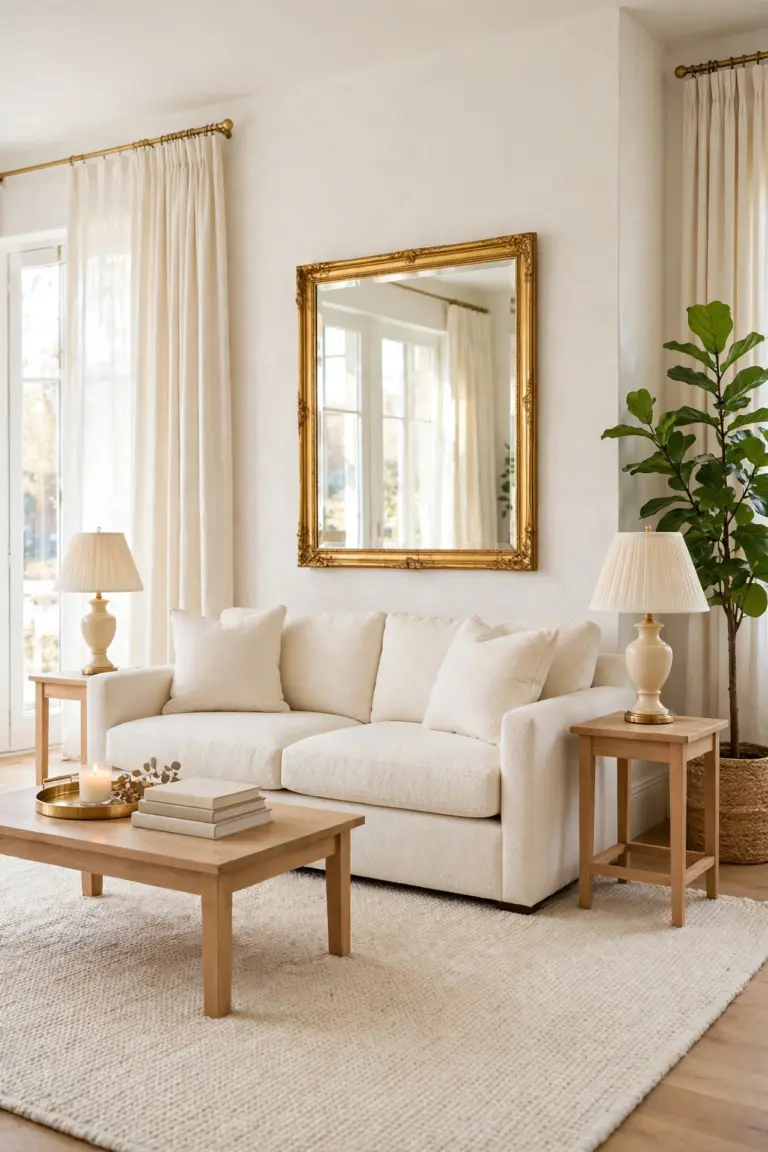
5. Layer a Sunburst Mirror Over the Credenza
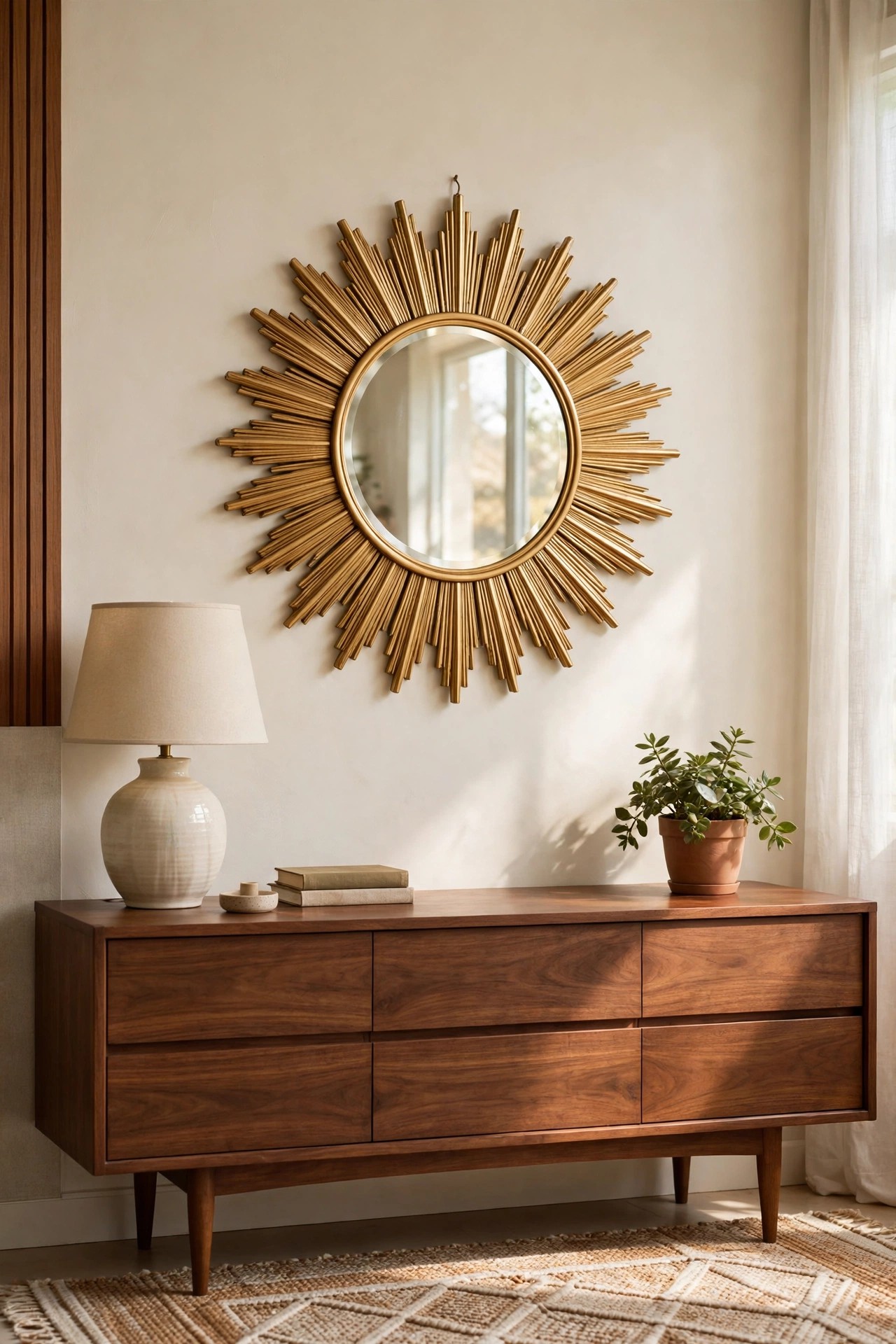
Description: A credenza wall can carry either the clock or this mirror, and the mirror is the better choice in a darker room because it returns window light into the seating area. Look for a round mirror around 26 inches across with a radiating or scalloped gold frame: the rays echo the starburst language without repeating the clock exactly. Centered above the credenza, it also gives the low, long furniture line a single round counterpoint, which is a very midcentury balance.
Best For: North-facing or low-light living rooms where the credenza wall faces a window.
Not Ideal For: The same wall as the starburst clock; choose one focal piece per wall.
Estimated Cost: $80-$160 (estimate) for a 24 to 28 inch framed sunburst-style mirror.
Budget Note: A plated metal frame in brushed gold costs far less than brass and gives the same warm reflection against walnut.
Renter Friendly: With Conditions
Renter Note: Mirrors are heavier than they look; use a hook or anchor rated for the full weight and keep the packaging until you are sure of the spot.
What You Need
A round sunburst-style mirror around 26 inches, a wall anchor or hook rated above its weight, a level, a tape measure, a stud finder.
Product recommendation (verified): Kate and Laurel Viona Modern Scalloped Round Wall Mirror, 26 inch diameter, Gold
Why it fits: A 26 by 26 inch round mirror with a scalloped gold frame the maker describes as sunburst-inspired, so it brings the radiating shape and the warm metal in one piece without competing with a clock on another wall.
Retailer/product page: https://www.amazon.com/dp/B09RSM9W8S
How To Do It
- Decide what the mirror will reflect; a window or the room itself works, a blank wall opposite does not.
- Mark the center point 8 to 10 inches above the credenza top and find the stud or fit a rated anchor.
- Hang, level the frame, and check from the sofa that no lamp glare sits in the reflection.
- Style the credenza below with low pieces only, so nothing tall crowds the frame.
Pro Tip
If the reflection shows a ceiling light fitting, shift the mirror 2 inches to one side rather than tilting it; a tilted mirror distorts the room line.
6. Arc a Floor Lamp Over the Reading Corner
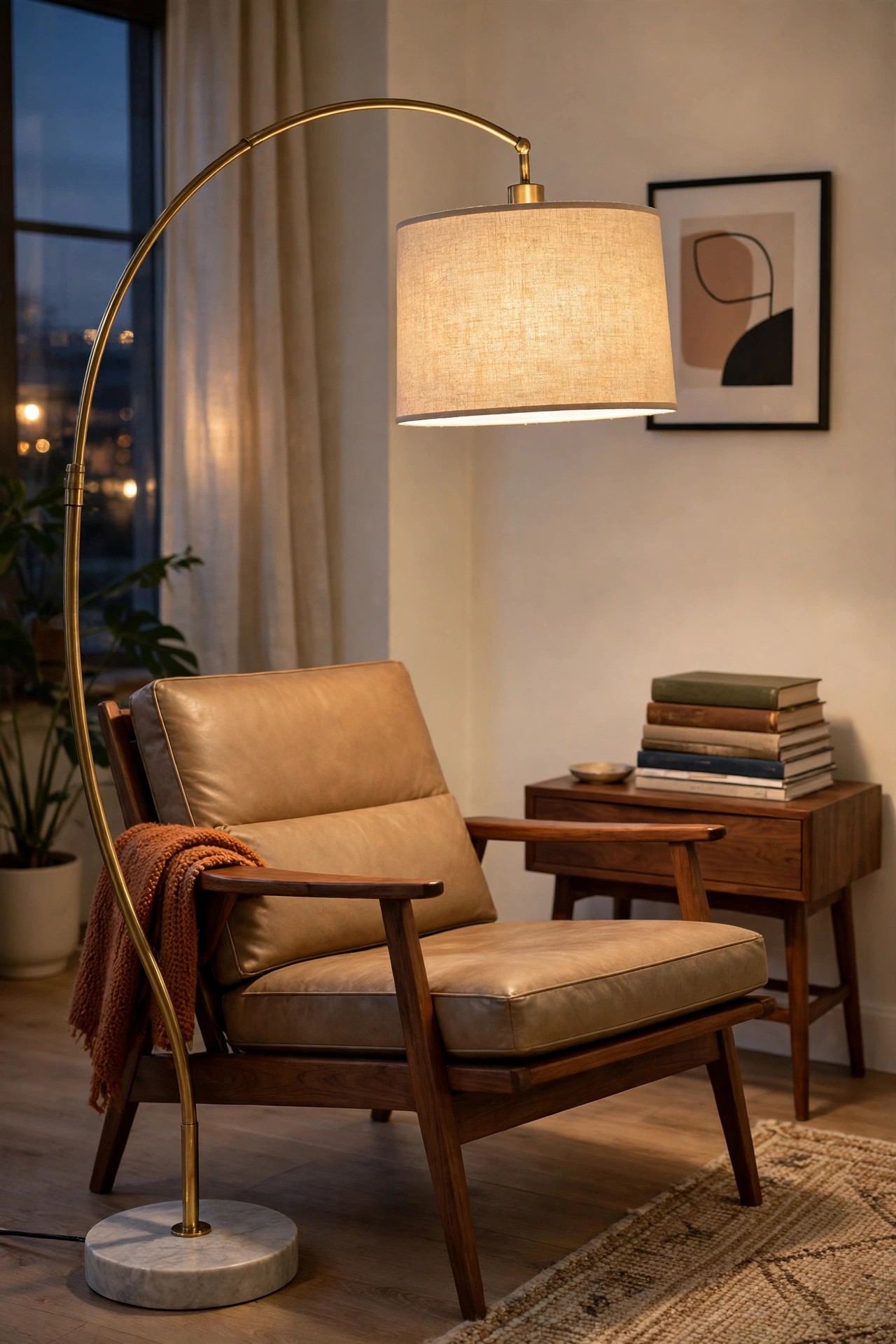
Description: The arc lamp solves a real layout problem: light that lands where people actually sit, without a ceiling fitting and without a table lamp eating the side table. A heavy marble base stands behind or beside the chair, the stem curves forward, and the shade hangs over the seat at roughly reading height. In brass or antique gold it also warms the walnut, and the curve softens a room that is otherwise all straight lines, which midcentury rooms can easily become.
Best For: A reading chair placed away from walls and ceiling fittings.
Not Ideal For: Homes with toddlers or large dogs; a tall lamp on a base can be knocked, so placement matters.
Estimated Cost: $150-$280 (estimate) for a full-height arc lamp with a stone base.
Budget Note: The base weight is the safety feature, so do not save money by choosing a light hollow base.
Renter Friendly: Yes
Renter Note: Freestanding and plug-in; no wiring or ceiling work is involved.
What You Need
An arc floor lamp with a heavy stone base, a warm-white LED bulb, a cord cover if the cable crosses a walkway.
Product recommendation (verified): Brightech Logan Arc Floor Lamp, Antique Brass finish
Why it fits: A 76 inch tall arc lamp with a real marble base and a linen drum shade, sold by Brightech’s own Amazon storefront, in the listing’s stated mid century modern style, so it reads as period furniture rather than a generic task light.
Retailer/product page: https://www.amazon.com/Brightech-Logan-LED-Floor-Lamp/dp/B074QH891N
How To Do It
- Place the base behind the chair or sofa end, never in a walkway, and check the arc clears heads when seated.
- Rotate the stem until the shade centers roughly 20 inches above the seat cushion.
- Fit a warm-white bulb around 2700K so the brass and walnut stay warm at night.
- Run the cord along the baseboard with a cover if feet pass anywhere near it.
Pro Tip
Test the lamp from the chair with a book before fixing the layout: glare on the page means the shade sits too far forward, and a small rotation usually fixes it.
7. Put a Sputnik Chandelier on the Ceiling, Once
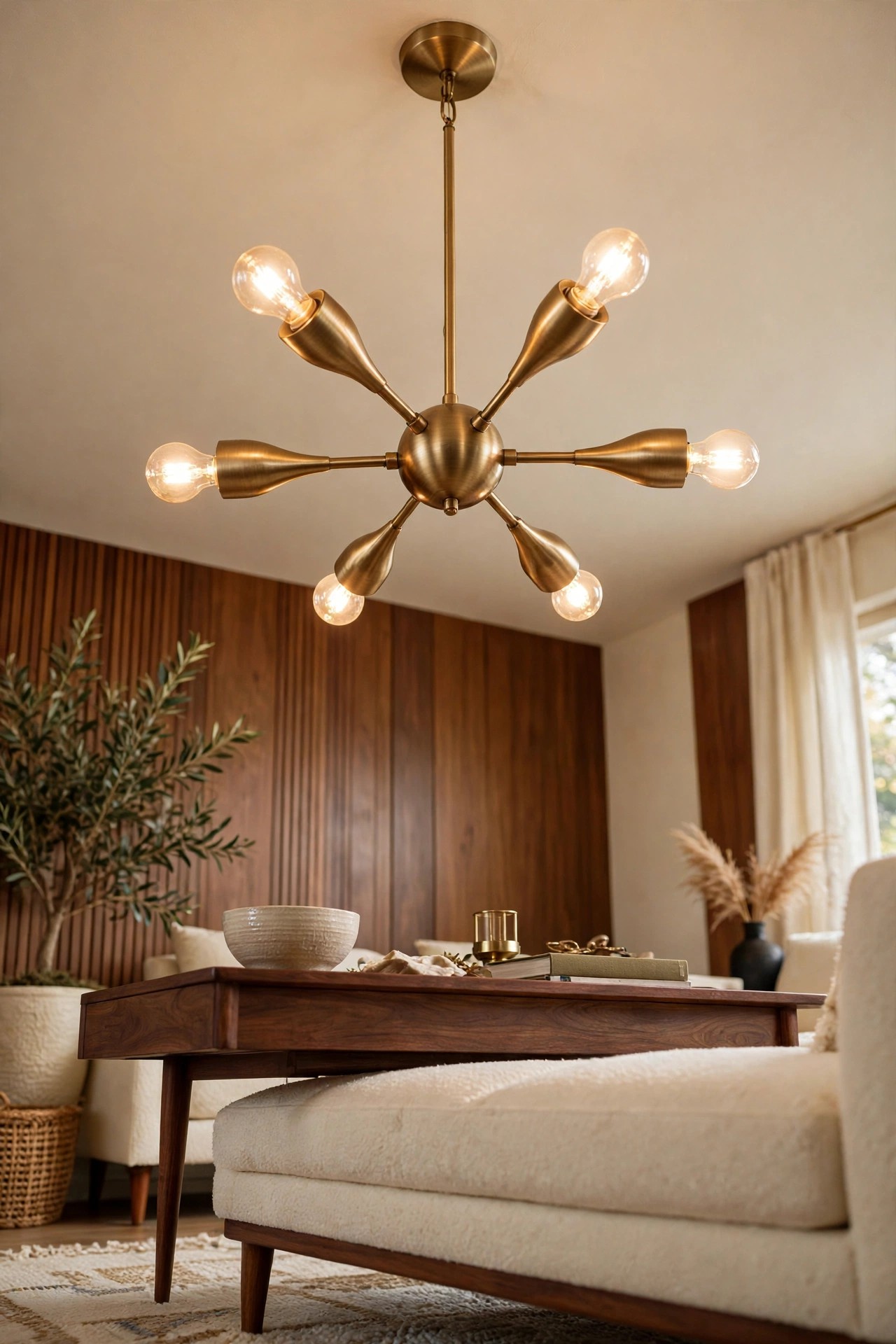
Description: The sputnik is the one ceiling statement this style is known for, and one is enough: six to eight arms in brushed brass, sized so the widest point stays well inside the coffee table footprint below. It works because everything under it is low and quiet, so the ceiling carries the single dramatic shape. Keep the bulbs visible and warm, on a dimmer if the circuit allows, and skip matching sputnik wall lights; repetition is what tips this fixture from period to theme park.
Best For: Rooms with ceilings of 8 feet or more and a fixed seating arrangement underneath.
Not Ideal For: Low ceilings or open-plan rooms where the seating moves often; the fixture is fixed even when the furniture is not.
Estimated Cost: $120-$300 (estimate) for a six-light brass sputnik, plus an electrician’s visit if you are not confident wiring a fitting.
Budget Note: A six-arm fitting costs much less than the large twelve-arm versions and suits most living rooms better.
Renter Friendly: With Conditions
Renter Note: Swapping a ceiling fitting needs the landlord’s written permission in most rentals, and the original fitting kept safely for reinstatement.
What You Need
A sputnik chandelier around 20 to 24 inches wide, warm-white dimmable bulbs, a step ladder, a voltage tester. If you are not fully confident with ceiling wiring, book an electrician; the fitting itself is a standard ceiling swap.
Product recommendation (partially verified): BONLICHT Modern Sputnik Chandelier, 6 Lights, Brushed Brass
Why it fits: Six brushed brass arms in a true sputnik layout, dimmable with compatible bulbs, and modest enough in scale to sit over a coffee table without dominating a standard room; brass rather than chrome keeps it warm against walnut.
Retailer/product page: https://www.amazon.com/dp/B07BC93SNW
How To Do It
- Switch the power off at the breaker, not just the wall switch, and test the fitting with a voltage tester.
- Remove the old fitting and keep every part bagged and labelled in case it must go back.
- Fit the sputnik’s mounting bracket, connect like-for-like wires, and set the drop so the lowest arm clears seated heads by a wide margin.
- Fit warm-white bulbs, restore power, and check the dimmer at its lowest setting for flicker.
Pro Tip
Photograph the old wiring before disconnecting anything. That one photo is what an electrician, or you at reinstatement time, will want most.
8. Set a Low Coffee Table With One Closed Compartment
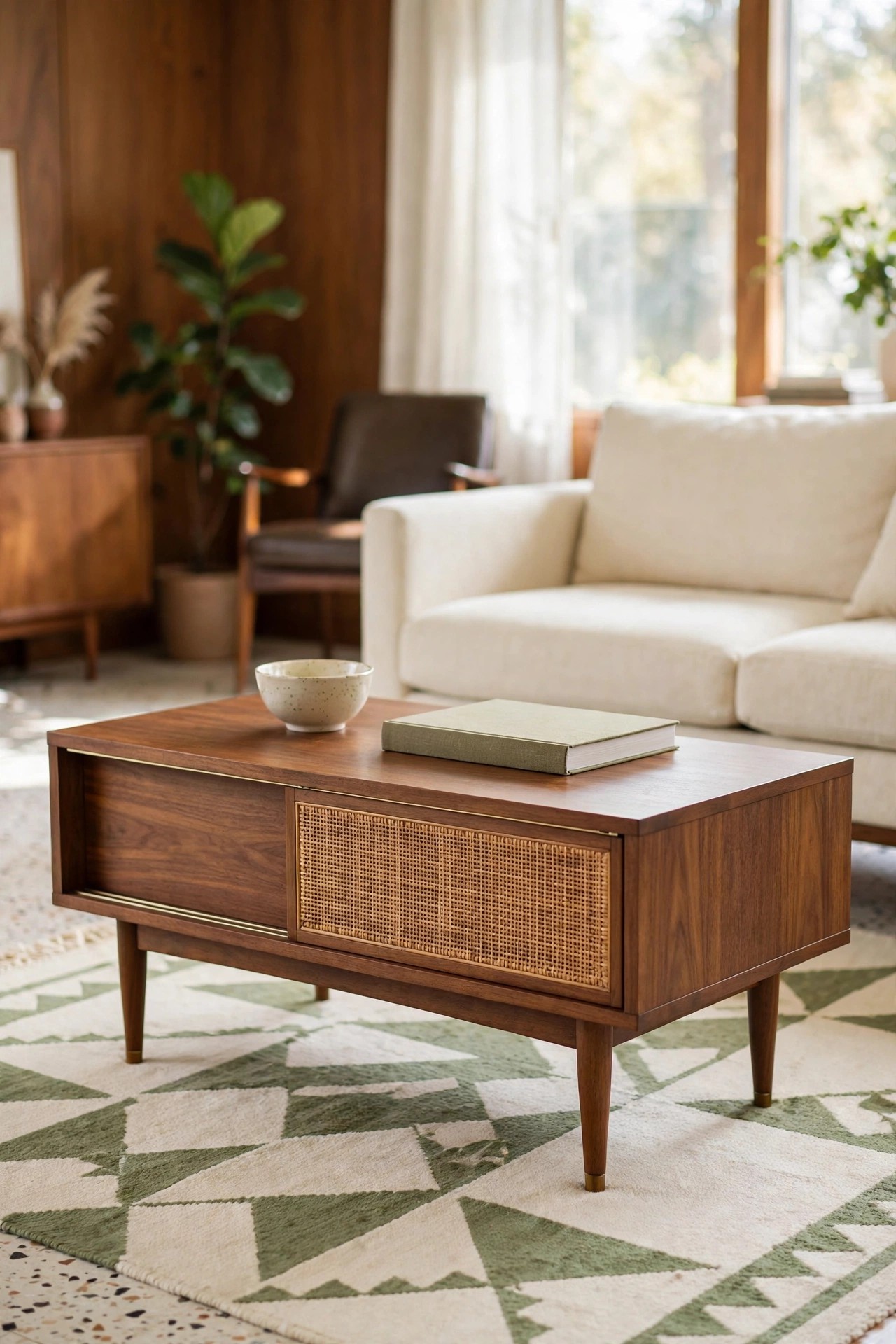
Description: Midcentury coffee tables are long, low and leggy: about 40 inches long, 16 inches high, standing on tapered legs so the rug shows underneath. The useful upgrade on modern versions is one closed compartment, a sliding door or a drawer, which takes remotes, chargers and coasters out of sight and keeps the top clear. A woven rattan door panel suits the walnut frame well and adds texture without adding another pattern to compete with the rug.
Best For: Family living rooms where the coffee table collects daily clutter.
Not Ideal For: Anyone who wants a lift-top work surface; this height and style are for drinks and feet, not laptops.
Estimated Cost: $120-$260 (estimate) for a 39 to 43 inch walnut-finish coffee table with storage.
Budget Note: Veneer over engineered wood with solid wood legs is the sweet spot; the legs carry the look and the wear.
Renter Friendly: Yes
Renter Note: Freestanding furniture; fit felt pads before it first touches a hard floor.
What You Need
A low coffee table around 40 inches long with one closed compartment, felt pads, a small tray for the items that stay out.
Product recommendation (partially verified): Ganooly Mid Century Modern Coffee Table with Storage, 41.3 inch
Why it fits: A 41.3 inch low table on solid wood tapered legs with a sliding PE rattan woven door hiding a storage compartment, so the top stays clear and the woven texture sits naturally against walnut and cream.
Retailer/product page: https://www.amazon.com/dp/B0BZQF4T8J
How To Do It
- Leave about 14 to 18 inches between the sofa edge and the table; less feels cramped, more makes drinks hard to reach.
- Fit felt pads and check the table sits level on the rug, adjusting for pile thickness.
- Assign the closed compartment one job, such as remotes and chargers, and put a small liner inside.
- Keep the top to a tray, one book and one bowl at most, so the proportions stay visible.
Pro Tip
Slide the table 2 inches toward the sofa’s most-used seat rather than centering it perfectly; daily reach beats perfect symmetry.
9. Ground the Seating With a Flat Geometric Rug
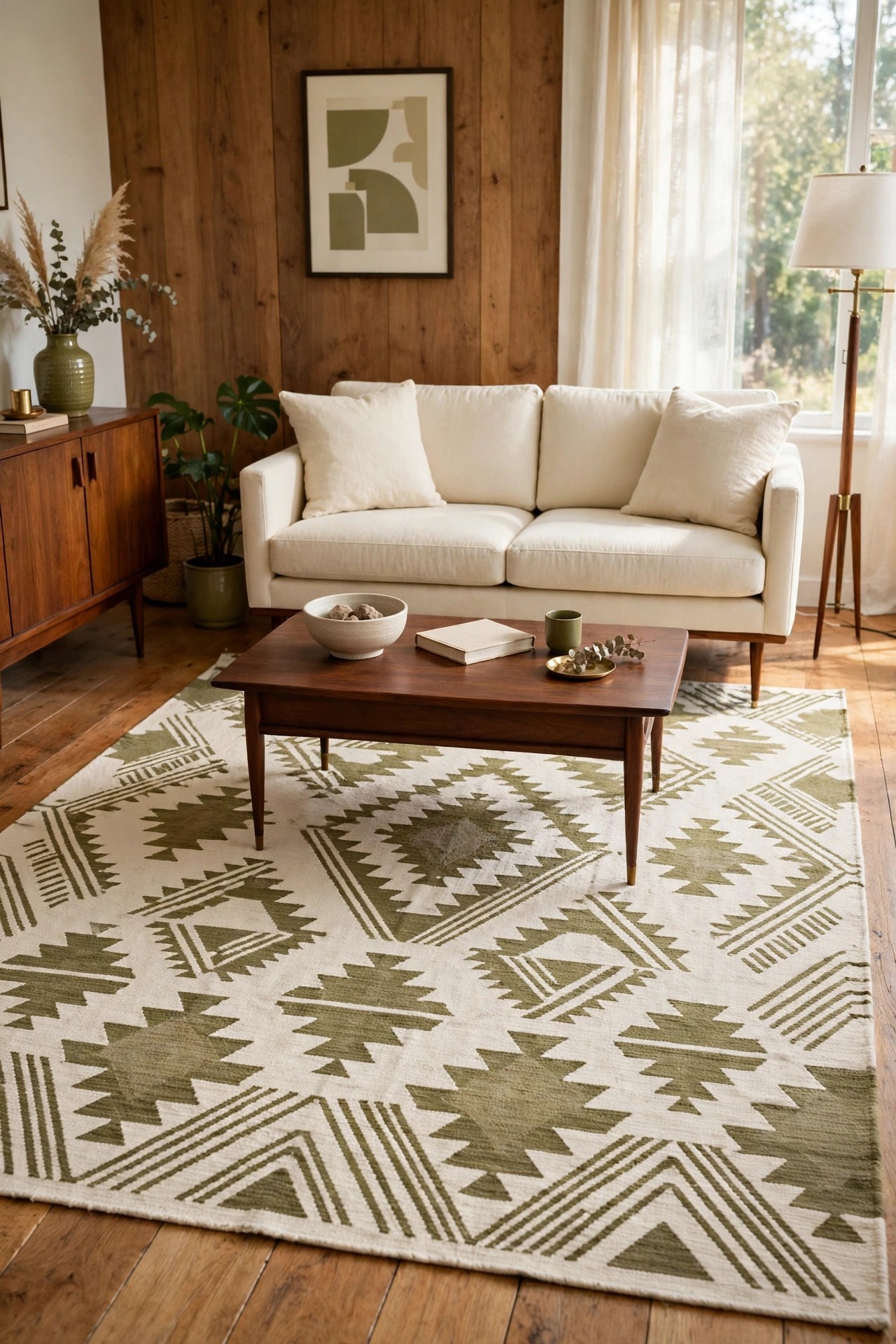
Description: The rug is where the geometry belongs: a flat weave with a simple repeated shape in cream, olive and a little mustard ties the wood tones to the cushions and defines the seating area without walls. Flat weave matters here because tapered legs stand steady on it and the low furniture keeps its clean line close to the floor. Size up rather than down: the front legs of the sofa and chairs should all stand on the rug, which usually means at least 5 by 8 feet.
Best For: Open-plan rooms where the seating group needs a boundary.
Not Ideal For: Anyone wanting a plush underfoot feel; flat weave is firm by design.
Estimated Cost: $140-$320 (estimate) for a 5 by 8 to 8 by 10 foot washable geometric rug.
Budget Note: Synthetic flat weave costs a fraction of hand-knotted wool and can go in the wash, which suits a family room better.
Renter Friendly: Yes
Renter Note: A rug also protects the landlord’s floor; use a non-slip pad that is safe for your floor finish.
What You Need
A flat-weave geometric rug at least 5 by 8 feet, a non-slip rug pad cut slightly smaller than the rug, painter’s tape.
Product recommendation (verified): nuLOOM Kailani Geometric Washable Area Rug, Green, 5 x 8 feet
Why it fits: A geometric pattern in green tones on a 100 percent PET polyester flat weave that is machine washable, so it carries the olive accent at floor level, stands up to daily use, and gives tapered legs a firm, even surface.
Retailer/product page: https://www.amazon.com/dp/B0D4VTGJSG
How To Do It
- Mark the seating footprint with tape, front legs included, and buy the rug size that covers it.
- Lay the pad first, cut 2 inches smaller than the rug on every side.
- Unroll the rug, weight the corners with books overnight, then position the furniture.
- Rotate the rug 180 degrees every few months so traffic wear and daylight spread evenly.
Pro Tip
Hold a cushion against the rug sample before ordering: the olive in the rug should sit one shade deeper than the cushion fabric, not match it exactly.
10. Use Round Walnut End Tables Instead of Square Ones
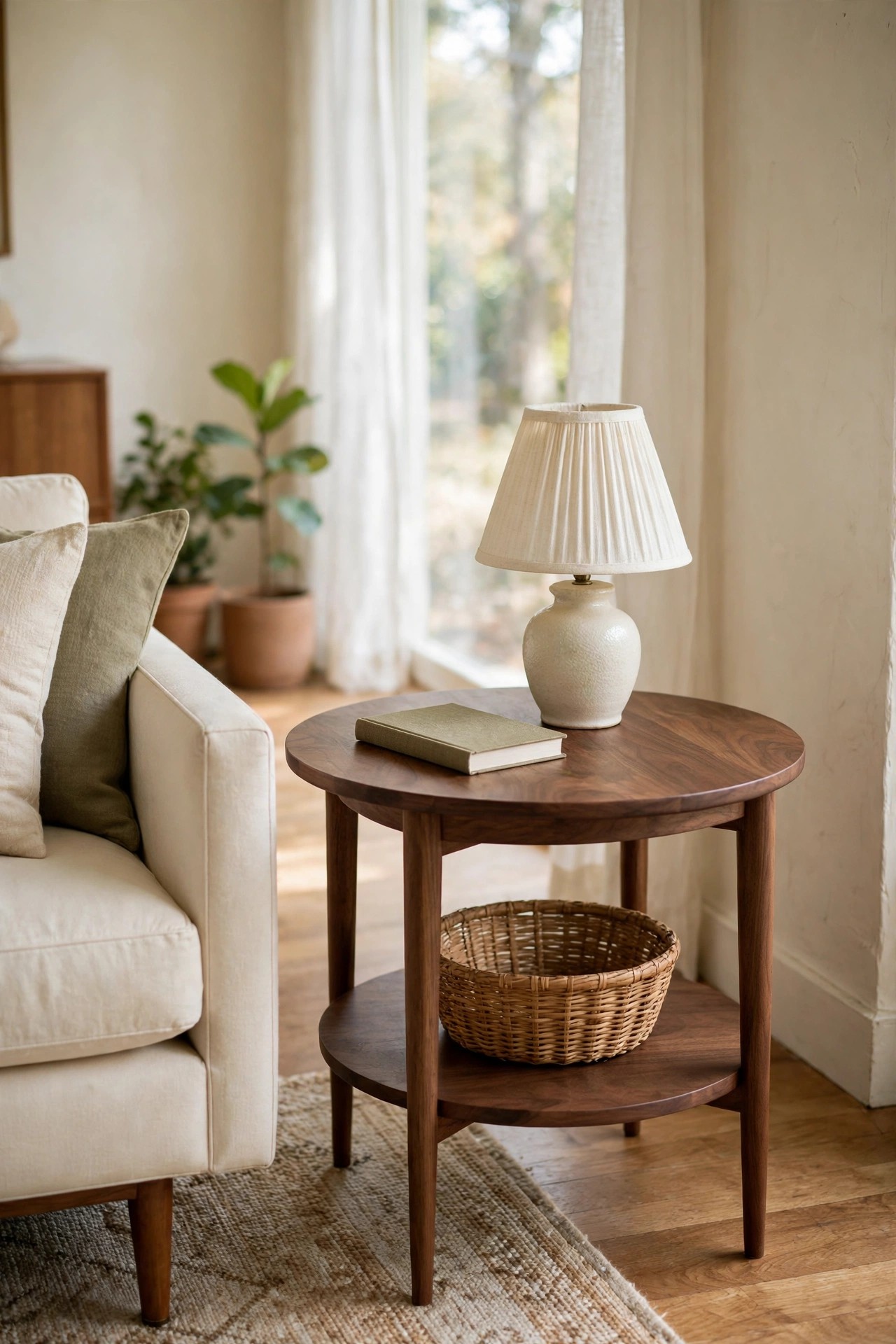
Description: Most midcentury rooms are full of rectangles: credenza, sofa, rug, coffee table. A round end table breaks the grid in the right place, removes the sharp corner at the sofa’s end, and its tapered legs echo the bigger pieces. Around 15 to 18 inches across and 22 inches high suits a low sofa arm, and a two-tier version gives books a home without a second piece of furniture. Buy them as a pair even for one sofa; the second table balances the lounge chair.
Best For: Sofas with low arms and rooms with a lot of straight-lined furniture.
Not Ideal For: Anyone who parks a large lamp and a laptop at the sofa end; the round top is small by design.
Estimated Cost: $70-$140 (estimate) for a pair of round walnut-finish end tables.
Budget Note: Pairs are sold at a better per-table price than singles, and matching legs across the pair keep the room consistent.
Renter Friendly: Yes
Renter Note: Freestanding furniture, light enough to move aside for cleaning or guests.
What You Need
A pair of round walnut end tables around 22 inches high, felt pads, one small tray or coaster set per table.
Product recommendation (partially verified): Giantex Round End Table, Walnut, Set of 2
Why it fits: A pair of round two-tier tables at about 15 by 15 by 22 inches in a walnut finish, the right height for a low midcentury sofa arm, with a lower storage tier that keeps the small round top clear.
Retailer/product page: https://www.amazon.com/dp/B0CH4X4KGT
How To Do It
- Set one table at the sofa end so its top sits level with, or just below, the arm.
- Place the second by the lounge chair to balance the pair across the seating group.
- Fit felt pads and check for wobble on hard floors before loading the shelves.
- Keep the top to a lamp or a drink and a book; the lower tier takes the rest.
Pro Tip
Round tables still need a flat anchor for glasses: one small round tray per table stops wobble and protects the walnut finish from rings.
11. Dose Mustard and Olive Through Cushion Covers Only
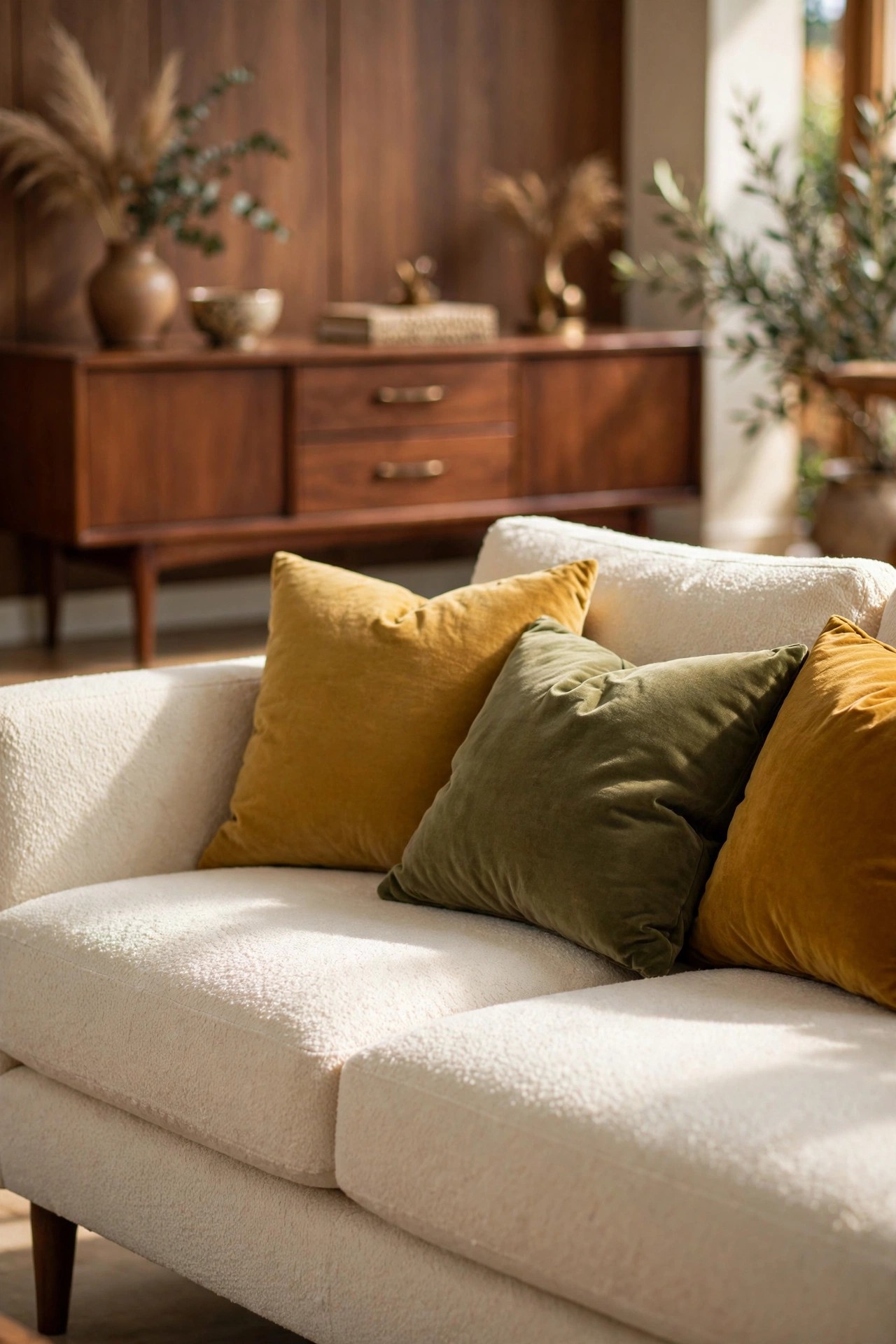
Description: The era’s accent colors, mustard, olive and a little burnt orange, are strong enough that a whole sofa in any of them dates the room fast. Cushion covers are the correct dose: two mustard, one olive, and the rest of the sofa left cream. Velvet suits the period and catches light against flat woven upholstery. Because covers zip off, the palette can change by season for the price of a takeaway meal, which is exactly the flexibility a strong color scheme needs.
Best For: Cream or oatmeal sofas that feel flat and need the period color without commitment.
Not Ideal For: Patterned sofas; strong solid cushions fight existing prints instead of settling them.
Estimated Cost: $40-$90 (estimate) for four to six cushion covers in 18 inch square.
Budget Note: Buy covers, not filled cushions; covers store flat and your existing inserts keep their shape.
Renter Friendly: Yes
Renter Note: Fully reversible and portable; nothing about this idea touches the room itself.
What You Need
Four to six cushion covers, 18 by 18 inches, in mustard and olive velvet, inserts 2 inches larger than the covers for a full look.
Product recommendation (verified): MUSSEL Mustard Yellow Floral Pillow Covers, 18 x 18 inch, Set of 2, Velvet
Why it fits: A pair of mustard velvet covers with a soft floral pattern in the period palette, sized 18 by 18 inches, shipped from Amazon and sold by the maker’s own store, so the strongest color in the room arrives as a washable, changeable cover.
Retailer/product page: https://www.amazon.com/dp/B0FC6HN9SD
How To Do It
- Count the sofa seats: one accent cushion per seat, plus one extra for the chair, is the ceiling.
- Place mustard at the two outer ends and olive in the middle, or the reverse, but keep the arrangement symmetrical.
- Use inserts 2 inches larger than the covers so the velvet sits smooth, not wrinkled.
- Check the colors against the rug and the wood in morning and evening light before removing tags.
Pro Tip
Keep one burnt orange cover in the drawer for autumn. Swapping a single cushion shifts the whole palette for the season at almost no cost.
12. Build a Small Vinyl Corner on a Walnut Record Stand
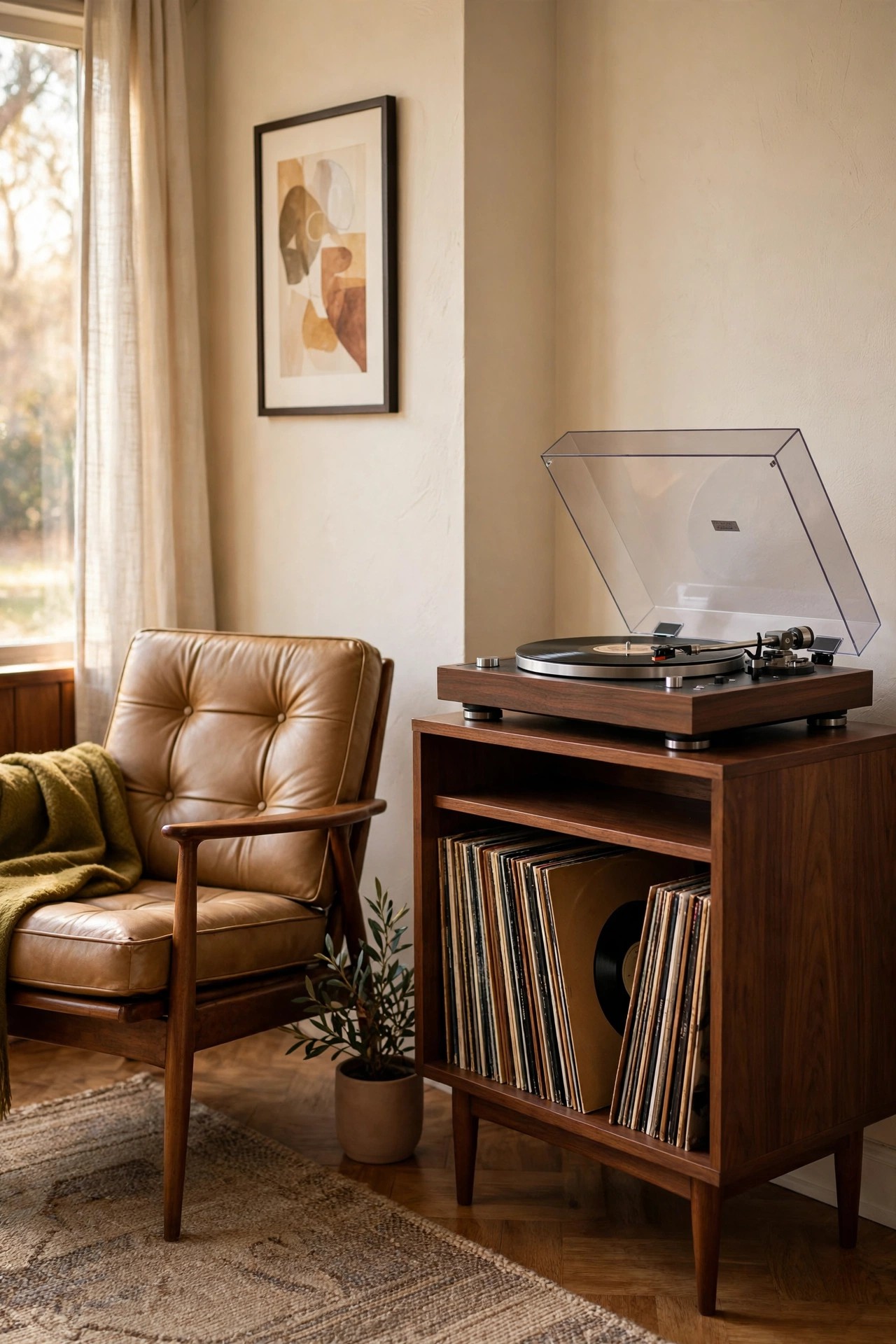
Description: A record player was standard furniture in the period this style comes from, and a small vinyl corner still earns its place: it gives the room a reason for the lounge chair, and records stored upright in an open stand add warm, varied color without any decor shopping. A stand around 27 inches high with dividers keeps sleeves from slumping, which is what damages them. Keep the corner compact, one stand and the chair, so it reads as a listening spot rather than a collection taking over.
Best For: Anyone with even a small record collection and an underused corner.
Not Ideal For: Serious collectors; a stand holding around 100 records fills quickly.
Estimated Cost: $80-$180 (estimate) for the stand alone; a turntable is a separate purchase.
Budget Note: The stand is simple furniture, so buy for solid dividers and a level top rather than brand names.
Renter Friendly: Yes
Renter Note: Freestanding furniture; the turntable’s weight sits on the stand, not on any fitting.
What You Need
A record stand with upright dividers, a turntable, a small level, felt pads.
Product recommendation (partially verified): VASAGLE Record Player Stand, 3-Tier, Natural Walnut (model ULET275K02)
Why it fits: A natural walnut stand at 16.9 inches wide by 11.8 inches deep by 27.1 inches high, rated on the listing to store up to 100 albums with a top load capacity of 44 pounds, tall enough to use standing and low enough to suit the room’s height line.
Retailer/product page: https://www.amazon.com/dp/B0D4DJTJGY
How To Do It
- Choose the corner nearest a power socket so no cable crosses the floor.
- Level the stand carefully; a turntable skips and wears records on a tilted surface.
- File records upright with a little slack, grouped by how often they are played.
- Keep direct sun off the corner; heat and light warp vinyl and fade sleeves.
Pro Tip
Store the records you actually play at the front and the archive at the back; a listening corner that needs digging through 100 sleeves stops being used.
13. Finish the Credenza With One Ceramic Table Lamp
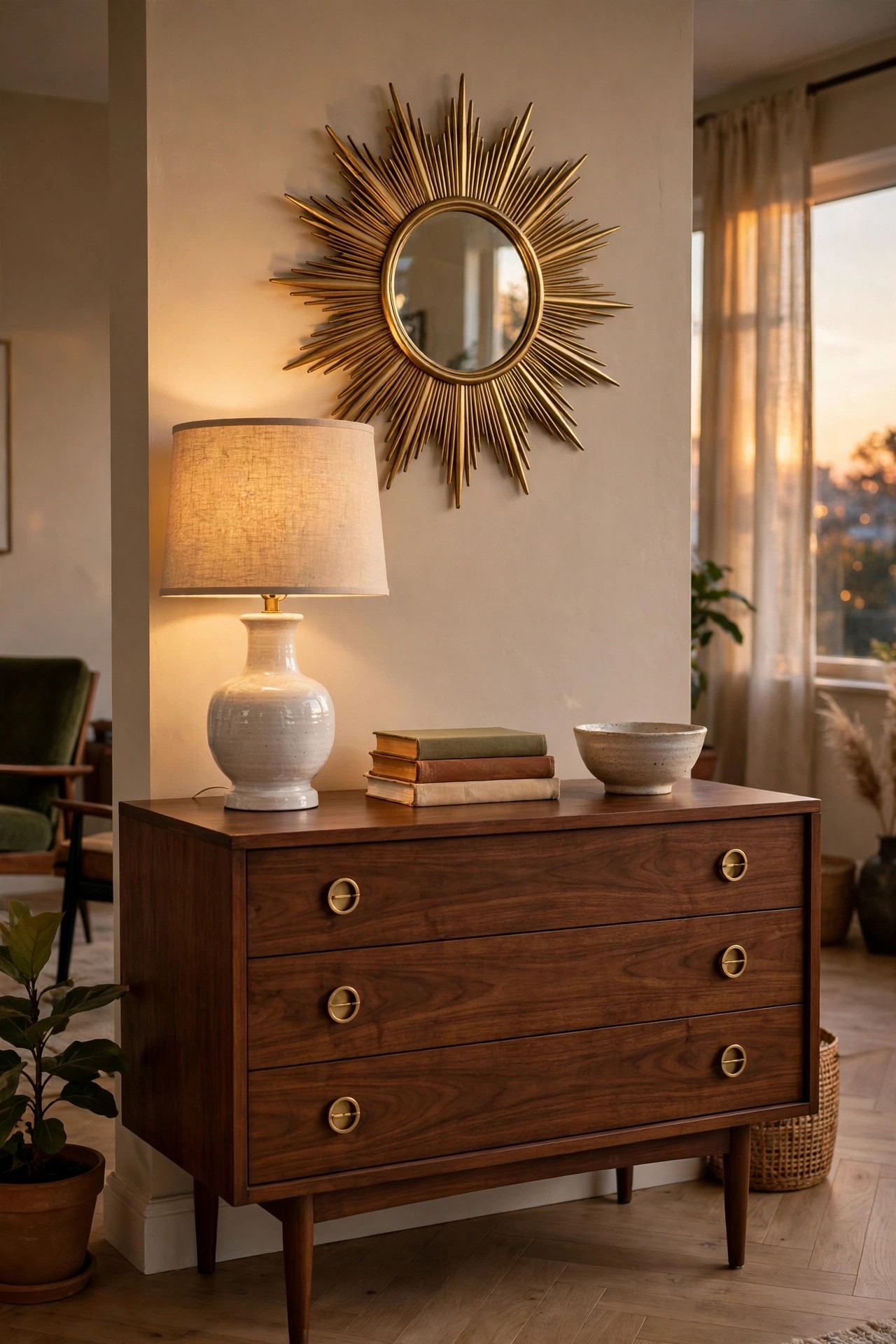
Description: The credenza top needs one light source, and a ceramic lamp with a drum shade is the period-correct shape: a rounded or gently tapered base, a straight-sided shade, and a total height around 26 inches so it stands clear of the mirror or clock above without touching it. White or cream ceramic keeps the walnut as the dark note on that wall. A built-in dimmer earns its keep here, because credenza lamps are evening lamps, used low while the room is occupied.
Best For: Credenza walls that look finished in daylight but flat and dark at night.
Not Ideal For: Credenzas under 48 inches; a 26 inch lamp overwhelms a short console.
Estimated Cost: $90-$180 (estimate) for a ceramic table lamp with a linen shade.
Budget Note: The shade can be replaced separately later, so choose the lamp for the ceramic base you will keep.
Renter Friendly: Yes
Renter Note: Plug-in furniture; route the cord behind the credenza so nothing crosses a walkway.
What You Need
A ceramic table lamp around 26 inches high with a drum shade, a warm-white bulb, a cord clip for the credenza back.
Product recommendation (verified): Possini Euro Design Cosgrove Mid-Century Modern Table Lamp, 26.5 inch high, White Ceramic with Light Brown Linen Drum Shade
Why it fits: A 26.5 inch white ceramic base with a linen drum shade in the listing’s mid-century style, with a tabletop dimmer and a built-in USB charging port, so the credenza gains evening light and a phone charger without extra clutter.
Retailer/product page: https://www.amazon.com/dp/B09C2DVZ8D
How To Do It
- Place the lamp at one end of the credenza, never the center; the mirror or clock owns the middle.
- Fit the cord down the back of the credenza with a clip so it is invisible from the front.
- Balance the other end with a low stack of books or a plant of about half the lamp’s height.
- Set the dimmer to the level you would actually use in the evening and leave it there.
Pro Tip
Measure the gap between the credenza top and the bottom of the mirror before buying: the lamp shade should clear it by at least 4 inches.
14. Use a Low Walnut Bookcase as a Room Divider or Display Wall
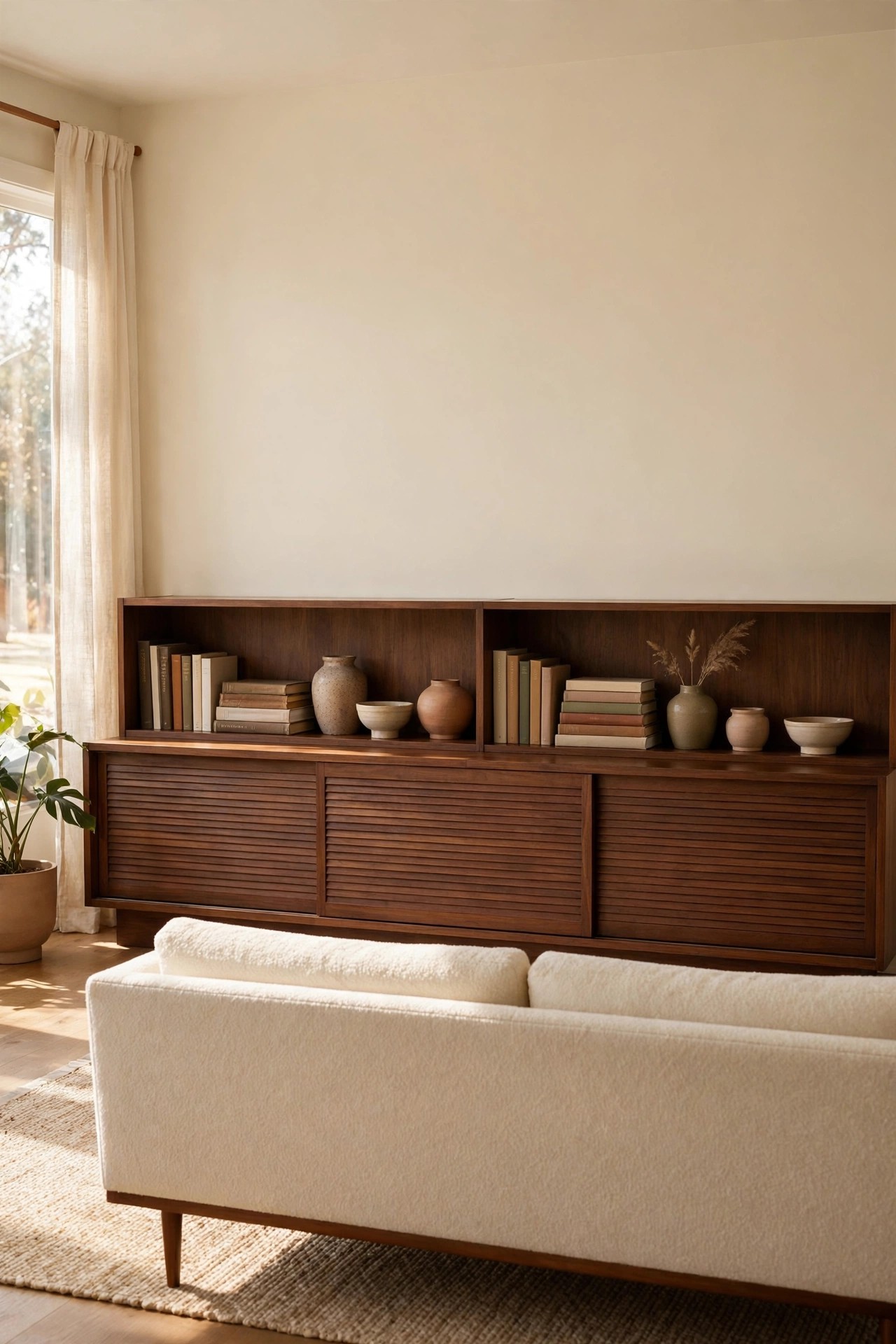
Description: A tall bookcase fights the midcentury height line, but a long, low one extends it. At around 59 inches wide and under 68 inches high, a walnut bookcase with sliding doors can sit behind the sofa as a console wall, or across an open-plan room as a divider that stores books and hides clutter behind the doors. The mix matters: roughly half open display, half closed storage keeps it looking like furniture rather than a library stack, and the top surface takes plants and ceramics.
Best For: Open-plan rooms that need a soft divide between living and dining zones.
Not Ideal For: Homes with climbing toddlers unless it is anchored; see the safety note in the steps.
Estimated Cost: $300-$600 (estimate) for a 55 to 60 inch walnut-finish bookcase with sliding doors.
Budget Note: Sliding doors cost more than open shelving but do the clutter-hiding work that keeps the room calm.
Renter Friendly: With Conditions
Renter Note: The anti-tip anchor needs one wall screw; get the landlord’s agreement first, or use it against a wall with a furniture anchor strap into a stud where permitted.
What You Need
A low walnut bookcase with sliding doors, an anti-tip anchor kit, a stud finder, felt pads, a level.
Product recommendation (verified): Modway Transmit Bookcase with Sliding Doors in Walnut, 59 inch
Why it fits: A walnut bookcase sized 59.09 inches wide by 11.46 inches deep by 67.6 inches high with sliding doors that conceal half the storage, shipped and sold through Amazon, giving the long low line and the open-closed mix this idea depends on.
Retailer/product page: https://www.amazon.com/dp/B0DSJVM2H7
How To Do It
- Fit the anti-tip anchor to a stud before loading a single shelf; this step is not optional, especially with children or pets in the home.
- Load the heaviest books on the lowest shelves to keep the center of gravity down.
- Arrange open shelves in a rhythm: books, gap, ceramic, books, so the eye reads pattern, not piles.
- Keep the top surface to three groups at most, with the tallest piece at one end.
Pro Tip
If it stands as a divider, finish the back view too: the sliding doors mean the closed side can face the dining zone and look deliberate, not like the back of a bookcase.
15. Try One Geometric Accent Wall in Peel and Stick Paper
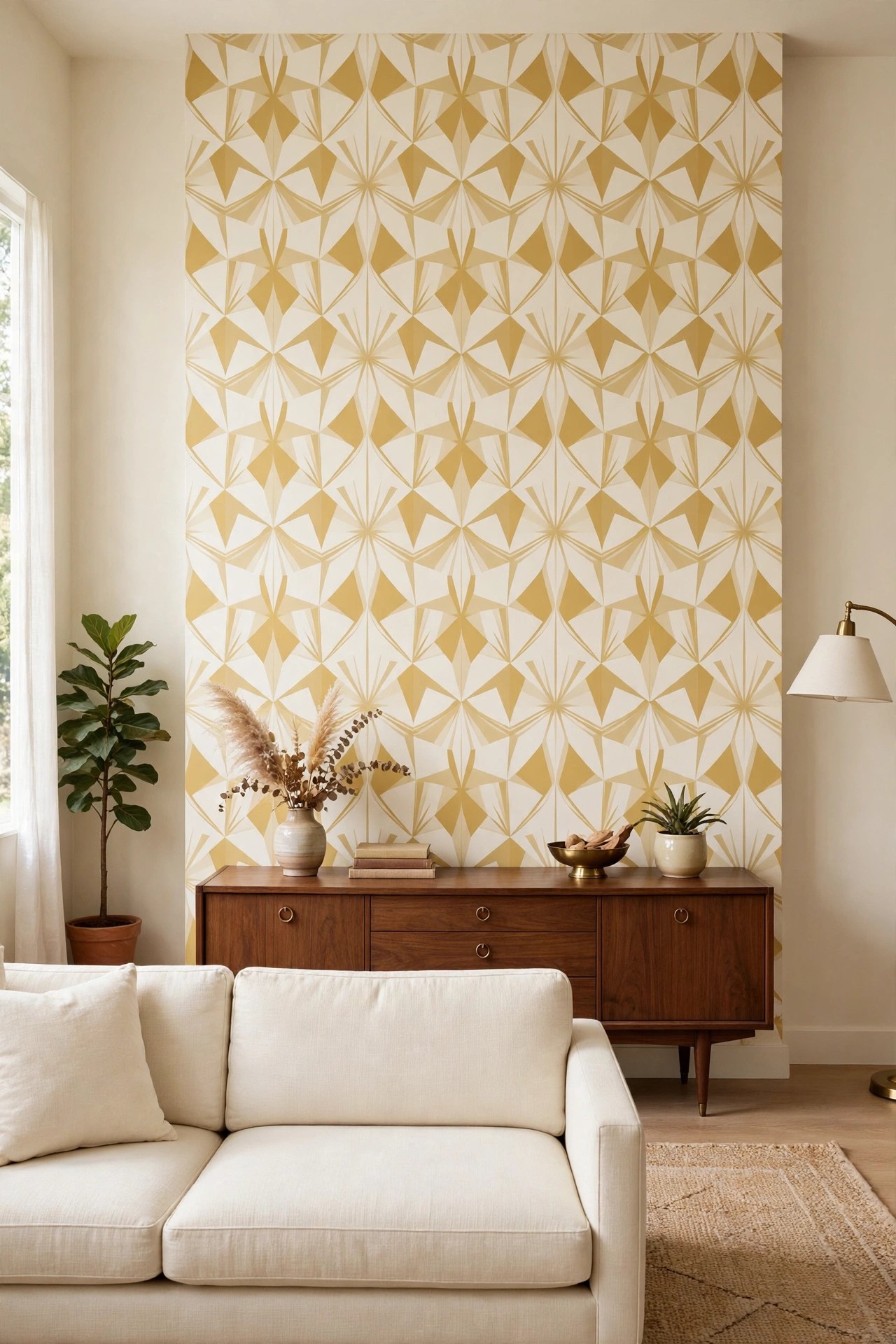
Description: If the room still feels plain after the furniture is right, one patterned wall is the controlled way to add the atomic geometry: a retro repeat of arcs, diamonds or boomerangs in cream, mustard, sage and a little brown, behind the credenza where the furniture breaks it up. Peel and stick paper makes the experiment honest, because it comes off without paste or damage on sound paint. Keep every other wall plain cream; two patterned walls turn the room into a set, which is what this list has avoided throughout.
Best For: Plain rental rooms that need pattern without paint or permanent change.
Not Ideal For: Textured, freshly painted or damp walls; peel and stick needs a smooth, fully cured surface.
Estimated Cost: $60-$140 (estimate) for two rolls to cover one standard accent wall.
Budget Note: Order one extra roll from the same batch; pattern repeats eat more paper than the coverage figure suggests.
Renter Friendly: Yes
Renter Note: Peel and stick removes cleanly from sound paint, but test a hidden patch first and never apply over paint that is less than a month old.
What You Need
Two to three rolls of geometric peel and stick wallpaper, a smoothing tool, a sharp craft knife, a level or plumb line, a step stool.
Product recommendation (partially verified): Livelynine Retro Peel and Stick Wallpaper, Geometric Mid Century Modern, 17.5 x 276 inch roll
Why it fits: A geometric midcentury repeat in navy, green, mustard yellow and brown on a removable peel and stick roll, 17.5 inches wide with a 17.5 inch pattern repeat, so a single accent wall gets the era pattern with a renter-safe exit.
Retailer/product page: https://www.amazon.com/dp/B0D9CXRJ9C
How To Do It
- Test a small piece behind the credenza for a week to confirm it releases cleanly from your paint.
- Mark a plumb vertical line for the first strip; walls are rarely true, and the repeat will expose any drift.
- Smooth each strip from the center outward, aligning the repeat at eye level where mismatch shows most.
- Trim at the ceiling and baseboard with a fresh blade, and keep the offcuts for patch repairs.
Pro Tip
Hang the first strip on the least visible edge of the wall. By the time you reach the center, your smoothing technique is practiced and the joins there are the neatest.
Practical Tips for a Midcentury Modern Living Room
- Repeat the wood tone, not the wood pieces. Walnut on the credenza, chair frame and tables ties the room together even when every piece comes from a different shop. This is also where paler rooms can borrow a trick from scandinavian living room layouts: keep walls and upholstery light, and let one wood tone do the warming.
- Keep the shape count low. Starburst, sputnik and boomerang are the style’s loud shapes. One per room zone is the working limit; the rest of the room should be rectangles, cylinders and quiet curves.
- Run the accents as a pair of colors everywhere. Mustard plus olive, repeated in cushions, the rug and one small object, looks planned. A third accent, burnt orange, should appear once, not everywhere. For help fixing the ratio, see how living room color combination pairings balance a strong color against neutrals.
- Respect the height line. Credenzas, sofas and bookcases in this style all sit low. One tall piece, like an arc lamp or a plant, is welcome; two tall pieces start a different room. If your taste runs warmer and more layered, farmhouse living room ideas show the same low furniture arranged with more textiles.
- Buy the silhouette first, the era details second. Tapered legs, low backs and clean fronts carry the look from across the room. Starbursts and atomic prints are finishing touches, and they are the easiest part to change later.
Frequently Asked Questions
What colors define a midcentury modern living room?
Cream and warm white walls, walnut or teak wood, and measured doses of mustard, olive and burnt orange. The neutrals cover most of the room; the era colors appear in cushions, one rug and small objects, which keeps the room bright rather than themed.
How do I stop midcentury modern from looking like a museum set?
Use fewer shapes, modern comfort and living clutter kept tidy. A low sofa you can actually lounge on, a washable rug and closed storage for daily items keep the room in 2026. The starburst clock or the sputnik fitting is enough period theater for one room.
Is walnut or teak better for this style?
Both are period correct. Walnut is darker and easier to match across modern shops, which is why this list leans on it; teak is warmer and more orange, and mixes best when it is the only wood tone in the room. Mixing walnut and teak pieces side by side usually clashes.
Can midcentury modern work in a small living room?
Yes, and it suits small rooms well: low furniture on raised legs shows more floor, which reads as space. Choose a 60 inch credenza over a wall unit, one lounge chair instead of a pair, and the 5 by 8 foot rug size rather than wall-to-wall pattern.
What should I buy first on a small budget?
The credenza if the media wall is bare, or the cushions and rug if the furniture shapes are already low and clean. Lighting is the third spend: the arc lamp changes how the room feels every evening.
Conclusion
A good midcentury modern living room is mostly restraint: warm walnut repeated calmly, furniture sitting low on tapered legs, cream walls doing the quiet work, and the famous shapes used once each where they earn their place. Build it in the order this list runs, credenza and sofa first, lighting and textiles after, pattern last, and the room will read as collected rather than themed. Start with the one idea that fixes your room’s biggest gap, and let the rest follow over time.