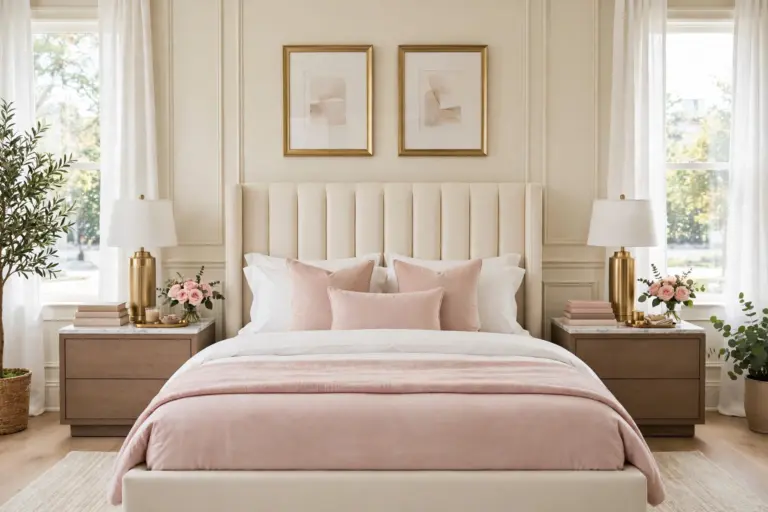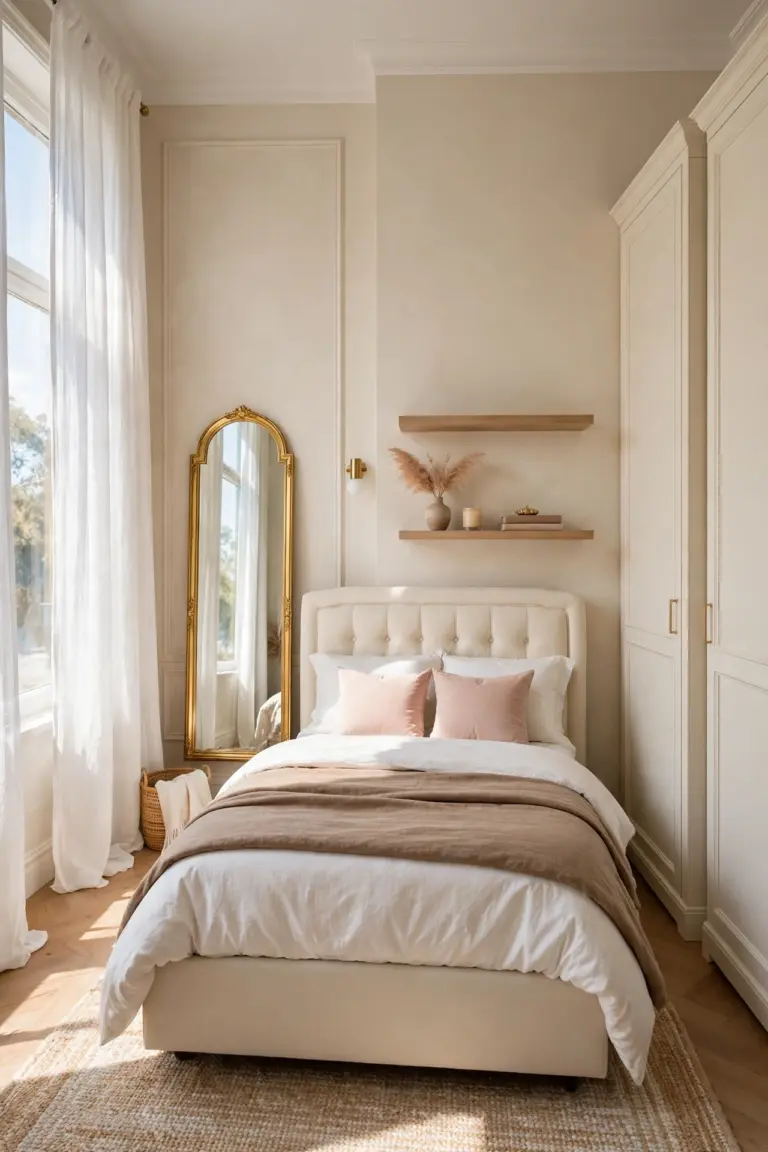
17 Luxury Bedroom Ideas for a Calm, Expensive-Looking Retreat
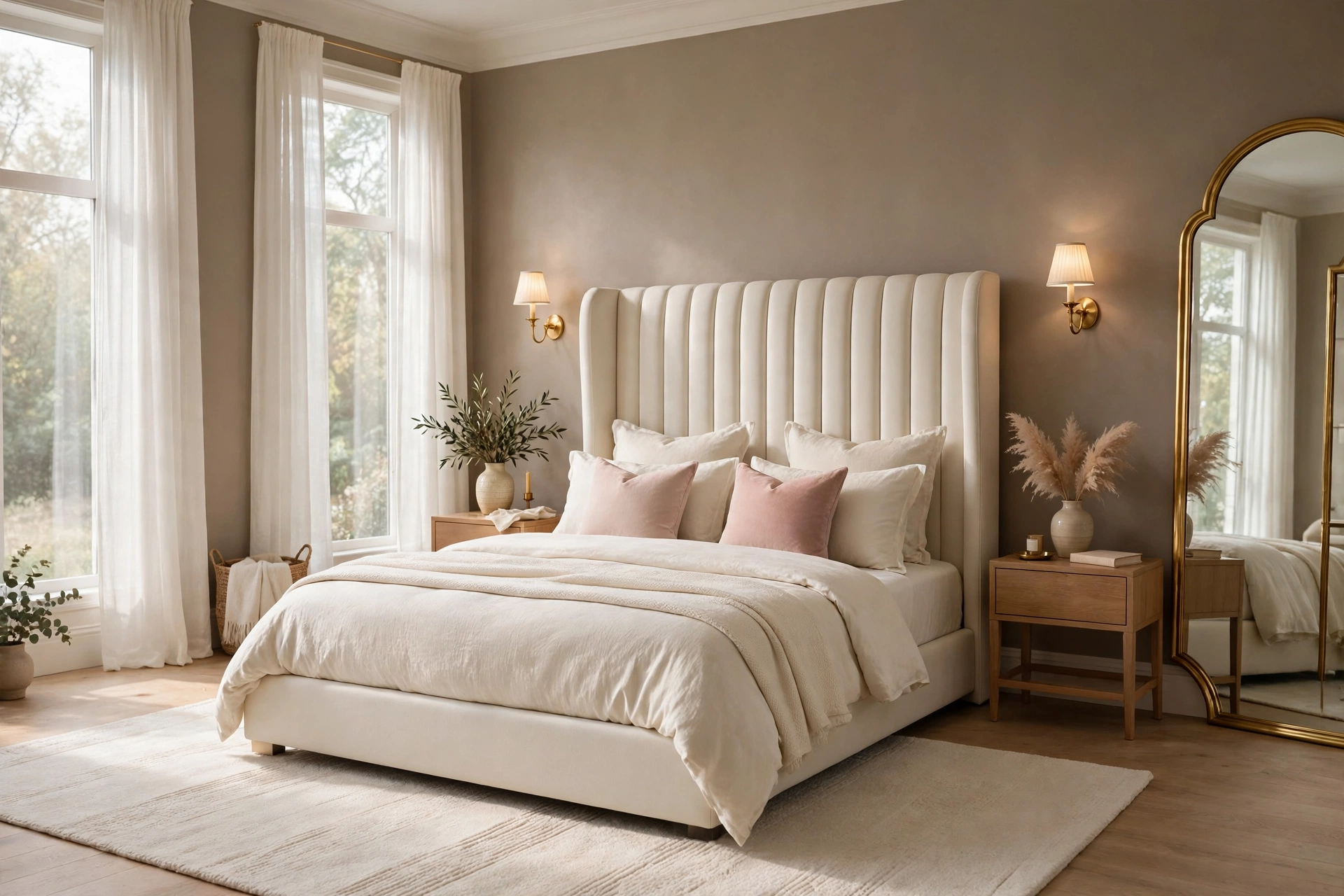
17 Luxury Bedroom Ideas for a Calm, Expensive-Looking Retreat
A calm luxury bedroom is not built from expensive pieces. It is built from quiet decisions repeated across the whole room: one soft palette, one tall bed as the center, layered cream textiles, warm gold light at a low level, and surfaces that are styled but never crowded. When those decisions agree with each other, even a plain room with basic furniture reads as a retreat, and the eye relaxes the moment it enters.
These 17 luxury bedroom ideas build that retreat in order, starting with the palette and the bed, moving through walls, light, and windows, and finishing with the small daily habits that keep the room calm after the styling day is over. Every idea uses the same bedroom and the same palette, white, cream, and warm taupe with blush pink and gold, so the ideas stack into one complete room instead of fighting as separate looks.
1. Set the Whole Room on One Soft Palette
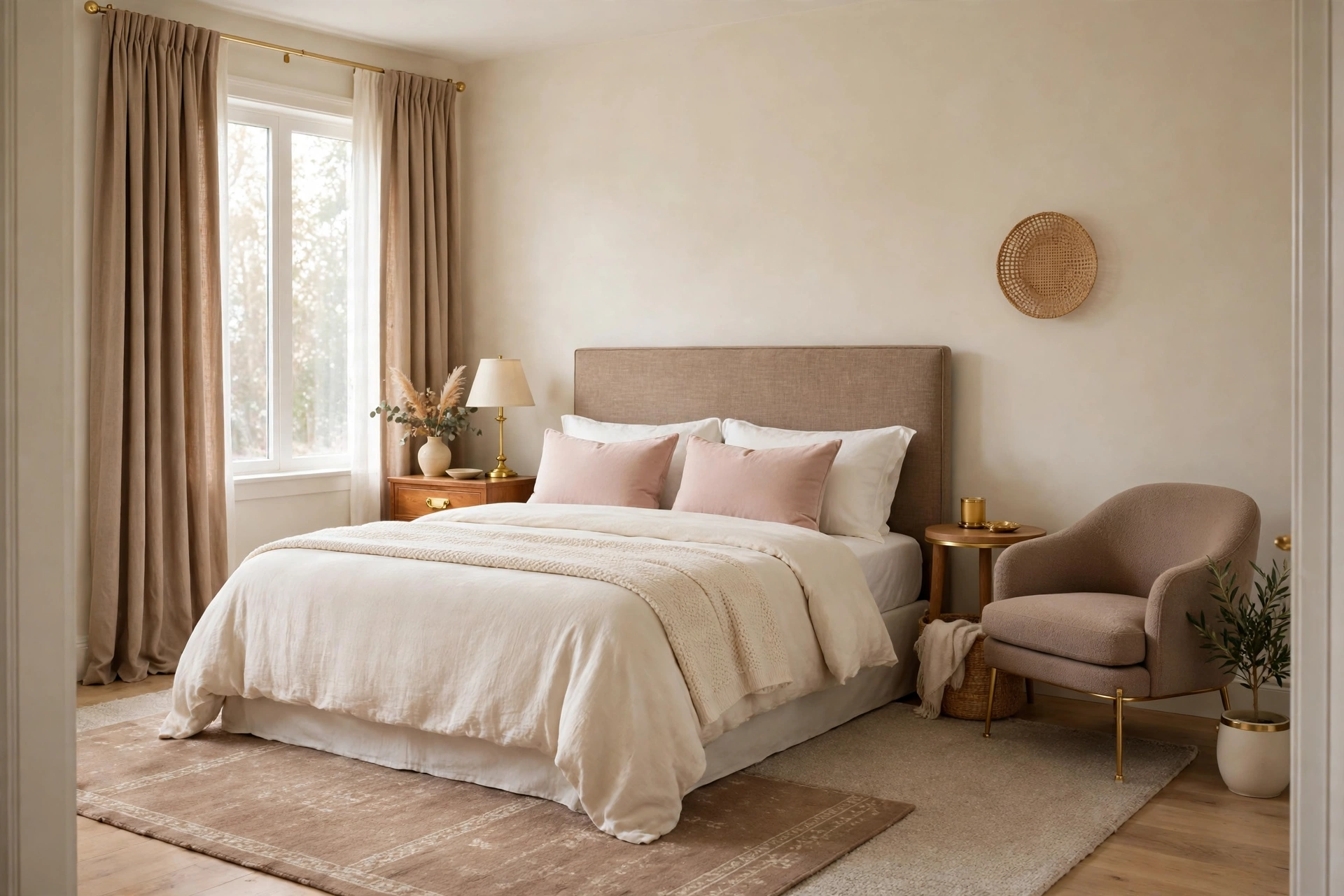
Expensive looking rooms share one trait before any furniture is noticed: their colors agree. A calm palette of white, cream, and warm taupe across the bed, walls, curtains, and rug removes every visual argument from the room, and small doses of blush pink and gold then read as jewelry instead of noise. The room feels costly because nothing in it is shouting.
How to do it: Pick three base colors, for this room warm white, cream, and taupe, and give every large surface one of them. Add blush only in two or three soft textiles, and gold only in small hard details like lamp bases, frames, and handles. Remove or move out anything in a bright or cold color, even a favorite piece, for one week and feel the difference. Pro Tip: Hold every new purchase against a cushion from the room before buying. If it does not sit quietly beside that cushion, it does not belong in the palette. Common mistake: Adding a fourth strong color as an accent wall or a bright throw. One loud color resets the whole room to ordinary.
2. Make the Bed the Tall Center of the Room
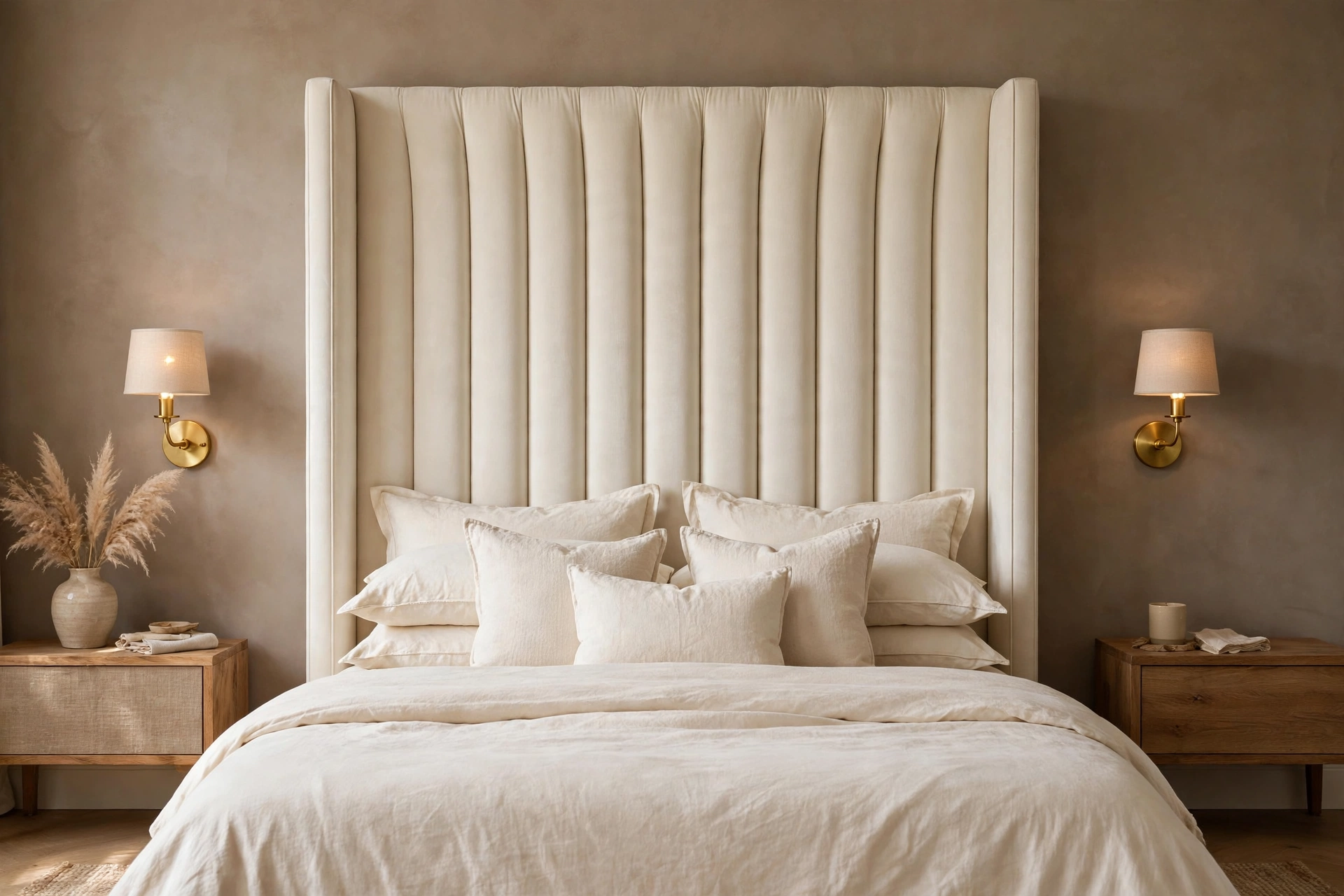
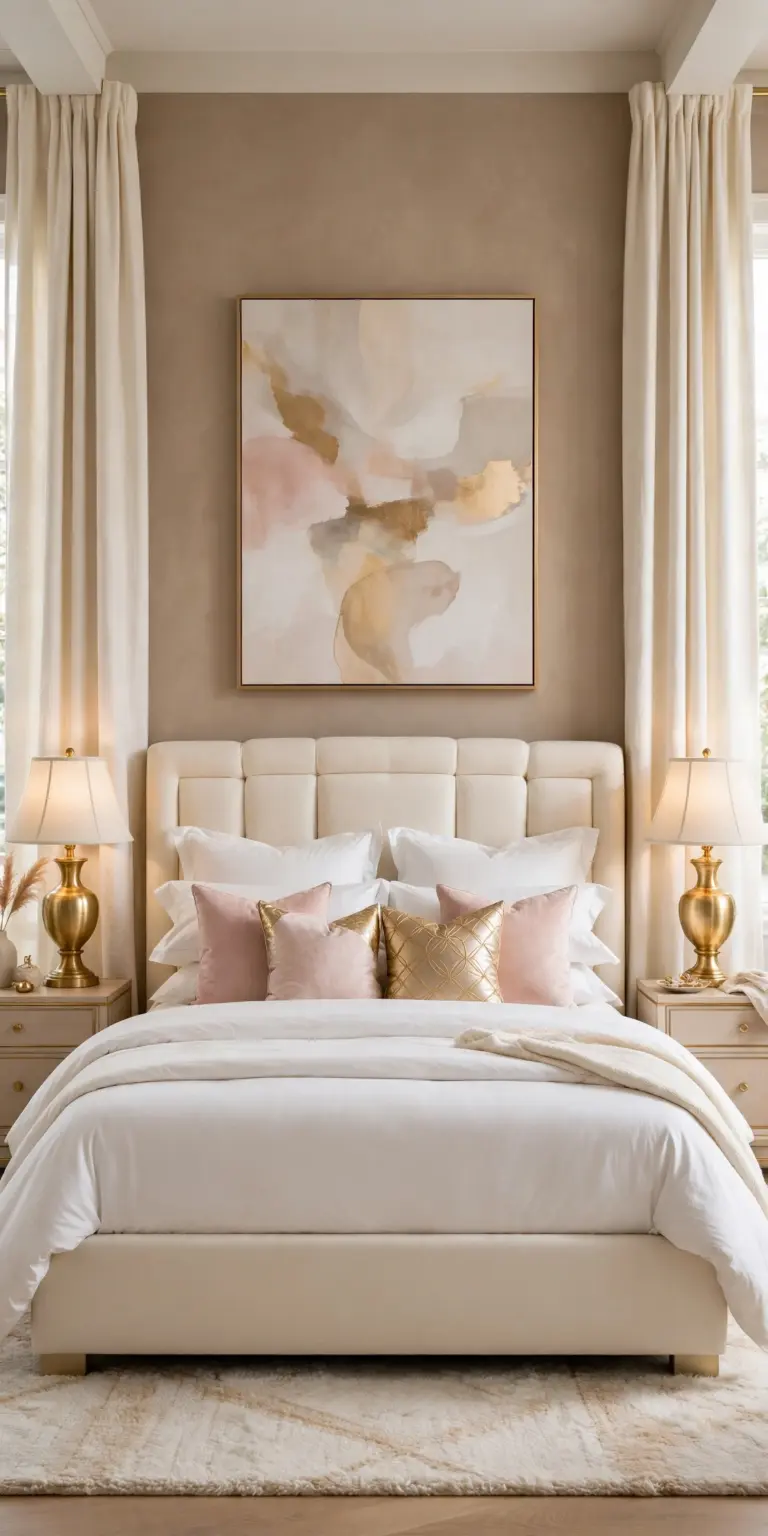
A retreat needs a center, and in a bedroom the bed earns that role only when its headboard has real height. A tall upholstered headboard, reaching well above the pillows, gives the bed the scale of a boutique hotel bed and makes every other piece in the room arrange itself around it. Soft channels or plain padded panels in ivory or cream keep that height calm instead of formal.
How to do it: Choose a headboard that rises at least 30 cm above the top pillow once the bed is made, in a soft fabric like linen look weave or velvet in ivory, cream, or warm taupe. Center the bed on the wall with equal space on both sides. Keep artwork and shelves off the headboard wall if the headboard is tall, its height is the decoration. Pro Tip: If a new bed is not possible, hang a pair of tall upholstered wall panels or a wide padded cushion panel behind the pillows for the same height at a fraction of the cost. Common mistake: A low headboard buried behind six pillows. The bed shrinks, and the room loses its center no matter how nice the bedding is.
3. Layer the Bedding in Soft Textures
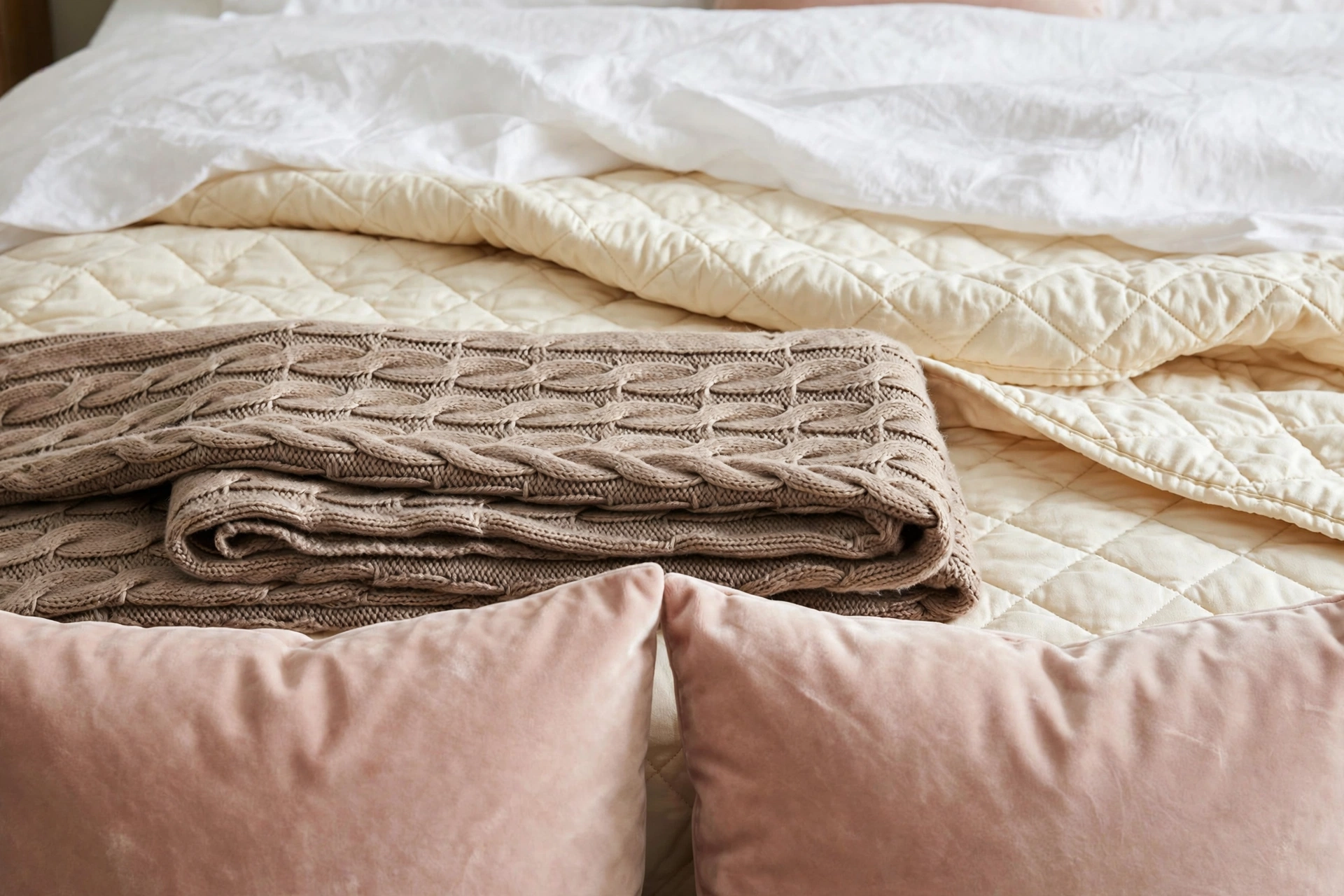
One flat duvet reads as a bed. Three soft layers read as a retreat. Texture is how a cream bed stays interesting without color: a smooth white sheet layer, a quilted cream cover with a visible stitched pattern, and a chunky knit or woven throw in warm taupe folded across the foot. The eye travels over the changes in surface, and the bed looks deep, generous, and calm.
How to do it: Start with white or warm white bedding as the clean base. Add a cream quilt or coverlet laid over the duvet, folded back once at the top. Fold a taupe knit throw in thirds lengthwise and lay it across the foot of the bed, ends even. Finish with sleeping pillows standing, two cream shams in front, and one or two blush cushions last. Pro Tip: Keep every layer washable and light enough to remake in five minutes. Layers that are hard to rebuild get built once, for a photograph, and never again. Common mistake: Many thin layers in clashing patterns. Texture should change, pattern should mostly stay quiet, or the bed turns busy instead of deep.
4. Warm the Wall Behind the Bed
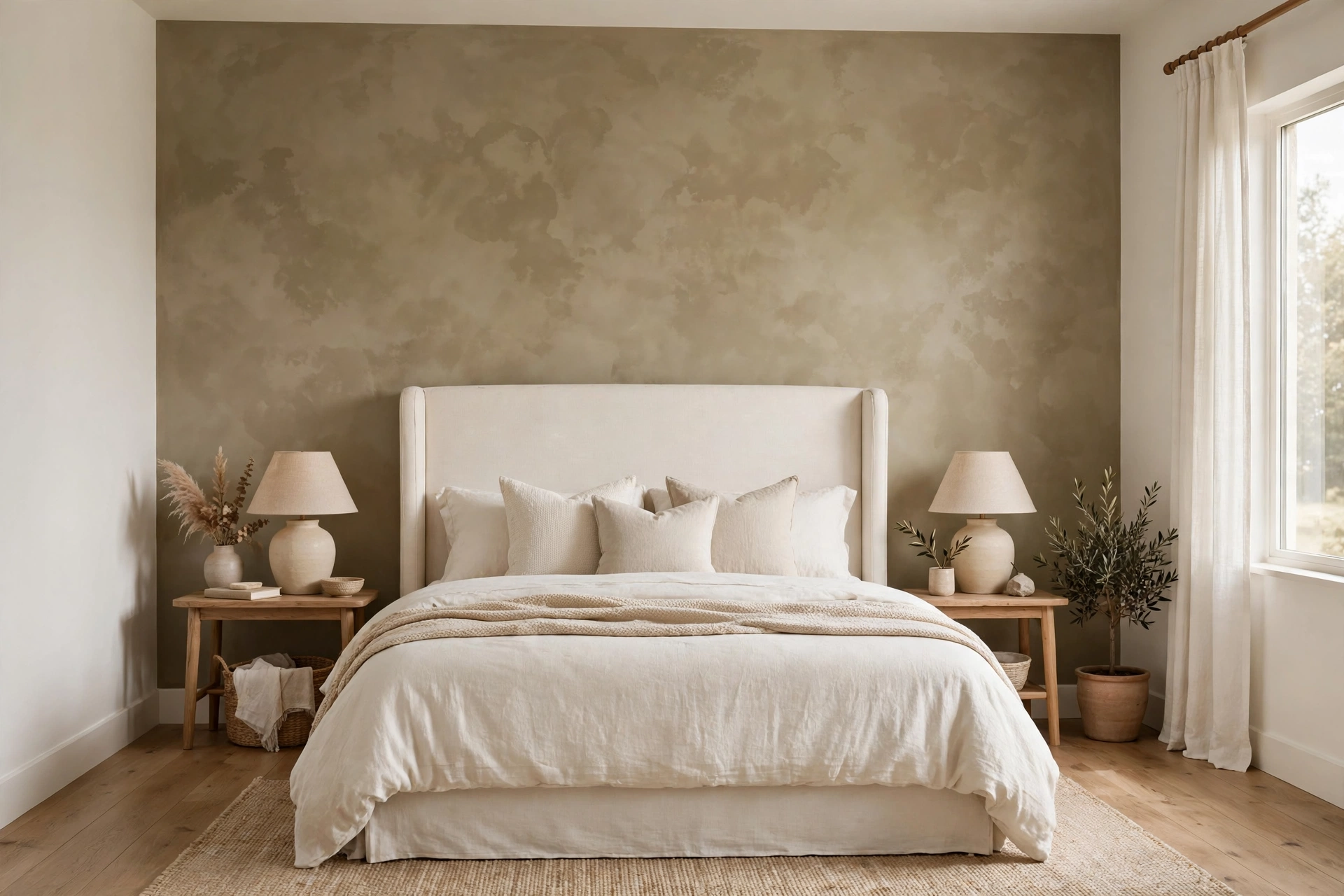
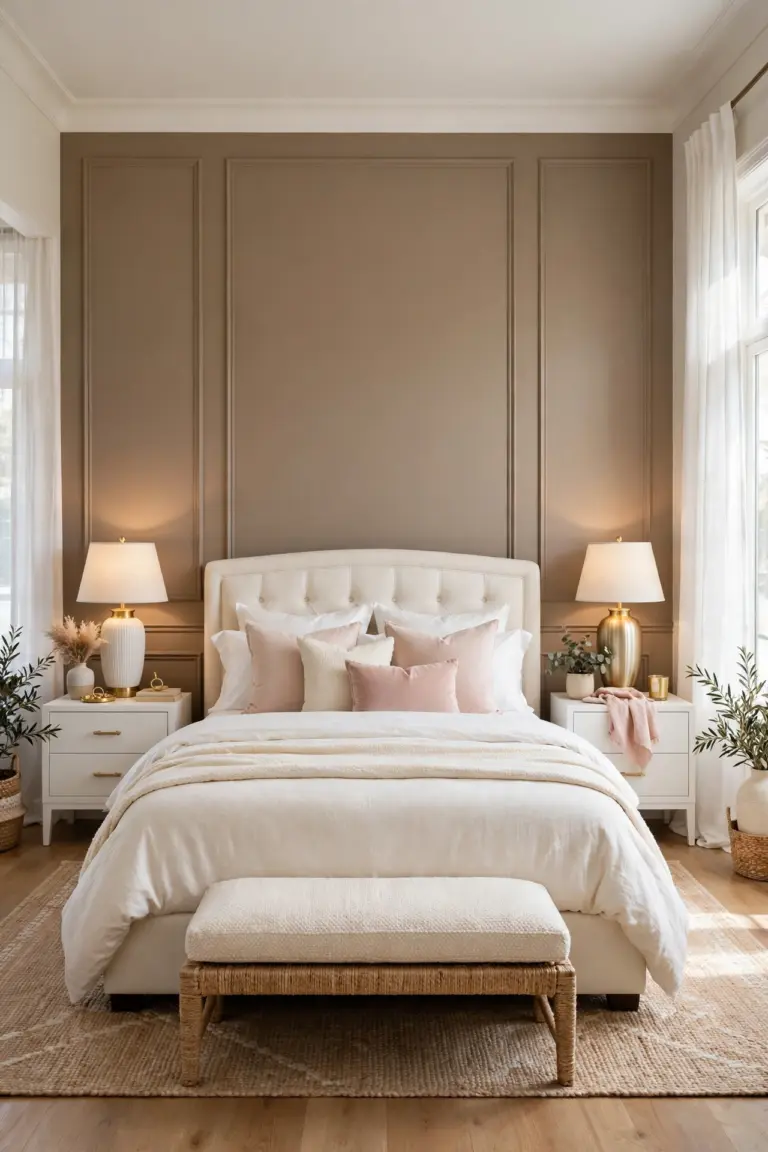
The wall behind the bed does more for the retreat feeling than any accessory, because it is the backdrop in every view of the room. A warm taupe wash, limewash finish, soft plaster effect, or simple warm paint, wraps the bed in a cocoon tone that white side walls cannot give. Against that depth, cream bedding glows instead of disappearing into a white wall.
How to do it: Choose one warm taupe with a grey free, muddy softness, and test a large patch behind the bed for two days of light before committing. Apply it to the headboard wall only, edge to edge and floor to ceiling, so it reads as architecture, not a stripe. Keep the remaining walls warm white so the room stays bright. Pro Tip: A limewash or plaster effect finish hides minor wall flaws and adds movement, which makes it the forgiving choice for older walls and rental friendly large panels. Common mistake: A taupe that turns pink or purple in evening light. Always check the test patch at night under the room lamps before painting the whole wall.
5. Hang One Large, Calm Piece of Art
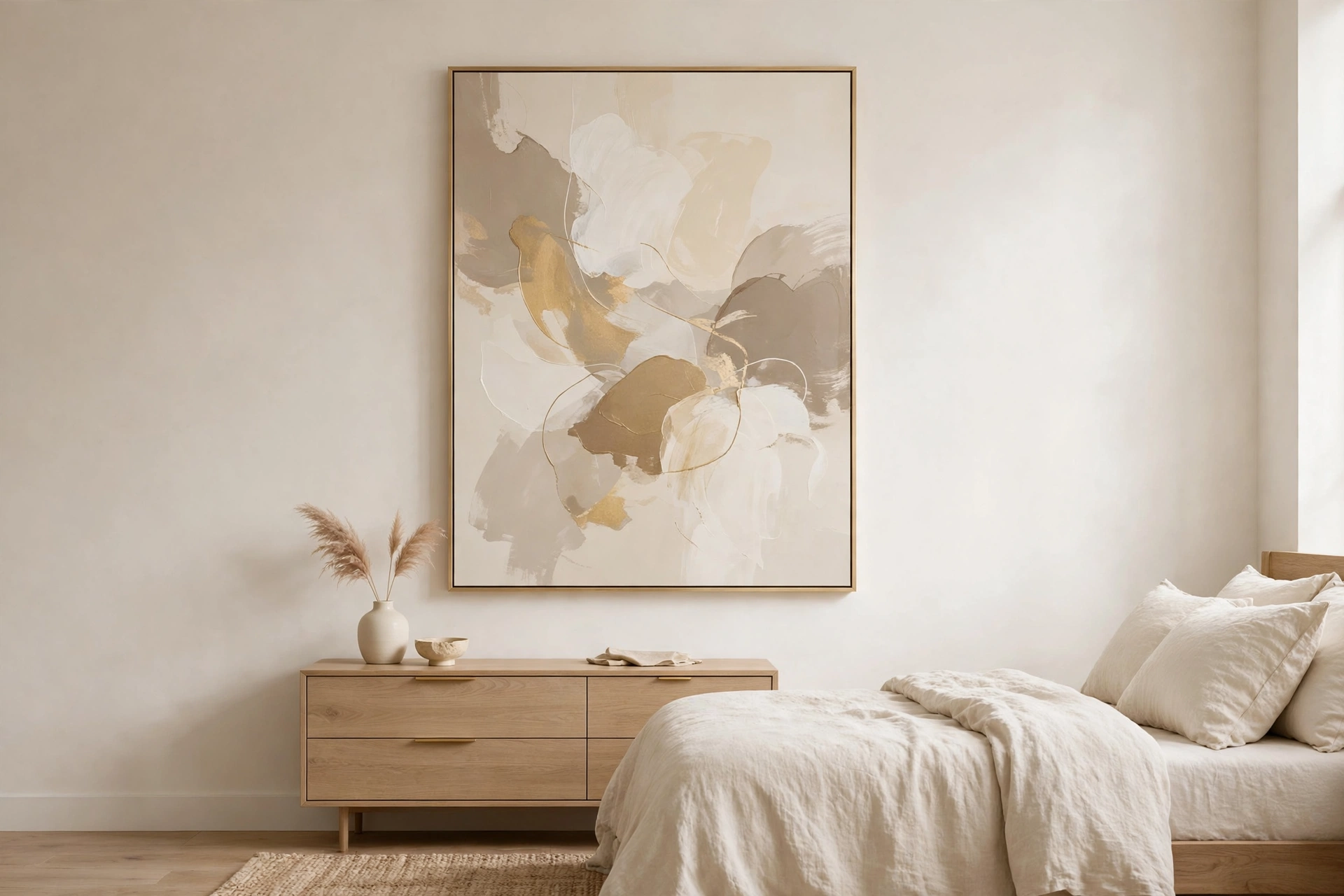
Luxury rooms use fewer, larger pieces of art, and calm rooms choose art the way they choose colors: soft abstract shapes, gentle landscapes, or line work in the room palette, in one generous frame. A single large piece gives the eye a place to rest. A cluster of small frames, however pretty, adds the visual chatter a retreat is trying to remove.
How to do it: Choose one piece at least half as wide as the furniture it hangs above, in cream, taupe, blush, or soft gold tones with a thin gold or warm wood frame. Hang it with its center around eye level and clear space on every side. If it hangs near the bed, keep it on a side wall when the headboard is tall, so the two do not compete. Pro Tip: A large canvas print with a hand painted gel or matte finish looks far richer than glossy paper behind glass, and it does not reflect the lamps at night. Common mistake: A gallery wall of mixed small frames. It belongs in a hallway or living room; in a retreat bedroom it is noise at rest height.
6. Style the Nightstands as a Matched Pair
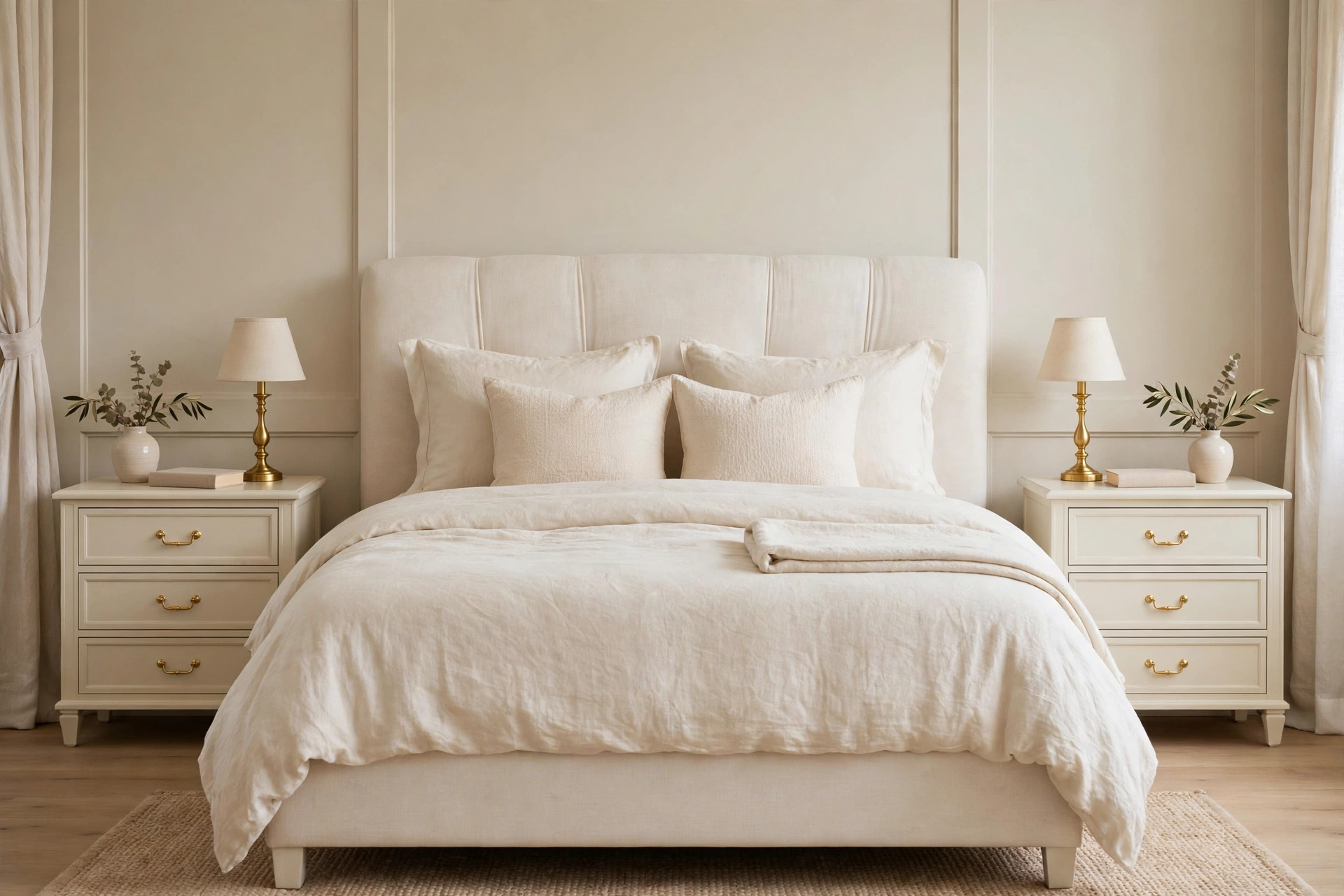
Symmetry is the fastest signal of a planned, expensive room, and the nightstands are where a bedroom proves it. Two matching nightstands with matching lamps tell the eye the bed wall was designed, not gathered. Each top then carries the same small formula, lamp, book, one soft object, so the pair stays balanced even in daily use.
How to do it: Match the nightstands first, same height, ideally level with or just below the top of the mattress. Match the lamps second, same height and same warm shade. Style each top with one book and one small item, a tiny vase, a dish, a candle, placed in mirror positions. Pro Tip: If matching nightstands are out of budget, paint two different sturdy tables the same warm cream and fit the same gold handles. The eye reads color and hardware as a pair. Common mistake: One nightstand styled and the other used as a charging station and shelf. The pair breaks, and the whole bed wall drops a grade.
7. Layer Warm Light at Three Heights
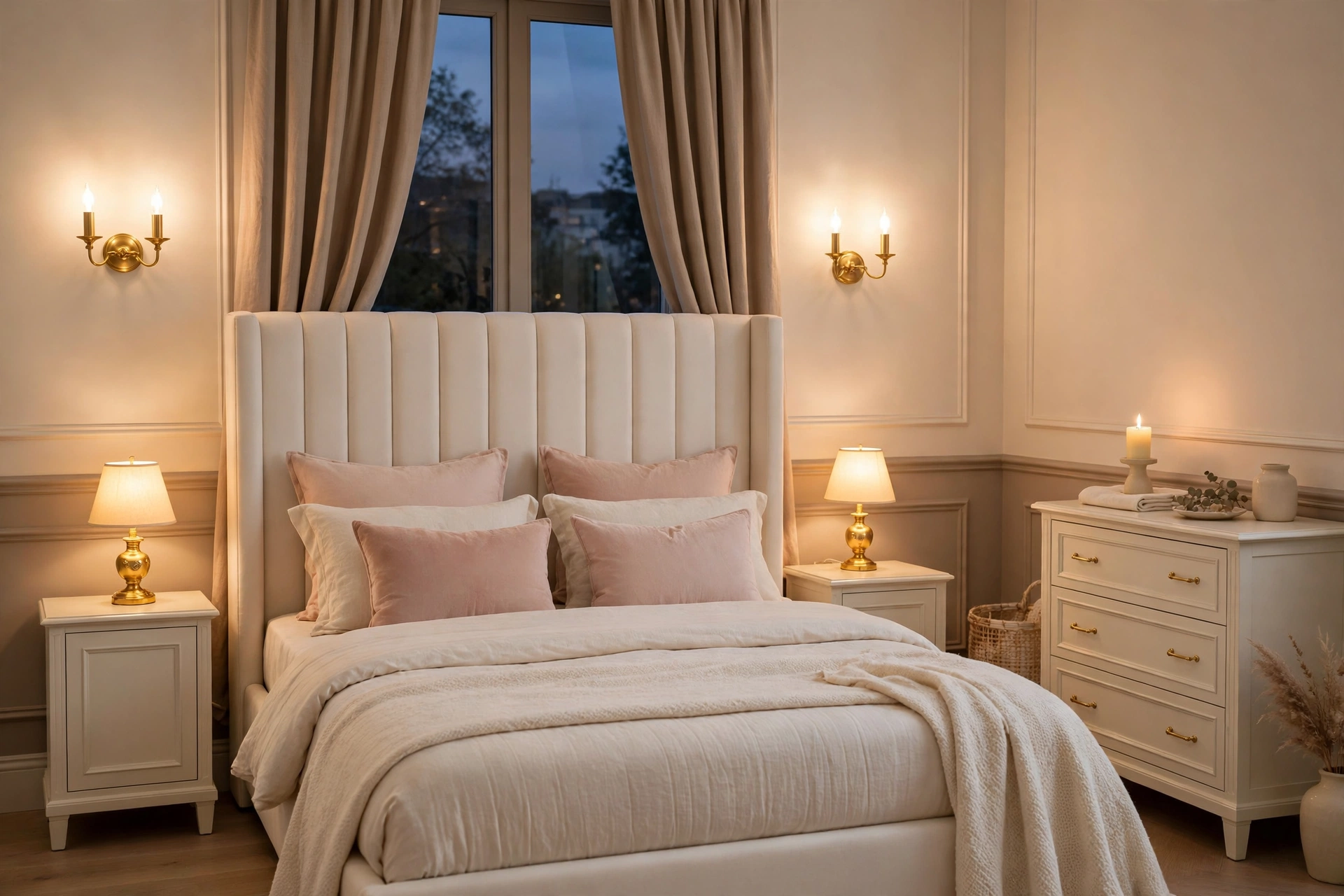
Calm is mostly lighting. A single ceiling light flattens a bedroom and makes every color look cheaper, while warm light placed low and at bed height wraps the room in the glow people associate with good hotels and quiet evenings. Three heights, sconce or pendant light, table lamp light, and one low glow like a candle, give the room depth after dark.
How to do it: Fit warm white bulbs, never daylight blue white, in every bedroom light. Add wall sconces or hanging pendants above the nightstands to free the surfaces, keep table lamps or a floor lamp for the middle layer, and place one candle or small low lamp near the dresser for the lowest glow. Put the main lights on dimmers or use smart bulbs so the evening level can drop. Pro Tip: Light the corners, not the center. A lamp glow at the room edges makes the bed feel held by the room instead of exposed under a ceiling bulb. Common mistake: Cool white bulbs in beautiful gold lamps. The fitting says luxury, the light says office, and the light always wins.
8. Add a Bench at the Foot of the Bed
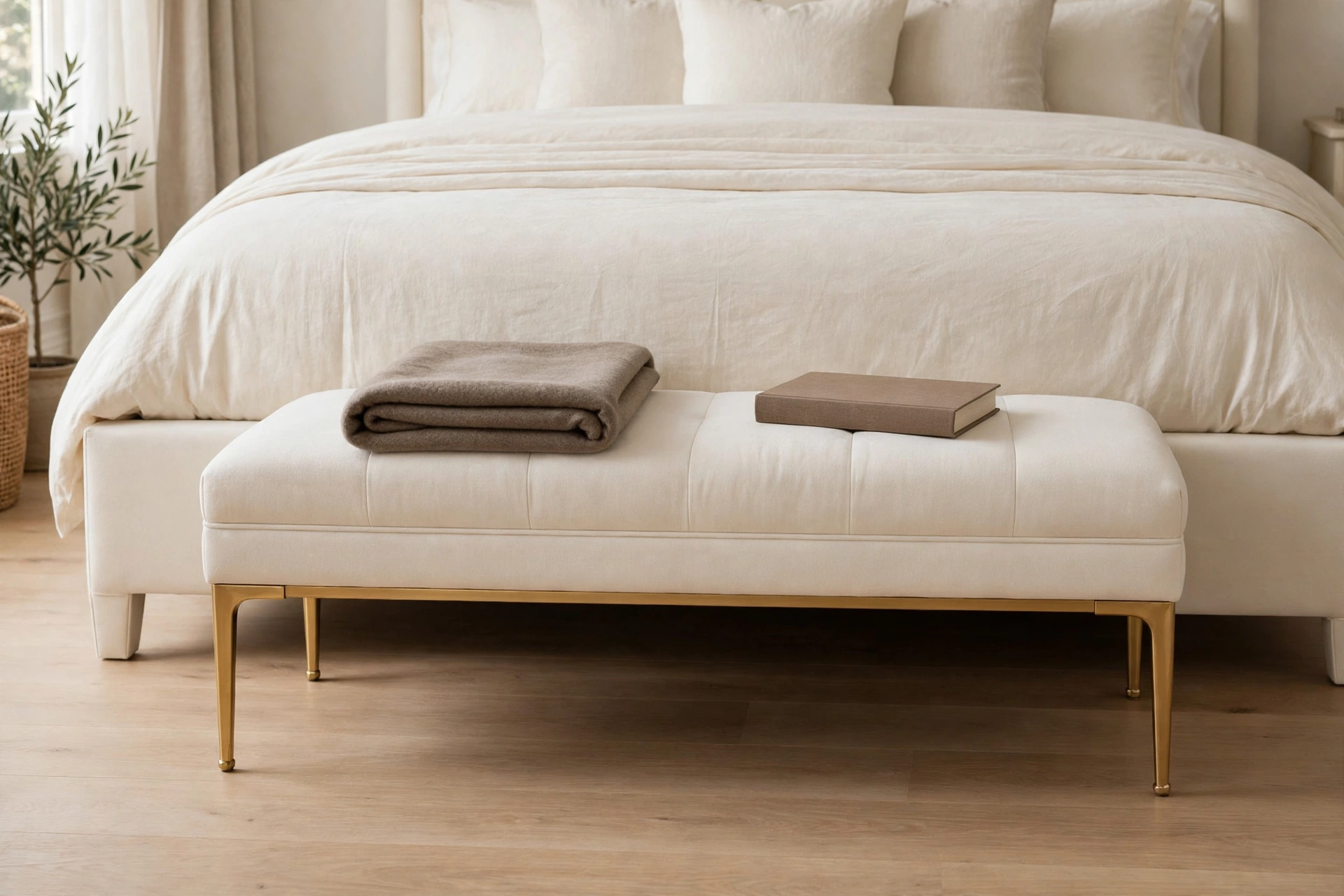
A bench at the foot of the bed finishes the bed the way a frame finishes a picture. It gives the long line of the bed an ending, catches the throw and tomorrow clothes that would otherwise land on the bedding, and adds a seat for shoes and morning dressing that keeps the bed itself purely for rest.
How to do it: Choose a bench slightly narrower than the bed, in cream upholstery, warm wood, or woven texture, with legs in gold or light wood to quote the room finishes. Keep its height below the top of the mattress so it does not wall off the bed. Style it with at most two things, a folded throw and one book or a small tray. Pro Tip: In a small room, choose a bench with a lift up seat or an open shelf below. It does the same visual job and quietly swallows spare blankets or shoes. Common mistake: A bench used as a clothes pile. Give the clothes a basket in the wardrobe instead, and reset the bench each morning to its two styled items.
9. Anchor the Bed on a Large Soft Rug
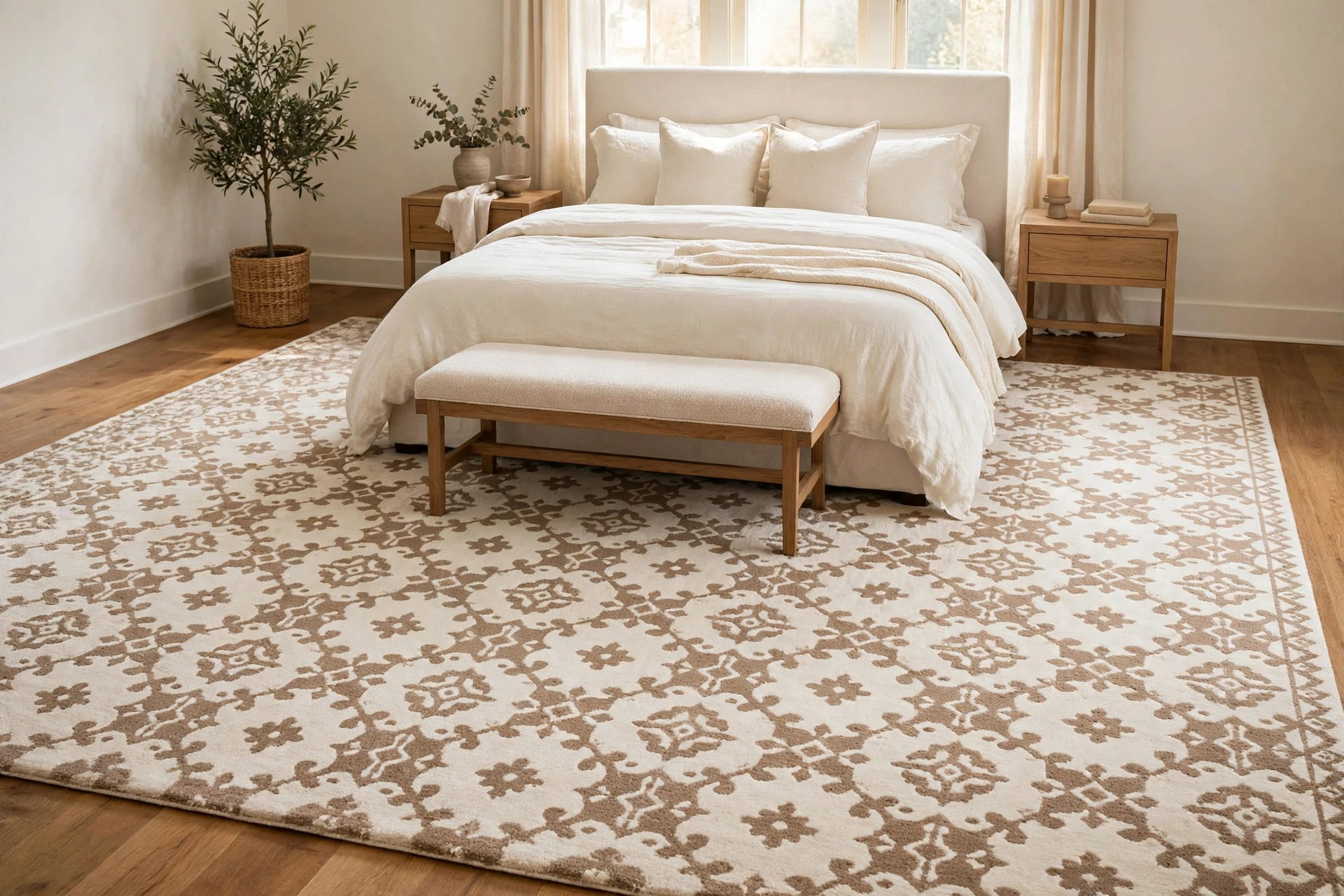
A rug that is too small makes a luxury bed look like it is floating on a raft. A generous rug, extending well past both sides and the foot of the bed, grounds the whole arrangement, softens every step around the bed, and gives the room its quiet, padded sound. The pattern should whisper: cream and taupe tones with a soft worn or subtle bordered design.
How to do it: Size the rug so at least 50 cm shows on each side of the bed and past the bench at the foot. Place it under the bed with the long edge starting just in front of the nightstands. Choose a low, soft pile that doors can clear and bare feet enjoy. Pro Tip: A rug pad underneath stops creep, adds the thick underfoot feel that reads as expensive, and protects both rug and floor for almost no money. Common mistake: A small rug placed only at the foot or only on one side. It reads as a mat, splits the room, and is the most common reason a styled bed still looks unfinished.
10. Dress the Windows in Two Soft Layers
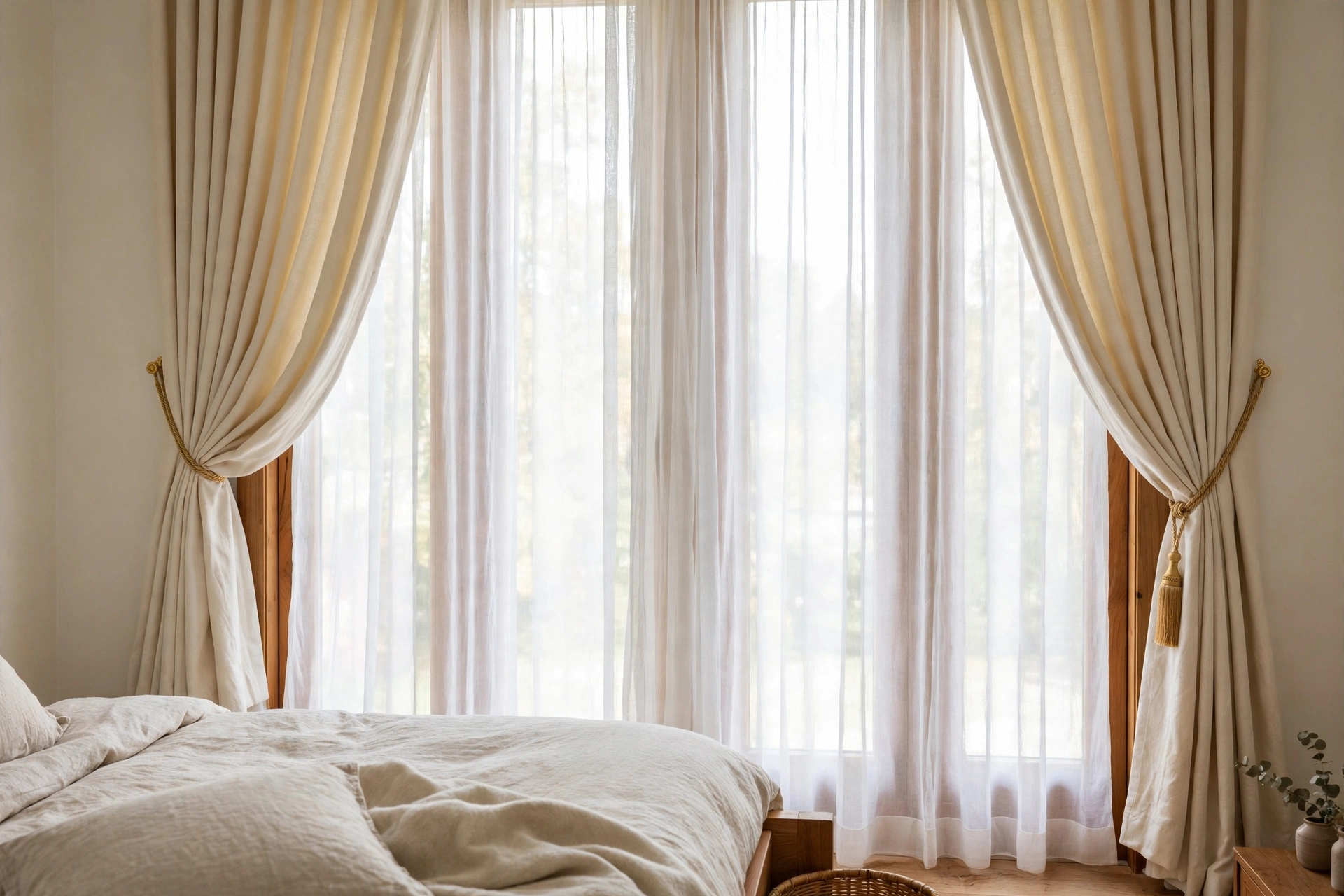
Windows decide how a retreat handles light, privacy, and sleep, and two layers handle all three gracefully. Sheers alone give the soft filtered daylight that makes cream rooms glow in photographs. Full blackout curtains alone can feel heavy. Together, sheers for the day and blackout drapes for the night, the window is dressed at every hour and the room gains tall soft lines of fabric.
How to do it: Hang a double rod as high and as wide as the wall allows so the curtains frame the window instead of covering it. Fit white or warm white sheers to just touch the floor, then cream blackout panels in front with simple gold tiebacks or rings. Keep both layers inside the room palette so the window wall stays calm. Pro Tip: Curtains that pool by one centimeter look tailored and soft; curtains that stop short of the floor always look rented, whatever they cost. Common mistake: One thin curtain trying to do both jobs, glowing at dawn, offering no privacy at night, and dressing the window at neither hour.
11. Create a Small Reading Corner
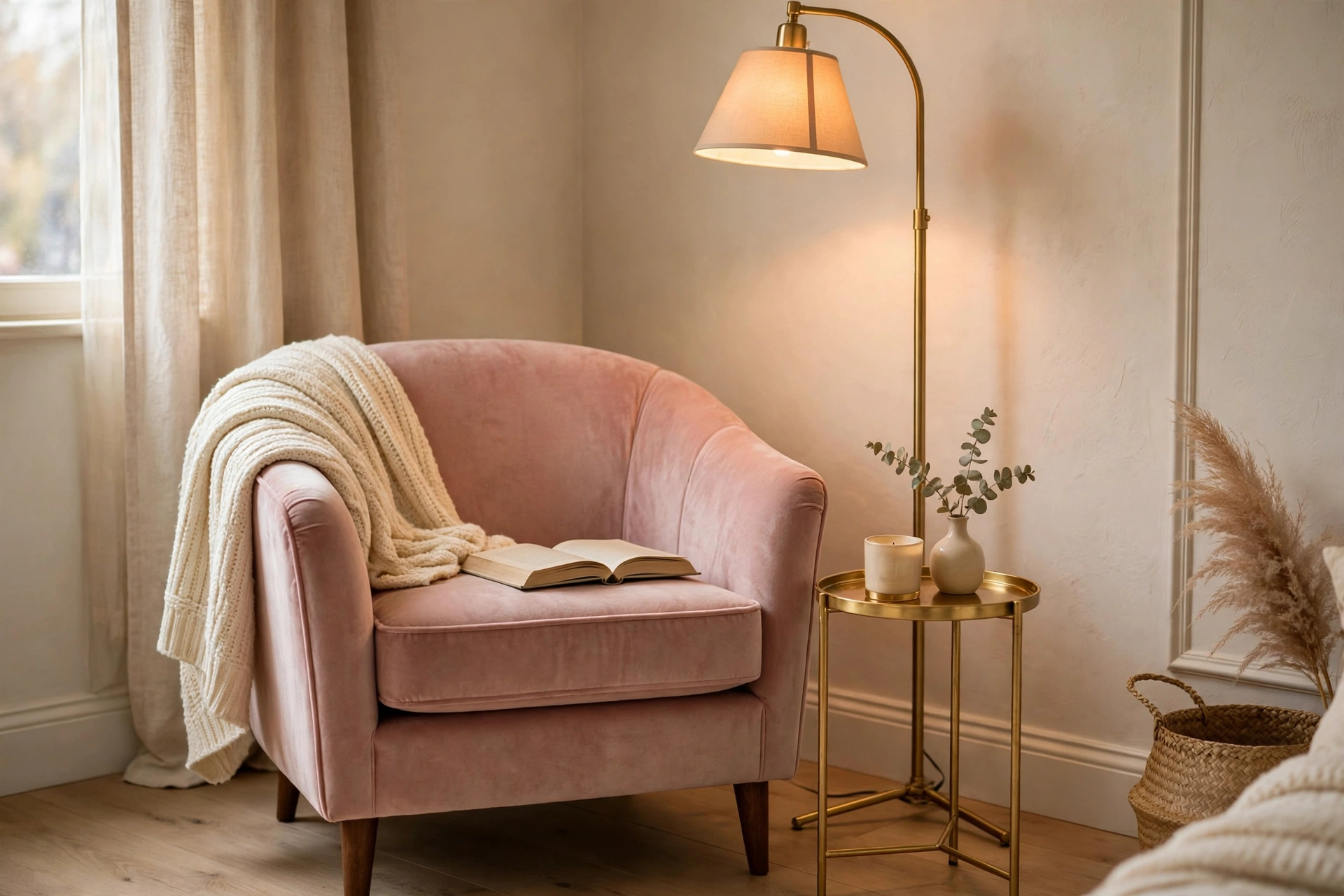
A retreat is a room you can be in without being in bed, and one well placed chair creates that second life. A soft armchair in the corner, with its own small table and warm lamp, gives reading, morning coffee, and quiet phone free minutes a home, and it fills the awkward corner that most bedrooms waste on a laundry basket.
How to do it: Choose the corner that catches natural light but sits outside the walkway between door and bed. Place one comfortable chair, blush velvet or cream boucle, angled slightly toward the room. Add a small gold or marble side table and a warm floor lamp behind the chair, plus one knit throw over the arm. Pro Tip: Keep one good book and nothing else on the side table. A corner that holds only its purpose stays inviting; a corner that becomes storage stops being used. Common mistake: A chair facing the wall or buried under clothes. Angle it in, clear it nightly, and it will be used every day, which is the real luxury.
12. Lean an Arched Gold Mirror for Soft Light
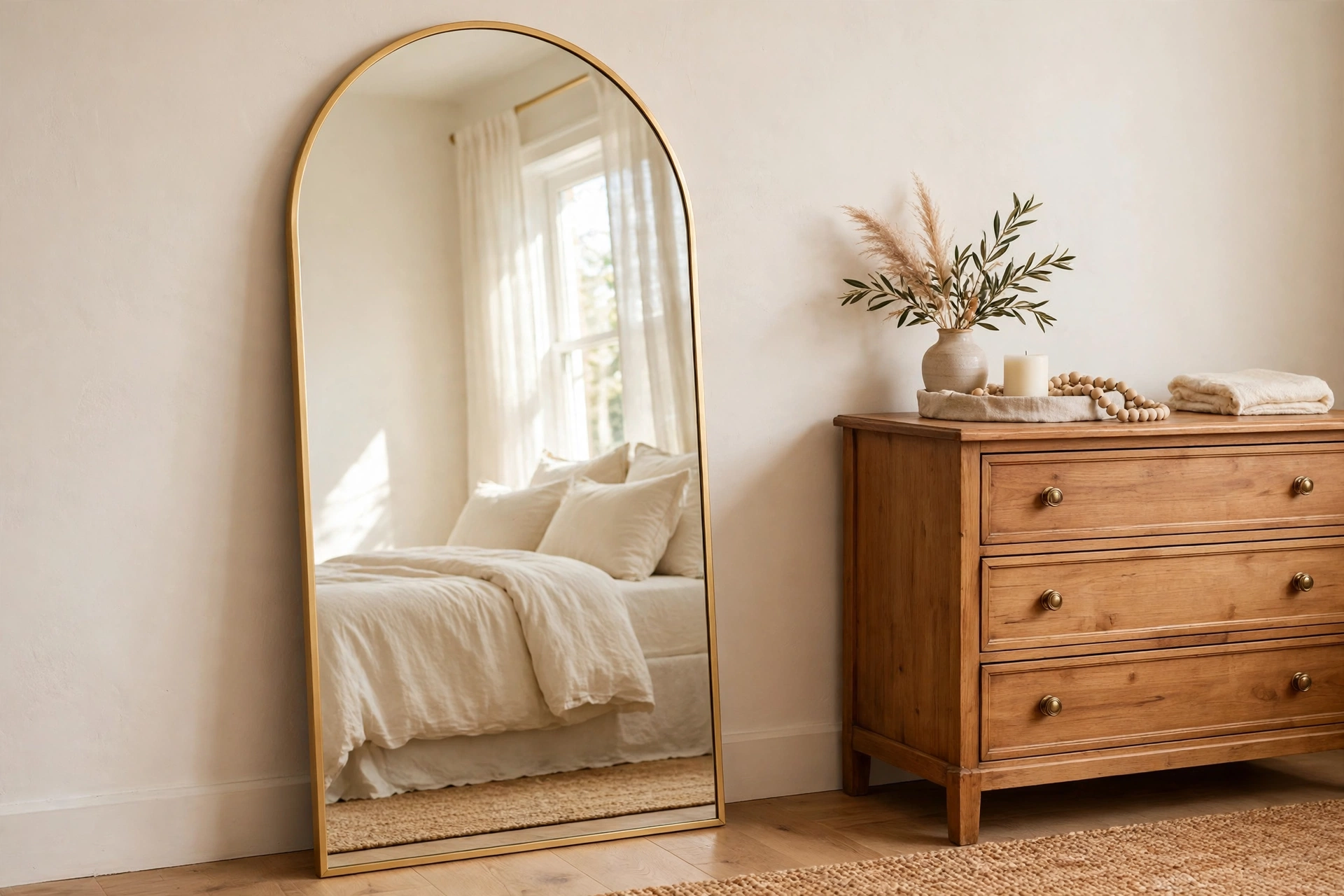
A tall arched mirror earns its place in a calm bedroom twice: it bounces window light into the room soft side, and its curved top softens a room full of straight lines, bed, dresser, doors, into something gentler. The thin gold frame quotes the lamps and handles, so the mirror belongs to the palette while doing quiet practical work every morning.
How to do it: Choose a tall arch mirror, ideally 150 cm or higher, and lean it against a wall near the dresser or beside a window, secured at the top for safety. Angle it to reflect the bed or the window, never a cluttered corner or a door. Keep the floor in front of it clear so the reflection stays open. Pro Tip: A mirror opposite or beside a window can double the soft daylight on the bed wall, which is why stylists place it before they place any art on that side of the room. Common mistake: A mirror reflecting the wardrobe doors or a messy shelf. Mirrors repeat whatever they face, good or bad, with perfect loyalty.
13. Style the Dresser in Three Quiet Groups
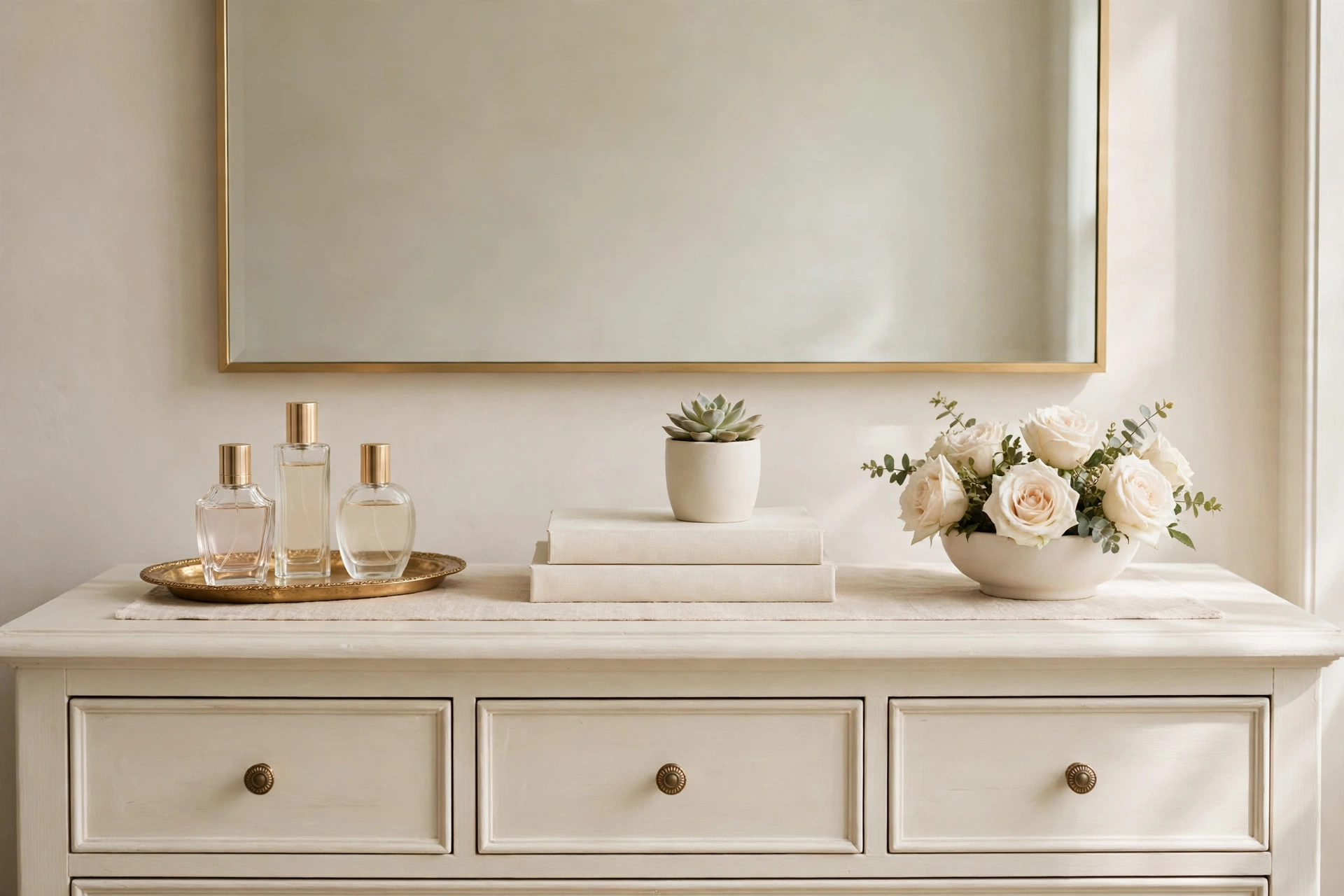
The dresser is the bedroom second surface, and it decides whether the room feels kept or chaotic. Three quiet groups, a tray of daily objects, a small stack with something green, and one low soft piece like a bowl of roses, give every daily item a planned place while leaving most of the top calmly empty. It is the same discipline as a styled table, softened for a private room.
How to do it: Clear the dresser completely first, then place group one, a gold or marble tray holding perfume and daily jewelry, at one end. Place group two in the middle distance, two cream books with a small plant or candle on top. Place group three, the low flowers or a small bowl, at the other end, and leave the space between the groups bare. Pro Tip: Count groups, not objects. Three groups of small things read as calm, while the same things spread loose read as clutter, even when nothing extra was added. Common mistake: Lining products along the back edge like a shop shelf. Group them on a tray or move them into a drawer; the back edge line is what makes dressers look messy in photographs.
14. Add Fresh Flowers and One Green Plant
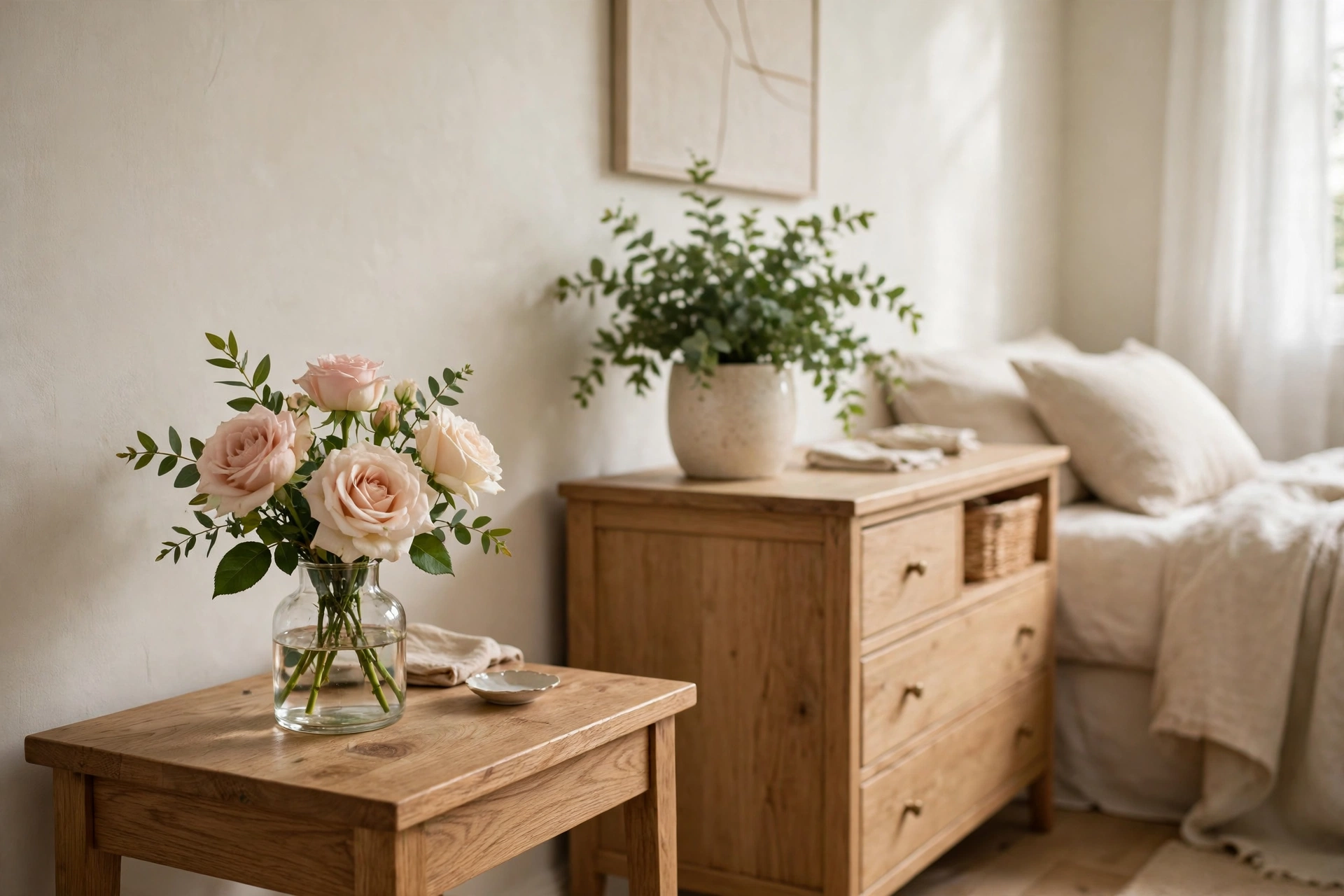
Living things are what separate a styled room from a showroom, and a bedroom needs only two: a small vase of fresh flowers near the bed, and one soft green plant across the room to answer it. Cream and blush roses or tulips keep the palette, while real green leaves add the one color no fabric can copy, because it moves and changes.
How to do it: Keep the flowers small and low, a short glass or ceramic vase on one nightstand, stems cut so the heads sit just above the rim. Place one easy plant, a pothos, a small fern, or a soft olive, in a cream pot on the dresser or the reading corner table. Replace water every two days and remove fading stems at once. Pro Tip: One supermarket bunch split in two, half for the nightstand and a few stems for the bathroom, makes the whole suite feel considered for the price of one. Common mistake: A large bouquet on the dresser and three small plants on every surface. The room turns into a garden center; two living accents are the luxury number.
15. Hide the Clutter Behind Closed Doors
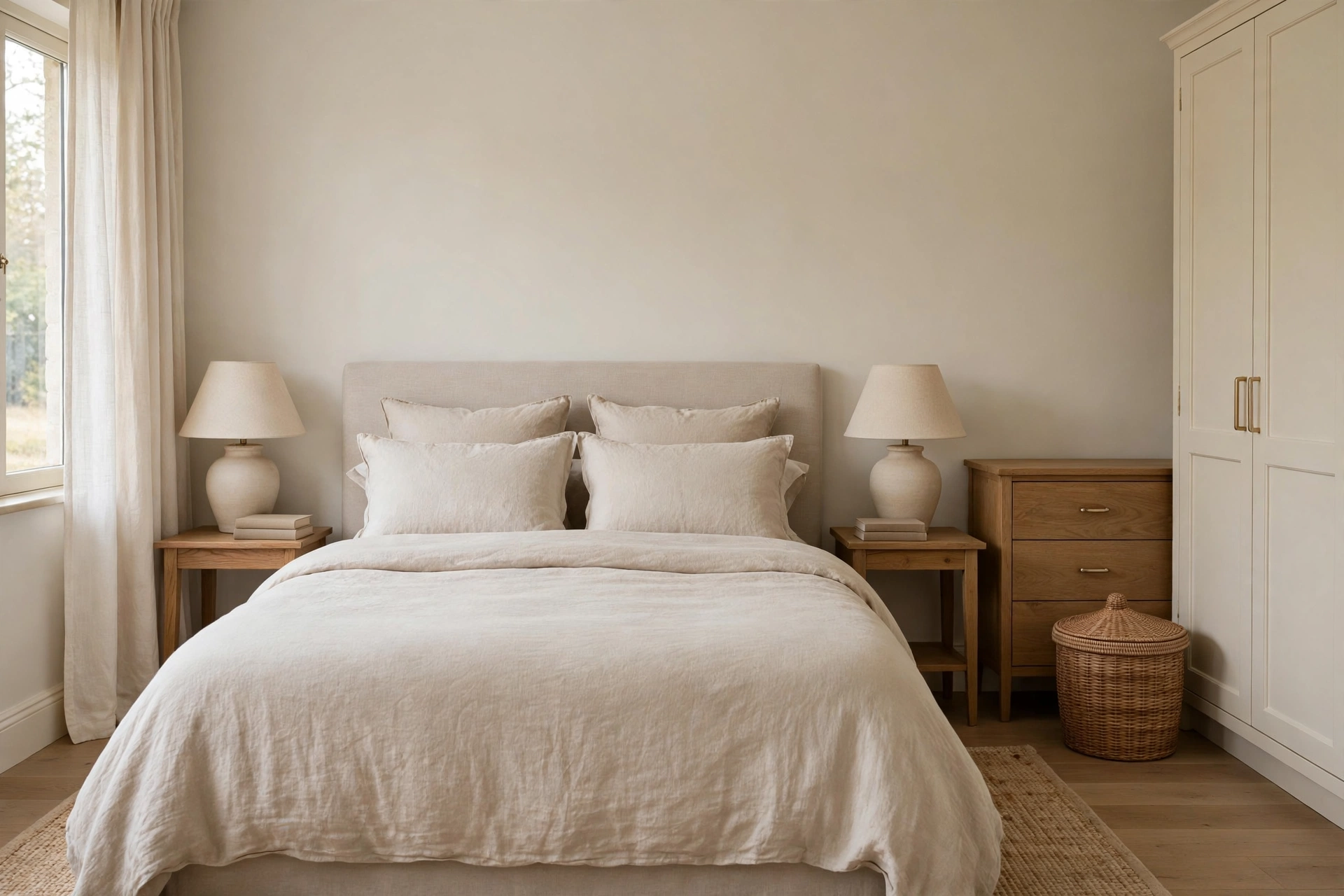
Calm is easier to keep when clutter has nowhere visible to live. Open shelves, open rails, and clear storage boxes all display their contents at the eye all day, while closed wardrobe doors, drawers, and lidded baskets let the room rest. Most of what makes a bedroom feel chaotic is not dirt or damage, it is simply seeing too many small things at once.
How to do it: Move visible storage behind doors and into drawers first, starting with the surfaces the eye meets from the bed. Give chargers, medicines, and daily bits one drawer or one lidded box per nightstand instead of the top. Add one lidded basket for the overflow that has no home yet, and empty it into place once a week. Pro Tip: The view from the pillow is the audit that matters. Lie in bed and look around; anything your eye snags on gets a door, a drawer, or a new home outside the room. Common mistake: Buying open storage to solve clutter in a retreat bedroom. It organizes the objects and keeps the visual noise, which was the actual problem.
16. Keep a Small Wind Down Tray by the Bed
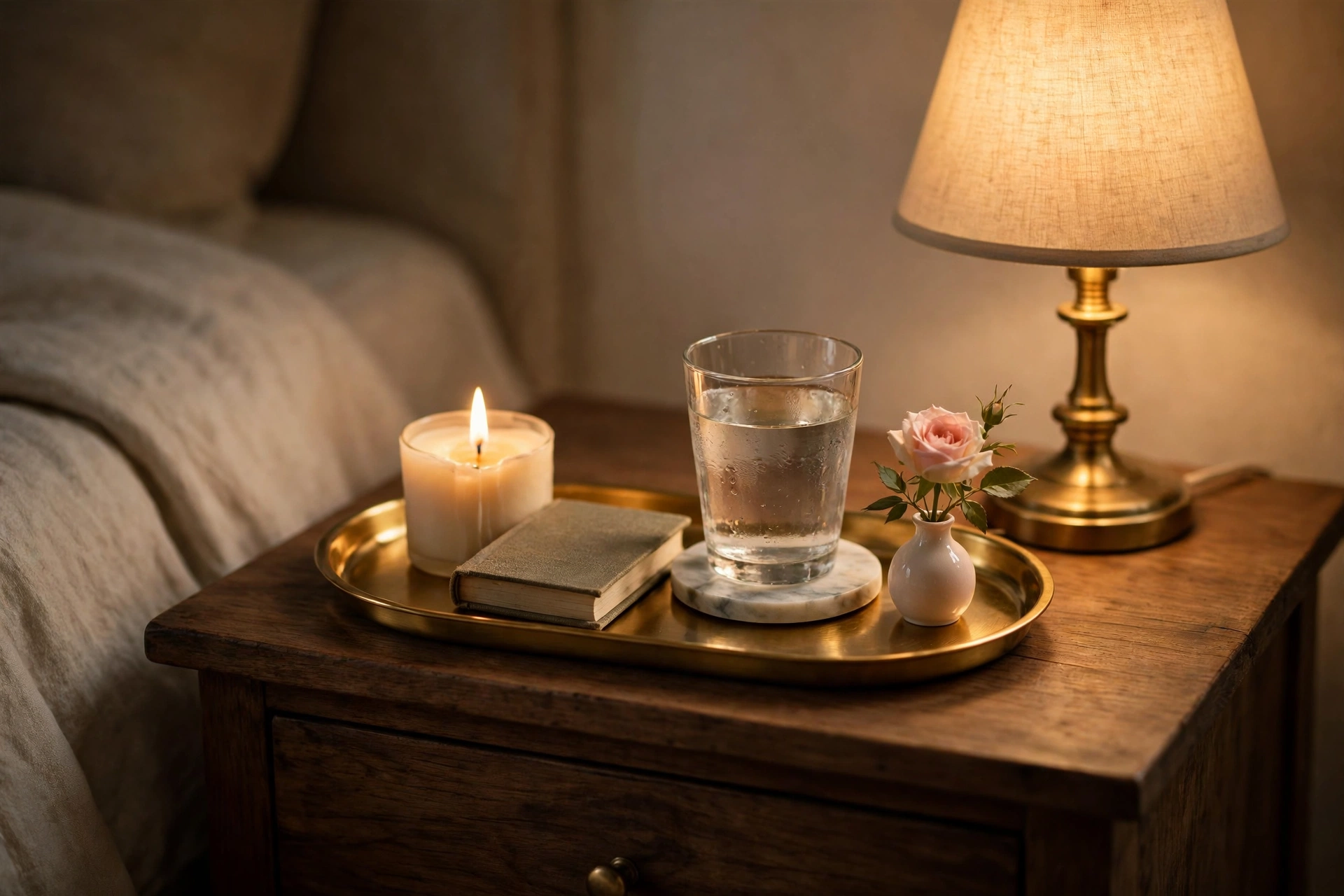
The last hour decides how the retreat feels, and a small planned tray makes that hour gentle instead of scattered. A candle, a book, water on a coaster, and one soft flower on a single tray turn the nightstand from a charging shelf into a small ritual: lights lower, phone stays outside the tray zone, and the room closes the day in the same calm order every night.
How to do it: Choose a small gold, marble, or woven tray that fits one nightstand with room to spare. Place only the evening items on it: a cream candle, the current book, a coaster for water, and a tiny vase or dish. Keep chargers and the phone on the far side of the lamp or outside the room, so the tray stays a screen free zone. Pro Tip: Light the candle while you brush your teeth and blow it out as you get into bed. The scent and the small routine become the signal that teaches the body the day is done. Common mistake: Letting the tray grow: remotes, snacks, medicines, and mail join within a week. The rule is four items; anything new must replace, not join.
17. Finish With an Evening Reset
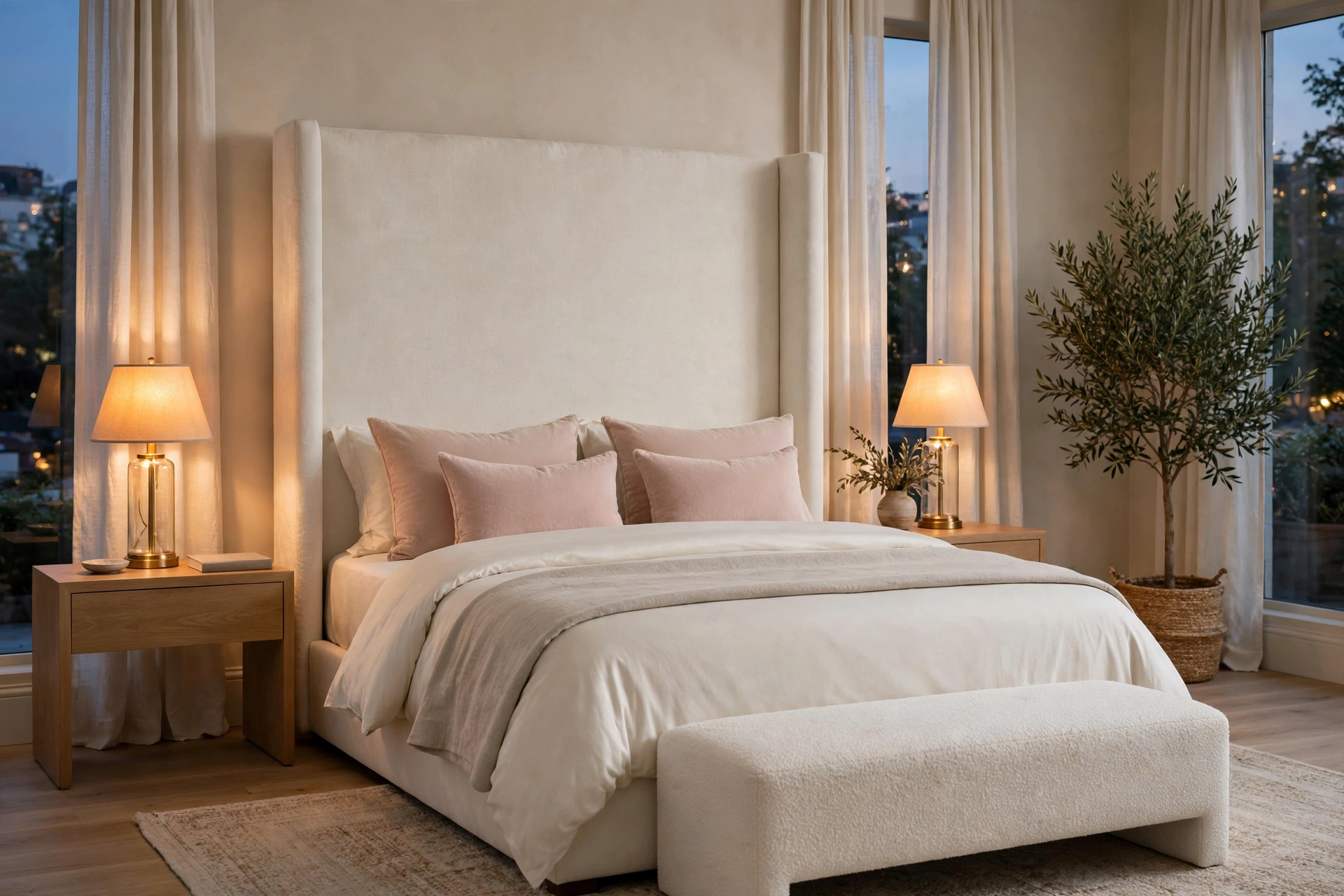
A retreat stays luxurious through a five minute evening reset, not through weekly deep styling. The bed is smoothed, cushions returned to their order, the bench cleared to its two items, the dresser groups restored, and the lamps switched from ceiling light to warm low light. Done nightly, the room you wake in is the room you styled, and calm becomes the default instead of an event.
How to do it: Work in one circle around the room: bed first, smoothing layers and standing cushions in their set order, then bench, then dresser, then nightstand trays. Return every stray item to its door, drawer, or basket as you pass it. Finish by setting the evening light layer and, if you use one, lighting the nightstand candle for the wind down hour. Pro Tip: Take one photograph of the finished room and keep it on your phone as the reset target. After guests, travel, or a busy week, the room returns to its photograph in minutes, not guesses. Common mistake: Resetting only before guests arrive. A retreat that is only calm for other people is a stage set; the nightly reset is what makes it yours.
Quick Reference Table
| Bedroom Idea | What It Adds | Key Rule |
|---|---|---|
| Soft palette | Whole room calm | Three base colors, blush and gold in small doses |
| Tall headboard | A center | Height above the pillows, bed centered |
| Layered bedding | Depth | Texture changes, pattern stays quiet |
| Taupe wall | Warm backdrop | One wall only, tested at night |
| Large calm art | Rest for the eye | One big piece, space around it |
| Matched nightstands | Designed symmetry | Same height, same lamps, same formula |
| Layered lighting | Evening calm | Warm light at three heights |
| Foot bench | A finished bed | Narrower than the bed, two items max |
| Large rug | Grounding | 50 cm showing on each side |
| Layered curtains | Dressed windows | Sheers by day, blackout by night |
| Reading corner | A second life | Chair, table, lamp, one book |
| Arched mirror | Soft light | Reflect the bed or window only |
| Styled dresser | Kept surfaces | Three groups, space between |
| Flowers and plant | Living softness | Two living accents only |
| Hidden clutter | Visual quiet | Doors and drawers, not open storage |
| Wind down tray | A gentle last hour | Four items, screen free zone |
| Evening reset | Calm that lasts | One circle, nightly, photo as target |
The Calm Retreat Checklist
- One palette: white, cream, taupe, blush, gold
- Tall headboard clear above the pillows
- Bedding layered in three textures
- One warm taupe wall behind the bed
- One large calm artwork with space around it
- Nightstands matched, lamps matched
- Warm light at three heights, no cool bulbs
- Bench at the foot, styled with two items
- Rug showing on both sides and past the foot
- Sheers plus blackout curtains, both to the floor
- Reading corner with chair, table, and lamp
- Arched gold mirror reflecting bed or window
- Dresser in three quiet groups
- One vase of fresh flowers, one green plant
- Clutter behind doors, drawers, and lids
- Wind down tray with four evening items
- Evening reset done, photograph as the target
Frequently Asked Questions
What colors make a bedroom look expensive and calm at the same time?
Soft neutrals used together: warm white, cream, and warm taupe as the base, with blush pink and gold kept to small accents. The expensive feeling comes from agreement, every large surface inside the palette, not from any single costly color. Idea 1 and Idea 4 show the palette on the room and on the wall behind the bed.
How can I make a small bedroom feel like a luxury retreat?
Keep the same system at a smaller scale: a tall headboard panel for height, bedding layered in texture rather than bulk, one large rug that runs under the bed, and closed storage so surfaces stay clear. Skip the bench if the walkway becomes tight, and use the reading chair only if a corner truly fits it. Calm comes from clear surfaces and one palette, both of which work in any size room.
Do I need to buy a new bed to get this look?
No. The tall center of Idea 2 can be built with upholstered wall panels or a wide padded panel behind the pillows, and the retreat feeling comes mostly from palette, bedding layers, lighting, and clear surfaces. A new bed is the last step, not the first, and many rooms reach the look without one.
Conclusion
A calm, expensive looking retreat is a system, not a shopping list: one soft palette, a tall bed at the center, bedding layered in texture, a warm wall behind it, matched nightstands, light layered low and warm, windows dressed in two layers, and every surface kept in quiet groups behind closed doors. Build it in the order of these ideas, then hold it with a five minute evening reset. The room will feel like a retreat every night, not only on the day it was styled. Save this guide for your next bedroom refresh and pin your favorite idea for later.