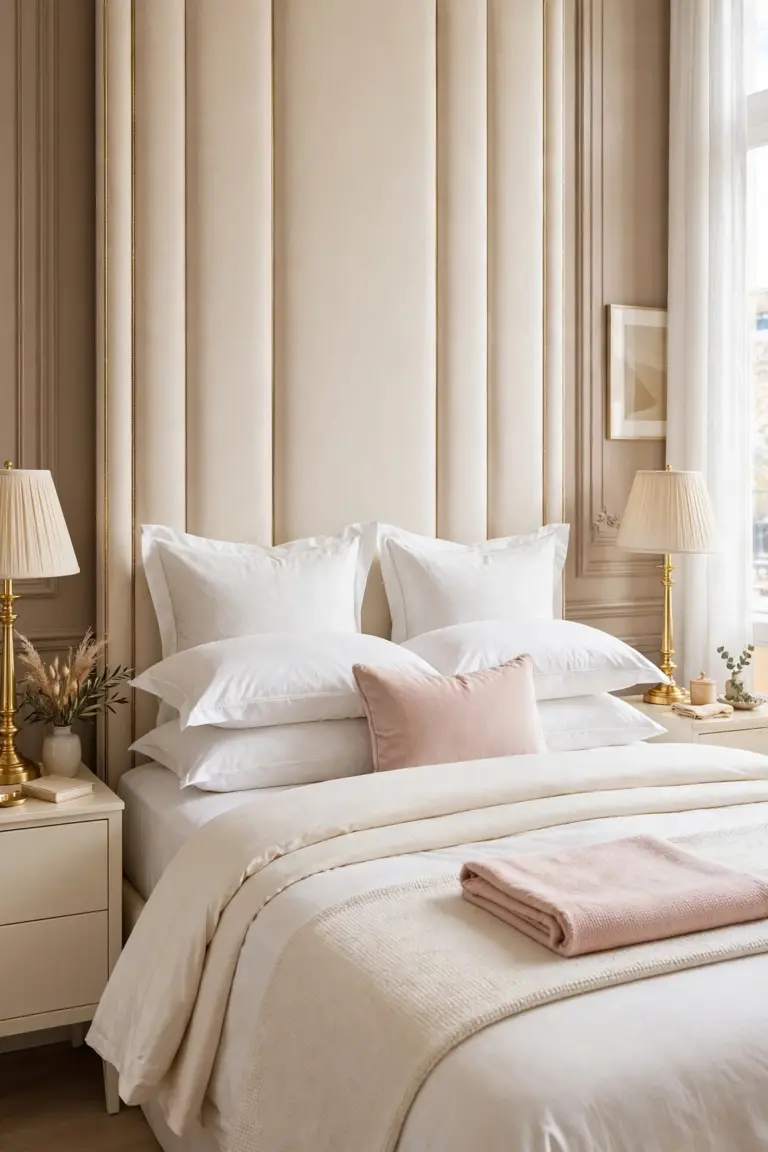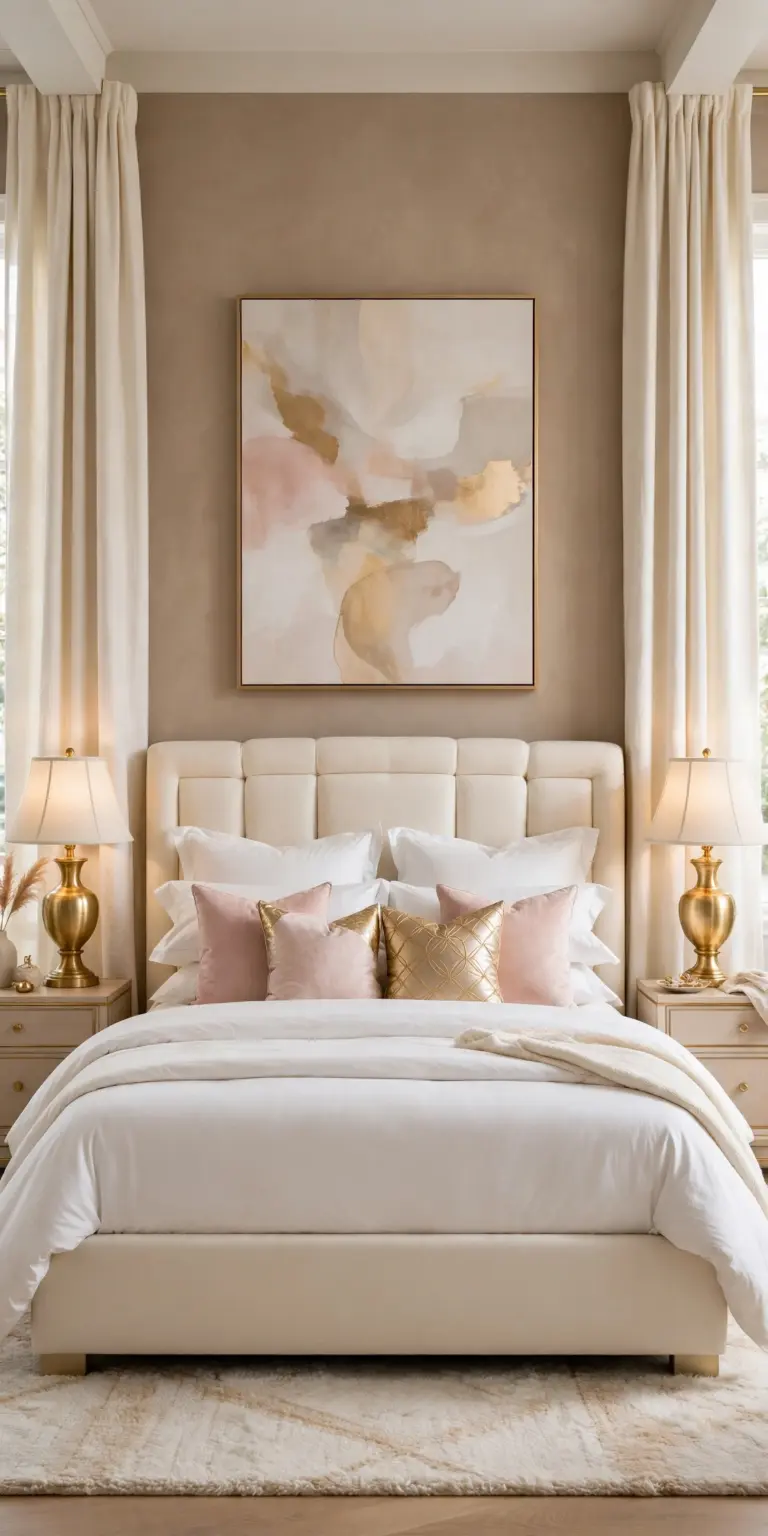
15 Small Bedroom Ideas That Maximize Space Without Sacrificing Style
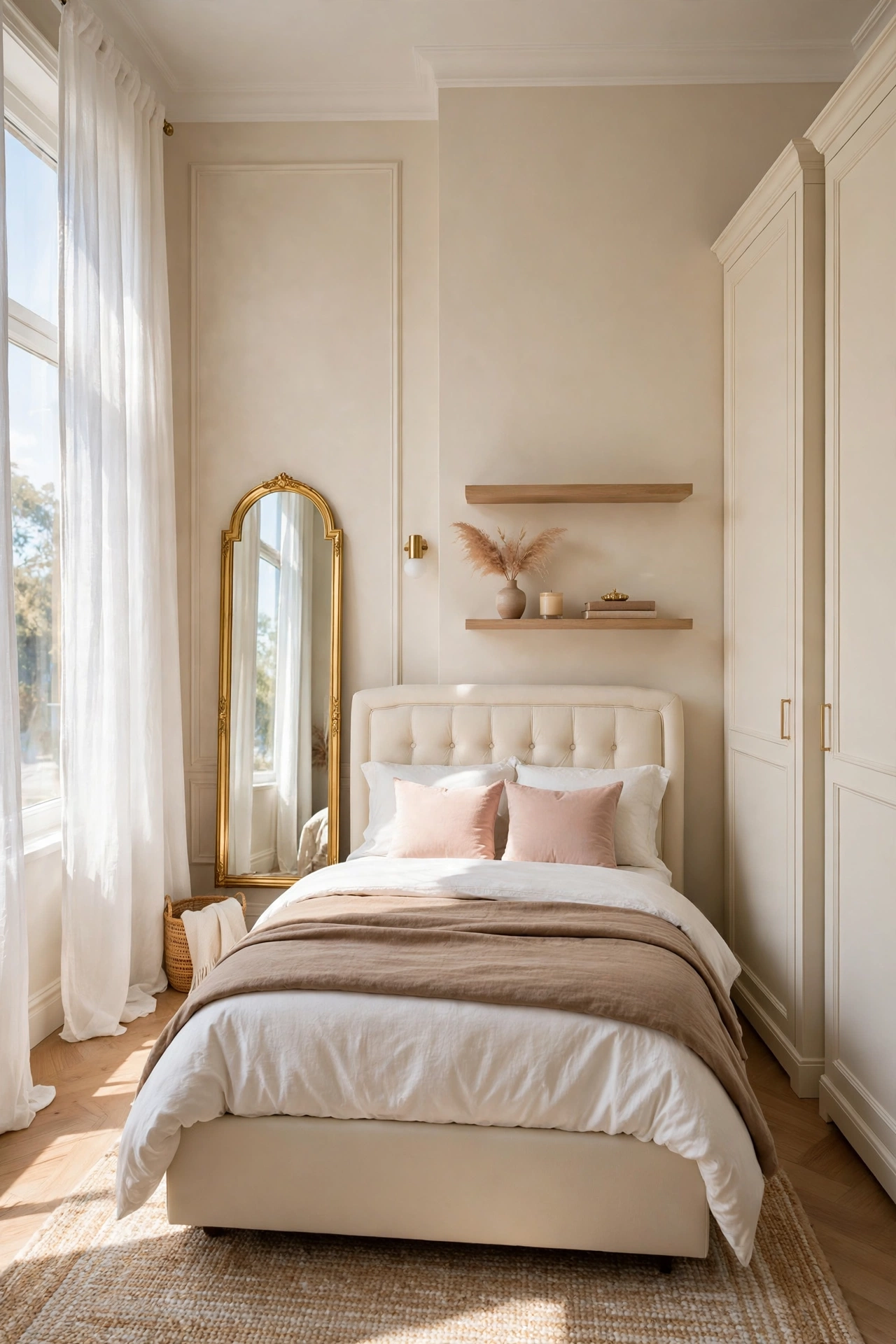
15 Small Bedroom Ideas That Maximize Space Without Sacrificing Style
A small bedroom fails in a predictable way: the bed is too big for the walls, the storage is too low and too wide, and every flat surface becomes a shelf. The fix is not a smaller life. The fix is a room where storage climbs the walls, hides under the bed, and hangs on the door, so the floor can stay clear and the bed can stay beautiful.
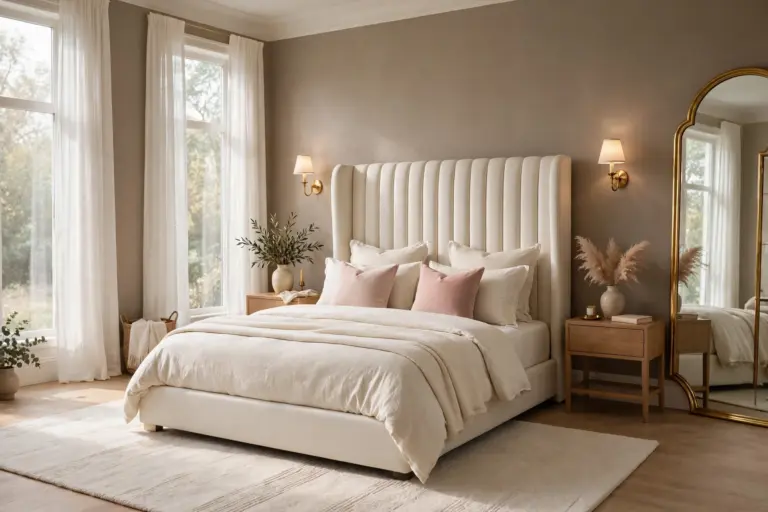
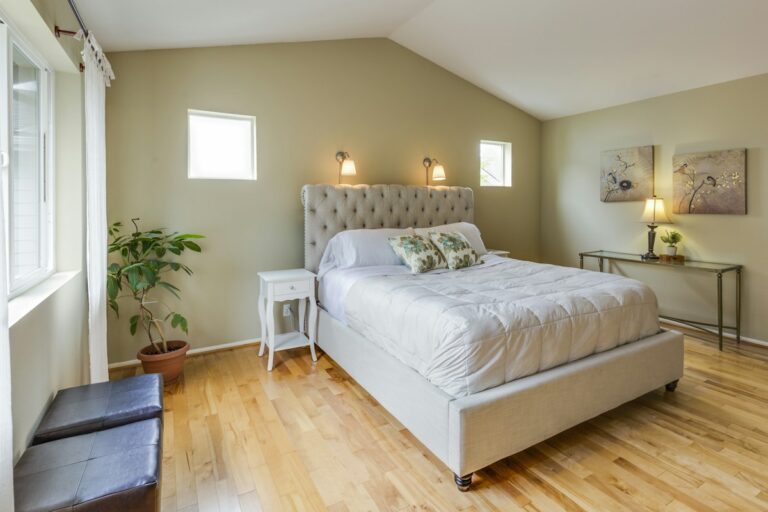
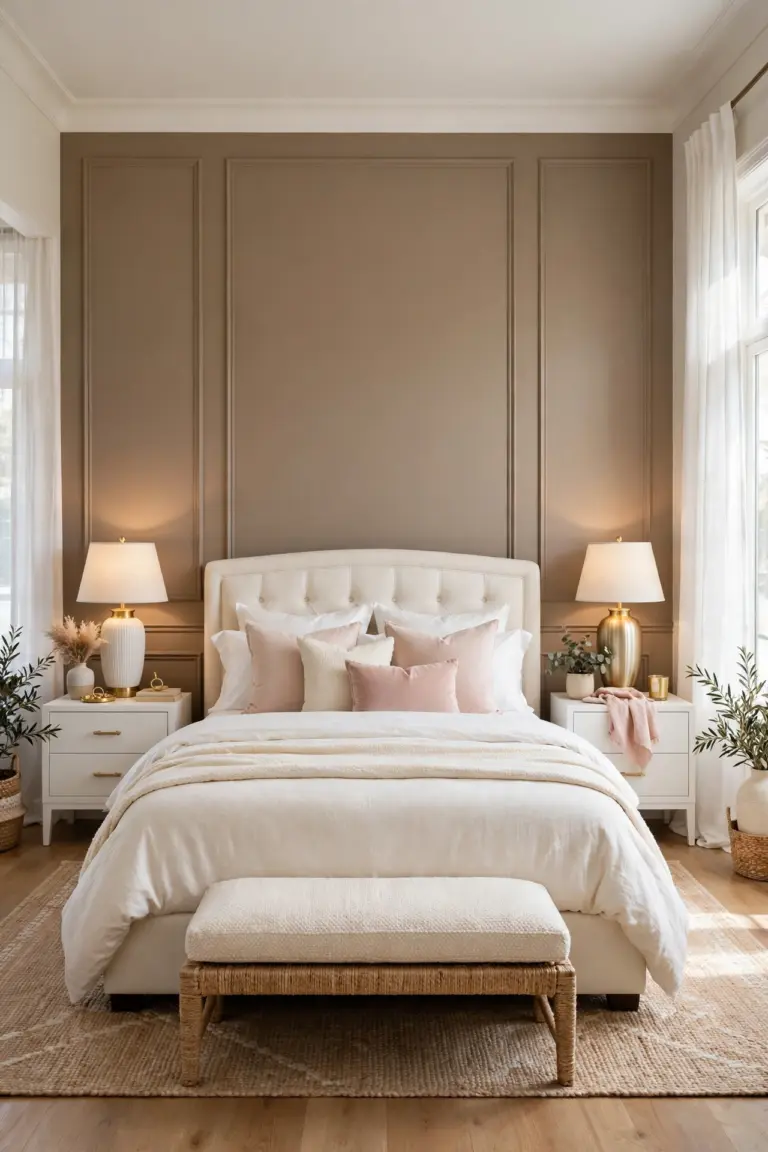
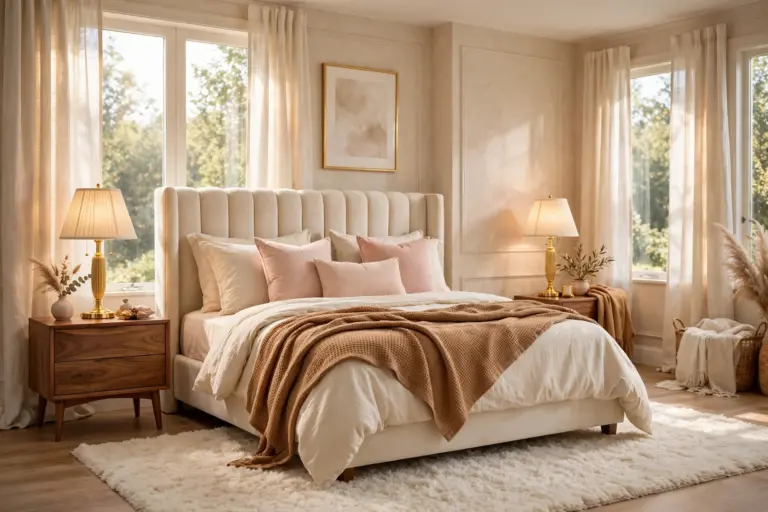
These fifteen small bedroom ideas work in one order: layout first, then vertical storage, then the light and mirror tricks that make the saved space visible. Every room in the photographs keeps the same glam family, a cream upholstered bed, warm taupe and white bedding, blush pink softness, and gold details, so a small room reads as one finished design instead of fifteen separate purchases.
1. Anchor the Bed Flat Against the Longest Wall
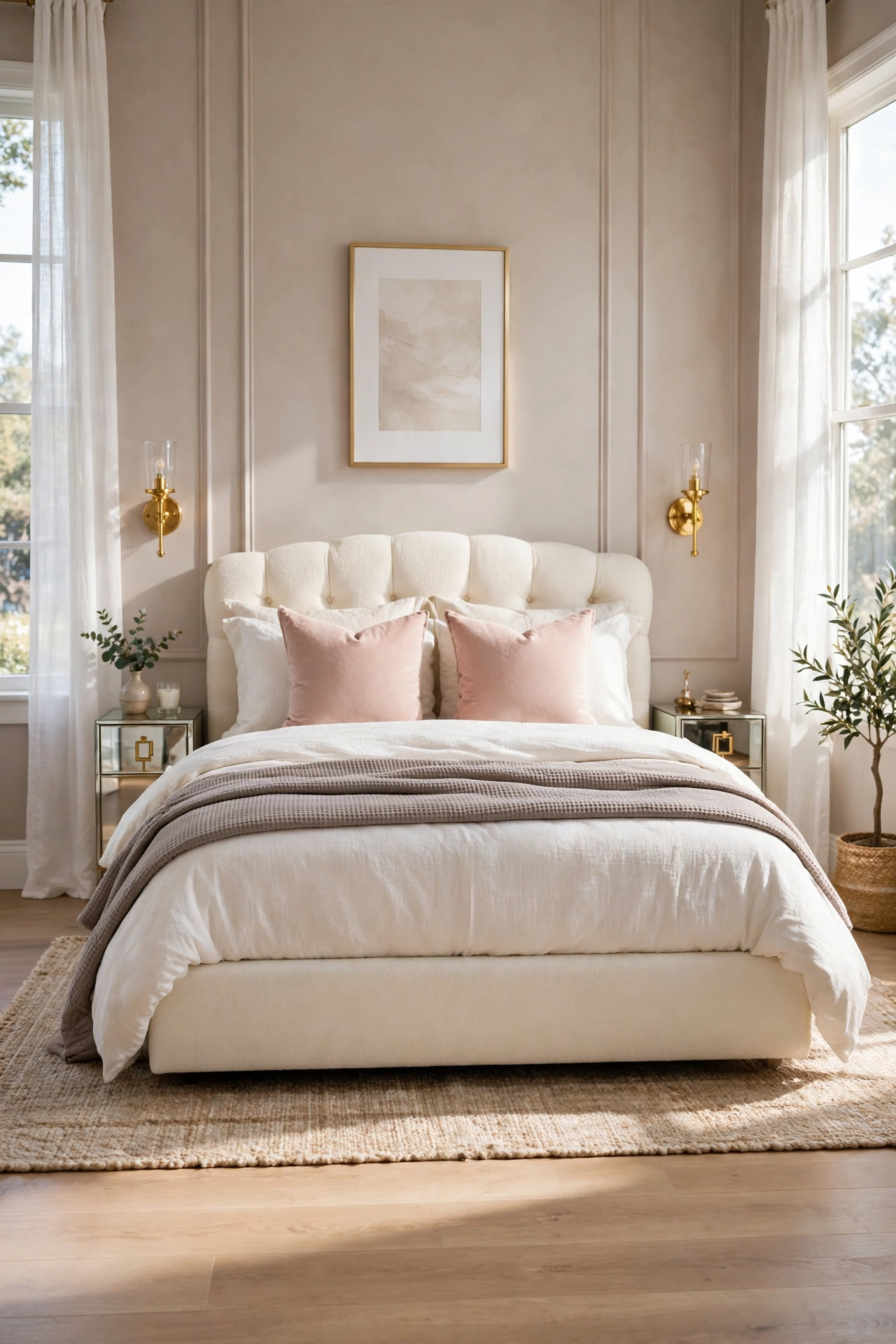
In a small room, the bed is the largest object by far, so its position decides everything else. Pushed flat and centered against the longest wall, with no gap behind the headboard and no angled corner placement, the bed leaves one clean rectangle of open floor in front of it. That rectangle is what makes the room feel usable instead of squeezed.
Centering matters as much as the wall choice. A centered bed lets both sleepers get in and out, gives the room one balanced focal point, and stops the dead wedge of wasted floor that appears when a bed is shoved into a corner. Measure the wall, find its middle, and build every other decision around that center line.
How to do it: Measure all four walls and choose the longest one that does not hold the door swing. Push the headboard fully flat to the wall with no gap. Center the bed on that wall, even if it means moving a socket-side item elsewhere. Leave the clearest walkway, ideally 24 to 30 inches, on the door side. Pro Tip: If the longest wall has a window, center the bed under it with low headboard styling rather than moving the bed to a short wall; the symmetry reads as a design choice. Common mistake: Floating the bed a few inches off the wall for cables. That gap collects dust, wastes the room’s scarcest inches, and makes the bed look parked instead of placed.
2. Replace Nightstands With Floating Wall Shelves
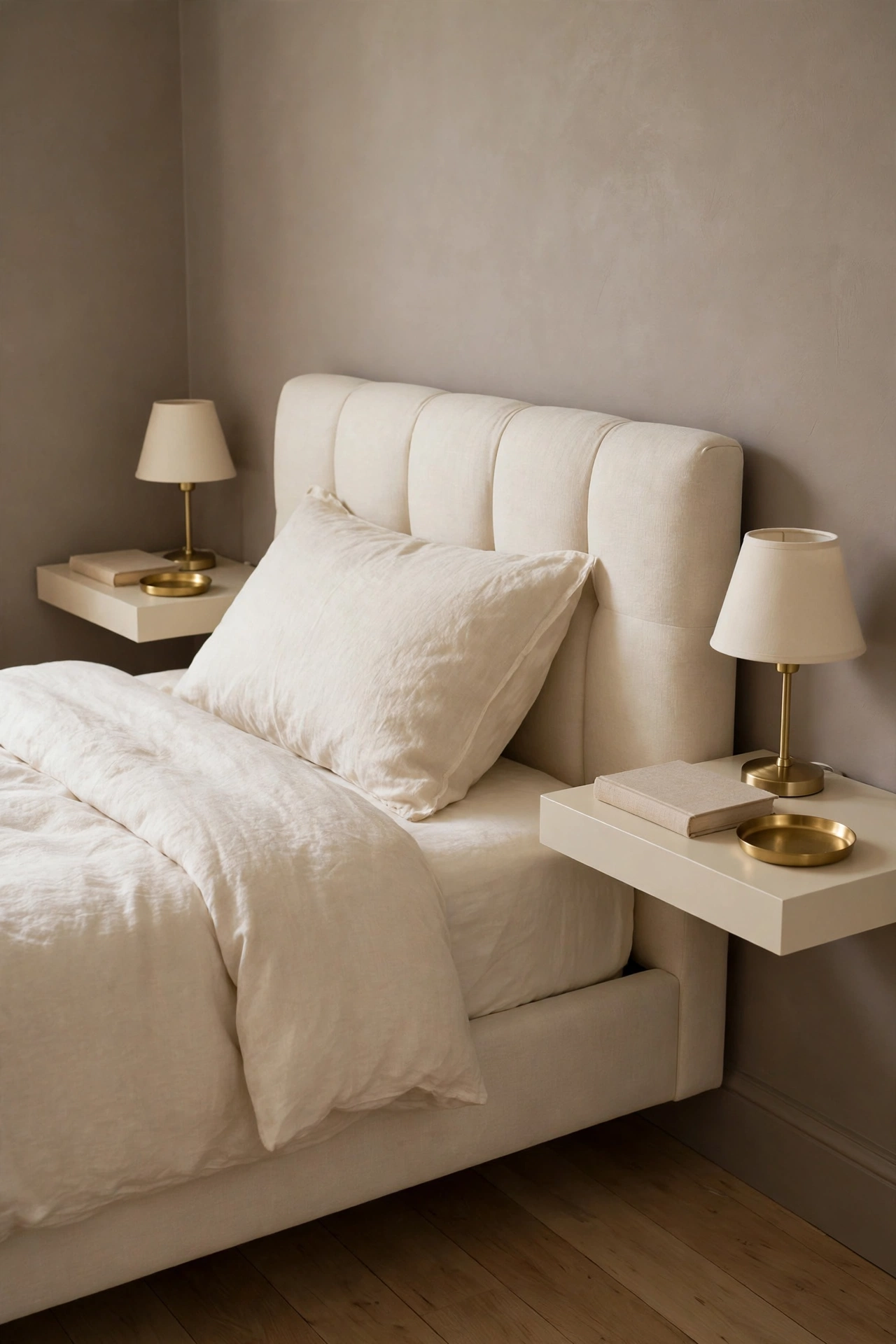
A standard nightstand eats about two square feet of floor and offers one drawer in return. A floating shelf at mattress height offers the same working surface, a lamp, a book, a glass of water, while the floor underneath stays visible and cleanable. Visible floor is the cheapest space illusion there is, because the eye reads the room by how much floor it can see.
Two matched floating shelves, one each side of the bed, also keep the symmetry the glam look depends on without the bulk. Choose shelves with a small raised lip or add a slim gold tray, so nothing slides off in the night, and keep the styling to three items per shelf at most.
How to do it: Mount the shelf top level with the top of the mattress, usually 24 to 28 inches from the floor. Fix into studs or use anchors rated well above the shelf load, and keep each shelf 12 to 16 inches wide. Run lamp cords down the wall in a slim cover painted to match. Pro Tip: Choose a shelf with a shallow built-in drawer when you can; it hides chargers and lip balm, the small clutter that makes a styled room look lived on by morning. Common mistake: Mounting the shelves at picture height instead of mattress height. A shelf you have to sit up and reach for is decor, not a nightstand.
3. Choose Leggy Furniture So the Floor Shows Through
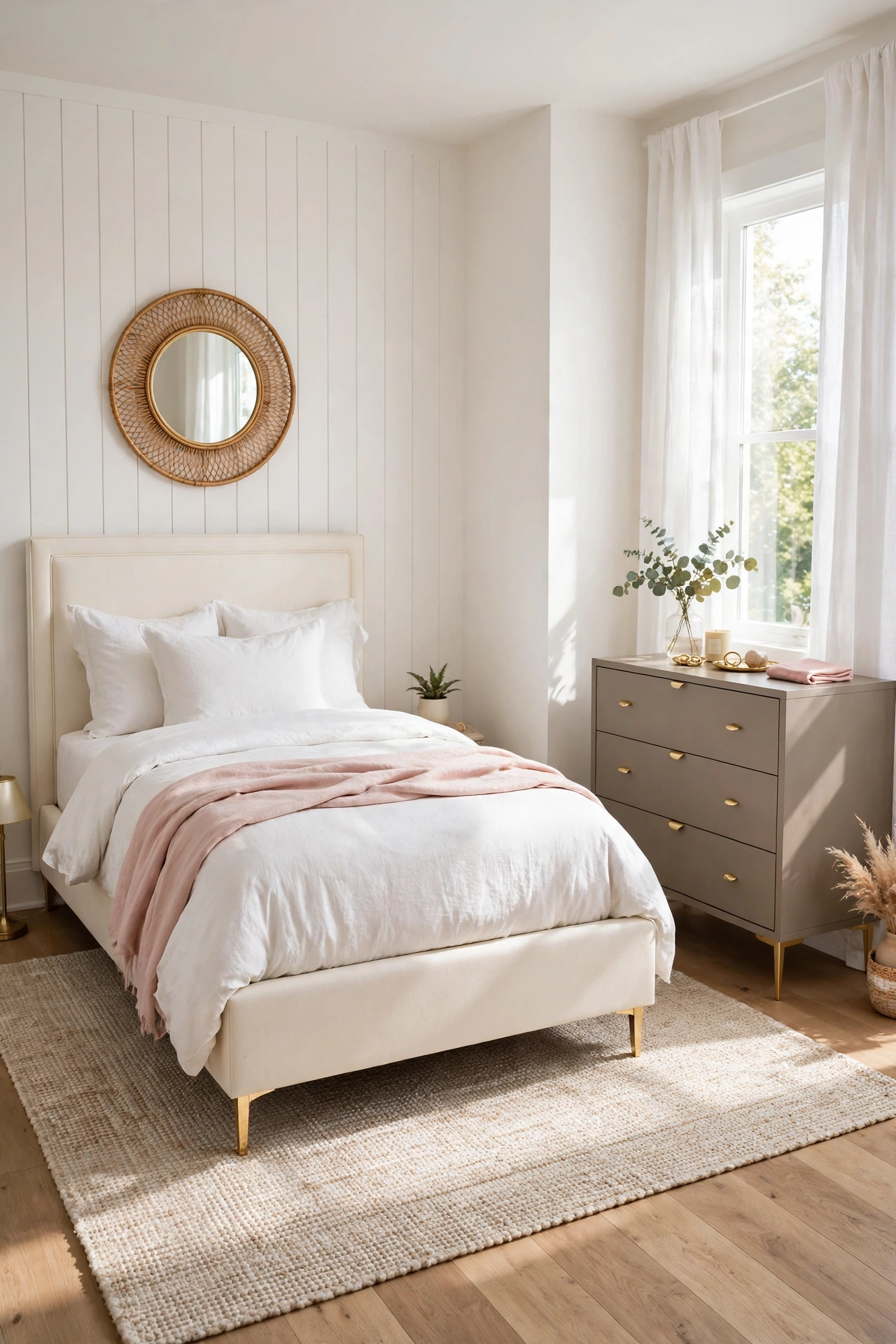
Furniture that sits flat on the floor reads as solid blocks, and solid blocks shrink a room. The same bed, dresser, or bench raised on slim legs lets light and sight lines pass underneath, so the floor plane runs unbroken from wall to wall. The room has the same furniture and more visible space at the same time.
Legs also make a small room easier to live in. A vacuum or mop passes under a raised frame, dust stays out of sight lines, and air moves better around bedding stored low. Aim for legs of 5 to 8 inches on the main pieces; below that the effect disappears, above that storage boxes start to show.
How to do it: When buying, filter for raised or legged versions of the bed frame and dresser first. Keep the leg finish in the room’s metal, here slim gold or warm brass, so the pieces read as one set. Use the under-furniture gap for nothing visible from the doorway; it is a light channel, not a storage shelf. Pro Tip: A leggy bed pairs with Idea 6: choose a frame height that lets standard low storage boxes slide fully out of sight, not halfway. Common mistake: Mixing one leggy piece with several floor-flat blocks. The trick works as a system; one floating object in a room of blocks looks accidental.
4. Hang One Oversized Mirror Opposite the Window
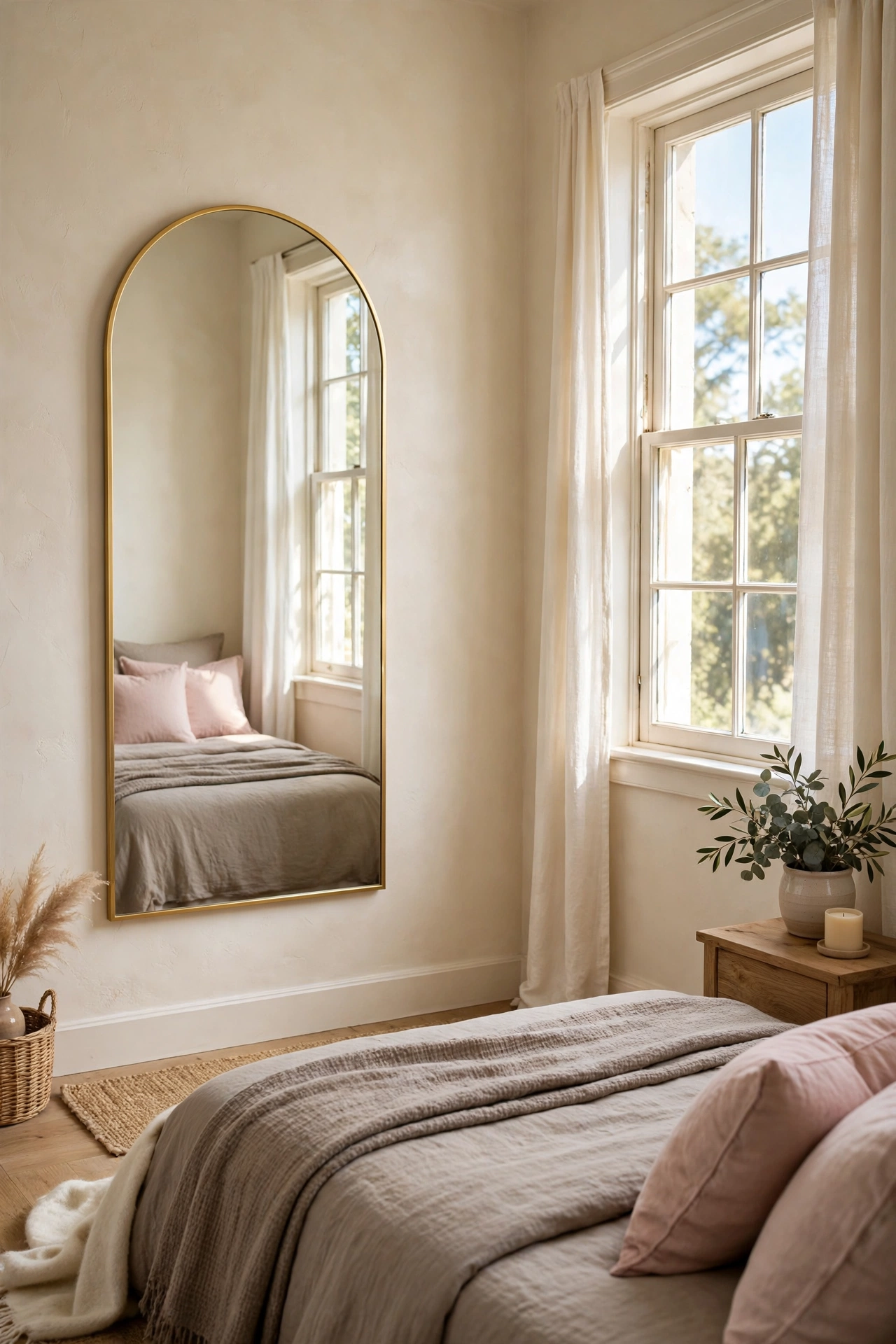
A mirror earns wall space in a small bedroom because it does two jobs at once: it returns the room’s daylight to the corners the window cannot reach, and it shows the eye a second, reflected room, which the brain reads as depth. One oversized mirror does this better than a cluster of small ones, which break the reflection into fragments.
Placement is the whole trick. Opposite or just angled to the window, the mirror reflects light and, ideally, something worth seeing: the made bed, a plant, the curtain line. Facing a blank wall or a clutter pile, it doubles those instead. A tall arched shape in a thin gold frame keeps the glam note while its height pulls the ceiling up visually.
How to do it: Choose a mirror at least 48 inches tall and hang it so its center sits at eye level, or lean a secured full-length mirror on the wall opposite the window. Check the reflection from the bed and from the door before fixing it. Anchor any leaning mirror to the wall at the top; leaning alone is not safe. Pro Tip: In a room with no clear window wall, hang the mirror beside the window on the same wall; it still catches side light and widens the window’s effect. Common mistake: A gallery of many small mirrors. They sparkle, but they chop the light into pieces and give back no sense of extra room.
5. Go Tall With Narrow Tower Storage
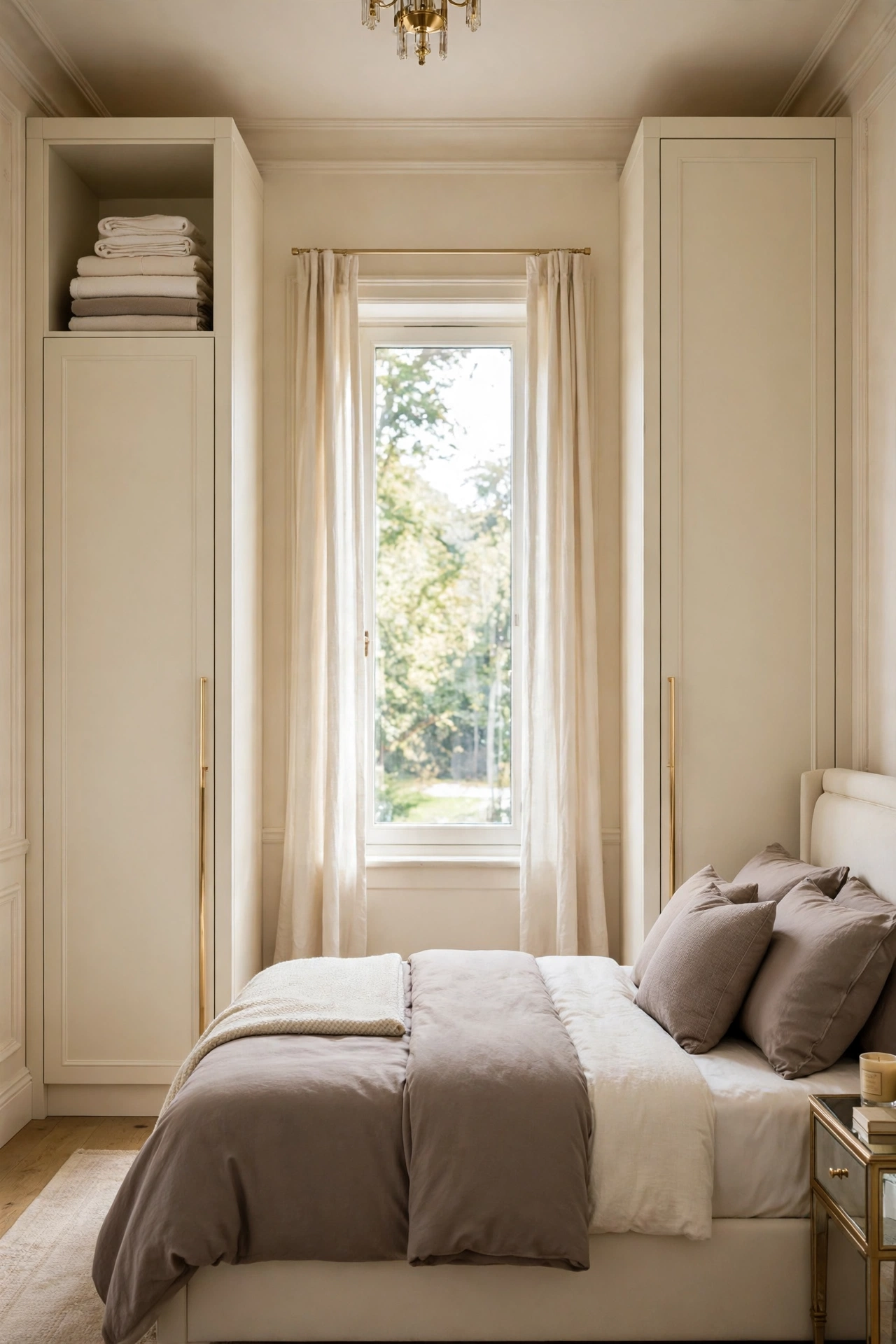
Most small bedrooms waste the top two feet of every wall. A tall, narrow tower, 16 to 20 inches wide and reaching close to the ceiling, stores as much as a wide low dresser on a third of the floor print. Height is the one dimension a small room usually still has in stock, so spend it deliberately.
Towers work best as a matched pair or a single calm column in the room’s main finish, because a tall object in a clashing finish becomes a monument. Inside, give the top shelves to the least-used items, off-season bedding and spare blankets, and keep daily clothes between waist and eye level so the tall storage stays practical.
How to do it: Measure ceiling height and order or build towers that stop 2 to 3 inches below it. Fix every tower to the wall with anti-tip straps; tall and narrow is exactly the shape that must be anchored. Sort contents by frequency before loading: daily at the middle, weekly above, seasonal at the top. Pro Tip: Run one tower as closed storage and, if a second is needed, match it exactly. Two different tall pieces read as clutter at height. Common mistake: Tall storage with the heaviest items at the top. Heavy boxes go low; light, bulky bedding goes high.
6. Put the Under-Bed Zone to Work With Drawers
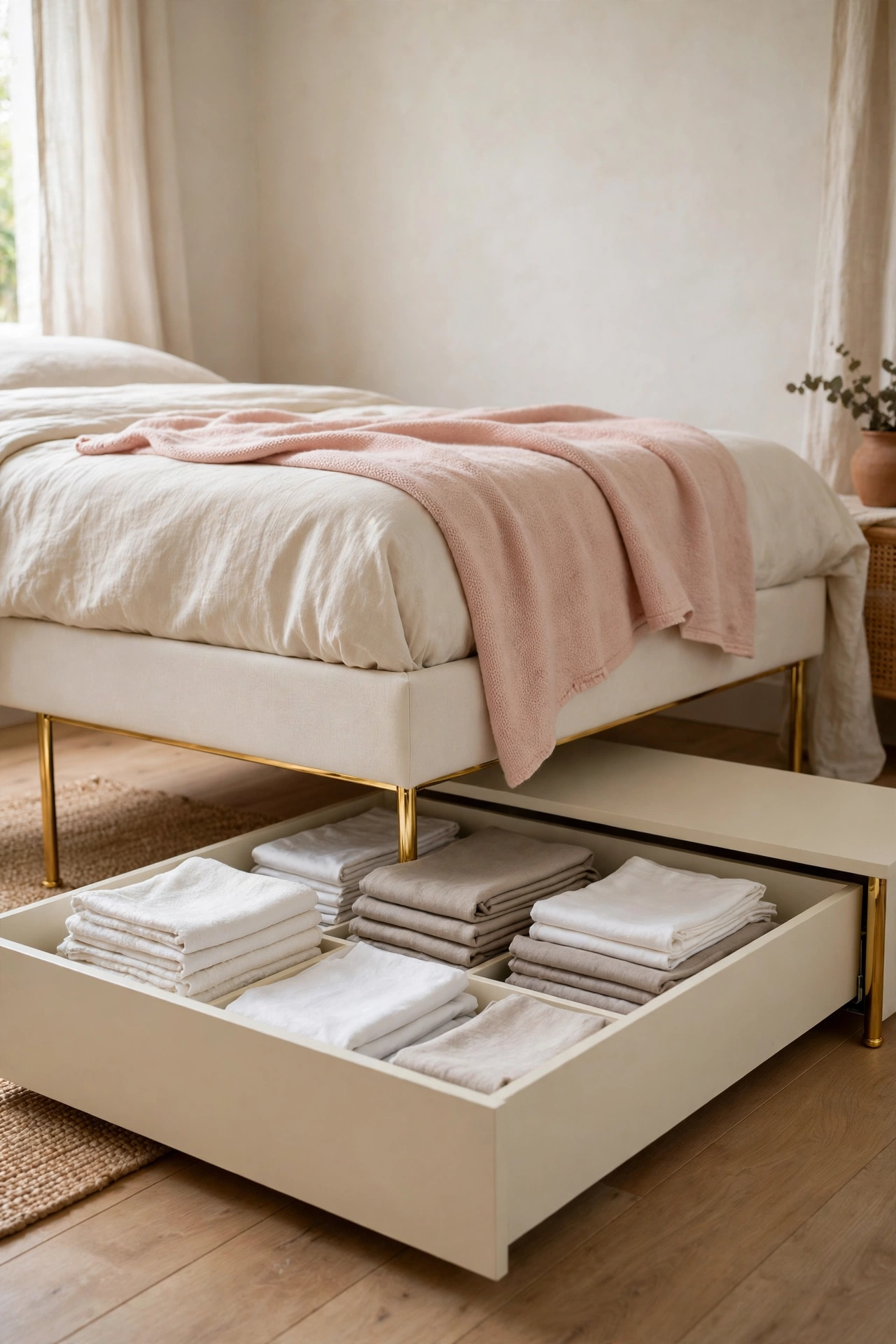
The space under a bed is the largest storage area in a small bedroom and the most often wasted. Low drawers or lidded boxes on casters turn it into a proper dresser: off-season clothes, spare bedding, and shoes all live there, invisible behind the bed skirt or frame line and reachable in one pull.
Drawers beat open sliding boxes for one reason: order. A drawer opens to a single layer you can see at a glance, while a deep box becomes a dig pit within a month. If the bed has no built-in drawers, choose low boxes with a lid and a handle on the short end, sized to slide from the long side of the bed.
How to do it: Measure the clear height under the frame, then buy drawers or boxes at least one inch lower. Divide the zone by category, one drawer per type, and label the ends if two people share. Vacuum the zone before loading; whatever goes in clean has a chance of staying clean. Pro Tip: Keep one under-bed drawer as the linen drawer. In a small room with no linen closet, the bed storing its own bedding is the neatest closed loop there is. Common mistake: Storing daily clothes under the bed. The pull-out step is fine weekly and irritating daily; daily items belong in the towers of Idea 5.
7. Claim the Back of the Door
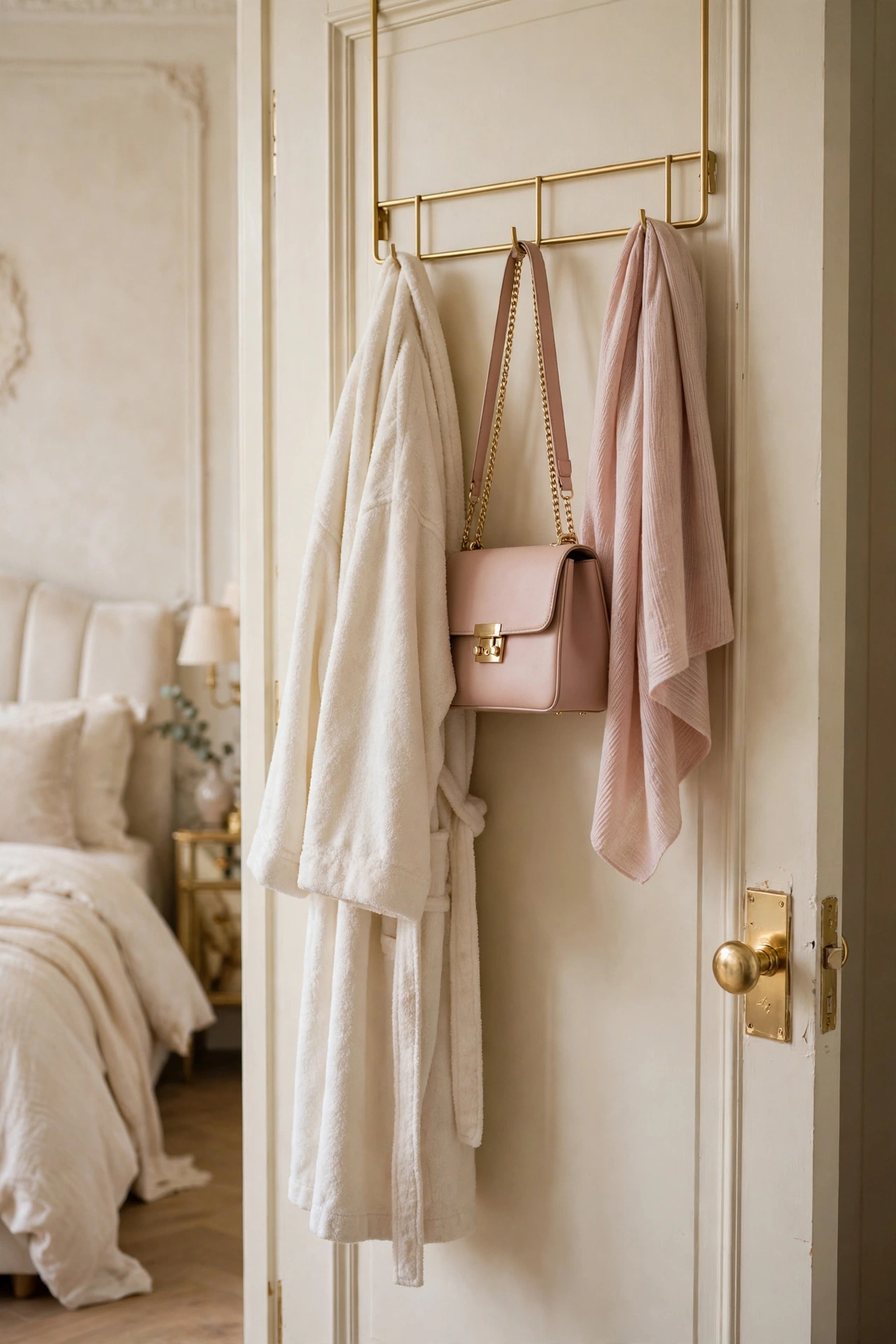
The back of the bedroom door is a full wall panel that usually carries nothing. A slim over-door rack or a row of mounted hooks turns it into vertical storage for the soft, light things that otherwise drape over chairs: robes, bags, scarves, tomorrow’s outfit. In a small room, reclaiming the chair from draped clothes is itself a visible gain of space.
Keep the load light and flat. Door storage works because the items hang in the door’s own depth and vanish when the door is open against the wall. Heavy or bulky loads strain hinges and make the door thump, so this is a home for fabric and small bags, not for shoe collections in deep pockets.
How to do it: Fit an over-door rack with padded hooks so it does not rattle, or mount a slim rail on the door’s back face if the door is solid. Check the door still opens fully against the wall with the rack loaded. Assign every hook one job and keep one hook empty for guests or laundry day. Pro Tip: Match the rack finish to the room’s gold details and it reads as part of the design, not as a dorm-room fix. Common mistake: Deep pocket organizers stuffed until the door will not close. If the door cannot close quietly, the storage has failed its only test.
8. Add a Shallow Ledge Above the Bed
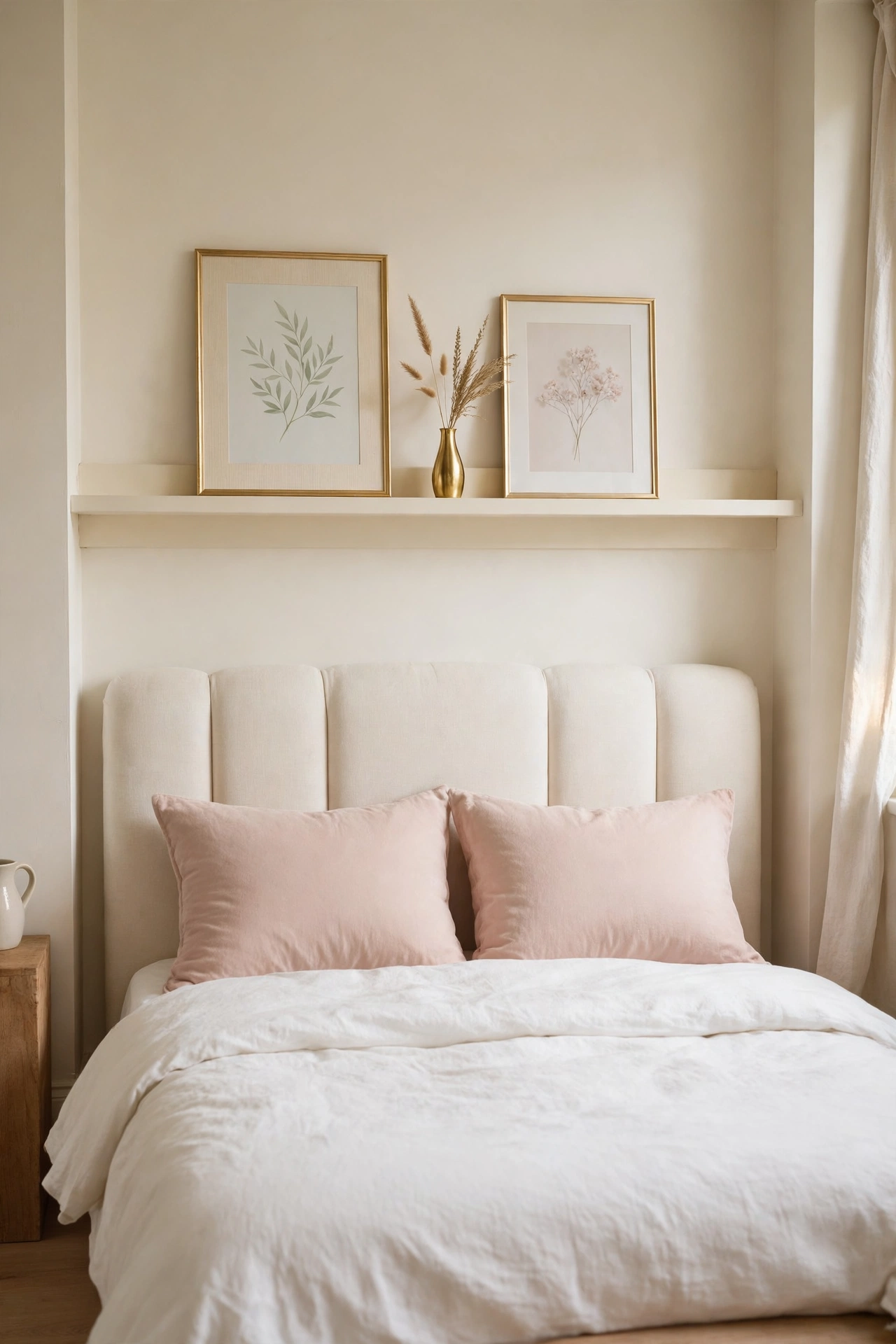
Wall space above the headboard is display space that costs no floor and no surface. A shallow picture ledge, 3 to 4 inches deep, holds framed prints, a small vase, or a leaning book, and lets you restyle the room’s focal wall in minutes by swapping what sits on it. Unlike hung frames, a ledge makes change free, which suits a small room where every other change is work.
Depth discipline is the rule. A ledge above a bed must be shallow enough that nothing on it can feel like a falling risk, and everything placed on it should be light: paper-framed art, a small plant in a light pot, an empty decorative vase. Save heavy frames and thick books for walls nobody sleeps under.
How to do it: Mount the ledge at least 18 inches above the top of the pillows, fixed into studs where possible. Keep the display to three or four light pieces with space between them. Choose frames in the room’s gold or cream so the ledge reads as one designed line above the headboard. Pro Tip: One ledge, not two stacked shelves. A single line looks like a gallery; stacked shelves above a bed start to read as storage creeping over the sleeper. Common mistake: Placing a heavy mirror or thick framed canvas on the ledge. Above-bed display stays light, always.
9. Hold the Room to Three Light Tones
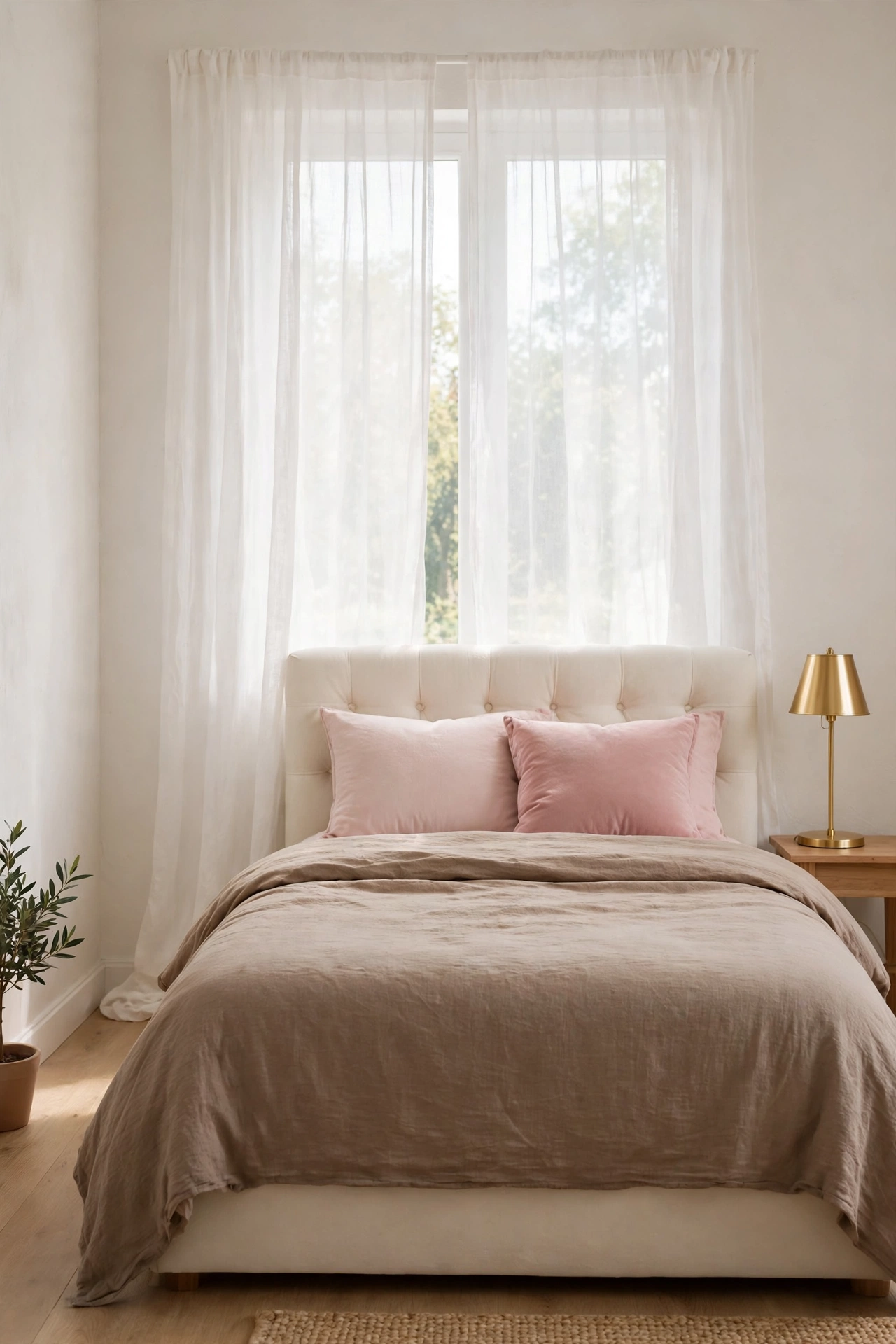
A small room in many colors reads as many small pieces. The same room held to three light tones, here warm white, cream, and warm taupe across walls, bedding, and curtains, reads as one continuous space, because the eye stops finding edges to measure. Fewer edges, more room: that is the whole mechanism behind the light palette rule.
Light tones also return more of the room’s daylight to the eye than deep tones do, which is why this palette partners with the mirror of Idea 4. Blush pink and gold still belong in the room, but as the accent layer only: pillows, a throw, the mirror frame, the lamp metal. Accents are seasoning; the three tones are the meal.
How to do it: Name your three tones before buying anything else, and test them together in the room’s own light. Put the lightest tone on the largest surfaces, walls and curtains, and the deepest of the three on the bed, which grounds the room. Repeat each tone at least twice so nothing looks like a leftover. Pro Tip: Keep one texture change per tone, matte walls, washed linen bedding, a woven throw, so a calm palette does not go flat. Common mistake: Adding a fourth strong color as a feature wall. In a small room the feature wall becomes the wall that moves closer.
10. Move the Lamps Onto the Wall
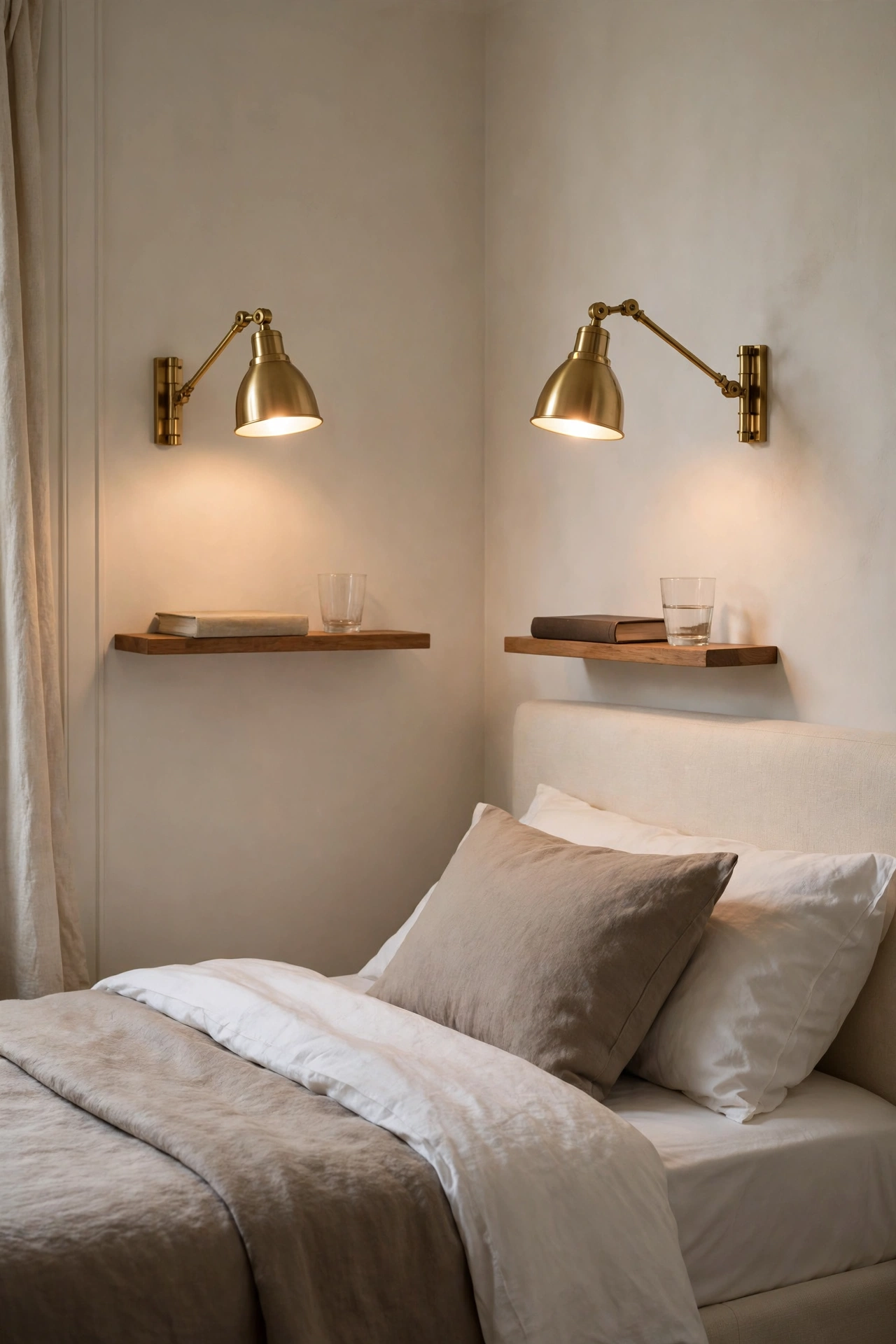
Table lamps are surface thieves. Each one claims the most useful corner of the nightstand or shelf and gives light that mostly hits the wall behind it. A pair of wall sconces at the head of the bed returns the whole surface to books, water, and chargers, and puts the light exactly where reading happens: over the pillow line.
Swing-arm or adjustable sconces earn their place in a small room because one fitting does two jobs, ambient light swung out, reading light pulled close. Plug-in models with a cord cover keep the idea renter-friendly, while hardwired models give the cleanest line in an owned home. Either way, the surface below stays clear, which you can see in every photograph of the room.
How to do it: Mount sconces 5 to 6 inches out from the bed’s edge and about 40 to 48 inches above the mattress top, then check the light pool from lying position before final fixing. Choose warm white bulbs so the gold finish and cream bedding keep their color at night. Route plug-in cords in painted cord covers, never loose down the wall. Pro Tip: Put both sconces on one dimmer or choose dimmable bulbs; a small room lit at full brightness feels smaller at night, not bigger. Common mistake: Sconces placed as decoration at mismatched heights. Measure from the mattress, not the floor, and match the pair exactly.
11. Hang Curtains at the Ceiling and Wider Than the Window
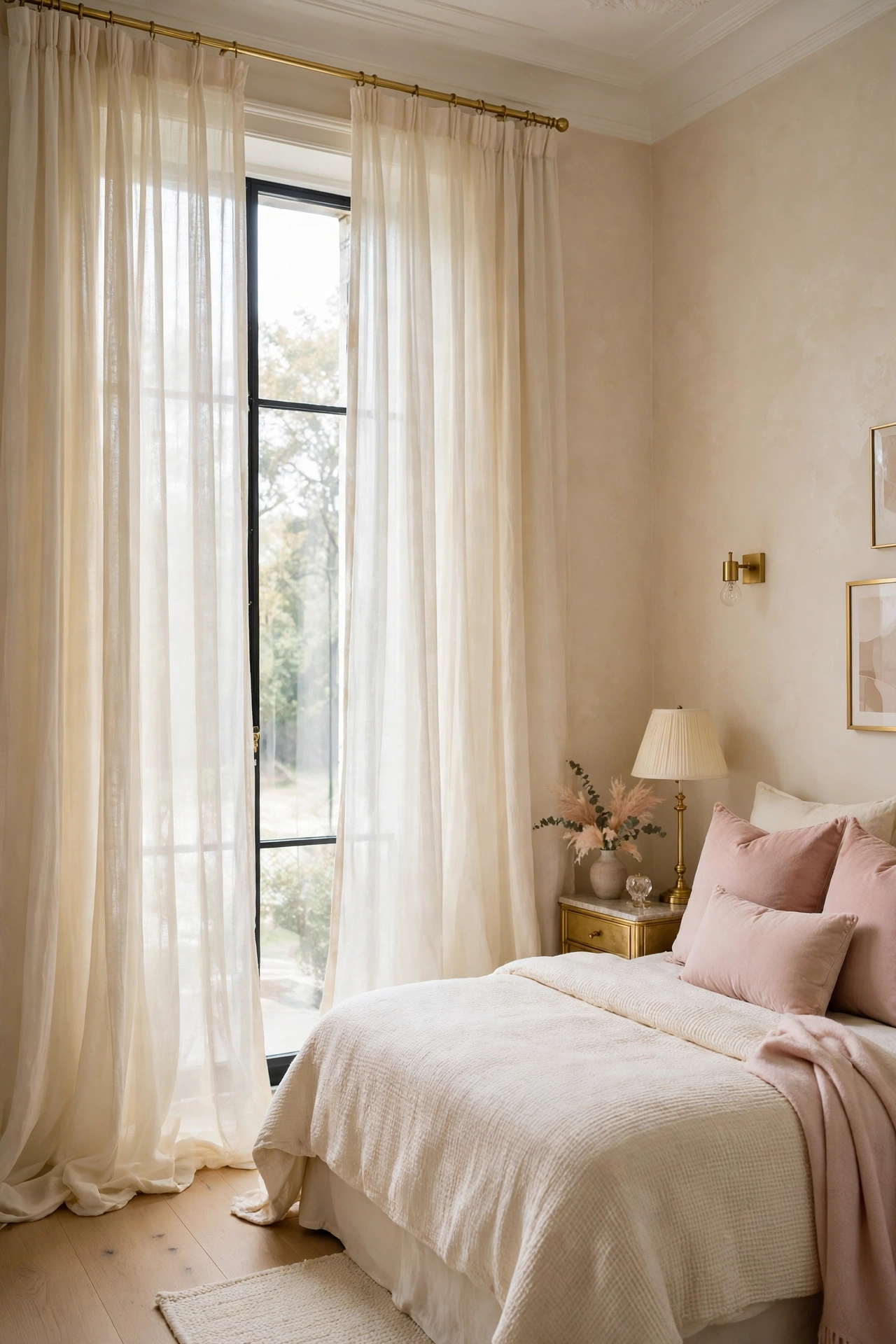
Curtains hung just above the window frame announce the window’s true, small size. The same curtains hung at ceiling height, on a rod that runs 6 to 10 inches beyond the frame on each side, tell the eye a taller, wider story: the wall reads as height, the glass reads as width, and the fabric stack sits mostly on wall instead of covering glass when open.
Sheers and light fabrics do the small room version of this job best. A sheer or linen-look panel in cream filters glare without eating daylight, and daylight is the one form of space a small room cannot buy. If blackout is needed for sleep, layer a slim blackout panel behind the sheer on a double rod rather than replacing the light layer.
How to do it: Fix the rod as close to the ceiling as the molding allows, usually within 2 to 4 inches. Extend it past the frame on both sides and choose panels long enough to just kiss the floor. Keep the fabric color inside the three tones of Idea 9 so the tall curtain wall stays calm. Pro Tip: Two narrow panels per side look fuller than one wide panel and stack back into less space, leaving more glass exposed. Common mistake: Curtains cut to sill length on a tall rod. The height trick only works if the fabric completes the line from ceiling to floor.
12. Choose a Slim Headboard and Skip the Footboard
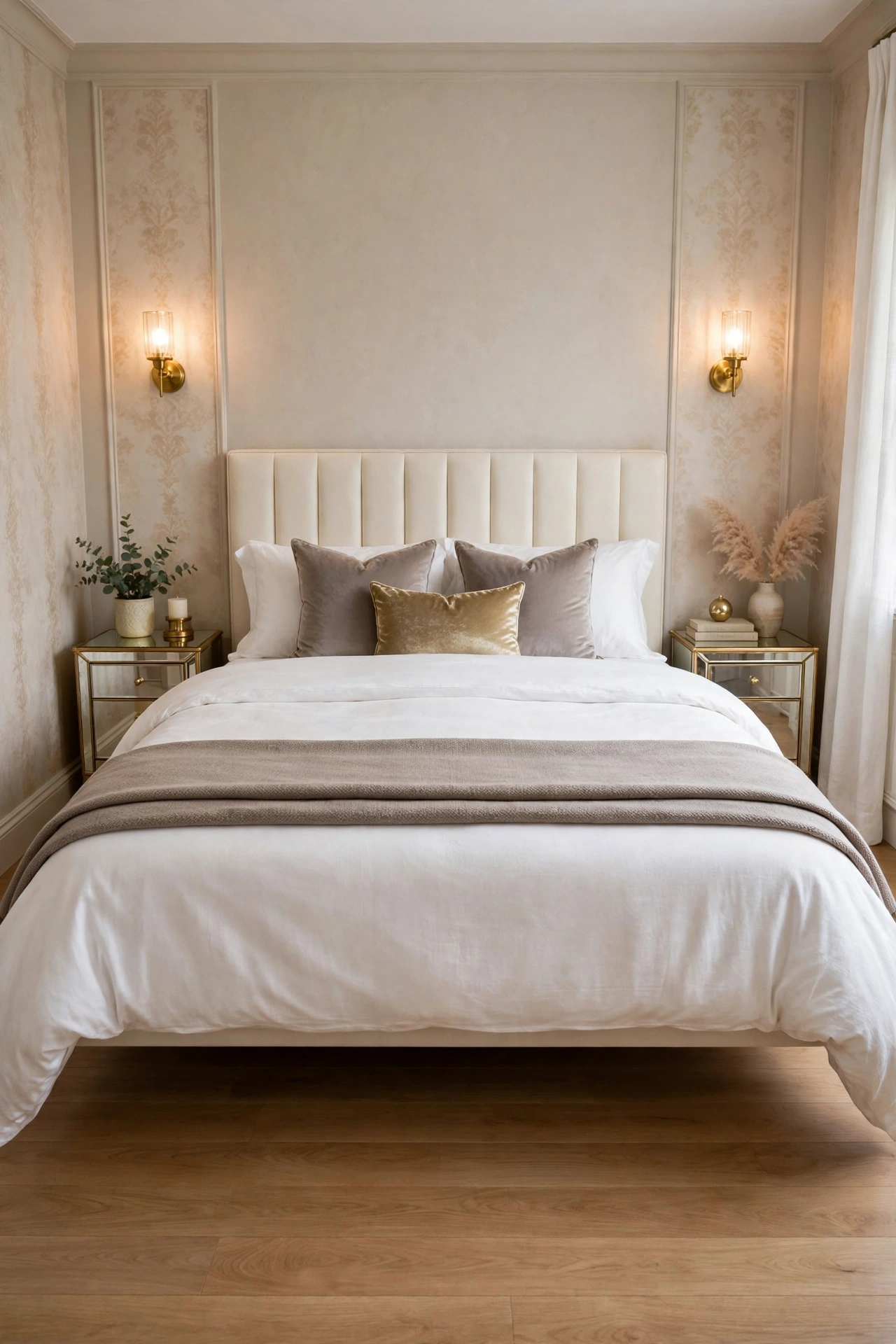
A footboard is a wall built at the end of the bed. It closes the room’s main sight line, catches shins in the dark, and shortens the bed’s visual run. A slim upholstered headboard with no footboard keeps the glam comfort where you lean and read, and leaves the end of the bed open, so the eye and the walkway both travel past it.
Slim is the operative word. A padded panel 3 to 4 inches thick gives the soft, tailored look of the glam style without the 10 to 12 inches a chunky sleigh frame takes from the room. In cream or warm taupe upholstery it carries the palette of Idea 9 onto the bed itself, tying the largest object in the room into the scheme.
How to do it: Measure the frame before ordering; the headboard should sit no wider than the mattress by more than an inch each side. Choose a wall-mounted panel if the bed frame is plain, fixed securely at sitting height. Dress the open bed end with a folded throw across the foot, which gives the finished look a footboard used to provide. Pro Tip: A headboard with shallow built-in side shelves can replace the floating shelves of Idea 2 in the very smallest rooms, doing both jobs in one piece. Common mistake: Keeping a beautiful but bulky frame because it was expensive. In a small room, one wrong-scale anchor piece taxes every other idea on this list.
13. Fold a Desk Down From the Wall
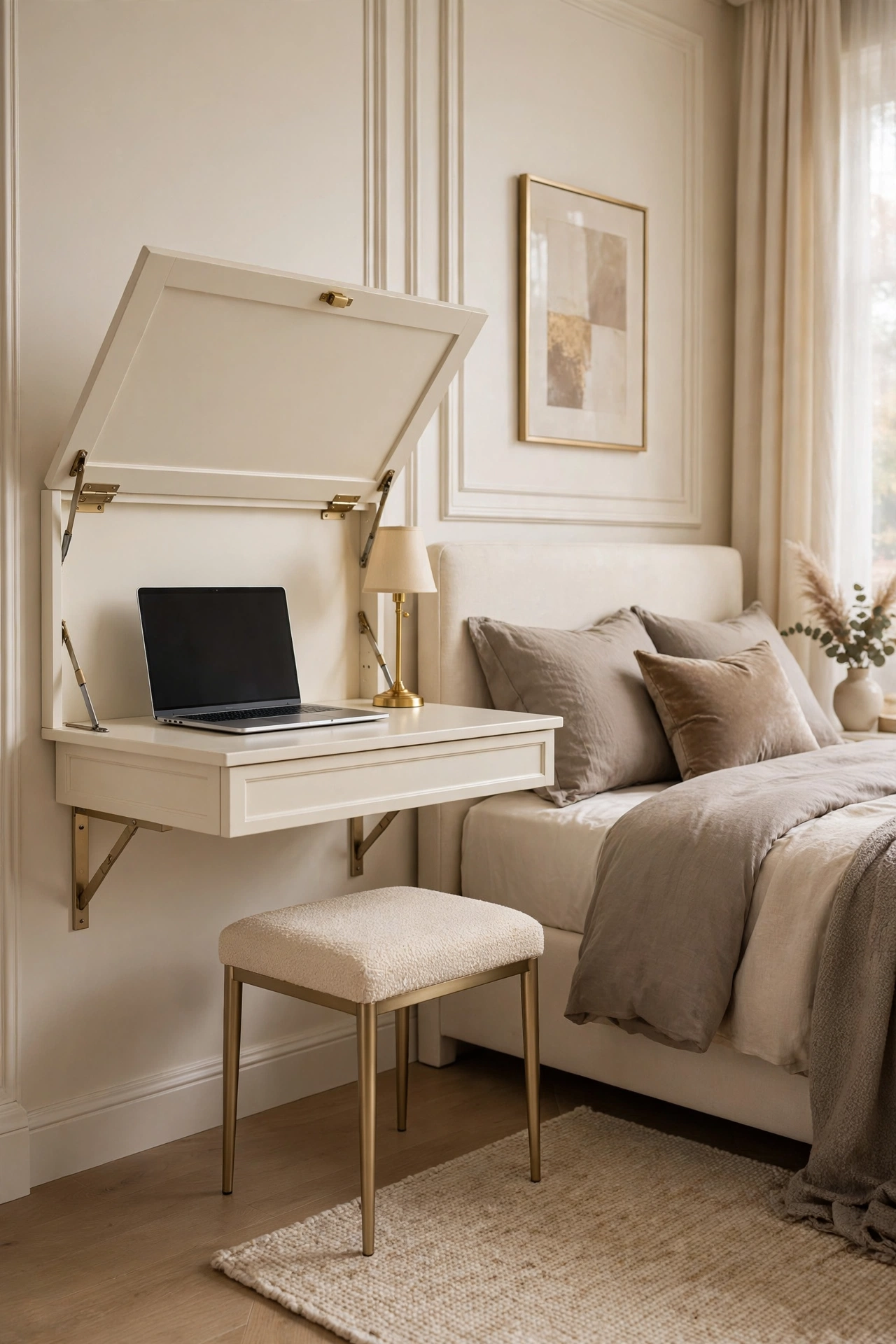
A small bedroom often has to be two rooms, and a fixed desk claims its floor space all day for a job that takes two hours. A fold-down wall desk gives a real work surface when it is open and returns the wall, and the walkway, when it is closed. Closed, the best models read as a slim cream cabinet or framed panel, fully in keeping with the room’s calm lines.
The discipline is in what lives on it. A fold-down desk works only if everything on the surface has a home inside the closed depth or in a small box that moves to a tower shelf: laptop, notebook, one lamp or a sconce above. Treat it like a folding tray table with rules, and it will be folded; treat it as a shelf, and it will stay open and cluttered forever.
How to do it: Mount the desk on a clear wall section, ideally near the window for work light, fixed into studs at standard desk height of about 29 to 30 inches. Add a wall sconce or use the light from Idea 10’s circuit so no lamp base eats the surface. Keep a slim chair or stool that tucks fully under a tower or the bed end. Pro Tip: Paint or choose the closed front in the room’s cream tone and add one gold handle; guests will read it as a panel, not as office furniture. Common mistake: Choosing a deep desk that folds into the walkway. Measure the open depth against your walkway before buying; the open desk must still let the door and the bed path work.
14. Frame the Bed With Storage on Three Sides
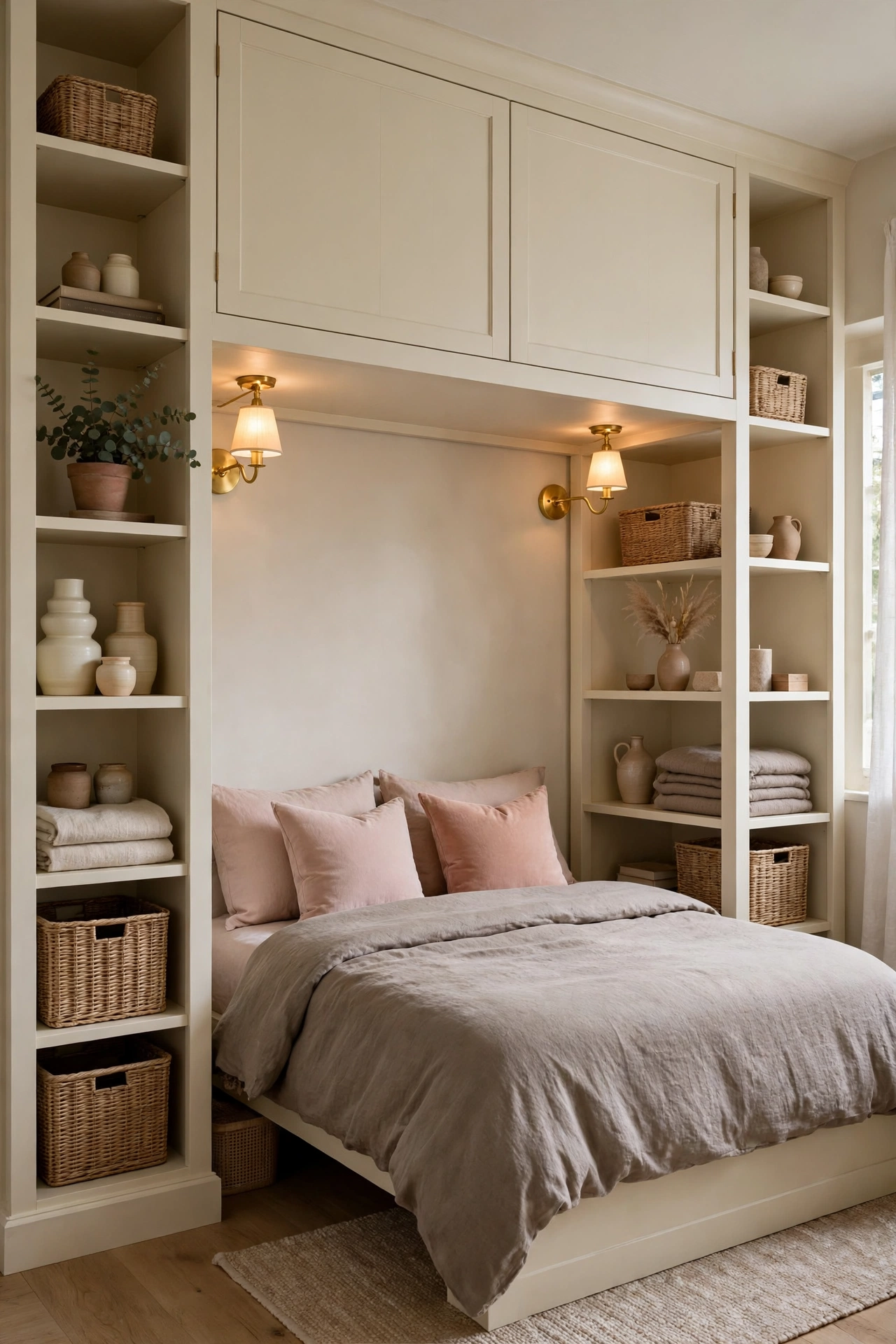
The wall the bed stands against can work much harder than one headboard. A surround of shelving and cabinets, towers on both sides joined by a cabinet bridge above the bed, turns that whole wall into storage while the bed sits inside it like an alcove. It is the built-in version of Ideas 5 and 8 combined, and in the smallest rooms it can replace a separate wardrobe entirely.
The alcove effect is a style gain, not just a storage gain. A bed framed on three sides looks intentional and cozy, the tailored nook that boutique hotels charge for, especially with the sconces of Idea 10 mounted inside the frame and the palette held to cream and taupe. Keep the bridge cabinet shallow and light in contents, spare bedding only, and leave the shelf styling airy: this wall must never look packed.
How to do it: Build or assemble two towers first, following the anchoring rules of Idea 5, then add the top bridge at a height that clears a sitting person by a wide margin. Run all three pieces in one finish so the surround reads as one piece of furniture. Style the open shelves with the palette rule, mostly closed storage, a few light display pieces on the ledges. Pro Tip: Line the inside back panel of the alcove in a slightly deeper taupe than the walls; the shallow depth you have gets read by the eye as real depth. Common mistake: A surround so deep it becomes a tunnel. Keep side towers at standard wardrobe depth and the look stays like furniture, not construction.
15. End the Bed With a Slim Storage Ottoman
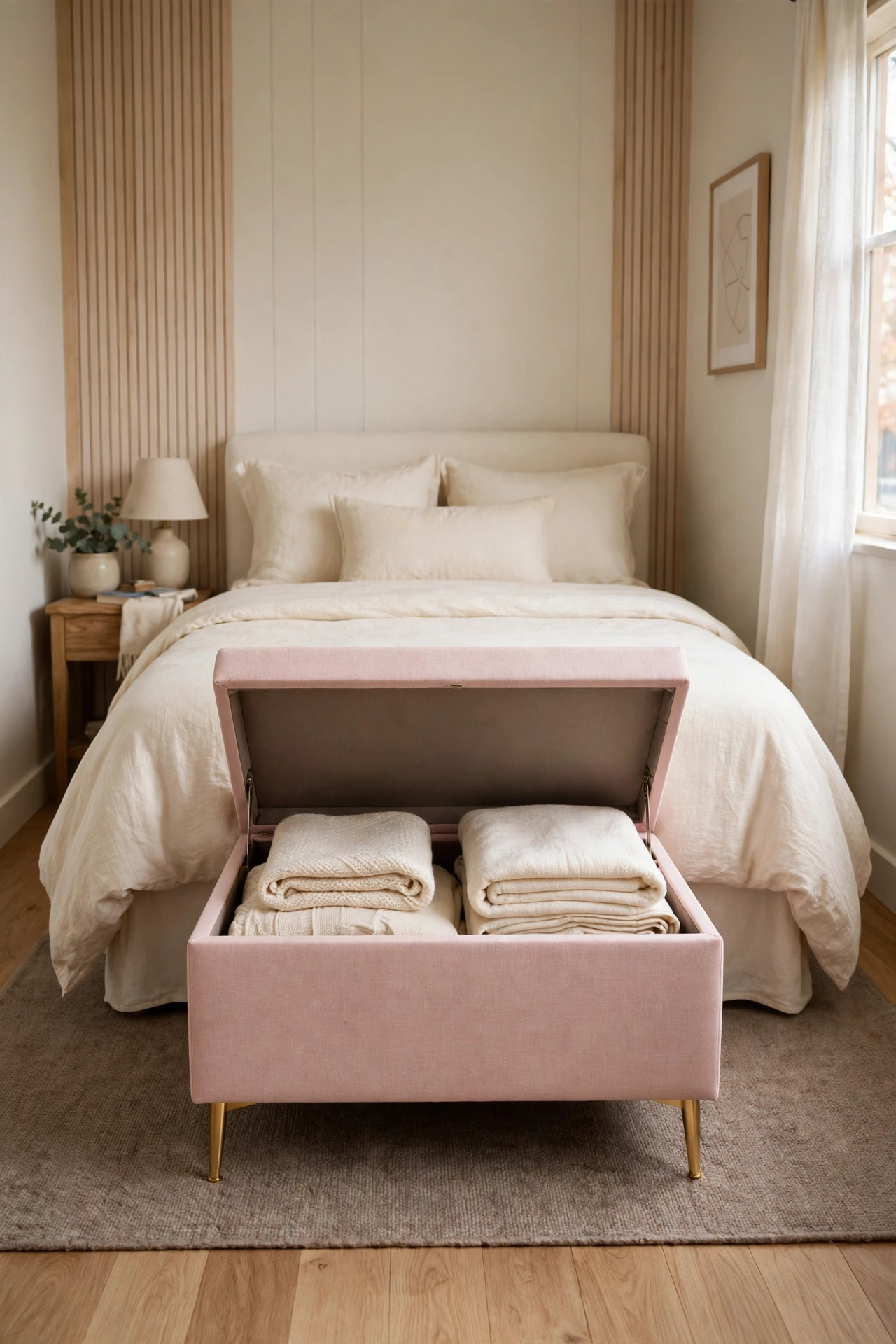
Every small bedroom needs one piece that does three jobs, and the slim storage ottoman is it: a seat for dressing, a step-up surface for the top shelves, a trunk for throws and spare pillows, and a soft landing strip at the foot of the bed that finishes the room like the footboard Idea 12 removed. Choose one narrower than the bed and low enough to sit below the mattress top.
Inside, give it the bulky soft things that defeat drawers: the spare duvet, the winter throw, the cushions that rotate off the bed at night. Because it opens from the top and sits in the open, the ottoman is the easiest storage in the room to use, which makes it the right home for things used weekly. In blush upholstery with gold legs it also carries the room’s accent color at its largest single dose.
How to do it: Measure the gap between the bed end and the wall or door swing; the ottoman must leave a real walkway, at least 18 to 24 inches, or it should move under the window instead. Pick a hinged lid that stays open on its own for safe loading. Keep the inside to soft goods only and add one cedar block or lavender sachet so stored textiles stay fresh. Pro Tip: If the walkway test fails, use a pair of small round storage stools instead; they split apart to where the space actually is, one by the desk wall and one by the towers. Common mistake: An ottoman so deep it becomes a second bed. Slim and low is the whole brief; if you can lie on it, it is too big for the room.
Quick Reference Table
| Space Idea | What It Adds | Key Rule |
|---|---|---|
| Bed on longest wall | Open floor rectangle | Centered, flat to the wall |
| Floating nightstand shelves | Surface without floor use | Mattress height, stud fixed |
| Leggy furniture | Visible floor and light | 5 to 8 inch legs, as a system |
| Oversized mirror | Reflected light and depth | Opposite the window, anchored |
| Tall narrow towers | Storage on little floor | Anti-tip straps, heavy items low |
| Under-bed drawers | A hidden dresser | One category per drawer |
| Back of door storage | A free wall panel | Light and flat items only |
| Ledge above the bed | Display without depth | Light pieces only, 18 inches clear |
| Three light tones | One continuous space | Accents are seasoning only |
| Wall sconces | Surfaces back from lamps | Measured from the mattress |
| Ceiling curtains | Taller, wider window | Ceiling height, floor length |
| Slim headboard | Open bed end | No footboard, 3 to 4 inches thick |
| Fold-down desk | A room that works twice | Everything has a home inside |
| Bed storage surround | A whole storage wall | One finish, shallow bridge |
| Storage ottoman | Seat, step, and trunk | Must pass the walkway test |
The Small Bedroom Checklist
- [] Bed centered flat on the longest wall
- [] Walkway of 24 to 30 inches kept on the door side
- [] Floating shelves at mattress height, properly anchored
- [] Main furniture raised on legs, floor visible beneath
- [] One oversized mirror reflecting light, safely fixed
- [] Tall storage anchored with anti-tip straps
- [] Under-bed drawers divided by category
- [] Door back fitted with light, flat storage only
- [] Above-bed ledge holding light pieces only
- [] Palette held to three light tones, accents as seasoning
- [] Lamps moved to wall sconces, surfaces cleared
- [] Curtains at ceiling height, wider than the frame
- [] Slim headboard fitted, footboard removed
- [] Fold-down desk closing flat with nothing left out
- [] Storage surround in one finish, bridge kept shallow
- [] Ottoman passing the walkway test
Frequently Asked Questions
What is the first thing to fix in a very small bedroom?
The bed position, Idea 1. Until the largest object in the room is flat and centered on the longest wall, every other improvement is working around a layout problem. Layout costs nothing, and it decides how much of every later idea, the towers, the ottoman, the desk, will even fit.
How do I add storage without making the room feel crowded?
Store upward and downward, not outward. Towers and the bed surround take storage to the ceiling (Ideas 5 and 14), under-bed drawers take it to the floor (Idea 6), and floating shelves and door storage use surfaces that were doing nothing (Ideas 2 and 7). Crowding comes from wide, mid-height furniture; height and depth you cannot see are free.
Can a small bedroom still look glam?
Yes, if the glam layer is kept to accents and finishes rather than furniture size. Cream upholstery, gold sconces and mirror frames, blush soft furnishings, and a made bed with layered bedding give the full look in the photographs here, while every large piece underneath is slim, leggy, or wall mounted. Glam is a finish, not a footprint.
Conclusion
A small bedroom gets bigger in a set order: the bed placed flat and centered, storage sent up the walls and under the frame, lamps and nightstands lifted off the floor, and then light multiplied by a mirror, a three-tone palette, and ceiling-high curtains. None of the fifteen ideas asks for a bigger room. Together they give the room you have a clear floor, a closed home for everything you own, and a cream and gold finish that reads as a designed retreat rather than a compromise.