17 Brown Couch Living Room Ideas That Feel Light and Fresh
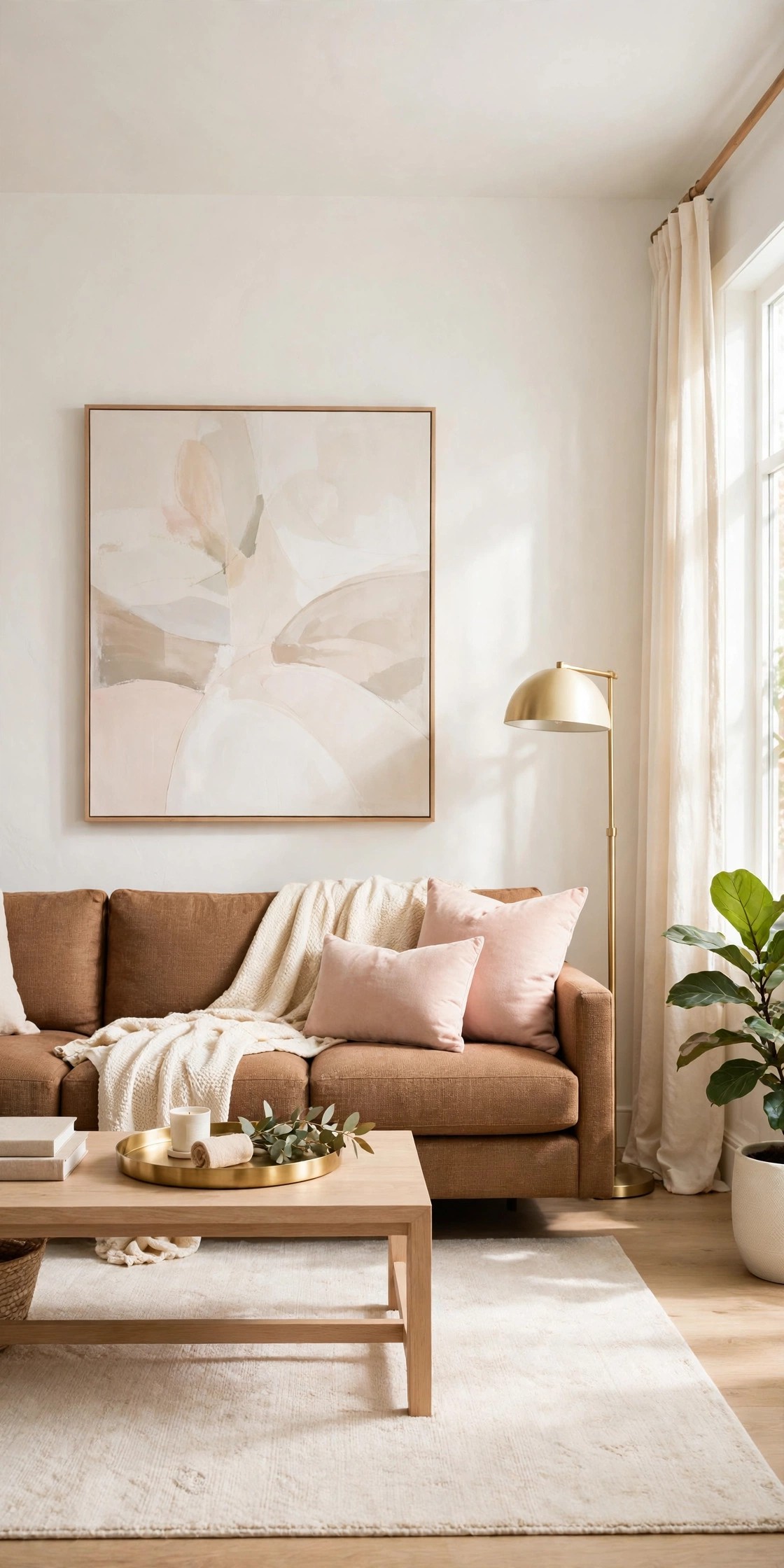
A brown couch is rarely the problem people think it is. Brown is warm, forgiving, and hides everyday life better than any pale fabric, which is exactly why so many homes own one. The problem is everything around it: dark cushions on a dark sofa, a dark rug under dark legs, dim corners, and heavy curtains, until the whole room feels like it is sitting in shadow even at noon.
These seventeen brown couch living room ideas restyle one warm mid-brown sofa in one bright living room, without replacing the sofa and without painting it into a corner. Every idea adds light, softness, or air around the brown, cream textiles, a pale rug, warm lamplight, brushed gold, a touch of blush, and green from plants, so the sofa reads as the rich, warm anchor of a fresh room instead of the darkest thing in it.
1. Drape a Cream Throw Over the Sofa Back
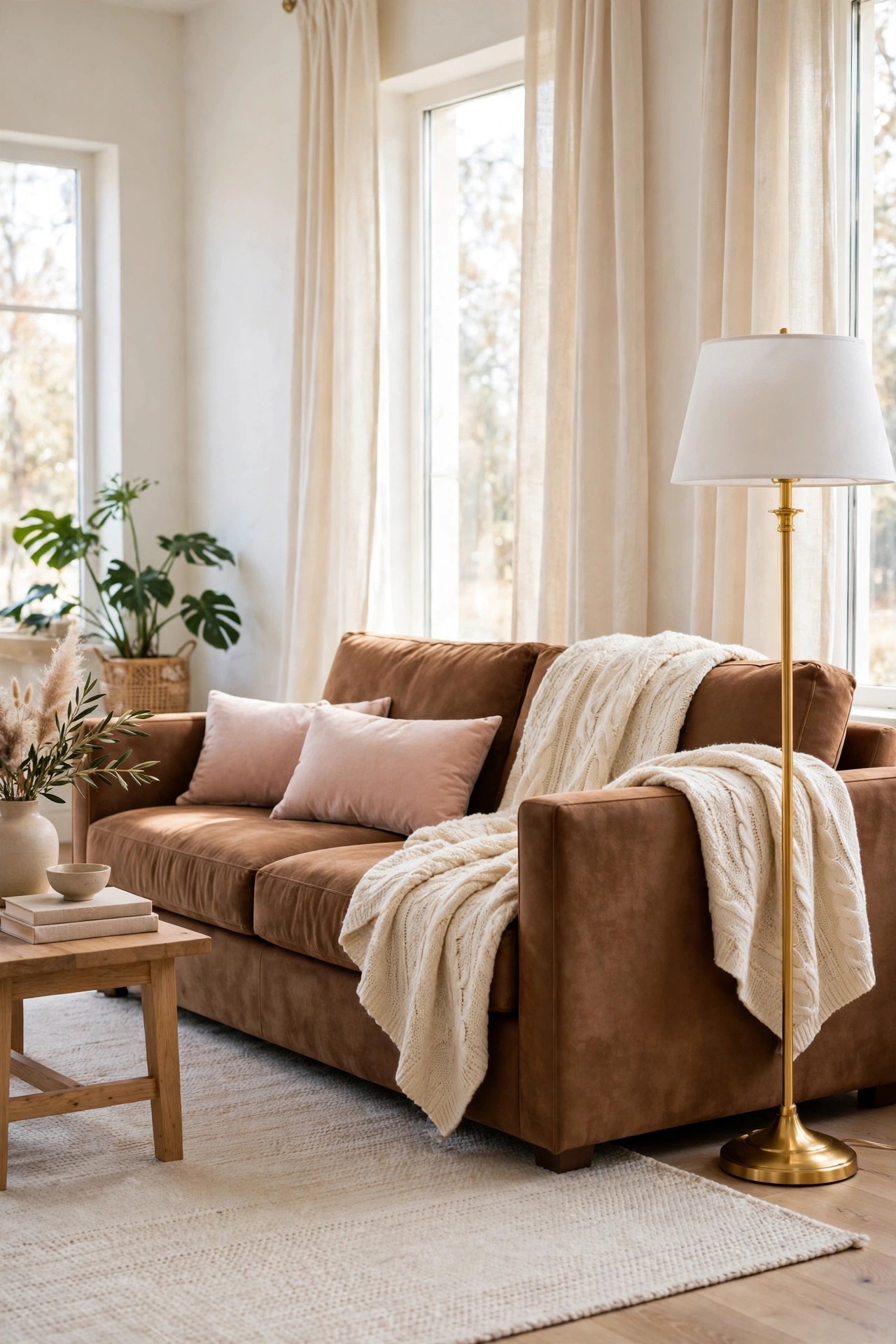
The single fastest lift for a brown sofa is a cream throw, because it breaks the sofa’s dark block into two tones and puts the lightest color in the room exactly where the eye lands first. Draped over the back, it also softens the sofa’s top line, the long straight edge that makes a big brown couch look heavy.
Choose a throw with visible texture, a knit, a soft weave, a gentle fringe, in cream or warm ivory rather than stark white. Pure white against mid-brown can look like a sheet left behind; warm cream looks chosen. One throw is enough: this is a highlight, not a cover-up, and the brown should still show proudly on the seat and arms.
How to do it: Fold the throw lengthways into a band about a third of its width, lay it over the back so it falls evenly on both sides, and let it slide slightly toward one arm for a relaxed line. Tuck a small part behind one cushion so it stays put through the day. Pro Tip: If the sofa is leather, a textured knit throw also solves the slide and stick problem, giving a soft layer between skin and leather in summer and winter. Common mistake: Covering the whole sofa with throws and blankets until the brown disappears. A covered sofa reads as a sofa you are hiding; one cream band reads as styling.
2. Use the Two-Two-One Cushion Formula in Cream and Blush
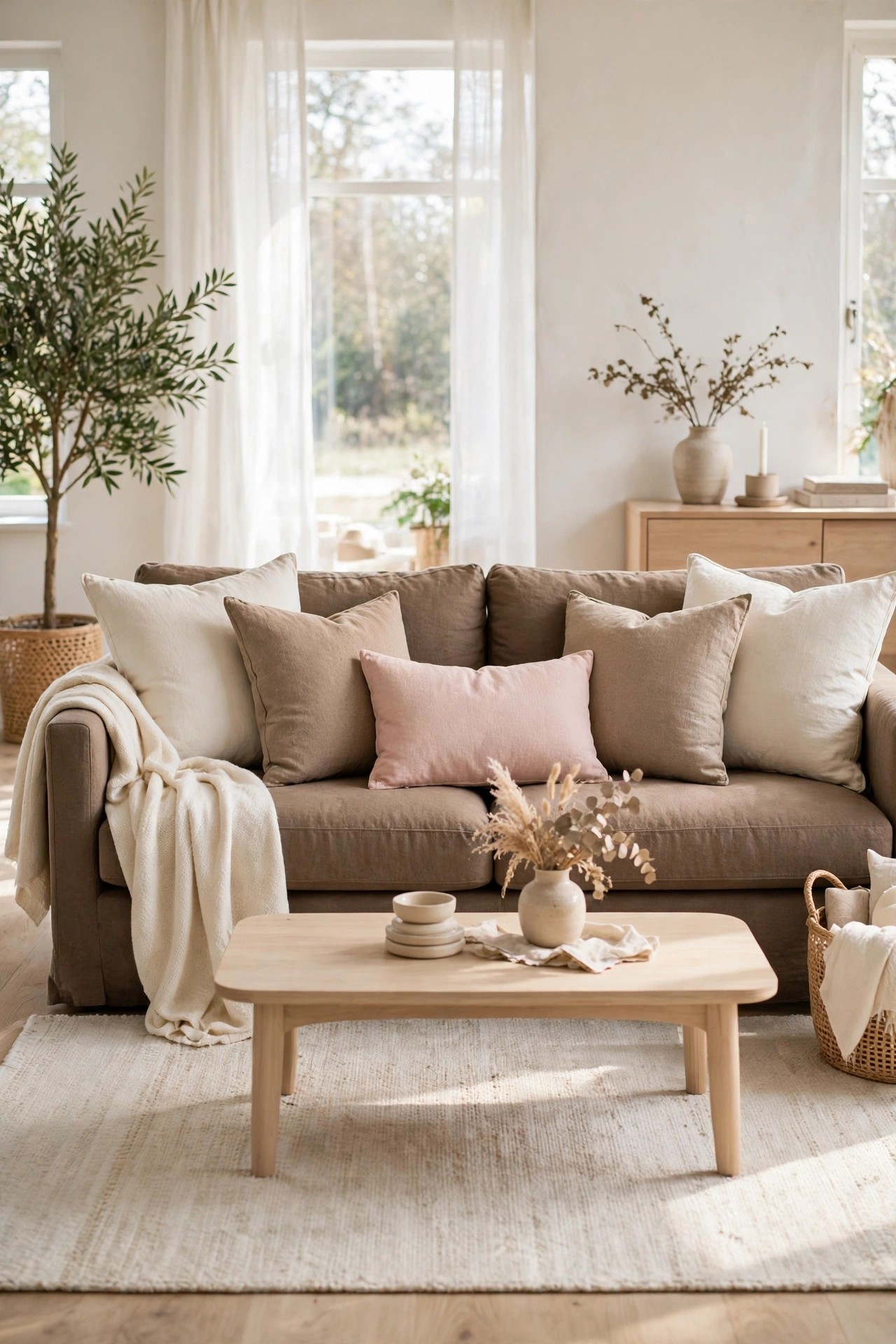
Cushions are where a brown sofa either wakes up or sinks. Dark cushions in burgundy, forest, and brown patterns are the usual choice, and they merge with the sofa into one dark mass. The two-two-one formula fixes it with light: two large cream cushions at the back, two mid-tone cushions in warm taupe or soft camel in front of them, and one accent cushion, dusty blush, at the center.
The formula works because it builds a light-to-dark staircase toward the sofa: the eye meets cream first, then the mid tone, then the brown, and the brown becomes the base of the arrangement instead of a wall. Keep the fabrics matte and textured, linen, cotton, a soft knit, so the pale colors look rich rather than flat.
How to do it: Place the two largest, palest cushions against the back corners, angled slightly inward. Set the mid-tone pair in front of them, then the single accent cushion centered and upright. Plump each cushion and give the front one the gentle top crease stylists use. Pro Tip: Buy cushion covers, not whole cushions, and keep the brown sofa’s original dark covers in a drawer; the whole formula swaps in minutes and swaps back when you want a moodier room. Common mistake: Five cushions in five different pale shades that almost match. Almost-matching creams look accidental; commit to one cream and one mid tone and let texture, not shade, vary.
3. Lay a Pale Rug That Reaches the Sofa Legs
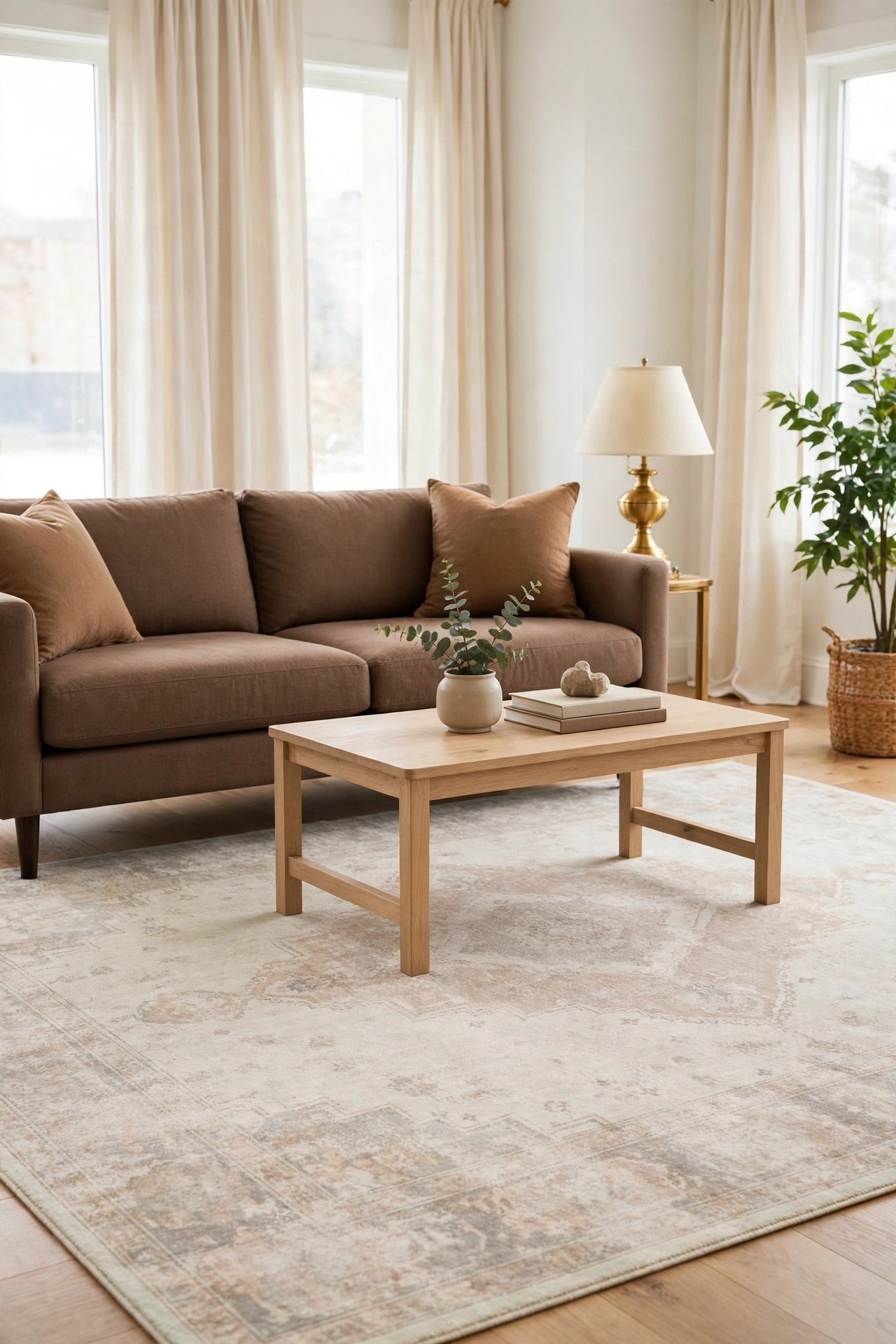
A brown sofa on a dark or bare floor has no light beneath it, so it sits in the room like a shadow. A pale rug changes the ground itself: cream, warm ivory, or a faded vintage-style pattern in cream and blush reflects light upward, and the sofa gains a bright stage that makes its brown look deliberate and rich.
Size is the whole secret. The rug must reach at least under the sofa’s front legs, and ideally run wider than the sofa on both sides, because a small pale rug floating in front of a big brown couch looks like a doormat that wandered in. Low pile is the practical choice: it lightens the floor without fighting chair legs or showing every crumb against its pale ground the way deep pile does.
How to do it: Measure the sofa’s width and choose a rug at least a foot wider on each side. Slide the front legs onto the rug and the back legs off if the rug’s depth is limited; that front-legs-on rule is what ties the sofa and rug into one arrangement. Add a non-slip underlay so the pale rug never creeps. Pro Tip: A faded vintage pattern in cream, taupe, and blush is the forgiving version of the pale rug: it lightens the floor like cream but hides the marks of real life between washes. Common mistake: A pale rug so small it ends at the coffee table. The brown sofa then sits on dark floor behind a pale island, and the contrast makes the sofa look darker, not lighter.
4. Paint the Sofa Wall a Warm White
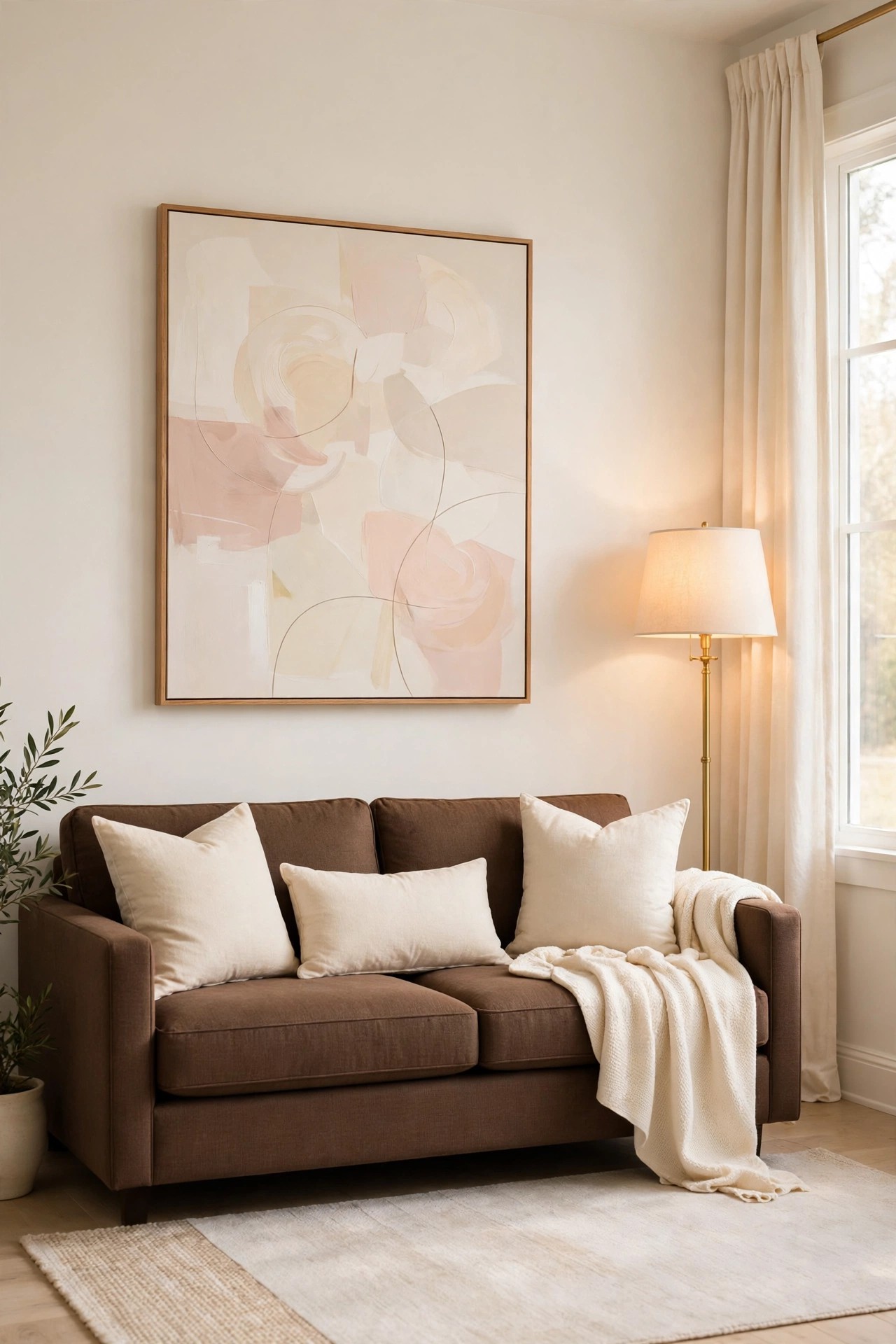
What sits behind a brown sofa decides how brown it looks. Against a grey, beige, or mid-tone wall, a brown sofa blends into a general murk. Against a warm white wall, the same sofa becomes a clear, warm shape, the way a dark wood table looks its best on a pale cloth. The wall is the biggest light surface in the room, and making it warm white lifts everything in front of it.
Warm white is the key phrase: a white with a cream or yellow base, not a blue-based brilliant white, which turns brown cold and makes the room feel like an office. Test the paint on the actual wall, because the sofa’s brown will shift the white’s apparent tone more than any other color in the room.
How to do it: Paint a large test patch directly behind where the sofa sits and live with it through a full day of light before committing. If painting the whole room is too much, the sofa wall alone in warm white, with the other walls a soft warm taupe, still gives the contrast where it counts. Keep the ceiling a matching warm white so light bounces evenly. Pro Tip: In a rented home where paint is not allowed, a large pale artwork or a pair of cream curtains hung behind the sofa zone gives a smaller version of the same pale backdrop. Common mistake: Choosing a white by the tin’s name in the shop. Whites are decided by the room’s light and the brown beside them; an untested white is the most common reason this idea disappoints.
5. Hang Cream Curtains High and Wide
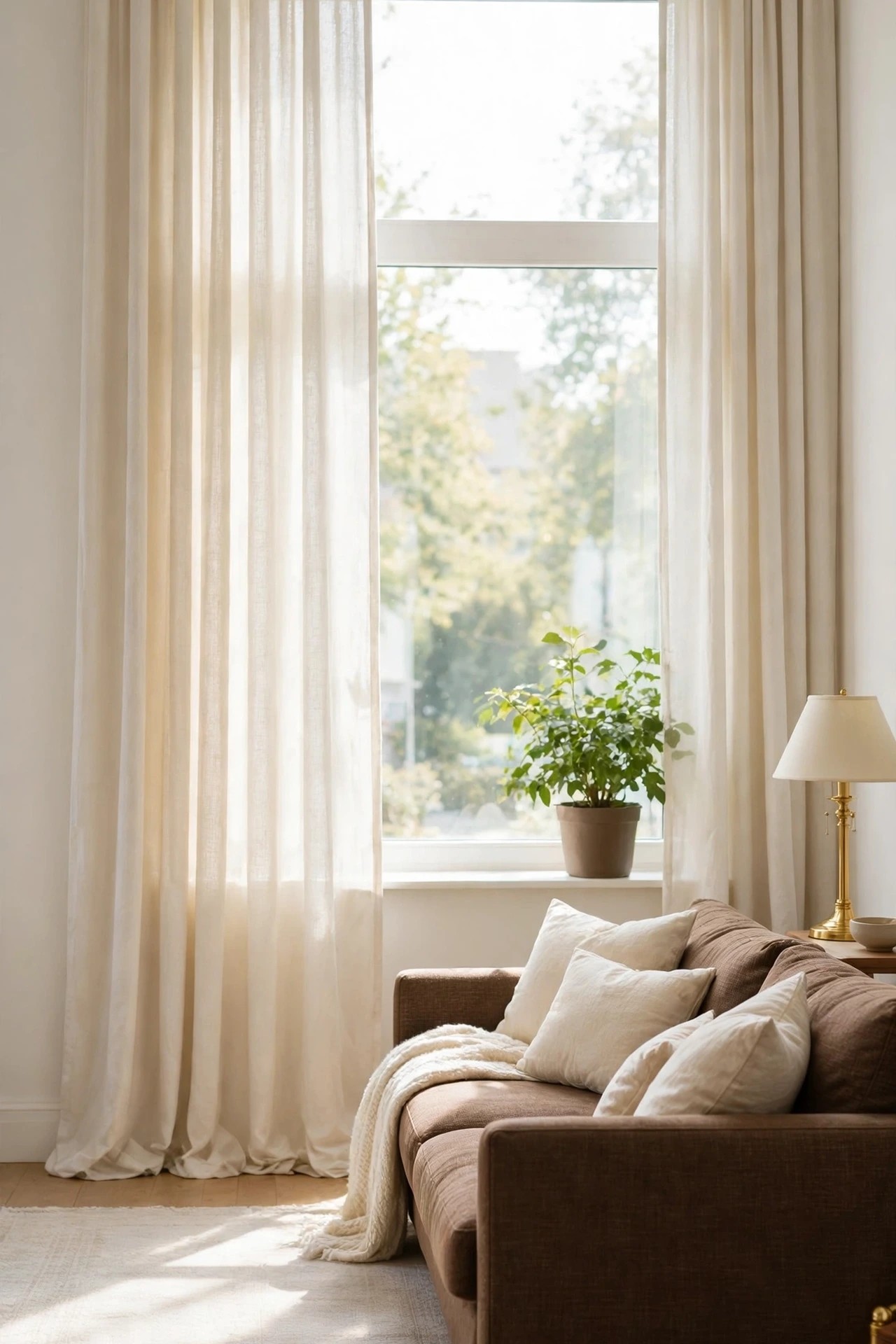
Dark or heavy curtains steal the light a brown sofa needs most, and curtains hung right at the window frame shrink the window that provides it. Cream curtains hung close to the ceiling and wider than the frame do the opposite twice: they make the window look larger, and the long pale folds add a second light surface that echoes the warm white wall.
When open, wide-hung curtains rest mostly on the wall, not the glass, so the room keeps its daylight. Choose a matte fabric with body, a linen look or a soft cotton, in warm cream; sheers behind them can stay for privacy while the main panels frame the glass.
How to do it: Fix the rod a few inches below the ceiling and extend it well past both sides of the frame, into studs or with proper anchors, since long curtains are heavy. Let the hems just touch the floor. If your current curtains end up short in the higher position, let down the hem or add a plain cream band at the bottom rather than lowering the rod. Pro Tip: Cream curtains are also the cheapest way to warm a room with cold north light; the fabric filters daylight through a warm tone before it reaches the brown sofa. Common mistake: Dark patterned curtains chosen to “match the couch.” Matching brown to brown doubles the darkness; the curtains should match the walls and the light cushions instead.
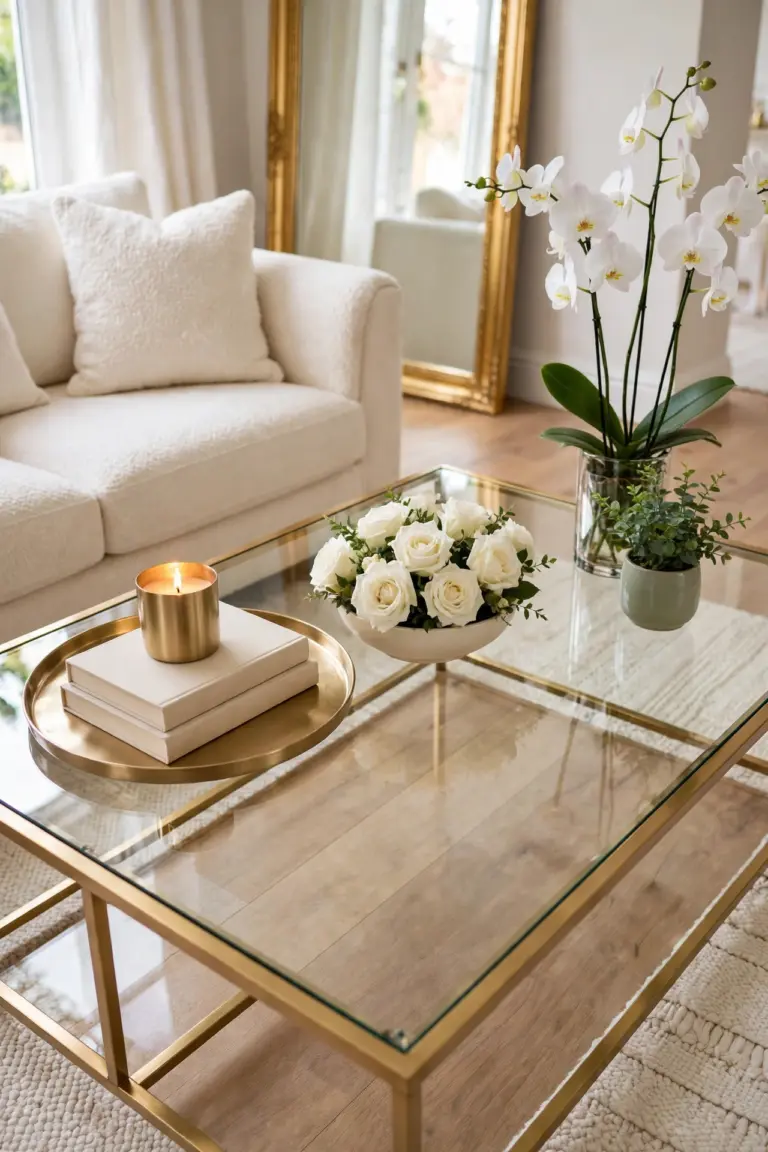
6. Choose a Light Wood or Glass Coffee Table
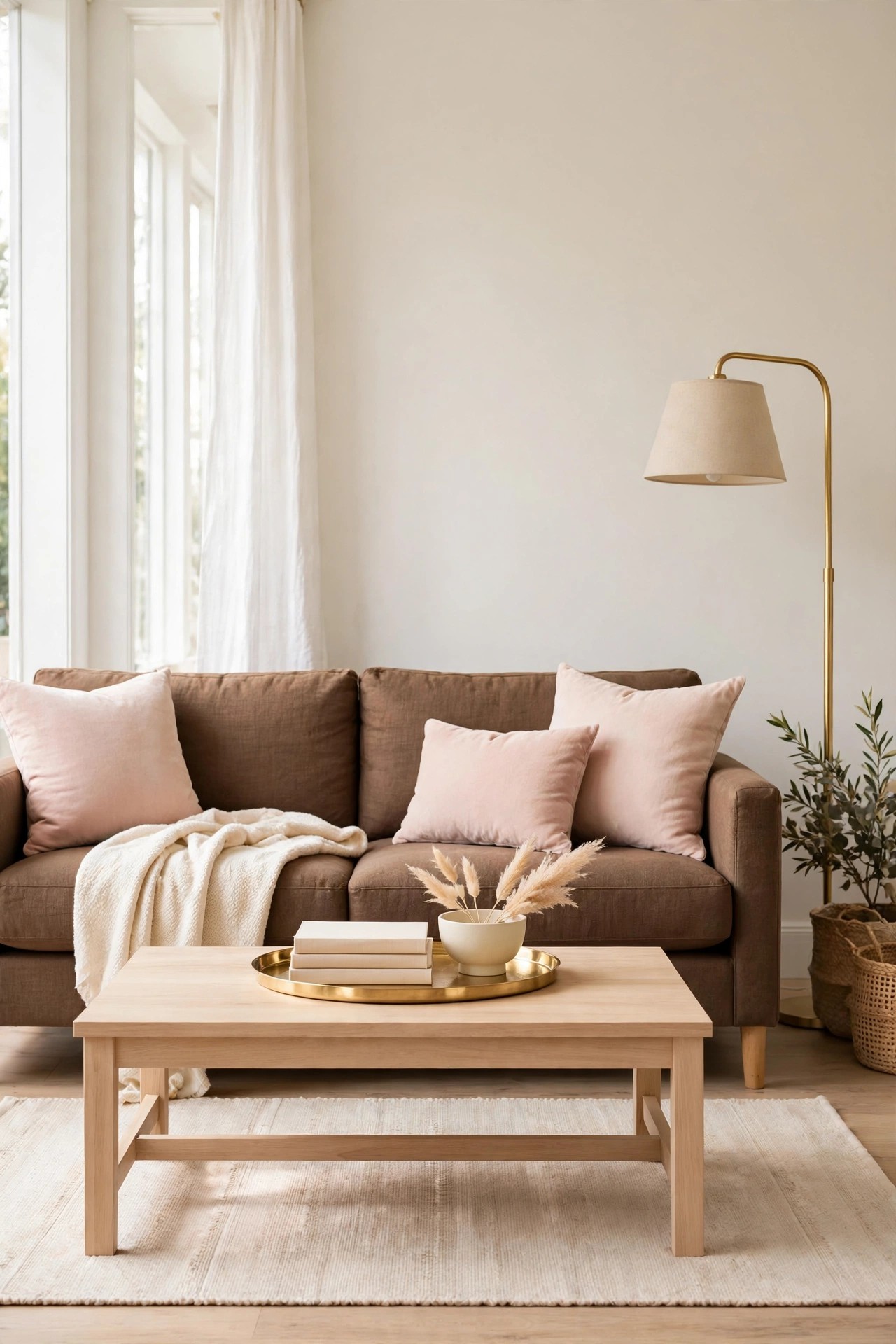
The coffee table sits in the middle of the room’s main view, and a dark wood or black table in front of a brown sofa builds a dark corridor across the whole seating area. A light table, pale natural wood, whitewashed oak tones, or glass, opens that corridor. Light wood warms the brown by family resemblance; glass removes the visual weight almost entirely and lets the pale rug show through.
Pick by how the room is used. Light wood forgives cups, feet, and children, and its grain keeps it from looking plain. Glass suits smaller rooms where every solid object counts double, but it shows dust and needs legs or a frame in a light metal, brushed gold is the glam choice, to keep it from reading cold.
How to do it: Keep the table’s length around two thirds of the sofa’s seat width and leave a comfortable gap you can walk your shins past without thinking. Style its top lightly, following Idea 11, because a light table crowded with dark objects loses its whole purpose. Pro Tip: If replacing the table is not possible, a cream runner or a large light tray across a dark table gives half the effect for almost nothing. Common mistake: A light table plus a light rug plus pale cushions all in the identical cream, which flattens the room. The brown needs pale partners, but in different textures and slightly different tones, so the layers stay readable.
7. Put Brushed Gold Light at Sofa Height
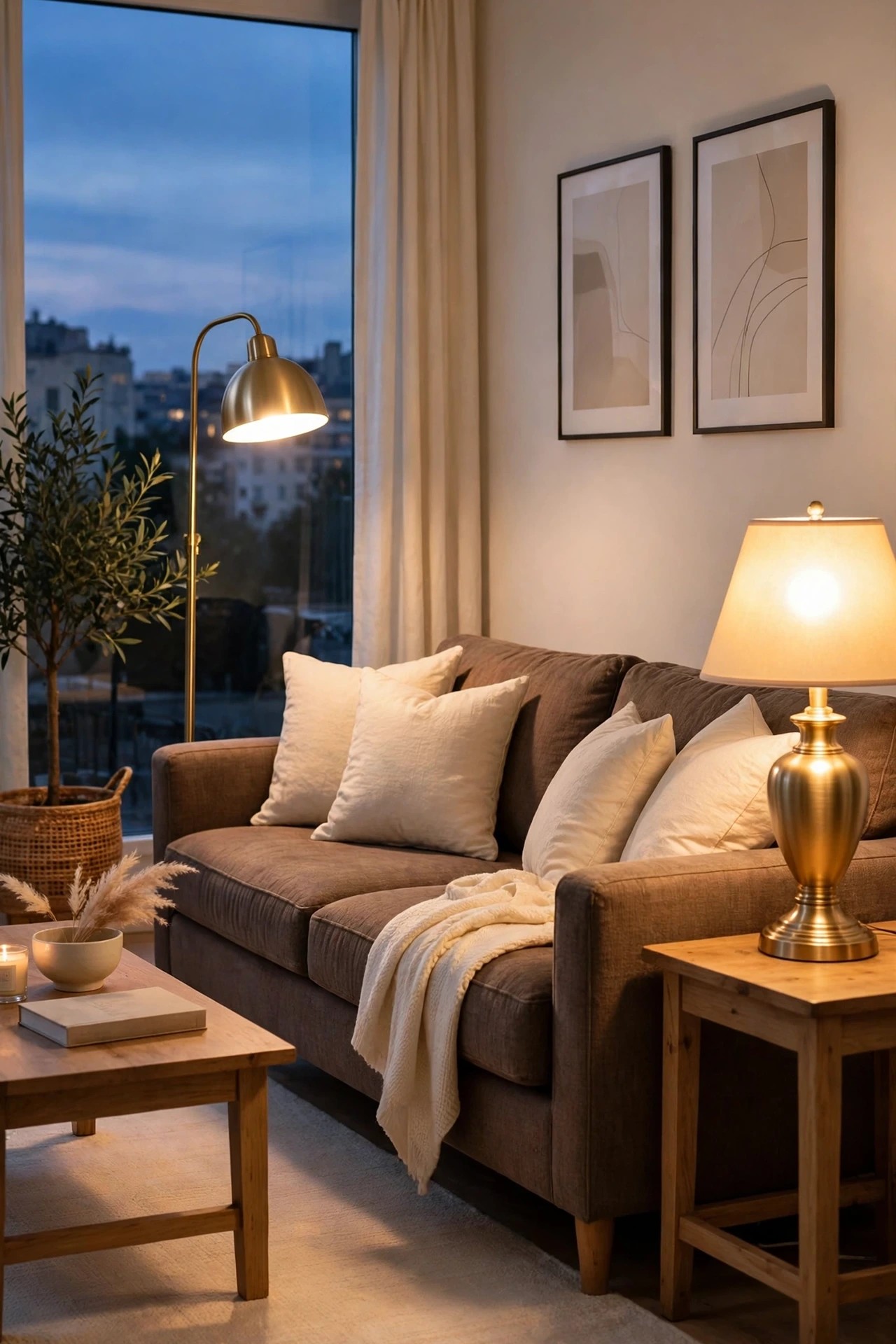
Brown sofas look their heaviest under one cold ceiling light, which throws the sofa’s top into glare and its seat into shade. Warm light at sofa height, a floor lamp at one end and a table lamp at the other, washes the brown evenly and brings out its warm tones, the difference between a sofa that looks muddy and one that looks like rich leather or deep velvet.
Brushed gold is the right metal for the lamps because gold and brown are natural partners, and the warm finish repeats in small accents around the room. Bulbs matter as much as lamps: every bulb in the seating area should be the same warm white, so the brown is lit by one consistent color of light.
How to do it: Place the floor lamp at the sofa end nearest the room’s darker corner, and the table lamp on the opposite side table, so light crosses the sofa from both directions. Match bulb warmth across both lamps and any ceiling light, and keep brightness similar so one end of the sofa is not a stage and the other a cave. Pro Tip: Put the lamps on a simple timer or smart plug set for dusk; the room will greet you already warm every evening, which is when a brown sofa most needs its light. Common mistake: One lamp only, at one end. A single source rakes across the brown and deepens every fold and shadow on the far cushions; two balanced sources are what flattens the heaviness out.
8. Hang One Large Light Artwork Above the Sofa
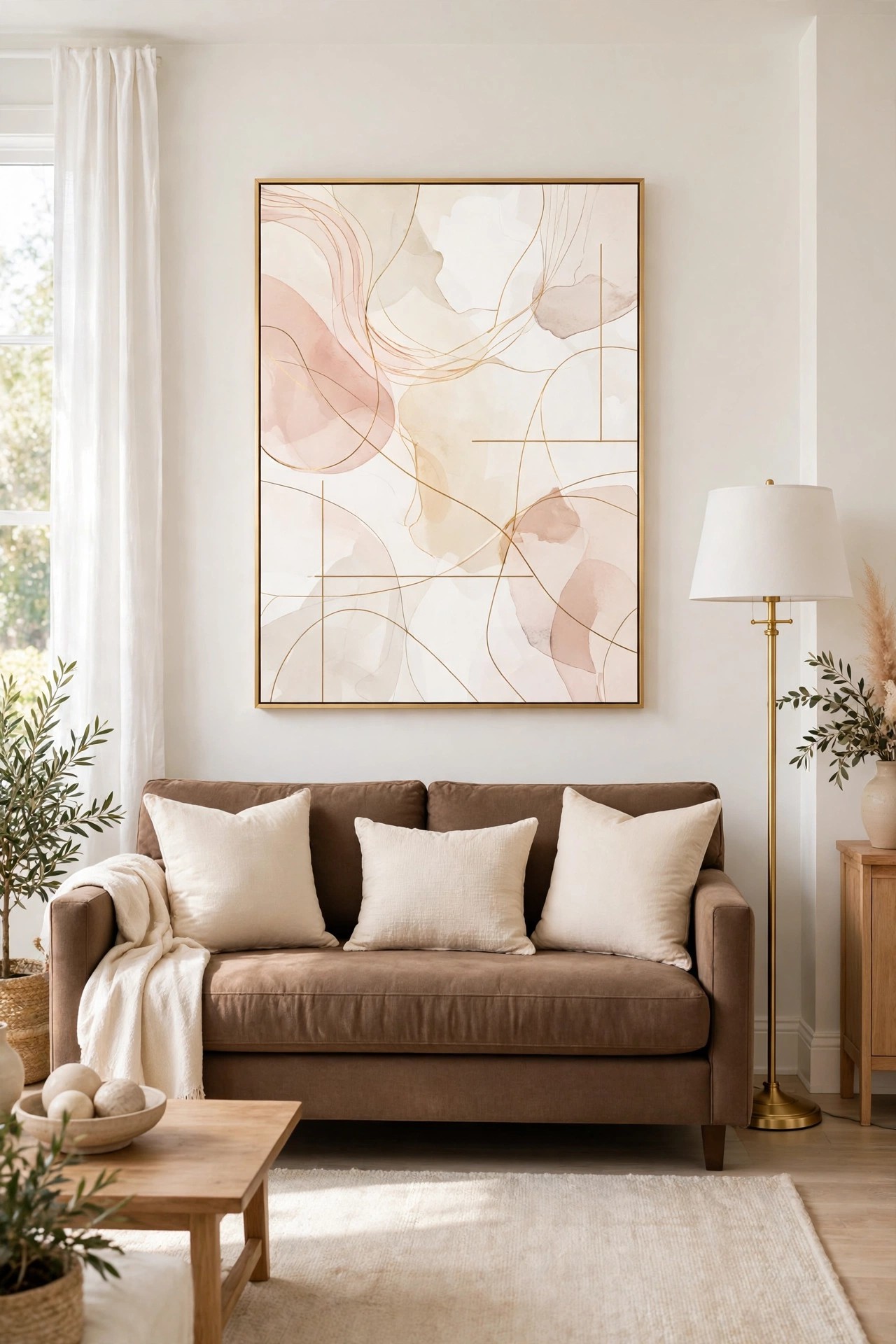
The wall above a brown sofa is the room’s headline space, and dark or busy art there doubles the sofa’s weight. One large, light artwork, soft abstracts in cream, warm white, blush, and a line of gold, does the opposite: it hangs a window of pale color above the brown, and the sofa below it reads as the grounding base of a balanced picture.
Scale carries this idea. The piece should span roughly two thirds of the sofa’s width, hung with its bottom edge a hand’s span above the sofa back, close enough to belong to the seating group. A slim brushed gold or pale wood frame ties the art to the lamps and the room’s metals without adding darkness.
How to do it: Measure the sofa and choose or make the piece to that two-thirds guide before shopping by taste. Hang it centered on the sofa, not on the wall, if the two differ. If one large piece is out of reach, two matching light prints side by side, tight together in matching frames, read as one wide piece. Pro Tip: Shop your own walls first: the large pale piece in a hallway or bedroom may be exactly what the sofa needs, and the swap costs nothing. Common mistake: A row of small dark frames above a brown sofa. Small pieces at that scale read as clutter, and dark ones merge with the sofa into one heavy band across the wall.
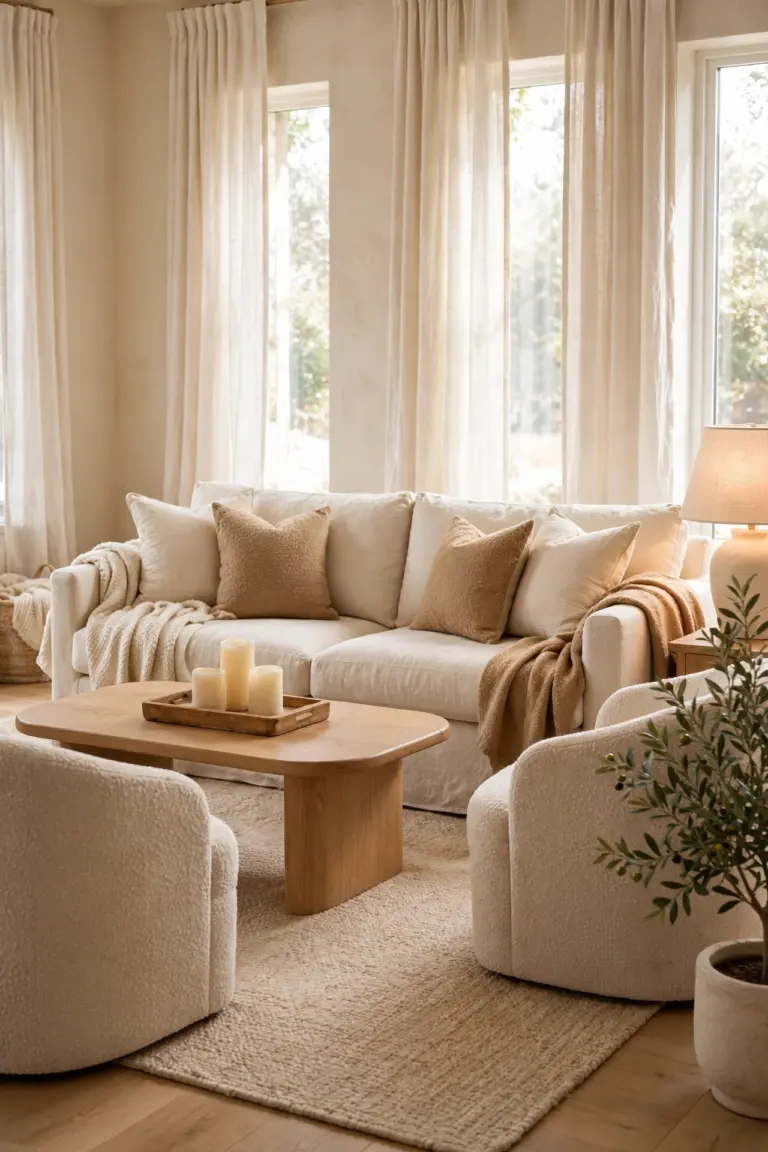
9. Face the Sofa With Light Accent Chairs
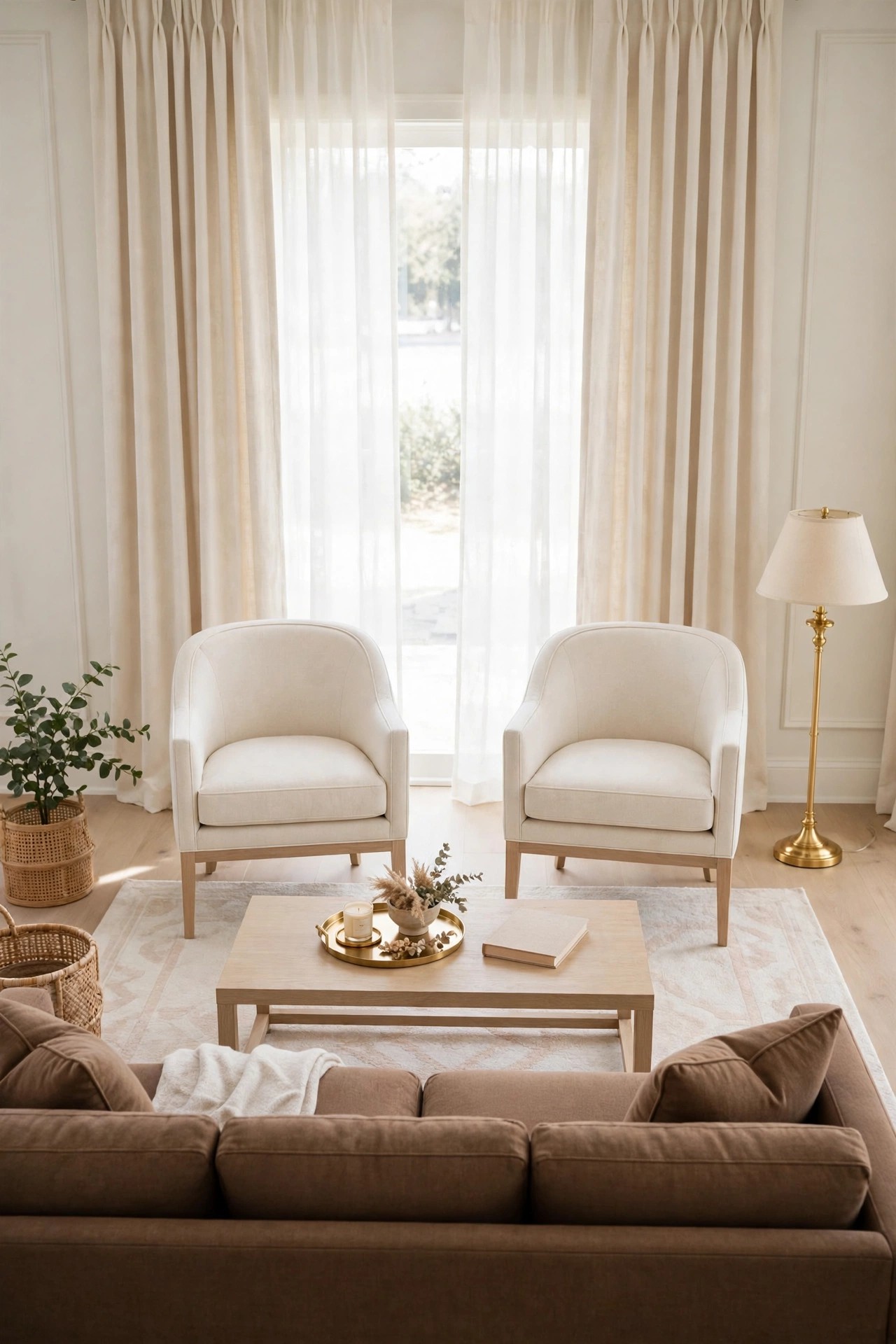
A seating group is read as a whole, so a brown sofa matched with dark chairs makes a dark room with a gap in the middle. Two light accent chairs facing the sofa, cream upholstery, pale boucle, or light wood frames with cream cushions, balance the arrangement: half the seats in the room are now pale, and the brown becomes one voice in a conversation instead of a monologue.
Chairs also lift a room because they are smaller and more open than sofas; light passes under and around them, especially on legs rather than a solid base. Angle them slightly inward toward the coffee table rather than in a stiff facing line, and the group feels gathered rather than arranged for an interview.
How to do it: Choose chairs in the palest fabric you can honestly maintain, or in a washable or performance cream, since accent chairs take spills meant for the sofa too. Keep their height a little below or level with the sofa’s back so the brown keeps its anchor role. Repeat their cream in the sofa cushions of Idea 2 so the two sides of the room agree. Pro Tip: If two chairs are too much for the space or budget, one light chair plus a pale ottoman gives most of the balance with more flexibility. Common mistake: Matching the chairs to the sofa in a slightly different brown. Two browns that almost agree look like a mistake every day; cream chairs are a decision, near-brown chairs are an accident.
10. Flank the Sofa With Green Plants
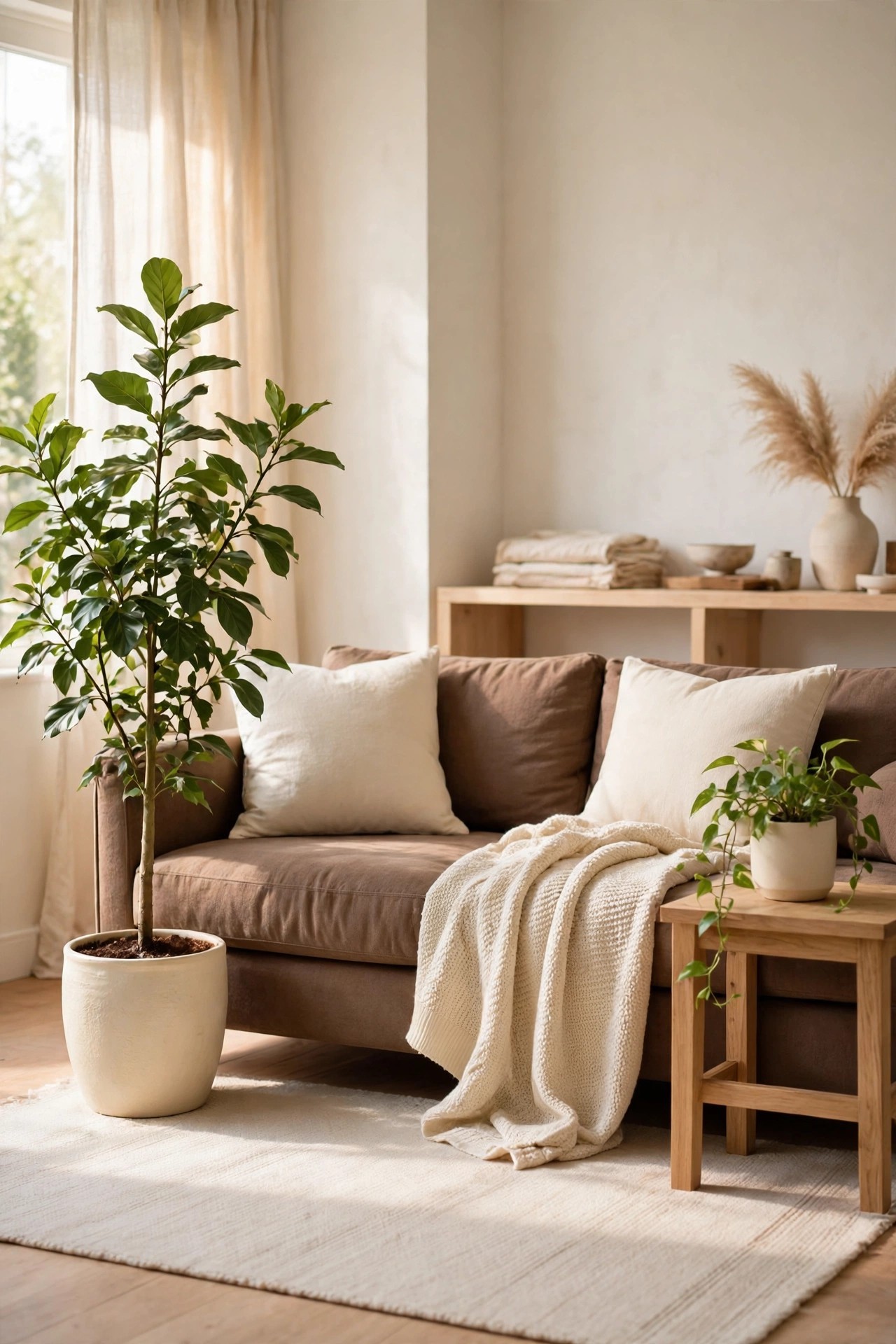
Brown is an earth color, and the color it loves most is green: it is the pairing every forest and garden already uses, and it makes brown look natural and fresh instead of heavy. A tall plant at one side of the sofa and a smaller one at the other, on the side table or a stand, frames the sofa in living color and breaks its long straight outline with soft shapes.
Height is the point of the tall plant: it should rise above the sofa’s back, drawing the eye up and giving the seating group a vertical the brown cannot provide. Cream or warm terracotta pots keep the plants inside the room’s palette, and the smaller plant can repeat the same pot family at table height.
How to do it: Choose plants for the light your room actually has, and place the tall one on the side away from the main walkway so it is never brushed past. Set floor pots on a tray or mat to protect the floor from watering spills. If real plants will not thrive in the room’s light, good artificial greenery is the honest substitute and keeps the color all year. Pro Tip: One plant with soft, arching leaves softens a boxy sofa more than a stiff upright one; shape matters as much as color here. Common mistake: A line of tiny plants along the sofa back or windowsill. Small plants at that scale read as clutter; one tall and one medium is the whole arrangement.
11. Style a Light Tray on the Coffee Table
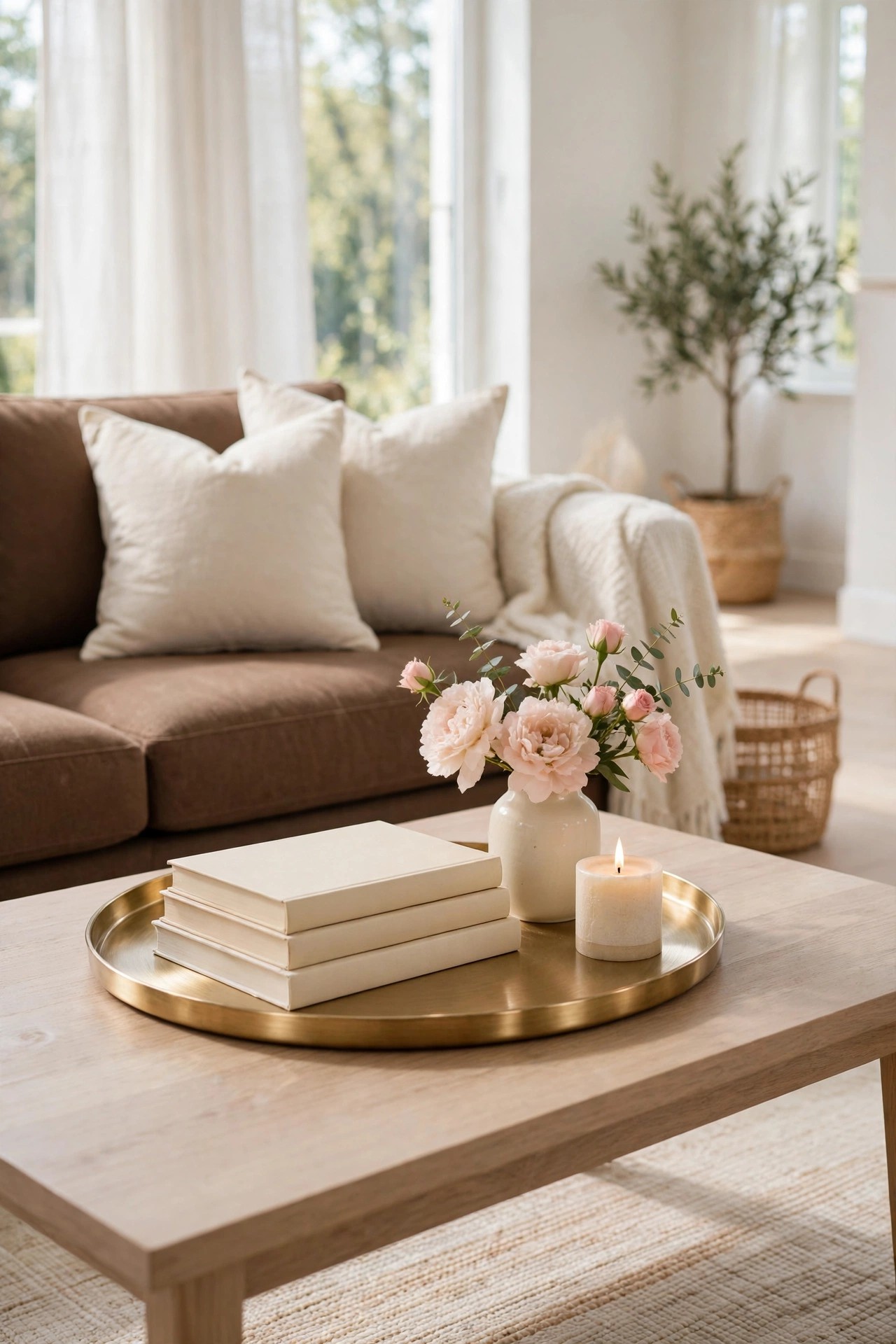
The coffee table is where the eye rests between the pale rug and the brown sofa, and its styling decides which of the two the room feels closer to. A light tray, brushed gold, white stone, or pale wood, holding a small bright group, puts a deliberate patch of light and order at the room’s center and stops the table collecting dark clutter by default.
Keep the group to the proven three: something tall and soft, a small vase of blush or cream flowers or a green sprig; something flat, a stack of two cream or light-spined books; and something that glows, a battery candle in a glass holder. Everything inside the tray is the display; cups and remotes land on the table’s clear half or not at all.
How to do it: Place the tray off-center, leaving real space for drinks and feet, and arrange the tallest item at the tray’s back corner. Lift the whole tray off to clean or to use the table fully, and set it back exactly as it was; that one-motion reset is what keeps the styling alive past the first week. Pro Tip: The tray is where the season can visit this room cheaply: a small pumpkin in autumn, a gold ornament group at Christmas, shells in summer, always inside the same border. Common mistake: A tray loaded with dark books, black remotes, and a brown bowl, which quietly rebuilds the dark corridor Idea 6 removed. If it lives on the tray, it follows the light rule.
12. Mix Cream Textures Across the Sofa
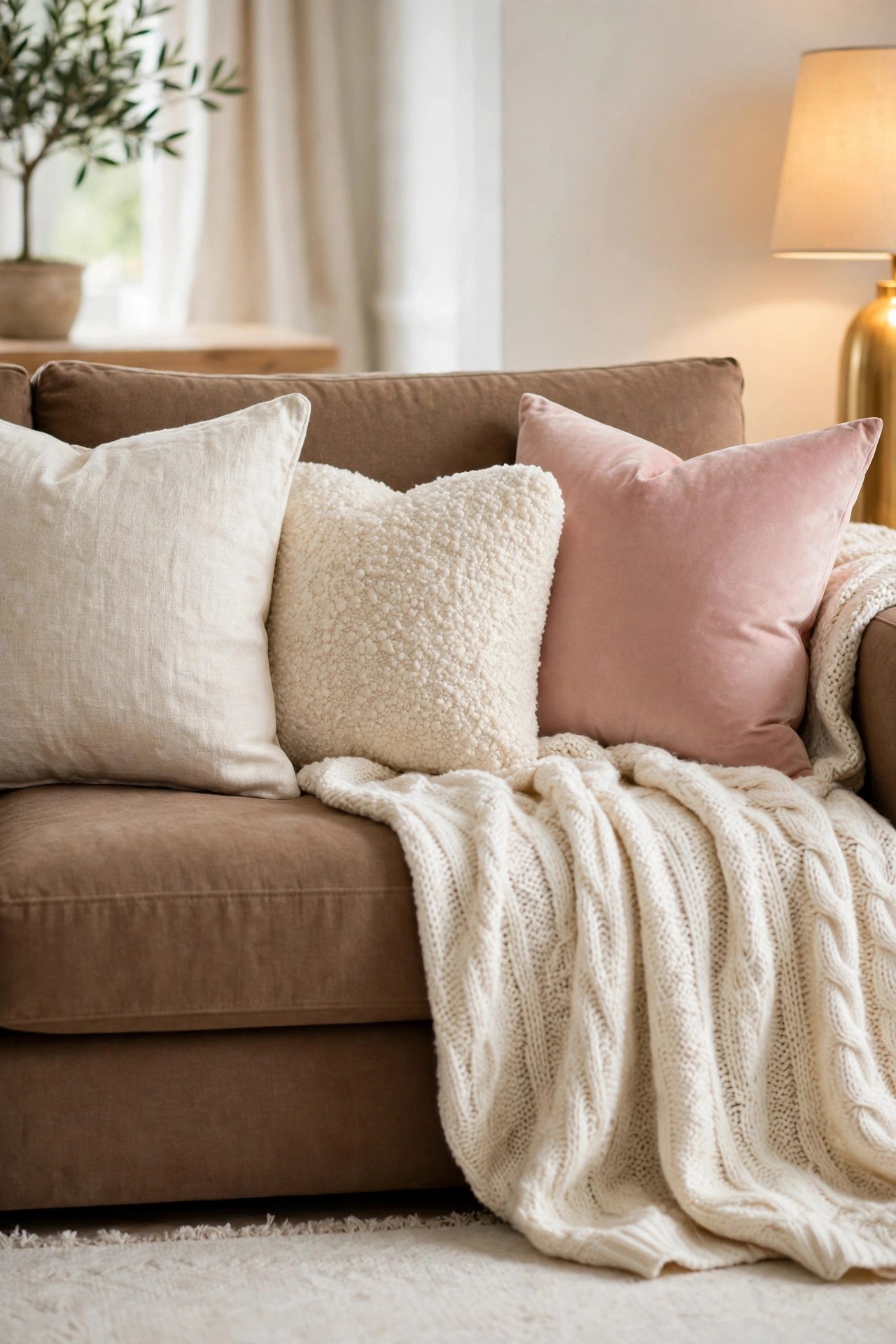
When every pale textile on a brown sofa is the same flat cotton, the light layer can look like a pile of laundry. Texture is what makes cream look expensive: linen’s slight wrinkle, boucle’s soft loops, a knit’s visible stitches, and one velvet piece for depth each catch light differently, so the pale side of the sofa reads as rich and layered rather than plain.
This idea upgrades Idea 2’s formula rather than replacing it: keep the same two-two-one arrangement, but choose each cushion in a different cream-family texture, and let the one blush accent be the velvet, since velvet holds deep color best and its sheen echoes the gold lamps.
How to do it: Count the textures on the sofa from the doorway; you want at least three clearly different ones across the cushions and throw. If two pieces look identical in fabric, change one cover rather than adding another cushion, because the count matters less than the variety. Keep every texture matte except the single velvet, so the mix stays calm. Pro Tip: Texture mixing is also the practical fix for creams that do not quite match: a cream linen and a cream boucle side by side look like a deliberate pair, while two flat creams in different shades just look mismatched. Common mistake: Adding a patterned cushion to create interest when texture was the missing layer. Pattern on a brown sofa pulls the eye sideways; texture keeps it resting on the light you built.
13. Add Two Gold Cushions to Catch the Light
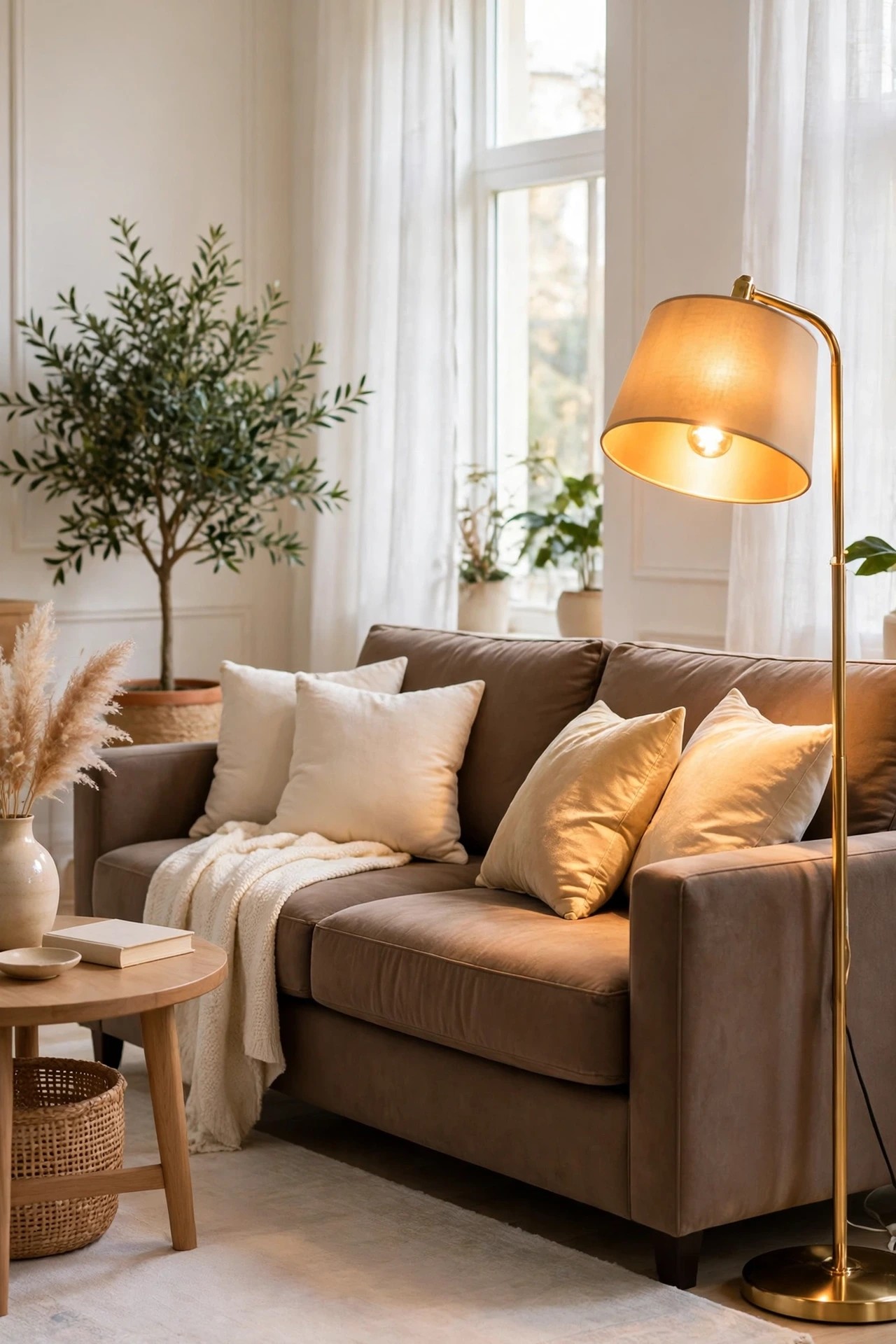
Gold is brown’s glamorous relative: it has the same warm base but it reflects light instead of absorbing it. Two cushions in a soft, brushed gold tone, not shiny foil, not yellow satin, placed where the lamplight reaches them, put two small glowing panels on the sofa and link the brown to the gold lamps, frames, and tray across the room.
Two is the dose. One gold cushion looks like a leftover from another set; three or more turns the sofa into a display for a metal. Place the pair symmetrically, one at each end of the cushion row, or together at one corner if your arrangement from Idea 2 already has a blush center; in that case, let gold take the mid-tone pair’s place instead of adding on top.
How to do it: Choose gold in fabrics with a soft face, velvet or a woven metallic thread that reads as texture up close and glow from the door. Test the pair at dusk with the lamps on, because gold that looks gentle at noon can blaze under warm light, and gentle is the goal. Pro Tip: Gold cushions are the fastest evening upgrade in this list: swapped in before guests, they make the whole seating group look dressed without moving another object. Common mistake: Mixing gold cushions with silver or chrome accents elsewhere in the group. The sofa’s metal story should match the room’s one finish, or the glow turns into glitter.
14. Lean a Tall Mirror Beside the Sofa
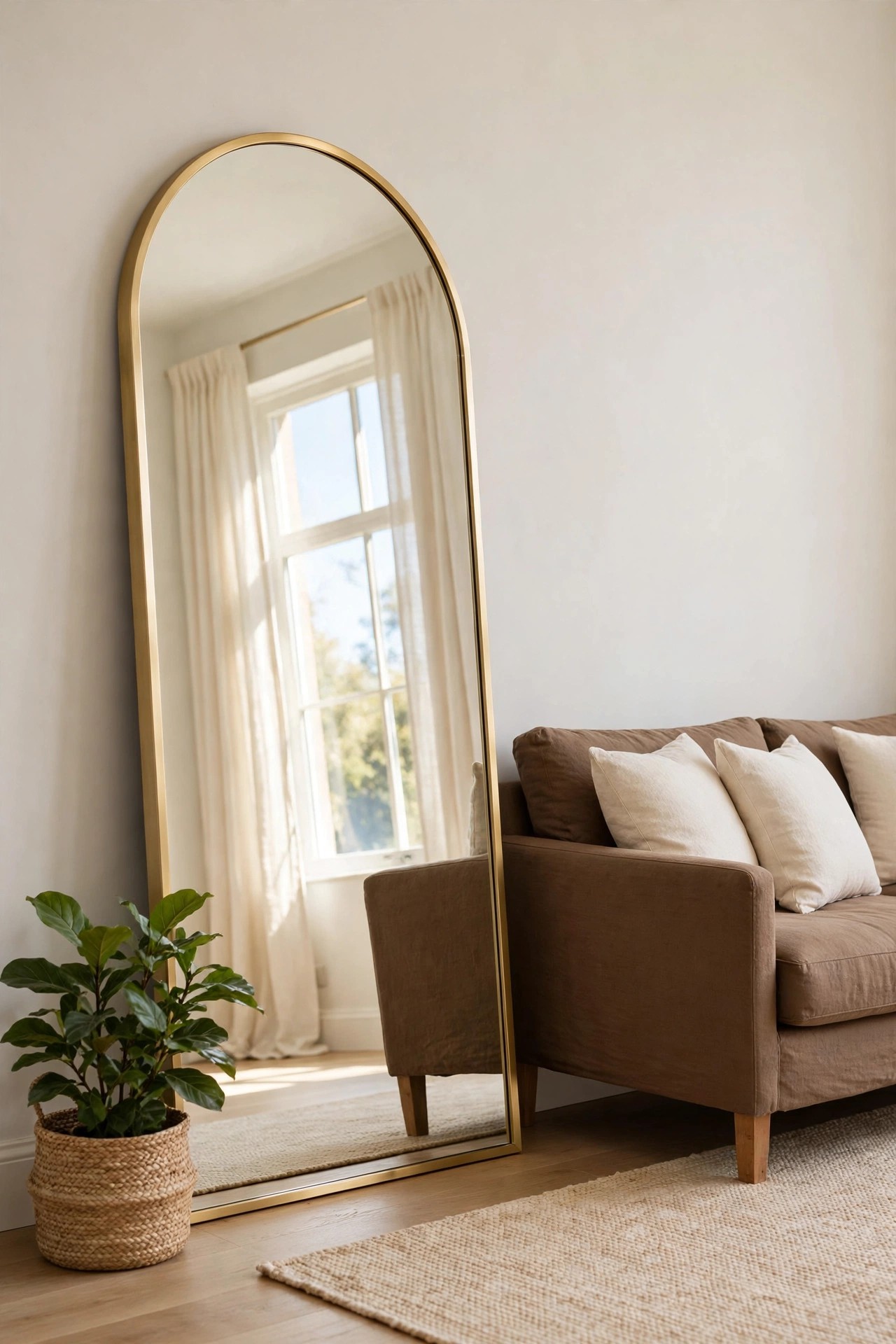
A brown sofa absorbs light; a mirror manufactures it. A tall mirror leaned or hung beside the sofa, where it catches the window, bounces daylight back across the seating group, and the brown that sat in the room’s dimmest corner suddenly has a light source of its own. An arched shape in a slim gold frame also softens the sofa’s straight lines and repeats the room’s metal.
Placement decides everything. The mirror must reflect something bright, the window, the pale wall, the lit side of the room, not the television or a dark hallway. Test positions by standing where you normally sit and checking what the glass shows; the right spot doubles the room’s best view.
How to do it: Lean the mirror only if it is tall and heavy enough to be stable, and always secure it to the wall with an anti-tip strap or fitting, because a leaning mirror near a sofa people flop onto must never be free to slide. Otherwise hang it with fixings rated well above its weight, into studs where possible. Angle or place it to throw window light across the sofa’s front. Pro Tip: A mirror beside the sofa also doubles your lamplight at night; position it so the evening reflection includes the gold lamp, and the room’s warmest glow appears twice. Common mistake: Leaning a mirror unsecured in a home with children or large dogs. The look is never worth the risk; if it cannot be strapped, hang it.
15. Keep the Side Tables Pale and Nearly Empty
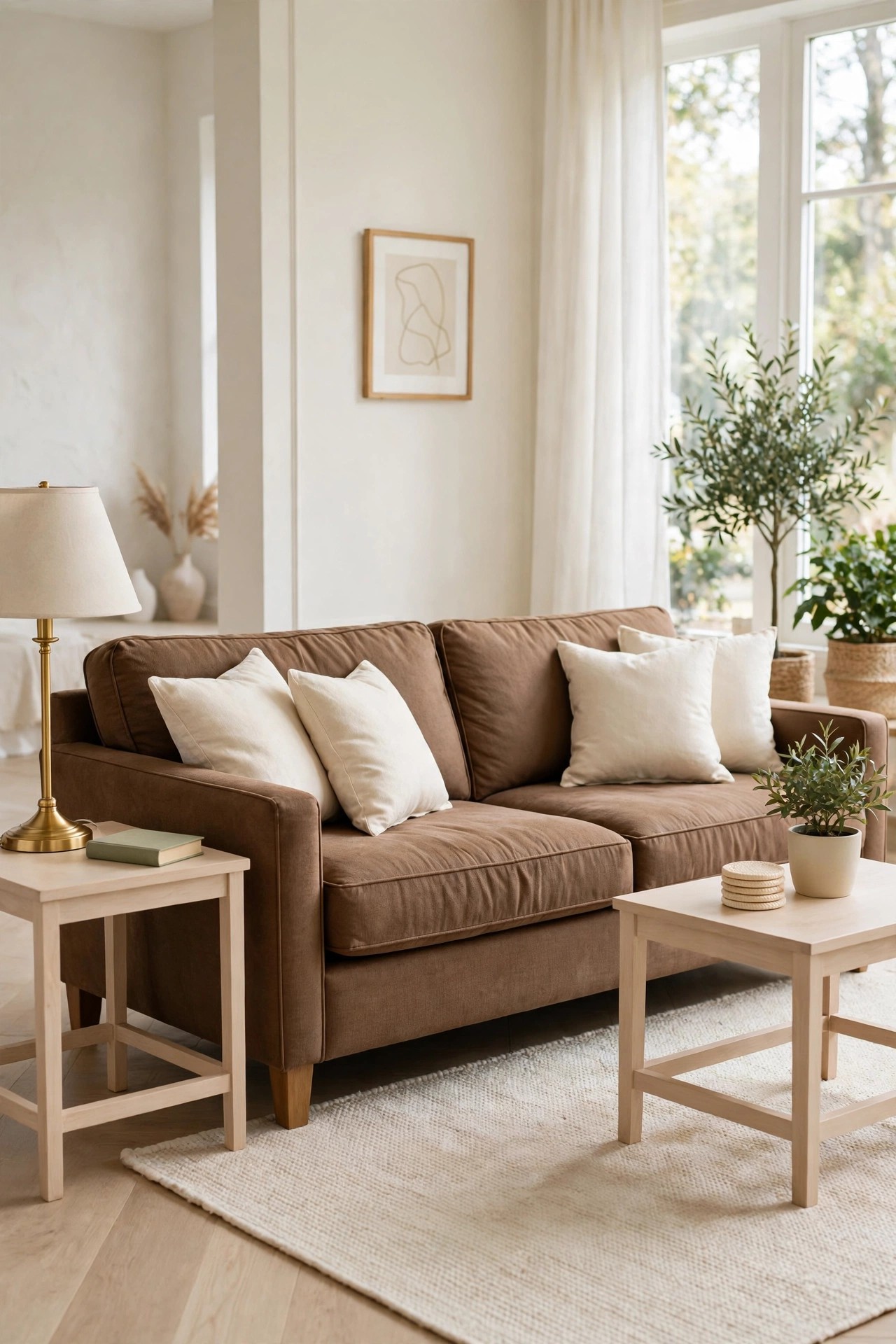
Side tables flank the sofa at the exact height of its arms, so dark tables extend the brown block sideways by a foot on each end. Pale tables, light wood, cream painted, or stone-look tops, stop the brown at the armrests and frame it with light, the same trick the pale rug plays on the floor, done at table height.
What sits on them matters as much. Each table earns two things: the lamp on one, and on each a single small item beyond it, a book, a plant, a coaster set on a tiny tray. A side table piled with remotes, chargers, cups, and paper makes its corner of the room look busy and dim regardless of the table’s color.
How to do it: Match the two tables to each other in tone even if their shapes differ slightly, and set the lamp table’s lamp to bring light to sofa-arm height. Give chargers and remotes a drawer, a lidded box on the table, or a basket beside it, so the surfaces stay at their two-item rule through the week. Pro Tip: If new tables are not an option, painting tired dark side tables in warm cream is a one-afternoon job that changes both ends of the sofa at once; use a finish made for furniture so cups do not mark it. Common mistake: One pale table and one dark one, balanced “for now.” The eye reads the pair as a set and the mismatch as a mistake; do both or wait.
16. Repeat the Cream on the Far Side of the Room
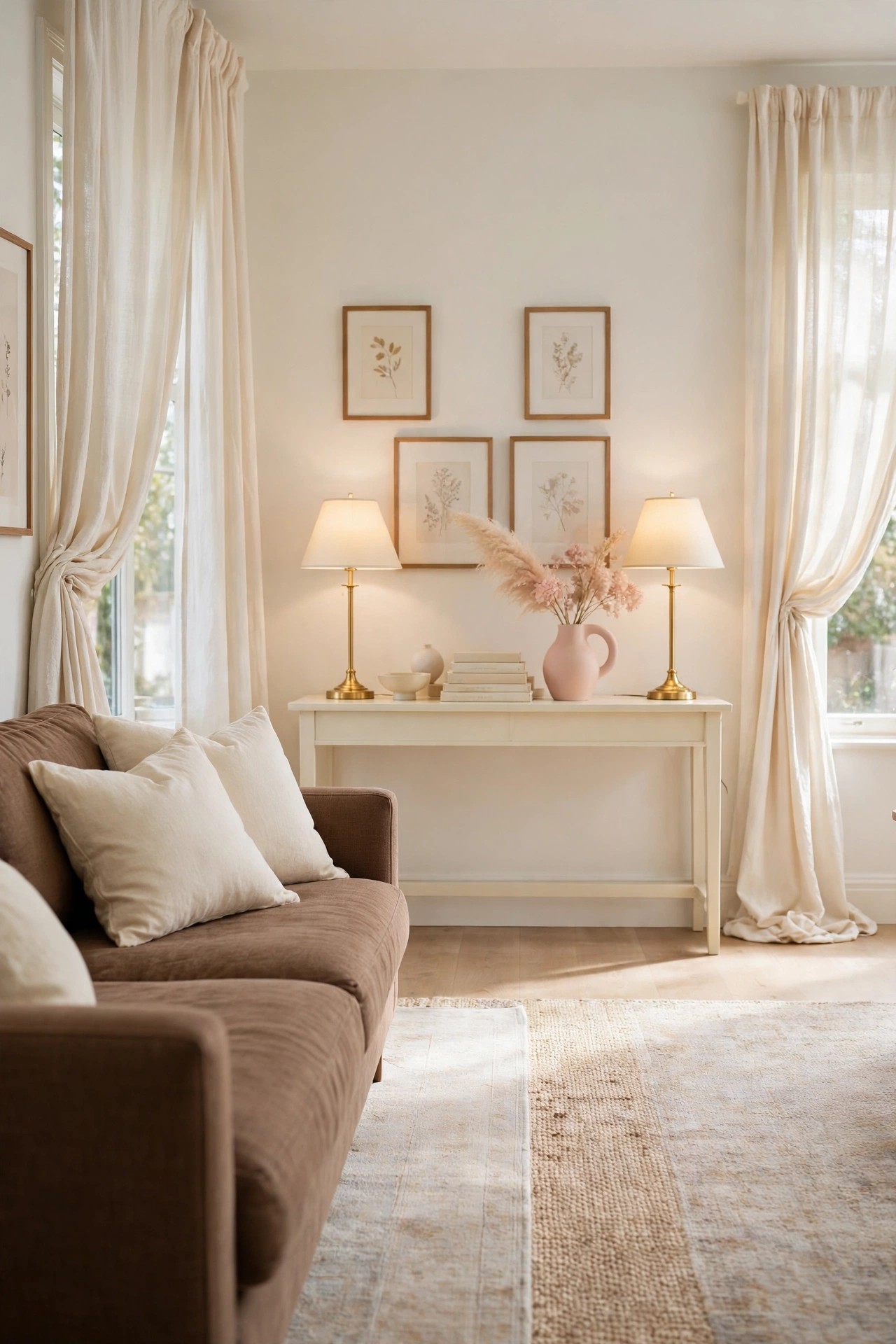
A room goes out of balance when all the light styling gathers around the sofa and the far wall stays dark and empty: the brown side then looks like a pale island instead of part of a scheme. Repeating the same cream and gold on the room’s far side, a cream console, light bookshelf styling, or cream curtains on a second window, spreads the light evenly, and the brown sofa becomes the warm center of a bright room rather than its exception.
This is a repetition idea, not a shopping idea. The far side needs the palette’s echoes, cream as the base, one gold or light-wood element, one blush or green note, in roughly the same proportions as the sofa group, so the two ends of the room rhyme.
How to do it: Stand in the doorway and compare the room’s two halves for light and dark; adjust until neither side is visibly heavier. Use what you own first: move the cream books, the spare gold lamp, or the plant that the sofa group does not need to the far side, and only then consider buying. Pro Tip: Take a photograph and turn it to black and white on your phone; tone balance shows instantly without color distracting you, and the heavy side will be obvious. Common mistake: Mirroring the sofa group exactly on the far wall, twin lamps, twin stacks, twin plants. Balance is about weight, not copies; an identical twin arrangement looks like a showroom, not a home.
17. Finish With a Light Basket and a Five-Minute Reset
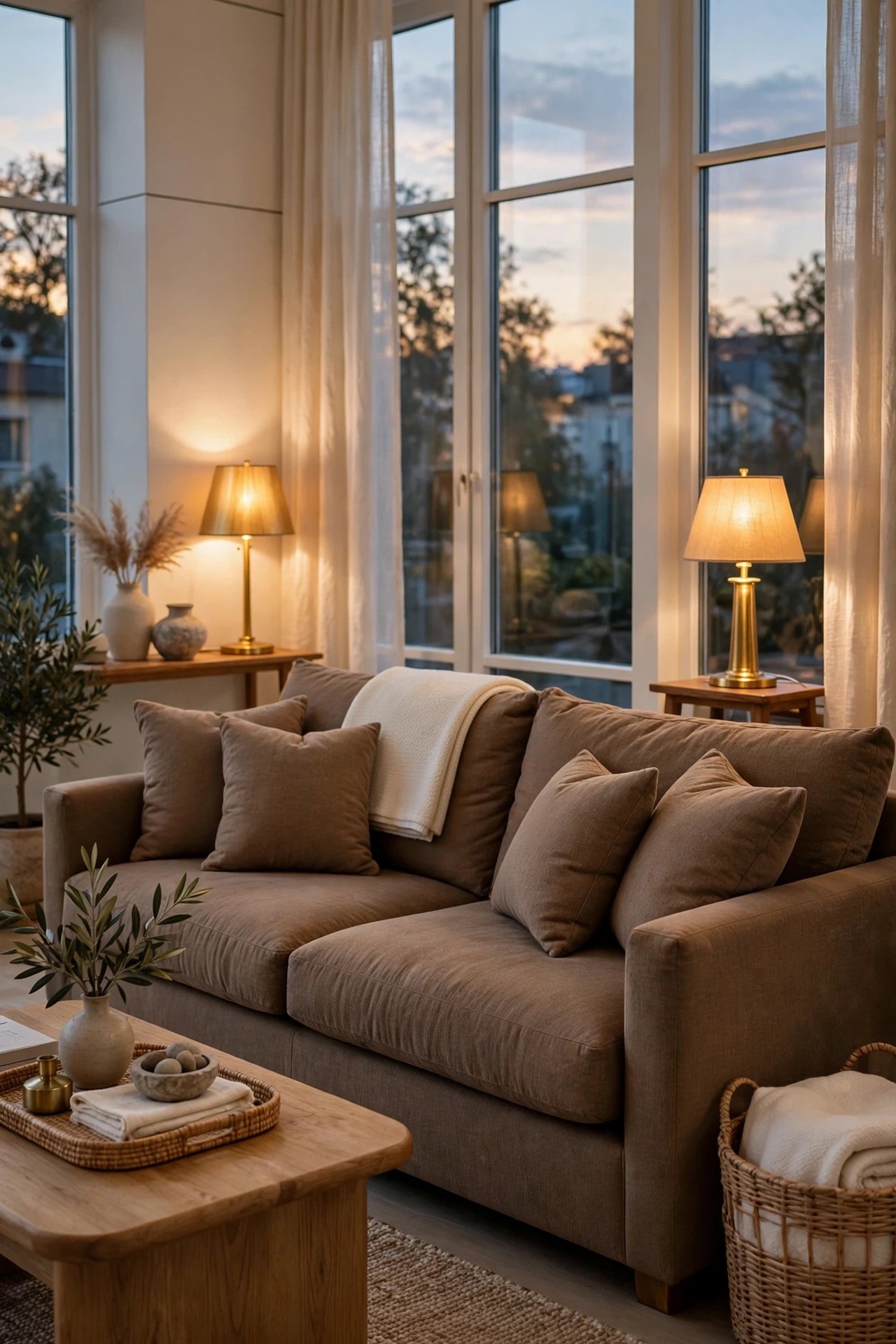
Every light layer in this list has one enemy: the slow creep of everyday dark clutter, remotes, hoodies, mail, chargers, game controllers, settling on and around the brown until the room returns to shadow. The closing idea is the habit that protects all sixteen before it: a woven basket beside the sofa to catch the living layer, and a five-minute reset each evening that puts the room back to its styled state.
The basket must suit the palette, natural woven fiber or cream fabric, with the spare blanket folded inside it in cream, so even the storage is part of the light scheme. The reset itself is small and fixed: cushions plumped and back in their formula, throw refolded over the back, tray group straightened, everything else into the basket or out of the room.
How to do it: Keep the basket within arm’s reach of the sofa’s most-used seat, because a basket across the room will not be used. Run the reset in the same order nightly, sofa, tables, floor, and end by switching on the lamps and looking from the doorway; that view is the reward that keeps the habit alive. Pro Tip: The reset is also when this room photographs best; if you ever want to share or sell from this space, shoot it at dusk right after the reset, lamps on. Common mistake: Letting the basket become a permanent overflow of dark clutter beside the sofa. The basket is a way station, emptied to real homes weekly, not a second sofa in hiding.
Quick Reference Table
| Idea | What It Adds | Key Rule |
|---|---|---|
| Cream throw | A light band across the brown | One throw, warm cream, textured |
| Two-two-one cushions | A light staircase to the sofa | Cream first, one blush accent |
| Pale rug | A bright stage under the sofa | Front legs on, wider than sofa |
| Warm white wall | A pale backdrop | Test behind the sofa first |
| High cream curtains | More light, taller windows | High, wide, to the floor |
| Light coffee table | An open center | Two thirds of sofa width |
| Gold light at sofa height | Warm, even glow | Two lamps, same warm bulbs |
| Large light art | A pale headline above | Two thirds of sofa width |
| Light accent chairs | Balance across the group | Cream, never near-brown |
| Flanking plants | Green against the brown | One tall, one medium |
| Light coffee table tray | Order at the center | Three things, one clear corner |
| Cream textures | Richness in the pale layer | Three textures minimum |
| Gold cushions | Glow on the sofa itself | Two only, soft brushed tone |
| Leaning mirror | Borrowed daylight | Secure it, aim at the window |
| Pale side tables | Light at both armrests | Two items per table |
| Far wall balance | A room in proportion | Match the weight, not the objects |
| Basket and reset | Freshness that lasts | Five minutes, same order |
The Light and Fresh Brown Couch Checklist
- One cream throw folded over the sofa back
- Cushions follow the two-two-one formula, cream first
- Pale rug reaches under the sofa’s front legs
- Sofa wall is warm white, tested behind the sofa
- Curtains are cream, hung high, wide, and to the floor
- Coffee table is light wood or glass
- Two gold lamps light the sofa at seat height
- Every bulb in the seating area is the same warm white
- One large light artwork hangs above the sofa
- Accent chairs are cream, never a second brown
- One tall and one medium plant flank the sofa
- Coffee table tray holds three light things and one clear corner
- At least three cream textures show on the sofa
- Gold cushions number two, no more
- Mirror is strapped or properly hung and reflects the window
- Side tables are pale and hold two items each
- Far wall repeats cream and gold in similar weight
- Blanket basket sits beside the sofa and is emptied weekly
Frequently Asked Questions
Can a brown couch really look light without replacing it?
Yes, because the darkness people dislike is rarely the sofa itself; it is the dark cushions, dark rug, dark tables, and dim light usually gathered around it. Change the frame, not the sofa: pale textiles on it, a pale rug under it, warm light at its height, and light art above it, and the same brown reads as warm and rich instead of heavy. Ideas 1, 2, 3, and 7 alone transform most rooms in a weekend.
Which colors go best with a brown couch?
Warm lights and soft accents: cream and warm ivory first, then warm taupe or camel as the mid tone, dusty blush as the gentle color, and brushed gold as the metal. Green from plants is the natural partner. Cool greys and blue-whites are the colors that fight brown, making it look muddy; keep them out of the sofa’s immediate area.
My brown couch is dark leather. Do these ideas still work?
They work even better, because leather’s sheen responds strongly to light and texture. The cream knit throw breaks the shine into softness, gold cushions and lamps warm the leather’s tone at dusk, and the pale rug stops a dark leather sofa from sitting in a dark pool on the floor. Choose matte textiles throughout; shiny cushions on shiny leather compete instead of calming.
What if my living room has very little natural light?
Then artificial light does the heavy lifting: two warm lamps at sofa height, the mirror placed to catch whatever window light exists, the palest rug you can maintain, and warm white walls. In a dim room, also raise bulb brightness slightly while keeping the warm color, since warm light at low strength can read as gloom on brown fabric.
Conclusion
A brown couch is an asset wearing the wrong frame in most homes: warm, practical, and built to last, hidden under dark cushions, dark floors, and dim corners. Frame it in light instead, cream textiles in three textures, a pale rug, warm gold light at sofa height, one large pale artwork, green at its sides, and a far wall that balances its weight, and the same sofa becomes the reason the room feels warm rather than the reason it feels dark. Start with the throw, the cushions, and the lamps this weekend; the rest can follow one idea at a time.