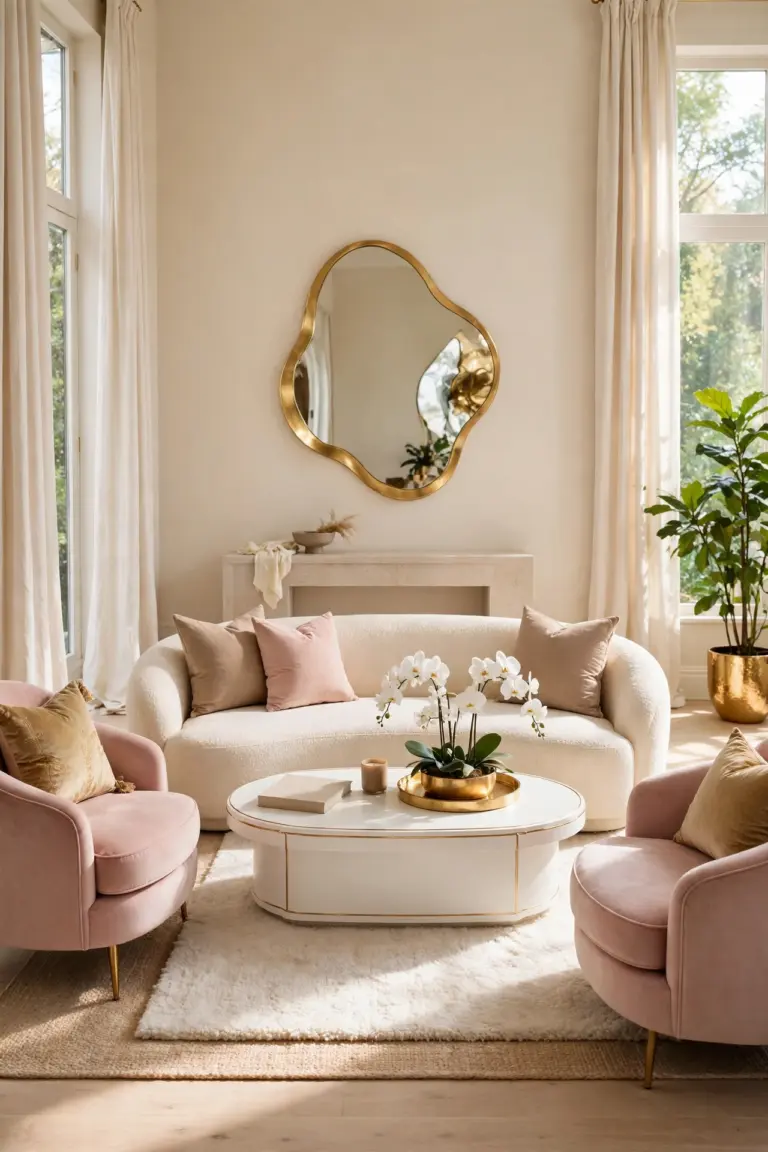
15 Vintage Living Room Ideas With Bright, Glam Style
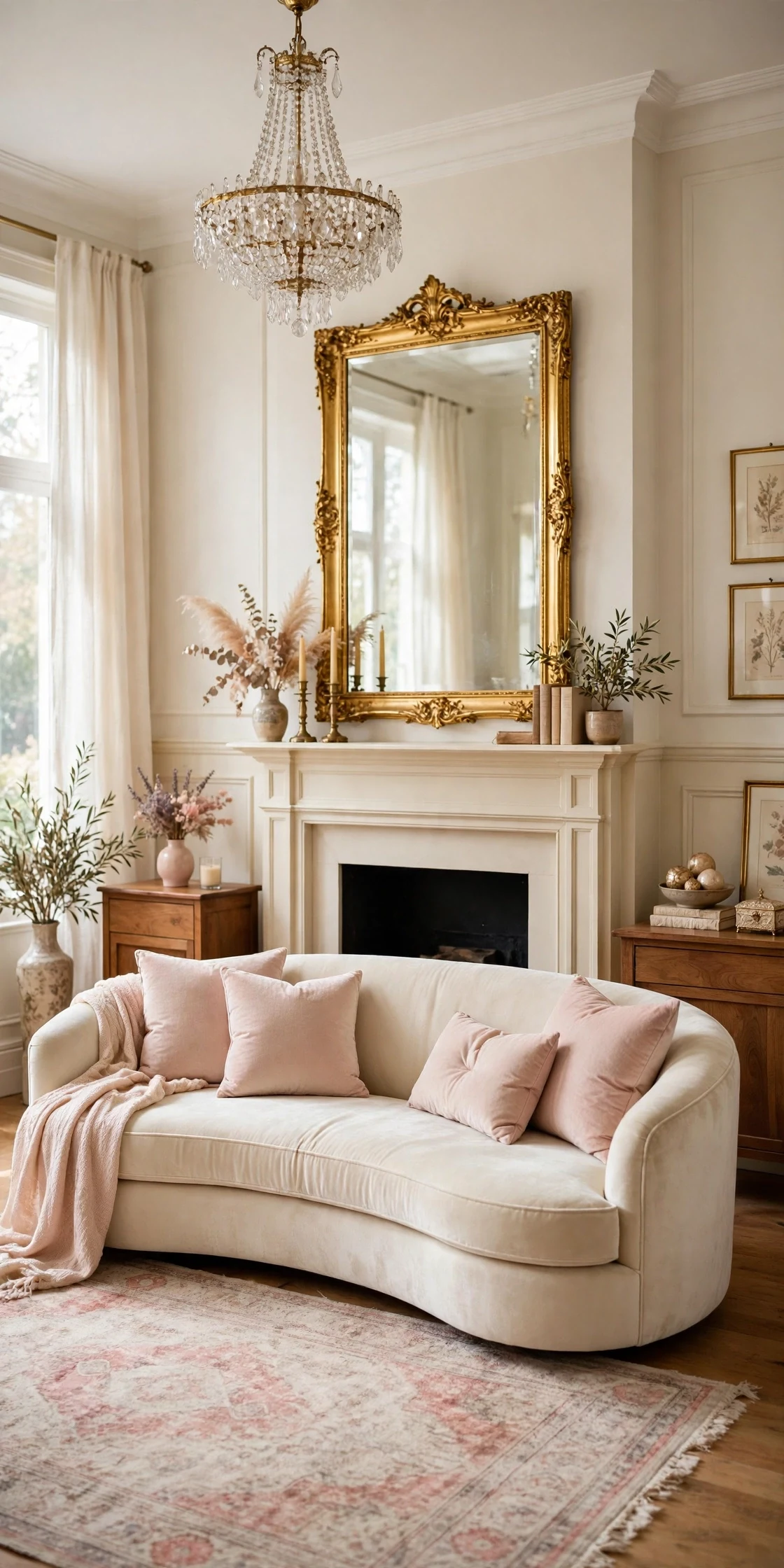
Vintage living rooms fail in two directions. One fills with dark wood, heavy drapes and dusty ornaments until the room feels like a museum nobody dusts. The other buys one antique and surrounds it with plain modern pieces, so the antique looks lost instead of loved. These vintage living room ideas take a third route: a bright glam base, cream walls, a curved velvet sofa and warm light, with vintage pieces chosen one category at a time, mirror, rug, wood, glass, brass, each restored or cleaned until it glows. The palette runs through every idea: white, cream and warm taupe, warmed with blush pink and brushed gold, so pieces from different decades agree with each other. If your taste runs a little newer, these rooms layer happily over the softer shapes in our farmhouse living room guide
Disclosure: This article may contain affiliate links. If you buy through a link on this page, GlamNStyle may earn a small commission at no extra cost to you. Product links in this article are plain links; each one is checked on the retailer’s own page before it is added.
1. Anchor the Room With a Curved Cream Velvet Sofa
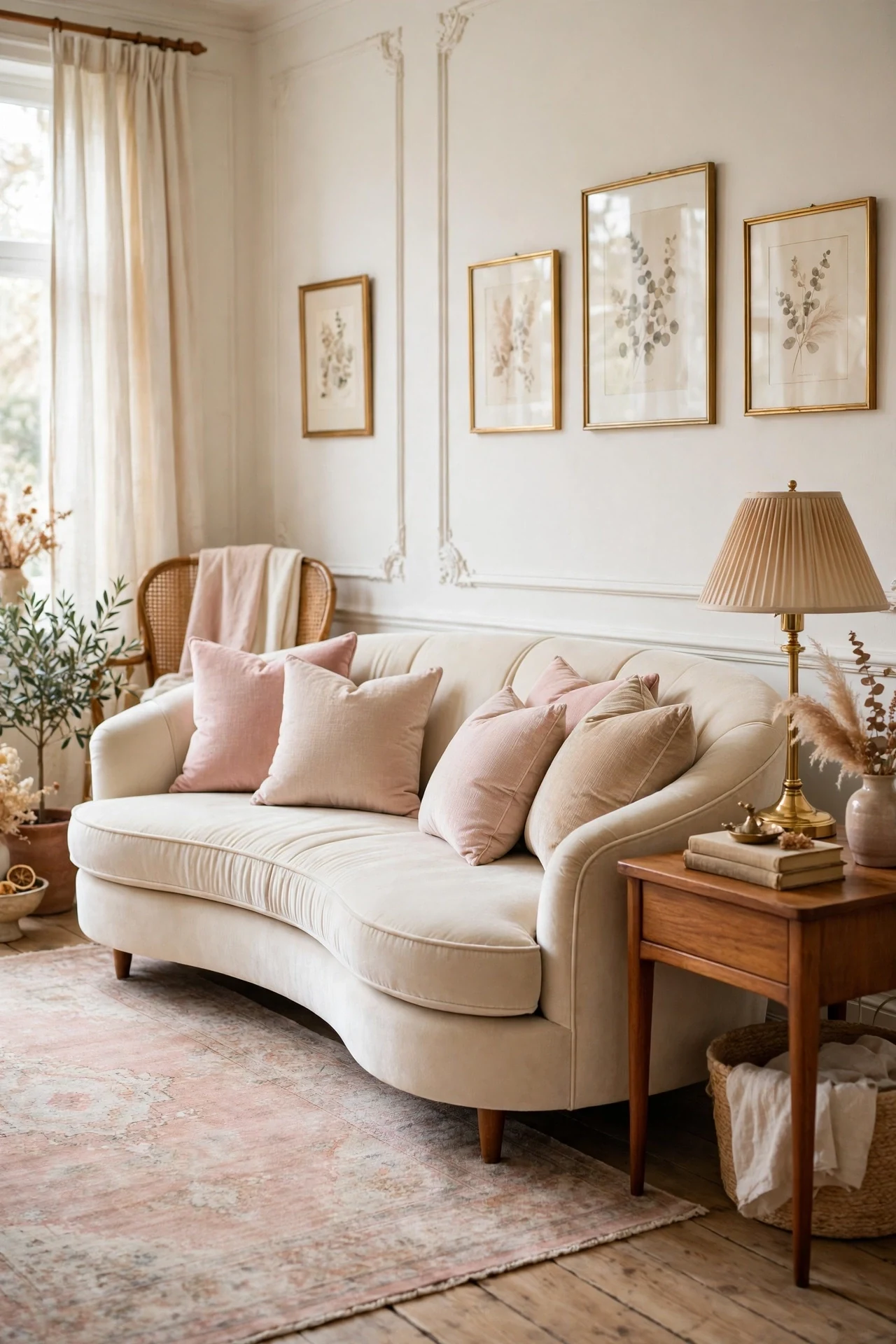
Every vintage room needs one piece that sets its period and its softness, and a curved sofa does both in a single shape. The rolled back and gentle kidney curve belong to the glamorous end of vintage, the 1930s to 1950s salon look, and in cream velvet the shape reads clearly without dark upholstery pulling the room down. New sofas are made in this shape today, which is the practical route: vintage comfort and springs, modern foam and clean fabric. Place it as the room’s centre and let everything else be older, smaller and quieter than it.
Best For: Anyone starting a vintage room from empty, and rooms that need one softening shape.
Not Ideal For: Households with toddlers and dark drinks as a daily routine; velvet in cream is a commitment, so choose a performance velvet.
Estimated Cost: $800-$1,600 (estimate) for a curved three-seat sofa in performance velvet.
Budget Note: This is the room’s one big spend by design; genuine antique sofas cost less to buy and far more to reupholster and repair, which is why the new version usually wins.
Renter Friendly: Yes
Renter Note: Fully freestanding; measure the curve’s full diagonal for doorways, because curved frames do not flex through tight halls.
What You Need
Curved three-seat sofa in cream performance velvet, blush and champagne cushions, tape measure, furniture sliders.
Product type to look for: A curved or kidney-shaped sofa with a low rolled back, in a stain-resistant velvet rated for daily use, with a seat depth that suits sitting upright with cushions.
How To Do It
- Tape the sofa’s curved footprint on the floor and confirm the walkway at its widest point.
- Float it facing the mirror or fireplace wall, with its back to the room’s entry if the layout allows.
- Dress it with cushions in blush and champagne only, two tones, so the cream stays the story.
- Stop adding seating until the vintage pieces arrive; one strong sofa makes extra chairs optional.
Pro Tip
Judge a curved sofa from the doorway, not from inside the room. The curve should read as one smooth line the moment you enter; if it reads as a lump, the room is too full around it.
2. Hang a Gilded Mirror as the Room’s Centrepiece
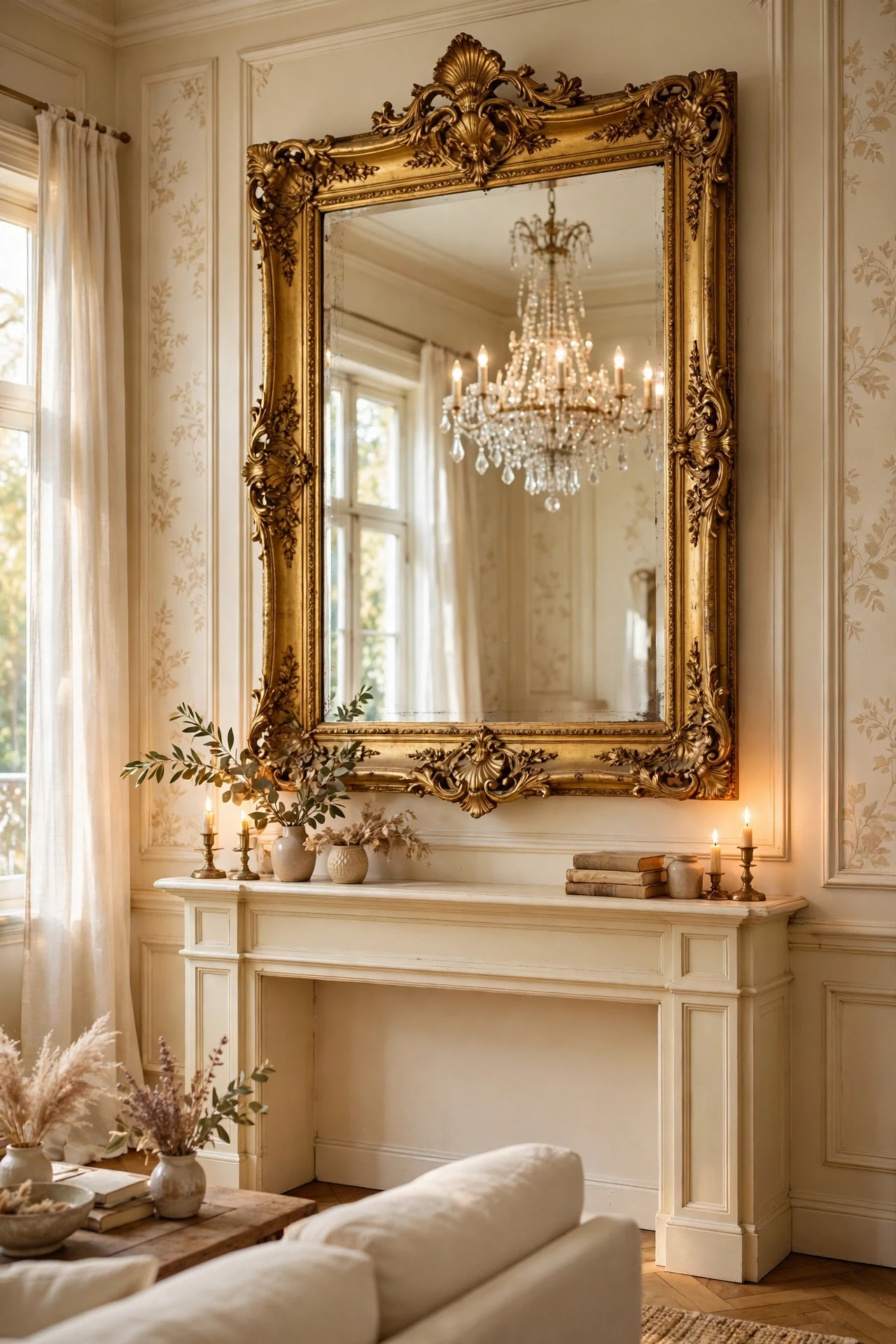
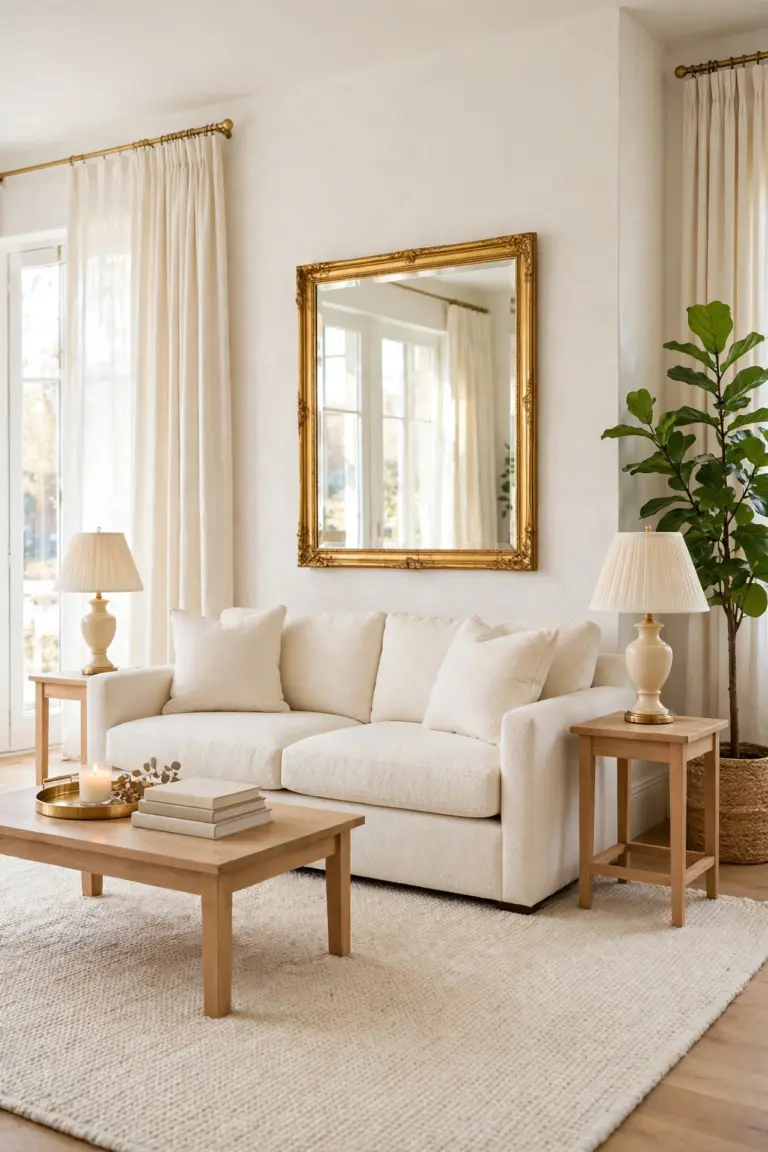
A gilded mirror is the hardest-working vintage piece there is: it carries the period detail, it doubles the room’s light, and it gives a plain wall the architecture it is missing. Ornamental gold frames in the vintage style are widely reproduced, which keeps this affordable, and a genuinely old frame with worn gilding is better still, because the soft patches where gold has thinned read as history, not damage. Hang it where it reflects light and life, a window, the chandelier, the sofa, never a bare wall or the television.
Best For: Rooms with a mantel, a sideboard or one long blank wall.
Not Ideal For: Walls that cannot take the weight; a large ornate mirror is heavy and needs proper fixings into studs or solid wall, checked against the maker’s guidance.
Estimated Cost: $120-$400 (estimate) for a large gilded mirror, vintage or reproduction.
Budget Note: Second-hand ornate frames are common and cheap relative to their size; budget for professional cleaning or a replacement mirror plate if the old glass is fogged.
Renter Friendly: With Conditions
Renter Note: Lean it on a mantel or sideboard instead of hanging if fixings are not allowed, and secure the top with a strap so it cannot slip.
What You Need
Large gilded mirror, heavy-duty picture fixings rated well above its weight, stud finder, level, soft cloth and glass cleaner.
Product type to look for: A mirror with real bevelled glass and a frame depth of at least an inch; flat printed frames read cheap at this size, and the depth is what catches light.
How To Do It
- Weigh the mirror and buy fixings rated comfortably above that weight.
- Find the studs or solid fixing points and mark the centre line of the mantel or wall.
- Hang with a second pair of hands and check the reflection from the sofa before final tightening.
- Clean the glass last, once it is hung, so fingerprints from handling do not stay.
Pro Tip
A mirror that reflects the chandelier doubles the chandelier. If yours reflects a window instead, you have doubled the daylight; either is right, but choose deliberately rather than discovering it later.
3. Lay a Faded-Look Rug in Blush and Cream
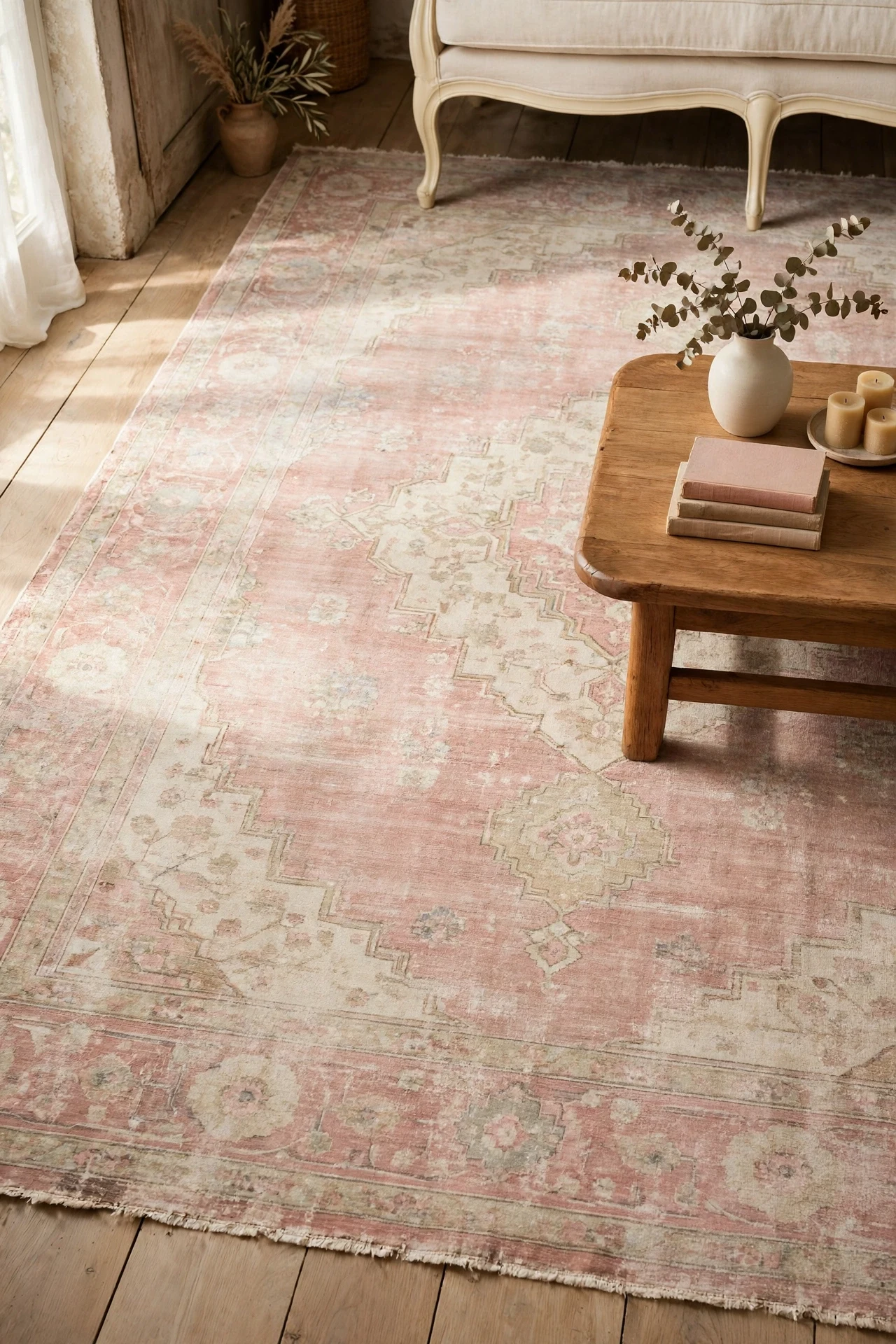
A vintage room’s colour usually comes from its rug, and the safest vintage rug for a bright scheme is a faded one: the traditional medallion pattern washed down to blush, cream and warm taupe, so it brings history without bringing darkness. Genuine old rugs in this palette exist and are beautiful, but modern vintage-look rugs copy the faded wash honestly, cost a fraction, and can be cleaned without fear. Size it like a modern rug: front legs of the sofa and chairs on it, so the pattern sits inside the seating group and ties the decades together.
Best For: Rooms that feel too new and need instant age and softness.
Not Ideal For: Anyone wanting bold vintage colour; this is the quiet end of the style by design.
Estimated Cost: $150-$450 (estimate) for a vintage-look rug around 8 by 10 feet.
Budget Note: Vintage-look machine-made rugs are the budget hero of this whole list; a genuine hand-knotted faded rug of this size can cost several times more.
Renter Friendly: Yes
Renter Note: Use a non-slip underlay; thin vintage-style rugs walk across hard floors and the underlay also protects the floor beneath.
What You Need
Vintage-look rug in blush and cream, non-slip underlay, vacuum with a gentle setting.
Product type to look for: A low-pile rug with the faded effect woven or printed evenly across the whole piece, not a bright rug sanded in patches, which reads as damage rather than age.
How To Do It
- Measure the seating group and choose the size that takes the front legs of every seat.
- Lay the underlay, then the rug, aligned to the sofa, not to the room’s walls, which are rarely square.
- Place the sofa and chairs onto the rug’s edges and check the medallion sits centred in the group.
- Vacuum gently and rotate the rug twice a year so light fades it evenly, the way real age would.
Pro Tip
If you find a genuine old rug you love that is slightly too strong in colour, layer a thin cream flatweave partly beneath the sofa so only the faded centre of the old rug shows. You keep the best of it and calm the rest.
4. Mix Warm Wood Antique Tables, One Pair Only
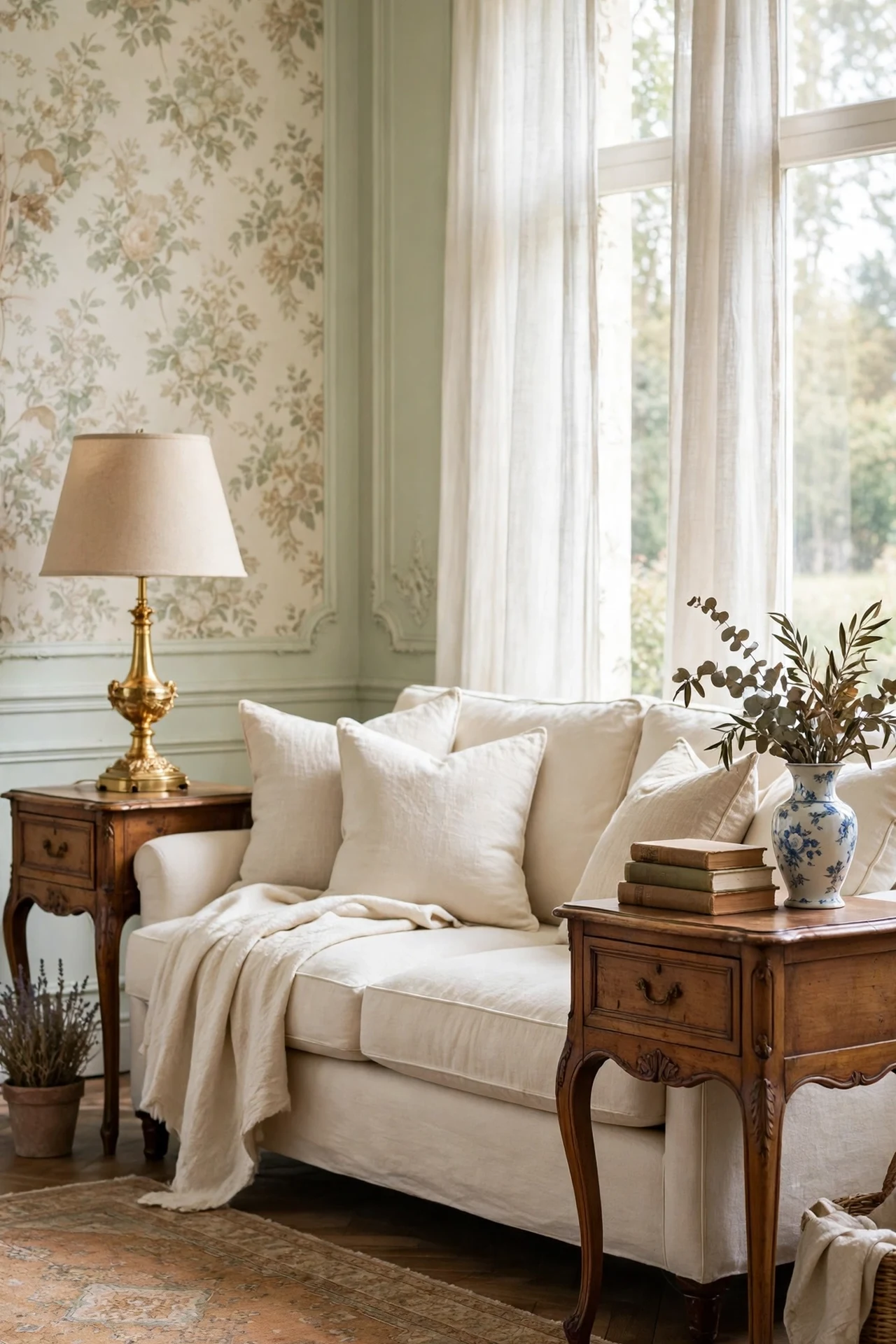
Warm wood is where vintage warmth actually lives, and side tables are the safest place to buy genuinely old. A pair of small antique tables in honey or walnut tones brings real age, real joinery and the slight irregularity that new furniture cannot fake, and because they are small, the wood stays an accent rather than a theme. One pair is the discipline: matching tables at the sofa, and then restraint everywhere else. A room where every surface is antique wood turns heavy and brown; a room with one warm pair glows against the cream around it.
Best For: First-time vintage buyers; small, common and easy to source second-hand.
Not Ideal For: Anyone who needs matched perfection; old pairs are rarely identical, and the charm is in the near-match.
Estimated Cost: $80-$300 (estimate) for a second-hand pair of warm wood side tables.
Budget Note: Condition beats age. Sound joints and a clean top matter more than a date; wobble and ring marks are your negotiating points, not deal-breakers if the price reflects them.
Renter Friendly: Yes
Renter Note: Fully freestanding; felt pads protect floors and the tables’ own feet.
What You Need
Pair of warm wood antique side tables, wood cleaner and wax polish, felt pads, soft cloths.
Product type to look for: Tables of similar height within an inch of each other and the sofa arm, in a warm mid-tone wood, with drawers if you can find them, because lamp cables and coasters need a home.
How To Do It
- Check each table for wobble and sound joints before buying; rock it, do not just look at it.
- Clean with a gentle wood cleaner, then feed the wood with wax polish and buff.
- Place the pair at the sofa, level them with felt pads, and dress one with the lamp, the other with books and one object.
- Keep every other wood piece in the room lighter or painted, so the pair stays the warm note.
Pro Tip
Ring marks on old tables come out more often than sellers think: gentle heat through a cloth lifts many of them. Test on the underside first, and never on a finish you have not identified.
5. Light It With a Crystal-Style Chandelier and Sconces
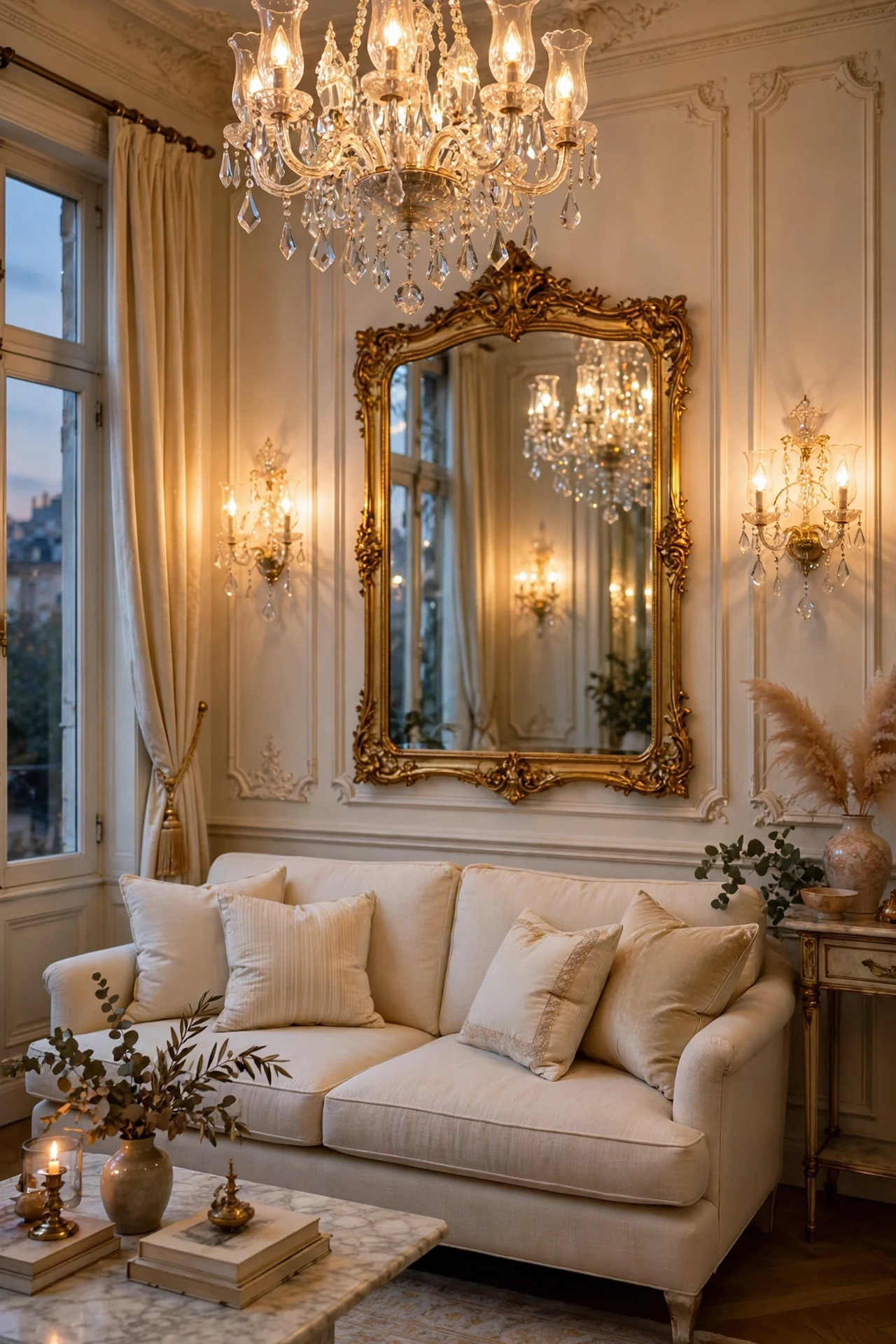
Vintage glamour is mostly lighting. A crystal-style chandelier throws warm sparkle across the ceiling and into the gilded mirror, and it dates the room to the salon era more surely than any furniture can. Modern versions with glass drops and warm LED candle bulbs give the effect without antique wiring, which is the one part of vintage nobody should romanticise: old light fittings need professional checking before use, every time. Add wall sconces in the same crystal language at the mirror or sofa wall, all on dimmers, and the room can move from bright daytime to evening glow without a single lamp competing for table space.
Best For: Rooms with the ceiling height for a drop fitting, roughly 8 feet and above.
Not Ideal For: Low ceilings; use a flush or semi-flush crystal fitting in the same style so heads and doors stay clear.
Estimated Cost: $180-$600 (estimate) for a crystal-style chandelier, plus electrician fitting.
Budget Note: The fitting is the visible spend; save by keeping the existing ceiling point so no new wiring run is needed.
Renter Friendly: No
Renter Note: Light fittings are electrical work belonging to the owner and a qualified electrician; renters get the glow from crystal-style table lamps instead.
What You Need
Crystal-style chandelier sized to the room, matching sconces if the walls allow, warm LED candle bulbs, dimmer switch, electrician booking.
Product type to look for: Glass drops rather than plastic, which yellows and reads cheap in daylight, and a fitting rated for dimmable bulbs so the sparkle can be softened.
How To Do It
- Size the chandelier to the room: a common guide is the room’s length plus width in feet giving the fitting’s diameter in inches.
- Have a qualified electrician fit the chandelier and sconces and check the circuit in one visit.
- Fit warm bulbs around 2700 Kelvin throughout, including the sconces, so the crystal throws one colour of light.
- Set the dimmer scene for evening and check the mirror’s reflection of the fitting from the sofa.
Pro Tip
Never hang untested antique electrical fittings. If you fall for a genuine vintage chandelier, budget for a full professional rewire before it goes up; the romance is in the glass, not the cloth cable.
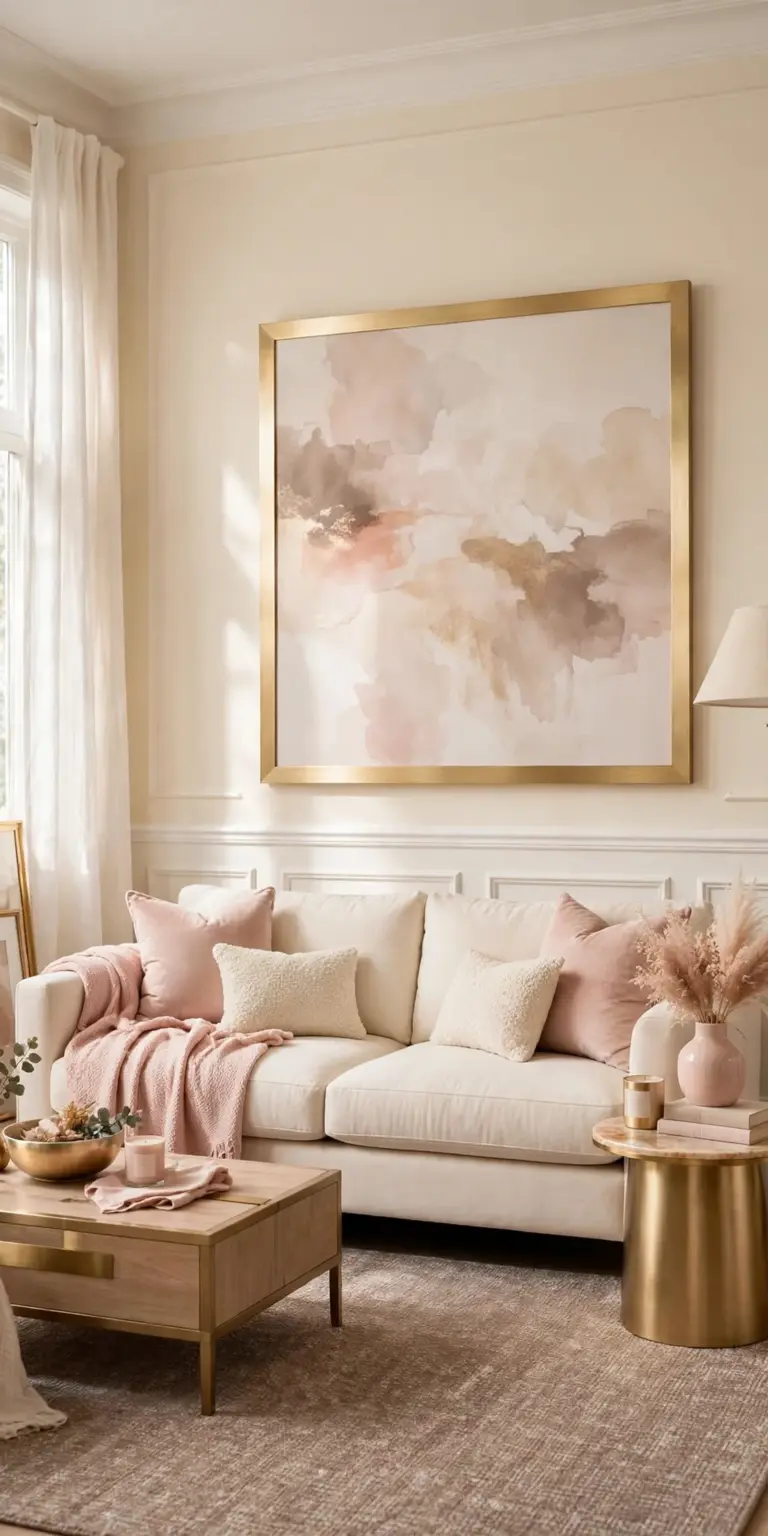
6. Layer Velvet Cushions in Blush and Champagne
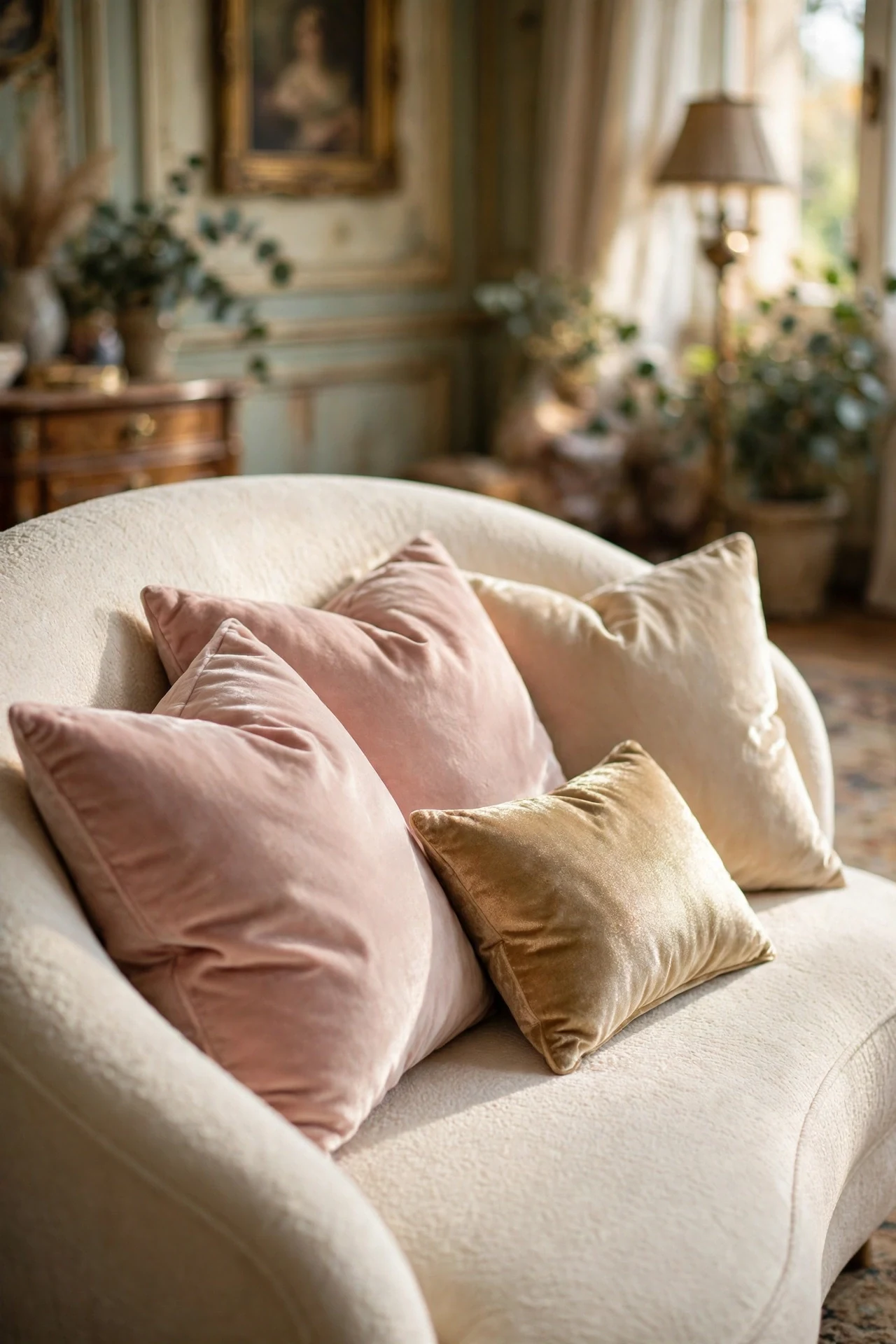
Cushions are where a vintage room gets its softness cheaply. Velvet in blush and champagne does three jobs at once: it repeats the rug’s faded colours at sofa height, it catches light the way vintage fabrics should, and it softens the cream sofa without pattern. Work in odd numbers, five across a three-seater, and mix two shapes, square and one long lumbar, so the arrangement looks collected rather than matched. This is also the fastest seasonal lever in the room: deeper blush in winter, paler champagne forward in summer, same sofa, same vintage bones.
Best For: Any vintage scheme that feels flat or too cream.
Not Ideal For: Homes where cushions live on the floor within the hour; a styled arrangement needs household agreement, not better cushions.
Estimated Cost: $60-$180 (estimate) for five velvet cushion covers and inserts.
Budget Note: Buy covers and good inserts separately; the insert decides whether velvet looks plump and expensive or flat and tired.
Renter Friendly: Yes
Renter Note: Nothing fixed, nothing marked; the easiest idea in this list to reverse.
What You Need
Five velvet cushion covers in blush and champagne, inserts one size larger than the covers, one small gold cushion as the single metallic note.
Product type to look for: Cotton-velvet or performance velvet covers with hidden zips, and feather-blend inserts sized 2 inches larger than the cover for a full corner.
How To Do It
- Choose two blush tones and one champagne, all within the rug’s faded family.
- Arrange large squares at the corners, smaller in front, the lumbar in the centre.
- Give each cushion a karate chop crease only if the fabric takes it; crushed velvet prefers a smooth plump.
- Photograph the sofa from the door and remove one cushion; vintage rooms almost always look better with one fewer.
Pro Tip
Repeat the blush exactly twice more in the room, the rug counts as one, so one more object, a vase or a throw, completes the triangle and the colour looks intended.
7. Set a Marble-Top Coffee Table With Gold Legs
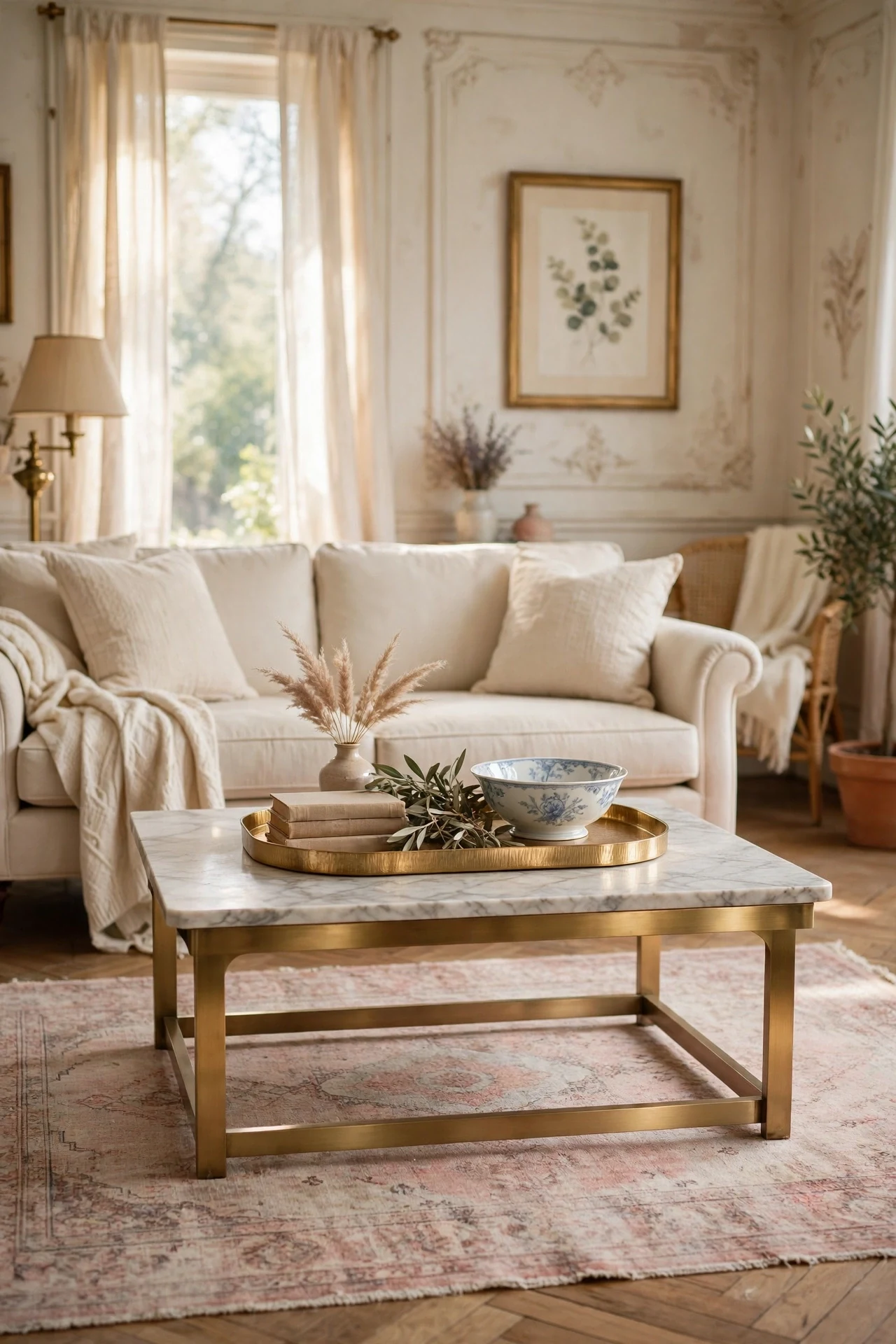
A marble top and gold legs is the coffee table shape that belongs to this style: cool stone to balance the velvet, a metal frame light enough to see the rug through. Vintage versions exist in quantity because the shape was made for decades, and new versions copy it faithfully, so buy whichever your budget finds first. Keep the top mostly clear, a gold tray, one porcelain piece, a book, because marble is the decoration and clutter hides it. Real marble needs coasters and quick wipes; it is a natural stone and it remembers red wine, so agree the house rules before it arrives.
Best For: Rooms whose seating group needs a glamorous centre that still feels light.
Not Ideal For: Anyone unwilling to use coasters; choose a marble-look ceramic or sintered top instead and keep the shape.
Estimated Cost: $200-$550 (estimate) for a marble-top coffee table with a metal frame.
Budget Note: Vintage marble tables are often priced below new ones of the same quality; check the stone for cracks at the corners, which are the honest wear points.
Renter Friendly: Yes
Renter Note: Freestanding and heavy; sliders under the legs protect floors when it needs to move for cleaning.
What You Need
Marble-top coffee table with gold frame, coasters, gold tray, stone-safe cleaner, felt sliders.
Product type to look for: A table around two thirds the length of the sofa, with a sealed marble top or a clearly labelled marble-look alternative, and a frame that does not flex when leaned on.
How To Do It
- Measure the gap between sofa and chairs; the table should sit 14 to 18 inches from the sofa edge.
- Centre it on the rug’s medallion, not on the room.
- Style with one tray grouping everything, so the surface can be cleared in one lift.
- Set the coaster rule from day one, on the tray where guests see it.
Pro Tip
Wipe marble with a pH-neutral cleaner only. Vinegar and lemon cleaners etch the surface dull, and the damage looks like a permanent water mark.
8. Display Glass and China in a Glass-Front Cabinet
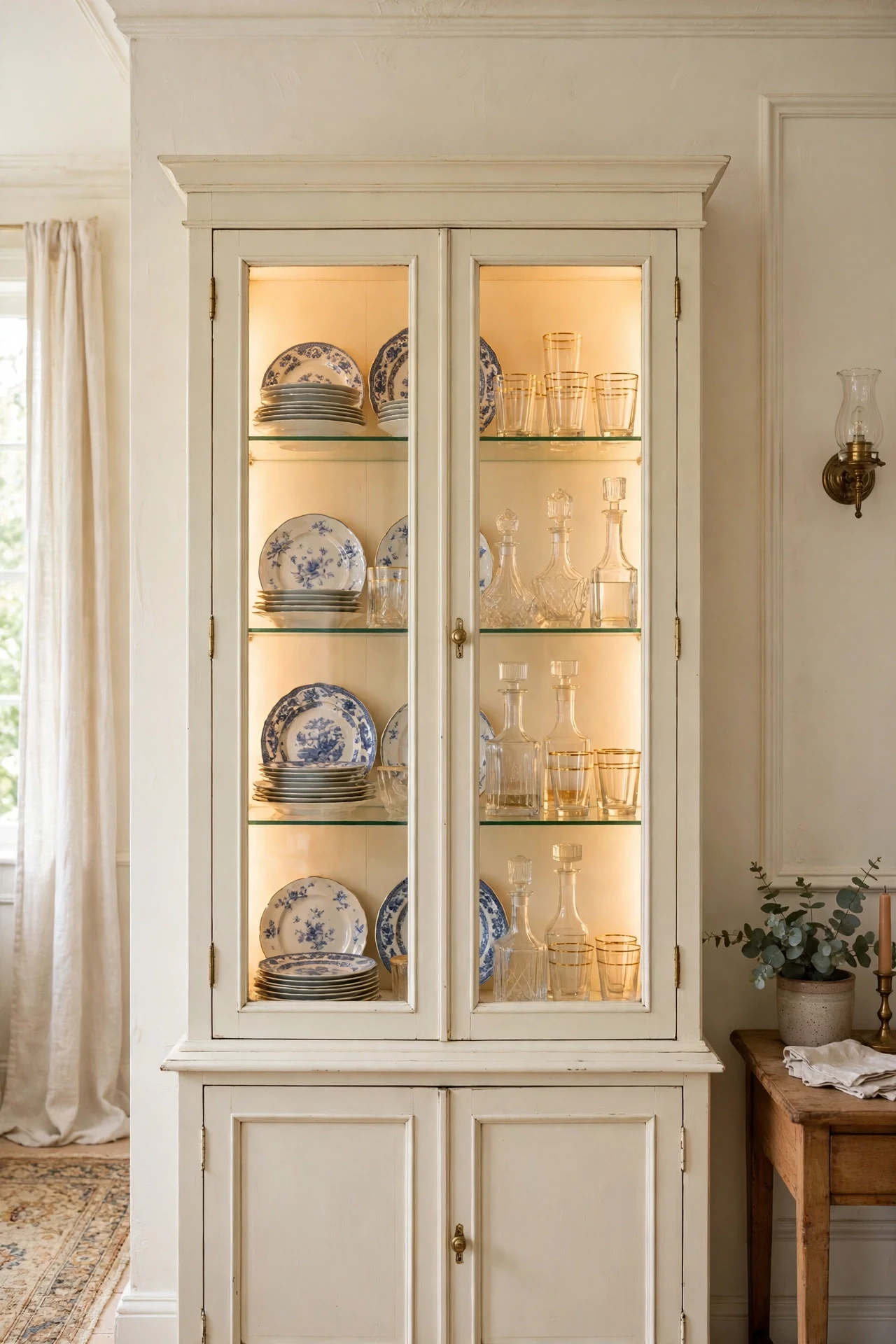
Vintage collections die in cupboards. A glass-front cabinet, painted cream so the cabinet itself stays in the palette, turns inherited porcelain, glass and gold-rimmed pieces into the room’s artwork, lit and dust-free. This is the idea that lets a vintage room be personal: the pieces inside carry the family’s own history rather than a shop’s. Arrange by height and sparkle, glass at the top where light catches it, porcelain below, and leave gaps. A cabinet packed like a shop window reads as storage; a cabinet with air in it reads as a collection.
Best For: Anyone with inherited or collected glass and china that never gets seen.
Not Ideal For: Pieces in daily use; display and daily service fight, so keep a working set in the kitchen and display the best here.
Estimated Cost: $250-$700 (estimate) for a glass-front display cabinet, less for a second-hand one painted at home.
Budget Note: Second-hand cabinets are plentiful and paint is cheap; spend the difference on a warm LED strip inside the cabinet, which is what makes glass glow at night.
Renter Friendly: Yes
Renter Note: Freestanding; anchor tall cabinets to the wall with the supplied strap for safety around children and pets.
What You Need
Glass-front cabinet, cream paint if refinishing, warm LED strip light, soft cloths, plate stands for the pieces worth showing upright.
Product type to look for: A cabinet with adjustable shelves deep enough for your largest plate stood upright, and glass in the doors that is clear, not green-tinted, so colours inside stay true.
How To Do It
- Anchor the cabinet first, then wash every piece before it goes in; display dust is visible dust.
- Arrange the top shelf with glass only, tallest at the centre.
- Work down through porcelain, leaving a hand’s width of air between groups.
- Fit the light strip along the inside top, cord hidden down the back, and view it at dusk before calling it done.
Pro Tip
Edit the collection to one colour story, here it is white, cream, glass and gold. Pieces outside the story, however loved, belong in another room, or the cabinet turns into a jumble sale.
9. Frame Vintage-Style Art With Brass Picture Lights
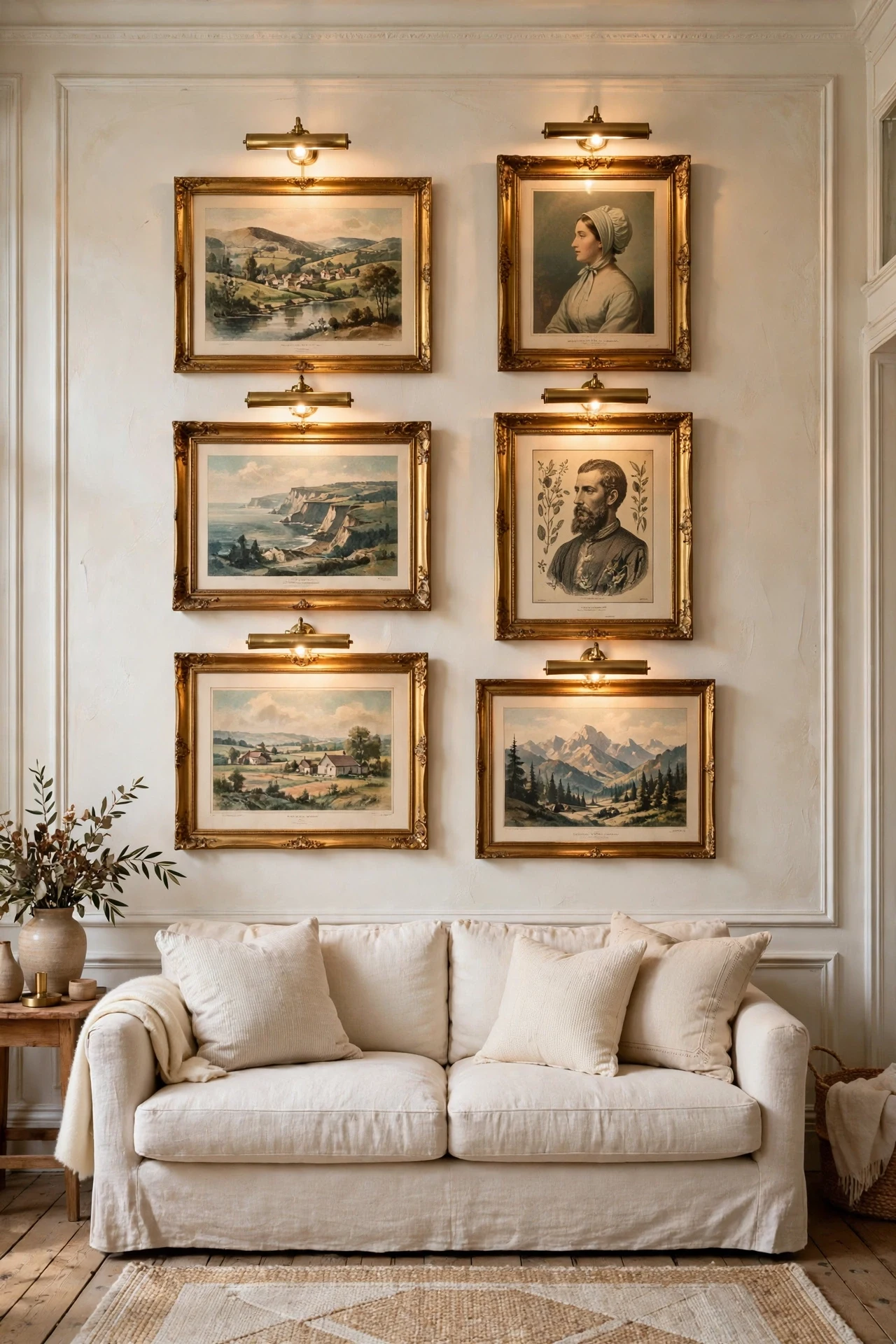
Bare walls are what make styled rooms feel modern and empty. A gallery of vintage-style prints, landscapes, portraits, botanical plates, in thin gold frames, with a brass picture light washing down the centre piece, gives a living room the layered, collected wall that vintage style is really about. The prints themselves are inexpensive, public-domain art is widely available as quality reproductions, so the money goes into frames and one or two lights, which is the correct order: it is the frames and the light that read as vintage, not the paper. Hang the group at sofa-back height so it belongs to the seating, not the ceiling.
Best For: Long or blank walls above a sofa or sideboard.
Not Ideal For: Walls in direct sun all day; prints fade and picture lights are pointless in daylight, so choose the shaded wall.
Estimated Cost: $120-$350 (estimate) for frames, prints and one or two picture lights.
Budget Note: Battery picture lights with remotes avoid electrician costs and are the renter route too, at some cost in brightness.
Renter Friendly: With Conditions
Renter Note: A gallery means several fixings; battery lights need none, and frames can hang from removable picture strips rated for their weight if the wall finish suits them.
What You Need
Four to six gold frames in two sizes, vintage-style prints, brass picture lights, paper template and painter’s tape, level.
Product type to look for: Frames with real glass rather than acrylic where weight allows, because glass gives the depth and reflections that sell the vintage effect.
How To Do It
- Lay the whole gallery out on the floor and photograph arrangements until one hangs together.
- Tape paper templates to the wall in that arrangement and live with them for a day.
- Hang from the centre piece outward, keeping gaps even at about 2 inches.
- Fit the picture light over the centre piece and set the evening scene: picture light and sconces, ceiling off.
Pro Tip
Keep every frame’s top edge in one of two lines, a level top row or a level centre line. Galleries look collected when one line is disciplined and everything else is free.
10. Roll In a Gold and Glass Bar Cart
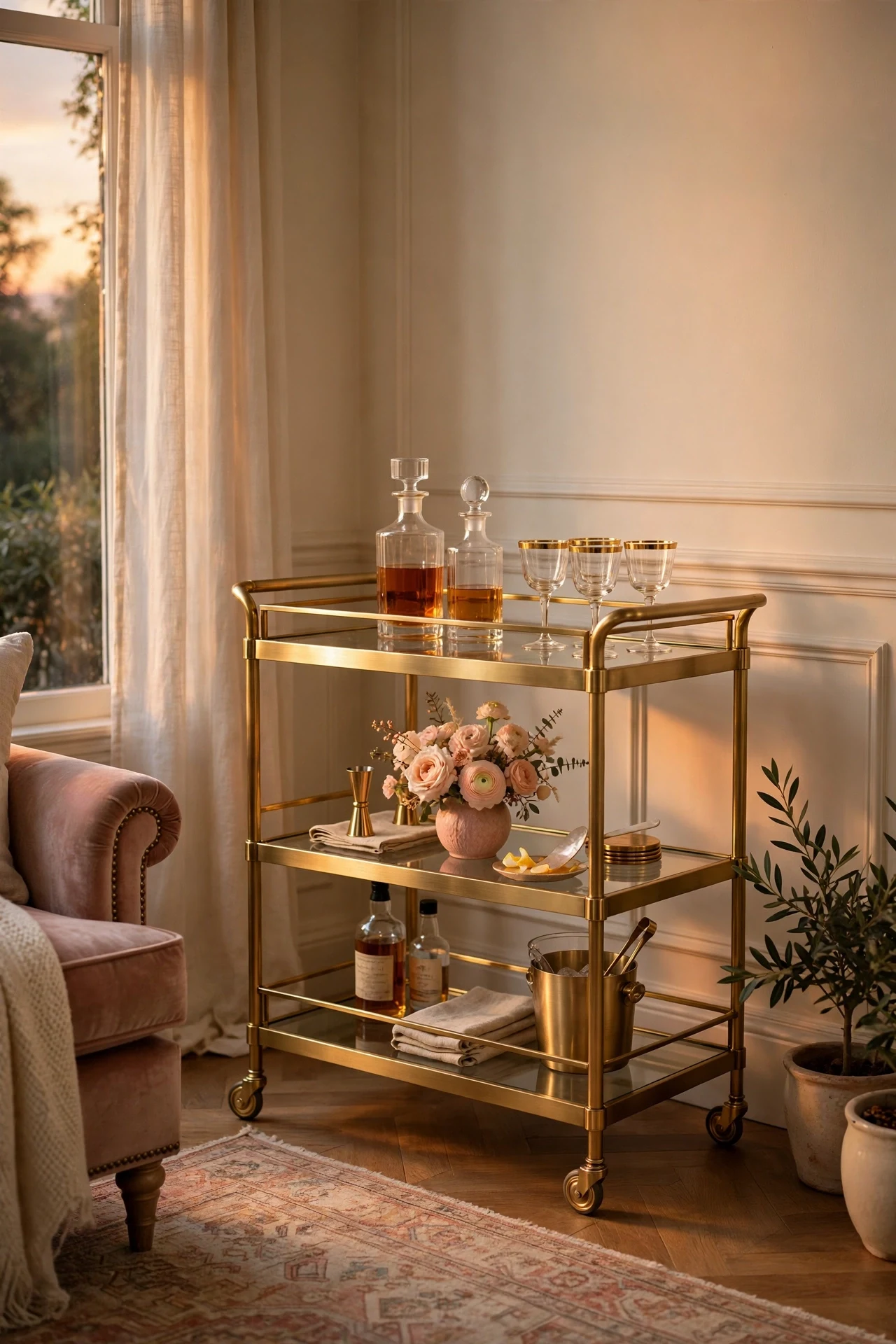
The bar cart is the vintage living room’s party trick: two glass shelves on a gold frame that serve drinks when guests come and serve as a styled side table the rest of the year, with a decanter, glasses and one small arrangement. It rolls, which makes it the only furniture in the room that can follow the evening from sofa to dining end. Households that do not drink should still consider it, because the same cart is a beautiful tea cart, coffee cart or plant stand in a sunny corner, and the shape, not the bottles, is what carries the style.
Best For: Entertainers and rooms with an empty corner near the seating.
Not Ideal For: Homes with toddlers at grabbing height and no door to close; glass and small wheels are a poor mix unsupervised.
Estimated Cost: $90-$300 (estimate) for a gold and glass two-tier cart.
Budget Note: Carts are common second-hand; check the castors roll true and the glass is unscratched, because replacement glass can cost more than the cart.
Renter Friendly: Yes
Renter Note: It only rolls in; nothing to fix, nothing to repair.
What You Need
Two-tier gold and glass bar cart, decanter and glasses or a tea set, small tray, one blush floral arrangement in a porcelain vase.
Product type to look for: A cart with a raised rail on both shelves, so bottles cannot slide when it moves, and castors that lock.
How To Do It
- Build the cart, lock the castors, and load the heavy bottles on the lower shelf.
- Style the top shelf as a serving surface: decanter, two glasses, the arrangement at the back corner.
- Park it within reach of the sofa but out of the walkway, angled slightly to the room for the photograph look.
- Before guests, unlock, roll it beside the host’s seat, and lock it again in place.
Pro Tip
Keep the cart three-quarters styled and one quarter empty. A cart with no working space becomes a shelf on wheels, and its charm was always that it works.
11. Drape Sheers and Long Linen Curtains Together
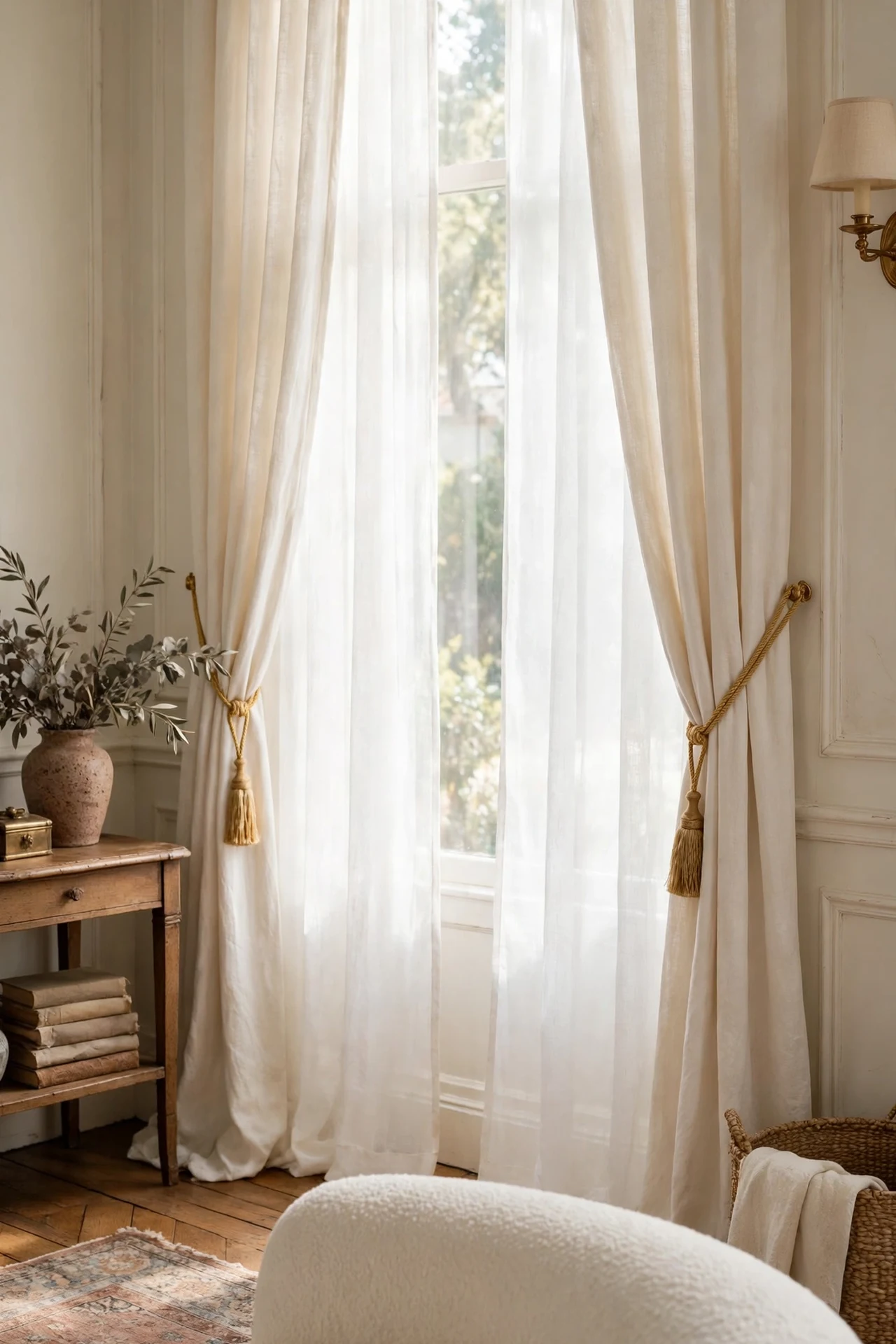
Vintage windows were dressed in layers, and the layers are what modern rooms dropped: a sheer at the glass for soft daylight and privacy, then a long curtain each side for the frame and the drama. In cream linen, with gold tiebacks holding the drapes in a gentle curve, the window becomes part of the furniture rather than a hole in the wall. Hang the rod high and wide, as in the bedroom guide’s rule, so the drapes fall from near the ceiling and pool very slightly, an inch of extra length that says vintage more surely than any pattern can.
Best For: Tall windows and any room where the window wall feels bare.
Not Ideal For: Windows above radiators, where long fabric is a poor neighbour to heat; choose sill-length drapes in the same layering idea.
Estimated Cost: $90-$260 (estimate) for sheers, two long linen drapes, rod and tiebacks.
Budget Note: Sheers are inexpensive and do most of the softening; spend on the drapes’ length, because vintage curtains that stop short look like a mistake, not a style.
Renter Friendly: With Conditions
Renter Note: The rod needs screws high on the wall; sheers alone on a tension rod give half the effect with no fixings.
What You Need
Sheer panels, two long cream linen drapes, curtain rod and brackets, gold tiebacks, steamer.
Product type to look for: Linen or linen-look drapes with enough body to hold a tieback curve, long enough to touch or just break on the floor from the high rod.
How To Do It
- Fit the rod 4 to 6 inches below the ceiling and past the frame on both sides.
- Hang the sheers first, spread evenly across the glass.
- Hang the drapes, steam the creases out in place, and set the tiebacks at about a third of the height from the floor.
- Adjust the fall of each drape so the front edge curves in a single smooth line.
Pro Tip
Steam, never iron, vintage-style linen in place. The slight natural rumple is the look; a pressed-flat drape reads as a hotel curtain.
12. Use a Tufted Ottoman as the Second Coffee Table
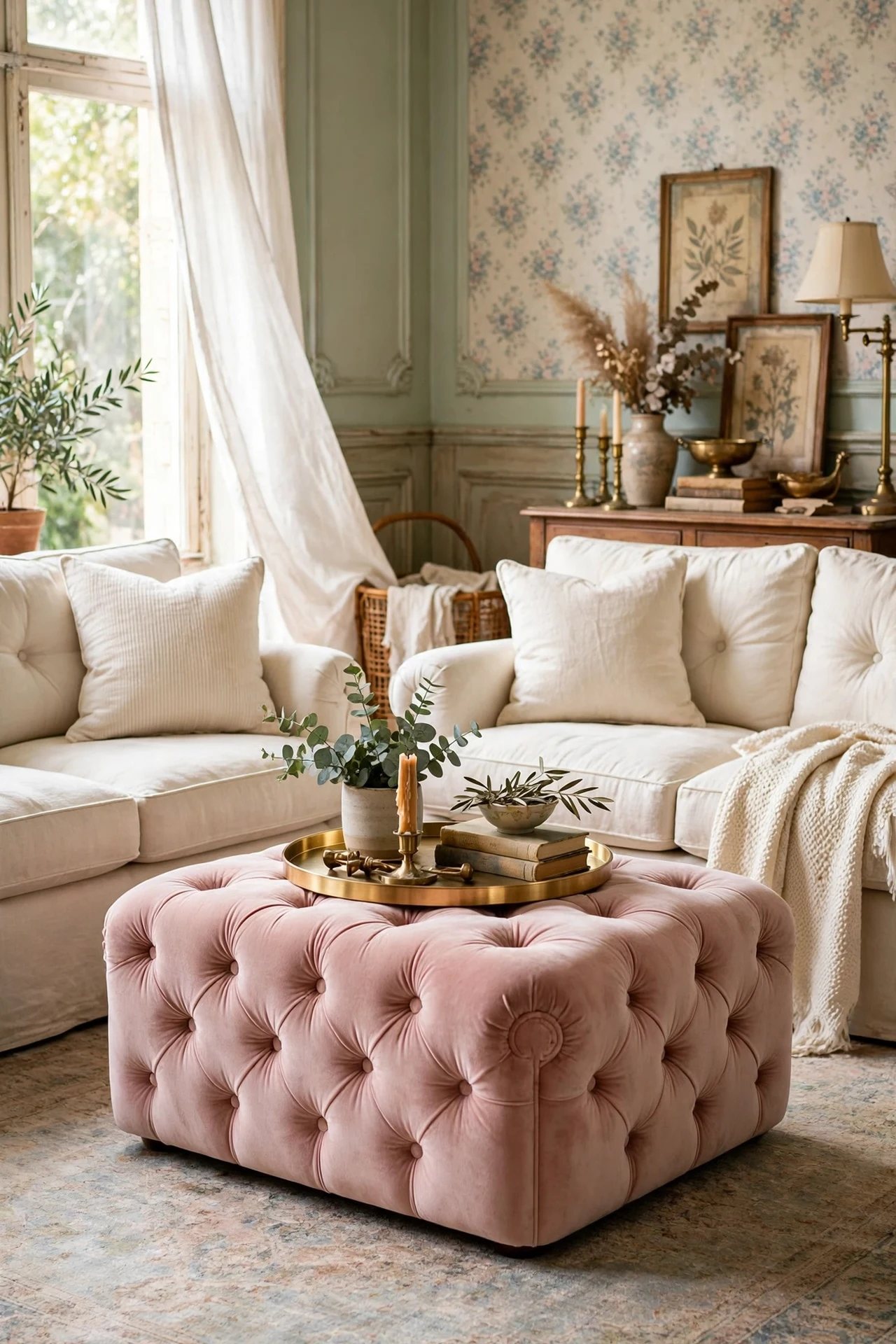
Not every room fits the marble table of idea 7, and a tufted ottoman is the vintage answer where it does not: a deep-buttoned velvet piece in blush that works as footrest, extra seat and, with a tray on top, a soft coffee table. It deepens the room’s one colour, because blush at the centre of the seating group ties the cushions to the rug, and its round or oval softness suits the curved sofa’s language. Choose a firm, flat-topped tufting if trays will live on it; deep soft tufting is beautiful and tips glasses with enthusiasm.
Best For: Smaller seating groups and rooms that need flexible extra seating.
Not Ideal For: Households wanting a hard, anything-goes surface; an ottoman always needs the tray discipline.
Estimated Cost: $150-$400 (estimate) for a tufted velvet ottoman.
Budget Note: Vintage ottomans and footstools are common and cheap to re-cover; a sound old frame in new blush velvet is the connoisseur’s version of this idea.
Renter Friendly: Yes
Renter Note: Freestanding; light enough to move for cleaning, which matters under a fabric piece.
What You Need
Tufted ottoman in blush velvet, a firm gold or marble tray, felt pads.
Product type to look for: An ottoman with a level top surface under the tufting, at coffee table height of 16 to 18 inches, on legs that show the rug beneath.
How To Do It
- Centre the ottoman on the rug where the coffee table would go, within easy reach of every seat.
- Set the tray dead centre and style it exactly as you would a table: one vessel, one book, coasters.
- Keep one side of the ottoman tray-free so it can be sat on or used for feet without a negotiation.
- Brush the velvet one way with a clothes brush so the tufting catches light evenly for photos.
Pro Tip
If guests are coming and the ottoman must seat one, move the tray to the marble table or the bar cart. Every piece in this room earns its place twice; let them.
13. Style a Vintage Trunk as Storage With a Story
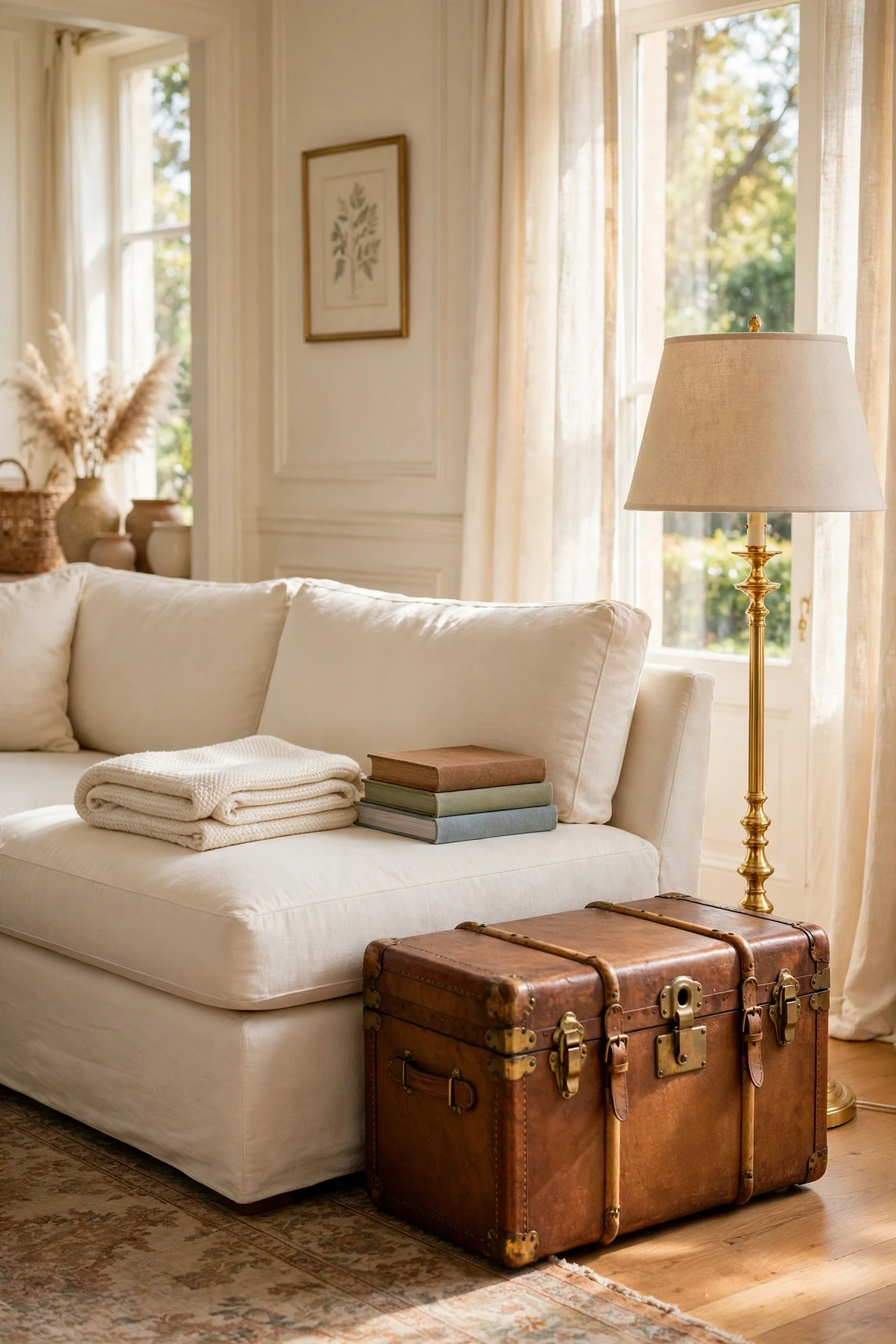
A vintage trunk is storage that introduces itself. Placed at the end of the sofa or under the window, it holds the blankets and board games, works as a side surface, and carries the room’s age in its straps, corners and worn finish in a way no new box can. Keep it to one trunk: two becomes a theme park. Genuine old trunks need a clean, a check for musty smells, and often a lining of plain cotton before blankets go in, and their tops are rarely flat, so style them with soft things, a folded throw and books, not drinks.
Best For: Blanket and game storage, and rooms missing one piece with real age.
Not Ideal For: Anyone needing level drinks space at that spot; the trunk is a soft surface by nature.
Estimated Cost: $60-$250 (estimate) for a genuine vintage trunk in clean, sound condition.
Budget Note: Trunks are priced by looks, so the honest, worn ones with good bones are the bargains; avoid any with a strong musty smell, which is slow and uncertain to remove.
Renter Friendly: Yes
Renter Note: Freestanding; felt pads under the base protect floors, and its weight means choosing its spot once.
What You Need
Vintage trunk, bicarbonate-based odour treatment if needed, plain cotton lining fabric, folded throw, art books.
Product type to look for: A trunk with sound hinges and a lid that stays open safely, in warm wood, leather or canvas tones that sit inside the palette.
How To Do It
- Clean the trunk outside and in, air it open for a full day, and treat any mustiness before lining.
- Line the inside with plain cotton so stored textiles never touch old surfaces.
- Place it at the sofa end or under the window, pads beneath, and load blankets first.
- Style the top with the throw folded lengthways and the books offset to one end.
Pro Tip
Check the lid’s stay or hinge with your hand before the first blanket goes in. A trunk lid that can fall is a finger trap, especially for children; fit a soft-close stay if the original is weak.
14. Group Porcelain and Milk Glass on the Mantel
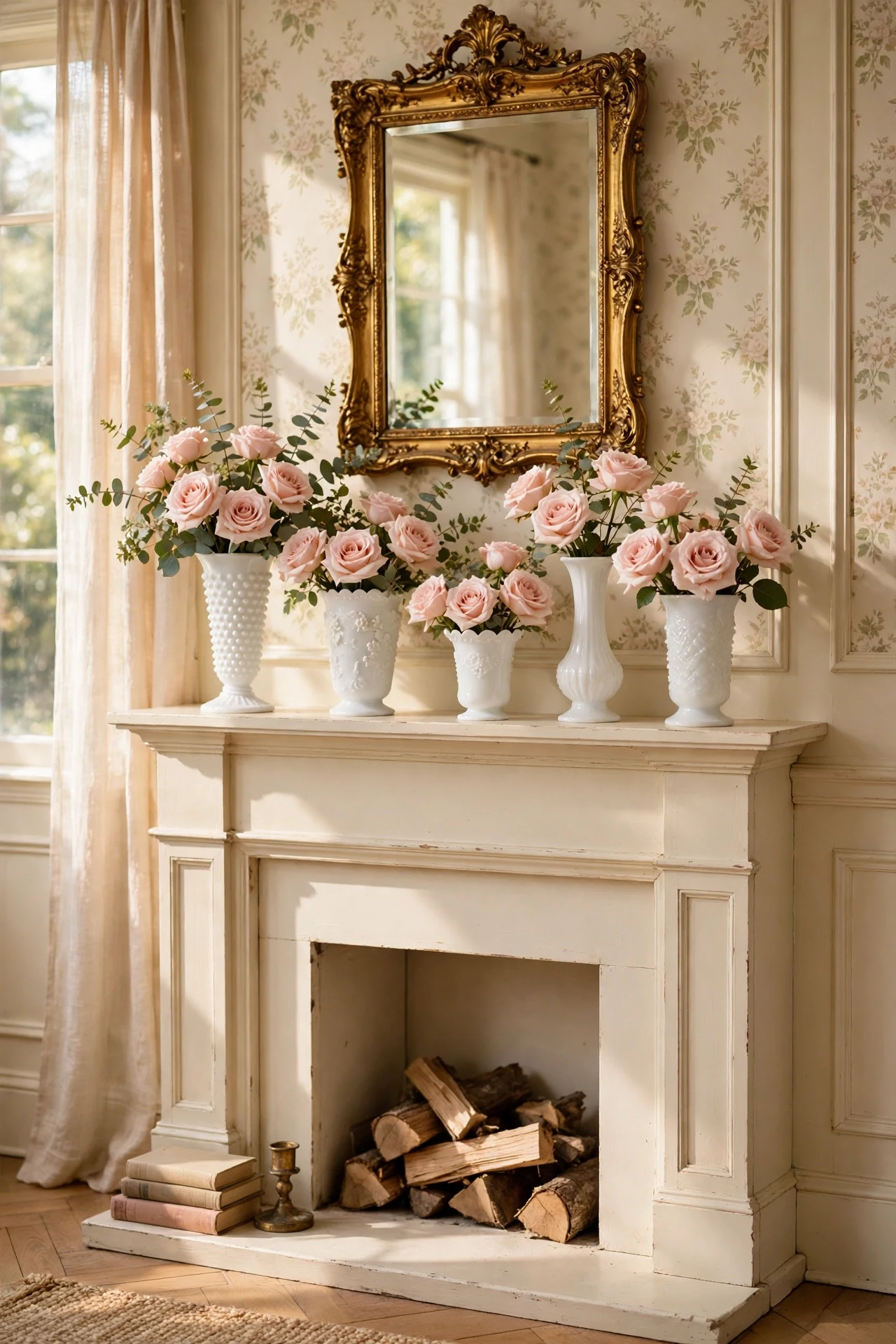
A mantel under a gilded mirror needs a display that is light in colour and varied in height, and white porcelain and milk glass are the vintage materials made for it: opaque, soft, cheap to collect second-hand, and happy in odd numbers. Grouped in a loose triangle, tallest at one end, they hold blush roses or nothing at all and still look finished, because the shapes do the work. This is the most collectable idea in the list: pieces arrive one at a time from markets and inheritances, and the mantel improves with every arrival, which is how real vintage rooms are actually built.
Best For: Mantels and sideboards that need styling without weight or dark colour.
Not Ideal For: Working fireplaces where the mantel gets hot and smoky; keep porcelain away from direct heat and soot, which stain matte glazes.
Estimated Cost: $30-$120 (estimate) to build a group of five to seven second-hand pieces over time.
Budget Note: Buy one good piece at a time rather than a matched set in a day; the charm is the slow mix, and single pieces are cheap.
Renter Friendly: Yes
Renter Note: Nothing is fixed; use museum putty under the bases if the household has cats or small children.
What You Need
Five to seven porcelain and milk glass vases in varied heights, blush roses or a single stem type, museum putty, soft cloth.
Product type to look for: Pieces in one colour family, white to cream, with varied silhouettes; colour discipline is what makes a mixed collection look curated.
How To Do It
- Arrange the group on a table first, tallest at one end, stepping down in an uneven rhythm.
- Set the tallest piece under the mirror’s edge, not its centre, so mirror and vases compose together.
- Add flowers to only two or three of the vases; empty vases are part of the display, not a failure.
- Step to the doorway and remove the piece your eye trips on; mantels are almost always one item too full.
Pro Tip
Milk glass glows when light passes behind it. Place the group so the window or a sconce sits behind the mantel’s end for part of the day, and the white glass will light itself.
15. Keep It Bright: Cream Walls, Warm Wood, One Rule
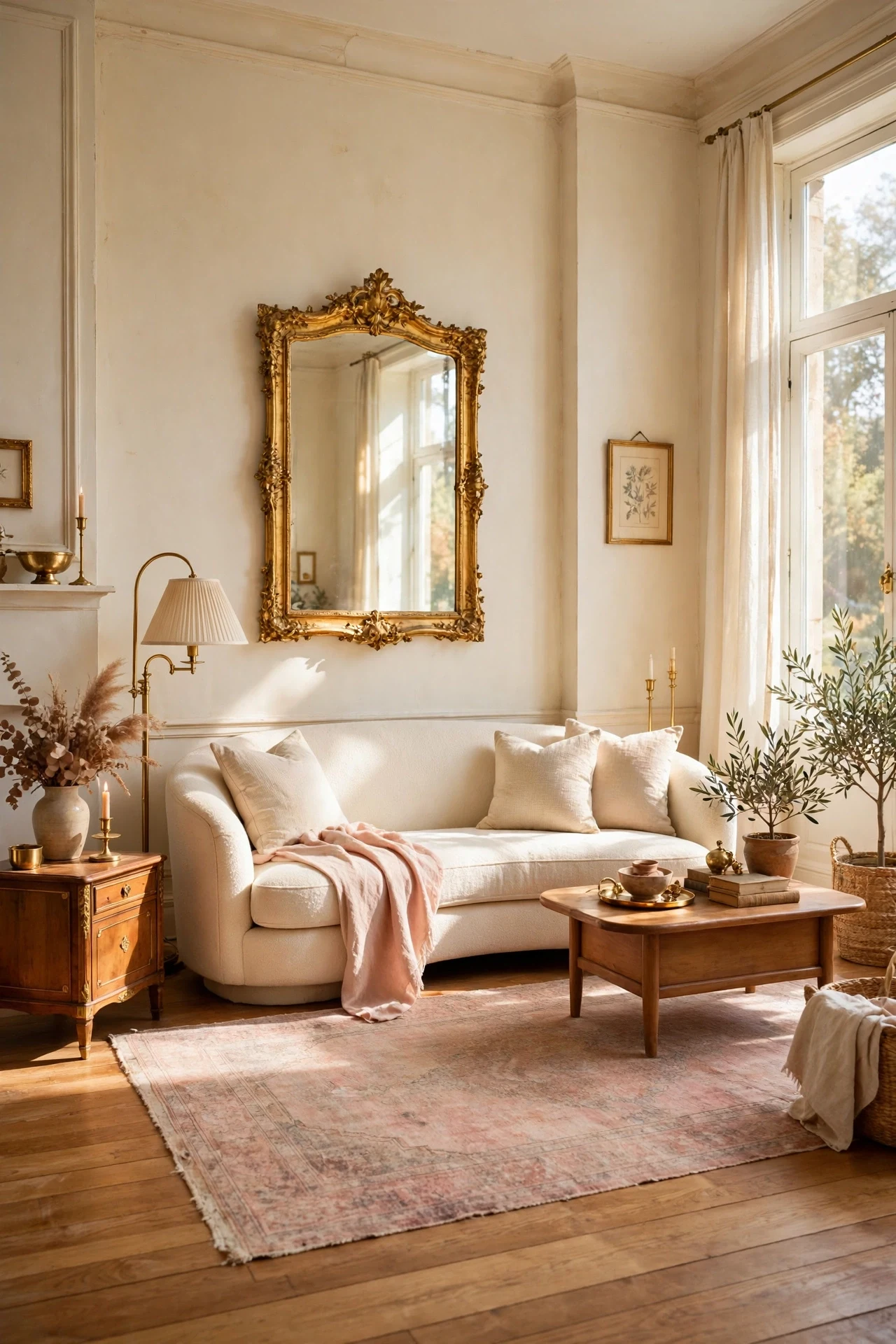
The last idea is the rule that holds the other fourteen together: in this style, the background stays bright so the vintage pieces can be the age in the room. Warm cream walls, never darker than a soft taupe at most, a warm wood floor or the faded rug over it, and daylight welcomed rather than draped against. Every dark decision gets questioned by this rule: a dark antique may enter only if it is small, like the tables of idea 4, and is surrounded by cream. Rooms that follow it feel like a sunny salon with antiques in it; rooms that break it slide, piece by piece, into the dusty museum this article promised to avoid.
Best For: Every vintage room in this palette; it is the scheme, not an option.
Not Ideal For: Anyone whose vintage taste is genuinely the dark, moody end; that is a legitimate style, but it is a different article.
Estimated Cost: $150-$450 (estimate) for warm cream paint for an average living room.
Budget Note: Paint is the cheapest brightness there is, and it should be judged only in the room, on two walls, at two times of day, before the full spend.
Renter Friendly: With Conditions
Renter Note: Paint needs the owner’s permission; renters can run the same rule through textiles, keeping every fabric and rug in the pale family and the vintage pieces small and warm.
What You Need
Warm cream paint in a washable finish, testers in two warm whites, painter’s tape, the discipline to test before committing.
Product type to look for: A warm white or cream with a yellow or pink undertone; blue-toned whites turn vintage wood orange by contrast and gold frames green-ish and cold.
How To Do It
- Paint tester patches on the lightest and darkest walls of the room.
- Judge them at noon and at lamp-lit evening with the sofa fabric held against them.
- Paint the room in the warmer of the two if in doubt; cream forgives, grey does not.
- Audit the room’s existing pieces against the rule and move the dark, large ones out first.
Pro Tip
Keep one small genuinely dark vintage piece if you love it, a clock, a frame, a box, and place it where the mirror reflects it. One dark note makes the brightness look chosen, and the rule survives because the exception is small.
Practical Tips for a Vintage Living Room
Buy vintage in the order of safety: textiles and wood first, glass and china next, anything electrical last and only after professional checking. Clean before you judge; half the pieces rejected as shabby are only dirty, and a washed, waxed antique often needs no restoration at all. Keep one palette and refuse pieces outside it, however bargain-priced, because a vintage room is edited by colour, not by era: pieces from five decades agree happily in cream, blush and gold. Mix one new anchor, like the curved sofa, with old accents, so the room is comfortable as well as characterful. And photograph the room from the doorway every time a piece arrives; vintage rooms creep, one lovely object at a time, into clutter, and the doorway photo is the honest editor.
Frequently Asked Questions
How do I make a vintage living room look bright instead of dark?
Keep the big surfaces pale: warm cream walls, a cream sofa, a faded rug, and let the vintage pieces be the smaller, warmer notes, wood tables, a gilded mirror, brass and glass. Darkness in vintage rooms comes from stacking dark wood and heavy fabric at full scale; at accent scale, the same pieces glow.
Should I buy real antiques or vintage-style new pieces?
A mix, chosen by category. New for the sofa and anything electrical, where comfort and safety matter. Real antiques for side tables, trunks, mirrors and china, where age is the value and the pieces are simple and safe. That split is what most bright vintage rooms actually are.
What colours define a bright vintage palette?
Warm white and cream as the base, warm taupe for depth, blush pink as the soft colour, and brushed gold as the metal, with warm mid-tone wood as the natural material. If a piece cannot sit inside those colours, it will fight the room, whatever its period.
Can a vintage living room work in a rental?
Mostly yes. The sofa, rug, tables, mirror leaned and secured, cabinet, cart, trunk and cushions are all freestanding. The chandelier, sconces and hanging fixings are the owner’s territory, and battery picture lights plus crystal-style table lamps cover most of their effect.
How do I stop a vintage room looking like a junk shop?
Edit by colour and by count. One palette, one pair of wood tables, one trunk, one cabinet collection with air in it, and a mantel you can see across. Junk-shop rooms are not too old; they are too full and too mixed in colour. Remove pieces until the room breathes, then stop.
Conclusion
Build the room in the order of this list: the curved cream sofa to set the shape, the gilded mirror and faded rug to set the light and colour, then the warm, genuinely old pieces, tables, cabinet, trunk, porcelain, one category at a time, each cleaned until it earns its place. Light it warm, drape it long, and hold the bright rule at the walls, and the result is a vintage living room with the dust left in the past where it belongs: all of the romance, none of the gloom. Start with the mirror if you start anywhere; it changes the light the day it goes up.