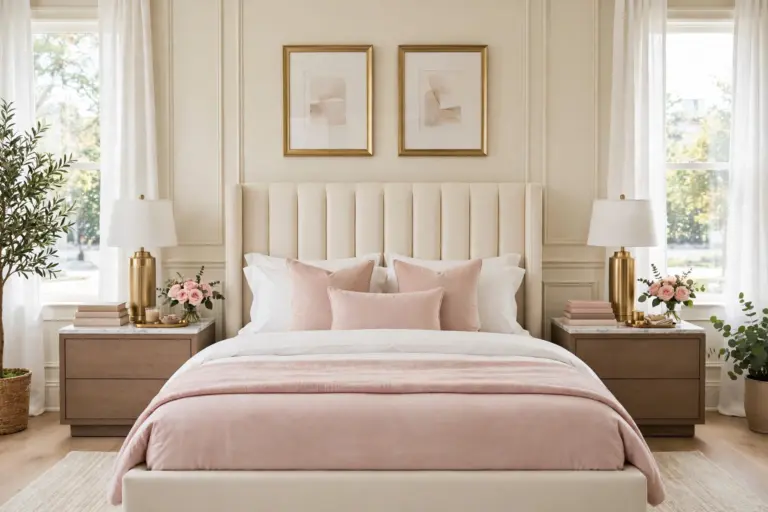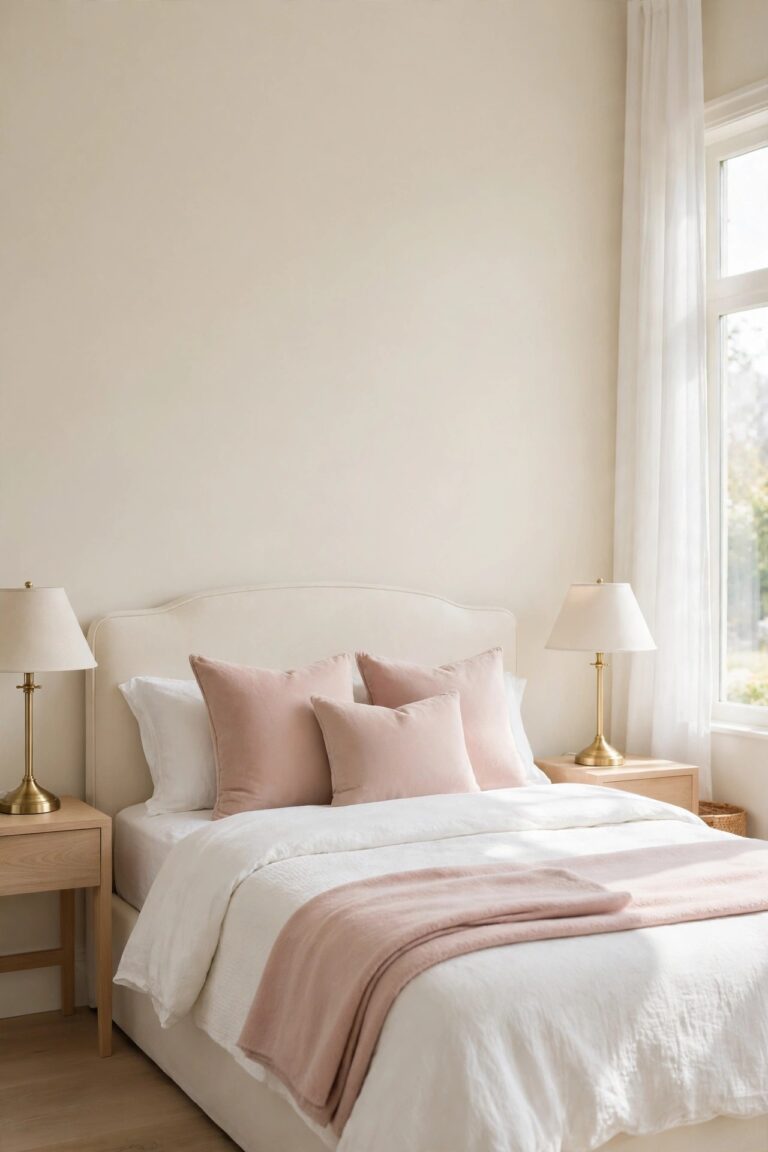
15 Very Small Bedroom Ideas That Feel Bigger and Calmer
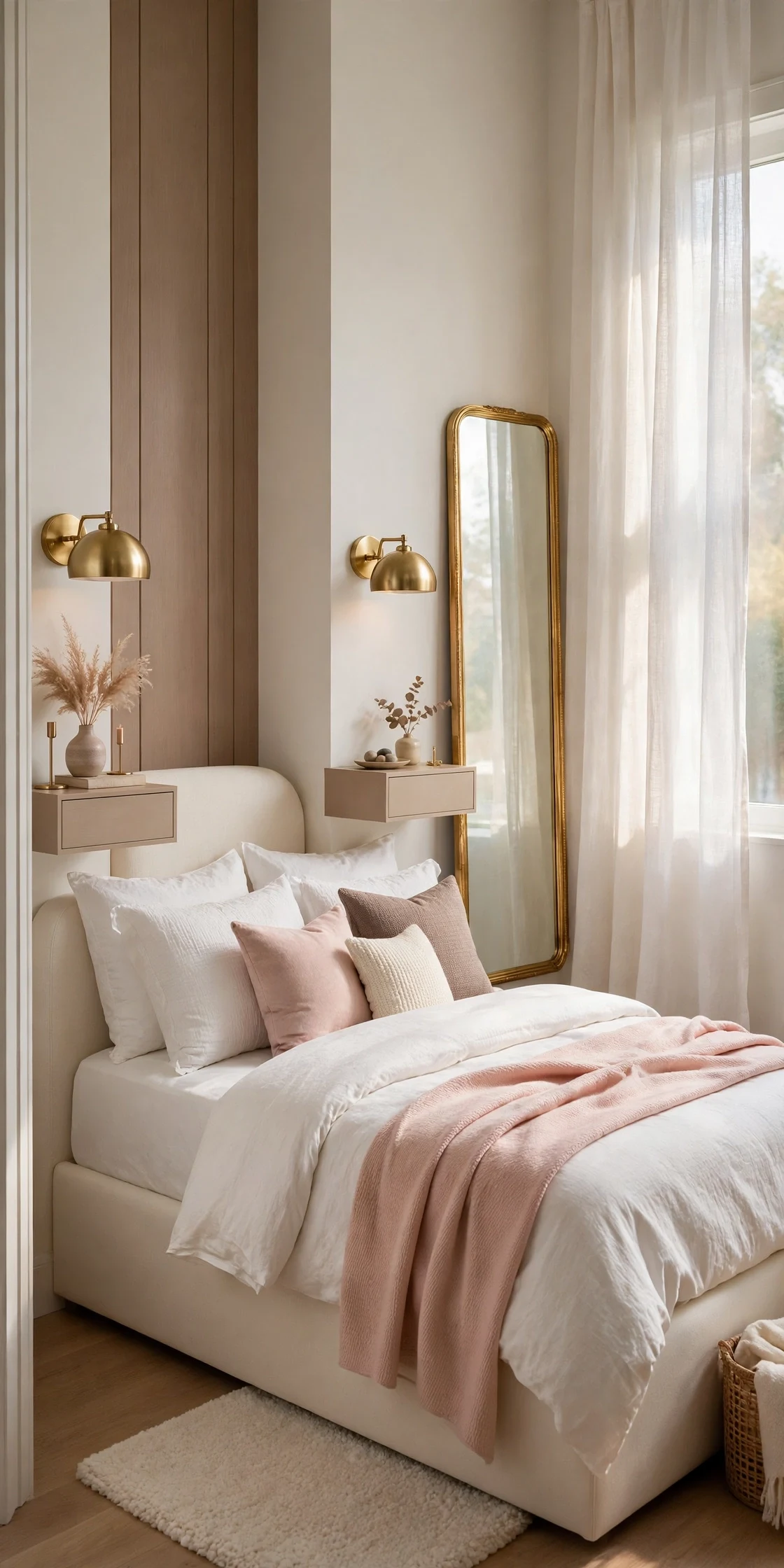
A very small bedroom punishes every wrong piece. A bed that sits too high eats the wall space above it, two chunky nightstands steal the floor on both sides, and a wide dresser turns the walkway into a squeeze. The room is not actually the problem. The proportions are. These very small bedroom ideas work on proportion first: lower the bed, lift storage off the floor, send one piece tall instead of wide, and let mirrors and pale layers do the expanding. Every idea is shown in the same bright glam palette, white, cream and warm taupe warmed with blush pink and brushed gold, so a tiny room still feels finished rather than stripped down. If your room is small but not tiny, the same rules in our small bedroom ideas guide will scale up
Disclosure: This article may contain affiliate links. If you buy through a link on this page, GlamNStyle may earn a small commission at no extra cost to you. Product links in this article are plain links; each one is checked on the retailer’s own page before it is added.
1. Choose a Low-Profile Bed With No Footboard
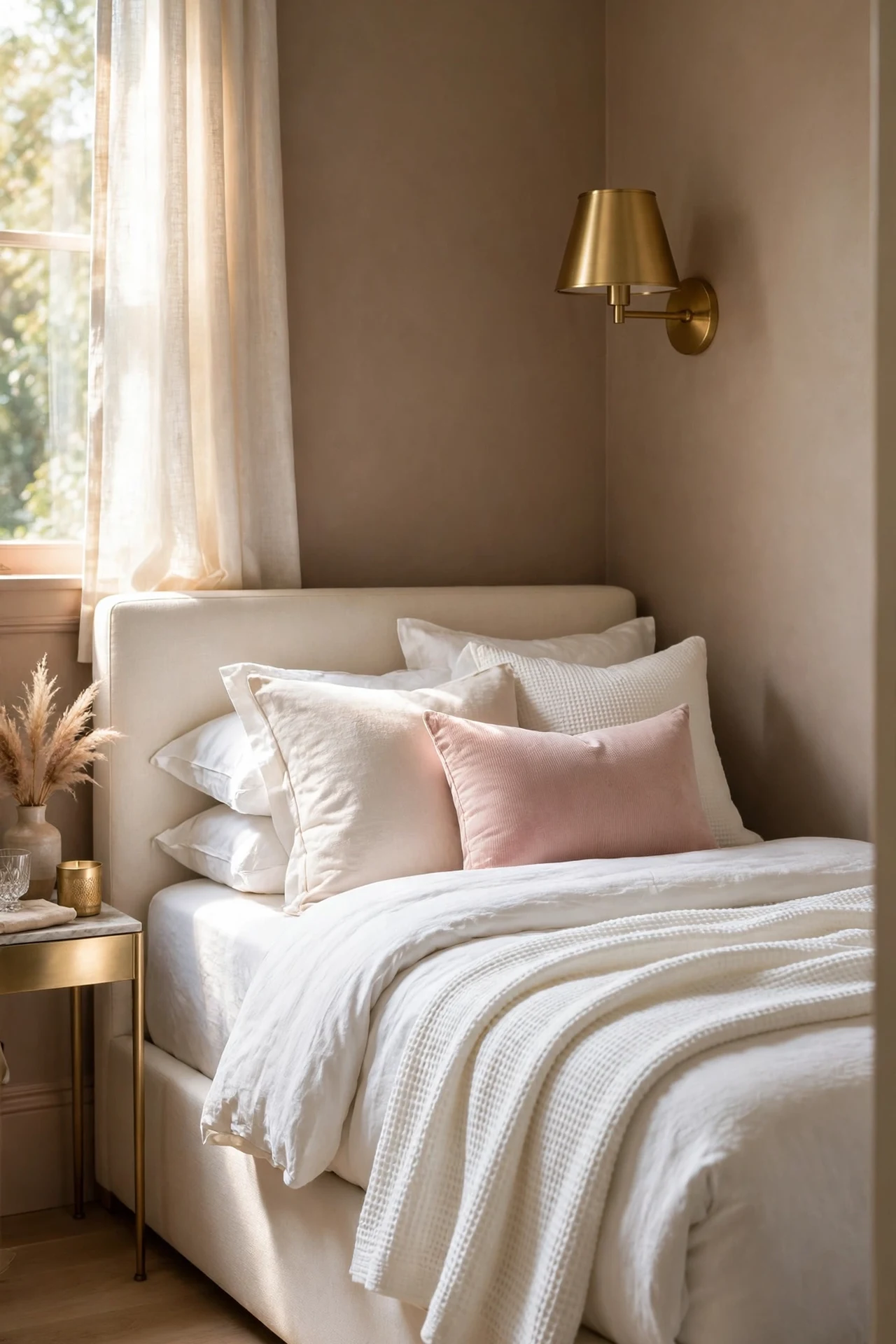
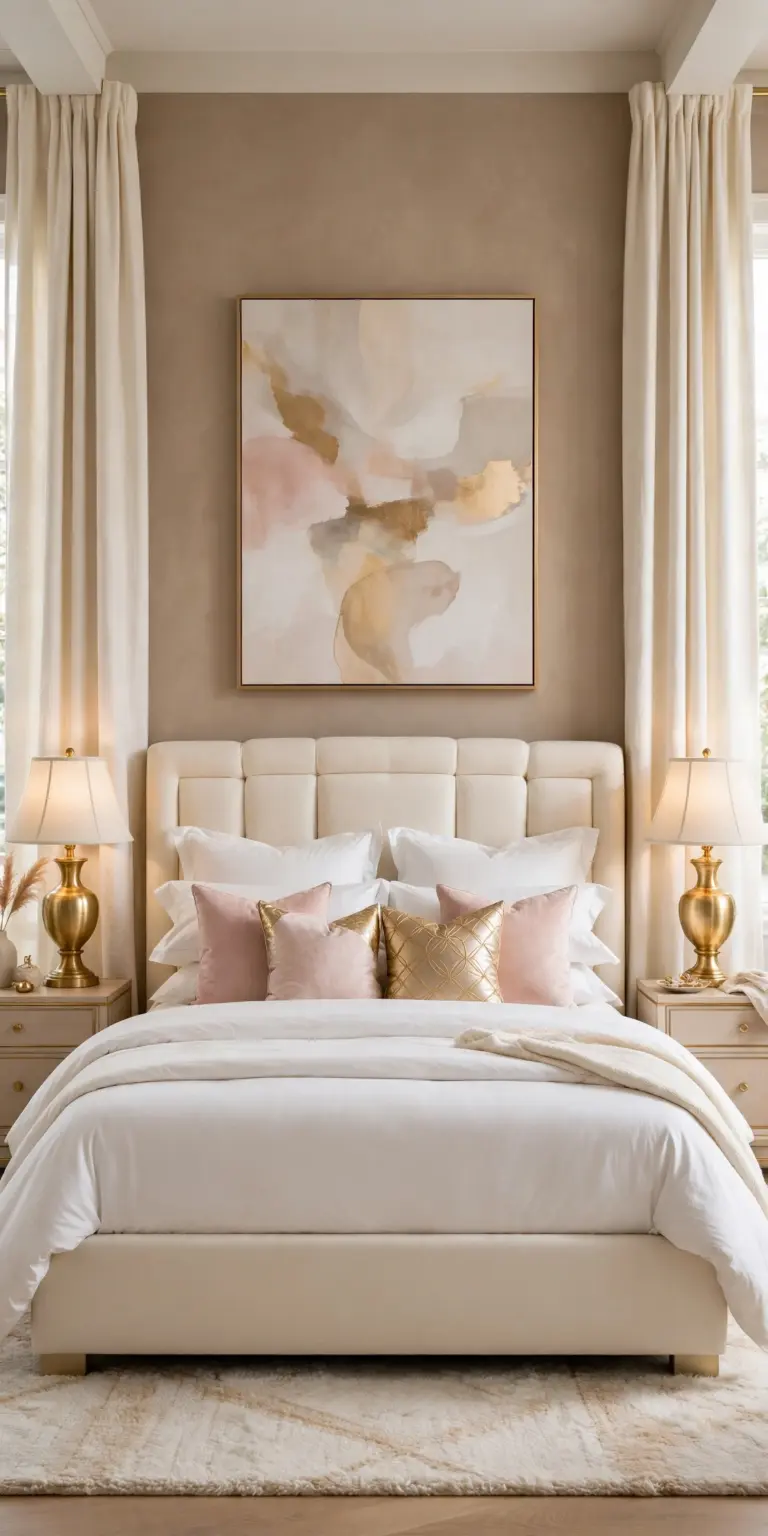
In a tiny room the bed is the room, so its frame decides how much space is left. A tall frame with a footboard builds a wall at the end of the bed: it cuts the sight line, blocks the walkway, and makes the floor plan feel two feet shorter than it is. A low-profile frame with no footboard keeps the top of the bed below the middle of the wall, so your eye travels over it to the wall behind and the room reads longer. Upholstery in cream keeps the biggest piece in the room soft and light instead of dark and heavy.
Best For: Rooms under 10 by 10 feet where the bed fills most of the floor.
Not Ideal For: Anyone who needs a high bed for mobility reasons; keep the height and save space elsewhere instead.
Estimated Cost: $250-$550 (estimate) for a low upholstered platform frame in full or queen.
Budget Note: The frame is the one piece worth buying once and well, because every other idea in this list builds around it.
Renter Friendly: Yes
Renter Note: Nothing is fixed to the room; measure the stairwell and door swing before ordering, because one-piece frames do not fold.
What You Need
Low upholstered platform bed frame with no footboard, layered white bedding, one blush cushion, tape measure.
Product type to look for: A platform frame under 12 inches tall at the rail, with a padded headboard under 42 inches and solid slats so no box spring is needed.
How To Do It
- Measure the room and mark the bed footprint on the floor with painter’s tape, leaving at least 18 inches on one side.
- Check the taped outline against the door swing and any radiator or vent.
- Assemble the frame in the room and centre it on the longest wall.
- Dress the bed in white layers and stop at one accent cushion, so the low line stays clean.
Pro Tip
Judge frames by headboard height, not by the photo online. In a small room, every inch of headboard above 42 inches is wall you cannot use for art or a mirror.
2. Hide Storage in Drawers Under the Bed
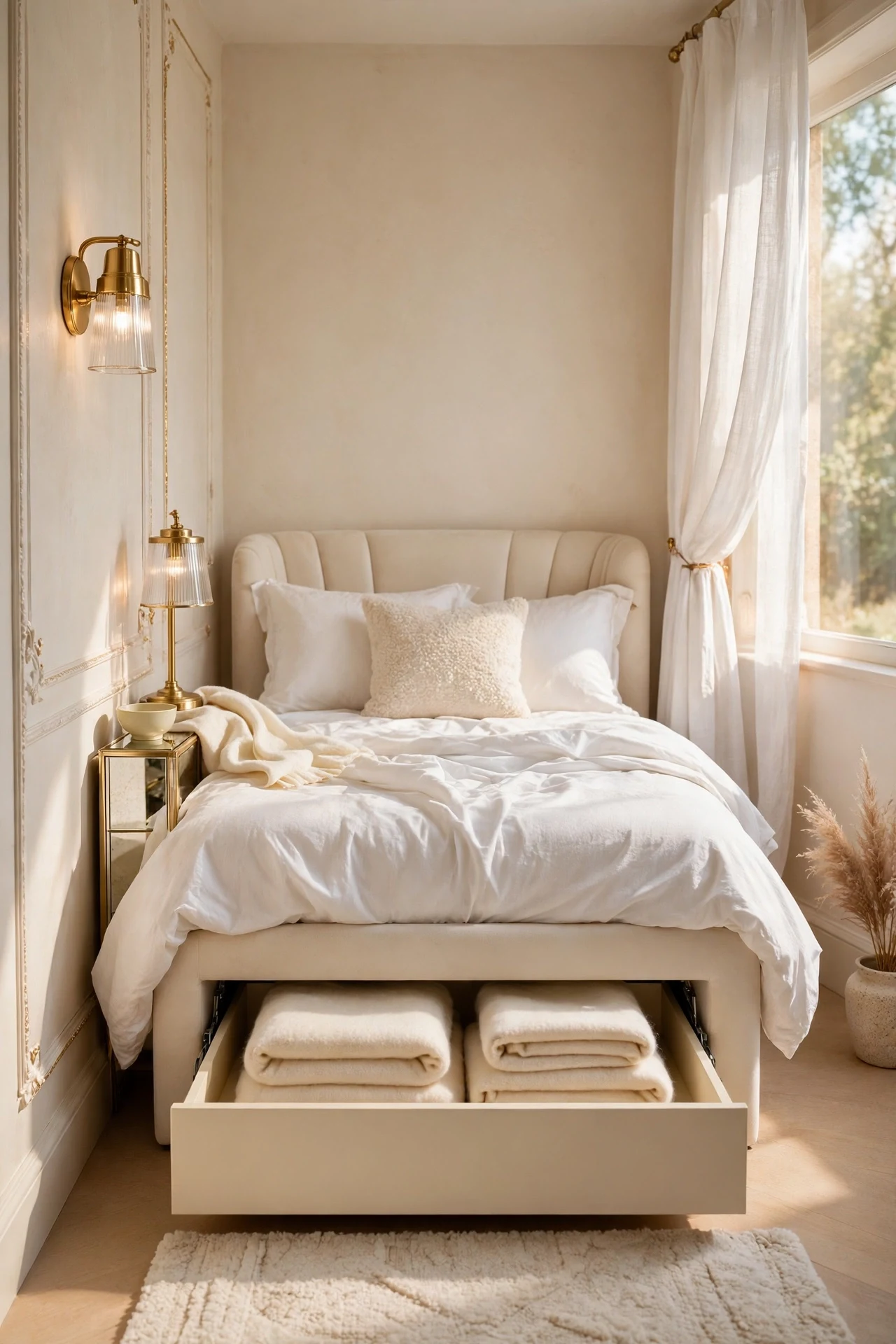
The space under a bed is the size of a whole dresser, and in most tiny bedrooms it holds dust and lost socks. Drawers built into the frame, or low rolling boxes made for the gap, turn that dead zone into the room’s main storage, which is what lets you skip a wide dresser entirely. Closed drawers matter here: open under-bed space shows clutter from the doorway, while a drawer front reads as part of the bed. Keep the contents boring and bulky, spare bedding, off-season clothes, towels, so the wardrobe is left for daily things.
Best For: Tiny rooms with no floor space for a dresser or chest.
Not Ideal For: Very low platform frames with under 5 inches of clearance; measure before buying loose boxes.
Estimated Cost: $60-$160 (estimate) for two low rolling under-bed drawers or boxes.
Budget Note: Two drawers cost far less than the smallest dresser and take zero floor space.
Renter Friendly: Yes
Renter Note: Rolling boxes with smooth wheels protect rental floors better than dragging plastic bins.
What You Need
Two low under-bed drawers or lidded rolling boxes that fit your frame clearance, labels, spare bedding or off-season clothing.
Product type to look for: Drawers or boxes at least 2 inches shorter than your under-bed clearance, with lids, because open tops collect dust on stored textiles.
How To Do It
- Measure the clearance from floor to frame rail at the lowest point, not the highest.
- Sort what will live under the bed into two groups only, bedding and off-season clothes.
- Fill, label the end of each drawer, and slide them in from the foot where access is easiest.
- Leave the last 6 inches near the head empty for airflow and easy pulling.
Pro Tip
Store by outfit season, not by item type. In a tiny room you open these drawers twice a year, so a full swap in spring and autumn beats daily rummaging.
3. Float the Nightstands to Free the Floor
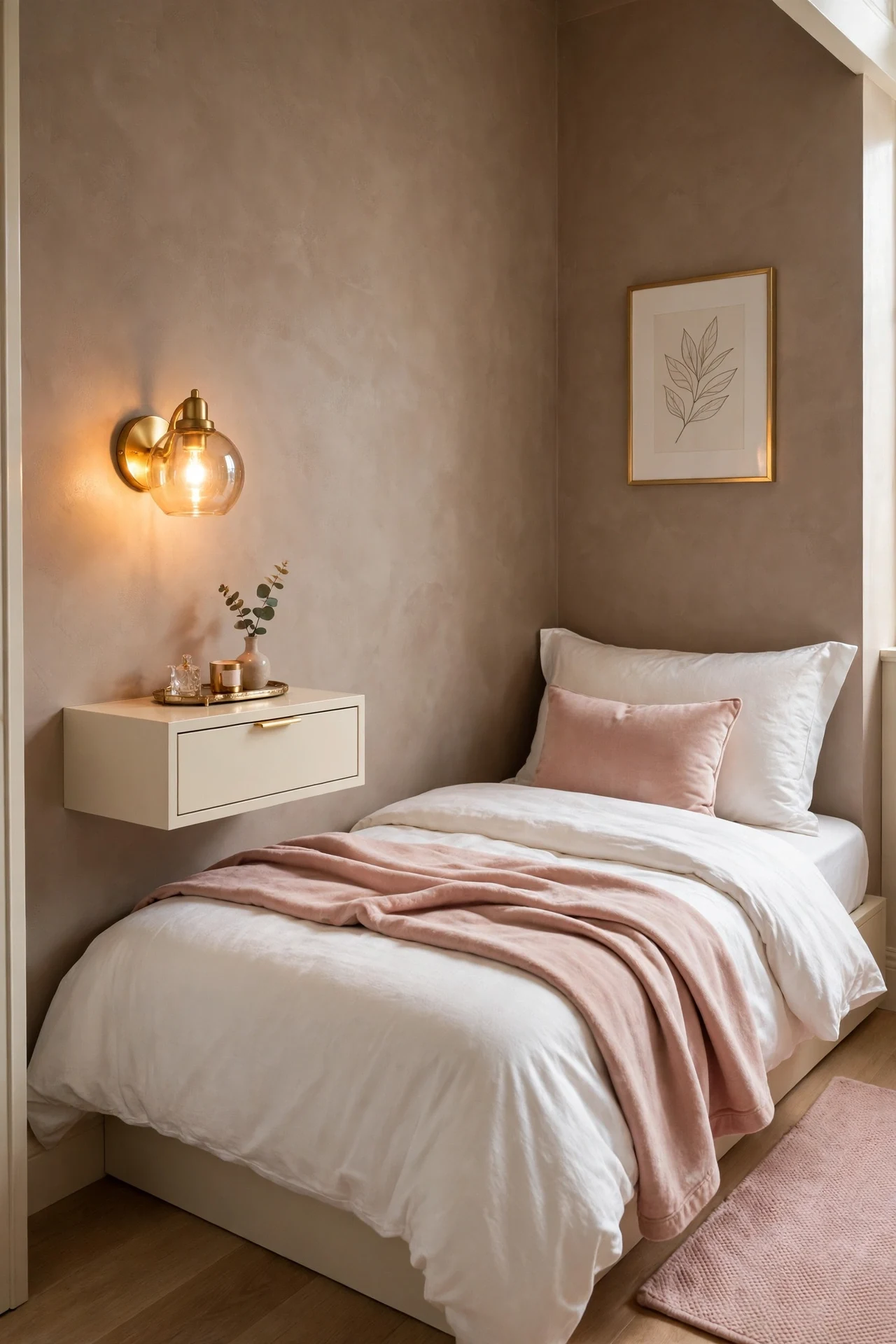
A standard nightstand spends most of its bulk on legs and empty sides. A floating nightstand, a small wall-mounted drawer or shelf at mattress height, holds the same book, phone and glass of water while leaving the floor beneath it visible and cleanable. Visible floor is the whole trick: the more floor your eye can follow to the wall, the bigger the room feels. One drawer is enough. It hides chargers and clutter, and the open top stays styled with a lamp or a small plant.
Best For: Beds pushed close to side walls where a legged nightstand will not fit.
Not Ideal For: Plaster or lath walls that cannot take fixings, and renters whose lease bans screws; use the shelf headboard in idea 13 instead.
Estimated Cost: $40-$120 (estimate) per floating nightstand drawer.
Budget Note: One good drawer per side costs less than a matched pair of small tables and looks more deliberate.
Renter Friendly: With Conditions
Renter Note: It needs two to four screws into studs or solid wall; patching is minor but get permission first if your lease is strict.
What You Need
Floating nightstand drawer, stud finder, level, drill, wall fixings rated for the drawer weight, small lamp.
Product type to look for: A wall-mounted drawer 12 to 16 inches wide with a soft-close runner and fixings rated well above what you will store in it.
How To Do It
- Find the studs or solid fixing points on both sides of the bed.
- Mark the top of the nightstand level with the top of the mattress, the height that works for reaching in bed.
- Fix the bracket, hang the drawer, and test it with books before styling.
- Route the lamp cord down the wall in a slim cord cover so no wire crosses the floor.
Pro Tip
Mount the pair before you finalise the bed position. In tiny rooms the nightstands, not the bed, decide where the bed can centre on the wall.
4. Send Storage Tall With One Narrow Wardrobe
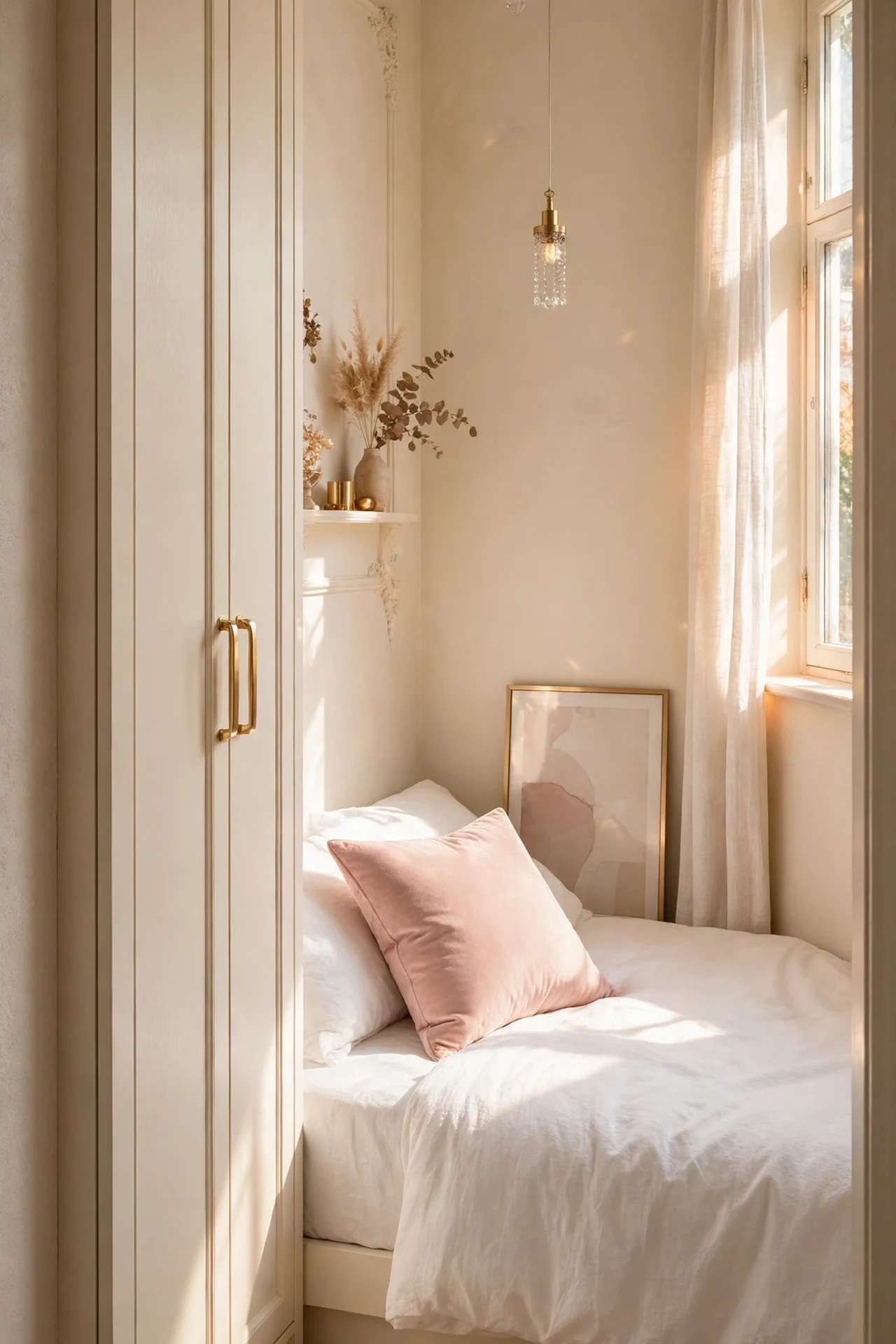
When floor space runs out, the only direction left is up. One tall, narrow wardrobe, 24 inches wide and 6 to 7 feet tall, stores as much as a wide low dresser while using half the footprint, and its height draws the eye up, which makes the ceiling feel higher. Keep it the same colour as the walls or one shade warmer, so it reads as part of the room rather than a box parked in it. Inside, a hanging rail up top and drawers below beats shelves for clothes you wear weekly.
Best For: Rooms with a short wall section, alcove or corner that fits nothing else.
Not Ideal For: Rooms with ceilings under 7 feet, where a tall piece crowds the line of the ceiling.
Estimated Cost: $200-$450 (estimate) for a tall narrow wardrobe with rail and drawers.
Budget Note: One tall piece replaces both a dresser and a storage bench, so compare it against the pair, not against one item.
Renter Friendly: Yes
Renter Note: Freestanding is fine, but anchor it to the wall with the supplied strap for safety; that is one small screw and worth it.
What You Need
Tall narrow wardrobe, anti-tip wall strap, two drawer organisers, tape measure.
Product type to look for: A wardrobe under 26 inches wide and at least 72 inches tall, with an adjustable rail and at least two drawers, and a supplied anti-tip kit.
How To Do It
- Measure the corner or alcove, including skirting boards, before choosing the width.
- Anchor the wardrobe to the wall first, then load it; a loaded tall piece is hard to shift.
- Hang long items at the top, drawers at hand height, heavy items at the bottom.
- Keep the top of the wardrobe empty; stored boxes up there undo the clean tall line.
Pro Tip
Paint or choose the wardrobe in the wall colour. A tall piece that disappears into the wall gives you the storage without the visual weight.
5. Hang Curtains High and Wide to Fake a Bigger Window
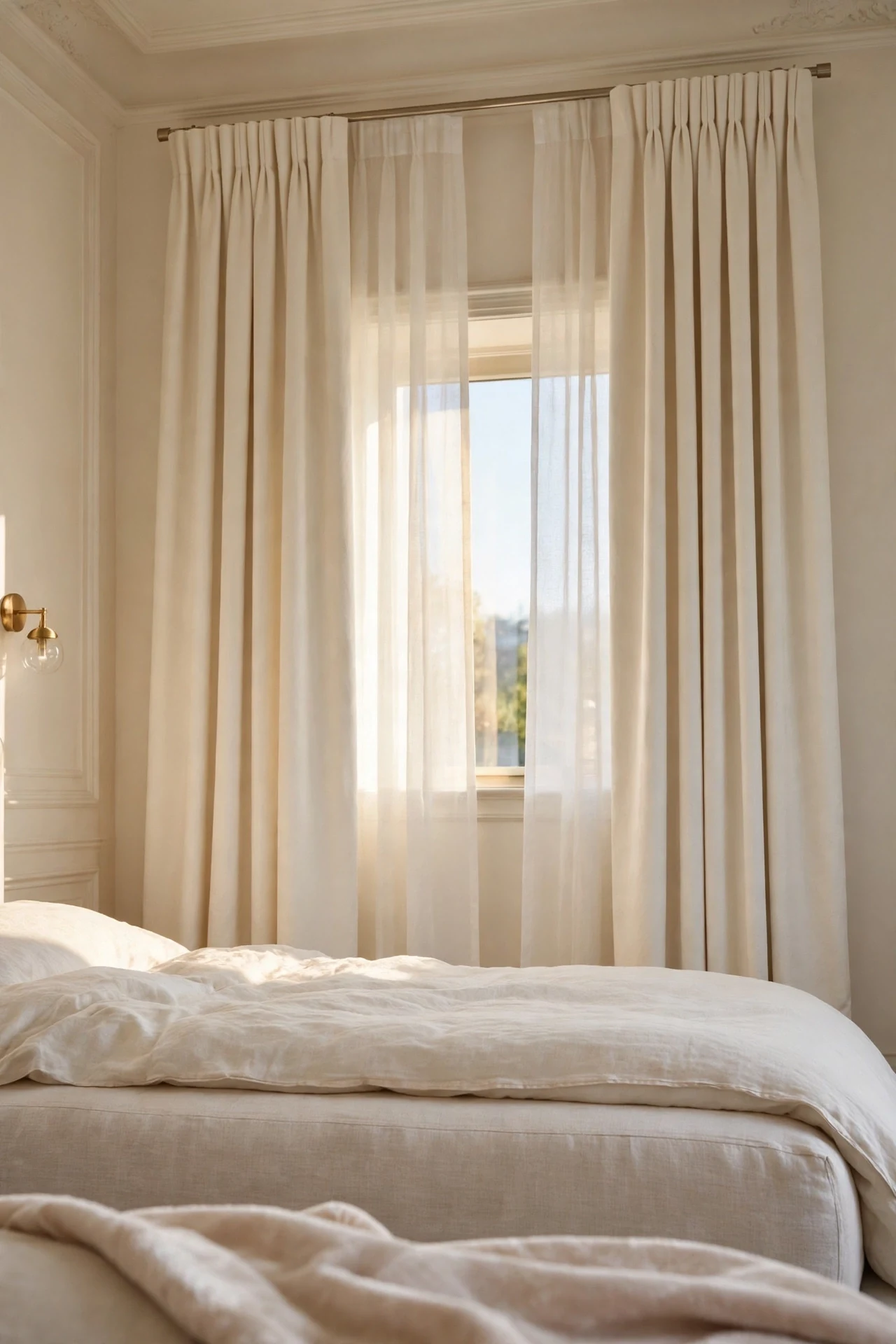
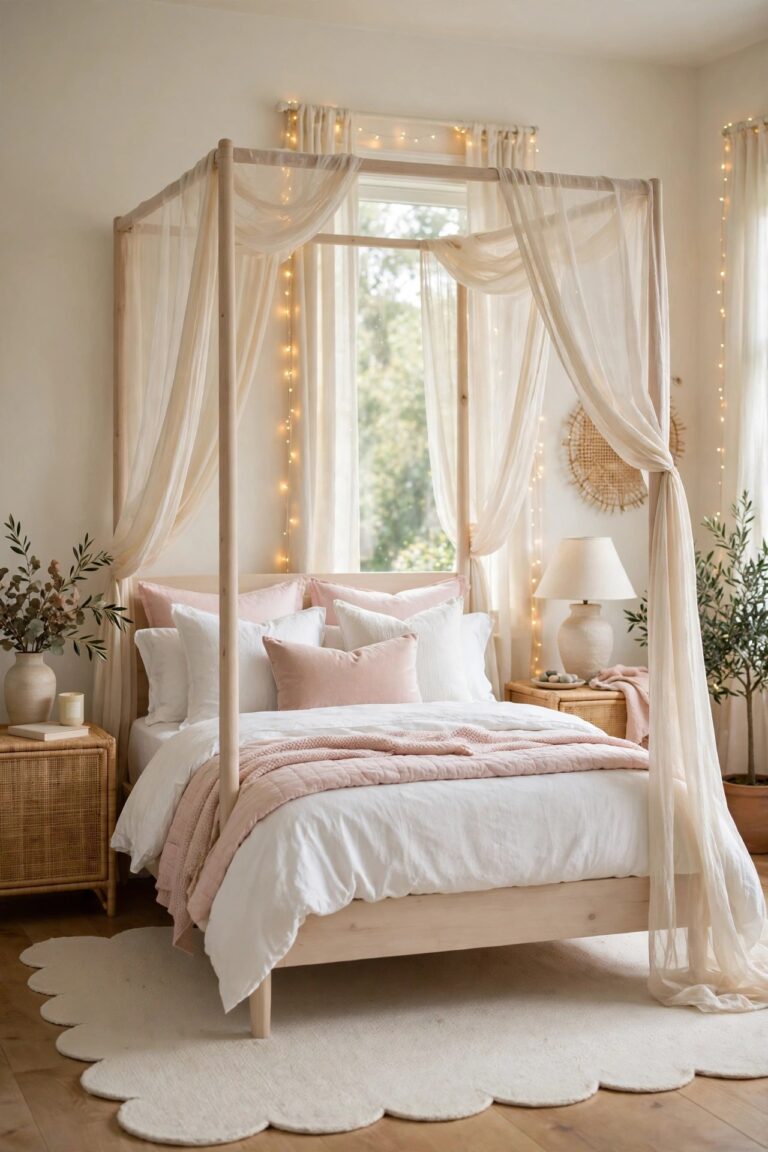
Small rooms usually have small windows, and short curtains hung just above the frame announce exactly how small. Mounting the rod close to the ceiling and well beyond the sides of the frame changes the maths: the fabric covers wall, not glass, so the window looks taller and wider and more light reaches the room. Cream linen-look curtains keep the wall of fabric pale, and a sheer behind them softens daylight so you can leave them open all day without glare. This is the cheapest size illusion in the whole list.
Best For: Any tiny bedroom with a small or badly placed window.
Not Ideal For: Windows that run wall to wall already; there is no wall to borrow, so spend the money on idea 6 instead.
Estimated Cost: $50-$130 (estimate) for rod, brackets and two long cream curtain panels with sheers.
Budget Note: Spend on length, not fabric brand; a long inexpensive panel hung high looks better than a short expensive one at the frame.
Renter Friendly: With Conditions
Renter Note: The rod needs screws above the window; use existing holes where possible and fill on leaving if needed.
What You Need
Curtain rod 12 to 20 inches wider than the frame, ceiling-close brackets, two floor-length cream panels, one sheer panel, steamer.
Product type to look for: Panels long enough to just kiss the floor from the higher rod position; measure from the new rod height, not the old one.
How To Do It
- Mark the rod line 2 to 4 inches below the ceiling, or as high as the brackets allow.
- Extend the marks at least 6 inches past each side of the frame so open curtains cover wall, not glass.
- Hang sheers first, then the cream panels, and steam out the creases in place.
- Check from the door: you should see fabric and light, not the window’s true edges.
Pro Tip
If the window is off-centre on the wall, centre the rod on the wall instead. The curtains will fake a centred window and the whole wall looks planned.
6. Lean a Tall Mirror Where It Doubles the Light
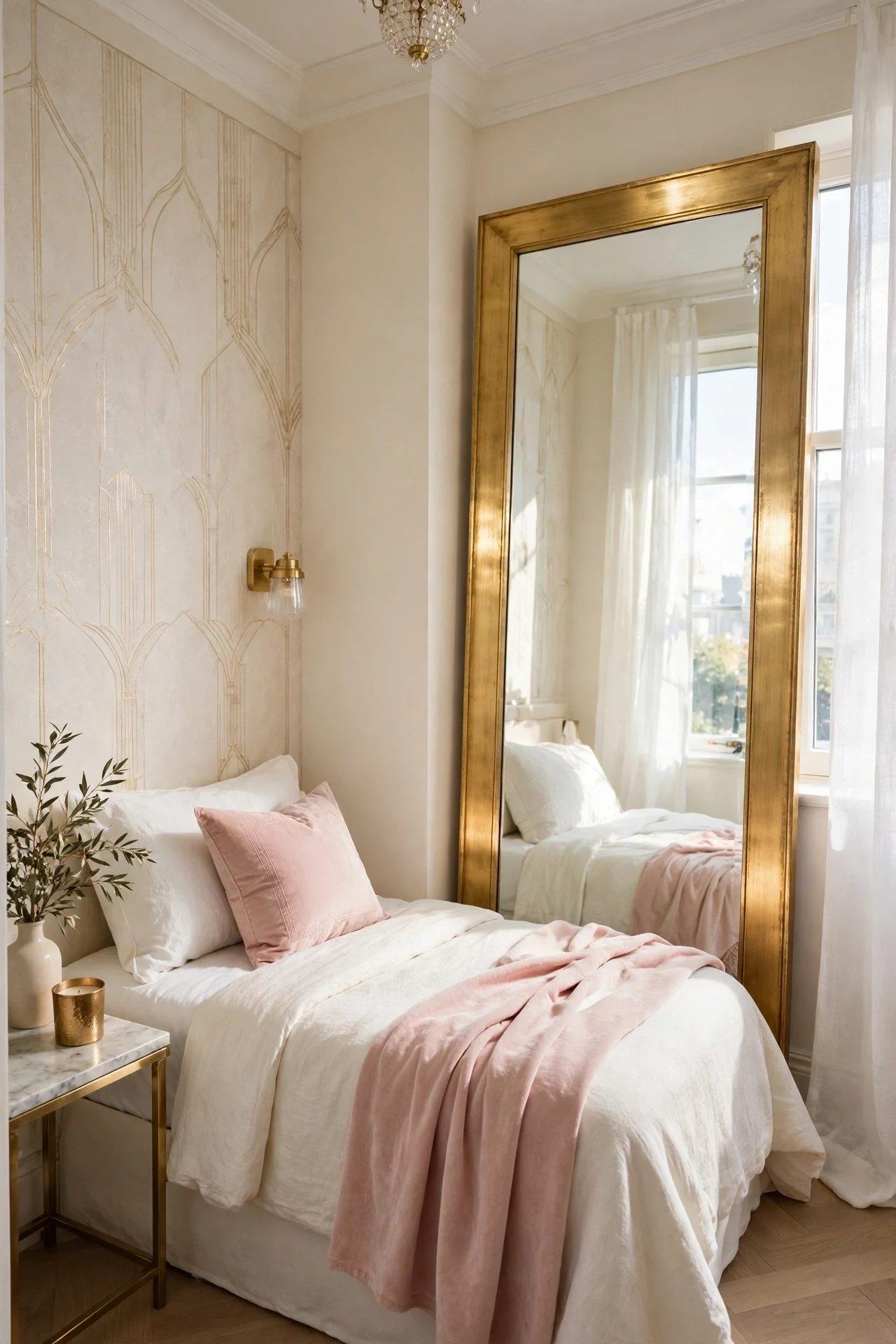
A mirror is the oldest small-room trick because it works twice: it bounces daylight deeper into the room and it shows a second, reflected room that your eye counts as space. In a tiny bedroom the mirror has to be tall and thin rather than wide, and it has to face light, not a blank wall. Leaning a full-length mirror in the corner beside the window reflects the window itself, which doubles the brightest thing in the room. A slim brushed gold frame keeps it inside the palette and adds the one metallic note a pale room needs.
Best For: Dark tiny rooms and rooms with one small window.
Not Ideal For: Rooms where the only free corner faces a cluttered wall; the mirror will double the clutter instead.
Estimated Cost: $70-$180 (estimate) for a tall gold-framed leaning mirror.
Budget Note: One tall mirror does more than three small decorative ones, which break the reflection into fragments.
Renter Friendly: Yes
Renter Note: Leaning needs no fixings, but secure the top with a removable adhesive hook and cord so it cannot slide.
What You Need
Tall mirror at least 60 inches high with a slim frame, adhesive wall hook and clear cord or anti-tip strap, microfibre cloth.
Product type to look for: A full-length mirror with safety-backed glass and a frame under 2 inches wide, so the reflection, not the frame, fills the view.
How To Do It
- Stand the mirror in the corner beside or opposite the window and check the reflection from the doorway.
- Angle it until it reflects the window and the bed, not the ceiling or a bare wall.
- Secure the top to the wall with the hook and cord.
- Keep the floor in front of it empty; a basket parked there shows twice.
Pro Tip
Clean a small-room mirror more often than feels necessary. In a reflected room, dust and smudges appear twice and quietly cheapen everything else.
7. Swap Table Lamps for Wall Sconces
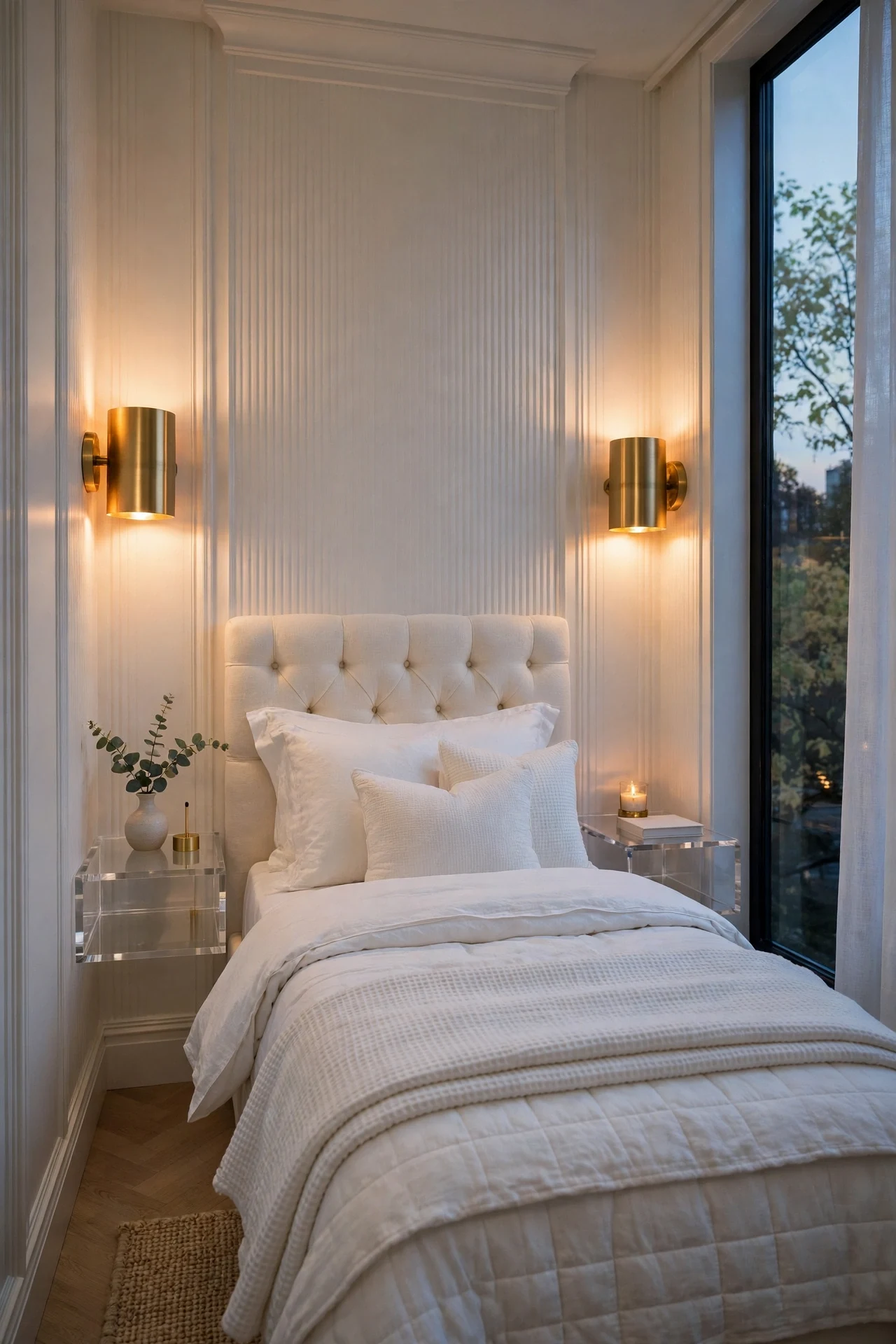
Table lamps are surface thieves. Each one takes the exact spot where a book, a phone and a glass need to go, and on a small nightstand that spot is the whole top. Wall sconces move the light up and off the surface, and a pair at headboard height gives the even, warm glow that makes a small room feel like a boutique hotel room rather than a box with a bed in it. Plug-in sconces with a cord cover do the job with no electrician, and warm white bulbs keep the light kind.
Best For: Rooms with floating or very small nightstands, and anyone who reads in bed.
Not Ideal For: Beds that move often; fixed light fixes the layout, so be sure of the bed position first.
Estimated Cost: $50-$140 (estimate) for a pair of plug-in brushed gold sconces.
Budget Note: Plug-in models avoid electrician costs entirely; hardwired pairs can double the budget once fitting is added.
Renter Friendly: With Conditions
Renter Note: Plug-in sconces need two small screws each; the cord cover sticks on and peels off cleanly.
What You Need
Pair of plug-in wall sconces, warm white bulbs, cord covers, level, drill and fixings.
Product type to look for: Plug-in sconces with an inline switch on the cord, so each side can be switched from the bed without a wall switch.
How To Do It
- Mark both sconces level, about 6 to 8 inches above the top of the headboard and just outside its width.
- Fix the backplates into studs or solid fixings.
- Run each cord straight down inside its cover to the socket.
- Fit warm white bulbs and check the pair reads as one line of light from the door.
Pro Tip
Put both bulbs on the same warmth and brightness, bought in the same pack. Mismatched bulbs are invisible in daylight and glaring at night.
8. Keep the Palette Pale, Then Add One Blush Accent
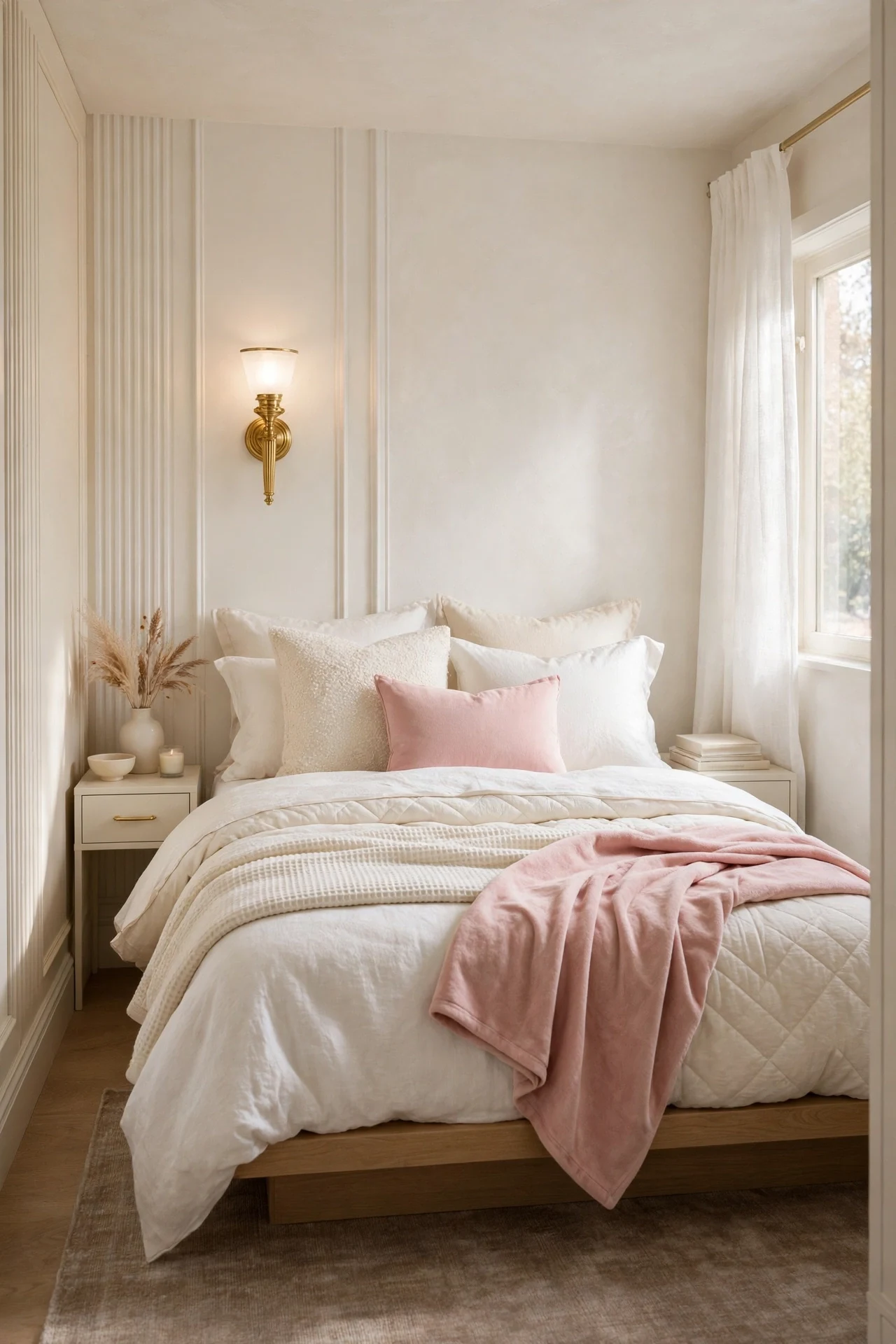
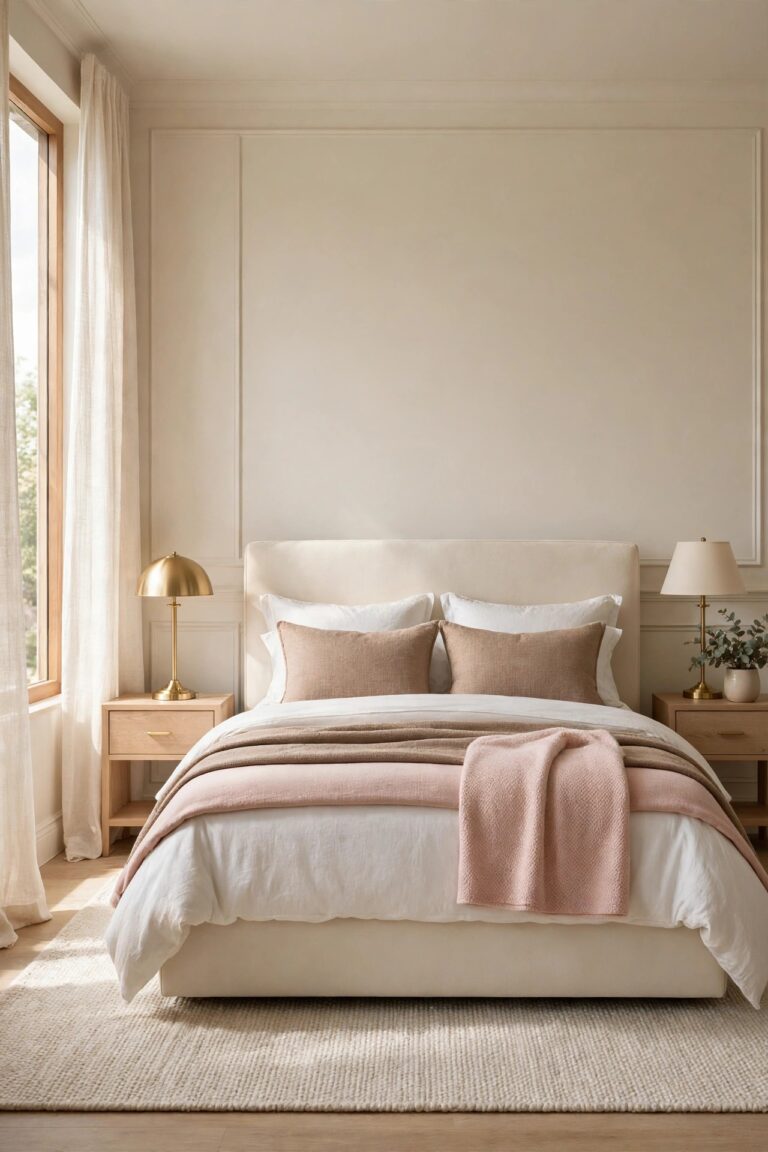
Colour shrinks a small room when it is chopped into pieces: one dark wall, one bright duvet, one patterned rug, each pulling the eye to a different corner. A pale, close-toned palette does the opposite. White walls, cream bedding and warm taupe textiles sit within a breath of each other, so the eye slides across the room without stopping, and the room feels like one calm volume instead of four small ones. The single blush accent, a throw or one cushion, is deliberate: one soft colour gives the eye a place to land and stops pale from turning bland.
Best For: North-facing and low-light tiny rooms that feel grey by day.
Not Ideal For: Anyone who loves strong colour contrast; this scheme trades drama for calm and space.
Estimated Cost: $40-$120 (estimate) for paint in a warm white, or $30-$80 (estimate) for textiles only.
Budget Note: Textiles first. Changing the duvet, throw and cushion to pale tones costs a fraction of repainting and proves the scheme before you commit.
Renter Friendly: Yes
Renter Note: The full effect is possible with textiles alone, so no paint permission is needed.
What You Need
Warm white or cream bedding set, warm taupe throw or rug, one blush cushion or throw, paint only if permitted.
Product type to look for: Bedding in warm whites with a slight cream undertone; blue-toned bright whites fight warm taupe and gold and turn the room cold.
How To Do It
- Pick the wall colour or the bedding as the base tone and match everything else within two shades of it.
- Layer the bed: white sheets, cream duvet, taupe throw at the foot.
- Add exactly one blush piece, at the bed, where the eye lands first.
- Remove any remaining dark or saturated item from sight for a week before deciding it can stay.
Pro Tip
Test pale layers at night, not in the shop. Warm taupe that looks gentle at noon can turn muddy under warm bulbs if it leans grey.
9. Size the Rug to the Bed, Not to the Room
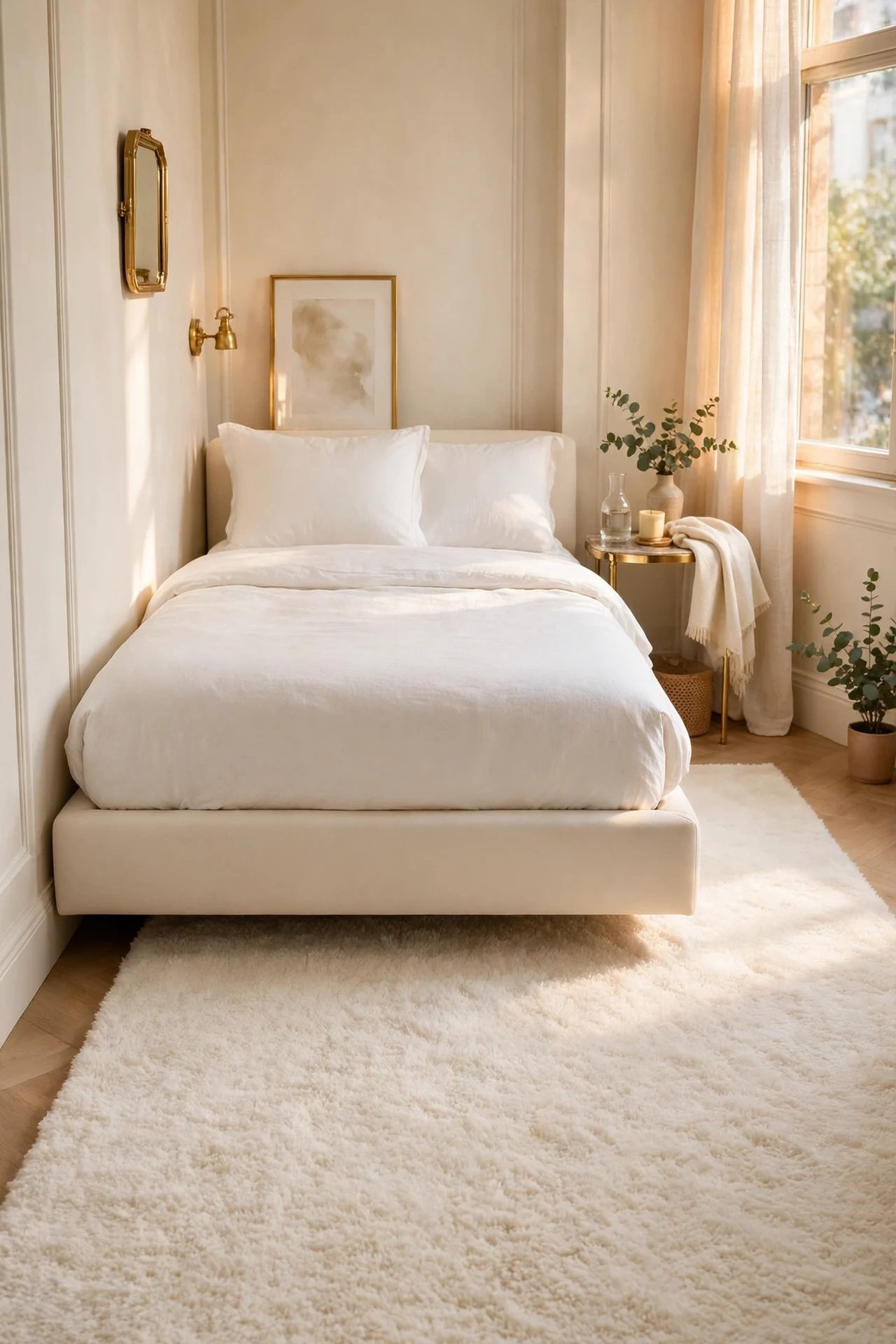
A tiny rug floating in the middle of a small room makes everything around it look smaller, because it draws a small rectangle inside a small rectangle. A rug sized to the bed does the opposite: slide it under the lower two thirds of the bed so a border of soft texture shows on both sides and at the foot. The bed zone reads as one generous platform, your feet land on something warm, and the remaining bare floor forms a clean frame. In cream or warm taupe with a low pile, it adds the layer a pale room needs without pattern noise.
Best For: Rooms with cold or worn flooring and a bed against one wall.
Not Ideal For: Rooms where the door swings across the rug position; check the swing before ordering.
Estimated Cost: $60-$180 (estimate) for a low-pile rug around 5 by 7 feet.
Budget Note: Low-pile synthetic rugs in this size are inexpensive and washable, which matters when the rug sits half under a bed.
Renter Friendly: Yes
Renter Note: Use a non-slip underlay sheet to protect the floor beneath and stop the rug creeping as you make the bed.
What You Need
Low-pile rug around 5 by 7 feet in cream or warm taupe, non-slip underlay, furniture sliders or a second pair of hands.
Product type to look for: A rug with pile under half an inch, so the bed sits level and drawers under the bed still pull clear over it.
How To Do It
- Roll the rug out and mark where the bed’s lower two thirds will sit.
- Lay the underlay, then the rug, with the long edge parallel to the bed.
- Lift or roll the bed onto the rug using sliders; do not drag a loaded frame.
- Check equal borders on both sides and at the foot before dressing the bed.
Pro Tip
If equal borders are impossible because the bed is against a wall, push the rug fully to the wall side and take all the border on the open side. One honest border beats two slivers.
10. Fold a Desk or Vanity Down From the Wall
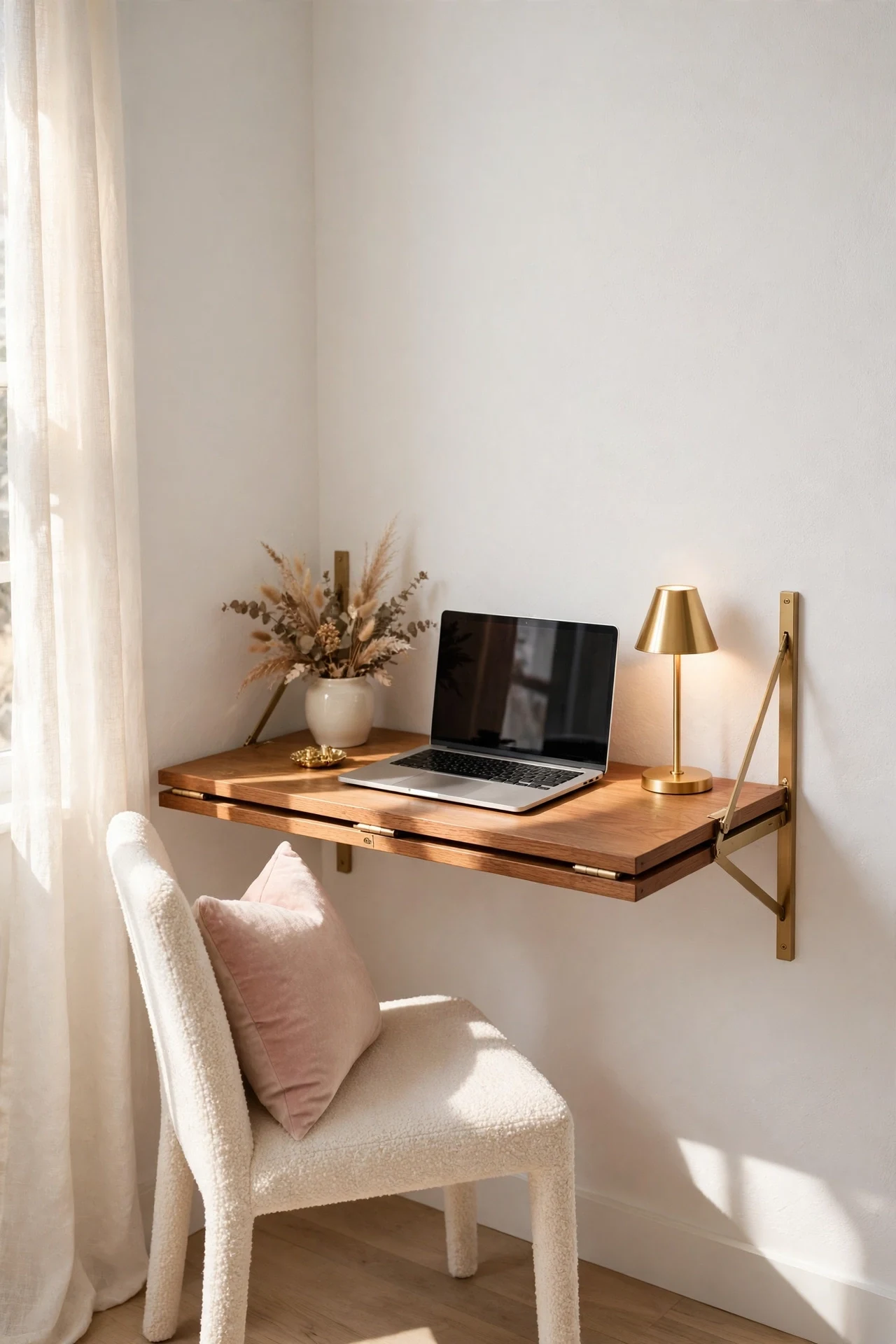
A tiny bedroom often has to be a bedroom and something else: a desk for two work-from-home days, a vanity, a place to write. A fixed desk claims its footprint all day for a job it does for two hours. A wall-mounted fold-down desk claims nothing when it is closed, a shallow panel on the wall, and opens to a real work surface when you need it. Mounted near the window it borrows the best light in the room, and paired with a chair that already lives in the room, the desk corner appears and disappears on demand.
Best For: Studio-style living and bedrooms that double as a weekday workspace.
Not Ideal For: Anyone who needs a permanent dual-monitor setup; folding desks suit a laptop and a lamp, not a full workstation.
Estimated Cost: $90-$220 (estimate) for a wall-mounted fold-down desk.
Budget Note: Compare it with a small fixed desk plus the chair it forces you to store; the folding version usually wins on both money and space.
Renter Friendly: With Conditions
Renter Note: It must fix into studs or solid wall at four or more points; this is a permission-first change in a rental.
What You Need
Wall-mounted fold-down desk, stud finder, level, drill, a chair that tucks fully under or hangs nearby, small lamp.
Product type to look for: A folding desk rated for at least 50 pounds, with a latch that holds the leaf closed, in a warm wood or cream finish that matches the room.
How To Do It
- Choose the wall nearest the window and confirm stud positions across the desk width.
- Mark the leaf height at standard desk height, about 29 to 30 inches, while seated in your chair.
- Fix the frame to the studs, then hang and test the leaf with books before a laptop.
- Keep only daily items inside; the desk folds clean only if it is nearly empty.
Pro Tip
Paint the closed panel the wall colour and hang one small gold-framed print on it. Closed, it reads as decor; the room never looks like an office at rest.
11. Use the Back of the Door and the Gap Beside the Wardrobe
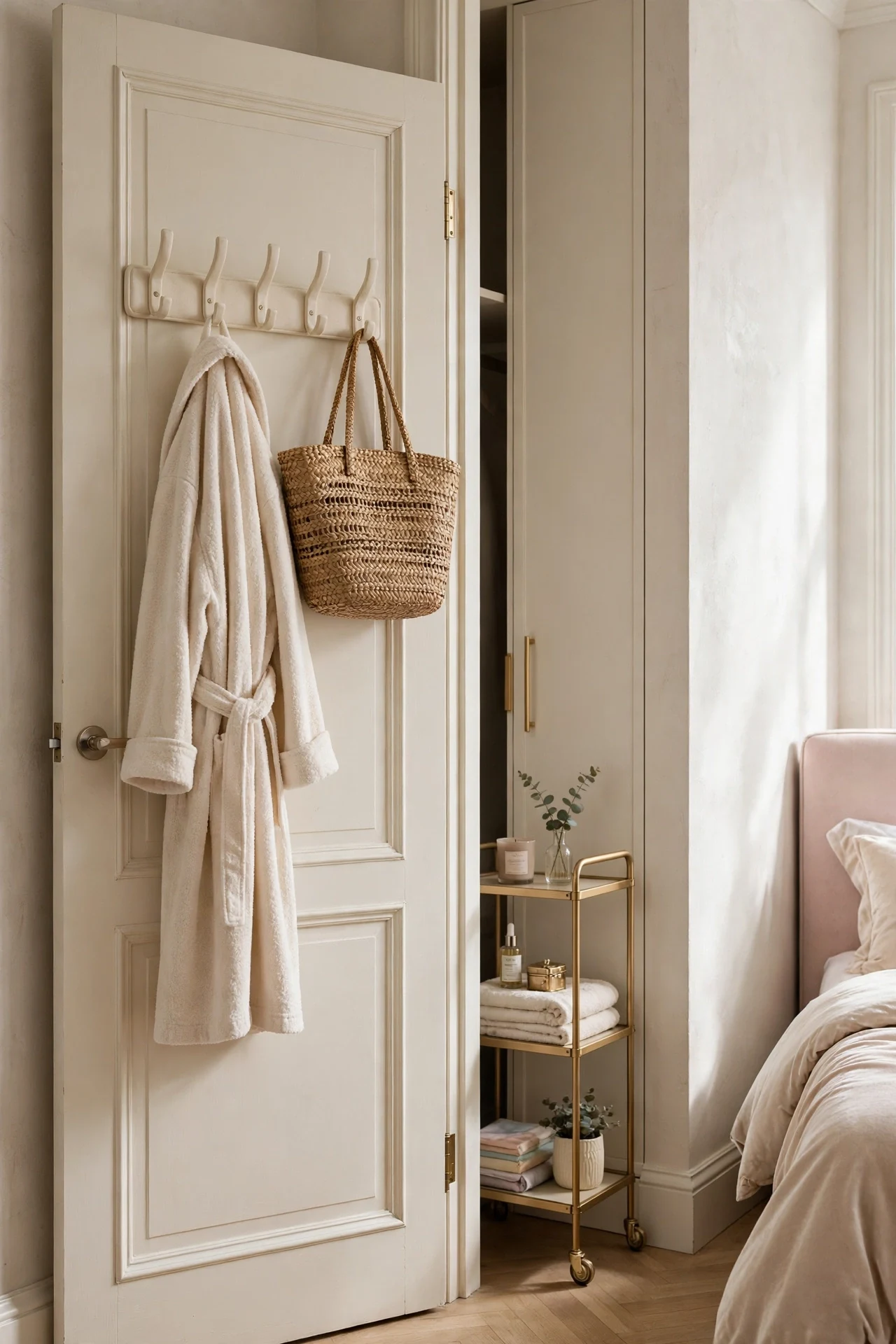
Every tiny bedroom has two storage zones hiding in plain sight: the back of the door and the sliver of space beside the wardrobe. The door back takes an over-door rack with no fixings at all, and it is the natural home for the robe, the gym bag and tomorrow’s outfit, the things that otherwise live on the bed. The 6 to 8 inch gap beside a wardrobe fits a slim rolling cart for chargers, books and bedside overflow. Neither zone is glamorous, and that is the point: the visible room stays calm because the working clutter has somewhere honest to go.
Best For: Rooms where every wall already holds furniture.
Not Ideal For: Doors that open against a wardrobe; check the swing so the rack does not bang the furniture.
Estimated Cost: $25-$70 (estimate) for an over-door rack and a slim rolling cart.
Budget Note: This is the cheapest storage in the list per item stored, because both pieces use space you already own.
Renter Friendly: Yes
Renter Note: Over-door racks hang without screws; add the felt pads supplied with most racks so the door paint is not marked.
What You Need
Over-door hook rack with felt pads, slim rolling cart under 8 inches wide, small baskets or pouches for the cart shelves.
Product type to look for: An over-door rack sized to your door thickness with padded hooks, and a cart on smooth castors that pulls out with one hand.
How To Do It
- Measure the door thickness and the wardrobe gap before ordering either piece.
- Hang the rack and load it heaviest at the bottom hooks.
- Stock the cart by frequency: daily items at the top, chargers and spares below.
- Set a rule that the bed stays clear because both zones exist; the system fails if the bed remains the default shelf.
Pro Tip
Keep the door rack to five hooks in use, however many it has. A door that looks like a coat stand makes the whole room feel like storage.
12. Choose a Storage Ottoman Instead of a Bench
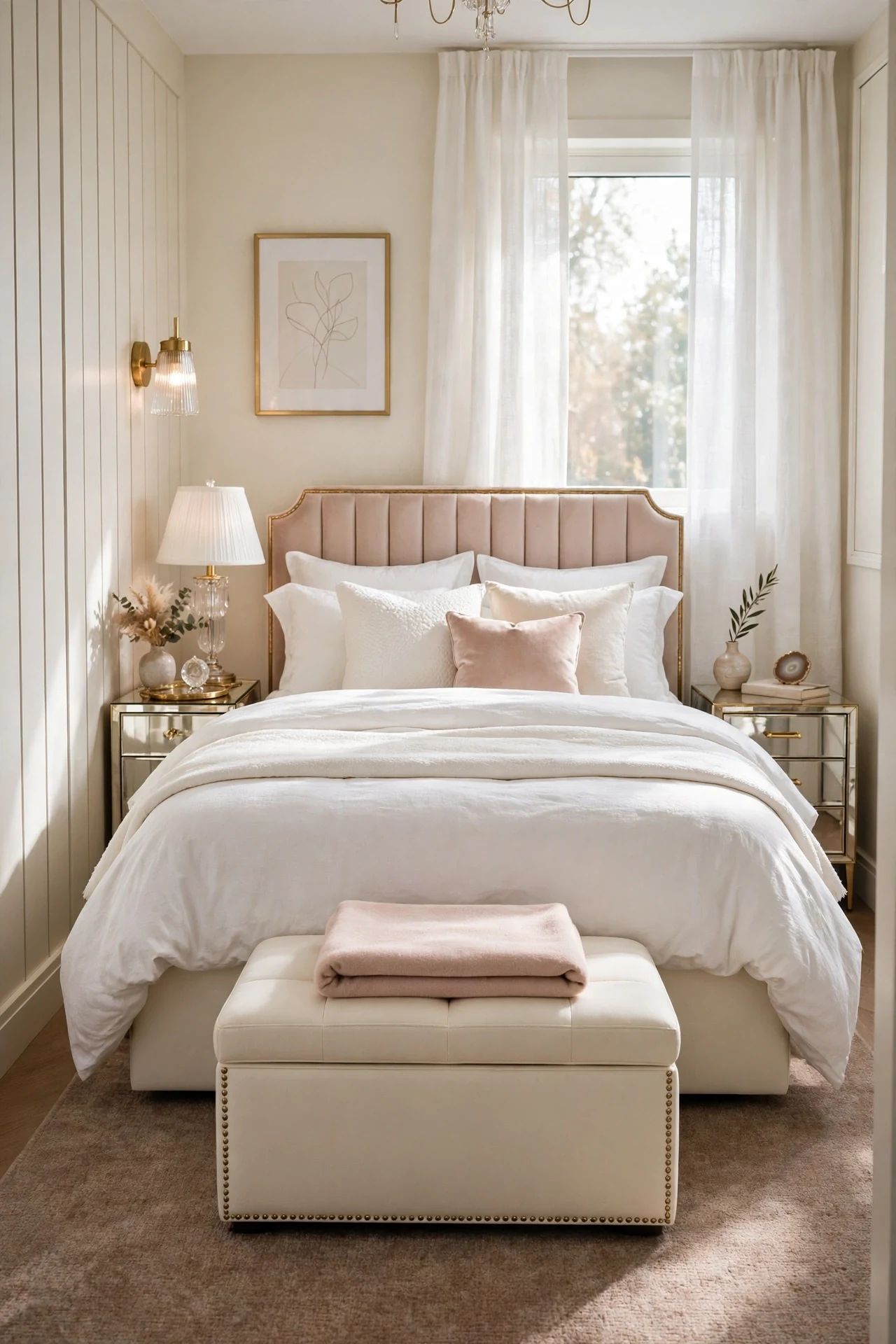
A bench at the foot of the bed is a lovely shape and a wasted box. A storage ottoman is the same shape doing two more jobs: it hides the spare blanket and the bed throw inside, and it gives you the one seat the room has, for shoes, dressing, or the two minutes of sitting a tiny room allows. In cream bouclé or velvet it also carries the soft texture at the foot of the bed, so the throw can live on it folded rather than spread across the bed all day. Measure the width against the bed; the ottoman should be narrower than the mattress, never wider.
Best For: Rooms with no chair and a bed that collects spare blankets.
Not Ideal For: Rooms where the foot of the bed is the walkway; take the under-bed drawers in idea 2 instead.
Estimated Cost: $70-$180 (estimate) for a storage ottoman around 30 inches wide.
Budget Note: Buy the ottoman before any purely decorative bench; it replaces a blanket box as well.
Renter Friendly: Yes
Renter Note: Fully freestanding; felt pads under the feet protect wood floors.
What You Need
Storage ottoman narrower than the bed, spare blanket and throw to store, felt floor pads.
Product type to look for: An ottoman with a hinged or lift-off lid that stays open hands-free, and a fabric that matches the bed upholstery family, cream or soft taupe.
How To Do It
- Measure the foot-of-bed space and the walkway before choosing the width.
- Place the ottoman centred on the bed, with equal gaps at both ends.
- Store only bed-related items inside, so the lid opens for a reason, not for rummaging.
- Keep the top styled with one folded throw, nothing else.
Pro Tip
If two people share the room, split the ottoman with a simple divider or two pouches, his and hers. Shared storage fails when it becomes one mixed pile.
13. Let the Headboard Hold the Shelf
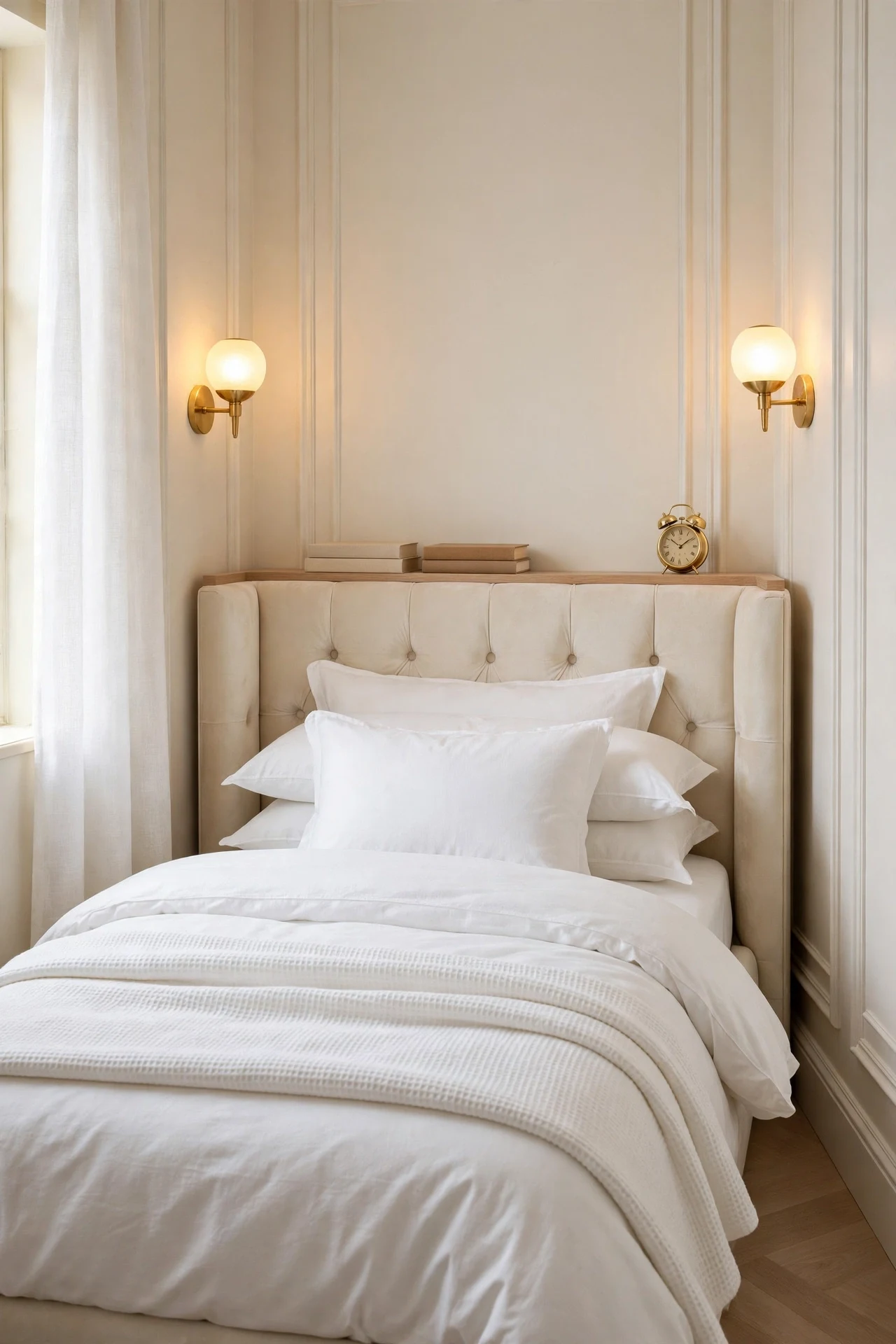
When there is no width for nightstands at all, not even floating ones, the headboard can take the job. A headboard with a slim shelf along its top edge holds a phone, a book and a water glass within reach, and paired with the sconces from idea 7, the whole bedside system takes zero floor and zero side wall. This is the idea that makes a bed-in-the-corner layout work: the bed pushes fully into the corner, the shelf serves the wall side, and the open side of the room stays clear for the wardrobe and the door.
Best For: Beds in corners and rooms narrower than the bed plus two tables.
Not Ideal For: Restless sleepers who knock things off ledges; keep only soft, light items on the shelf.
Estimated Cost: $180-$400 (estimate) for a shelf-top upholstered headboard, or it comes with the frame in idea 1.
Budget Note: If the bed frame is still to be bought, choosing a shelf headboard then costs little more than a plain one and saves two nightstands.
Renter Friendly: Yes
Renter Note: It is part of the furniture, so nothing touches the walls except the sconces, which have their own note in idea 7.
What You Need
Shelf-top headboard or frame, small non-slip shelf liner, bookend or small gold tray to group items.
Product type to look for: A headboard shelf at least 4 inches deep with a small raised lip at the back, so a phone cannot slide behind the bed.
How To Do It
- Choose the headboard with the shelf lip; line the shelf so glasses sit quietly.
- Push the bed fully into its final position before styling the shelf.
- Limit the shelf to three groups: book, glass, phone, gathered on one small tray.
- Route charging cables behind the headboard so nothing drapes across the shelf.
Pro Tip
Put the water glass on the tray, never straight on the shelf. One knock at night is the difference between a good idea and a wet bed.
14. Layer a Sheer With a Blackout Roller, Not Heavy Curtains
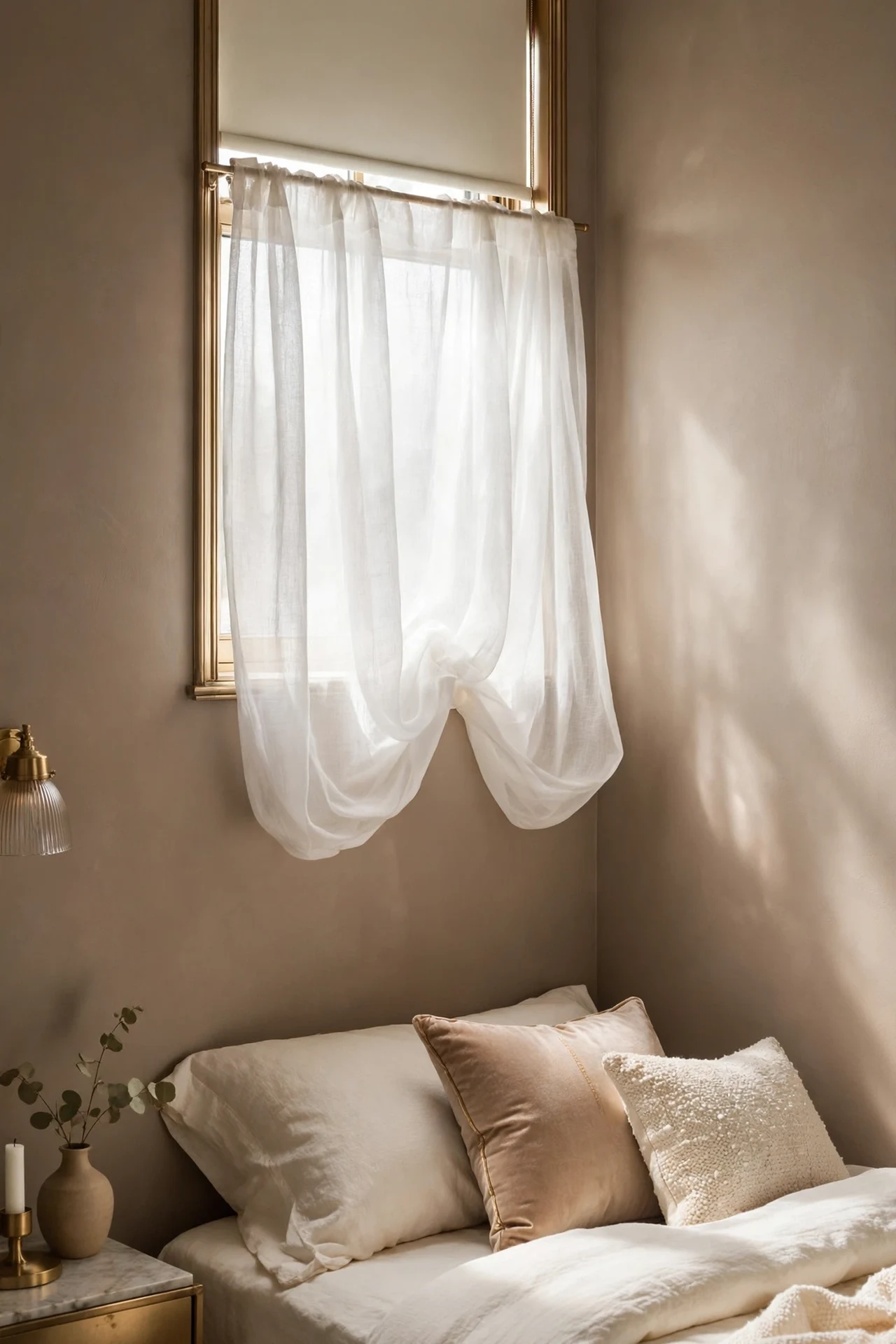
Heavy blackout curtains solve darkness and create bulk: two thick bunches of fabric eating the wall on both sides of a small window. A blackout roller blind does the same darkening job rolled into a slim tube at the top of the frame, and a sheer curtain in front of it keeps the window soft and private in the day. The wall stays visually flat, the window looks dressed rather than blocked, and sleep quality in a small room, where the bed is never far from the window, genuinely improves. Fit the blind inside the recess where possible so nothing projects into the room.
Best For: Light-sensitive sleepers and rooms overlooked by neighbours.
Not Ideal For: Windows with very deep or angled recesses that a standard roller cannot fit; measure before assuming.
Estimated Cost: $45-$120 (estimate) for a made-to-measure blackout roller and a sheer panel.
Budget Note: One recess roller plus a sheer costs less than lined blackout curtains and their heavier rod.
Renter Friendly: With Conditions
Renter Note: Inside-recess rollers fix with two small brackets; no-drill twist-fit rollers exist for many recess sizes and are the renter-safe route.
What You Need
Blackout roller blind sized to the recess, sheer curtain panel, existing rod from idea 5 or a slim tension rod, tape measure.
Product type to look for: A roller with a true blackout coating in cream or white, and child-safe cord fittings, which are standard on newer blinds and worth confirming.
How To Do It
- Measure the recess width at the top, middle and bottom and order to the smallest.
- Fit the roller brackets, or twist-fit the no-drill version, and test the roll before hanging the sheer.
- Hang the sheer on its rod in front of the recess.
- Set the routine: sheer only by day, roller down at night, so the room keeps both looks.
Pro Tip
Choose the sheer in the same warm white as the bedding. Two different whites at the window and the bed is the kind of small mismatch a small room cannot hide.
15. Put One High Shelf Above the Door for Rarely Used Things
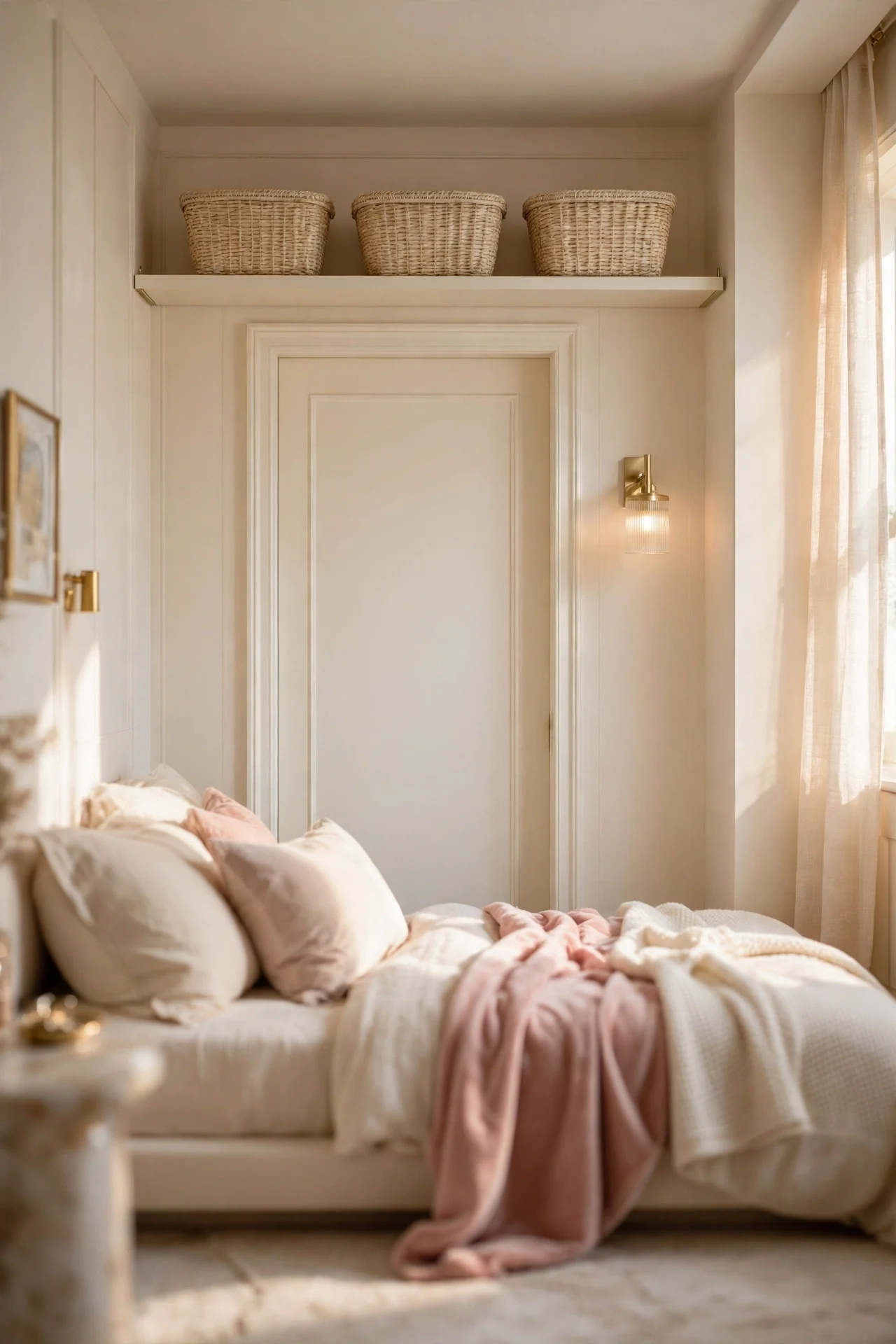
The wall above the door is the last free wall in a tiny room, and it is free precisely because nothing can stand in front of it. A slim shelf up there, holding two or three matching woven baskets, takes the genuinely rare things out of the everyday storage: guest towels, the spare duvet, paperwork you keep but never open. Because it is high and uniform, it reads as a design line rather than storage, and it finishes the room’s vertical story that the tall wardrobe started. Keep a small folding step in the wardrobe so reaching it is a choice, not a climb.
Best For: Rooms storing guest bedding or seasonal items with nowhere to put them.
Not Ideal For: Daily-use items of any kind; if you reach for it weekly, it belongs lower, in ideas 2, 4 or 11.
Estimated Cost: $30-$80 (estimate) for a shelf board, brackets and three woven baskets.
Budget Note: Matching baskets matter more than the shelf itself; three different boxes up high look like a stockroom, three matching baskets look styled.
Renter Friendly: With Conditions
Renter Note: The shelf needs solid fixings above the door; agree it with the landlord or skip to idea 11’s no-fix storage.
What You Need
Shelf board cut to the door width plus a few inches, two or three brackets, three matching woven baskets with lids, folding step stool.
Product type to look for: Lidded baskets in one size and one material, so the row reads as a single calm band from below.
How To Do It
- Fix the shelf at least 12 inches above the door frame, into studs or solid fixings.
- Fill the baskets before lifting them up; label the base of each, out of sight.
- Load the shelf heaviest in the middle, lightest at the ends.
- Store the step stool inside the wardrobe so the system stays usable.
Pro Tip
Photograph the shelf from the doorway after styling. If your eye stops on it, the baskets are too varied; if it slides past, the height trick is working.
Practical Tips for Very Small Bedrooms
Measure the room three times before buying anything: the walls, the door swing, and the delivery route. Most small-room failures are bought, not designed, and they arrive as furniture that technically fits the room but cannot get into it or leaves no walkway once it is there. Work on proportion before decoration: bed height, nightstand footprint and storage direction change how big the room feels more than any colour does. Keep one palette and repeat it, because in a small space every new colour is a new visual compartment. Leave the centre of the floor empty on purpose; a clear floor is a feature in a tiny room, not a gap waiting for a piece. Finally, style for the view from the doorway, because that is the view you and every guest judge the room by.
Frequently Asked Questions
What size bed works best in a very small bedroom?
A full or a carefully chosen queen usually works better than a king in rooms under 10 by 10 feet. The frame matters as much as the mattress: a low platform frame with no footboard gives back visual length, and under-bed drawers on that frame can remove the need for a dresser entirely.
How can I fit storage in a tiny bedroom without a closet?
Combine three zones: drawers under the bed for bulky items, one tall narrow wardrobe for clothes, and the back of the door plus a high shelf for rare things. Together they hold what a small closet holds, spread across space that was doing nothing.
Do mirrors really make a small bedroom feel bigger?
Yes, when they face light. A tall mirror beside or opposite the window reflects the brightest part of the room and adds a sense of depth. A mirror facing a blank or cluttered wall only doubles that wall, so placement matters more than size.
What colours make a very small bedroom feel bigger?
Close, pale tones: warm white walls, cream bedding and warm taupe textiles, with one soft accent such as blush. The eye moves across a room without hard colour stops, so it reads as one larger space. Avoid blue-toned whites, which make warm pieces look dirty by contrast.
Can a very small bedroom still fit a desk?
Yes, if the desk folds away. A wall-mounted fold-down desk near the window gives a real work surface by day and takes no floor space at night. It suits a laptop setup; a permanent multi-screen desk needs more room than a tiny bedroom can spare.
Conclusion
Start with the bed. A low frame with no footboard and drawers beneath it changes the proportions of the whole room and removes the need for the biggest storage piece. Then lift everything else: nightstands onto the wall, light into sconces, storage into one tall wardrobe and the forgotten zones behind the door and above it. Keep the palette pale and the floor clear, and a very small bedroom stops apologising for its size and starts feeling like a small, calm hotel room instead.