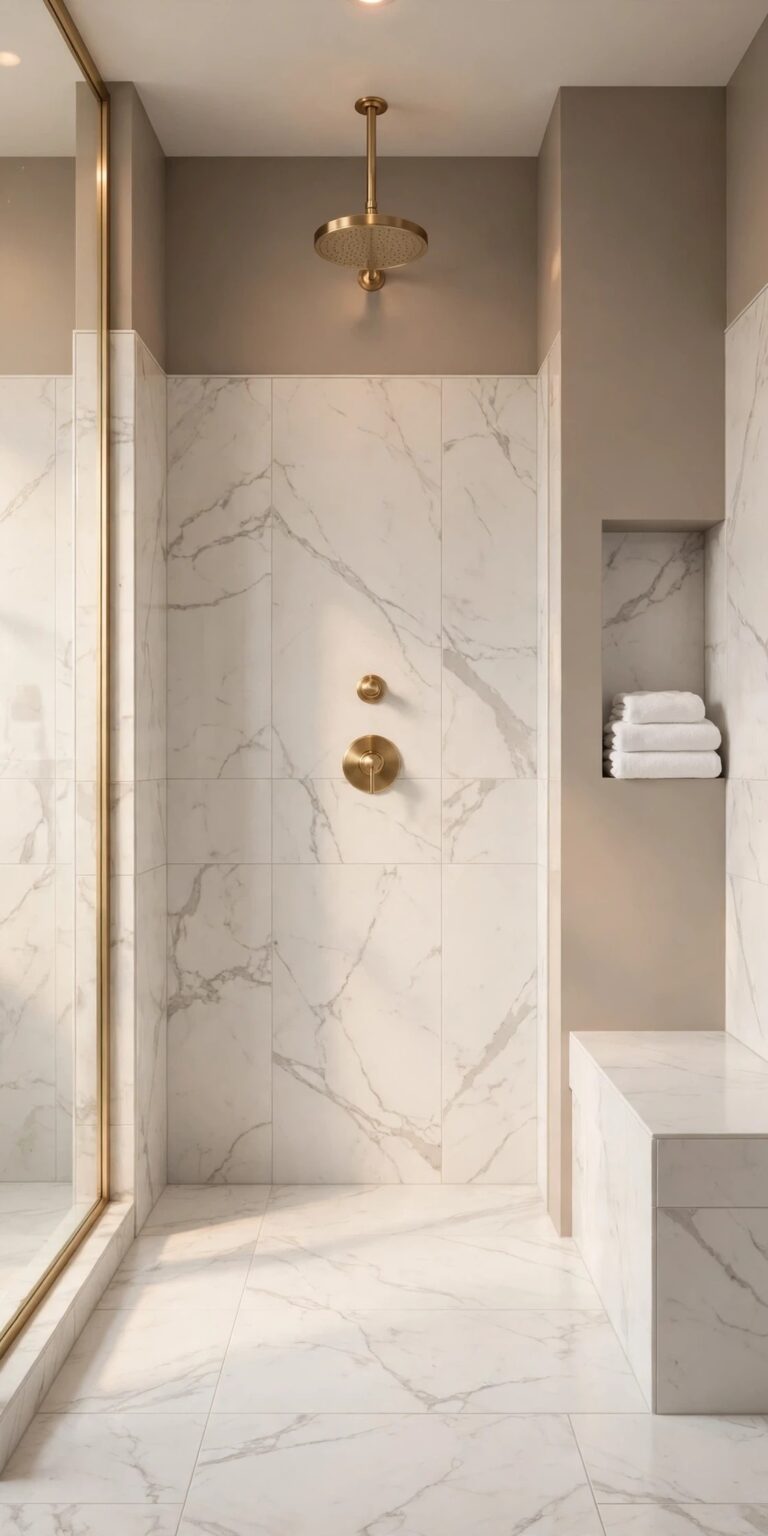
17 Bathroom Mirror Ideas That Change How the Room Feels
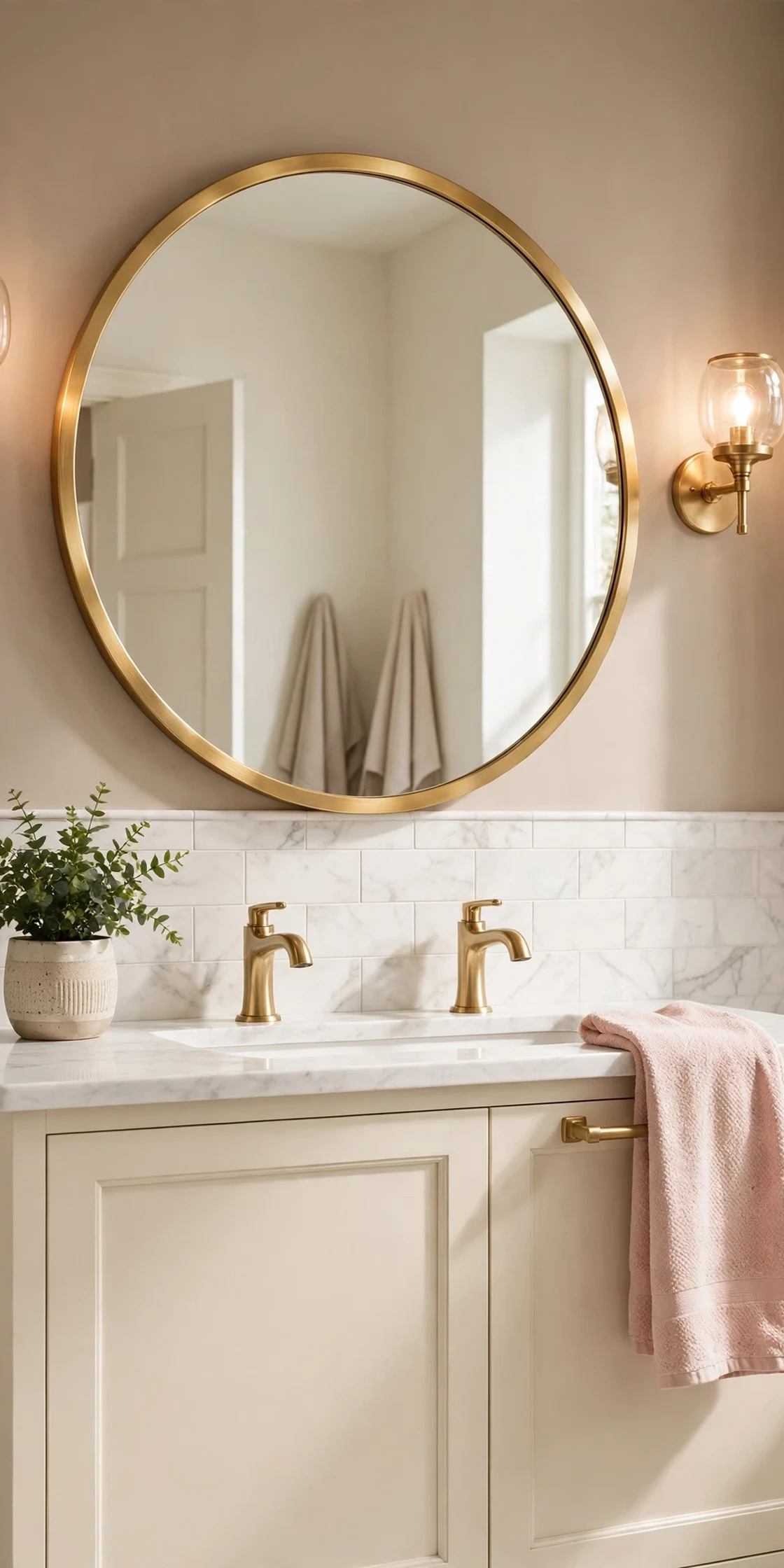
The mirror is the hardest-working surface in a bathroom and the one most often left as an afterthought, a plain sheet of glass glued up by the builder. Yet it is what you look at every morning, it decides how the light behaves, and its frame is usually the largest single piece of “furniture” on the vanity wall. Change the mirror and the whole room’s feeling changes with it, before a single tile is touched.
These seventeen bathroom mirror ideas all restyle the same bright glam bathroom, a cream vanity with brushed gold fittings, white marble-look tile, and warm taupe walls, so you can compare shapes, frames, and light honestly. Safety runs underneath every idea: mirrors are heavy glass, bathroom walls are often hollow or tiled, and a mirror is only ever as good as its fixings, so every hanging note here means studs or rated anchors, two secure points, and anti-tip straps wherever a mirror leans.
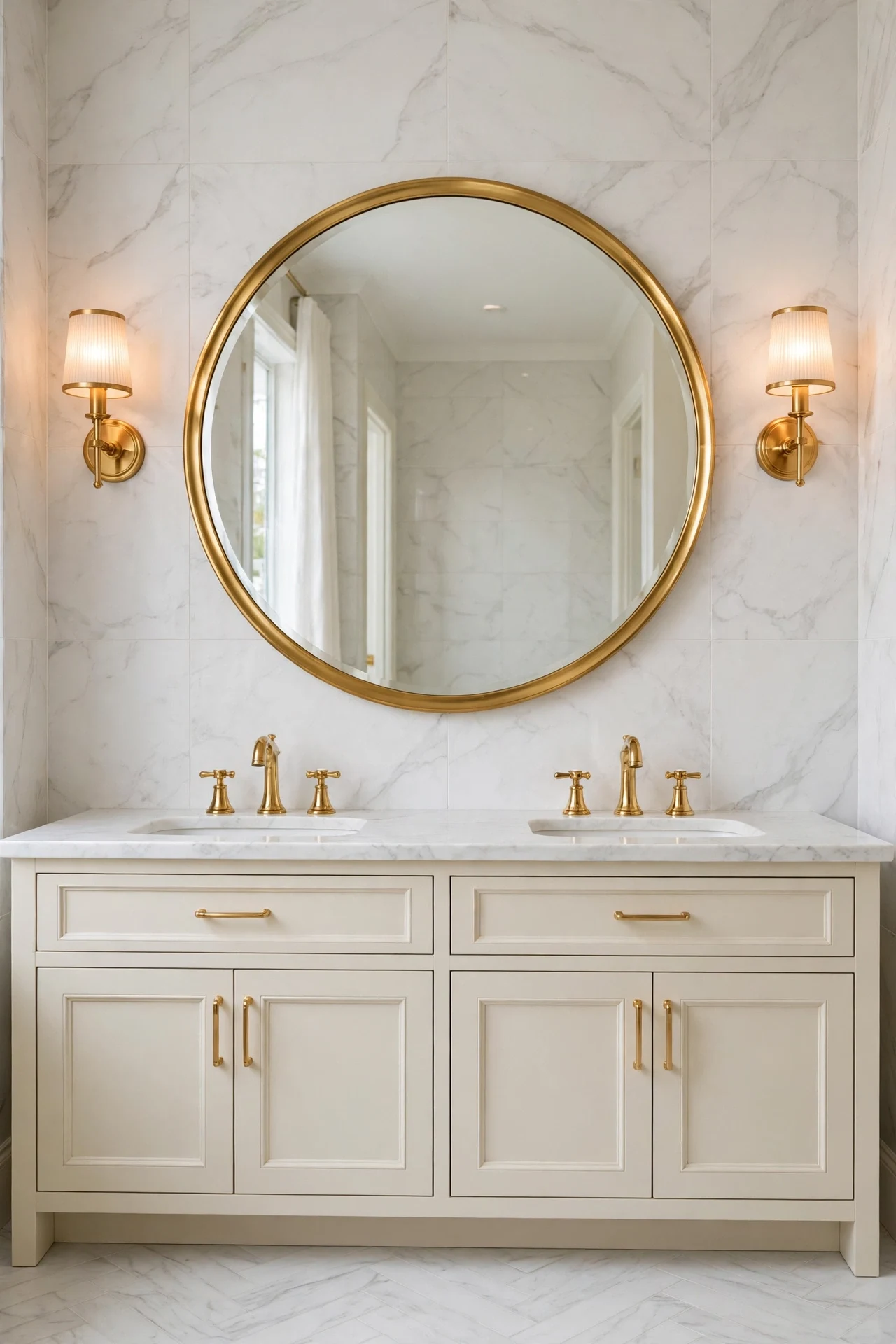
1. One Large Round Mirror in Brushed Gold
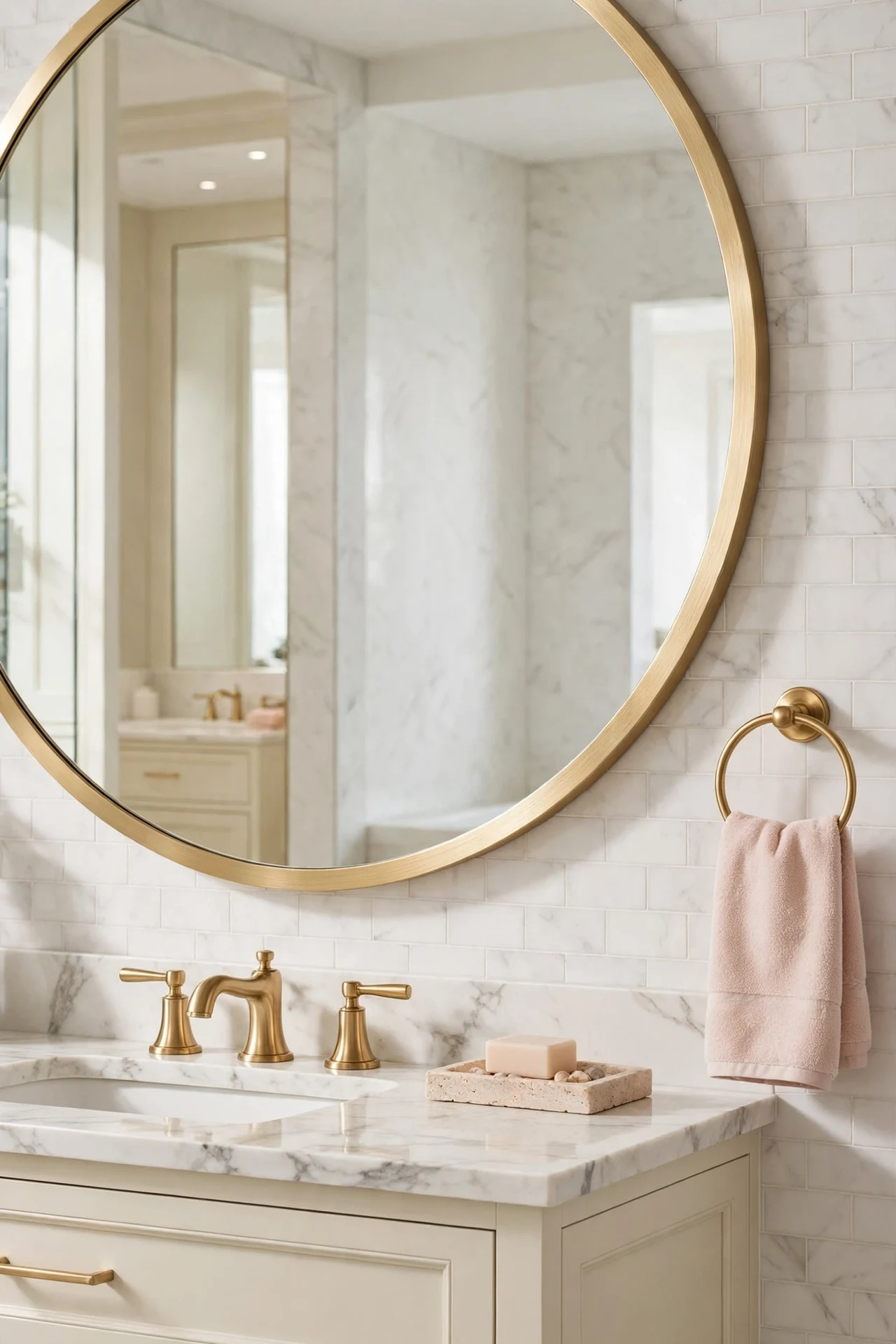
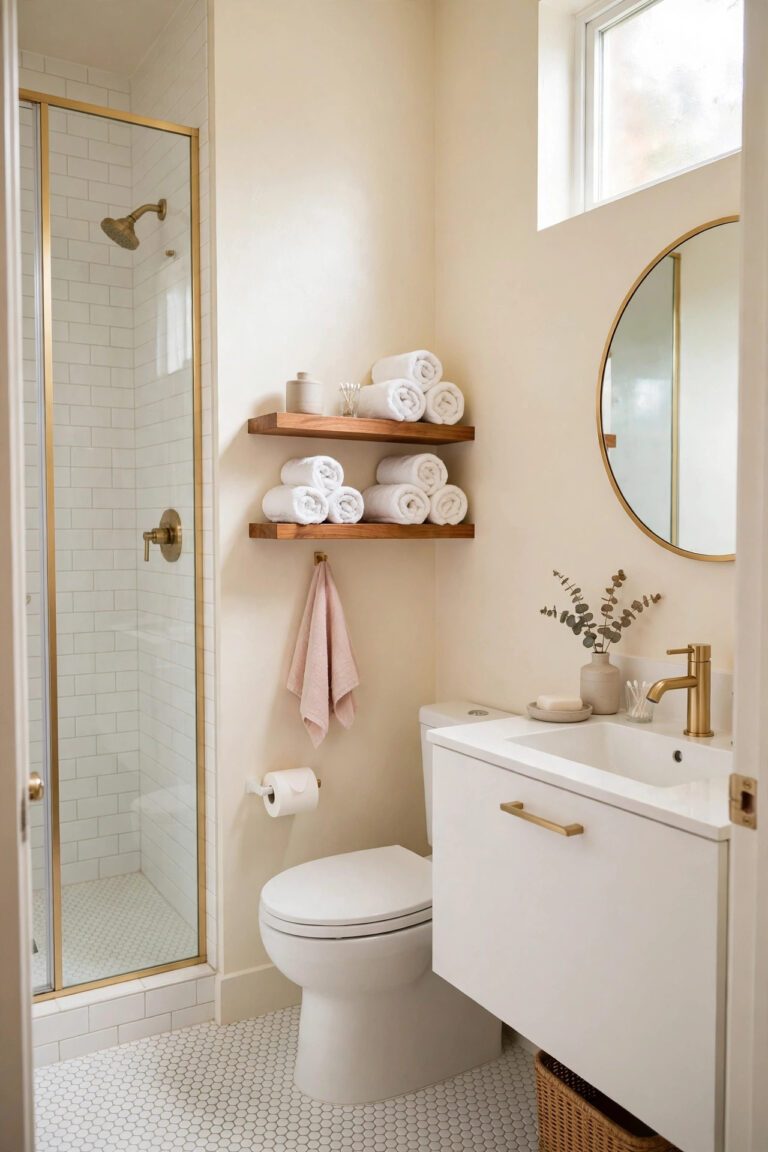
A bathroom is a room of straight lines: tile grids, counter edges, cabinet doors. One large round mirror breaks that grid in the best way, giving the eye a soft shape to rest on and making the vanity wall feel styled instead of built. Brushed gold is the frame finish that belongs to this palette; it warms the white tile, repeats the faucets, and catches sconce light like jewelry rather than shouting like polished chrome.
Scale is where round mirrors succeed or fail. Too small and the circle floats, lost on the wall; generous, a few inches narrower than the vanity below, and it reads as the room’s centrepiece. One large round also suits a single sink better than any other shape, because its width gathers the whole vanity into one composition.
How to do it: Measure the vanity and choose a round mirror roughly that width minus a hand’s span on each side. Center it on the faucet, not on the wall, if the two disagree, and hang it so the bottom edge sits a small gap above the backsplash. Fix it with the maker’s hardware into studs where possible, or rated heavy-duty anchors suited to your wall, at two points so it cannot swing. Pro Tip: A slim frame profile keeps a large round mirror light in feeling and in fact; deep, chunky frames add weight the fixings must then carry. Common mistake: Hanging a large round mirror too high, so it reflects the ceiling instead of the room and the person. The center of the mirror should sit near the eye level of the people who use it.
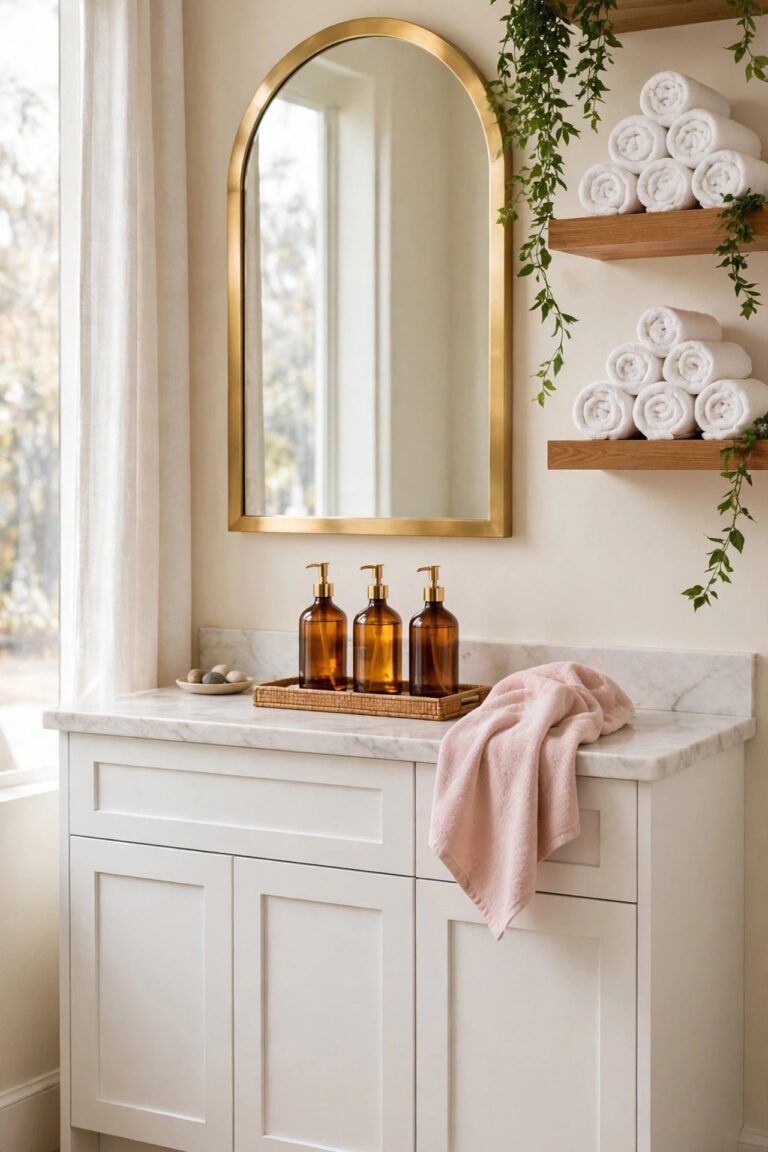
2. A Tall Arch Mirror Over a Single Vanity
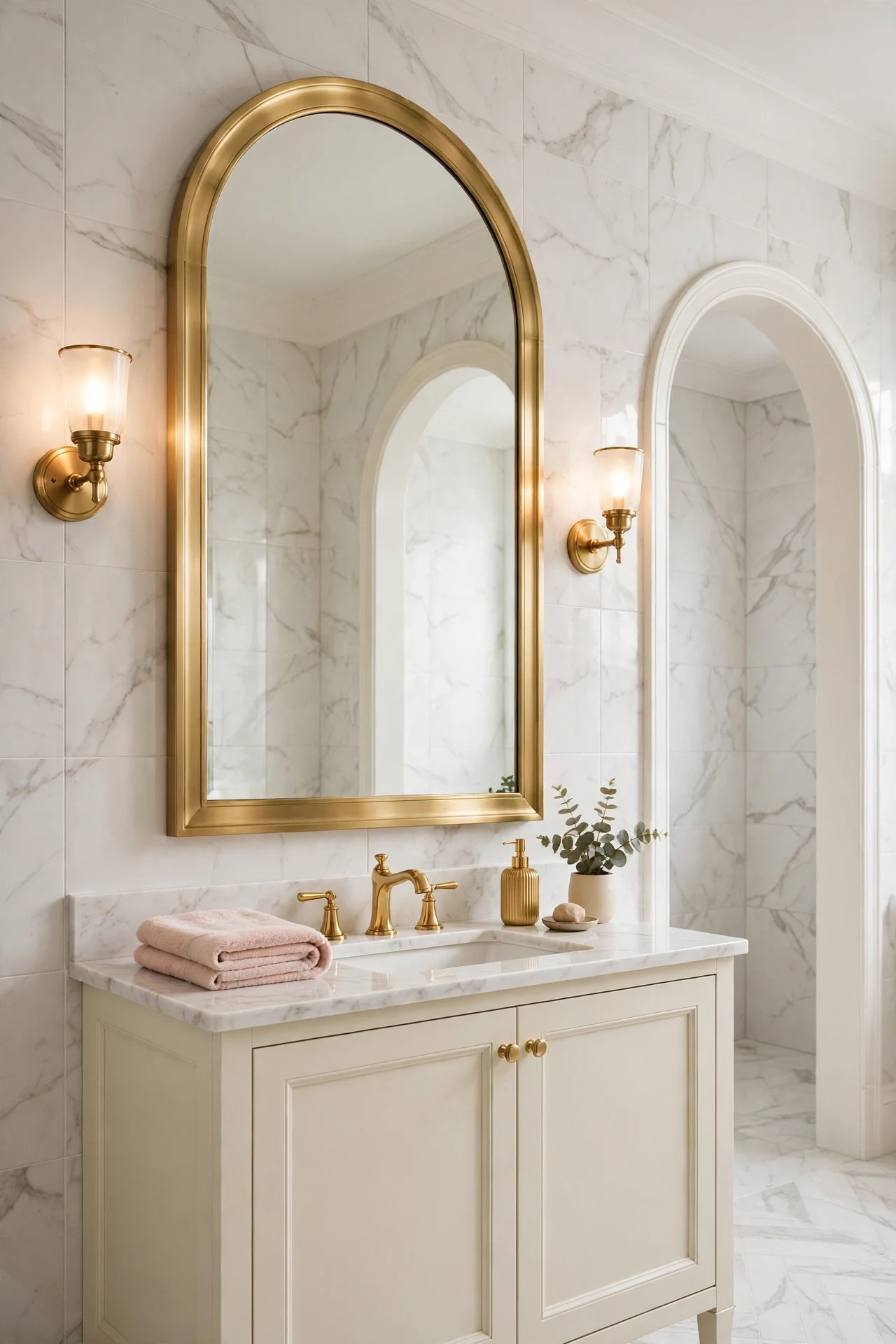
An arch mirror does two jobs at once: it is a mirror, and it is architecture. The curved top borrows the language of arched doorways and windows, so a plain bathroom wall suddenly has a designed feature, and the tall shape pulls the eye upward, making a standard ceiling feel higher. Over a single vanity it also solves a real proportion problem, giving a narrow vanity enough presence to hold a wide wall.
Because an arch is a statement, it works best as the only curved, ornate note on the wall. Keep the faucets and sconces simple and let the silhouette do the talking.
How to do it: Choose an arch roughly the width of the vanity or a little narrower, and tall enough that the curve clears the sconce line or sits between the sconces. Hang it plumb and centered; an arch that leans a degree off vertical is obvious at a glance. Use two fixings into studs or rated anchors, since tall mirrors concentrate their weight at the top fixing when they hang. Pro Tip: If your bathroom has an arched shower opening or doorway, matching the mirror’s curve to it makes the whole room feel planned. Common mistake: An arch mirror squeezed between two sconces that crowd its shoulders. Give the curve air, or choose the round of Idea 1 instead.
3. Two Mirrors Over a Double Vanity
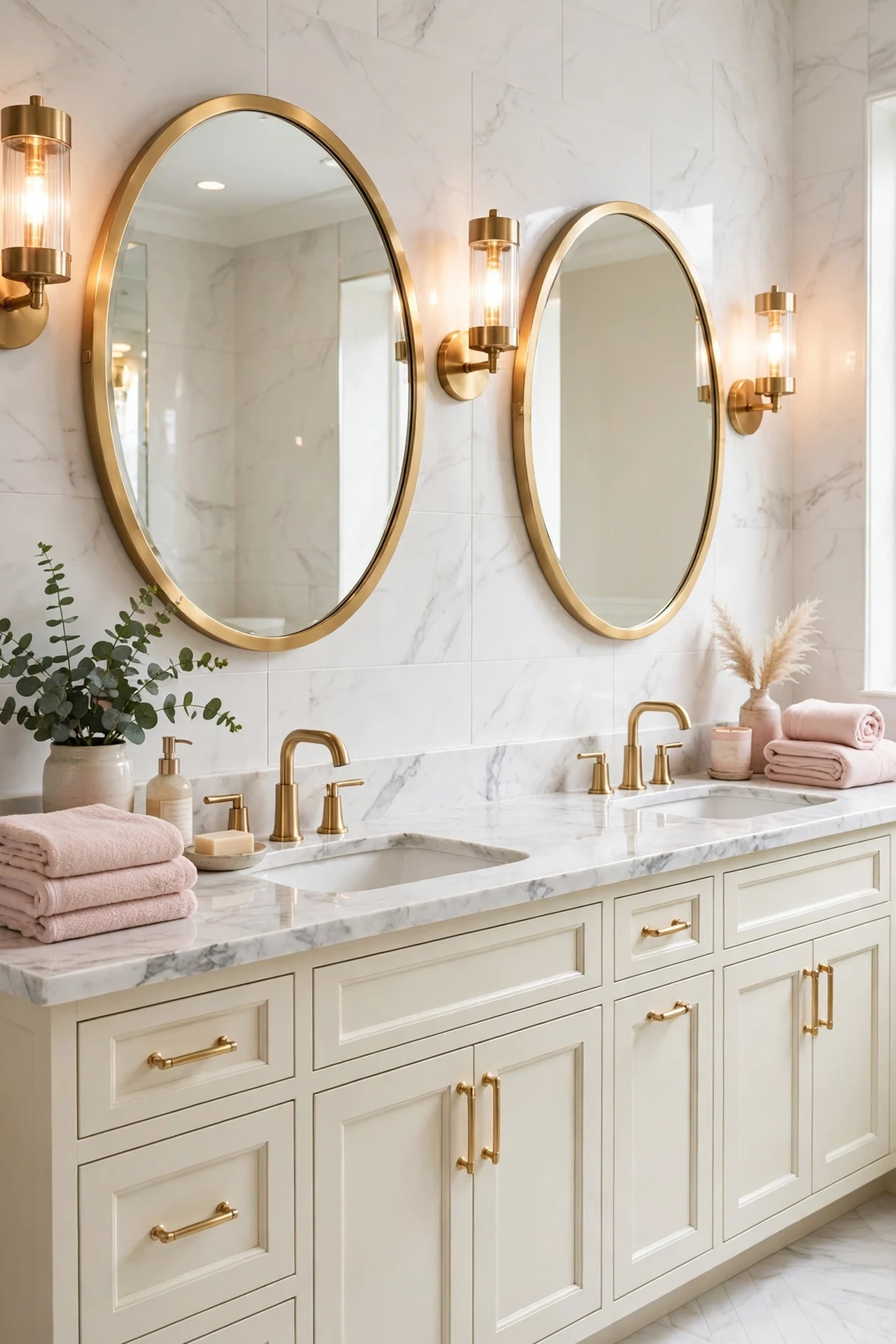
A double vanity with one wide mirror reads as a shared sheet of glass; the same vanity with two matching mirrors reads as two personal stations, and that small shift changes how a couple’s morning feels. Each person gets a mirror centered on their own faucet, their own light, and a slice of wall between the mirrors where the room’s style can show, a sconce, a small shelf, or simply calm tile.
Two mirrors also break up what would otherwise be the largest reflective surface in the house, softening the room and reducing the showroom glare of one enormous pane.
How to do it: Center each mirror exactly on its faucet centerline, at the same height, and keep the pair identical in size and frame. Leave a comfortable gap of wall between them; mirrors that nearly touch read as one mirror with a seam. Fix each mirror independently into studs or rated anchors, and check the pair with a level across both tops before the final tightening. Pro Tip: Hang the two mirrors, then stand back and check them in the doorway view; small height differences invisible up close are obvious from the door. Common mistake: Two mirrors of slightly different sizes bought at different times. The asymmetry looks like a mistake because it is one.
4. A Rounded Rectangle for a Tailored Look
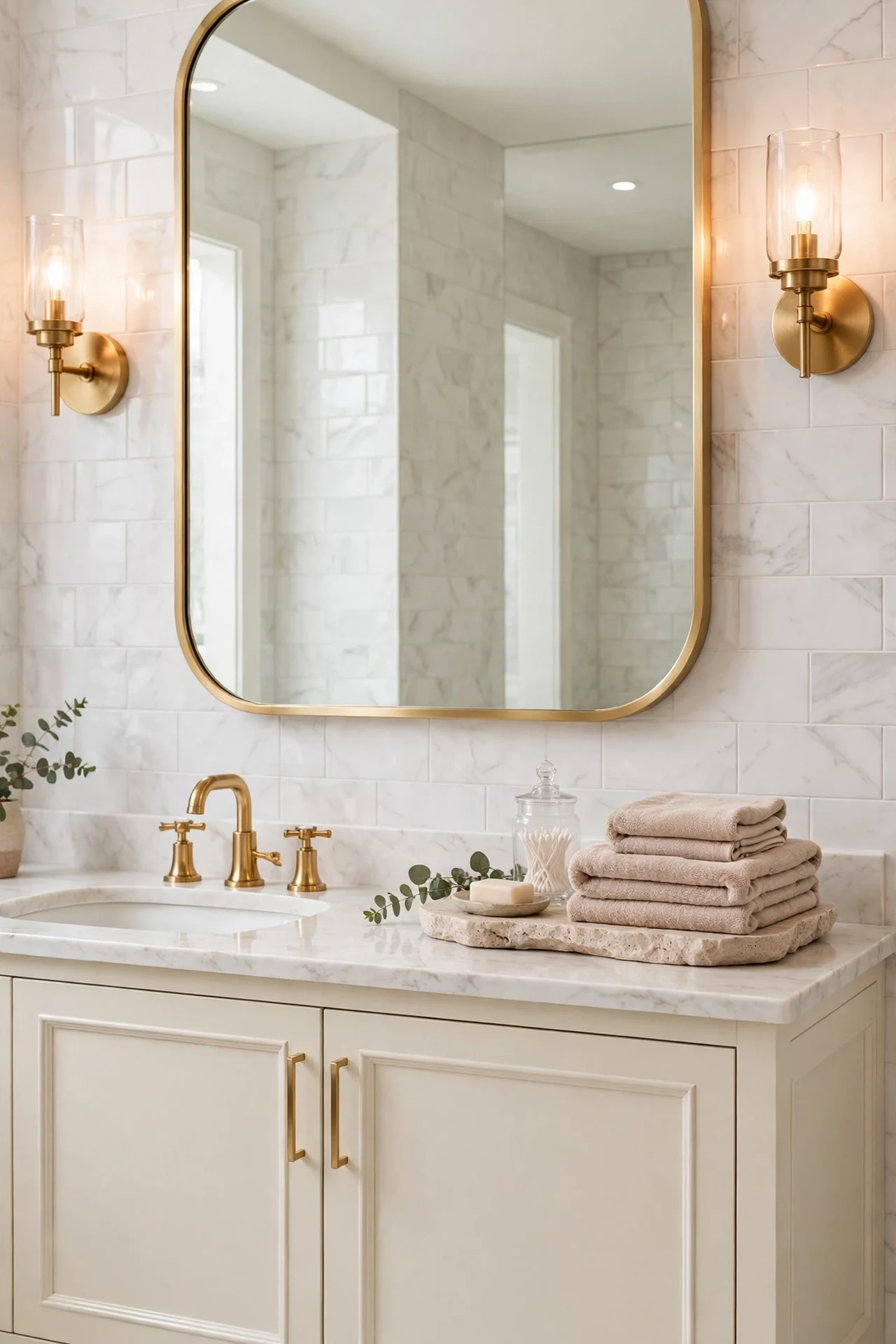
The rounded rectangle is the tailored shirt of bathroom mirrors: structured like a classic rectangle, but with its corners softened, so it suits a room that wants order without hardness. It gives the most usable reflection of any decorative shape, wide where you stand and tall where you dress, and its long straight sides sit calmly against tile lines and cabinet edges.
This is the shape that suits a vanity wall shared with tall cabinets or a linen tower, because its corners echo the cabinetry while the softened corners keep it from feeling like another door.
How to do it: Size it a few inches narrower than the vanity and tall enough to serve the tallest user with room to spare. Hang it level, checking both top corners, since a rectangle announces any tilt immediately. Fix at two points into studs or rated anchors matched to the wall. Pro Tip: Match the frame’s corner radius loosely to other soft shapes in the room, rounded faucets or an oval vessel, and the wall composes itself. Common mistake: A sharp-cornered metal rectangle in a room of soft glam shapes. It reads commercial, like a hotel corridor, next to cream and blush.
5. Backlit Glow for Shadow-Free Mornings
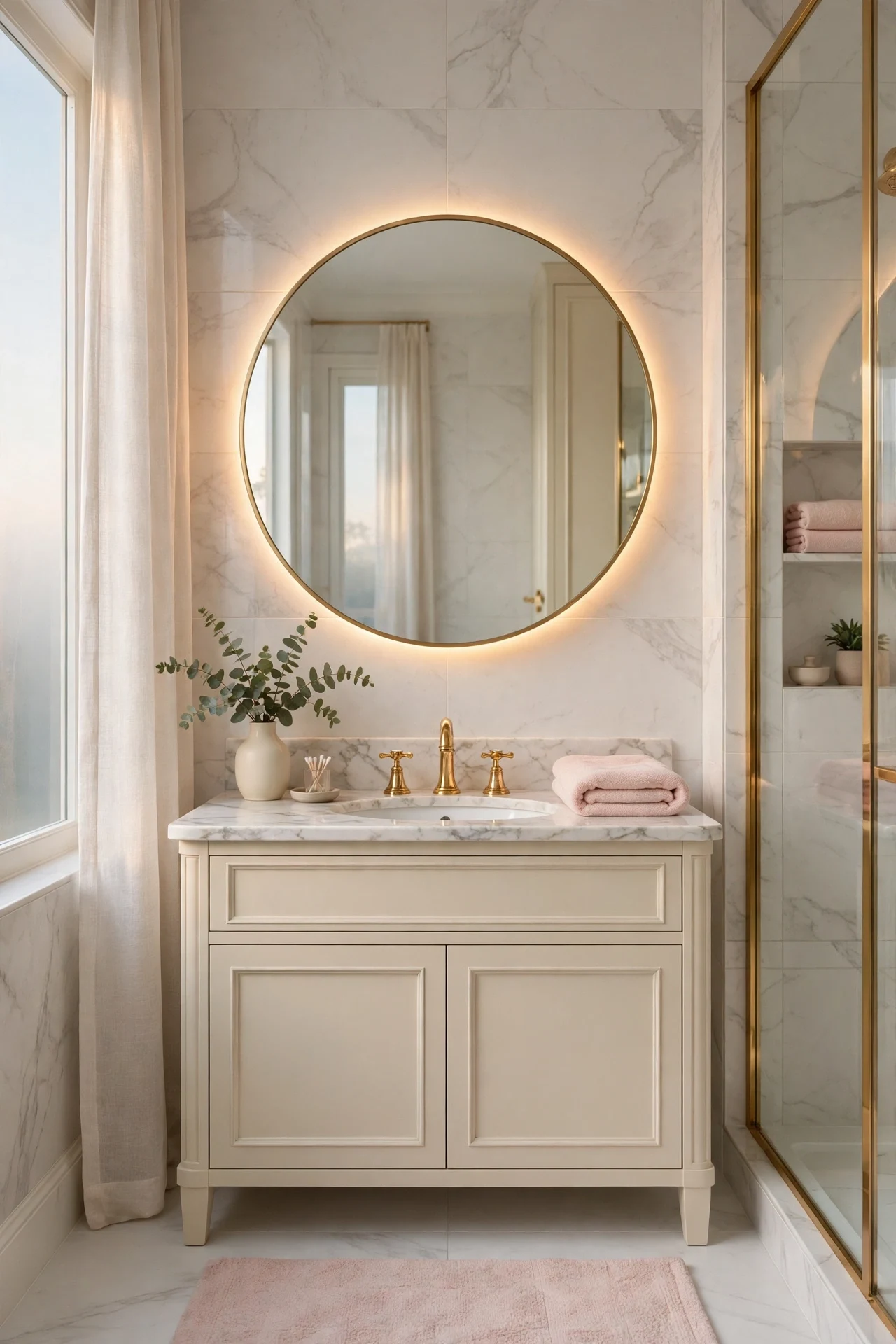
Overhead bathroom light points down, and down light carves shadows under eyes, nose, and chin exactly where you are trying to shave or apply makeup. A backlit mirror throws soft light forward from around its edges, wrapping the face evenly and giving the wall a gentle halo that makes the whole room feel like early evening in a good hotel. It is the most functional mirror upgrade on this list, and the one that changes mornings most.
The honest cautions are electrical. Most backlit mirrors are hardwired or plug into a nearby outlet, and bathroom electricity lives beside water, so connections belong on a protected circuit and any hardwiring is a job for a licensed electrician, not a weekend experiment.
How to do it: Choose warm white backlighting, never cool blue, and a dimmable model if you can, so the glow can drop at night. Have hardwired fitting done by a licensed electrician on the bathroom’s protected circuit, and keep plug-in cords routed dry and tidy per Idea 3’s cord discipline in the home’s other rooms. Hang and level the unit on its rated fixings before it is connected. Pro Tip: Pair a backlit mirror with no sconces at all for the calmest wall; two light systems competing around one mirror is glare, not layering. Common mistake: A backlit mirror as the room’s only light. It flatters the face but leaves the shower and tub in gloom; keep a warm ceiling light for the whole room.
6. A Pivoting Mirror for a Shared Bathroom
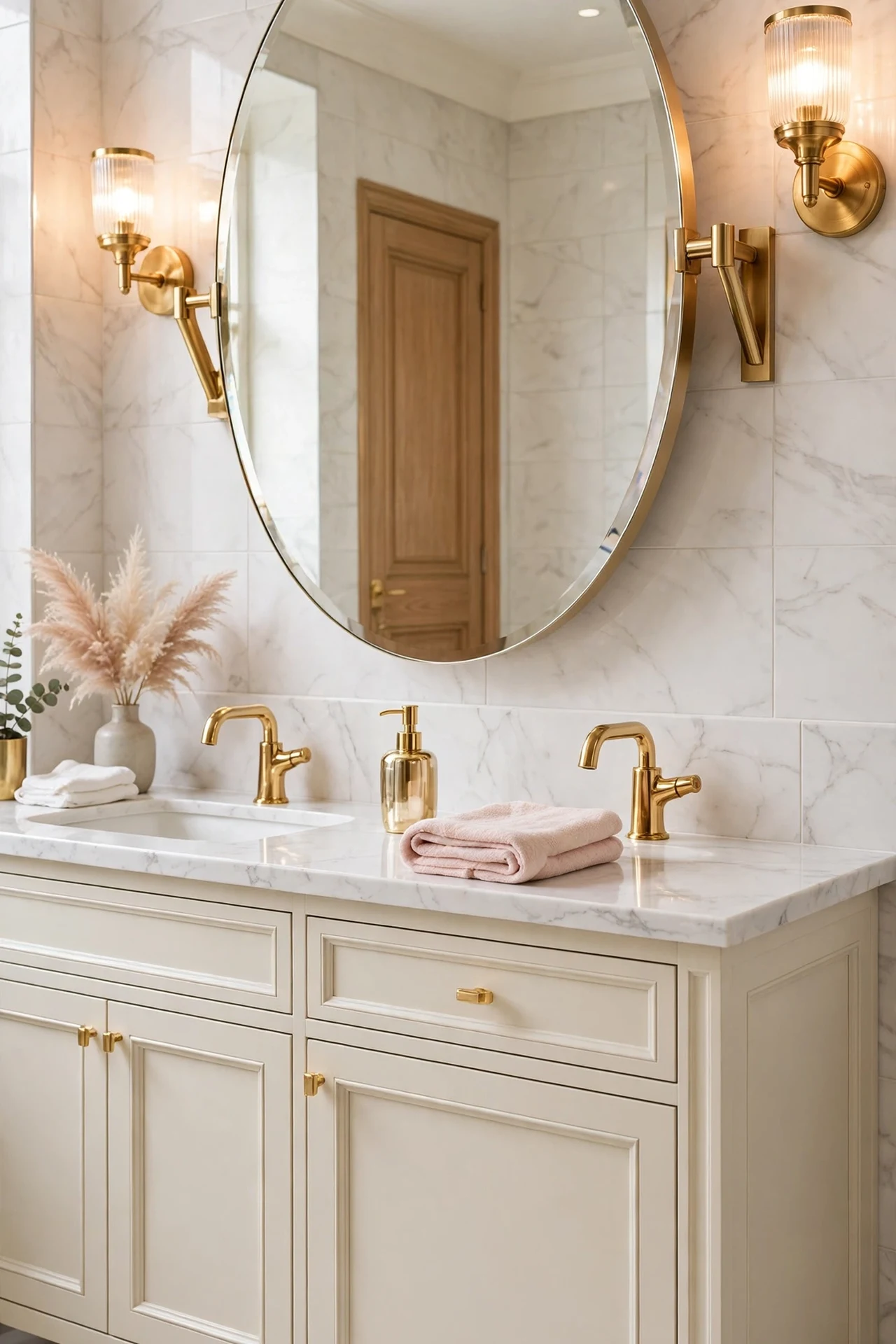
Households are not one height. A fixed mirror hung for the tallest user leaves a shorter partner or a child on tiptoes, and a mirror set low makes tall users stoop. A pivoting mirror on side arms tilts in seconds to whoever is standing there, which is why it has been the shared-bathroom answer in hotels and old houses for a century. In this palette, brushed gold arms and an oval or round glass keep the mechanism looking like jewelry instead of hardware.
The pivots are also the weak point, so this idea lives or dies on fixing. The arms take a small load every time the mirror tilts, worked back and forth for years, and they must be fixed into studs or solid blocking, not into tile and hope.
How to do it: Mark the stud positions first and choose a pivot mirror whose arm mounts can land on them; if the spacing does not suit, have proper blocking or rated heavy anchors installed rather than settling for weak fixings. Set the mirror’s center at a middle height for the household and check the tilt range clears the faucets at its lowest angle. Tighten and re-check the arm screws after the first week of use. Pro Tip: An oval pivot mirror gives the most tilt range without its corners nearing the wall or counter. Common mistake: Mounting pivot arms into tile over hollow wall with ordinary plugs. The daily rocking works them loose, and a falling mirror over a hard vanity is the worst outcome in this article.
7. A Recessed Mirrored Cabinet for Hidden Storage
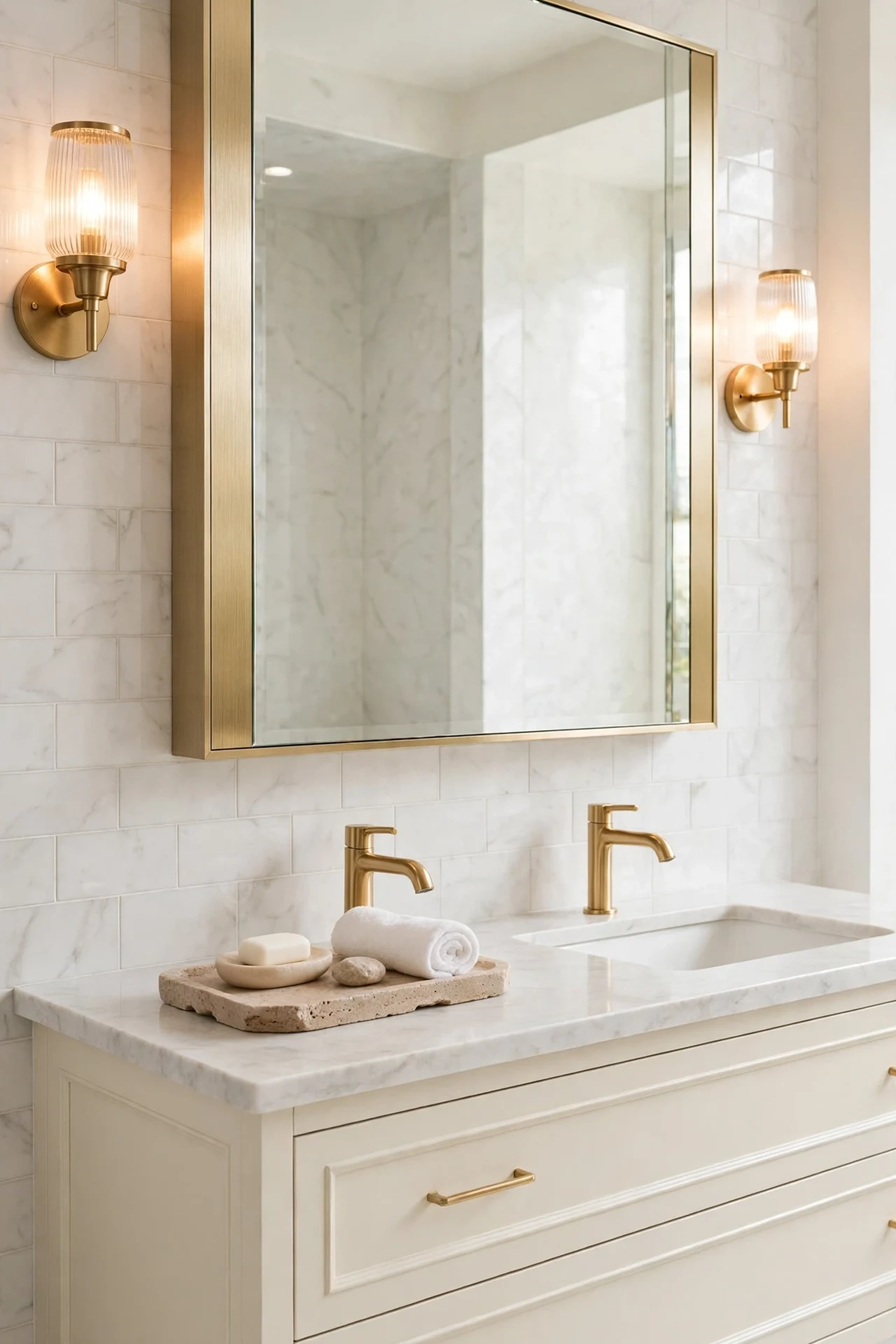
Counters calm down when daily bottles have somewhere to go, and a mirrored medicine cabinet is storage that hides behind the one surface the bathroom must have anyway. Recessed into the wall, it sits nearly flush, so the room keeps the clean line of a flat mirror while gaining shelves of invisible storage behind it. For a small bathroom, that trade, zero floor space for a cabinet’s worth of storage, is the best bargain available.
Recessing is carpentry, not decoration. Cutting into a wall means knowing what is inside it, studs, pipes, and wiring all run through bathroom walls, so this is a measure-twice job and often a professional one, especially in tiled walls. A surface-mounted cabinet is the honest alternative when the wall cannot be opened.
How to do it: Have the wall checked for studs, plumbing, and wiring before any cutting, and use a carpenter for the recess if you are not fully confident. Choose a cabinet with a mirrored interior back if you can; it doubles the cabinet’s usefulness. Fit soft-close hinges so the mirrored door never slams. Pro Tip: If recessing is impossible, a slim surface-mounted cabinet with a full mirror door gives nine tenths of the effect with two rated fixings. Common mistake: A deep, chunky surface cabinet that juts over the sink, so you lean in and meet it with your forehead. Depth discipline matters more than capacity.
8. A Full-Length Leaning Mirror, Strapped Safe
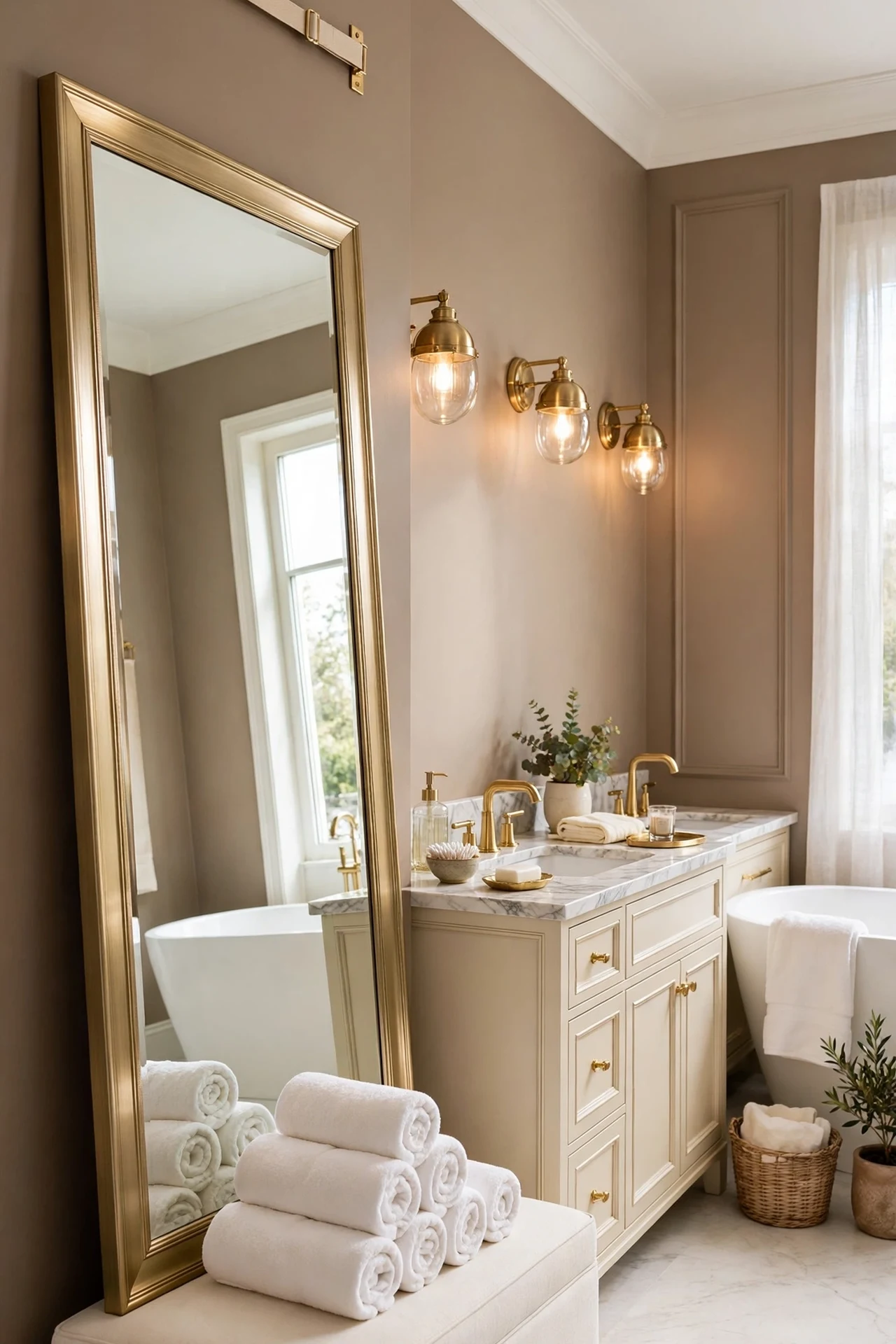
A bathroom with space for it gains something rare from a full-length mirror: the whole outfit, the whole posture, checked in the room where dressing finishes. Leaning a tall mirror against the wall gives that luxury a relaxed, furniture feeling no wall-hung panel has, and the slight angle is flattering because it lengthens what it reflects. In the glam palette, a tall gold frame leaning on warm taupe is practically a piece of art that happens to be useful.
Leaning is also the one mirror style that can walk, slide, and fall if it is treated as decoration rather than equipment. A tall mirror is heavy, top-heavy, and standing on a smooth bathroom floor, so it must be secured with an anti-tip strap or bracket fixed into a stud, every time, no exceptions, and its feet need grip, not glide, on tile.
How to do it: Place the mirror where its lean cannot be bumped by the door swing or a passing elbow, ideally in a corner-adjacent stretch of wall. Fit the anti-tip strap or safety bracket at the top, fixed into a stud, with the strap short enough that the mirror cannot gain momentum. Add clear non-slip pads under the frame’s feet and check the strap’s tension monthly. Pro Tip: Keep leaning mirrors out of homes’ splash zones and never in a bathroom used unsupervised by small children unless the fixing is absolutely rigid; wall-hung full-length is the safer twin of this idea. Common mistake: Leaning a tall mirror “just for now” without the strap. For now is exactly when it falls.
9. Two Slim Vertical Mirrors to Lift a Low Room
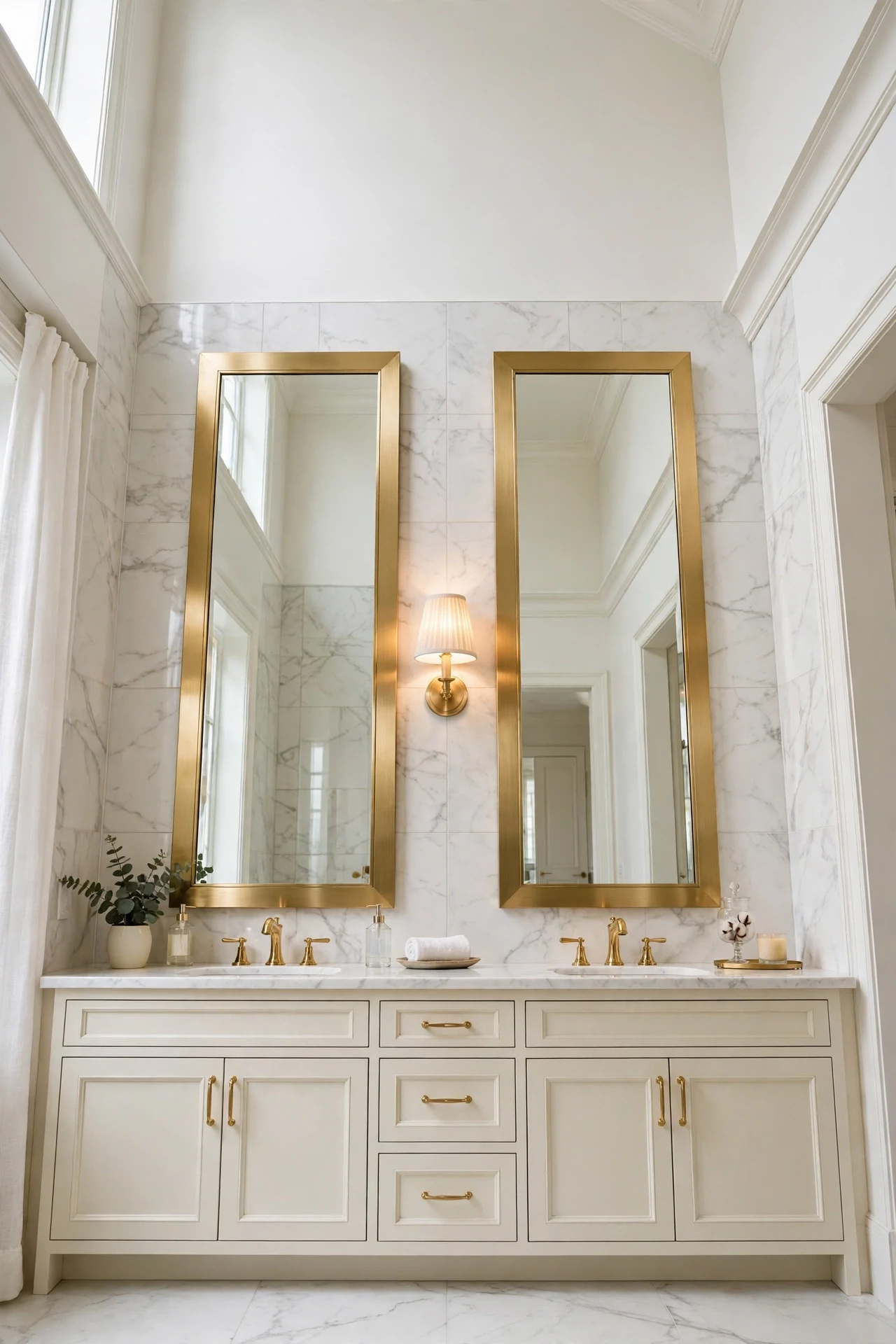
Vertical lines make rooms feel taller, and two slim mirrors are the strongest verticals a bathroom can wear. Over a wide single vanity or a double, a pair of narrow tall mirrors draws the eye up past the tile line to the ceiling, so a low bathroom borrows height it does not have. The slim shapes also leave more wall visible between and around them, which keeps the vanity wall light instead of paved with glass.
This is the mirror choice for bathrooms with tall storage or a high window on another wall, because the mirrors’ rhythm matches those verticals and the room composes.
How to do it: Choose mirrors roughly a third of the vanity’s width each and as tall as the wall allows between counter and ceiling light. Hang them at identical heights with tops level, each centered on its faucet or, over a single wide sink, spaced evenly across it. Fix each into studs or rated anchors at two points. Pro Tip: A slim mirror pair pairs beautifully with tall sconces between them; narrow glass, narrow light, one rhythm. Common mistake: Slim mirrors hung with their tops at different heights to “follow” uneven tile. Level is level; the eye forgives tile, not crooked mirrors.
10. An Oval Mirror for the Softest Lines
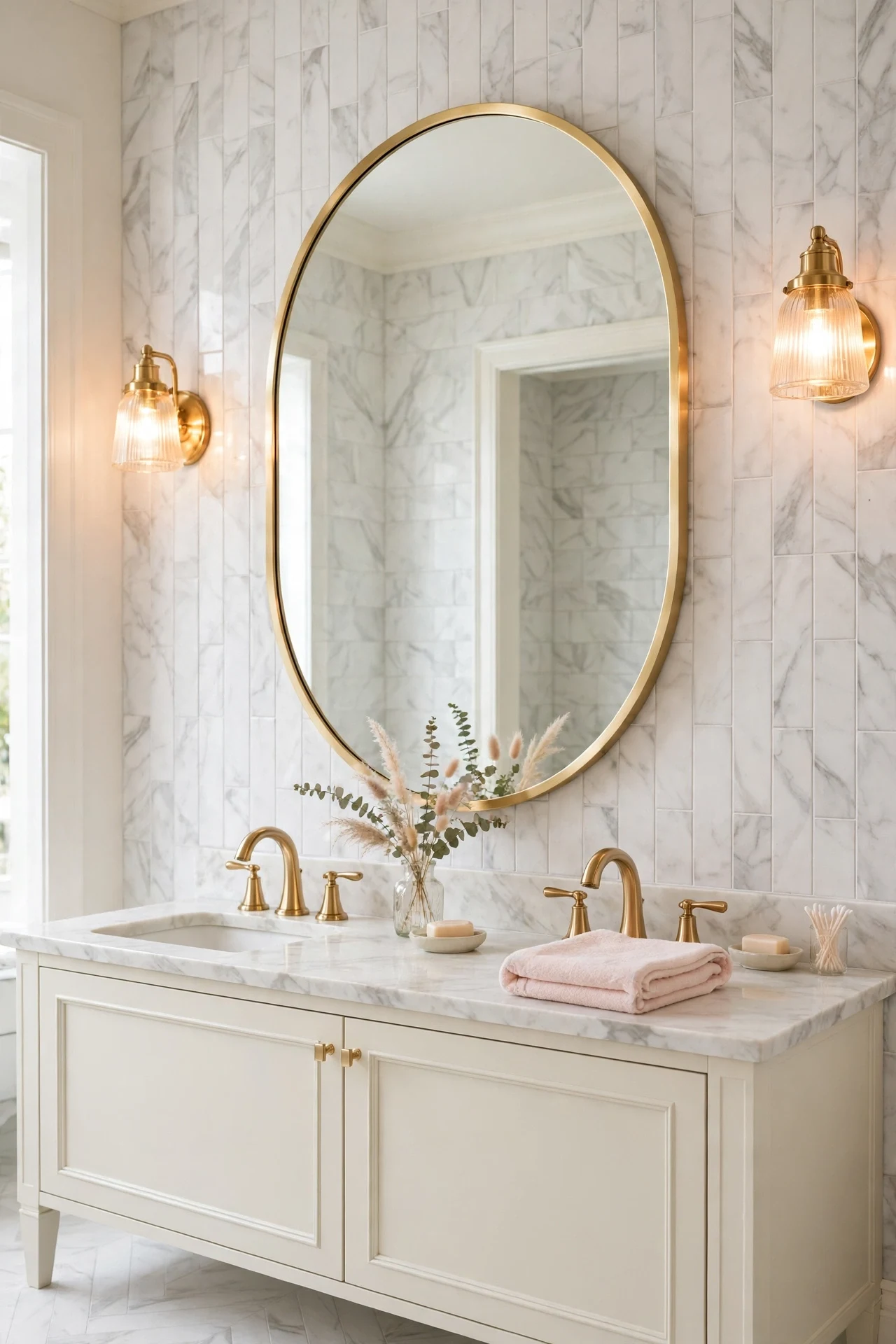
The oval is the round mirror’s calmer sister: the same softness, stretched gently upward, so it flatters a face, suits a narrower vanity, and leaves wall showing at its corners for sconces or a small shelf. Where the circle is a statement, the oval is a courtesy; it softens the tile grid without announcing itself, which is why it suits guest bathrooms and powder rooms that want welcome more than drama.
An oval also solves an awkward middle size. Vanities too wide for a small round and too narrow for a pair often land perfectly under one oval, whose vertical emphasis makes the vanity beneath it look deliberately chosen.
How to do it: Choose an oval whose width is about two thirds of the vanity’s and hang its center at the household’s eye level. Because an oval has no straight edge to level against, mark the wall from a plumb line and check the mirror’s symmetry from the doorway before final tightening. Fix into studs or rated anchors, two points, as always. Pro Tip: Turn the oval’s quietness up by pairing it with a curved faucet; two gentle arcs on one wall is a whole design language. Common mistake: An oval hung slightly rotated. With no corners to betray it, a rotated oval can go unnoticed for months while making everyone vaguely uneasy.
11. Frameless and Polished for a Small, Bright Room
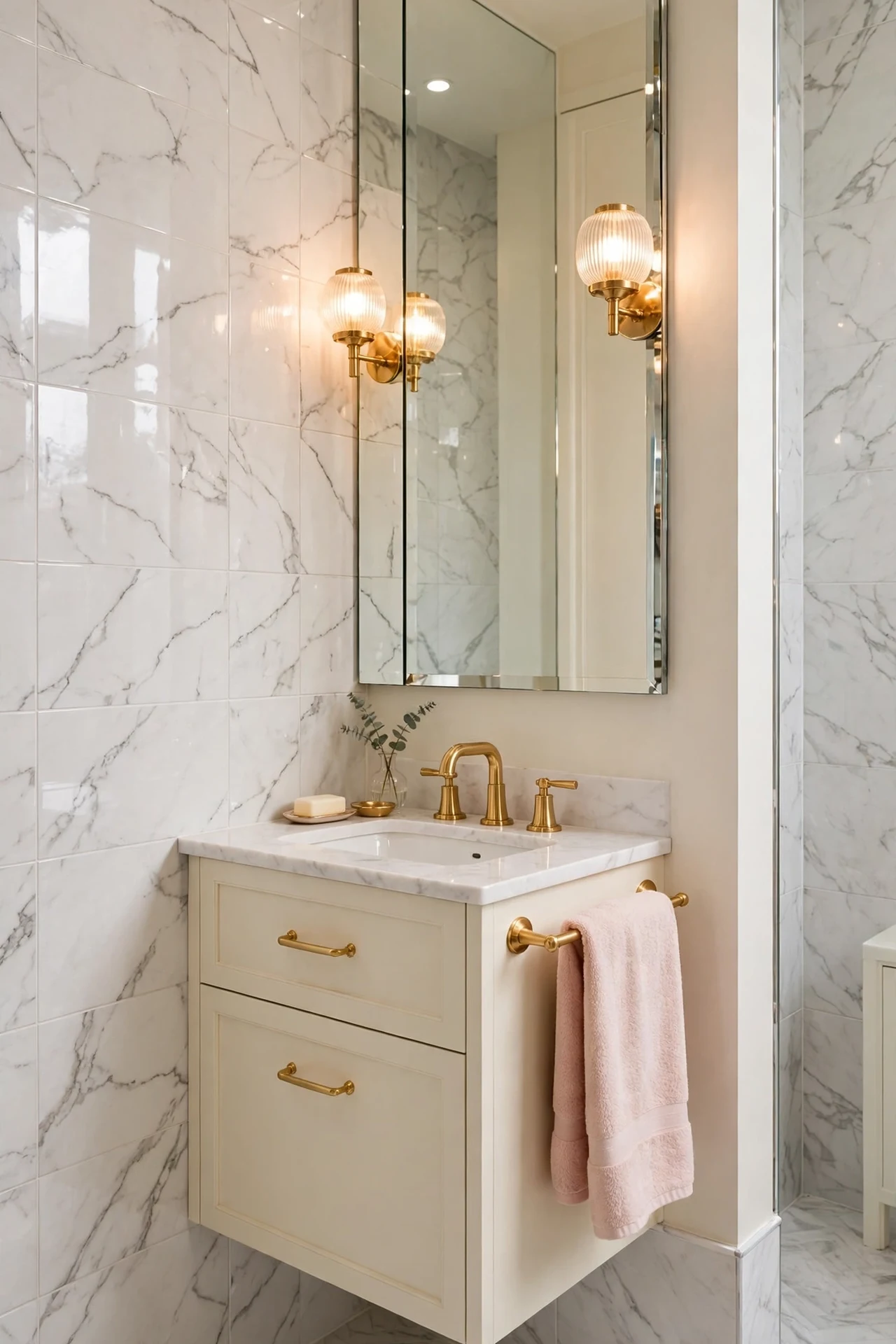
In a small bathroom, a frame is a border that stops the eye, and stopping the eye makes the room smaller. A frameless mirror with polished edges runs the reflection nearly wall to wall and lets the room double itself without interruption, which is the oldest small-bathroom trick there is and still the most effective. The glam palette survives the missing frame because the gold moves to the faucets, sconces, and towel ring, where it sparkles against all that uninterrupted glass.
Frameless does not mean casually fixed. Large frameless panels are usually mounted with clips, channels, or mirror adhesive systems rated for the weight, often in combination, and the bottom channel or clips carry real load over a hard sink.
How to do it: Have the mirror cut a small margin inside the wall’s width so it never binds against tile, with polished, not raw, edges. Use the maker’s clip or channel system fixed into studs wherever the layout allows, and treat adhesive-only mounting of a large panel over a sink as a professional decision, not a default. Keep a bead of clearance at the counter so cleaning water never sits against the glass edge. Pro Tip: In a small room, take the frameless mirror as high as the light allows; every extra inch of height is ceiling the room appears to gain. Common mistake: A frameless mirror resting its full weight on the backsplash or counter edge. Glass edges chip and the mounting above is then carrying a panel already damaged at its weakest point.
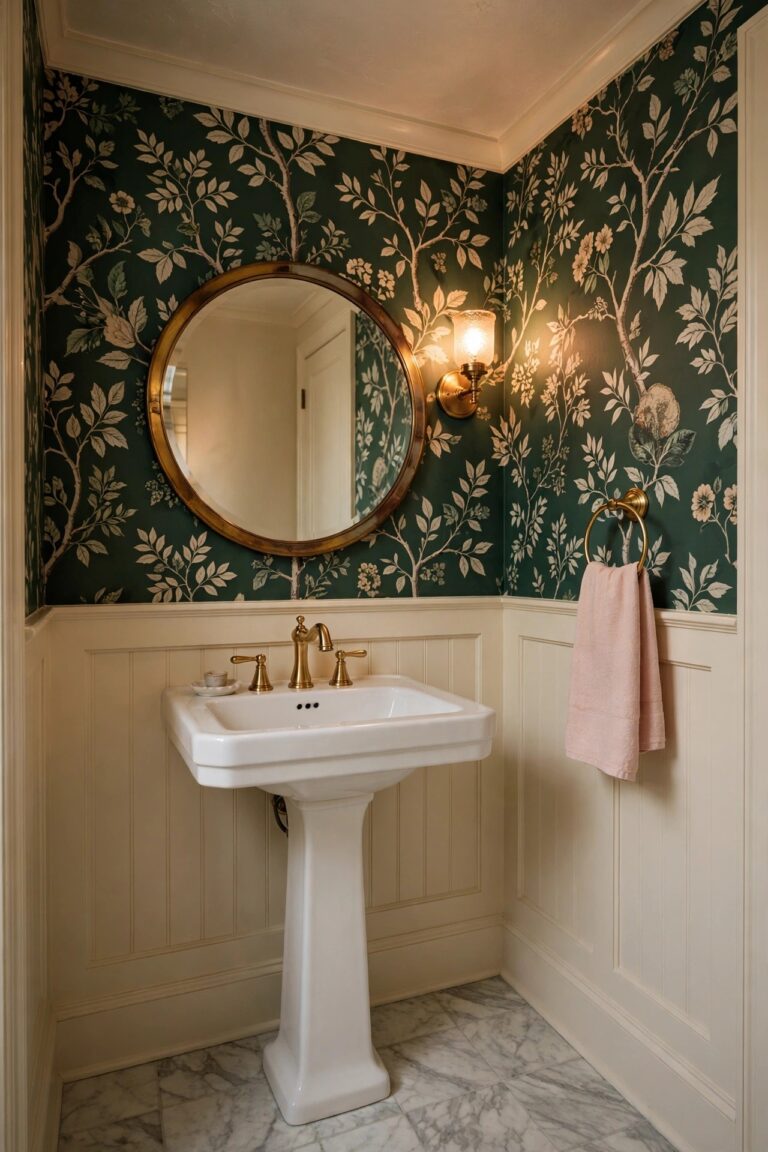
12. One Vintage-Style Gold Mirror as the Statement
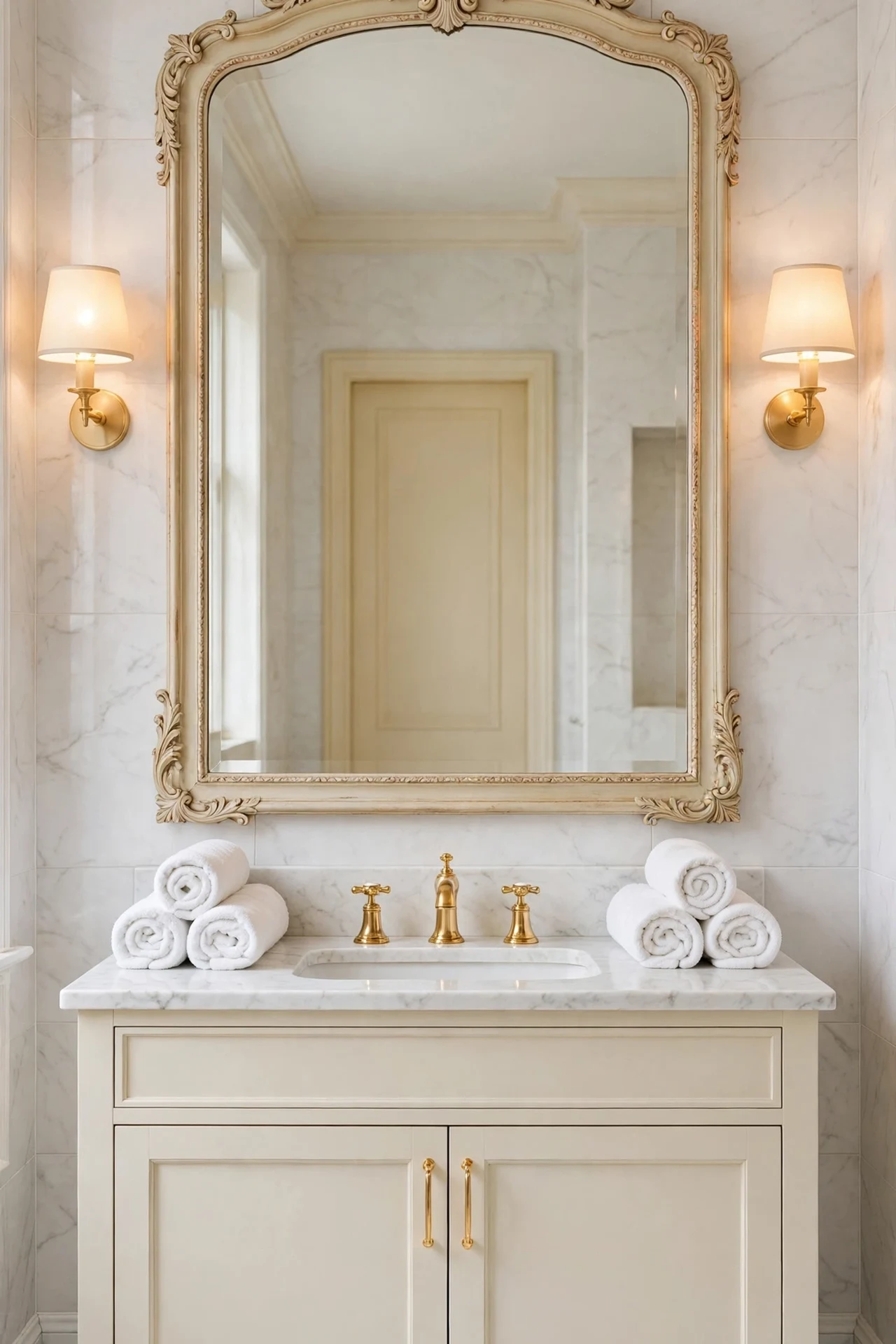
Every calm room benefits from one piece with a past, or at least a silhouette borrowed from one. A vintage-style gold mirror, with a shaped crest, a softly aged finish, and curves the rest of the room does not have, gives a new bathroom instant character and gives the glam palette its most romantic note. Because it is the statement, everything around it should quiet down: plain sconces, simple faucets, towels in white, so the mirror’s detail reads as richness rather than clutter.
True vintage mirrors carry two practical notes. Old glass can be heavier than modern equivalents in the same size, and old frames may need their hanging hardware replaced before they can be trusted; both are fixable, and both belong in the plan, not in a surprise.
How to do it: Check any genuinely old mirror’s frame joints and replace its hanging wire or rings with modern rated hardware fixed to the frame’s strongest points. Weigh it, and choose fixings, studs first, rated anchors second, for well beyond that weight, at two points. Hang it as the wall’s single ornament, centered on the vanity. Pro Tip: A vintage mirror above a very plain modern vanity is the safest way to try the look; the contrast is the style, so neither piece needs to match the other. Common mistake: Hanging a heavy antique on its original century-old wire over a porcelain sink. The wire is the artifact; do not ask it to work.
13. A Mirror With a Small Ledge for the Daily Few
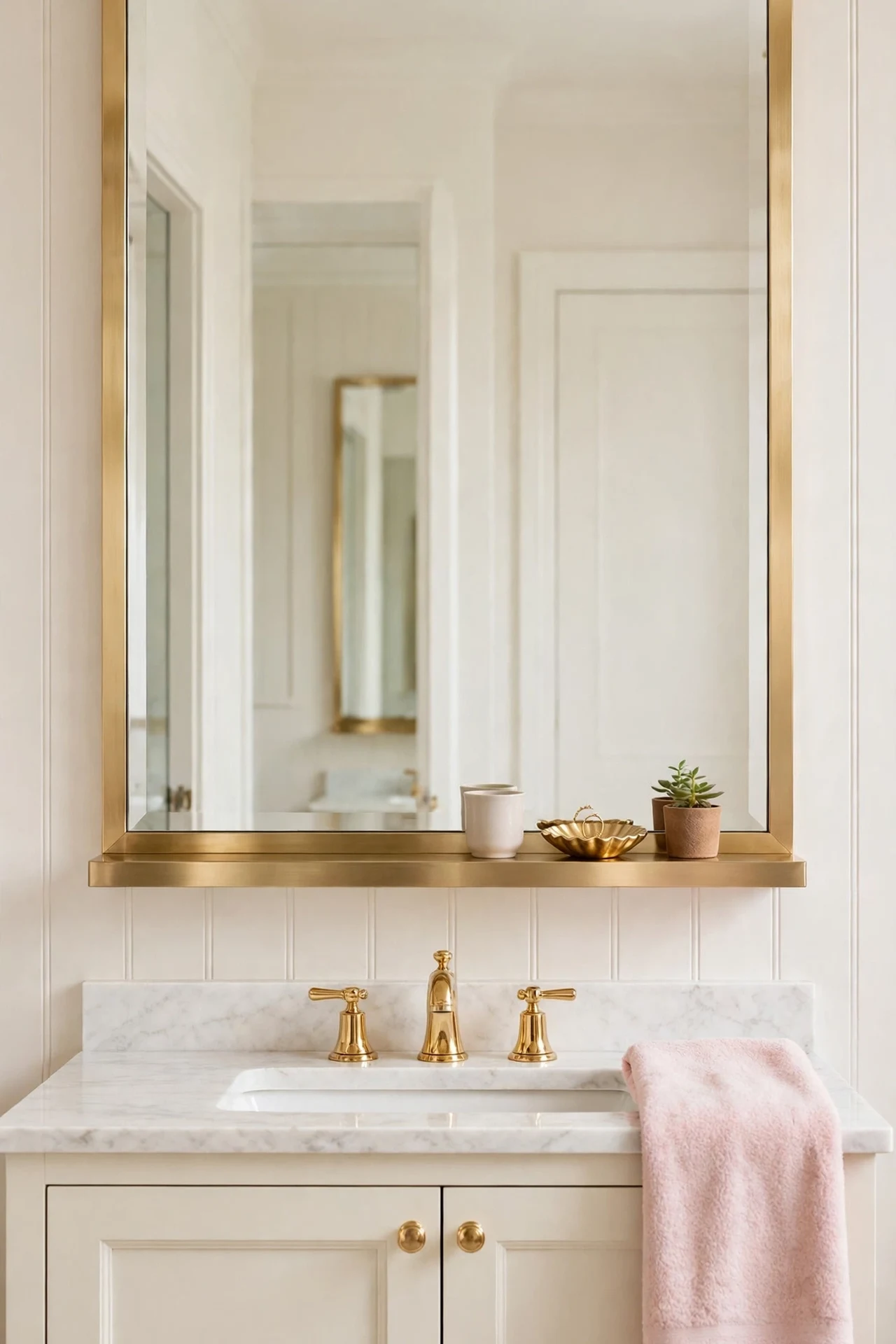
Some bathrooms have no counter depth to spare, and for those, a mirror with a small ledge along its base is storage disguised as a detail. The ledge holds the daily few, toothbrush cup, ring dish, the one product in morning use, up off the wet counter and in a line so neat it looks styled. It is the mirror equivalent of the stone tray rule: a border that decides what is allowed out.
A ledge changes the mirror’s fixing math, because the shelf invites small loads at the mirror’s bottom edge, exactly where a hanging mirror is least braced. The unit must be fixed as the furniture it is, into studs or rated anchors, and the ledge kept to genuinely light duty.
How to do it: Choose a ledge mirror whose brackets and fixings are rated for the mirror plus shelf load, and mount it into studs wherever possible. Keep the ledge to three or four light items, nothing glass-heavy, nothing a child will pull at. Wipe the ledge on the weekly reset, since a dusty ledge advertises itself at eye level. Pro Tip: Reserve the ledge for what is used at the mirror itself, grooming items, and keep skincare on the counter tray; two systems, two homes, no creep. Common mistake: Treating the ledge as a full shelf. Bottles ranked along it turn the mirror into a shop display and overload the very edge that should stay light.
14. Sconces Flanking the Mirror at Face Height
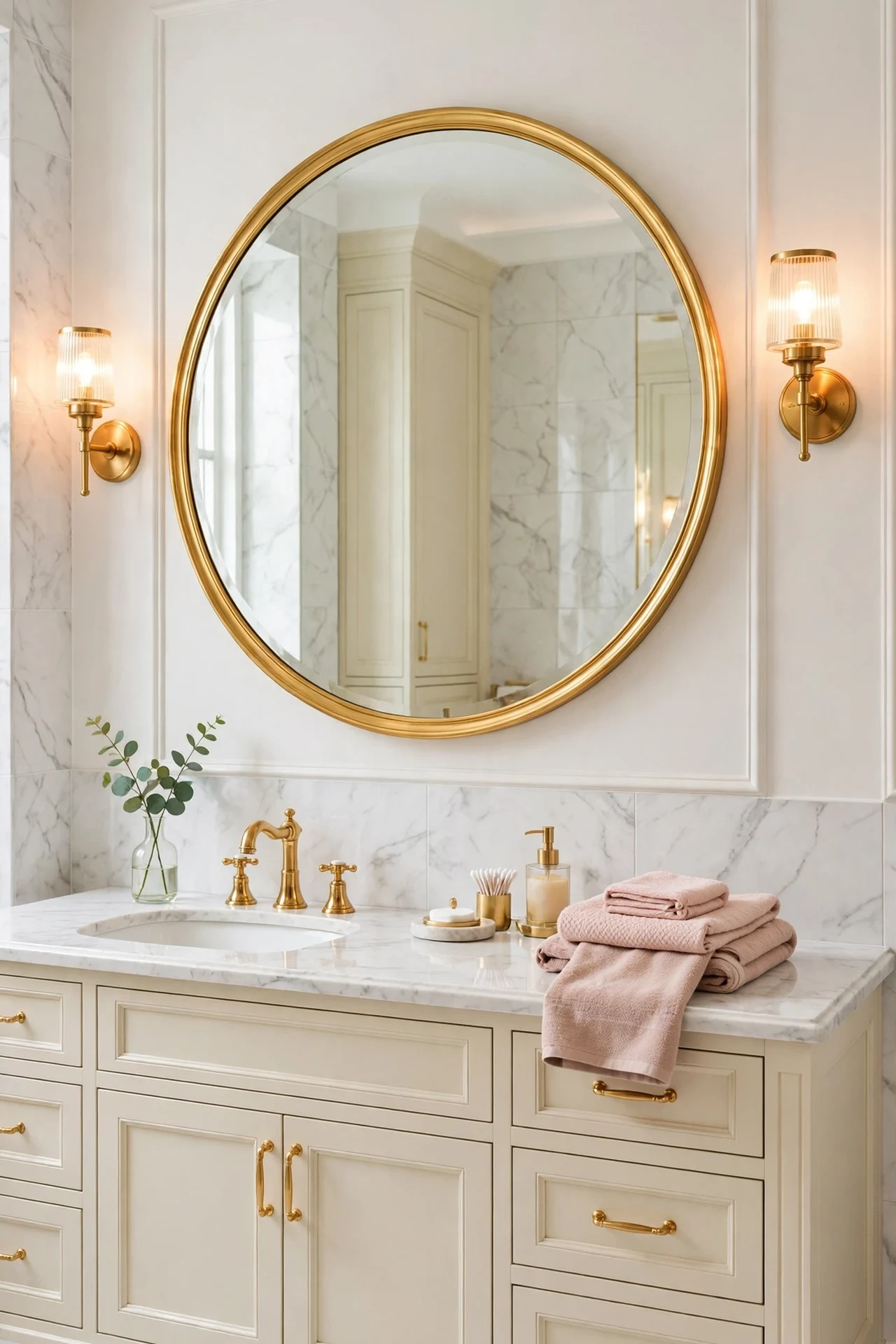
A mirror is only as good as the light in front of it. Cross light from two sconces at face height, one on each side of the mirror, is the kindest light a bathroom can offer, because it fills both sides of the face evenly and leaves no shadow for the overhead light to carve. Pairing the sconces with the mirror as one composition, rather than lighting the room and hoping the mirror benefits, is what separates a vanity that works from one that merely exists.
The sconces also frame the mirror visually. Two warm points of light at its sides give even a simple mirror a finished, deliberate setting, and in this palette brushed gold sconces extend the frame’s finish into the wall.
How to do it: Place sconces at roughly face height for the household, spaced evenly on either side of the mirror, and use the same warm white bulbs in both. Hardwired sconces beside bathroom water are an electrician’s job on the protected circuit; plug-in or rechargeable sconces are the renter’s route to the same geometry. If the mirror is wide and wall space is tight, mount the pair on the mirror’s own plane using fittings made for it, professionally fitted. Pro Tip: Put the sconces and the ceiling light on separate switches, so the mirror can glow alone for evening baths. Common mistake: One sconce, or a single bar above the mirror, as a compromise. One-sided light is worse than overhead light; it models half the face and hides the other.
15. A Magnifying Mirror on an Arm, Fixed Like It Matters
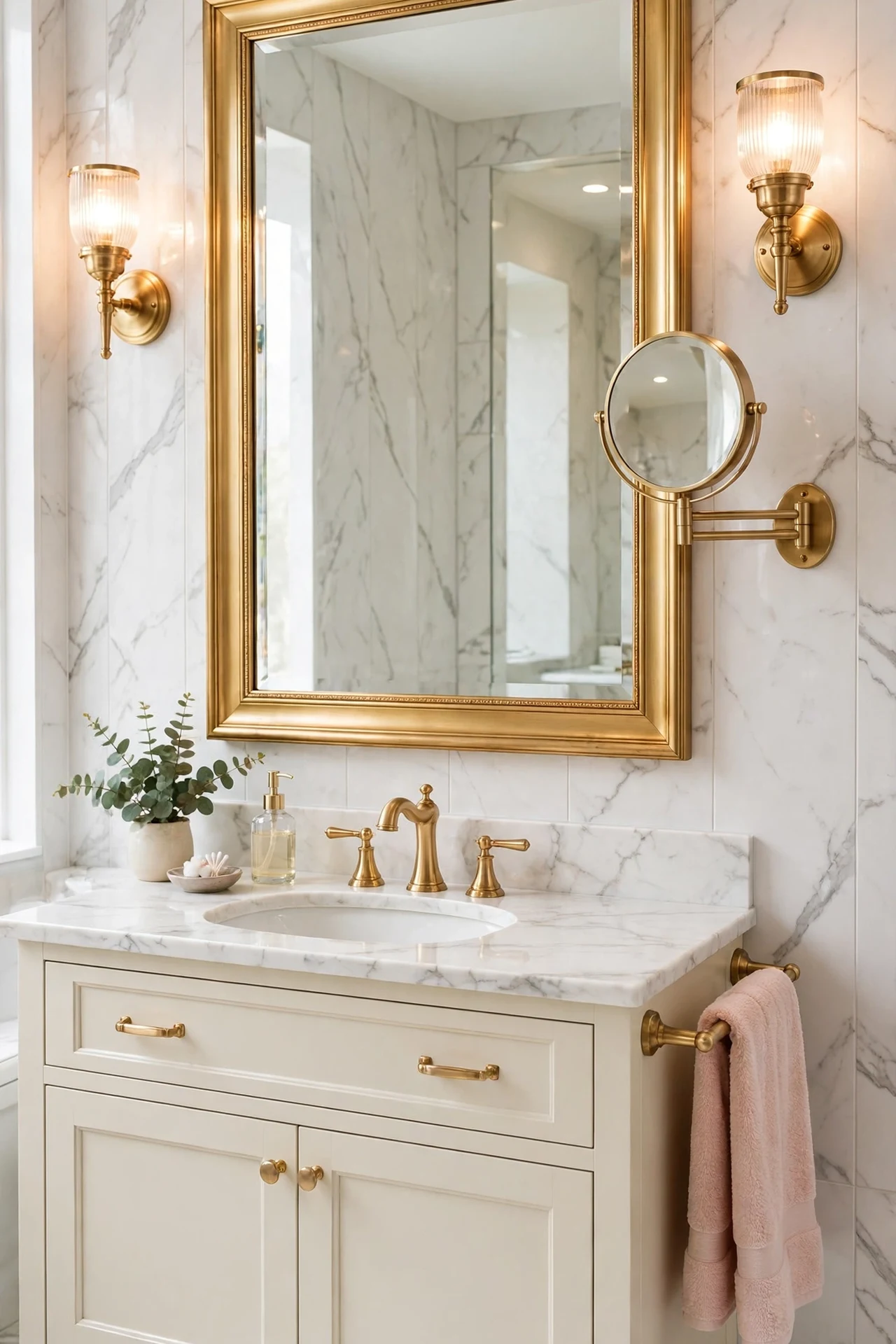
Close work, eyeliner, brows, contact lenses, a careful shave, asks more of a mirror than a wall panel can give. A small magnifying mirror on an extending arm brings the reflection to you, lit and enlarged, then folds flat against the wall when the morning is done. It is the most purely useful mirror in the article and, properly chosen in brushed gold, it reads as part of the vanity’s jewelry rather than a gadget.
An extending arm is a lever, and levers multiply force at their mounts. Every pull on the mirror tugs the fixing plate, so the arm’s base must land on a stud or solid blocking with the maker’s full screw pattern, never on tile over hollow board with two small plugs.
How to do it: Plan the arm’s spot before buying, beside the main mirror at the height of the person who will use it most, and confirm a stud or blocking behind that exact point. If no stud exists there, have blocking added or choose a counter-standing magnifier instead of accepting a weak fixing. Check the arm’s screws on the monthly tidy and stop using it at the first sign of play in the mount. Pro Tip: A double-sided arm mirror, plain on one side and magnifying on the other, covers guests who find magnification dizzying. Common mistake: Screwing the arm base into tile and grout alone. Tile is a finish, not a structure, and it will crack around a working lever.
16. An Extra-Wide Mirror to Unify Two Sinks
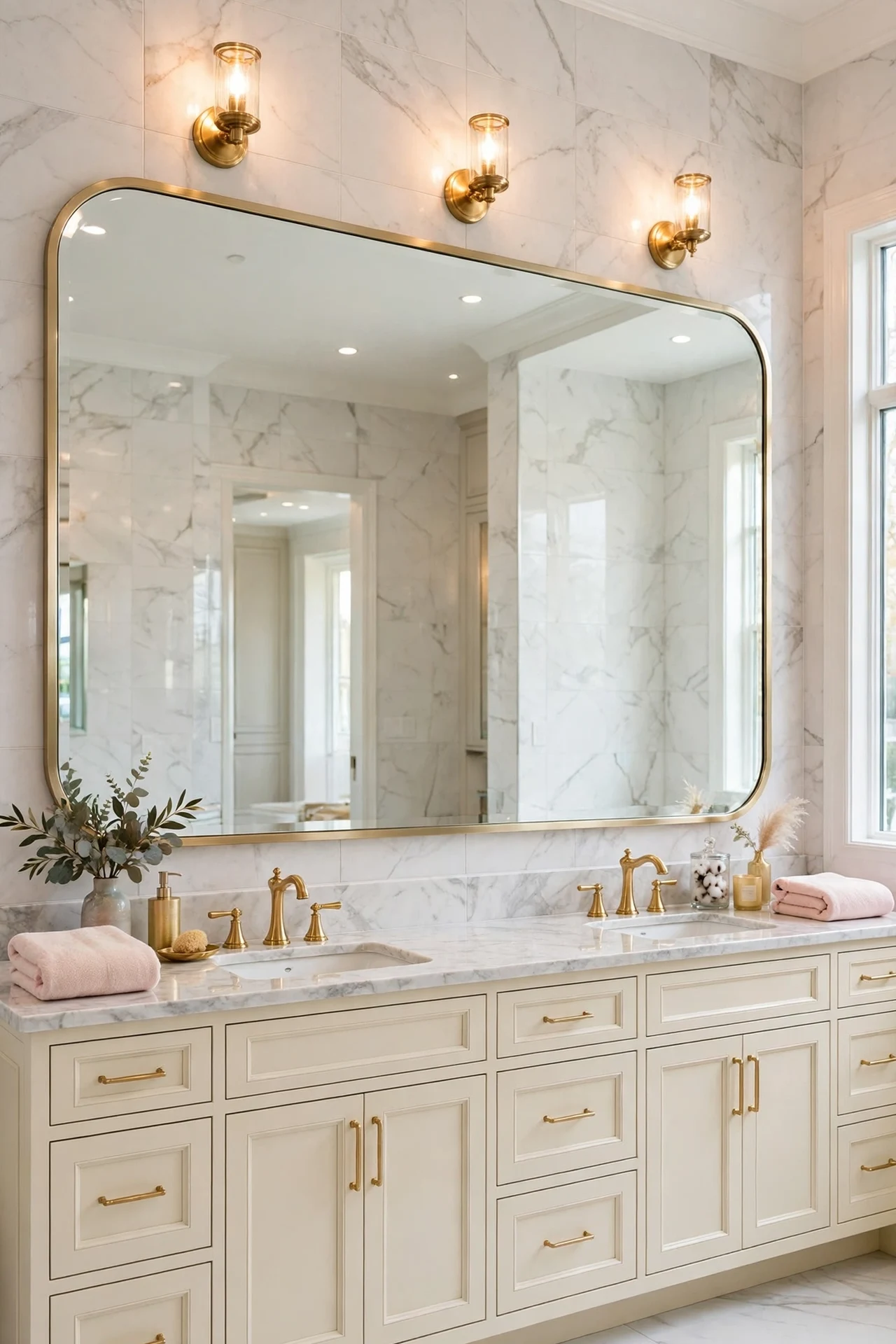
Where Idea 3 gives each sink its own mirror, the opposite choice can be just as right: one extra-wide mirror spanning the whole double vanity unifies the wall into a single calm plane, doubles the room’s reflected light in one sweep, and suits a household that shares the counter more than it divides it. The wide mirror is also the most forgiving choice for an uneven wall, since one large panel hides what two separate mirrors would frame and emphasize.
Size brings duty. A mirror this wide is the heaviest single piece in the article, and its fixing is a system, a channel, clips, or multiple rated hangers spread across studs, installed level and supported along its length rather than hung from two hopeful points.
How to do it: Have the mirror made or chosen to end a few inches inside the vanity’s width at each end. Use a continuous bottom channel or the maker’s full clip pattern, landing fixings in studs along the span, and level it with a long level across the whole width, not a short one walked along. For the largest panels, professional installation is the sensible spend. Pro Tip: Three sconces above a wide mirror, spaced in thirds, keep its light as unified as its glass. Common mistake: Hanging a wide mirror from two end hooks alone. The middle sags, the reflection bends almost imperceptibly, and the fixings carry a load they were never arranged for.
17. The Height Rule: Hang It for the People Who Use It
Every mirror in this article succeeds or fails on one unglamorous decision: its height. Hung too high, a mirror reflects the ceiling and serves nobody shorter than its installer; too low, and tall users stoop while the bottom edge crowds the faucets. The rule is simple and worth stating plainly: the center of the mirror should sit near the eye level of the people who use it most, adjusted for a mixed household by choosing a taller mirror rather than a compromise height, so everyone fits inside its span.
Placement has a horizontal half as well. A mirror belongs centered on its faucet, not on the wall section, because the person stands at the faucet; when the vanity is off-center in the room, following the wall instead is how mirrors end up serving nobody precisely.
How to do it: Stand at the vanity and mark the wall at the eye level of the main users; for households of mixed heights, let the tallest and shortest marks define the span and choose a mirror tall enough to cover both, centered between them. Keep the bottom edge clear of the backsplash and faucet arc, and the top below the light line. Fix into studs or rated anchors at two points, and do the final check from the doorway, where misalignment shows first. Pro Tip: Before drilling anything, tape the mirror’s outline on the wall in painter’s tape and live with it through one morning routine; height mistakes are free at the tape stage. Common mistake: Hanging the mirror to suit the tile pattern or a pre-existing hook. Tiles and old hooks serve the mirror’s placement, never the other way round.
Quick Reference Table
| Idea | What It Adds | Key Rule |
|---|---|---|
| Round gold mirror | A soft centrepiece | Sized to the vanity, centered on the faucet |
| Arch mirror | Architecture and height | Give the curve air, hang it plumb |
| Two mirrors, double vanity | Two personal stations | Identical pair, each on its faucet |
| Rounded rectangle | Tailored, usable reflection | Level both corners, frame echoes cabinetry |
| Backlit mirror | Shadow-free face light | Warm, dimmable, electrician for hardwiring |
| Pivot mirror | A height for everyone | Arms fixed into studs, no exceptions |
| Recessed mirrored cabinet | Storage behind the glass | Check the wall inside before cutting |
| Leaning full-length | The whole outfit check | Anti-tip strap into a stud, always |
| Slim vertical pair | Borrowed ceiling height | Tops level, each on its faucet |
| Oval mirror | The softest lines | Mark plumb first, ovals hide rotation |
| Frameless mirror | A small room doubled | Rated channel or clips, never resting on the counter |
| Vintage statement | Character in one piece | New rated hardware on old frames |
| Mirror with ledge | Storage for the daily few | Three or four light items only |
| Flanking sconces | The kindest face light | A matched pair at face height |
| Magnifying arm | Close work, folded away | Base on a stud or do not mount it |
| Extra-wide mirror | One calm unified wall | A fixing system along the whole span |
| The height rule | A mirror that serves its people | Center near eye level, tape it first |
The Mirror That Changes the Room Checklist
- The mirror is centered on the faucet, not just on the wall
- Its center sits near the eye level of the people who use it
- The outline was taped and lived with before any drilling
- Fixings land in studs or rated anchors, at two secure points
- Any leaning mirror has an anti-tip strap fixed into a stud
- Pivot arms and magnifying arms are mounted on studs or blocking
- The frame finish matches the faucets and other metals
- Light reaches the face from the sides or from the mirror itself
- Every bulb around the mirror is the same warm white
- Hardwired mirror or sconce work was done on a protected circuit
- The mirror’s bottom edge clears the backsplash and faucet arc
- Heavy or extra-wide mirrors use a full fixing system or an installer
- Vintage mirrors hang on new rated hardware, not original wire
- A ledge mirror holds only the daily few, nothing heavy
- Fixings and straps are checked on the monthly tidy
Frequently Asked Questions
How do I hang a heavy bathroom mirror safely?
Weigh the mirror, then choose fixings rated well beyond that weight: into wall studs wherever the layout allows, or heavy-duty anchors matched to your wall type where it does not. Use two secure fixing points so the mirror cannot swing, keep it level, and never rest its weight on the backsplash or counter. For very large, extra-wide, or antique mirrors, professional installation is a reasonable and often cheaper decision than repairing a fall.
What mirror shape makes a small bathroom feel bigger?
A large frameless mirror with polished edges, run nearly wall to wall, because nothing interrupts the reflection and the room doubles itself. If a frame is wanted, a large round mirror is the next best choice; its soft shape contrasts the tile grid and its size keeps the wall feeling generous. In both cases, bigger and simpler beats small and ornate.
Where should light go around a bathroom mirror?
At the face, from the sides. Two sconces at face height flanking the mirror, or a warm backlit mirror, light both sides of the face evenly and avoid the shadows a single overhead light carves. Keep every bulb the same warm white, and leave the ceiling light on its own switch for the rest of the room.
Can I lean a full-length mirror in a bathroom?
Only if it is secured: an anti-tip strap or bracket fixed into a stud, non-slip pads under the feet, and a spot outside door swings, splash zones, and elbow traffic. If those conditions cannot be met, or small children use the room unsupervised, hang the full-length mirror flat on the wall instead. A leaning mirror that is not strapped is not a style choice, it is a fall waiting for a bump.
Conclusion
A bathroom mirror is never just a mirror. It is the room’s light manager, its largest piece of wall furniture, and the surface every morning begins with. Choose its shape for the feeling you want, round for softness, an arch for height, a pair for fairness, frameless for space, then hang it like the heavy, valuable thing it is: centered on the faucet, at the eye level of its people, and fixed into the structure of the wall. Do that, and the room will feel different before anything else changes.