15 Blue Living Room Ideas That Feel Bright and Glam
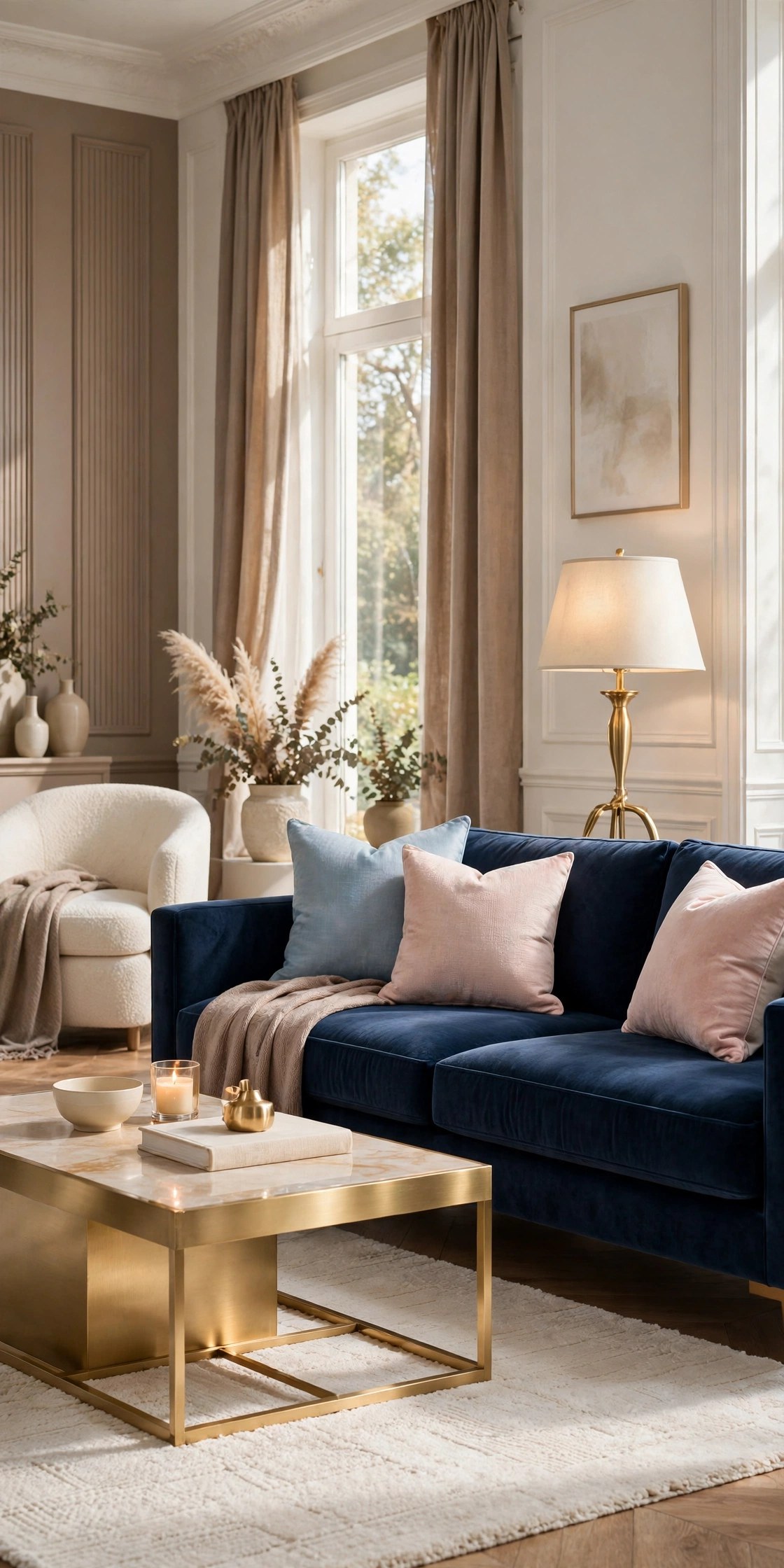
Blue is the colour most people want in a living room and the colour most people are afraid to use in one. The fear is reasonable: the wrong blue, used in the wrong amount, turns a warm room cold, dark and flat, and a sofa is an expensive place to learn that lesson. The fix is not to avoid blue. Navy gives depth on one anchor piece, dusty blue softens a wall without closing it in, powder blue keeps curtains and cushions light, and teal-blue adds one richer note where the room can carry it. These blue living room ideas move through the whole room, sofa, walls, curtains, rug, art, chairs, ceiling and lighting, so you can take one idea on its own or layer several without the scheme fighting itself. See our living room color combinations for the full palette.
Disclosure: This article may contain affiliate links. If you buy through a link on this page, GlamNStyle may earn a small commission at no extra cost to you. Product links in this article are plain links; each one is checked on the retailer’s own page before it is added.
1. Anchor the Room With One Navy Velvet Sofa
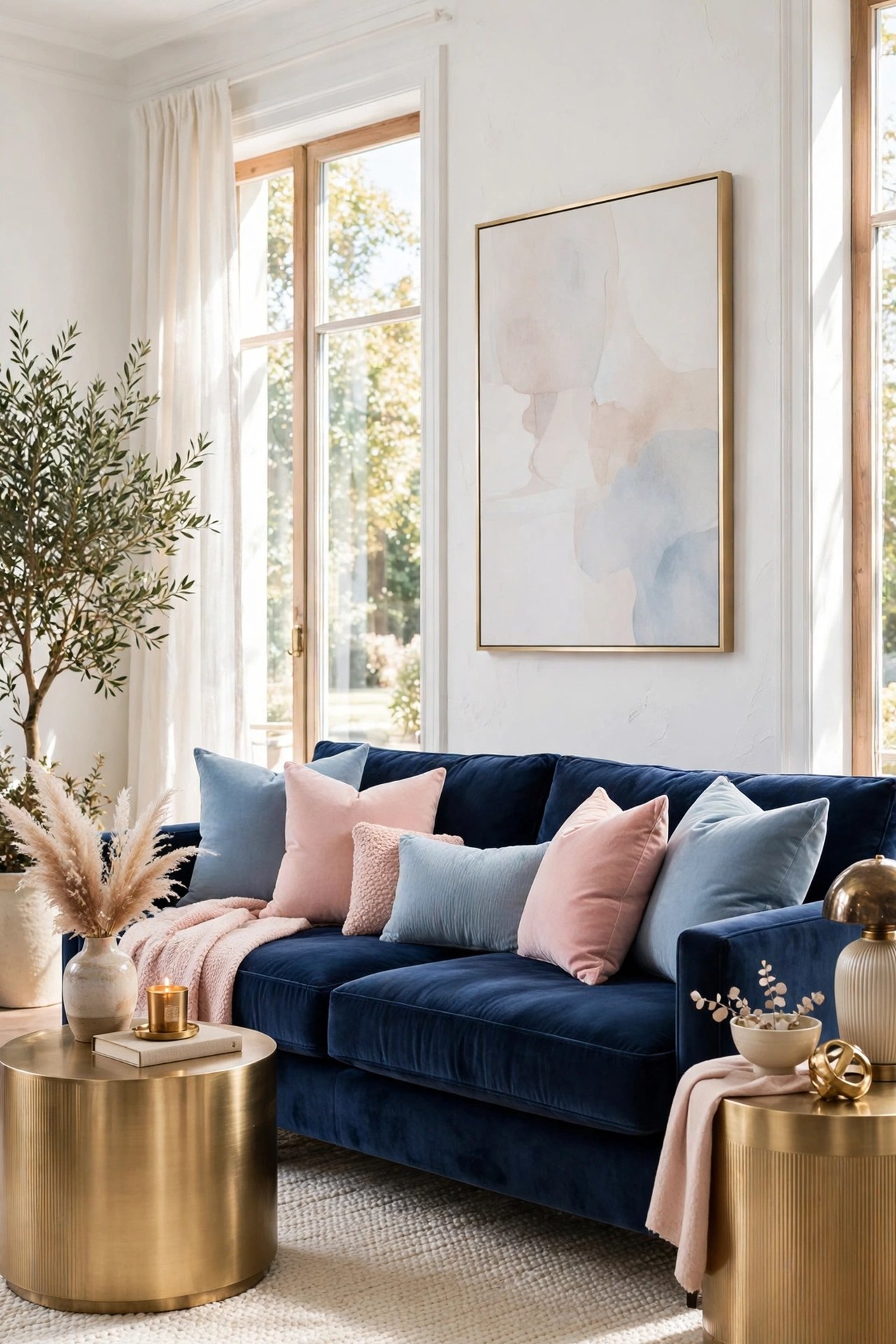
One deep piece, placed once, is the safest way to bring a strong blue into a bright room. A navy velvet sofa works because navy behaves almost like a neutral: it grounds the pale palette, hides everyday wear better than cream upholstery, and the velvet pile catches light so the colour reads rich rather than flat. Everything around it stays light, white walls, a cream rug, pale cushions in powder blue and blush, and brushed gold at the side tables and lamps, so the sofa reads as the deliberate anchor instead of the start of a dark room. See our living room furniture for the pieces that suit it.
Best For: Rooms with good daylight and a pale base that needs one strong anchor.
Not Ideal For: Small north-facing rooms with little natural light; use the lighter blues in idea 12 there instead.
Estimated Cost: $700-$1,800 (estimate) for a navy velvet sofa in a standard three-seat size.
Budget Note: The sofa is the anchor purchase of the whole scheme, so spend here and save on the cushions and throws that dress it.
Renter Friendly: Yes
Renter Note: Nothing is fixed to the room; check the delivery route and door widths, because a one-piece sofa is the hardest item to return.
What You Need
Navy velvet sofa, cream low-pile rug, powder blue and blush cushions, one navy throw, brushed gold side table or lamp.
Product type to look for: A velvet or velvet-look sofa with a tight, even pile and removable cushion covers, in a true navy rather than a bright royal blue, which reads colder against cream.
How To Do It
- Place the sofa on the longest wall and centre a cream rug under its front legs.
- Dress it with pale cushions first, powder blue and blush, then add one navy cushion to echo the upholstery.
- Put brushed gold on both sides, a lamp on one side and a side table on the other, so the dark piece is framed by light metal.
- Step back from the doorway and check that everything except the sofa still reads pale and bright.
Pro Tip
Test navy fabric samples at night under your own bulbs before ordering.
2. Paint One Dusty Blue Accent Wall Behind the Sofa
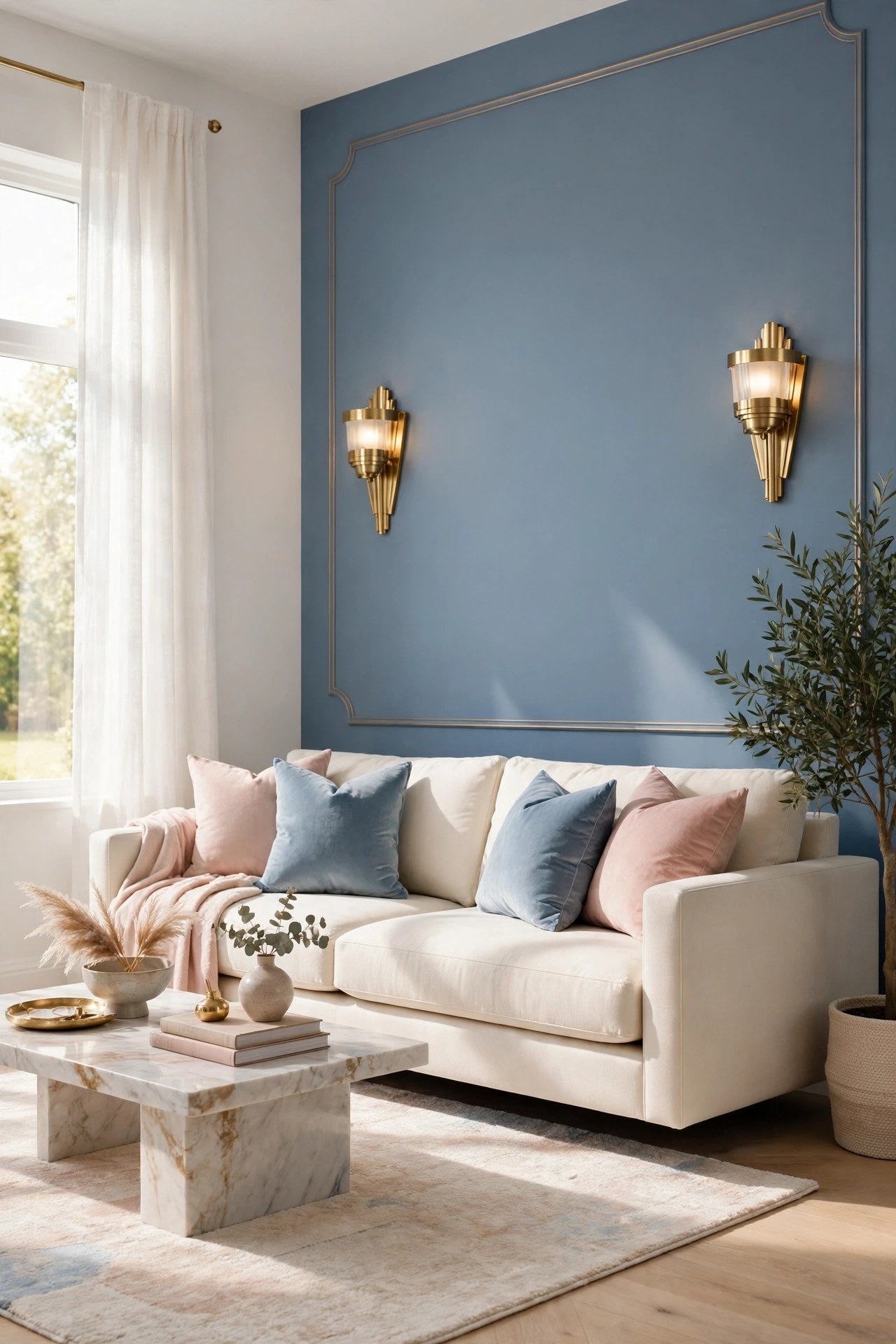
If the sofa stays cream, the wall behind it can carry the blue instead. Dusty blue, a blue softened with grey and a touch of warmth, does this job without turning the room cold, because it sits quietly behind pale furniture instead of shouting over it. Paint only the one wall the sofa sits against and leave the other walls warm white, so the room keeps its brightness and the blue reads as a backdrop. The pale sofa stands forward, art and sconces gain contrast, and the seating zone feels defined in an open plan.
Best For: Cream or white sofas that disappear against white walls and need a backdrop.
Not Ideal For: Rooms where the sofa wall is broken up by doors and windows; a fragmented accent wall never reads as one calm field.
Estimated Cost: $60-$150 (estimate) for paint, primer and tools for one standard wall.
Budget Note: One wall uses one to two cans of paint, so this is the cheapest strong change in the whole list.
Renter Friendly: No
Renter Note: Paint needs landlord permission in most leases; renters should use the removable options in idea 13 instead.
What You Need
Dusty blue paint in a matte or eggshell finish, primer if the wall is dark, painter’s tape, roller and tray, one gold-framed art piece.
Product type to look for: A dusty blue with a warm or grey undertone rather than a clean bright blue; paint a large sample board first and live with it for two days.
How To Do It
- Move the sofa out and tape the edges where the accent wall meets the white walls and ceiling.
- Prime if needed, then roll two even coats, cutting in the edges with a brush on each coat.
- Remove the tape while the second coat is still slightly wet for the cleanest line.
- Centre the sofa and one gold-framed piece of art on the wall, then dress the sofa in pale cushions.
Pro Tip
Paint the sample board, not the wall.
3. Hang Powder Blue Curtains High and Wide
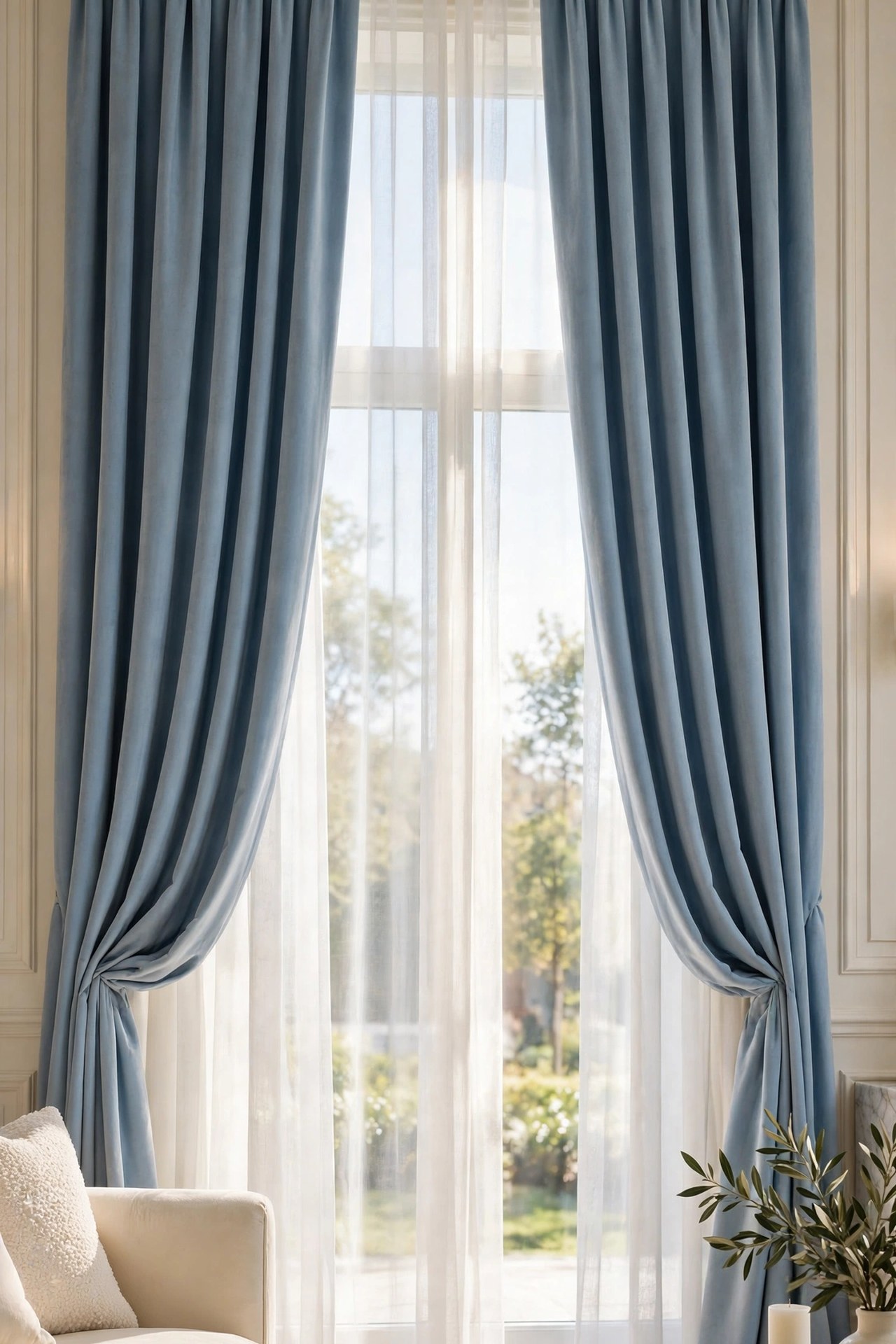
Curtains are where a light blue earns its keep, because fabric softens colour: the same blue that would feel strong on a wall reads gentle when it folds, moves and filters light. Powder blue panels, hung high near the ceiling and wide beyond the window frame, frame the window in colour while the glass itself stays bright, and the high rod makes the ceiling feel taller. Keep the rest simple, a sheer white layer behind the panels for daytime privacy and a brushed gold rod to hold the palette together. The panels should just touch the floor; powder blue that stops short looks like a measuring error.
Best For: White or cream rooms that need colour without paint or new furniture.
Not Ideal For: Windows with radiators directly beneath them, where full-length panels block heat; use sill-length panels there.
Estimated Cost: $80-$200 (estimate) for two powder blue panels, a sheer and a gold rod.
Budget Note: Linen-look synthetic panels give the soft matte fall of linen at a fraction of the price and crease far less.
Renter Friendly: With Conditions
Renter Note: The rod needs screws above the window; use existing holes where possible, or a tension rod inside the frame for a no-drill version.
What You Need
Two powder blue floor-length panels, one sheer white panel, brushed gold curtain rod with brackets, steamer.
Product type to look for: Panels in a matte linen-look fabric with enough width for soft folds when closed; shiny satin finishes make pale blue look cold.
How To Do It
- Mark the rod line a few inches below the ceiling and at least 6 inches past each side of the frame.
- Fix the rod and hang the sheer first, then the powder blue panels.
- Steam the panels in place so the folds fall straight.
- Check from across the room that the curtains frame the window and cover wall, not glass, when open.
Pro Tip
Buy one extra panel if the window is wide.
4. Ground the Seating With a Blue and Ivory Rug
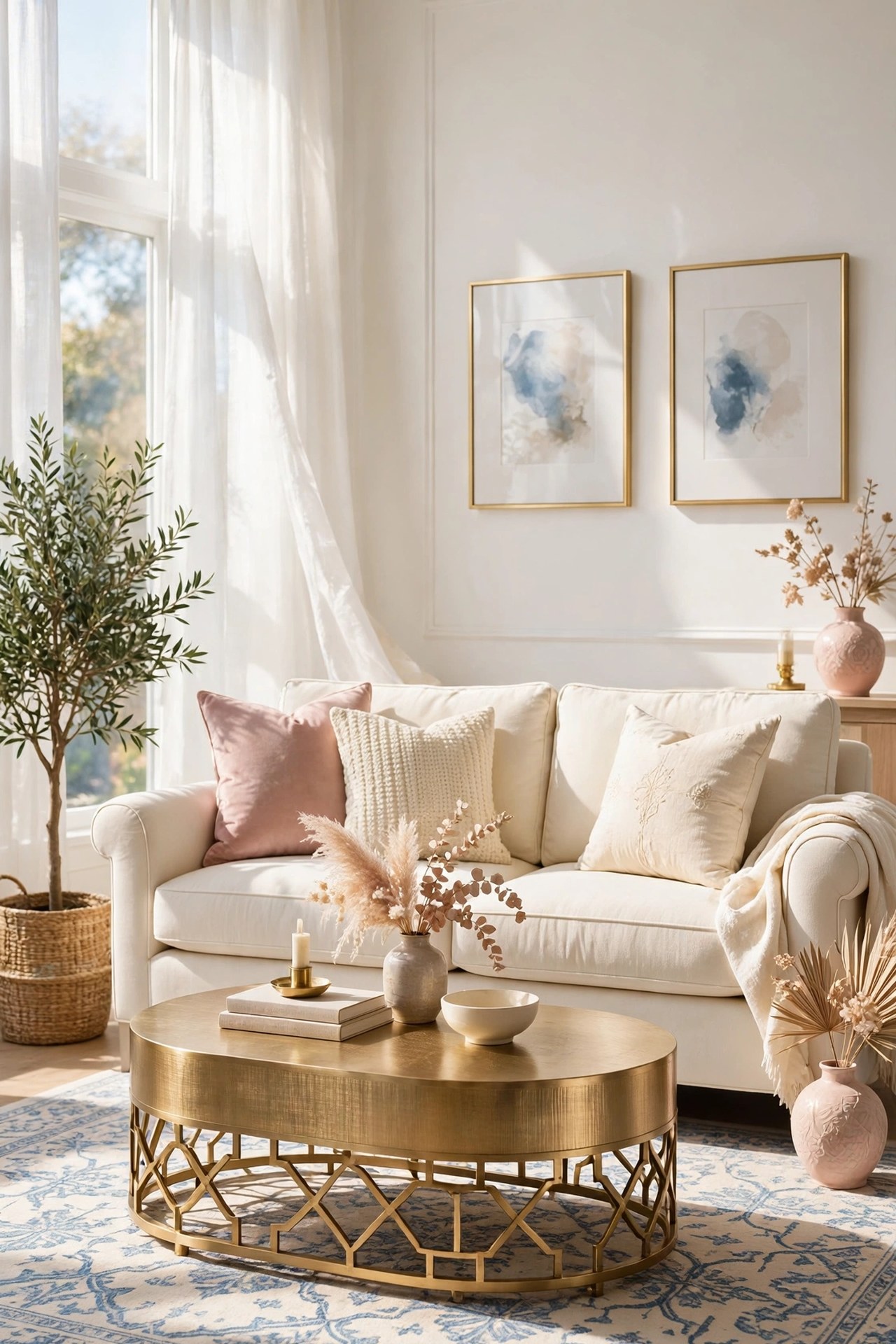
A rug is the one place where several blues can meet at once, because a pattern breaks colour into pieces the eye reads as texture rather than blocks. A blue and ivory rug under the seating zone defines where the living area starts in an open plan, introduces navy, dusty and powder blue together in proportions you did not have to calculate, and finishes a pale floor scheme. Size matters more than pattern: the rug should run under the front legs of the sofa and both chairs, with a border of floor showing around it, because a small rug floating in the middle makes a blue scheme look like an island.
Best For: Open-plan rooms where the seating zone needs defining, and pale floors that feel unfinished.
Not Ideal For: Rooms with heavy foot traffic from an outdoor door; even washable rugs in pale ivory show that path quickly.
Estimated Cost: $120-$400 (estimate) for a blue and ivory rug around 8 by 10 feet.
Budget Note: A larger inexpensive rug in the right size beats a small expensive one; undersizing is the mistake that cannot be styled away.
Renter Friendly: Yes
Renter Note: Fully freestanding; use a non-slip underlay to protect the floor beneath and stop the rug creeping.
What You Need
Blue and ivory rug sized to the seating zone, non-slip underlay, tape measure, cushion covers in two of the rug’s blues.
Product type to look for: A rug where ivory or cream is at least half the pattern, so the overall read stays light; dark-dominant rugs belong with idea 1’s anchor approach instead.
How To Do It
- Measure the seating zone and mark the rug outline on the floor with painter’s tape.
- Lay the underlay, then the rug, centred on the sofa.
- Push the sofa and chairs so their front legs sit on the rug.
- Pick two blues from the rug and repeat only those two in the cushions and throw.
Pro Tip
Photograph the rug sample on your own floor before ordering the full size.
5. Layer Cushions in Three Blues on a Cream Sofa
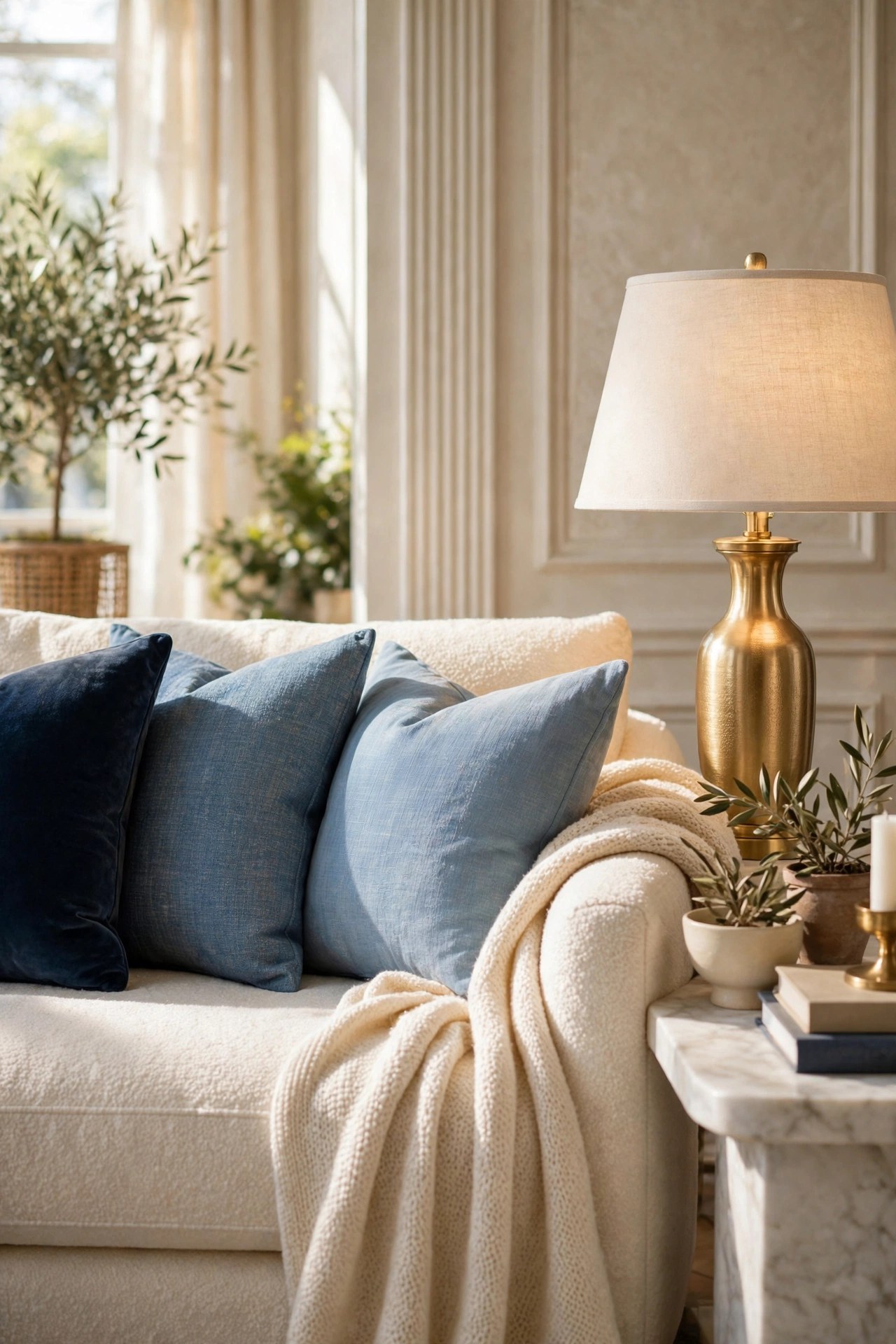
Cushions are the lowest-risk blue in the room: cheap to change, easy to move, and the fastest way to test whether a shade family suits your light before committing to paint or upholstery. The layered version works in threes. Put the deepest blue, one navy cushion, at each end of a cream sofa, add dusty blue in the middle size, and finish with powder blue or a blue and white pattern at the centre. Placed dark to light, the three blues read as one planned family; in a random order the same cushions read as leftovers. Mix in one texture, velvet, linen-look or a soft woven stripe, so the layers differ in surface as well as shade.
Best For: Anyone testing blue for the first time, and cream sofas that need colour without commitment.
Not Ideal For: Homes where cushions are used hard by children or pets daily; pale powder blue covers will need constant washing.
Estimated Cost: $50-$140 (estimate) for five cushion covers in three blues, using inserts you already own.
Budget Note: Buy covers only and reuse your inserts; covers cost a third of complete cushions and store flat when you swap the scheme.
Renter Friendly: Yes
Renter Note: No fixings and no permission needed; this is the first idea to try in any rental.
What You Need
Five cushion covers in navy, dusty blue and powder blue, one patterned blue and white cover, existing inserts, one pale throw.
Product type to look for: Covers with hidden zips and washable fabrics, sized one inch smaller than the insert so the cushion sits plump rather than loose.
How To Do It
- Strip the sofa bare and put the two navy cushions at the ends.
- Add dusty blue inside them, then the powder blue and patterned pair at the centre.
- Fold the throw over one arm rather than spreading it across the seat.
- Live with the arrangement for a week before deciding a shade deserves a bigger role in the room.
Pro Tip
Keep one blush or cream cushion in the mix even in a blue scheme.
6. Use One Oversized Piece of Blue Art as the Focal Point
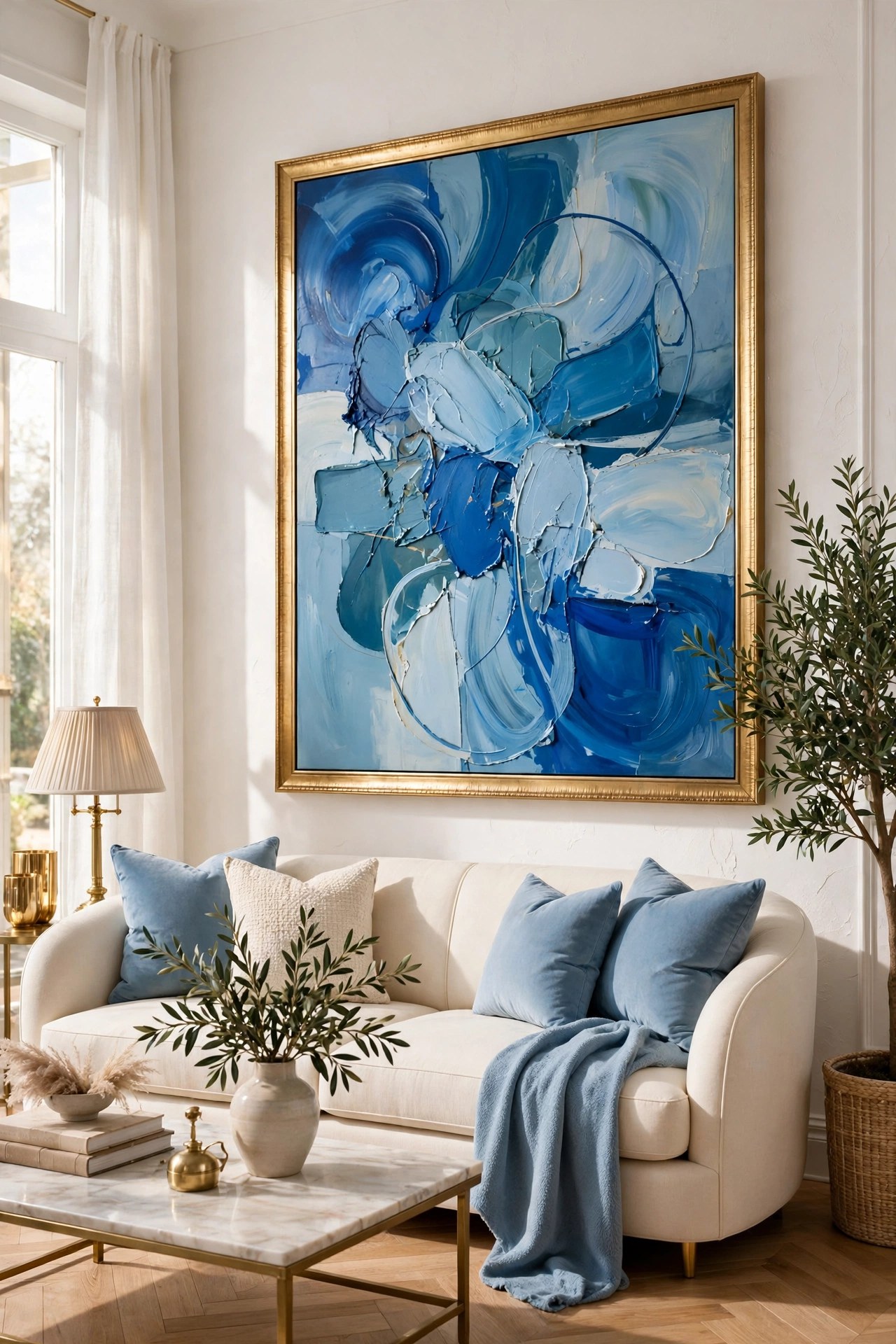
One large piece of art is the most controlled way to put blue on a wall: the colour stays inside the frame, the proportions are fixed, and the piece can move rooms or come down in minutes. Oversized matters. A single framed print at roughly two thirds the width of the sofa gives the blue enough presence to act as the focal point, while a cluster of small blue frames scatters the colour and pulls the eye in six directions. Abstract washes and seascapes in navy, dusty and powder blue suit the glam base, because they carry several shades at once and leave the cushions an easy echoing job.
Best For: Blank sofa walls, and anyone who wants a focal point that can change with the season.
Not Ideal For: Walls in direct harsh sunlight all day, where blue pigments fade unevenly over time.
Estimated Cost: $90-$300 (estimate) for one large framed blue print with a gold frame.
Budget Note: A large print in a ready-made gold frame costs far less than a gallery canvas and reads the same from seating distance.
Renter Friendly: With Conditions
Renter Note: One heavy piece needs proper fixings; use two hooks rated for the weight, or lean the frame on a console for a no-hole version.
What You Need
One oversized blue art print, brushed gold frame, two picture hooks rated for the weight, level, painter’s tape.
Product type to look for: A print where blue covers roughly half the surface with white or cream space in it, so the piece stays airy on a pale wall.
How To Do It
- Tape the outline of the frame on the wall above the sofa and check it from the doorway.
- Mark the hook points so the bottom of the frame sits 6 to 8 inches above the sofa back.
- Fix both hooks, hang the frame and level it.
- Echo exactly two colours from the art in the cushions below it, no more.
Pro Tip
If the art and the sofa are both strong, keep everything between them quiet.
7. Add a Pair of Teal-Blue Accent Chairs
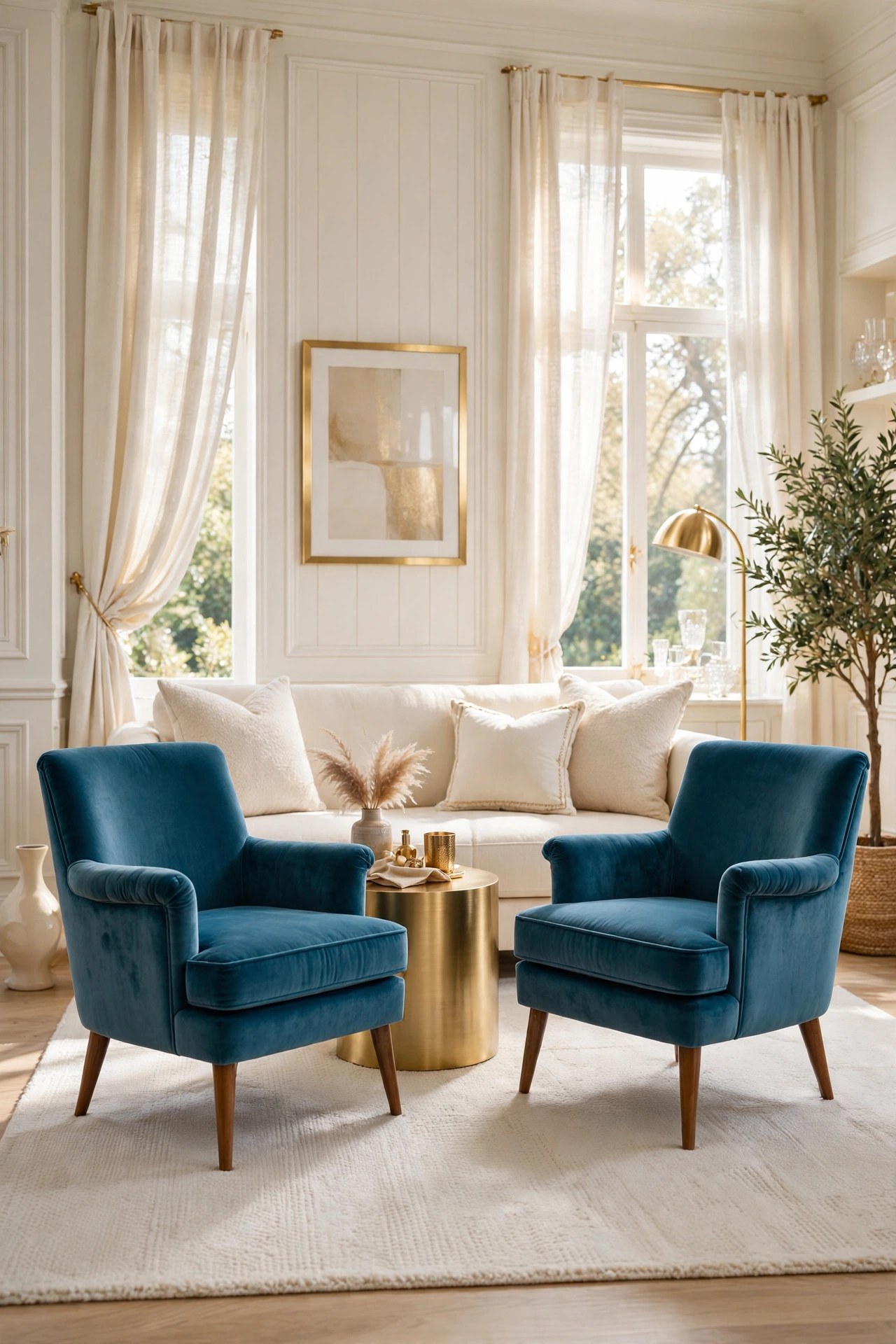
A pair of chairs is where a richer blue belongs, because chairs are smaller than a sofa, movable, and naturally read as accents rather than anchors. Teal-blue, the shade where blue leans toward green, is the warmest of the deep blues and sits most comfortably beside brushed gold and warm taupe, which is why it suits the glam base better than a cold royal blue. Place the pair facing the sofa or angled at the corners of the rug, with a small gold side table between them, and the room gains a proper conversation layout as well as colour.
Best For: Larger living rooms that need a second seating zone and a stronger second blue.
Not Ideal For: Small rooms where two extra chairs block the walkway; one chair, or idea 5’s cushions, is the honest version there.
Estimated Cost: $300-$800 (estimate) for a pair of teal-blue velvet accent chairs.
Budget Note: Chairs are often discounted in pairs at the end of a season; the colour is classic enough that a sale pair is a safe buy.
Renter Friendly: Yes
Renter Note: Fully freestanding; felt pads under the legs protect rental floors when chairs are moved for cleaning.
What You Need
Pair of teal-blue accent chairs, small brushed gold side table, two cream or blush cushions, felt floor pads.
Product type to look for: Chairs with a seat height close to your sofa’s, so the conversation layout feels level, and legs in gold or warm wood rather than chrome, which cools the blue.
How To Do It
- Mark the chair positions on the rug corners with tape and check the walkways stay clear.
- Angle each chair slightly toward the sofa rather than square to the wall.
- Place the gold side table between them, centred on the pair.
- Add one pale cushion per chair and nothing else.
Pro Tip
Buy the pair together, from the same batch, even if the room only has space styled for one today.
8. Try a Soft Blue Ceiling as the Fifth Wall
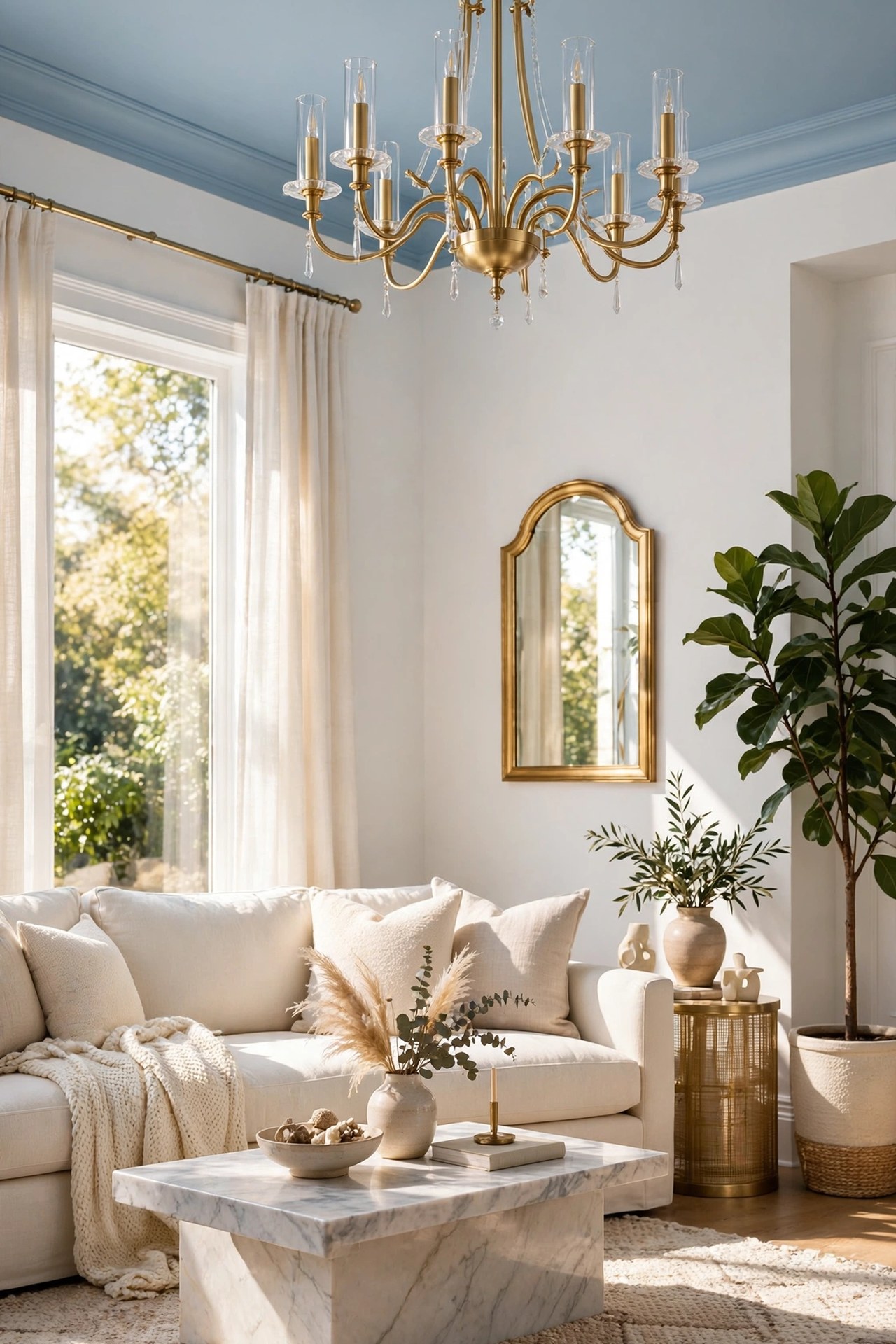
The ceiling is the largest uninterrupted surface in most living rooms and the one almost always left white by default. A soft powder or dusty blue overhead changes the feel of the whole room without touching a single wall: the ceiling reads like open sky, white walls stay bright by contrast, and a gold light fitting against blue looks richer than the same fitting against white. Keep the shade pale, at least two steps lighter than any blue you would put on a wall, because ceilings receive less light and always read darker than the sample.
Best For: Rooms with plain white walls that need character, and ceilings high enough to carry colour.
Not Ideal For: Low ceilings under 8 feet in dim rooms, where any ceiling colour can feel like it lowers the lid.
Estimated Cost: $50-$120 (estimate) for ceiling paint and tools for a standard room.
Budget Note: Ceiling paint is inexpensive and one coat over white often covers; the real cost is the taping and the neck ache.
Renter Friendly: No
Renter Note: Paint is a landlord-permission change, and ceilings are the hardest surface to repaint white again on leaving.
What You Need
Soft blue ceiling paint in flat matte, painter’s tape, roller with extension pole, dust sheets, gold or white ceiling light fitting.
Product type to look for: A blue at least two shades lighter than your wall-safe dusty blue, tested on a board held flat overhead, not against a wall.
How To Do It
- Tape the top edge of every wall so the blue stops in one clean line.
- Cut in the ceiling edges with a brush, working one side at a time.
- Roll the main area in sections, keeping a wet edge so no lap lines show.
- Remove the tape once the paint is touch dry and check the line in daylight.
Pro Tip
Judge the ceiling colour at midday and again in the evening before committing to the full coat.
9. Paint Wainscoting or Panelling in a Mid Blue
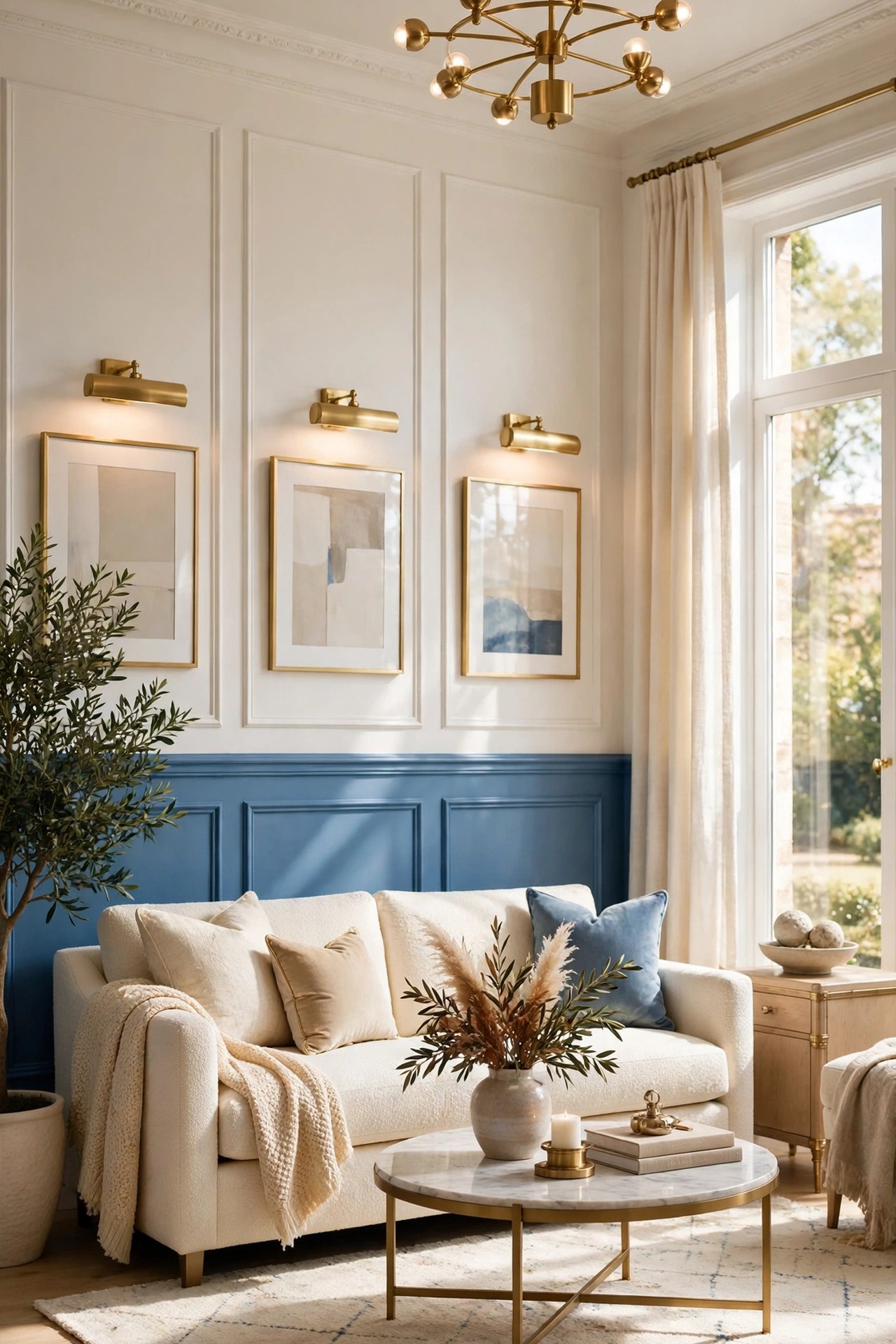
Panelling gives blue a boundary, and that boundary is what makes a mid-tone blue safe on a wall. Paint the wainscoting or wall panelling in a clear mid blue, keep the wall above it warm white, and the room gets structure, colour and brightness in fixed proportions: roughly the lower third in blue, the upper two thirds pale. Flat shaker squares read calm and classic, while narrow battens read more tailored, but the colour rule is the same, one blue in a satin or eggshell finish that wipes clean, because the lower wall takes scuffs from shoes, bags and chair backs. See our wainscoting ideas for more panelled looks.
Best For: Plain rectangular rooms that need architectural detail as well as colour.
Not Ideal For: Rooms with very low ceilings, where a strong horizontal colour line can make the wall feel shorter.
Estimated Cost: $150-$450 (estimate) for trim, adhesive, filler and paint for one feature wall of panelling.
Budget Note: One panelling wall in blue does the work of a whole painted room for a fraction of the paint and none of the darkness.
Renter Friendly: No
Renter Note: Panelling is fixed to the wall and paint needs permission; renters should take the textile route in idea 13.
What You Need
Panelling trim or a panelling kit, adhesive, filler, mid blue satin paint, warm white paint for the upper wall, level and tape.
Product type to look for: A mid blue that still reads clearly blue in your room’s light; pale blues on lower panelling can disappear to grey at floor level.
How To Do It
- Mark the panelling height, usually chair-rail height, and level the line around the wall.
- Fix the trim, fill every joint and sand once dry so the panels read as one built surface.
- Prime the new wood, then paint the panelling blue in two coats.
- Repaint or tidy the upper wall in warm white last, cutting in along the top rail.
Pro Tip
Paint the skirting board the same blue as the panelling.
10. Style a Light Coastal Blue Corner
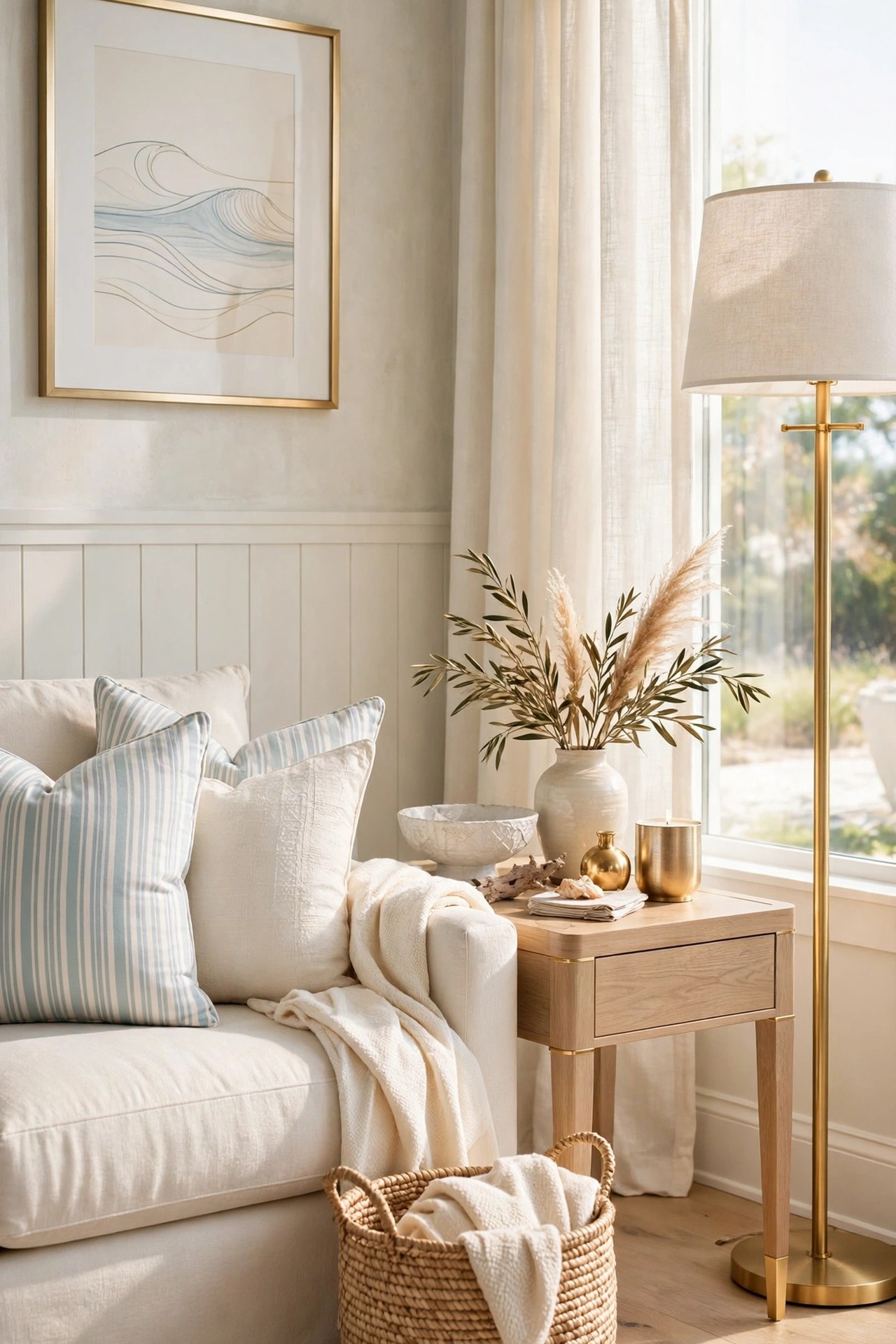
Coastal blue is the lightest, easiest member of the family: pale blue and white stripes, washed dusty blue textiles, natural woven texture and light wood, layered so the room feels airy rather than themed. The difference between a coastal corner and a beach souvenir shop is restraint. Choose one corner or one chair, add a blue and white striped cushion, a pale blue throw with a woven edge, a natural basket and one piece of light wood, and stop before any shells or rope appear. The glam base keeps it polished: the basket sits beside a gold lamp and the creams stay warm instead of drifting to stark white.
Best For: Bright rooms with garden doors or big windows, and anyone who wants blue at its palest and calmest.
Not Ideal For: Formal living rooms with dark wood antiques, where washed coastal tones can look out of place.
Estimated Cost: $60-$160 (estimate) for striped cushions, a pale throw, a woven basket and a small light-wood stool or tray.
Budget Note: This is a textiles-and-textures idea, so almost every piece can come from what you already own in cream and natural tones.
Renter Friendly: Yes
Renter Note: Nothing is fixed; the whole corner is cushions, a throw and a basket.
What You Need
Blue and white striped cushion covers, pale blue woven throw, natural woven basket, light wood tray or stool, cream base cushions.
Product type to look for: Stripes in dusty or powder blue on a warm white ground; bright white and royal blue stripes read nautical and cold against a cream scheme.
How To Do It
- Choose the brightest corner or the chair nearest the window.
- Layer the striped cushions against plain cream ones so the pattern has a quiet background.
- Drape the pale throw over the chair arm and place the basket beside it with the light wood tray on top or nearby.
- Remove one item; coastal corners almost always look better with one fewer piece than your first arrangement.
Pro Tip
Keep every other pattern out of the corner.
11. Pair Blue With Brushed Gold Lighting and Tables
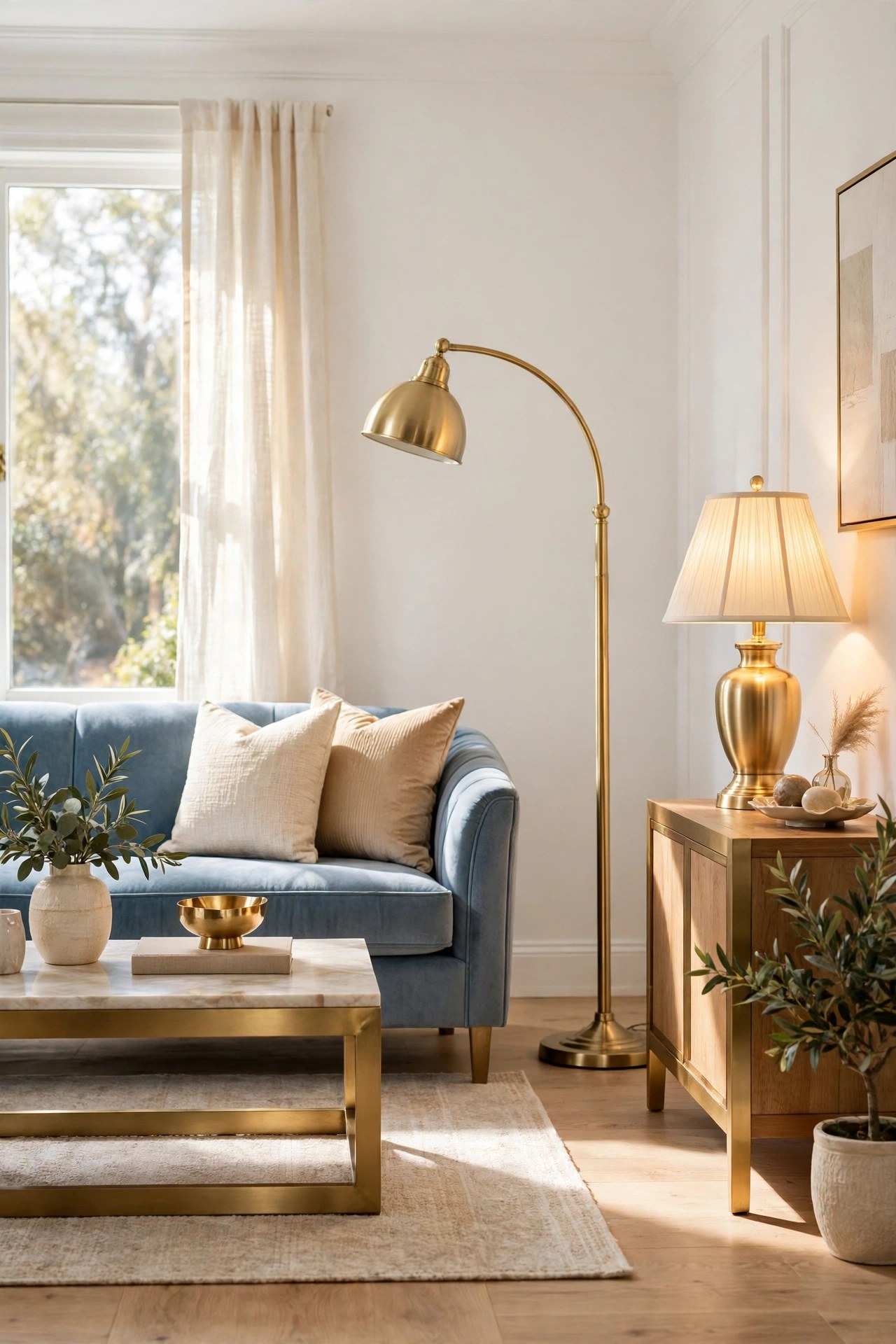
Blue on its own can sit cool; blue beside brushed gold cannot. Gold is the warm metal of the glam palette, and placing it directly against blue furniture or a blue wall is the most reliable way to keep a blue living room feeling luxurious instead of chilly. The pairing works at three scales: a gold coffee table in front of a blue sofa, a gold lamp whose light falls across blue upholstery, and small gold tray edges, frames and candle holders repeated so no blue surface sits alone. The same gold-and-blue pairing runs through our wall paneling ideas.
Best For: Any blue scheme that feels slightly cold in the evening, and glam rooms that need their metal note strengthened.
Not Ideal For: Rooms already heavy with silver or chrome; mixing a second cool metal with gold splits the scheme.
Estimated Cost: $120-$350 (estimate) for a gold floor or table lamp and one gold coffee or side table.
Budget Note: Start with the lamp. Warm light against blue changes the room more per pound or dollar than any table does.
Renter Friendly: Yes
Renter Note: Lamps and tables are freestanding; plug-in gold wall sconces are the only version needing small screws.
What You Need
Brushed gold floor lamp or table lamp with a cream shade, gold coffee table or side table, warm white bulbs, small gold tray or frames.
Product type to look for: Brushed or satin gold finishes rather than polished mirror gold; the softer finish sits with dusty and powder blues without glare.
How To Do It
- Put the largest gold piece, the coffee table, directly against the largest blue piece, the sofa or rug.
- Place the lamp so its light falls across the blue upholstery, not away from it.
- Fit warm white bulbs everywhere in the room, not just in the new lamp.
- Add two or three small gold pieces at the far side of the room so the pairing reads throughout, not in one corner.
Pro Tip
Check the pairing at night with the main light off and only the lamps on.
12. Keep Blue Light and Low in a Small Living Room
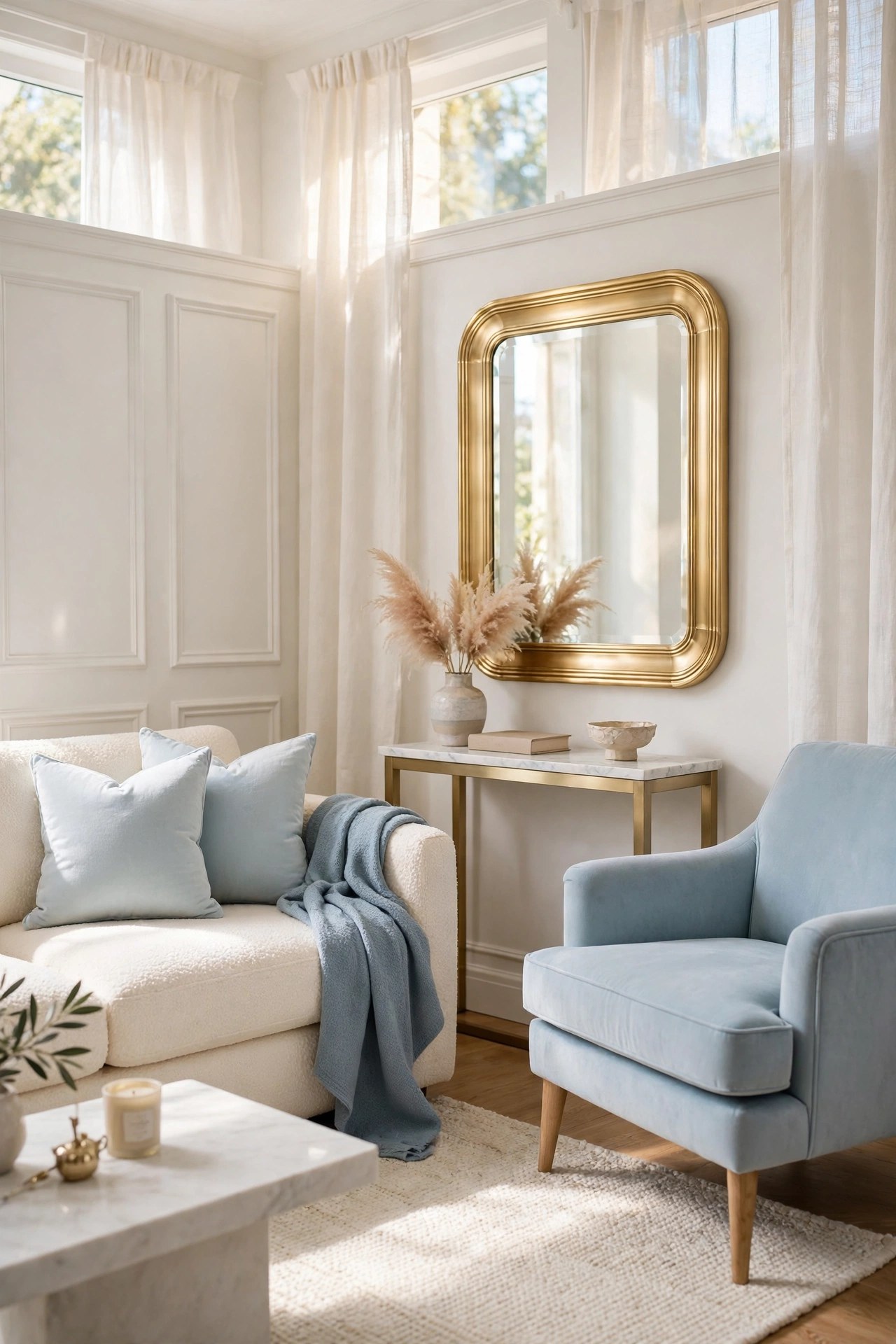
Small living rooms do not need to avoid blue; they need to choose its shade and its height with care. The small-room rule is light blues, placed low. Powder and dusty blue on cushions, a throw, a rug border and one small chair keep the colour below the sight line, where it grounds the room without enclosing it, while the walls and the upper half stay white and cream, where the eye judges space. One mirror in a slim gold frame doubles the light the pale blues are working with. The same pale, low approach shapes a scandinavian living room.
Best For: Small and low-ceilinged living rooms that still want a real colour scheme.
Not Ideal For: Small rooms that are also very bright and south-facing; there, one deeper blue from idea 1 or 7 is safe after all.
Estimated Cost: $80-$220 (estimate) for pale blue cushions, a throw, one small chair cover or chair, and a gold-framed mirror.
Budget Note: Textiles first again; in a small room, cushions and a throw deliver the whole effect for the price of one chair.
Renter Friendly: Yes
Renter Note: Every piece here is movable or leanable; the mirror can lean on a console instead of hanging.
What You Need
Powder blue cushion covers, dusty blue throw, light blue rug or rug border, slim gold-framed mirror, one small light blue chair or chair cover.
Product type to look for: Blues described as powder, sky or dusty rather than navy or royal, and fabrics in matte weaves that do not add shine to a small space.
How To Do It
- Clear the room back to white and cream only, then add the rug or throw first as the lowest blue layer.
- Add cushions in two pale blues, keeping the deepest shade to one cushion only.
- Lean or hang the gold mirror where it reflects the window.
- Check the upper half of the room from the doorway: it should still read entirely pale.
Pro Tip
In a small room, repeat one pale blue three times rather than using three blues once each.
13. Get the Blue Look in a Rental Without Paint
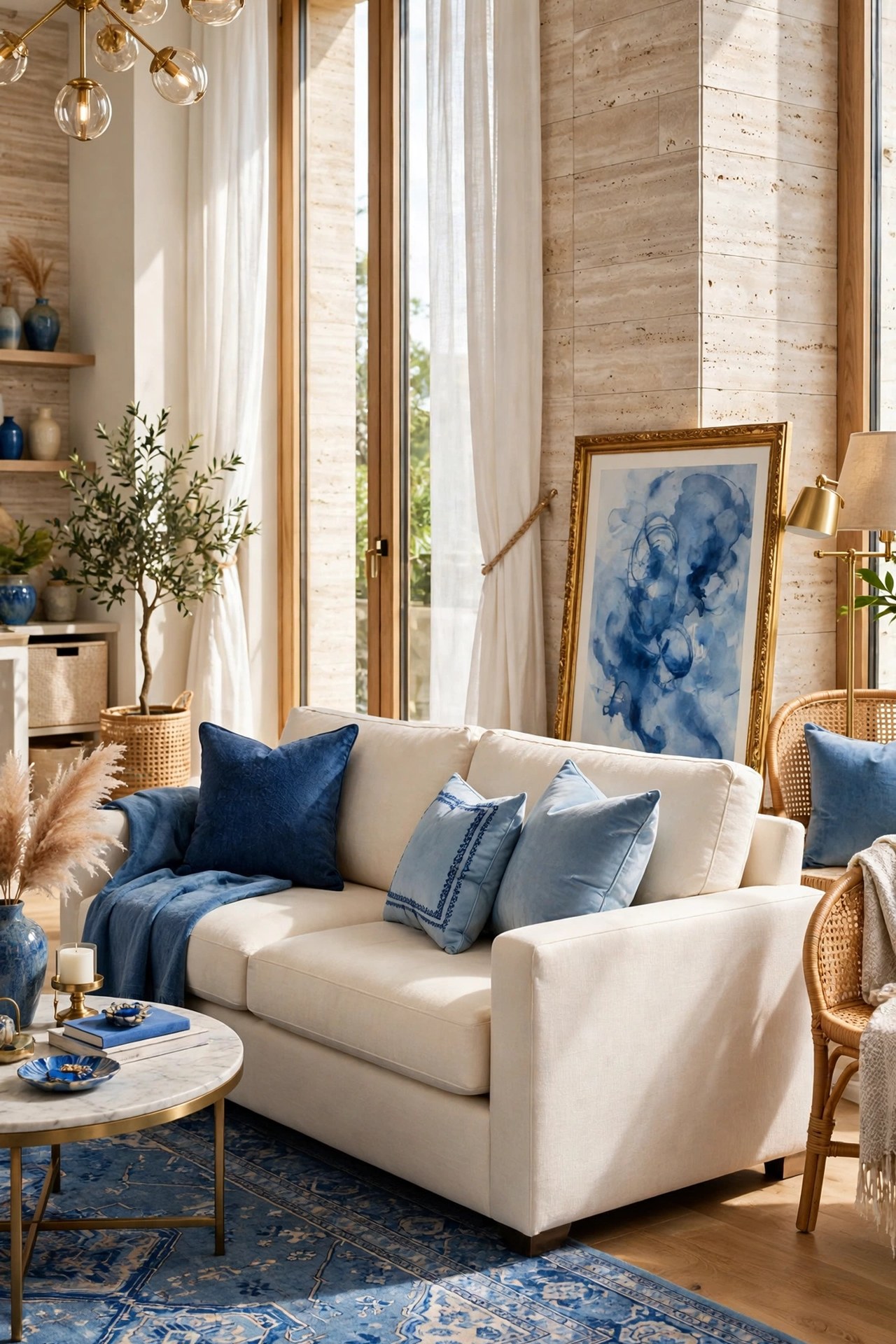
Renters are often told to live with white walls and like it, but a blue living room does not actually need paint. Almost every permanent-looking blue in this list has a movable twin: the accent wall becomes one oversized piece of blue art leaning on a console, the panelling colour becomes a blue rug and blue cushions, and the ceiling moment becomes powder blue curtains that leave with you. The rental version works hardest on the two biggest textiles, the rug and the curtains, because together they frame the seating zone in blue from floor to window. Everything else is small and packable: cushion covers, a throw, a blue ottoman.
Best For: Renters with strict no-paint leases who still want a full colour scheme, not a compromise.
Not Ideal For: Rentals where even leaning frames are banned by lease terms; in that case, textiles alone, ideas 5 and 10, are the whole answer.
Estimated Cost: $150-$400 (estimate) for a blue rug, powder curtains, cushion covers and one large leaning art print.
Budget Note: Every piece is portable and reusable in the next home, so the honest comparison is against years of use, not one tenancy.
Renter Friendly: Yes
Renter Note: This is the renter-first idea in the list: no paint, no screws, fixings limited to removable hooks used within their rating.
What You Need
Blue and ivory rug, powder blue curtain panels for an existing rod or tension rod, cushion covers in three blues, one large blue art print to lean, removable hooks.
Product type to look for: Curtains and cushion covers in washable fabrics, and art light enough to lean safely rather than hang.
How To Do It
- Photograph every wall before you start, for your own deposit record.
- Lay the blue rug and centre the seating on it.
- Hang the powder curtains on the existing rod, or a tension rod inside the frame.
- Lean the large blue art piece on the wall behind the sofa or on a console, and layer the cushions last.
Pro Tip
Keep the packaging for the rug and curtains.
14. Add a Blue Ottoman as the Flexible Extra Seat
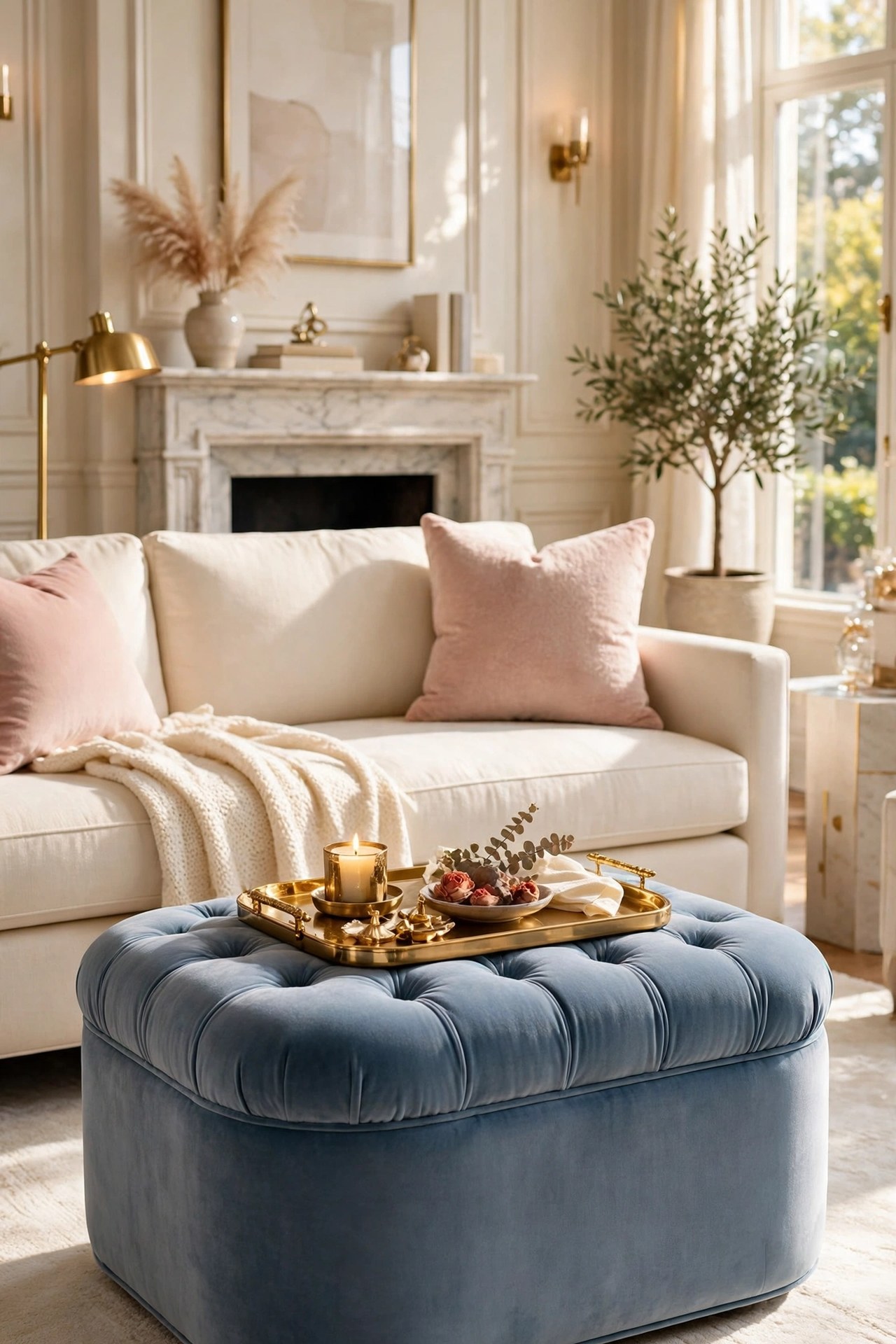
An ottoman is the hardest-working small piece in a living room, and in a blue scheme it is also the most flexible way to add the colour. A dusty or navy blue ottoman in front of a cream sofa works as a footrest, an extra seat when guests arrive, and, with a gold tray on top, a soft stand-in for a coffee table. Because it is small and movable, it lets you place a strong blue exactly where the room needs balancing, opposite a blue chair, beside pale curtains, at the empty end of a rug, and move it when the balance changes.
Best For: Cream sofas needing one movable blue piece, and rooms short on guest seating.
Not Ideal For: Rooms where the centre of the rug is the main walkway; a movable piece there will always be in someone’s path.
Estimated Cost: $90-$250 (estimate) for a blue velvet or upholstered ottoman.
Budget Note: One ottoman replaces a footrest, a spare seat and, with a tray, a side table, so judge it against all three.
Renter Friendly: Yes
Renter Note: Fully freestanding and easy to move between homes; felt pads protect floors when it is dragged rather than lifted.
What You Need
Blue upholstered ottoman, brushed gold tray, felt floor pads, one folded throw.
Product type to look for: A firm flat top at or just below sofa seat height, with a wipeable or washable cover in navy, dusty or teal-blue.
How To Do It
- Place the ottoman centred on the sofa, a comfortable footrest distance from the seat edge.
- Set the gold tray on top and style it with one book and one small plant or candle only.
- Fold the throw across one corner rather than covering the blue.
- Test it as a seat; if it wobbles or dips, it is a footrest only, and guests should get the chairs.
Pro Tip
An ottoman is the best piece in the room to buy in the deepest blue you love.
15. Mix Blue Patterns at Different Scales
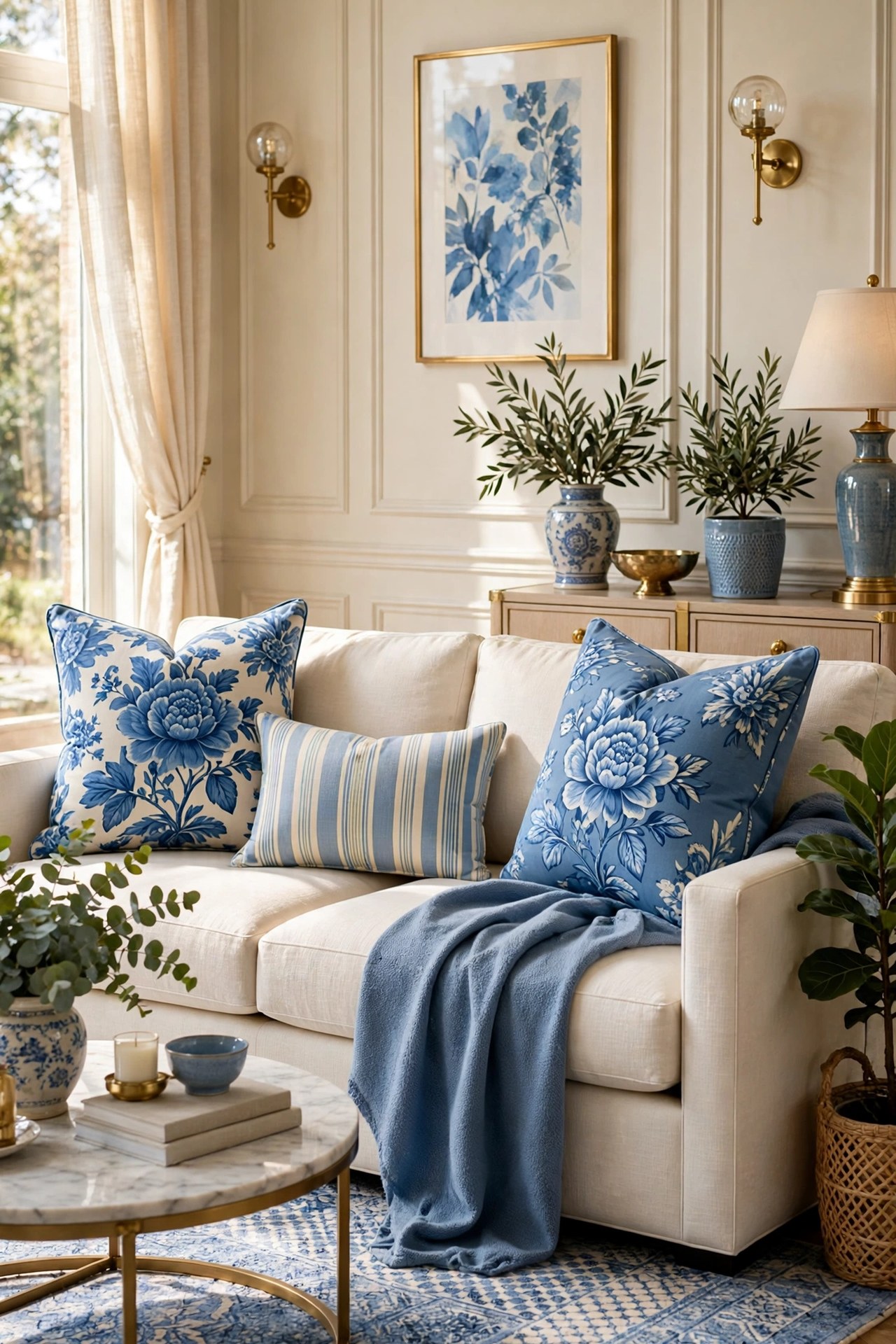
Pattern is where a blue living room stops looking assembled from a list and starts looking collected, but blue patterns only mix well under one rule: change the scale every time you repeat the colour. A large-scale blue floral cushion, a medium blue and white stripe, and a small pinstripe or plain textured blue can sit together happily, because the eye reads them as three textures in one family. Two patterns at the same scale fight even when the blues match perfectly.
Best For: Plain cream rooms that feel flat, and anyone with blue textiles collected over time that need unifying.
Not Ideal For: Rooms that already have a strong patterned rug and patterned curtains; add plain blues there instead.
Estimated Cost: $60-$160 (estimate) for three patterned cushion covers and one plain throw in the shared shade.
Budget Note: Covers make pattern experiments cheap; a failed pattern costs one cover, not one chair.
Renter Friendly: Yes
Renter Note: Entirely textile-based, so the whole idea packs into one box on moving day.
What You Need
One large-scale blue patterned cover, one medium stripe or check cover, one small pinstripe or textured plain cover, plain throw in the shared blue, cream base cushions.
Product type to look for: Patterns that share one exact blue; take an existing cushion cover shopping, physically or by photo in daylight, rather than trusting memory.
How To Do It
- Choose the shared blue from the piece you own and love most.
- Place the large-scale pattern at the sofa ends, where it has room to show.
- Put the medium pattern inside it and the small scale or plain at the centre.
- Add the plain throw in the shared shade and remove any pattern that shares a scale with another.
Pro Tip
Squint at the sofa from across the room.
Practical Tips for a Blue Living Room
Decide the base before the blue. Every idea in this list assumes the same bright glam base, white and warm cream walls and large furniture, warm taupe textiles, blush as the warm accent and brushed gold as the metal. Work in shades, not in one blue: a scheme built from navy, dusty blue and powder blue with one teal note has depth, while a room matched to a single blue looks flat and showroom-like. Keep the deepest blue to one or two pieces at most, the anchor sofa or the chairs, and let the paler shades do the repeating in cushions, curtains and patterns. Finally, repeat each blue at least twice; a blue that appears once looks like an accident, twice it looks like a scheme.
Frequently Asked Questions
What colours go best with a blue living room?
Warm neutrals and warm metals. Cream, warm white and warm taupe keep blue from turning cold, blush adds a soft warm contrast, and brushed gold warms blue furniture and walls on contact.
Will a navy sofa make my living room look dark?
Not if it is the only deep piece and the room around it stays pale. Cream walls, a light rug, pale cushions and gold lighting keep a navy sofa reading as an anchor rather than a dark block.
Which shade of blue is best for a small living room?
Powder blue and dusty blue, used low in the room on cushions, throws, a rug and one small chair. Pale blues below the sight line ground a small room without enclosing it, while the walls and upper half stay white and cream, which is where the feeling of space is decided.
Can I have a blue living room in a rental without painting?
Yes. The largest colour surfaces a renter can change are the rug and the curtains, and together they frame the seating in blue.
How do I stop a blue living room from feeling cold?
Warm the light and the metals. Fit warm white bulbs throughout, place brushed gold lamps and tables directly beside the blue pieces, and keep the base textiles warm, cream and taupe rather than bright white and grey.
How many shades of blue should one room use?
Three is the comfortable number: one deep shade for the anchor, one mid shade for larger textiles or a wall, and one pale shade for cushions and curtains, with teal-blue as an optional fourth. More than four blues usually stops reading as a family.
Conclusion
A blue living room stays bright and glam when the order of decisions is right: the warm pale base first, then blue placed on purpose, shade by shade and piece by piece. Anchor with navy on the sofa or warm the room from the wall behind a cream one, let powder blue do the soft work at the curtains and cushions, and let brushed gold and warm light keep every shade honest in the evening.